
The month of Ramadan is a golden moment for a believer to practice self-control (al-imsāk) and elevate spiritual quality. Fasting is not merely withholding from thirst and hunger; it is a profound medium for purifying the soul. However, in practice, Muslims often face medical issues or physical therapies during the day. One such treatment is cupping while fasting (ḥijāmah) and minor bloodletting (faṣd). Regarding medical treatments, many also frequently ask whether injections, infusions, and eye drops invalidate the fast.
Some people believe that drawing blood breaks the fast, while others hold the opposite view. This divergence of opinions often causes confusion among the lay public. To place this issue on a solid foundation of evidence, we will unravel the ruling on cupping during fasting through the lens of Shafi’i fiqh. This analysis relies on the authoritative book Asnā al-Maṭālib Syarḥ Rawḍ aṭ-Ṭālib (Vol. 1, p. 416) by Shaykh al-Islam Zakariyyā al-Anṣārī.
The Basic Ruling on Cupping and Fasd During Ramadan Daytime
In Shafi’i fiqh literature, the boundaries regarding things that invalidate the fast are generally closely related to the entry of a physical substance (al-‘ain) into the body cavity through a naturally open aperture (manfadh maftuh).
Conversely, cupping therapy focuses on the process of extracting blood from the skin’s surface, not the act of inserting something into the body. Shaykh Zakariyyā al-Anṣārī strictly outlines the basic legal ruling:
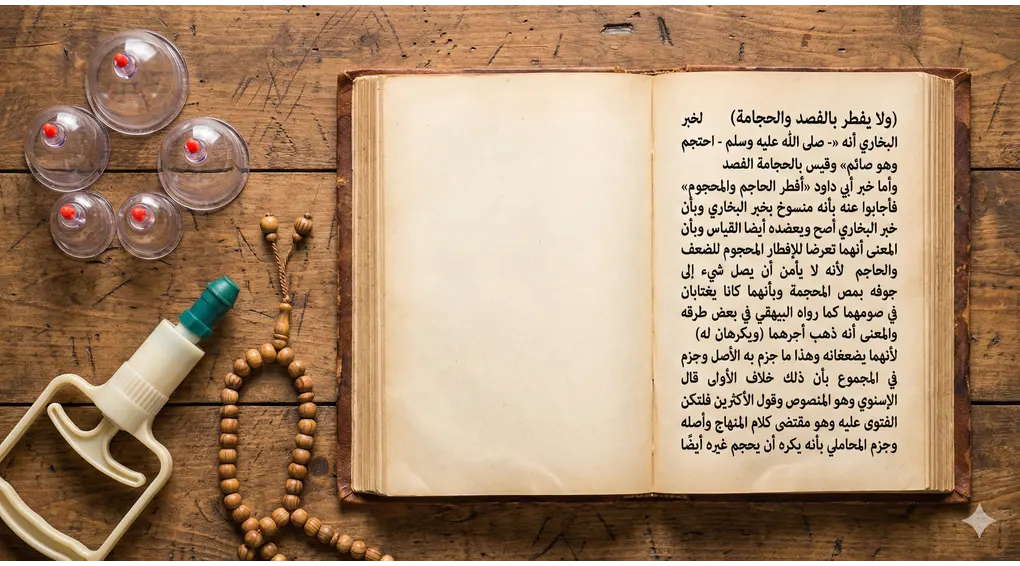
قوله: (ولا يفطر بالفصد والحجامة) لخبر البخاري أنه «- صلى الله عليه وسلم – احتجم وهو صائم» وقيس بالحجامة الفصد
Translation: “(And the fast is not invalidated by fasd and hijamah/cupping) based on the hadith narrated by Al-Bukhari that the Prophet ﷺ performed cupping while he was fasting. And the ruling of fasd is analogized (qiyas) to cupping.”
From the text (nass) above, it is legally clear whether cupping while fasting breaks the fast. The answer is that it does not. A person’s fast remains perfectly valid. The primary evidence is the direct practice of Prophet Muhammad ﷺ, as narrated by Imam Bukhari.
Reconciling the Hadith “The Fast is Broken for the Cupper and the Cupped”
In the hadith corpus, there is a narration from Abu Dawud stating: “Aftara al-haajimu wal mahjuum” (The fast is broken for the one who cups and the one who is cupped). This hadith seems to contradict the authentic narration from Al-Bukhari.
How do the scholars of the Shafi’i school reconcile these two proofs? The book Asna al-Matalib presents four brilliant arguments that demonstrate the expertise of the jurists (fuqaha):
وأما خبر أبي داود «أفطر الحاجم والمحجوم» فأجابوا عنه بأنه منسوخ بخبر البخاري وبأن خبر البخاري أصح ويعضده أيضا القياس
- First, the hadith narrated by Abu Dawud is judged as mansukh (abrogated, its validity period has expired) by the Prophet’s ﷺ action in Al-Bukhari’s hadith.
- Second, Al-Bukhari’s hadith holds a higher degree of authenticity, and its application is supported by the method of qiyas (analogical deduction).
Furthermore, scholars provide a contextual interpretation (ta’wil) of the word “broken” (aftara) in Abu Dawud’s hadith:
وبأن المعنى أنهما تعرضا للإفطار المحجوم للضعف والحاجم لأنه لا يأمن أن يصل شيء إلى جوفه بمص المحجمة
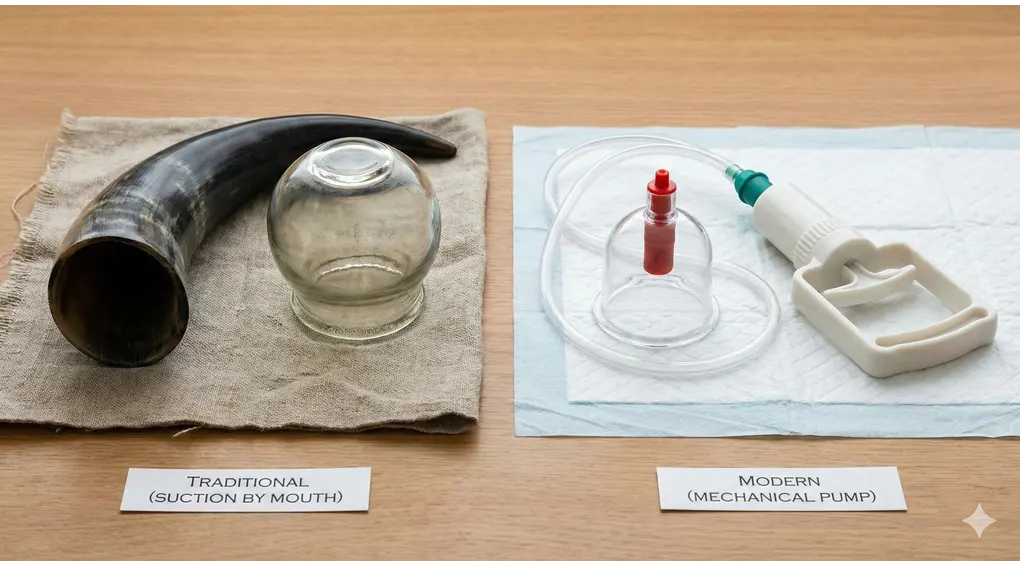
- Third, the meaning is that both individuals are “exposed to the risk of breaking the fast.” The person being cupped risks breaking the fast because his body becomes very weak (dha’if), potentially forcing him to eat and drink. Meanwhile, the cupping expert risks breaking his fast because, in classical medical methods, a therapist sucks the cupping tool (a horn or glass) using his mouth. This condition creates a risk that blood might accidentally be swallowed into his stomach cavity.
وبأنهما كانا يغتابان في صومهما كما رواه البيهقي في بعض طرقه والمعنى أنه ذهب أجرهما
- Fourth, Al-Baihaqi’s narration mentions that both individuals (the cupper and the cupped) were engaging in ghibah (backbiting others) at that time. Thus, the meaning of “broken” here is the nullification of their fasting reward, not the invalidation of the fasting obligation itself.
Fiqh Ethics Perspective: Makruh or Khilaful Aula?
Although performing cupping during the daytime of Ramadan does not invalidate the act of worship jurisprudentially, the Shari’ah still provides ethical guidelines. Islam highly preserves a servant’s physical fitness to perform various obligatory acts of worship without excessive fatigue (futur).
قوله: (ويكرهان له) لأنهما يضعفانه وهذا ما جزم به الأصل وجزم في المجموع بأن ذلك خلاف الأولى قال الإسنوي وهو المنصوص وقول الأكثرين فلتكن الفتوى عليه
Translation: “(And both are considered makruh for the fasting person) because they can weaken his physique. This is what is affirmed in the book al-Ashl. However, Imam an-Nawawi in the book al-Majmu’ affirmed that it is Khilaful Aula (contrary to what is best). Imam Al-Isnawi said, this is what is explicitly stated and is the opinion of the majority (of Shafi’i scholars), so the fatwa should adhere to this opinion.”
If cupping therapy is proven to weaken the physique, the ruling shifts. Scholars lean towards establishing the ruling as Khilaful Aula, meaning the action is better left undone to conserve energy for worship. Imam Al-Mahamili also added that it is makruh for someone to act as a cupping therapist for another while he is fasting.
Harmonizing Fiqh and Sufism in Fasting

Studying the ruling on cupping while fasting gives us valuable lessons on how to maintain the spiritual station (maqām) of the fast. From a Sufi perspective, fasting is the primary means to practice sincerity and avoid vain matters.
The scholars’ explanation regarding the “loss of fasting rewards due to ghibah” during the cupping process should serve as a stern warning. What is the point of enduring hunger and thirst if the tongue still delights in harming the honor of fellow Muslims? You can reflect further on the dangers of the tongue in the review of the true meaning of ghibah.
High-quality fasting requires us to constantly supervise ourselves (muraqabah). The goal is to ensure the tongue remains guarded and the physique stays strong for intimate supplication to Allah ﷻ in the latter third of the night.
Summary Table of Cupping Therapy Rulings During Fasting
For those who need a practical and quick guide, please study the following details of legal statuses:
| Condition / Subject | Fasting Status | Legal Consequence (Ethics) |
| The Person Cupped (Patient) | Valid (Not Broken) | Khilaful Aula (Best avoided) as it potentially weakens the physique. |
| The Cupper (Therapist) | Valid (Not Broken) | Makruh, especially if using the mouth suction method due to the risk of swallowing blood. |
| Surgical Therapy (Fasd) | Valid (Not Broken) | Khilaful Aula (Analogized to the ruling of cupping). |
| Cupping accompanied by Ghibah | Valid (Jurisprudentially) | The reward of the fast is broken/lost. Obligatory to immediately perform sincere repentance (Taubah Naṣūḥā). |
FAQ: Questions and Answers on Medical Treatments While Fasting
Does excessive bleeding from cupping therapy invalidate the fast?
No. Based on the text from Asna al-Matalib, the extraction of blood from the body’s surface—whether through cupping (hijamah) or bloodletting (fasd)—does not impair the validity of your fast whatsoever.
Why is there a recommendation to avoid cupping during Ramadan daytime?
This recommendation is based on medical and physical endurance reasons. This therapy induces bodily weakness. The Shari’ah intends for your physique to remain stable to complete the fast until the Maghrib call to prayer and to perform Qiyam al-Lail without being hindered by lethargy.
If I am perfectly healthy and certain I won’t feel weak, may I get cupped?
Your fast remains valid, but according to fiqh ethics, its status is Khilaful Aula (contrary to what is best). The wisest step is to postpone the therapy until nighttime and observe the best times and prohibitions for cupping so that both health benefits and worship rewards can be achieved simultaneously.
Conclusion
We hope this academic analysis provides clarity of thought in carrying out obedience during the holy month. Navigating medical procedures requires both fiqh knowledge and spiritual mindfulness to ensure our fast is both legally valid and deeply rewarding.
Wallahu a’lam bish-shawab.
Reference
Zakariyā al-Anṣārī, Asnā al-Maṭālib fī Sharḥ Rawḍ al-Ṭālib, with the ḥāsyiyah by Aḥmad al-Ramlī, edited by Muḥammad az-Zuhrī al-Ghamrāwī (Cairo: al-Maṭbaʿah al-Maymānīyah, 1313 H; repr. Dār al-Kitāb al-Islāmī), vol. 1, p. 416.


