
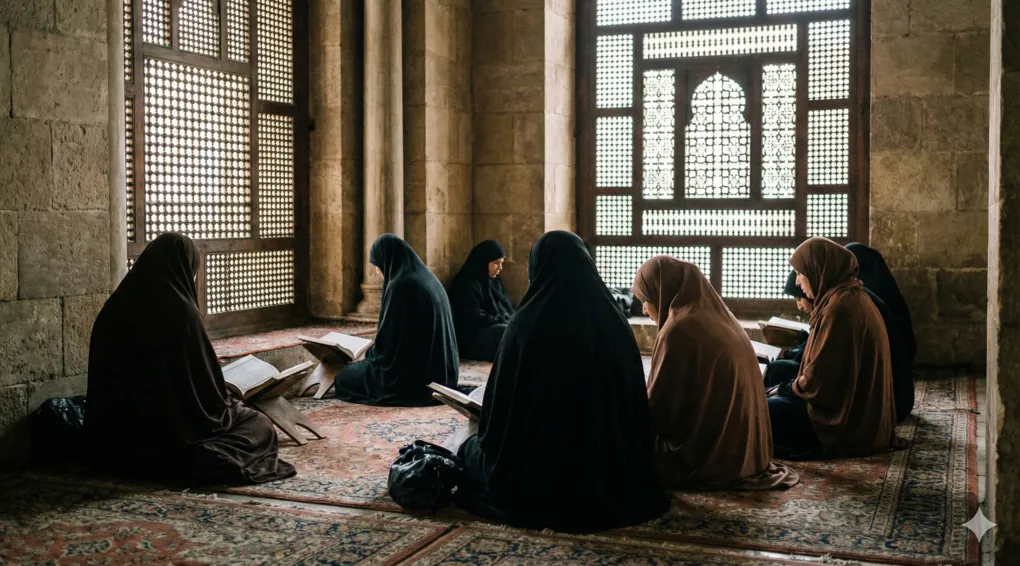
The worship of I’tikaf is a magnificent spiritual practice for drawing closer to Allah the Exalted. The opportunity to attain its immense virtues is not limited to men; it is also widely open to Muslim women. Nevertheless, the Islamic Shari’ah establishes specific guidelines (dhawabith) and rules for women to preserve their honor and ensure the smooth fulfillment of household rights.
This article provides an in-depth breakdown of the rules of I’tikaf for women, relying entirely on the authoritative (mu’tamad) fiqh literature, specifically the book Asna al-Matalib Syarh Rawdh ath-Thalib authored by Shaykh al-Islam Zakariyya al-Ansari.
🌐 Foundational Reading: Explore the broader context in our Complete Guide to the Fiqh of I’tikaf According to the Shafi’i School.
The Valid Conditions of I’tikaf for Women
Fundamentally, women possess the same legal validity as men in performing I’tikaf, provided they meet the general criteria: being a Muslim, sane, and pure from major ritual impurities. Shaykh al-Islam Zakariyya al-Ansari affirms:
قوله: (فيصح من المميز والعبد والمرأة) كصيامهم
Meaning: “Thus, the I’tikaf of a discerning child (mumayyiz), a slave, and a woman is valid, just as their fasting is valid.”
📖 Related Guide: You can study the general prerequisites of this worship in detail at The Valid Conditions and Pillars of I’tikaf in Detail.
However, for a married woman, there is an absolute additional ruling: the obligation to seek her husband’s permission.
The Obligation of Seeking the Husband’s Permission
A wife is not permitted to step into the mosque for I’tikaf without obtaining the pleasure and permission of her husband. Doing so is considered a violation of the Shari’ah and is ruled as strictly forbidden (haram).
قوله: (ويحرم) اعتكاف العبد والمرأة (بغير إذن السيد والزوج) لأن منفعة العبد مستحقة لسيده والتمتع مستحق للزوج ولأن حقهما على الفور بخلاف الاعتكاف
Meaning: “And it is forbidden for a slave and a woman (wife) to perform I’tikaf without the permission of the master and the husband. This is because the utility of the slave belongs to the master, and the right of enjoyment (istimta’) belongs to the husband, and because their rights are immediate (faur), unlike the worship of I’tikaf.”
Furthermore, even if a husband has initially granted permission for a voluntary (sunnah) I’tikaf, he retains the full right to ask his wife to return home and cancel the I’tikaf midway through.
قوله: (فلهما) الأولى ولهما (إخراجهما من التطوع) وإن اعتكفا بإذنهما لما مر ولأنه لا يلزم بالشروع
Meaning: “Thus, for both of them (the master and the husband)—and the more accurate phrasing is wa lahuma (and for both of them)—they have the right to remove them both from voluntary I’tikaf (tathawwu’), even if they performed I’tikaf with their permission. This is based on the previously mentioned reasons, and because voluntary I’tikaf does not become obligatory merely by commencing it (syuru’).”
Addressing the Ruling on Women Performing I’tikaf at Home
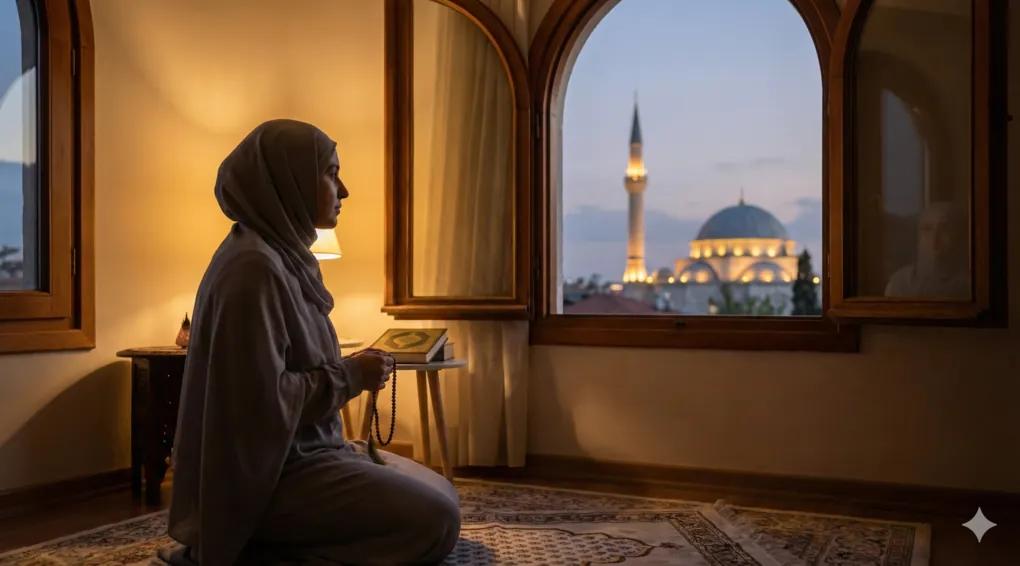
One of the most frequently asked fiqh questions is regarding the ruling on a woman performing I’tikaf at home. Many Muslim women assume that to protect themselves from fitnah, it is sufficient to stay in the designated prayer room (mushalla) inside their private residence.
What is the perspective of the Shafi’i school on this matter? The text of Asna al-Matalib provides a highly decisive answer:
قوله: (ولا يجزئ المرأة) اعتكافها (في مصلى بيتها) لأنه ليس بمسجد فهي كغيرها
Meaning: “And it is not valid for a woman to perform her I’tikaf in the prayer area of her house, because that place is not a mosque. Therefore, she is judged the same as anyone else (she must perform it in a mosque).”
This ruling settles the debate regarding women performing I’tikaf at home. A prayer room inside a house does not hold the legal status of an endowed (waqf) mosque, thus the fundamental pillar of “staying in the mosque” is not fulfilled. If a woman wishes to perform I’tikaf, she must attend a legally recognized mosque.
Rules for Attractive Women (Dzawatul Hai’ah)
Although permitted to attend the mosque, the Shari’ah provides a noble ethical note for Muslim women. For women categorized as dzawatul hai’ah—namely, women whose appearance may attract the attention of men—it is considered disliked (makruh) to force themselves to perform I’tikaf in a mosque crowded with male congregants.
قوله: (لكن يكره لذوات الهيئة) كما في خروجهن للجماعة
Meaning: “However, it is disliked (makruh) for women of attractive appearance (dzawatul hai’ah), just as it is disliked for them to go out to attend congregational prayers.”
This stems from the principle of blocking the means to evil (sad adz-dzari’ah). If her presence risks causing harm or temptation, worshiping at home (even if it does not hold the legal status of I’tikaf) is far superior for her.
💡 Further Reading: To learn more about proper conduct inside the mosque, read our article onThe Etiquette of I’tikaf: Eating, Sleeping, and Disliked Acts in the Mosque.
Rulings on I’tikaf for Women with Istihadhah and Menstruation
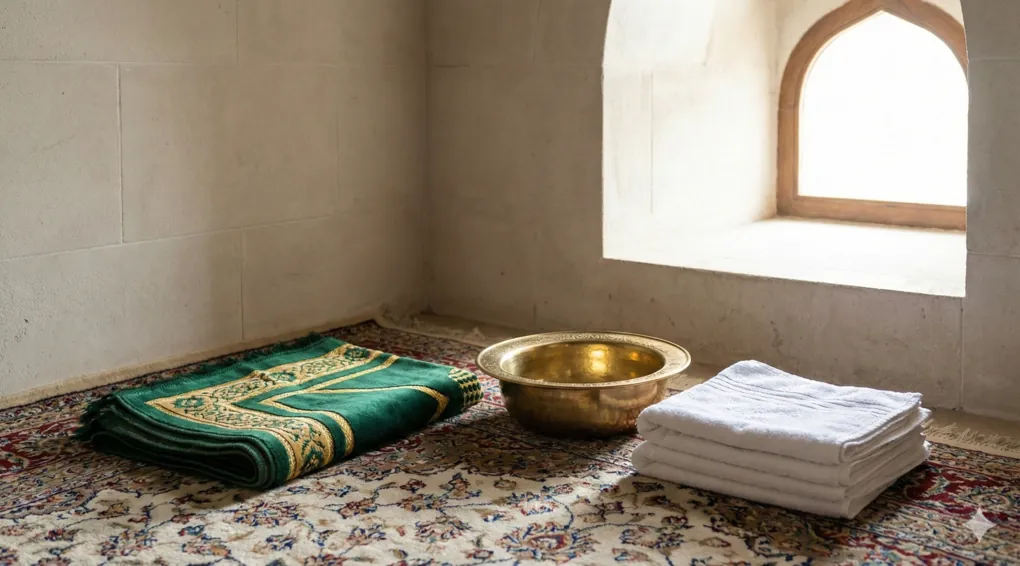
A woman’s biological condition, such as her menstrual cycle and irregular bleeding (istihadhah), dictates the validity or invalidity of this worship.
1. Women with Istihadhah (Irregular Bleeding)
Istihadhah (bleeding outside the regular menstrual cycle) is classified as a minor impurity (hadats kecil), so the sufferer is not prohibited from entering the mosque. A woman experiencing istihadhah is permitted to perform I’tikaf, with the strict condition that she must bind herself securely so that no blood drips and stains the purity of the mosque floor.
Shaykh al-Islam cites a hadith narrated by Imam Al-Bukhari:
ويدل له ما رواه البخاري «أن بعض نساء النبي – صلى الله عليه وسلم – اعتكفت معه وكانت مستحاضة» فربما وضعت الطست تحتها وهي تصلي
Meaning: “And this is indicated by the narration of Al-Bukhari: ‘That some of the wives of the Prophet ﷺ performed I’tikaf with him while in a state of istihadhah.’ So sometimes she would place a basin (thast) beneath herself while she was praying.”
2. The Onset of Menstruation (Haid) During I’tikaf
Unlike istihadhah, menstrual blood (haid) and postpartum bleeding (nifas) are major impurities. Women who are menstruating are strictly forbidden from staying inside the mosque, which automatically invalidates their I’tikaf.
ولا اعتكاف الجنب والحائض والنفساء لحرمة المكث في المسجد عليهم
Meaning: “And the I’tikaf of a person in a state of junub, a menstruating woman, and a woman with postpartum bleeding is not valid, because it is forbidden for them to stay (al-makts) in the mosque.”
If menstrual blood appears in the middle of an I’tikaf that requires consecutive fulfillment (tatabbu’), is she obliged to repeat it from the beginning? Shafi’i fiqh provides a fair and detailed breakdown:
فرع: (الاعتكاف إن لم يسعه الطهر) من الحيض بأن طالت مدة الاعتكاف بحيث لا تنفك عن الحيض غالبا قال البغوي والنووي كأن زادت على خمسة عشر يوما (لم يقطع الحيض تتابعه)… (وإلا) أي وإن وسعه الطهر (قطعه)
Meaning: “Branch Issue: If the duration of the I’tikaf cannot be accommodated within the period of purity from menstruation—meaning the duration of I’tikaf is so long that it generally cannot be separated from the menstrual cycle (for example, vowing to perform I’tikaf for more than fifteen days)—then the arrival of menstruation does not sever its continuity (tatabbu’)… Conversely, if the period of I’tikaf can be completed within the days of purity, then the arrival of menstruation severs its continuity.”
⚖️ Legal Details: To deepen your understanding of the rules regarding things that break this worship, readThe Nullifiers of I’tikaf and the Rulings on Leaving the Mosque.
Summary Table: Fiqh of I’tikaf for Women
| Subject of Discussion | Legal Status in Shafi’i Fiqh | Specific Notes |
| I’tikaf at Home | Invalid | Must be performed inside an official endowed (waqf) mosque building. |
| Husband’s Permission | Absolutely Obligatory | The husband has the right to cancel his wife’s voluntary I’tikaf at any time. |
| Attractive Women | Disliked (Makruh) | Disliked to be present in a mosque where it may potentially cause temptation (fitnah). |
| Women with Istihadhah | Permissible (Mubah) | Must ensure that absolutely no blood drips onto the floor. |
| Menstruating Women | Forbidden & Invalid | Forbidden to stay in the mosque; it severs the continuity (tatabbu’) of a normal I’tikaf. |
FAQ: I’tikaf for Muslim Women
What is the ruling on women performing I’tikaf at home according to the Shafi’i school?
The ruling is invalid. The worship of I’tikaf requires the building to have the legal status of an endowed mosque (waqf). A mushalla or private prayer room inside a house does not meet this Shari’ah criterion.
Can a wife go for I’tikaf during the last ten days of Ramadan if her husband does not grant permission?
It is not permissible. Obeying the husband in permissible matters is an obligation of immediate priority (faur). Abandoning an obligation in pursuit of a voluntary (sunnah) deed is an error in jurisprudential priorities.
What if a woman vows to perform I’tikaf for 3 consecutive days, but on the second day her menstruation begins?
The menstruation invalidates the continuity (tatabbu’) of her I’tikaf. Because a 3-day duration is entirely possible to complete within a normal period of purity, she must leave the mosque when her menses begin. Later, once she is pure, she is obligated to repeat her I’tikaf from the very beginning for 3 consecutive days to fulfill her vow.
Reference
al-Anṣārī, Zakariyā. Asnā al-Maṭālib fī Sharḥ Rawḍ al-Ṭālib. With the marginalia (hashiyah) of Aḥmad al-Ramlī. Edited by Muḥammad az-Zuhrī al-Ghamrāwī. Cairo: al-Maṭbaʿah al-Maymānīyah, 1313 AH. Reprinted by Dār al-Kitāb al-Islāmī.


