
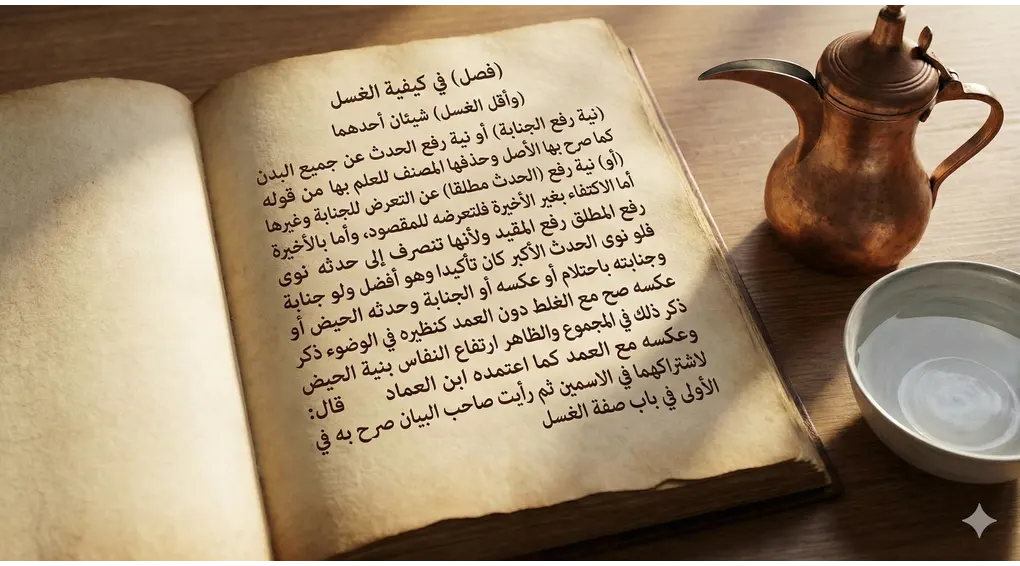
Within Islamic teachings, elevating oneself from a state of major ritual impurity (hadath akbar) through the process of Thaharah (purification) is an absolute necessity before a servant stands before Allah in prayer. This practice of purification, known academically as Ghusl or the major ritual bath, possesses a highly precise jurisprudential framework. Frequently, Muslims find themselves trapped in states of severe doubt (was-was) regarding the validity of their purification due to a lack of distinction between acts that are recommended (sunnah) and those that are obligatory (rukun).
Based on the classical text Asna al-Matalib Syarh Rawdh ath-Thalib (Volume 1, Pages 68-69) by Shaykh al-Islam Zakariyya al-Ansari, the pillars of Ghusl are fundamentally concise. There are only two absolute conditions for a valid major ritual bath that must never be omitted. Comprehending these pillars is essential once you have identified the causes requiring Ghusl according to Shafi’i Fiqh, ensuring your worship is legally valid according to the Shari’ah.
To understand the detailed recommended acts (sunan), you can always refer to the complete guide on the methodology of Ghusl. In this article, however, we will focus exclusively on dissecting the two fundamental pillars of Ghusl.
1. The Intention to Lift Major Impurity

The first pillar that differentiates a customary bath (‘adah) from a ritual act of worship (‘ibadah) is the presence of intention (niyyah) in the heart, grounded entirely in pure sincerity (Ikhlas) for the sake of Allah. Shaykh al-Islam establishes the parameters of this pillar with straightforward phrasing:
قوله: (وأقل الغسل) شيئان أحدهما (نية رفع الجنابة) … (أو) نية رفع (الحدث مطلقا)
“And the minimum (pillars) of the bath are two matters. One of them is the intention to lift the state of janabah… or the intention to lift hadath (impurity) absolutely.”
The Formulation and Articulation of the Intention
Based on the textual reference above, a Muslim is obligated to formulate the intention in their heart to lift the state of janabah or to lift major impurity in an absolute sense. You may articulate (as a recommended sunnah to affirm the heart) and internally intend the following formulation:
نَوَيْتُ رَفْعَ الْجَنَابَةِ
Transliteration: Nawaitu raf’al janabati.
Meaning: “I intend to lift the state of janabah (major ritual impurity).”
Alternatively, using the absolute phrasing:
نَوَيْتُ رَفْعَ الْحَدَثِ
Transliteration: Nawaitu raf’al hadatsi.
Meaning: “I intend to lift the state of hadath.”
It is important to note that both formulations for the intention can be utilized to remove all types of major impurities, including menstruation (hayd) and postpartum bleeding (nifas).
The Exact Timing of the Intention (Muqaranah)
Many individuals experience confusion regarding exactly when this intention must be established in the heart. The text Asna al-Matalib provides a strict rule of synchronicity (muqaranah):
قوله: (ويجب قرنها) أي النية (بأول فرض) وهو أول ما يغسل من البدن (وفي تقديمها على السنن وعزوبها) ما مر في الوضوء
“It is obligatory to synchronize it [the intention] with the beginning of the obligatory act, which is the very first part of the body to be washed. And regarding preceding it during the sunnah acts, and then it slips away (is forgotten)… [the ruling is invalidation, as it is in Wudu].”
This signifies that the intention in the heart must be present exactly at the moment water first touches any part of the body, whether it be the head, shoulder, or hand. If you recite the intention outside the bathroom, but your heart is empty or forgetful (‘uzub an-niyyah) at the exact moment you pour the first water, that initial wash is invalid as a pillar of Ghusl. You are obligated to bring the intention back into your heart for the subsequent wash.
2. Washing the Entire Body (Ta’mim al-Badan)
The second of the pillars of Ghusl is ensuring pure water reaches the entire external physical surface of the body. The specific jurisprudential term is ta’mim al-badan bil ma’ sha’ran wa basharan (encompassing the body with water, both hair and skin).
Shaykh al-Islam Zakariyya al-Ansari details the specific areas that must be washed as follows:
قوله: (و) الشيء الثاني (تعميم البدن بالماء شعرا) وإن كثف (وبشرا) وما ظهر من صماخ وأنف مجدوع وغيرهما ومن ثيب قعدت لقضاء حاجة … وما تحت قلفة
“The second matter is encompassing the body with water, both the hair, even if it is thick, and the skin. Along with what is visible from the outer ear canal, a severed nose, and for a non-virgin woman, the area that becomes visible when she sits to relieve herself… and the area beneath the foreskin (for an uncircumcised male).”
Based on this academic exposition, several critical points must absolutely be wet:
- All Hair and Its Roots: Unlike Wudu, during a major ritual bath, water must penetrate the scalp and the roots of the hair, regardless of how thick it is (wa in kathufa). For women, ensuring water reaches the roots is paramount when performing the correct ritual bath for menstruation in Islam.
- Skin and Body Folds: Water must flow into all skin folds, such as the navel, armpits, the area between the thighs, and beneath the fingernails.
- Intimate Areas: For women, the external skin of the genitalia that becomes visible when squatting to relieve oneself must be washed. For uncircumcised males (aqlaf), the skin hidden beneath the foreskin (ma tahta qulfah) is legally considered external skin; therefore, it is obligatory to retract it and wash it with water.
- The Outer Ear: The outer folds of the ear and the visible opening of the ear canal (shimakh) must be washed; however, it is not obligatory to force water deep into the internal ear canal.
Summary Table: Pillars vs. Sunnah Acts of Ghusl
To eliminate any confusion, observe the strict differentiation between the mandatory conditions (pillars) and the recommended acts of the major ritual bath:
| Action During Ghusl | Jurisprudential Status | Consequence if Omitted |
| Intention to Lift Major Impurity | Pillar (Rukun) | Ghusl is INVALID. Must be repeated. |
| Washing the Entire Skin & Hair | Pillar (Rukun) | Ghusl is INVALID. The dry area must be washed. |
| Performing Wudu before Ghusl | Recommended (Sunnah) | Ghusl remains valid; loss of sunnah reward. |
| Rinsing the mouth and nose | Recommended (Sunnah) | Ghusl remains absolutely valid. |
| Washing the right side first | Recommended (Sunnah) | Ghusl remains valid. |
Conclusion
Understanding the mandatory pillars of Ghusl is essential to ensure that our prayers and acts of worship are accepted by Allah SWT. Shafi’i Fiqh inherently facilitates ease for the Ummah by establishing only two primary pillars: a sincere intention in the heart synchronized with the first wash, and ensuring pure water encompasses the entire surface of the skin and hair without exception. By clearly distinguishing between the obligatory pillars and the recommended sunnah acts, a Muslim can liberate themselves from the spiritual disease of chronic doubt (was-was) and perform purification with absolute certainty.
Frequently Asked Questions (FAQ) on the Pillars of Ghusl
Is it permissible to vocalize the intention in a bathroom that contains a toilet?
In a bathroom equipped with a toilet, it is highly recommended to formulate the intention silently in the heart without moving the tongue or making a sound, in order to maintain proper etiquette (adab) towards Thaharah and the names of Allah. Remember, the true locus of intention is purely within the heart (al-qasd).
Is the ritual bath valid if there is dark dirt under the fingernails?
If the dirt beneath the nails prevents water from reaching the surface of the nail bed (such as waterproof nail polish, glue, or hardened tree sap), then the bath is invalid in that specific area, and the barrier must be removed. However, if the dirt is merely light dust or sweat that water can still penetrate, the bath is legally valid.
I often doubt whether the water has reached everywhere. What is the solution?
Islamic jurisprudence is built upon the principle of facilitation and ease (taysir), not hardship. If you have poured a sufficient amount of water over your body and reasonably rubbed it with your hands (especially in the folds), you are legally ruled as purified. Do not follow the whispers of Satan (was-was), which constantly demand repetition without concrete evidence.
References
Zakariyyā al-Anṣārī, Asnā al-Maṭālib fī Sharḥ Rawḍ al-Ṭālib, with marginalia by Aḥmad al-Ramlī, edited by Muḥammad az-Zuhrī al-Ghamrāwī (Cairo: al-Maṭbaʿah al-Maymānīyah, 1313 AH; repr. Dār al-Kitāb al-Islāmī), vol. 1, pp. 68-69.


