
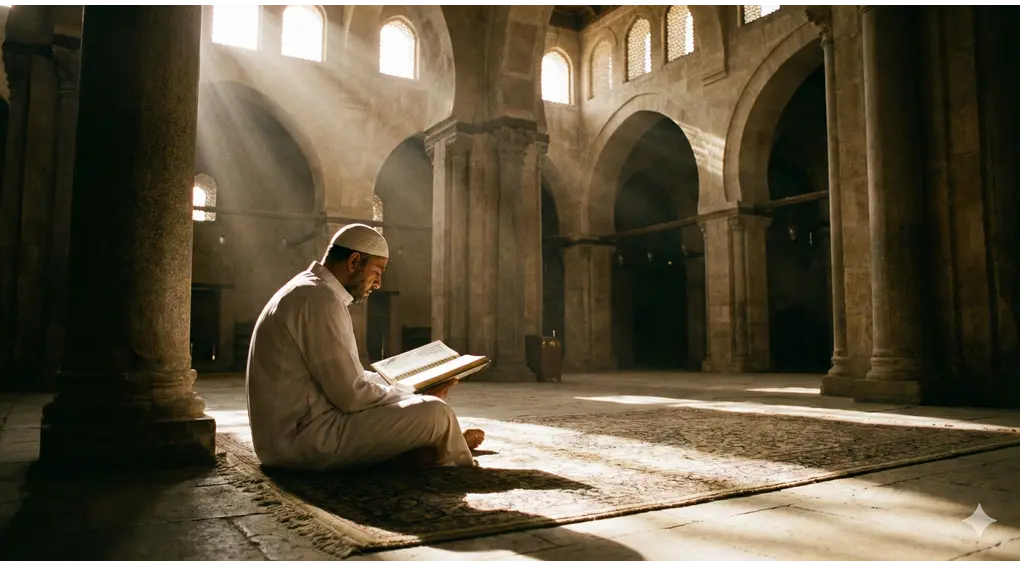
The worship of I’tikaf (spiritual retreat) is a noble practice that brings a servant closer to their Creator. For a Muslim seeking to attain the virtues of performing I’tikaf, understanding its precise rules is an absolute necessity. The validity of this worship relies heavily on fulfilling the valid conditions of I’tikaf and its pillars as outlined by the scholars.
In the perspective of Shafi’i jurisprudence, the framework of I’tikaf rests upon four primary pillars. This article provides an in-depth exposition of these pillars, referring directly to the authentic texts from Asna al-Matalib Syarh Rawdh ath-Thalib authored by Shaykh al-Islam Zakariyya al-Ansari. For a broader overview, you may also read the Complete Guide to the Fiqh of I’tikaf According to the Shafi’i School.
Explanation of the 4 Pillars of I’tikaf in the Shafi’i School
Shaykh al-Islam Zakariyya al-Ansari formulated the pillars of I’tikaf into four essential components. If any of these four elements are neglected, an individual’s practice of I’tikaf is deemed invalid according to the Shari’ah.
1. Staying in the Mosque (Al-Mukth) and the Minimum Duration
The first pillar is al-mukth, which means physically staying or residing within the boundaries of the mosque. A common question that arises among the Muslim community regards the minimum duration required for the I’tikaf to be considered valid. Shaykh al-Islam asserts:
قوله: (وأركانه أربعة الأول المكث وأقله أكثر من الطمأنينة) في الصلاة (بسكون أو تردد) لإشعار لفظه به فلا يجزئ أقل ما يجزئ في طمأنينة الصلاة (ولا يجزئ العبور) لأن كلا منهما لا يسمى اعتكافا
Meaning: “The pillars of I’tikaf are four. The first is al-mukth (staying). Its minimum limit is a duration longer than thuma’ninah (the brief pause) in prayer, whether done in a state of stillness or pacing around… and merely passing through the mosque (al-‘ubur) is not sufficient, because neither of these (less than thuma’ninah and merely passing through) is called I’tikaf.”
From this text, the Shafi’i school provides a very clear standard. The minimum duration of I’tikaf must exceed the duration of thuma’ninah (a brief moment of stillness after a movement) in the physical actions of prayer. A person who merely walks through the mosque from one door to another without stopping for a moment cannot validly claim to be performing I’tikaf.
Although a brief moment (lahzhah) is sufficient to fulfill an absolute vow (nadhr mutlaq), Shaykh al-Islam provides the ultimate recommendation:
قوله: (لكن المستحب يوم) للخروج من خلاف من أوجبه ولأنه لم ينتقل عنه – صلى الله عليه وسلم – وأصحابه اعتكاف دون يوم
Meaning: “However, what is highly recommended (sunnah) is to perform I’tikaf for a full day. This is to exit the difference of opinion (ikhtilaf) among scholars who mandate a full day, and because it was never narrated from the Prophet ﷺ nor his companions that they performed I’tikaf for less than a day.”
2. The Intention (Niyyah) and Rules for Renewing It
The second pillar is the intention (niyyah). The intention is what distinguishes the ordinary habit of sitting in a mosque from an act of worship. Shaykh al-Islam states:
قوله: (الركن الثاني النية فتجب) للاعتكاف في ابتدائه كما في الصلاة وغيرها سواء المنذور وغيره تعين زمانه أو لا (ويجب التعرض للفرض في المنذور) ليتميز عن النقل
Meaning: “The second pillar is the intention. The intention must be present at the beginning of the I’tikaf, just as in prayer and other acts of worship… It is also obligatory to specify the obligatory nature (fardh) in a vowed I’tikaf to distinguish it from a voluntary (sunnah) one.”
A crucial technical ruling involves renewing the intention (tajdid al-niyyah). When is a person required to renew their intention?
If a person intends an absolute I’tikaf (without specifying a time limit), and then exits the mosque—even to answer the call of nature—without a firm resolve in their heart to return, they are legally required to renew their intention upon re-entering.
قوله: (وإن نوى الاعتكاف وأطلق فخرج) من المسجد ولو لقضاء حاجة (لا بعد العزم على العود) إليه (ثم عاد جدد) النية وجوبا إن أراد الاعتكاف إذ الثاني اعتكاف جديد
Conversely, if they intended I’tikaf for a specific duration (such as intending for a month), and they exit purely to relieve themselves, they do not need to renew the intention upon returning. However, if they exit for reasons other than relieving themselves (without a valid excuse), they are obligated to renew the intention when they return.
3. Criteria for the Person Performing I’tikaf (Al-Mu’takif)



The third pillar pertains to the individual performing the act. The valid conditions of I’tikaf demand specific criteria for a mu’takif.
قوله: (الركن الثالث المعتكف وشرطه الإسلام والعقل وحل اللبث في المسجد)… (فيصح من المميز والعبد والمرأة) كصيامهم (لكن يكره لذوات الهيئة)
The conditions for the mu’takif are: (1) Being a Muslim, (2) Being of sound mind (‘aqil), and (3) Being legally permitted to stay in the mosque (free from major ritual impurity).
Therefore, I’tikaf is invalid if performed by someone who has lost their sanity (such as being insane, unconscious, or intoxicated). This worship is also invalid—and indeed forbidden (haram)—for a person in a state of junub (major impurity), a menstruating woman, and a woman in postpartum bleeding (nifas).
For married women, Islamic jurisprudence applies strict rules. A wife’s I’tikaf is prohibited if done without her husband’s permission (ويحرم بغير إذن السيد والزوج). The husband has full rights over the benefits of his wife, thus he has the right to order her to leave and cancel a voluntary I’tikaf even if he had initially granted permission.
4. The Place of I’tikaf (The Mosque Condition)
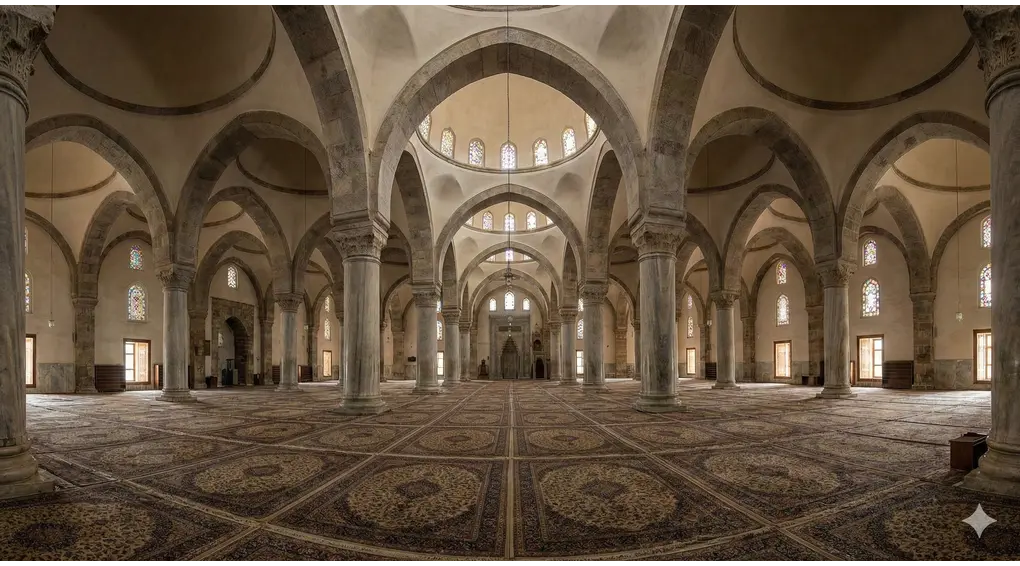
The fourth pillar of I’tikaf is the place of its execution, namely the mosque (Al-Mu’takaf fih).
قوله: (الركن الرابع المعتكف) فيه (فلا يصح) الاعتكاف (إلا في المسجد) للاتباع رواه الشيخان وللإجماع
Meaning: “The fourth pillar is the place of I’tikaf. I’tikaf is not valid except in a mosque, following the practice of the Prophet as narrated by Al-Bukhari and Muslim, and based on scholarly consensus (Ijma’).”
This ruling applies generally, including to Muslim women. There is a frequent misconception that it is sufficient for a woman to perform I’tikaf in the designated prayer area within her home. The classical texts firmly refute this:
قوله: (ولا يجزئ المرأة) اعتكافها (في مصلى بيتها) لأنه ليس بمسجد فهي كغيرها
Meaning: “A woman’s I’tikaf is not valid in the prayer room (mushalla) of her house, because that place does not legally hold the status of a mosque. Thus, she is judged the same as anyone else (must be in a mosque).”
Furthermore, Asna al-Matalib provides the hierarchy of virtues regarding mosques. I’tikaf in a Jami’ mosque (where Friday prayers are held) is superior to a regular mosque. There is also a special distinction for the three holy mosques:
قوله: (ولا يتعين مسجد للاعتكاف بنذر) له (فيه)… (إلا المسجد الحرام وكذا مسجد المدينة والمسجد الأقصى)
If someone vows to perform I’tikaf in a regular mosque, they may fulfill it in any mosque. However, if they vow to perform I’tikaf in Al-Masjid al-Haram, Al-Masjid an-Nabawi, or Al-Masjid al-Aqsa, performing it there becomes obligatory. Al-Masjid al-Haram can substitute the functions of both the Prophet’s Mosque and Al-Aqsa in fulfilling a vow. The Prophet’s Mosque can substitute Al-Aqsa, but not vice versa, in accordance with their respective levels of virtue.
Summary Table: Conditions and Pillars of I’tikaf
To facilitate understanding, please observe the summary table of the pillars and the minimum limits of I’tikaf below:
| Pillar Component | Details of Validity Conditions in Shafi’i Fiqh |
| 1. Staying (Al-Mukth) | The minimum duration must exceed the time of thuma’ninah. Merely walking through (ubur) is invalid. |
| 2. Intention (Niyyah) | Obligatory upon entry. Must specify “fardh” if it is a vow. Must be renewed if exiting without the resolve to return. |
| 3. The Person (Mu’takif) | Muslim, of sound mind, pure from major impurities (menstruation, postpartum, junub). Women must obtain their husband’s permission. |
| 4. Place (Mosque) | Must be within a building legally endowed (waqf) as a mosque. A woman’s home prayer room is not valid. |
FAQ Regarding the Pillars and Conditions of I’tikaf
Can a person who is merely walking through the mosque intend I’tikaf and get the reward?
No. Shaykh al-Islam strictly states, (ولا يجزئ العبور) which means merely walking across the mosque without stopping is not validly called I’tikaf. The primary condition is to pause for a moment longer than the duration of thuma’ninah.
If I step out of the mosque briefly to use the restroom, do I have to make the intention for I’tikaf again upon re-entering?
If from the beginning you intended an absolute I’tikaf (without a duration limit), and you exit to the restroom without a firm resolve in your heart to return, then upon re-entering, you are obligated to renew your intention. However, if from the start your intention was to stay for a specific period, and your exit was solely to relieve yourself, there is no need to renew the intention upon returning.
Is it permissible for a woman to perform I’tikaf in her dedicated prayer room at home?
It is invalid. The classical text firmly declares: (ولا يجزئ المرأة اعتكافها في مصلى بيتها). A prayer room inside a house does not carry the legal status of an endowed mosque, thus the pillar of Al-Mu’takaf fih is not fulfilled.
We hope this explanation of the pillars of I’tikaf facilitates our steps in constantly reviving the Sunnah within the mosque. If you wish to learn what is permissible and prohibited while inside the mosque, please continue reading our next dedicated article.
References
al-Anṣārī, Zakariyā. Asnā al-Maṭālib fī Sharḥ Rawḍ al-Ṭālib. With the marginalia (hashiyah) of Aḥmad al-Ramlī. Edited by Muḥammad az-Zuhrī al-Ghamrāwī. Cairo: al-Maṭbaʿah al-Maymānīyah, 1313 AH. Reprinted by Dār al-Kitāb al-Islāmī.


