
The worship of I’tikaf is one of the great symbols of Islam; it is a profound manifestation of a servant isolating themselves to draw closer to Allah ﷻ. Within the Islamic scholarly tradition, specifically the rules and procedures of I’tikaf according to the Shafi’i school of thought, this act of worship possesses highly precise pillars and jurisprudential boundaries.
This article is designed as a comprehensive guide, referring directly to the authoritative (mu’tamad) literature: the book Asnā al-Maṭālib Syarḥ Rawḍ aṭ-Ṭālib by Shaykh al-Islam Zakariyyā al-Anṣārī. The following discussion outlines the original ruling, scriptural foundations, and technical details to guide the validity of your I’tikaf.
Definition and Scriptural Foundation of I’tikaf
Understanding the reality of a matter is the first step before practicing it. The Shafi’i scholars formulated the definition of I’tikaf with meticulous care, examining it from both linguistic and jurisprudential (Fiqh) perspectives.
Linguistic and Terminological Definition
Shaykh al-Islam Zakariyyā al-Anṣārī explains the definition as follows:
قوله: (هو لغة اللبث والحبس والملازمة على الشيء خيرا كان أو شرا) … وشرعا اللبث في المسجد من شخص مخصوص بنيته
Meaning: “Linguistically, it means to stay (al-labth), to confine oneself (al-ḥabs), and to continuously adhere to something (al-mulāzamah), whether that thing is good or bad… And legally (in Sharia), it is the staying in a mosque by a specific person with a specific intention.”
Therefore, in the terminology of Shafi’i Fiqh, the essence of I’tikaf is: Staying inside a mosque, performed by an individual meeting specific criteria, accompanied by an intention.
The Foundation from the Quran and Sunnah
The Fiqh of I’tikaf stands on a solid textual foundation. Even before the consensus (Ijma’) of the scholars, the basis for this worship originated from the Quran:
قال تعالى {ولا تباشروهن وأنتم عاكفون في المساجد} [البقرة: ١٨٧]
Meaning: “And do not have relations with them [your wives] as long as you are staying for I’tikaf in the mosques.” (QS. Al-Baqarah: 187)
The classical text also cites the evidence from the continuous practice of the Prophet Muhammad ﷺ, as recorded in the Ṣaḥīḥayn (Bukhari and Muslim):
أنه «- صلى الله عليه وسلم – اعتكف العشر الأوسط من رمضان ثم اعتكف العشر الأواخر ولازمه حتى توفاه الله ثم اعتكف أزواجه من بعده»
Meaning: “That the Prophet ﷺ performed I’tikaf during the middle ten days of Ramadan, then he performed I’tikaf during the last ten days and continuously adhered to it until Allah took his soul, and then his wives performed I’tikaf after him.”
Furthermore, a group of scholars states that this worship is part of the laws of previous nations (ash-sharā’i’ al-qadīmah), based on the word of Allah concerning Prophets Ibrahim and Ismail (peace be upon them) in Surah Al-Baqarah, verse 125.
The Original Ruling of I’tikaf
Based on the absolute nature of the textual evidence, Asnā al-Maṭālib affirms the legal status of performing I’tikaf:
قوله: (وهو سنة مؤكدة ويستحب في كل الأوقات) لإطلاق الأدلة
Meaning: “And it is a highly recommended Sunnah (Sunnah Mu’akkadah), and it is recommended to be performed at all times, due to the absolute nature of the evidences.”
The default ruling is highly recommended. However, this ruling can elevate to obligatory (Wajib) if a person makes a vow (Nadhr) to perform it.
The Four Main Pillars (Arkān) of I’tikaf in the Shafi’i School



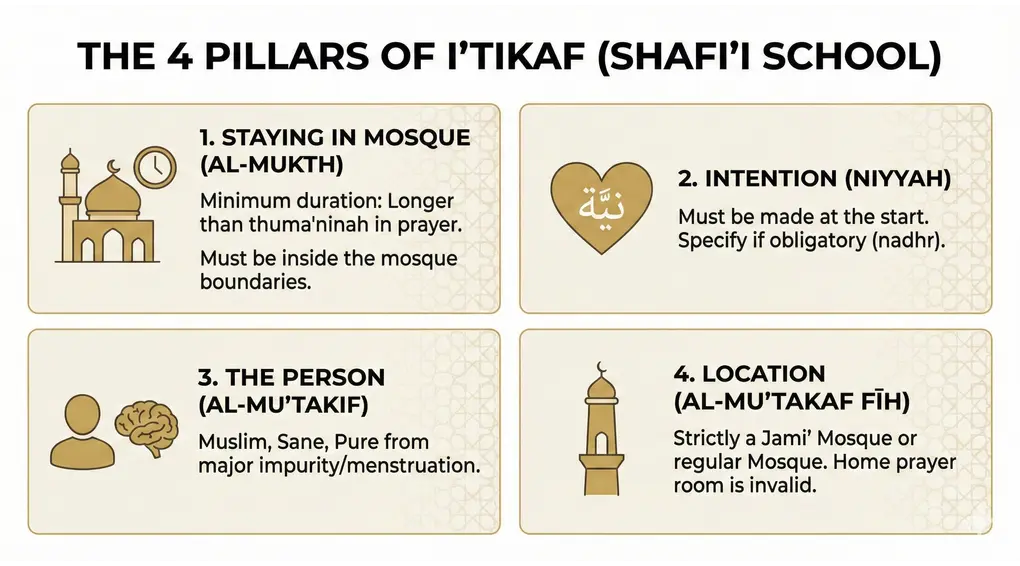
The validity of this worship depends on four mandatory pillars. If even one is missing, the practice is legally invalid.
1. Staying in the Mosque (Al-Mukth)
The first pillar is physical presence inside the mosque. Asnā al-Maṭālib details the minimum required duration:
(وأقله أكثر من الطمأنينة) في الصلاة (بسكون أو تردد) لإشعار لفظه به فلا يجزئ أقل ما يجزئ في طمأنينة الصلاة (ولا يجزئ العبور)
Meaning: “(And its minimum is longer than the duration of tranquility/thuma’ninah) in prayer, (whether by remaining still or pacing back and forth)… Therefore, merely passing through (al-‘ubur) does not suffice.”
The minimum duration of staying must be slightly longer than the thuma’ninah (moment of stillness) required in prayer. Therefore, merely walking through the mosque without pausing is invalid and does not count as I’tikaf.
If someone vows to perform a general I’tikaf, the vow is fulfilled even with a momentary stay (laḥẓah). However, it is highly recommended to complete a full day to exit the scholarly dispute (as some scholars mandate a full day) and to closely follow the practice of the Prophet ﷺ.
2. The Intention (Niyyah)
All actions depend on intentions. The intention must be present at the very beginning of the I’tikaf. If the I’tikaf is obligatory (due to a vow), the person must explicitly specify its obligatory nature in their heart to distinguish it from a voluntary I’tikaf.
It is highly recommended for every Muslim, every time they step foot into a mosque, to intend I’tikaf in order to gain its spiritual rewards while they are inside.
🔗 Further Reading: Delve deeper into the regulations of the pillars, valid conditions, and the duration of intention in the article: The Valid Conditions and 4 Pillars of I’tikaf in Shafi’i Fiqh
3. The Person Performing It (Al-Mu’takif)
The individual performing I’tikaf must meet specific legal criteria: they must be Muslim, sane, and legally permitted to stay in the mosque.
فلا يصح اعتكاف الكافر وغير العاقل كالمجنون والمغمى عليه والسكران إذ لا نية لهم ولا اعتكاف الجنب والحائض والنفساء لحرمة المكث في المسجد عليهم
Meaning: “Thus, the I’tikaf of a disbeliever, or someone who is not sane like a madman, a fainting person, or an intoxicated person is invalid because they cannot form an intention. Nor is the I’tikaf of someone in a state of major impurity (junub), menstruation, or postnatal bleeding valid, due to the prohibition of them staying in the mosque.”
I’tikaf is valid for a discerning child (mumayyiz), a slave, and a woman (provided she has permission and is free from menstruation/postnatal bleeding).
🔗 Further Reading: For specific legal discussions regarding Muslim women, including the necessity of the husband’s permission and the rulings on istihadhah (irregular bleeding), please refer to the article: Rules of Itikaf for Women in Shafi’i Fiqh: A Complete Guide.
4. The Place of Performance (Al-Mu’takaf Fīh)
The fourth pillar is the mosque itself. This worship is strictly invalid if performed outside the boundaries of a mosque.
قوله: (فلا يصح) الاعتكاف (إلا في المسجد)… ولا يجزئ المرأة اعتكافها في مصلى بيتها لأنه ليس بمسجد فهي كغيرها
Meaning: “The I’tikaf is not valid except in a mosque… And a woman’s I’tikaf in the designated prayer area of her house (mushalla baitiha) is not valid, because it is not legally a mosque.”
Performing I’tikaf in a Jami’ mosque (where Friday prayers are held) is superior. However, there is no requirement to designate a specific mosque when making a vow, except for the three holy mosques: Al-Masjid al-Haram, Al-Masjid an-Nabawi, and Al-Masjid al-Aqsa.
Permitted and Disliked Actions During I’tikaf
The Fiqh of the Shafi’i school does not completely prohibit human activity while in the mosque. Asnā al-Maṭālib mentions several permissible (Mubāḥ) actions:
- Light Work: It is permissible to sew or write, provided it is not excessive. Writing Islamic knowledge (kitābat al-‘ilm) is highly encouraged and never disliked, as it is a form of obedience.
- Personal Grooming: Combing hair, applying perfume, and wearing nice clothes are permitted.
- Contracts: It is permissible to conduct a marriage contract inside the mosque.
- Eating and Drinking: Eating, drinking, and washing hands are allowed. However, it is preferred (al-awlā) to use a mat (sufrah) or a basin (ṭast) to protect the mosque’s cleanliness.
Conversely, it is disliked (Makruh) to engage in commercial professions or transactions like buying and selling without a pressing need, or to perform cupping (hijamah) if there is a fear of dirtying the sacred space.
🔗 Further Reading: You can explore the full details of the etiquette, permissible (mubah), and disliked (makruh) acts in our dedicated article: The Etiquette of I’tikaf: Permissible & Disliked Acts in the Mosque
Invalidators of I’tikaf and Leaving the Mosque
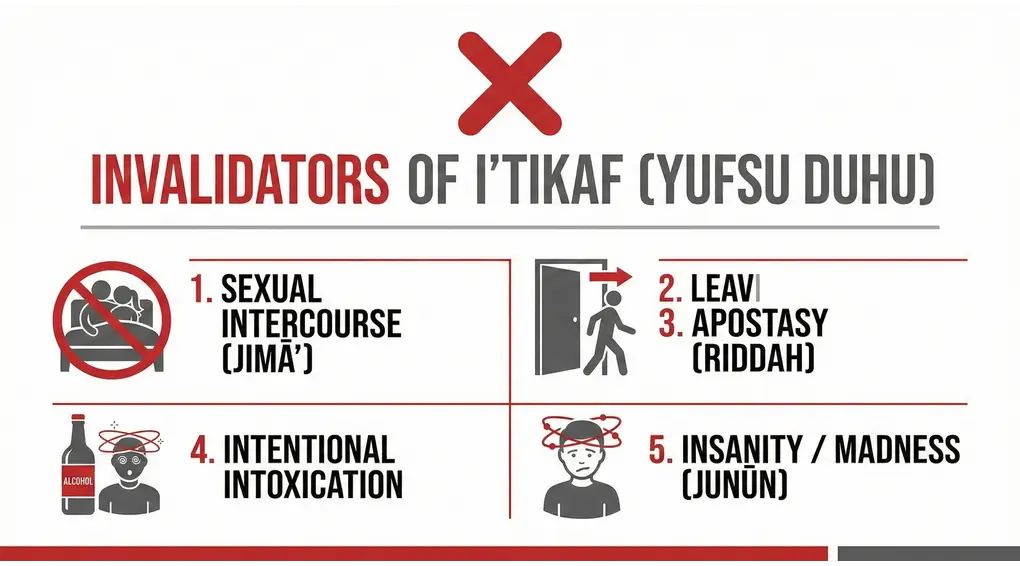
A fundamental aspect of successfully performing I’tikaf is avoiding its invalidators.
ويفسده أي الاعتكاف من الجماع ما يفسد الصوم منه… متى ارتد المعتكف أو سكر بمحرم بطل اعتكافه
Meaning: “And sexual intercourse invalidates I’tikaf just as it invalidates fasting… Whenever the person performing I’tikaf apostatizes or becomes intoxicated by something forbidden, his I’tikaf is nullified.”
Sexual intercourse invalidates I’tikaf. It is also nullified by apostasy, intentional intoxication, or a lustful touch that leads to the emission of semen (inzāl).
Leaving the mosque without a valid excuse (bilā ‘udhrin) will break the continuity (tatabbu’) of the I’tikaf. However, one is permitted to leave for pressing, unavoidable needs, such as:
- Answering the call of nature (urination/defecation).
- Performing an obligatory bath (Ghusl).
- Eating or drinking, if provisions cannot be brought into the mosque.
- Severe illness requiring outside care, or other legal excuses like forgetting or being forced (ikrah).
🔗 Further Reading: A study regarding the valid excuses permitting leaving the mosque and the fiqh rules concerning vows of consecutiveness (nadzar tatabbu’) is available in: The Nullifiers of I’tikaf and the Rulings on Leaving the Mosque.
Summary Table: Rules of I’tikaf (Shafi’i School)
To easily understand the procedures, here is a classification based on Asnā al-Maṭālib:
| Aspects of Fiqh | Legal Ruling (Shafi’i School) |
| Minimum Duration | Longer than the thuma’ninah of prayer. Merely passing through is invalid. |
| Original Ruling | Sunnah Mu’akkadah (Can be performed at any time of the year). |
| Location | Strictly inside a legally designated Mosque. A home prayer room is invalid. |
| The Worshipper | Muslim, sane, pure from major impurity/menstruation. Women require husband’s permission. |
| Main Invalidators | Intercourse, apostasy, intentional intoxication, insanity, leaving the mosque without excuse. |
| Permitted Actions | Eating/drinking (using a mat), writing knowledge, applying perfume, marriage contracts. |
FAQ: Questions About the Procedures of I’tikaf
Can I intend to perform I’tikaf for just a few minutes when entering the mosque for congregational prayer?
Yes, it is highly recommended. Shaykh al-Islam mentions: (ويستحب كلما دخل المسجد أن ينوي الاعتكاف). Every time you step into the mosque, it is Sunnah to intend I’tikaf, even for a short while, to gain its immense virtues.
Can a wife perform I’tikaf in the prayer room (mushalla) of her house?
According to the Shafi’i school, it is not valid. (ولا يجزئ المرأة اعتكافها في مصلى بيتها). A prayer area inside a home does not possess the legal status of a mosque, thus the pillar of location is not met.
If someone is in I’tikaf, can they wash their hands after eating inside the mosque?
It is permitted. (وله أن… يأكل ويشرب ويغسل يده). However, the emphasized etiquette is to use a basin (ṭast) so that the water splashes do not defile the purity and cleanliness of the mosque floor.
Does I’tikaf require fasting?
Fasting is not an absolute condition for the validity of I’tikaf. However, it is highly recommended to combine the two: (يستحب للمعتكف الصوم للاتباع… وللخروج من خلاف من أوجب الصوم). An exception is if a person specifically vowed to perform I’tikaf while fasting.
The article above serves as the primary cornerstone of the I’tikaf guide on this website. Please direct your navigation to the links embedded within the body of the article to deepen your understanding of the specific branches of fiqh related to the procedures of I’tikaf according to the Shafi’i school.
Reference
Zakariyyā al-Anṣārī, Asnā al-Maṭālib fī Sharḥ Rawḍ al-Ṭālib, with a ḥāshiyah by Aḥmad al-Ramlī, ed. Muḥammad az-Zuhrī al-Ghamrāwī (Cairo: al-Maṭbaʿah al-Maymānīyah, 1313 AH; repr., Dār al-Kitāb al-Islāmī), vol. 1, pp. 433-443.


