

The worship of fasting (al-ṣawm) is a medium for disciplining the soul and body. Its main essence lies in al-imsāk, namely refraining from everything that invalidates the fast from dawn until sunset. For individuals who are married, the challenge of fasting extends to the manner of physical interaction with their lawful spouses during the day.
Many questions have arisen from Muslims regarding the limits of physical affection. Is expressing love through kissing permissible? Or does such an act immediately invalidate the fast?
To unravel this issue clearly and to complete our understanding of things that invalidate the fast comprehensively, we are obliged to refer to the authoritative literature of the Shafi’i school of thought. Shaykh al-Islam Zakariyya al-Anshari in the book Asna al-Matalib Syarah Rawd at-Talib (Volume 1, page 415) provides a very detailed, proportional, and wisdom-laden fiqh limitation. Let us dissect the legal determination so that our worship is protected from invalidating matters.
Legal Basis: Conditionally Permissible
Islamic law consistently adheres to the principle of moderation. Physical interaction with a spouse is fundamentally permissible, however, when an individual enters the sacred state of fasting, there are restrictions that must be obeyed.
According to the book Asna al-Matalib, the original ruling regarding kissing one’s spouse (qublah) while fasting is Permissible (Mubah). However, this permissibility is tied to a very strict condition: the person doing it must have full control over their desire, so that the kiss does not lead to sexual intercourse (jimak) or the emission of semen (inzāl).
Although permissible, Sheikh Zakariyya al-Anshari offers an important note for pious servants:
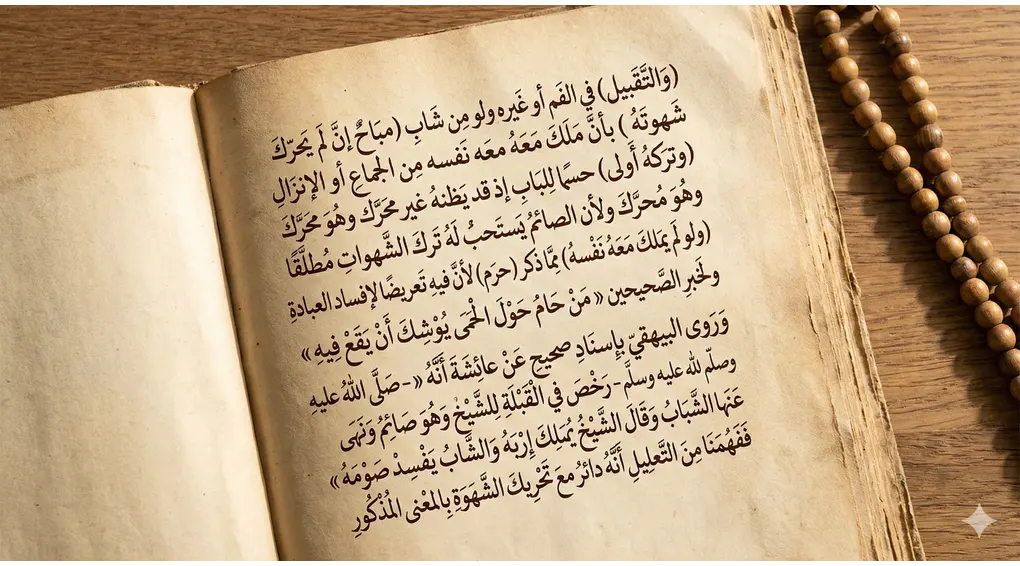
قوله : ( والتقبيل ) في الفم أو غيره … ( مباح إن لم يحرك شهوته )… ( وتركه أولى )
Meaning: “(And kissing) on the mouth or elsewhere… (is permissible if it does not arouse desire)… (and abstaining from it is more virtuous / khilāful awlā).”
The term khilāful awlā means that even though it is not threatened with sin, abstaining from the act is far better and more preferable in Islamic law. This is a preventative measure to prevent someone from slipping into the abyss of invalidating the fast.
Legal Transitions: When Does Kissing Become Ḥarām?
Fiqh law is dynamic, adapting to the conditions (ḥāl) of the actor. The permissibility of kissing one’s spouse can change in degree to become absolutely Ḥarām if the actor is aware of their own weakness.
If a husband knows or strongly suspects that a kiss will ignite uncontrollable desire, rendering him unable to restrain himself, and potentially invalidate his fast (leading to jimak or ejaculation), then such an act is strictly Ḥarām.
A deeper jurisprudential analysis regarding how physical touch risks invalidating the fast can be found in the fiqh discussions on intentional seminal emission (istimnā’) and the strict boundaries of physical intimacy during Ramadan.
In Islamic scholarly tradition, the principle of sadd al-dharī‘ah (blocking the means to evil) is applied here. Something that is originally permissible becomes Ḥarām if it becomes a certain path to a forbidden act (invalidating the fast).
The Wisdom of Age Differences: Youth and the Elderly

One of the proofs of the beauty of Islamic law is its realistic approach to human biological realities. The book Asna al-Matalib records the wisdom of the Prophet Muhammad ﷺ in addressing this issue by considering the factor of age.
Prophet Muhammad ﷺ granted concessions (rukhṣah) to the elderly to kiss their spouses while fasting, but he strongly forbade young men from doing the same. Sheikh Zakariyya quoted the reason behind this different treatment:
وقال الشيخ يملك إربه والشاب يفسد صومه
Meaning: “Old people are able to restrain their desires, while young people ruin their fast.”
Older people generally have emotional maturity and a decrease in biological desire, allowing them to control themselves (yamliku irbahu). Kissing for them is merely a manifestation of pure affection. Conversely, young people at the peak of their vitality are very vulnerable to losing control.
For young men, a small touch can ignite a difficult-to-extinguish lust, which ultimately ruins the worship of their fast. Do not let this negligence lead to further violations, considering the ruling of intercourse during the day in Ramadan and its consequences requires the payment of a kaffārah (expiation) which is very burdensome.
A Spiritual (Tasawwuf) Perspective: Maintaining the Station and Etiquette of Fasting
From a fiqh perspective, kissing without the emission of semen does not invalidate the fast. However, let us raise our gaze to the dimension of Tasawwuf. Fasting is essentially a secret worship between a servant and Allah ﷻ that demands the highest level of ikhlaṣ (sincerity).
A sālik (spiritual traveler) will not be content with merely the validity of worship in its outward form. They strive to preserve the maqām (spiritual station) of their fast from all blemishes. Intimacy during the day of Ramadan, even if able to restrain oneself, demonstrates a lack of shame and adab (respect) towards Allah ﷻ. The daytime of Ramadan should ideally be filled with tilawah (recitation of the Quran), dhikr (remembrance of Allah), and guarding the heart from negligence (futūr). Doing things that are khilāful awlā (contrary to what is most appropriate) means scratching at the glory of that sacred day.
Summary Table: Rulings on Kissing a Spouse While Fasting
To facilitate understanding of the detailed rulings from the book Asna al-Matalib, please refer to the following table:
| Actor’s Condition and Situation | Legal Status | Fiqh Explanation |
| Able to absolutely restrain desire | Permissible | The fast is valid, but abstaining from it (Khilāful Awlā) is far better. |
| Unable to restrain oneself | Forbidden (Ḥarām) | Strictly prohibited due to a high risk of invalidating the fast. |
| Elderly (Senior Citizens) | Granted Concession | Possess strong control over their desires (yamliku irbahu). |
| Youth (Productive Age) | Prohibited / Highly Disliked (Makruh Tahrim) | Prone to losing control and potentially ruining the fast. |
FAQ: Questions About Physical Affection During Fasting
Does kissing one’s wife on the forehead before leaving for work invalidate the fast?
Based on the references in the above books, kissing one’s wife is permissible as long as the person doing it is safe from lustful desires. Kissing the forehead as a sign of farewell is generally a natural expression of affection and does not invalidate the fast, although avoiding it (khilāful awlā) is preferable as a precaution.
When exactly does kissing one’s spouse become Ḥarām during fasting?
The ruling changes to Ḥarām when a person is fully aware that they will not be able to control their desire after a kiss, such that the act has a high potential of leading to daytime intercourse or the emission of semen due to physical contact. This is, of course, a different legal status than if desire arises without any touch, as specifically discussed in the ruling on the emission of semen due to imagination or a wet dream.
Why do young people receive different rulings than adults?
This is a form of wisdom and mercy from the teachings of the Prophet Muhammad ﷺ. The Sharia recognizes the biological inclination of youth, whose desires are more difficult to control. The prohibition for young people is a protection to prevent them from falling into serious transgressions (jināyah) that require two consecutive months of fasting (kaffarah).
Maintaining the fast from things that invalidate it and those that diminish its value is the path to the degree of piety. For husband and wife, delaying the fulfillment of desire until the time of breaking the fast is a sweet form of obedience. May Allah ﷻ grant us the strength to perform this worship perfectly.
And Allah knows best.
Reference
Zakariyā al-Anṣārī, Asnā al-Maṭālib fī Sharḥ Rawḍ al-Ṭālib, with a ḥāshiyah by Aḥmad al-Ramlī, edited by Muḥammad az-Zuhrī al-Ghamrāwī (Cairo: al-Maṭbaʿah al-Maymānīyah, 1313 H; repr. Dār al-Kitāb al-Islāmī), vol. 1, p. 415.


