
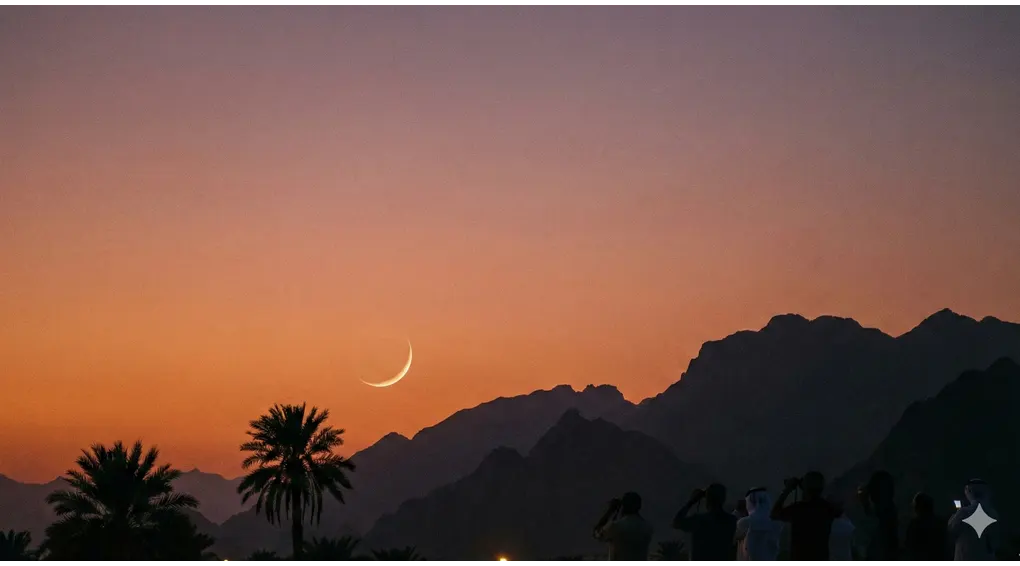
The passage of time in Islamic law is heavily reliant on the movement of celestial bodies, particularly the moon. The transition of lunar phases, especially when awaiting the arrival of the holy months of Ramadan and Shawwal, is a time imbued with spiritual value. A servant of God who treads the path of tazkiyatun nufus (spiritual purification) constantly maintains vigilance of the heart (murāqabah) as time changes, renewing faith and elevating hope.
This writing outlines the guidance for reciting the prayer upon sighting the new crescent moon (hilal) and the prayer to welcome the beginning of the Hijri month based on the explanation of Al-Imam Yahya bin Syaraf An-Nawawi rahimahullah in his monumental work, Kitab Al-Adhkar (specifically on page 188). This discussion is purely based on narrations that have been verified by hadith scholars.
Variations in the Wording of the Prayer Upon Sighting the New Crescent Moon (Beginning of the Month)
The hilal is the first sighting of the crescent moon that appears after the astronomical new moon (Ijtima’). Its presence marks the beginning of a new month. The Messenger of Allah ﷺ taught several variations of prayers upon sighting the hilal to his ummah.
1. The Account of Thalhah bin Ubaidillah (The Utterance of Blessing and Faith)
Imam An-Nawawi narrated Hadith number 536 from Musnad Ad-Darimi and Kitab At-Tirmidzi, from the companion Thalhah bin Ubaidillah radhiyallahu ‘anhu, that the Prophet ﷺ when he saw the new moon, he would say:
اللهم أهله علينا باليمن والإيمان والسلامة والإسلام ربي وربك الله
Allāhu akbar, Allāhumma ahillahu ʿalaynā bil-amni wal-īmāni, was-salāmati wal-islāmi, wat-tawfīqi limā tuḥibbu wa tarḍā, rabbunā wa rabbukallāh.
Translation: “O Allah, bring this month to us with blessings, faith, safety, and Islam. My Lord and your Lord is Allah.”
Imam At-Tirmidhi assessed this narration with the statement: “A good hadith.”
2. The Account of Ibn Umar (The Formulation of Takbir and Divine Guidance)
Other variations of the prayer at the beginning of the Hijri month are recorded in Hadith number 537 from Musnad Ad-Darimi. Ibn Umar radhiyallahu ‘anhuma narrated that the Messenger of Allah ﷺ would begin with a takbir when he saw the new crescent:
الله أكبر , اللهم أهله علينا بالأمن والإيمان والسلامة والإسلام , والتوفيق لما تحب وترضى , ربنا وربك الله
Allāhu akbar, Allāhumma ahillahu ʿalaynā bil-amni wal-īmāni, was-salāmati wal-islāmi, wat-tawfīqi limā tuḥibbu wa tarḍā, rabbunā wa rabbukallāh.
Translation: “Allah is the Greatest. O Allah, bring forth this month upon us with security, faith, safety, Islam, and guidance to that which You love and approve. Our Lord and your Lord is Allah.”
The wording of this prayer upon sighting the new crescent moon is laden with the content of monotheism. The utterance “Rabbuna wa Rabbukallah” (Our Lord and your Lord is Allah) is a form of affirmation of the creed that the moon is merely a creation of Allah that is subject to sunnatullah, not an entity that possesses the power to regulate the universe.
3. The Narrative of Qatadah (Repeated Three Times)




There is also a narration from Qatadah in Sunan Abu Dawud (Hadith No. 538), which explains that the Prophet ﷺ recited the following prayer three times:
هلال خير ورشد , هلال خير ورشد , هلال خير ورشد , آمنت بالله الذي خلقك
Hilāla khayrin wa rushdin, hilāla khayrin wa rushdin, hilāla khayrin wa rushdin, āmantu billāhillażī khalaqak.
Translation: “Crescent of goodness and guidance, crescent of goodness and guidance, crescent of goodness and guidance. I believe in Allah who created you.”
Thereafter, he continued with the statement: “Alhamdulillāhilladzī dzahaba bisyahri kadzā wa jā’a bisyahri kadzā” (All praise is due to Allah who has made this month pass and brought this month). There is also an additional narration that the Prophet ﷺ turned his face away from the crescent moon after seeing it.
In the application of this supplication is: If currently there is a transition from the month of Sha’ban to the month of Ramadan, then the practical utterance to be read is: Al-ḥamdu lillāhil-ladzī dzahaba bi-syahri Sya’ban, wa-jāʾa bi-syahri Ramadan. (All praise is to Allah who has passed the month of Sha’ban and brought the month of Ramadan).
Although this wording is beautiful in meaning, Imam An-Nawawi objectively quotes Abu Dawud’s statement regarding the status of its isnād (chain of narration): “There is no ḥadīth in this chapter with a connected isnād that is ṣaḥīḥ (authentic) from the Prophet ﷺ.” Therefore, this narration of Qatadah is judged as a mursal ḥadīth (with a broken chain at the level of the Companion) and may be practiced.
The Difference in Prayers When Seeing the Hilal (New Crescent Moon) and Qamar (Moon)

Astronomically and in fiqh, there is a distinction in terminology between Hilal and Qamar. Hilal refers to the crescent moon at its first appearance, while Qamar refers to the moon when its form has grown or reached the full moon phase. The guidance for its prayer is also different.
For the Qamar phase, Imam An-Nawawi quotes Hadith No. 540 from the book of Ibn Sinni. Sayyidah Aisyah radhiyallahu ‘anha narrated an incident when the Messenger of Allah ﷺ held her hand while the full moon was shining brightly, then he said:
تعوذي بالله من شر هذا الغاسق إذا وقب
Translation: “Seek refuge in Allah from the evil of this intensely dark night when it has arrived.”
This hadith is an instruction from the Prophet ﷺ to ‘Aisyah to seek refuge in Allah upon seeing the moon. This aligns with the guidance of the Qur’an in Surah Al-Falaq. Therefore, to act upon this hadith, you can recite Surah Al-Falaq.
Spiritual Preparation: Prayers for Welcoming Ramadan (The Months of Rajab and Sha’ban)
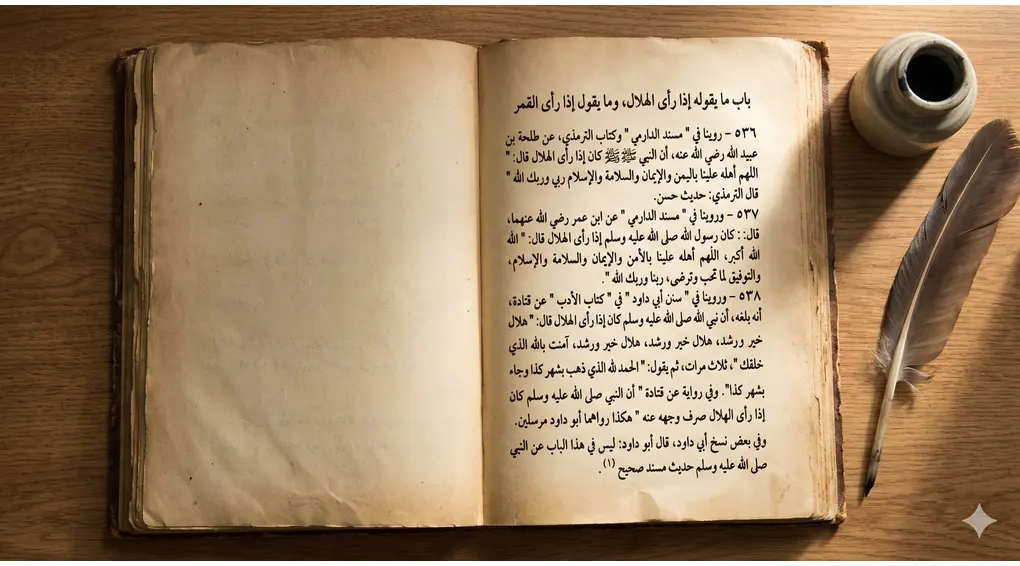
In anticipation of the arrival of obligatory fasting worship, Muslims commonly recite preparatory prayers starting from the entry of the month of Rajab. This practice has a historical basis mentioned by Imam An-Nawawi in Hadith No. 541 from Hilyatul Auliya, through the narration of Ziyad An-Numairi from Anas radhiyallahu ‘anhu:
اللهم بارك لنا في رجب وشعبان وبلغنا رمضان
Allāhumma bārik lanā fī Rajaba wa Shaʻbāna, wa ballighnā Ramaḍān.
Translation: “O Allah, bless us in the months of Rajab and Sha’ban, and allow us to reach the month of Ramadan.”
As a scholar who firmly upholds the discipline of ḥadīth science, Imam An-Nawawi provided a critical note regarding the sanad (chain of narration) of this prayer welcoming Ramadan. He wrote that this narration has a sanad containing weakness (dha’if).
This objective explanation from Imam An-Nawawi demonstrates the intellectual integrity of Islam. Even though its sanad is considered dha’if (weak), scholars permit its practice within the scope of fadhā’il al-a’māl (the virtues of deeds), as an expression of a believer’s longing and spiritual preparation.
Comparison Table of Hilal and Qamar Prayers
| Condition / Visibility Object | Phrase / Arabic Text Fragment | Hadith Status (Al-Adkar) |
| Seeing the New Crescent (Beginning of the Month) | اللهم أهله علينا باليمن والإيمان | Hasan (Narrated by At-Tirmidhi) |
| Seeing the New Crescent (Beginning of the Month) | الله أكبر ، اللهم أهله علينا بالأمن | Accepted / Musnad Ad-Darimi |
| Seeing the New Crescent (Beginning of the Month) | هلال خير ورشد | Mursal (Narrated by Abu Dawud) |
| Seeing the Full Moon (Qamar) | تعوذي بالله من شر هذا الغاسق | Accepted / Kitab Ibnu Sinni |
| Entering the Month of Rajab | اللهم بارك لنا في رجب وشعبان | Dha’if / Hilyatul Auliya |
Frequently Asked Questions (FAQ) Regarding Prayers to Welcome the New Month
When is the appropriate time to recite the prayer for sighting the new crescent moon?
The time to recite the prayer is immediately after successfully sighting (seeing) the first crescent moon on the western horizon, right after sunset on the 29th day of the current month.
Is this prayer only recited when welcoming Ramadan?
No. The guidance for reciting it applies generally to the beginning of each Hijri month (Muharram, Shafar, etc.), However, it feels much more solemn when anticipating the arrival of Ramadan, marking the beginning of a month where believers will routinely recite the authentic supplications for breaking the fast every sunset.
Is it permissible to continue reciting the supplications for the month of Rajab even if the chain of narration is weak?
Certainly permissible. Imam An-Nawawi himself included it in Kitab Al-Adzkar as a guide for daily remembrance. Scholars agree that a dha’if (weak) ḥadīth may be practiced for supplication and motivation for good deeds, as long as it is not within the realm of establishing legal rulings regarding what is Ḥarām and ḥalāl (Ahkam) or fundamental tenets of faith (Aqidah).
Why did the Prophet ﷺ turn his face away after seeing the crescent moon?
Some scholars interpret it as an attitude of humility and to prevent prolonged gazing upwards, but rather to immediately refocus attention on the power of Allah, the creator of the crescent.
Consistently performing the prayer upon sighting the new crescent moon is a concrete step for a servant in elevating their spiritual station (Maqam) of servitude. Once the new moon is sighted and the first night of Ramadan commences, the immediate next step is establishing the fiqh of aligning the fasting intention and controlling anger for the days ahead. May Allah always grant us guidance to revive the Sunnahs of the Prophet ﷺ.
Reference
Yaḥyā ibn Sharaf al-Nawawī, al-Adhkār, ed. ʿAbd al-Qādir al-Arnaʾūṭ (Beirut: Dār al-Fikr, 1994), 188–189.


