
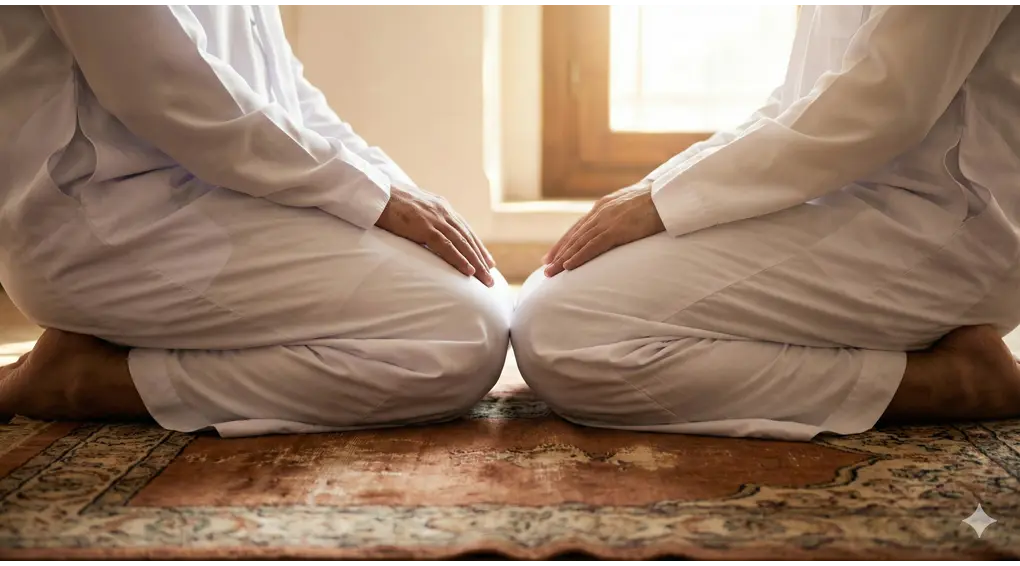
In the Talaqqi tradition (direct acquisition of knowledge) in Islam, body language plays as important a role as speech. A student’s etiquette before their teacher often determines the extent of futuḥ (openness of understanding) that Allah will bestow upon their heart.
One of the most magnificent portrayals of the etiquette of a study session is eternally recorded in Hadith Jibril. When the Angel Jibril ‘alaihis salam came in the form of a man to teach religion to the companions, he did not simply pose theological questions, but he demonstrated a body posture full of profound meaning.
Many contemporary seekers of knowledge overlook this detail. Why did Jibril have to sit so close that his knees touched the knees of the Messenger of Allah ﷺ? Is this merely a coincidence, or is there a Rabbani indication behind it?
Referring to the book Al-Fath Al-Mubin on pages 142-143, we will dissect the philosophical meaning and the legal precepts behind the sitting position of the Leader of the Angels.
The Jalsatul Muta’allim Position (Sitting Face-to-Face)
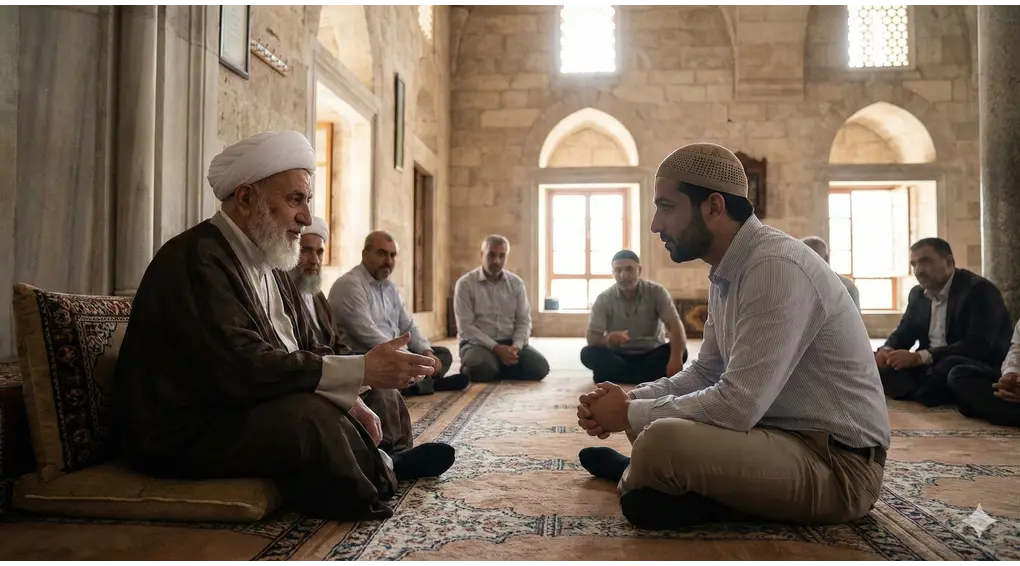
Umar bin Khattab radhiyallahu ‘anhu narrated the moment of Jibril’s arrival with a very visual description:
حتى جلس إلى النبي صلى الله عليه وسلم , فأسند ركبتيه إلى ركبتيه
(Until he sat before the Prophet ﷺ, and rested his knees against the Prophet’s knees).
Sheikh Ibn Hajar Al-Haitami provided a profound ta’liq (commentary) regarding this phrase. He explained that Gabriel’s sitting position was not a casual one, but rather the standard position for a true seeker of knowledge.
In the manuscript Al-Fath Al-Mubin it is mentioned:
صريح في أنه جلس بين يديه دون جانبه , وهي جلسة المتعلم
(This is clear evidence that he [Jibril] sat in front of him [in front of him], not beside him. And this is the sitting position of a student).
The first lesson in the etiquette of facing a teacher is direct confrontation (muwajahah). A student should sit directly facing their teacher, not to the side, let alone with their back turned, unless there is a legitimate Islamic excuse (ʿudhr sharʿī) or the conditions of the assembly do not allow it. Sitting face-to-face allows the student to capture not only the voice, but also facial expressions, lip movements, and the radiance (nur) from the teacher.
The Secret of Knees Touching: A Symbol of “Mubalaghah fil Qurb”
The most striking point is the act of Jibril resting (isnad) his knees against the knees of the Prophet Muhammad ﷺ. In Arab culture, as well as other cultures, this is a very intimate and bold act.
Sheikh Ibn Hajar explained the wisdom behind this “extreme” action:
لكنه بالغ في القرب حتى وضع كفيه على ما يأتي جريا على ما بينهما قبل من مزيد الود والأنس حين يلقي عليه الوحي
(However, he [Gabriel] exceeded [totality] in drawing near, until he placed both palms of his hands… this occurred based on the deep love and intimacy between them when Gabriel conveyed the revelation).
This act of kneeling implies two fundamental things in the Thariqah of seeking knowledge:
1. Total Seriousness (Jiddiyah)
Jibril wanted to show that in seeking knowledge, there should be no distance separating the student and the teacher, whether physical distance or distance of the heart. The touching of knees is a symbol of the removal of the veil of arrogance. A student must dissolve their ego and get as close as possible to the source of knowledge.
2. Reminders to Focus (Tanbih)
Sheikh Ibn Hajar added another wisdom of a psychological nature:
تنبيها على أنه ينبغي للسائل قوة النفس , وعدم فعل ما يمنع عنه كمال التلقي من نحو الالتهاء عما هو بصدده
(As a reminder that a questioner should possess strength of soul, and not do things that prevent the perfection of receiving knowledge, such as having their attention diverted from what they are pursuing).
That close and locked sitting position (knees touching knees) minimizes distractions (distraction). The student cannot turn their head to the right or left; their focus is locked solely on the teacher. This is a requirement for attaining kamal at-talaqqi (the perfection of receiving knowledge).
The Mystery of the Handprint on the Thigh
Besides the knees, Jibril also made specific hand gestures:
ووضع كفيه على فخذيه
(And he placed both of his palms on his thighs).
There is a difference of opinion among scholars regarding the dhamir (pronoun) “his thigh.” Does it refer to Gabriel’s thigh or the thigh of the Prophet?
Shaykh Ibn Hajar in Al-Fath Al-Mubin (p. 143) strengthens the opinion that the hand was placed on the Prophet ﷺ’s thigh, as clarified in the narration of An-Nasa’i.
فخذي النبي صلى الله عليه وسلم كما صرحت به رواية النسائي
(Meaning: Above both thighs of the Prophet ﷺ as affirmed in the narration of An-Nasa’i).
The act of placing a hand on a teacher’s thigh may seem impolite to the layman (su’ul adab). However, when aligned with the proper etiquette of a student asking a teacher, this specific gesture by Jibril is actually a form of Mubalaghah fil Iyqadz (maximum effort to build attention). He wanted to ensure that the Prophet ﷺ was truly ready to answer the series of difficult questions that would be posed.
However, Sheikh Ibn Hajar made an important note:
وللمسؤول ألا يعاتبه حينئذ وإن لم يسلك الأدب ظاهرا
(And for the one who is asked [a teacher], he should not disparage the questioner in that condition, even if outwardly he has not followed the path of proper etiquette).
In other words, if a student does something that appears presumptuous due to high enthusiasm in asking questions, a teacher should be understanding and not scold them. This attitude of forbearance is a true application of the Prophet’s teaching method in accommodating the spirit of a muta’allim who is overcome with a thirst for knowledge.
The Relevance of This Etiquette in the Modern Era
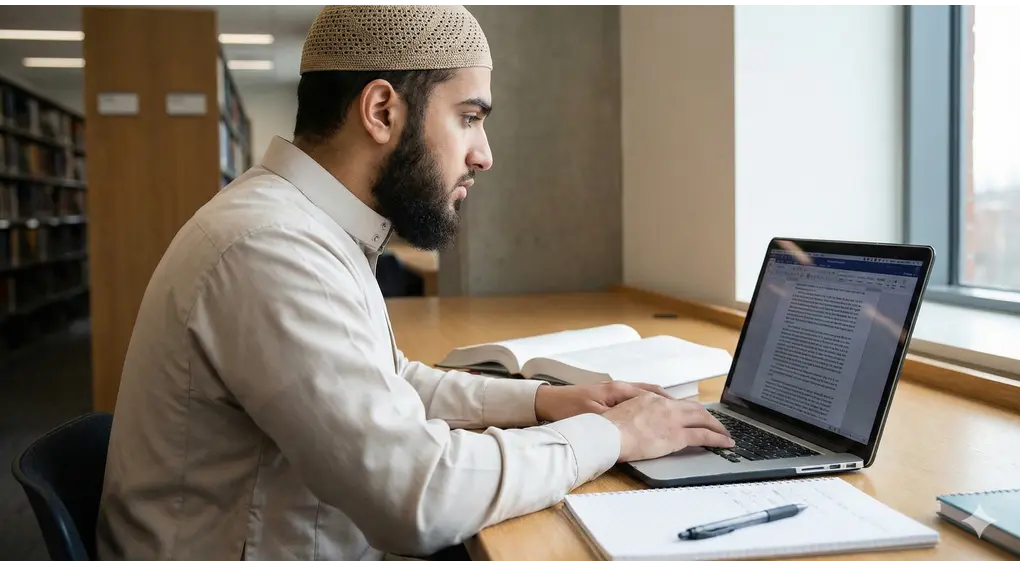
In an era where knowledge is often acquired through screens or streaming, the essence of this “knee to knee” connection begins to fade. We lose a strong spiritual ittishal (connectedness).
Although we may not be able to physically touch the knees of scholars today due to social norms and respect, the spirit of this etiquette must remain alive:
- Be Fully Present: When learning, turn off notifications, and focus your gaze and heart on the teacher.
- Approaching the Congregation: Do not sit in the back if the front rows are still empty. The closer your physical position, the greater the chance of maintaining focus.
- Building Spiritual Connection: Cultivate the feeling of wudd (love) for the teacher, as Jibril showed to the Prophet.
Summary Table: The Meaning of Gabriel’s Body Gestures




| Body Gestures | Outward Meaning | Inward Meaning (Sufism) |
| Sitting Face to Face (Baina Yadaihi) | The position of a student (Jalsatul Muta’allim) | Muwajahah: Facing the mirror of the heart to the source of light. |
| Pressing Knees Together (Isnadur Rukbatain) | Extreme physical closeness | Eliminating the distance of the ego, Kamal at-Talaqqi (perfect reception). |
| Hands on the Prophet’s Thighs | Awakening attention | Mazidul Wudd (Excessive affection), unifying the frequency of feeling. |
FAQ: Questions About the Etiquette of Facing a Teacher
Is it permissible for a student to hold their teacher’s thigh at this time?
It is not recommended to imitate this action literally (textual), as Jibril has a special status and the context was ta’miyah (disguise) as a naive Bedouin Arab. Our current etiquette is to maintain a polite distance while remaining close in attention. Shaykh Ibn Hajar mentioned that Jibril’s action might appear “outwardly impolite” (in lam yasluk al-adaba zhahiran), but it was excusable due to its purpose.
What is meant by “Strength of the Soul” in seeking knowledge?
Sheikh Ibn Hajar mentioned Quwwatun Nafs (the strength of the soul). This means that a seeker of knowledge must have a strong mentality, not be easily distracted, and be brave enough to ask questions to eliminate ignorance. The position of Jibril sitting reflects this firmness of the soul.
What if I study online?
You can still practice this principle by: sitting respectfully (not reclining) while listening to online lectures, observing the proper clothing etiquette for a seeker of knowledge (such as wearing neat and clean clothes, just like Gabriel in white robes), and focusing solely on the screen without opening other applications. This is a form of Ta’zim towards knowledge that transcends physical boundaries.
Conclusion
The event of Gabriel pressing his knee to the knee of the Prophet Muhammad ﷺ is not merely a meaningless historical detail. It is an eternal symbol of how knowledge should be approached: with sincerity, closeness, and love.
The etiquette of facing a teacher are not merely about normative politeness, but a spiritual strategy to open the door of the heart. Without closeness of the heart and seriousness of the body, knowledge will only stop at the ears without ever permeating the deepest depths of the heart (inner self).
And Allah knows best.
Reference
Aḥmad ibn Muḥammad Ibn Ḥajar al-Haytamī, al-Fatḥ al-Mubīn bi-Sharḥ al-Arbaʿīn, ed. Aḥmad Jāsim Muḥammad al-Muḥammad, Quṣayy Muḥammad Nūrūs al-Ḥallāq, and Anwar al-Shaykhī al-Dāghistānī, 1st ed. (Jeddah: Dār al-Minhāj, 2008), 142-143.


