

The Adhan is not merely a marker of time; it is a profound and majestic Islamic symbol. For a muezzin, understanding the correct recitation of the Adhan and Iqamah, alongside the jurisprudential rules governing them, is absolutely crucial. Many individuals still lack clarity on essential details, such as the proper pronunciation of the Takbir, the accurate Arabic text, or the specific distinctions of the Fajr call to prayer. To build a foundational understanding of this topic, you can read about the understanding of Adhan and Iqamah.
This article will comprehensively examine the texts of the Adhan and Iqamah, referencing the classical text Asna al-Matalib Sharh Raudh at-Talib by Shaykh al-Islam Zakariyya al-Ansari. We will explore the conditions for validity, the exact Arabic phrasing, and the English transliteration to assist those who are actively learning.
Conditions for a Valid Adhan and Muezzin Guidelines
Before delving into the specific texts and translations, it is necessary to understand the legal foundations. According to Asna al-Matalib and the broader definition of Fiqh, several primary conditions must be met for the Adhan to be considered legislatively valid:
- Entry of Prayer Time: The fundamental condition is that the prescribed time for prayer has begun. If the Adhan is called prematurely, it is invalid and must be repeated when the time enters (with a specific exception for the first Fajr Adhan, which is permitted before dawn in some valid opinions).
- Sequential Order (Tartib): The phrases must be recited in the correct, established order. If a muezzin mistakenly begins with Hayya ‘alas Salah before the Takbir, the Adhan is invalid and fails to fulfill the Sunnah.
- Continuity (Muwalat): The phrases must be connected without long interruptions. Extended pauses, falling asleep, or fainting invalidate the call. However, a brief pause to take a breath is perfectly acceptable.
- Audibility (Jahar) for the Congregation: When calling the Adhan in a mosque or for a communal prayer, raising the voice is mandatory. If the call is only audible to the muezzin himself (sirr), the communal obligation (Sunnah Kifayah) is not fulfilled.
Furthermore, the muezzin himself must be a Muslim and possess the age of discernment (Tamyiz).
The Text of the Adhan: Arabic, Transliteration, and Translation
Let us examine the core recitations. Generally, the Adhan commences with the Takbir. Below is the accurate text, complete with Arabic, international transliteration, and English translation.
1. The Standard Adhan (Dhuhr, Asr, Maghrib, Isha)
This sequence applies to the majority of the daily prayers. It is highly recommended to recite these phrases with Tartil (a slow, measured pace).
1. The Takbīr (Proclamation of Greatness)
Recited twice (each recitation contains two Allahu Akbars).
اللّهُ أَكْبَرُ , اللّهُ أَكْبَرُ
Allāhu akbar, Allāhu akbar.
Meaning: “Allah is the Greatest, Allah is the Greatest.”
2. The First Shahādah (Declaration of Faith in Allah)
Recited twice.
أَشْهَدُ أَنْ لَا إِلٰهَ إِلَّا اللّهُ
Ashhadu an lā ilāha illallāh.
Meaning: “I bear witness that there is no deity worthy of worship except Allah.”
3. The Second Shahādah (Declaration of Faith in the Messenger)
Recited twice.
أَشْهَدُ أَنَّ مُحَمَّدًا رَسُولُ اللّهِ
Ashhadu anna Muḥammadan rasūlullāh.
Meaning: “I bear witness that Muhammad is the Messenger of Allah.”
4. The Call to Prayer (Hay’alah 1)
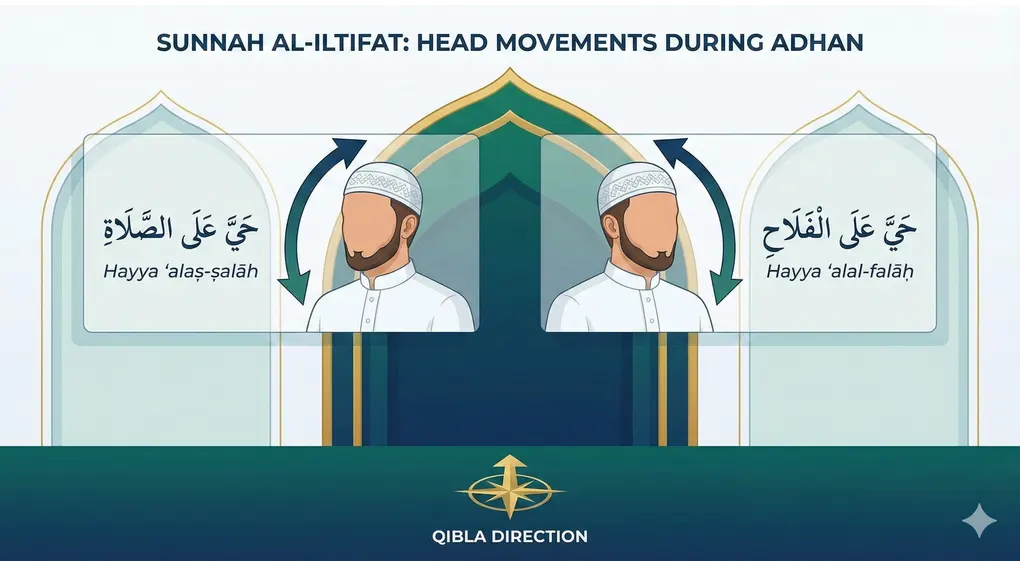
Recited twice. (It is Sunnah to turn the head to the right when reciting this).
حَيَّ عَلَى الصَّلَاةِ
Ḥayya ʿalash-ṣalāh.
Meaning: “Come to the prayer.”
5. The Call to Success (Hay’alah 2)
Recited twice. (It is Sunnah to turn the head to the left when reciting this).
حَيَّ عَلَى الْفَلَاحِ
Ḥayya ʿalal-falāḥ.
Meaning: “Come to success.”
6. The Concluding Takbīr
Recited once.
اللّهُ أَكْبَرُ , اللّهُ أَكْبَرُ
Allāhu akbar, Allāhu akbar.
Meaning: “Allah is the Greatest, Allah is the Greatest.”
7. The Final Declaration of Faith
Recited once.
لَا إِلٰهَ إِلَّا اللّهُ
Lā ilāha illallāh.
Meaning: “There is no deity worthy of worship except Allah.”
Important Note: Asna al-Matalib emphasizes the Sunnah of combining two Takbirs in a single breath (Allahu Akbar-Allahu Akbar). The letter ‘Ra’ on the first Akbar should ideally be pronounced with a sukun (silent) because the concept of Niyyah here is to pause (waqf), even while vocally connecting it to the next word.
2. The Fajr Adhan and Its Unique Addition
The Fajr prayer features a specific addition. After the phrase Hayya ‘alal falah and before the final Takbir, the muezzin is instructed to add the Tathwib.
الصَّلَاةُ خَيْرٌ مِنَ النَّوْمِ
Aṣ-ṣalātu khairum minan-naum.
Meaning: “Prayer is better than sleep.”
Recited twice.
This addition is exclusive to the Fajr Adhan. Jurisprudentially, this serves as a necessary spiritual alarm, as dawn is a time when people succumb to the heaviness of sleep.
The Correct Text of the Iqamah (Arabic & Transliteration)
Unlike the Adhan, which utilizes repetition (totaling 19 phrases when including Tarji’), the Iqamah is significantly more concise (11 phrases). The Iqamah signals that the meaning of Salah is about to be physically actualized by the congregation.
Here is the precise sequence:
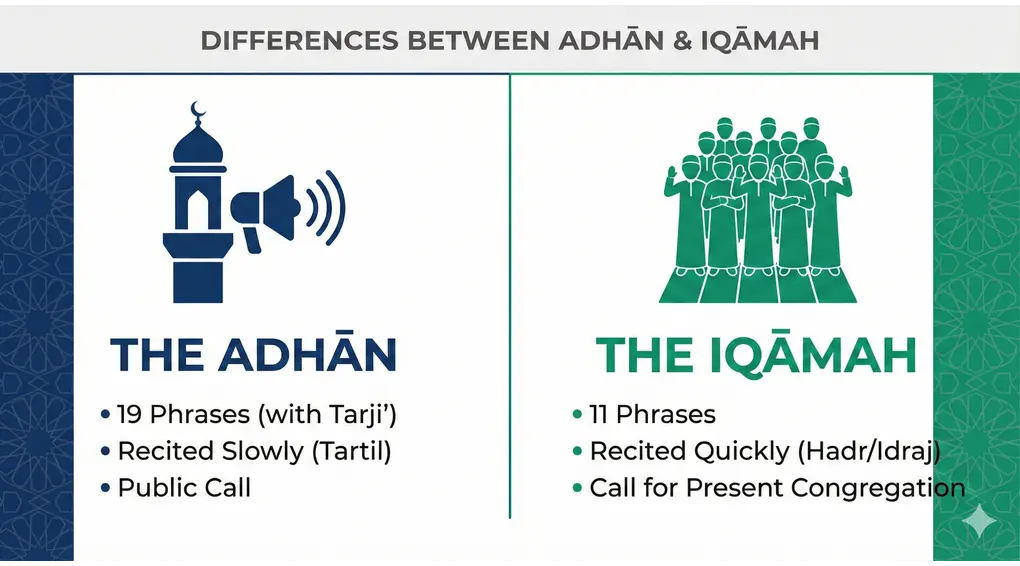
Unlike the Adhan, which consists of 19 phrases (including the Tarji’ or repetition of the Shahadah), the wording of the Iqamah is significantly more concise, totaling only 11 phrases.
Here is the authentic text of the Iqamah in its correct sequence, complete with the Arabic script, transliteration, and English translation:
1. The Takbīr (Proclamation of Greatness)
Recited twice.
اللَّهُ أَكْبَرُ، اللَّهُ أَكْبَرُ
Allāhu akbar, Allāhu akbar.
Meaning: “Allah is the Greatest, Allah is the Greatest.”
2. The First Shahādah (Declaration of Faith in Allah)
Recited once.
أَشْهَدُ أَنْ لَا إِلَهَ إِلَّا اللَّهُ
Asyhadu an lā ilāha illallāh.
Meaning: “I bear witness that there is no deity worthy of worship except Allah.”
3. The Second Shahādah (Declaration of Faith in the Messenger)
Recited once.
أَشْهَدُ أَنَّ مُحَمَّدًا رَسُولُ اللَّهِ
Asyhadu anna Muḥammadan rasūlullāh.
Meaning: “I bear witness that Muhammad is the Messenger of Allah.”
4. The Call to Prayer
Recited once.
حَيَّ عَلَى الصَّلَاةِ
Ḥayya ‘alaṣ-ṣalāh.
Meaning: “Come to the prayer.”
5. The Call to Success
Recited once.
حَيَّ عَلَى الْفَلَاحِ
Ḥayya ‘alal-falāḥ.
Meaning: “Come to success.”
6. The Declaration of Commencement (Iqāmah)
Recited twice. (This is the defining phrase announcing that the prayer is establishing immediately).
قَدْ قَامَتِ الصَّلَاةُ، قَدْ قَامَتِ الصَّلَاةُ
Qad qāmatiṣ-ṣalāh, qad qāmatiṣ-ṣalāh.
Meaning: “The prayer has been established, the prayer has been established.”
7. The Concluding Takbīr
Recited twice.
اللَّهُ أَكْبَرُ، اللَّهُ أَكْبَرُ
Allāhu akbar, Allāhu akbar.
Meaning: “Allah is the Greatest, Allah is the Greatest.”
8. The Final Declaration of Faith
Recited once.
لَا إِلَهَ إِلَّا اللَّهُ
Lā ilāha illallāh.
Meaning: “There is no deity worthy of worship except Allah.”
For the Iqamah, it is recommended to recite it with hadr or idraj (a swift, continuous pace), contrasting directly with the slow, deliberate pace of the Adhan.
Technical Details from Asna al-Matalib
To solidify our academic understanding of the Adhan and Iqamah, we must observe specific technical details outlined by Shafi’i scholars:
The Practice of Tarji’




A frequently overlooked Sunnah is the Tarji’. According to the Shafi’i school, the muezzin should first recite the two testimonies of faith softly (sirr) to himself, and immediately repeat them loudly (jahar). This practice ensures the Adhan maintains its full, intended length and spiritual weight.
The Muezzin’s Posture
When broadcasting the call, standing while facing the Qiblah is a core Sunnah. Additionally, there are specific head movements required:
- When reciting Hayya ‘alas salah, the face turns to the right.
- When reciting Hayya ‘alal falah, the face turns to the left.
The chest remains firmly facing the Qiblah; only the neck and face rotate. This applies universally across all prayer times.
Etiquette for the Listener
Listeners are highly encouraged to practice answering the Adhan according to the Sunnah by mirroring the muezzin’s words. However, upon hearing the two Hayya phrases, the listener substitutes them with the Hauqalah:
لَا حَوْلَ وَلَا قُوَّةَ إِلَّا بِاللّهِ
Lā ḥawla wa-lā quwwata illā billāh.
To maximize your spiritual reward, learn more about the virtues of the Hauqalah and the secret practices when hearing the Adhan.
Original Reference Text (Asna al-Matalib)
To validate these rulings, here is the direct excerpt from Asna al-Matalib Sharh Raudh at-Talib (Vol. 1, pp. 126-128):
فصل في صفة الأذان والإقامة. (وكلماته) مع كلماتها (مشهورة) وعدة كلماته بالترجيع تسع عشرة كلمة وعدة كلماتها إحدى عشرة … (ويستحب ترتيل الأذان) أي التأني فيه (وإدراج الإقامة) أي الإسراع بها … (و) يستحب (التثويب) بالمثلثة ويقال التثويب (في أذاني الصبح) وهو أن يقول بعد الحيعلتين الصلاة خير من النوم مرتين … (و) يستحب (القيام) في الأذان والإقامة … (ويجب الترتيب) في كل منهما للاتباع … (و) تجب (الموالاة) بين كلماته لأن تركها يخل بالإعلام1.
This text explicitly confirms the exact number of phrases (19 for the Adhan with Tarji’, 11 for the Iqamah), alongside the strict requirements of sequential order (Tartib) and continuity (Muwalat).
Conclusion
Mastering the precise recitation of the Adhan and Iqamah is the foundational step in perfecting congregational worship. Muezzins must remain vigilant regarding the Tathwib addition during Fajr, while listeners must actively engage with the prescribed responses. Remember, transliterations serve solely as a temporary bridge; the ultimate goal is to pronounce the Arabic text flawlessly in accordance with classical jurisprudence. May this detailed guide assist you in upholding this magnificent syiar of Islam.
Frequently Asked Questions (FAQ)
What is the main difference between the Adhan and Iqamah?
The Adhan is the public call to announce that the prayer time has entered, characterized by repeated phrases (19 in total) and a slow pace. The Iqamah is the internal call to signal that the congregation is immediately standing for prayer, featuring fewer repetitions (11 phrases) and a faster pace.
Why is the Fajr Adhan different from the others?
The Fajr Adhan includes the Tathwib (“As-salatu khairun minan nawm” / “Prayer is better than sleep”) after the call to success. This is a Sunnah specifically designed to wake people from their slumber for the dawn prayer.
What are the primary conditions for someone to be a muezzin?
A valid muezzin must be a Muslim and have reached the age of discernment (Tamyiz). Additionally, for communal prayers, he must possess a loud voice to ensure the congregation can hear the call clearly.
Reference
- Zakariyyā al-Anṣārī, Asnā al-Maṭālib fī Sharḥ Rawḍ al-Ṭālib, with a ḥāshiyah by Aḥmad al-Ramlī, ed. Muḥammad az-Zuhrī al-Ghamrāwī (Cairo: al-Maṭbaʿah al-Maymānīyah, 1313 AH; repr., Dār al-Kitāb al-Islāmī), vol. 1, pp. 126-128. ↩︎


