

You may have bathed, cleansed your entire body, and used abundant water, but is your purification legally valid according to Islamic law? There is a profound jurisprudential reality that many overlook: an individual can spend hours scrubbing their body until it is impeccably clean, yet their bath remains invalid if the primary foundational condition is not met. When a ritual bath is invalid, the state of major impurity (hadath akbar) remains unlifted, and consequently, any prayer performed in this state is legally void. The most fundamental element frequently missed in this process is formulating a valid ghusl intention.
In the classical literature of the Shafi’i school of jurisprudence (madhhab), scholars often use the terms “condition of validity” (syarat sah) and “pillar” (rukun or fardhu) interchangeably when discussing the mandatory ritual bath (ghusl). The core of this matter is absolute: there are two indispensable pillars required for ghusl to be deemed valid—the intention and the comprehensive washing of the body with water.
This academic treatise will thoroughly elucidate the guidelines for a valid ghusl intention to ensure your act of worship is accompanied by pure sincerity (Ikhlāṣ) and devoid of doubt.
This discussion covers five primary areas:
- The two foundational pillars of the mandatory ritual bath.
- The details of a valid intention, including three alternative formulations.
- Complete intention texts (Arabic, Transliteration, and Translation) for various causes of ghusl.
- The exact timing required for the intention.
- Flawed intentions that invalidate the ritual bath.
The primary reference for this exposition is the esteemed classical text, Asna al-Matalib Syarh Rawdh ath-Thalib (Vol. 1, pp. 68-69), authored by Shaykh al-Islam Zakariyya al-Anshari.
Only Two Pillars of Ghusl — No More, No Less
When an individual experiences any of the causes of the mandatory bath, they bear the legal obligation (taklif) to perform the major purification. To prevent obsessive doubts (waswas), it is crucial to understand that the pillars of ghusl janabah are remarkably concise: there are only two.
Pillar 1: The Intention (Al-Niyyah)

The intention is the definitive boundary separating a mundane habit (such as a regular shower to cool off) from a divine act of worship (Thaharah). Without a valid ghusl intention, washing the body holds no theological power to lift major impurity. To deepen your understanding of this spiritual prerequisite, you can explore the fundamental meaning of intention in Islamic jurisprudence. The great jurisprudential maxim states that all matters are judged by their underlying purposes (al-umuru bi maqashidiha).
The Messenger of Allah ﷺ stated in an authentic hadith narrated by Al-Bukhari and Muslim:
إِنَّمَا الْأَعْمَالُ بِالنِّيَّاتِ وَإِنَّمَا لِكُلِّ امْرِئٍ مَا نَوَى
“Actions are dependent upon their intentions, and every person will be rewarded according to what they have intended.”
Pillar 2: Flowing Water Over the Entire Body (Ta’miimul Badan)

Pure water must reach every single millimeter of the external body: from the tips of the hair to the surface of the skin, under the nails, and within the hidden folds of the body. Even a single strand of hair left dry is enough to nullify the validity of your ghusl.
This directive is derived directly from the words of Allah Ta’ala:
وَإِنْ كُنْتُمْ جُنُبًا فَاطَّهَّرُوا
“And if you are in a state of janabah, then purify yourselves.” (Surah Al-Ma’idah: 6)
Shaykh al-Islam Zakariyya al-Anshari affirms this boundary in Asna al-Matalib:
قوله: (تعميم البدن بالماء شعرا) وإن كثف (وبشرا)
“Encompassing the body with water, both the hair—even if it is thick—and the skin.”
For practical steps on achieving this thorough cleansing, refer to the complete guide to the ghusl procedure.
Summary Table: Mandatory vs. Sunnah Acts in Ghusl

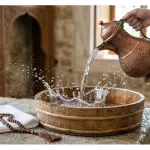

To protect your worship from errors, here is a categorical breakdown of ghusl actions:
| Mandatory (Absolute Pillars) | Sunnah (Recommended Enhancements) | Not Required (Do Not Force) |
|---|---|---|
| 1. A valid ghusl intention to lift major impurity. | Performing wudu (ablution) before the bath. | Untying braided hair (if water can penetrate without doing so). |
| 2. Flowing water over all hair, skin, and nails. | Rinsing the mouth (Madhmadah) & sniffing water (Istinsyaq). | Washing the inside of the eyelids. |
| Washing bodily folds (e.g., navel). | Washing the right side of the body first. | Scrubbing the skin with excessive physical force. |
Three Alternative Formulations for a Valid Ghusl Intention
Seeking the correct formulation for a valid ghusl intention often confuses the public, as various guidebooks present different phrasings. Which one is the most legitimate?
According to Asna al-Matalib, there are three formulations recognized as completely valid in the Shafi’i school. Shaykh al-Islam documents these forms as follows:
قوله: (نية رفع الجنابة) أو نية رفع الحدث عن جميع البدن… (أو) نية رفع (الحدث مطلقا)
Alternative 1: The Most Specific
نَوَيْتُ رَفْعَ الْجَنَابَةِ
Nawaitu raf’al-janābah “I intend to lift the state of janabah.”
This phrasing is used specifically for impurity caused by intercourse or the emission of seminal fluid. It directly identifies the cause of the impurity and immediately lifts the status of janabah.
Alternative 2: Explicitly Addressing the Whole Body
نَوَيْتُ رَفْعَ الْحَدَثِ عَنْ جَمِيعِ الْبَدَنِ
Nawaitu raf’al-hadatsi ‘an jamī’il badan “I intend to lift the state of impurity from the entire body.”
While mentioned in classical texts, this is often omitted in modern summaries because its essence is captured by the third alternative. It is excellent for those who need their heart to be highly focused.
Alternative 3: The Safest and Most Comprehensive
نَوَيْتُ رَفْعَ الْحَدَثِ
Nawaitu raf’al-hadath “I intend to lift the state of impurity.”
Scholars recommend this as the “safest” absolute intention. By simply intending to lift “the impurity” (al-hadath), it comprehensively covers the major impurity currently experienced. However, adding the word “major” (al-akbar) is considered superior for mental affirmation.
Complete Intention Formulations Based on the Cause
To facilitate memorization, here are the specific Arabic and transliterated intentions for various causes of major impurity.
Intention for Janabah (Intercourse or Emission)
نَوَيْتُ الْغُسْلَ لِرَفْعِ الْحَدَثِ الْأَكْبَرِ فَرْضًا لِلَّهِ تَعَالَى
Transliteration: Nawaitul ghusla liraf’il hadatsil akbari fardhan lillāhi ta’ālā. Meaning: “I intend to perform ghusl to lift the major impurity, obligatory for the sake of Allah Ta’ala.”
Intention for Post-Menstruation (Haid)
This intention is strictly for women whose menstrual bleeding has completely ceased.
نَوَيْتُ الْغُسْلَ لِرَفْعِ حَدَثِ الْحَيْضِ فَرْضًا لِلَّهِ تَعَالَى
Transliteration: Nawaitul ghusla liraf’i hadatsil haidhi fardhan lillāhi ta’ālā. Meaning: “I intend to perform ghusl to lift the impurity of menstruation, obligatory for the sake of Allah Ta’ala.” For detailed guidance regarding women’s purification, consult the rules on how to properly perform ghusl after menstruation.
Intention for Postpartum Bleeding (Nifas)
نَوَيْتُ الْغُسْلَ لِرَفْعِ حَدَثِ النِّفَاسِ فَرْضًا لِلَّهِ تَعَالَى
Transliteration: Nawaitul ghusla liraf’i hadatsin-nifāsi fardhan lillāhi ta’ālā. Meaning: “I intend to perform ghusl to lift the impurity of postpartum bleeding, obligatory for the sake of Allah Ta’ala.”
Shaykh al-Islam Zakariyya al-Anshari highlights a unique jurisprudential rule: the intentions for menstruation and postpartum bleeding are interchangeable because their biological and legal essences are aligned. To understand the exact parameters of when this obligation begins, read about when women must start their purification after bleeding.
Intention for Childbirth (Wiladah)
If a mother gives birth without accompanying postpartum blood, the birth itself necessitates a bath:
نَوَيْتُ الْغُسْلَ لِرَفْعِ حَدَثِ الْوِلَادَةِ فَرْضًا لِلَّهِ تَعَالَى
Transliteration: Nawaitul ghusla liraf’i hadatsil wilādati fardhan lillāhi ta’ālā.
Crucial Timings: When Must the Intention Be Made?
Questions regarding when exactly to formulate the intention often trigger anxiety. Misplacing the timing of your intention invalidates the entire ritual bath.
The Fundamental Rule: Conjunction with the First Obligatory Act
A valid ghusl intention must be present in the heart at the exact moment water touches any part of the body that falls under the obligatory washing. This is termed qarnun-niyyah bil ‘amal (joining the intention with the action).
ويجب قرنها بأول فرض وهو أول ما يغسل من البدن
“And it is obligatory to join it (the intention) with the first obligatory act, which is the first part of the body to be washed.”
Ideal Chronology of the Intention
- Before Ghusl (Sunnah): You formulate the intention in your heart while performing the preliminary wudu or cleaning private parts. This is a preparatory, recommended intention.
- First Pour of Water (MANDATORY): This is the critical juncture. The intention must actively exist in your mind when water first strikes your head or shoulders.
- Flowing the Water: Once the intention is validly established at the first pour, you are not required to actively concentrate on it for the remainder of the shower, provided you do not deliberately cancel it.
Intentions That Invalidate Your Ghusl
Ignorance can lead to fatal errors in worship. Beware of these specific scenarios:
| Condition of the Intention | State of Mind | Legal Status of Ghusl | Shafi’i Fiqh Explanation |
|---|---|---|---|
| Intending to lift minor impurity only | Deliberate | INVALID | Considered mocking the religion (Tala’ub). |
| Intending to lift minor impurity only | By Mistake (Ghalat) | Partially Valid | Major impurity is lifted ONLY from the wudu limbs (excluding the head). |
| Intending a Sunnah bath (e.g., Friday bath) while in Janabah | Deliberate | Obligation Not Met | A mandatory act cannot be fulfilled by a merely sunnah intention. |
Contemporary Practical Questions
Modern daily life frequently generates specific inquiries regarding purification.
1. Is it permissible to combine two intentions in one bath?
Yes. If a woman experiences janabah followed by menstruation, she carries two major impurities. She can perform one bath intending to lift both simultaneously. However, combining a mandatory bath (like janabah) and a sunnah bath (like the Friday bath) requires specific knowledge to ensure the fardhu is prioritized.
2. Is wudu required before ghusl?
Wudu is a highly recommended sunnah (muakkadah), not an absolute requirement. Your ghusl is entirely valid without it. Further details on these recommended acts can be studied in the sunnah actions of ghusl. Additionally, maintaining proper behavior post-bath is vital; you can learn more through the etiquette of the Shafi’i ghusl.
3. Does condom usage affect the intention?
Yes, seminal emission or penetration, regardless of barriers, triggers the need for a major bath. The intention remains the same. Read the specific rulings regarding ghusl after using a physical barrier for precise boundaries.
Frequently Asked Questions (FAQ)
What are the absolute conditions for a valid ghusl in Islam?
There are strictly two: (1) A valid ghusl intention to lift major impurity, formulated in the heart, and (2) ensuring pure water reaches every part of the external skin and hair.
Must the ghusl intention be spoken aloud?
No. The seat of the intention is the heart (Al-Qashd). Verbalizing it is merely a sunnah practice to help the heart focus, but a completely silent bath with a firm internal intention is 100% valid.
What should I do if I remember I forgot my intention after finishing my shower?
The bath is legally invalid. In Islamic jurisprudence, there is no compromise for omitting a foundational pillar. You must repeat the entire ghusl from the beginning, ensuring the intention is present when the water first touches your body.
Conclusion & Practical Checklist
Ghusl is a divine medium of purification to attain the pleasure of Allah. Its perfection relies heavily on a sincere, valid ghusl intention and the meticulous flowing of water. To ensure your purification is accepted, use this mental checklist before bathing:
- [ ] Intention is Present: My heart acknowledges the intention exactly as the first water touches my body.
- [ ] Correct Formulation: I am using a specific intention (e.g., for menstruation) or the safe, comprehensive absolute intention.
- [ ] No Physical Barriers: My skin and nails are free from waterproof cosmetics, glue, or polish.
- [ ] Water Reaches Everywhere: All hair roots and external skin are thoroughly wet.
- [ ] Folds are Washed: I have actively washed my navel, underarms, and between my toes.
Through the study of classical orthodox texts, may we be protected from negligence (futur), and may every drop of purifying water cleanse us outwardly and inwardly, elevating our spiritual station (Maqām) before Allah. Wallahu a’lam bish-shawab (And Allah knows best).
Reference
Zakariyā al-Anṣārī, Asnā al-Maṭālib fī Sharḥ Rawḍ al-Ṭālib, with ḥāsyiyah by Aḥmad al-Ramlī, edited by Muḥammad az-Zuhrī al-Ghamrāwī (Cairo: al-Maṭbaʿah al-Maymānīyah, 1313 H; repr. Dār al-Kitāb al-Islāmī), juz 1, p. 68-69.


