
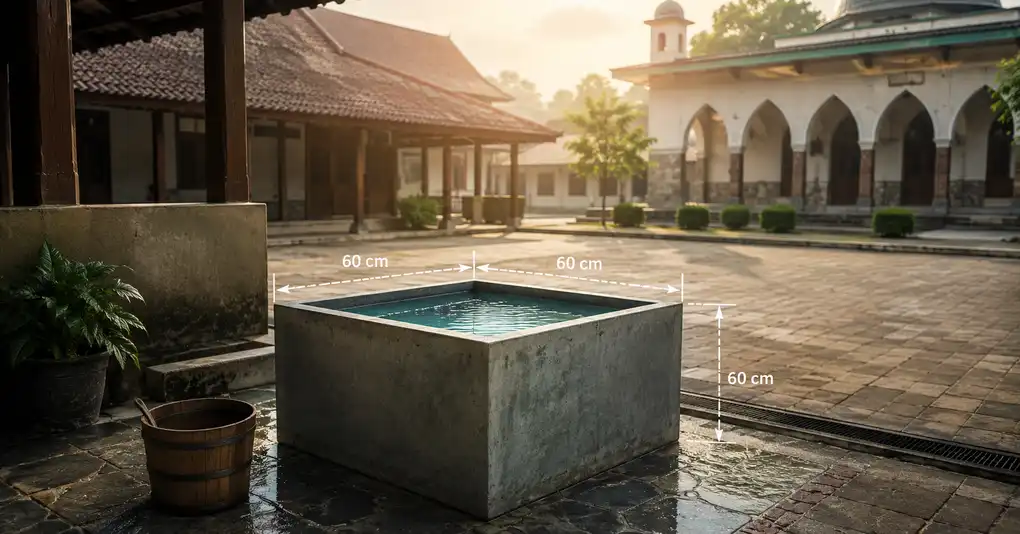
Two qullahs are a key threshold in Shafi’i fiqh when unqualified water comes into contact with impurity. The rule distinguishes a small amount of water from a large amount of water, especially in still water held in a bucket, tank, pool, or reservoir.
Two qullahs are not the minimum amount required for valid ablution or ritual bathing. A small amount of water may still be used for purification as long as it is pure and purifying, has not contacted impurity, and remains unqualified water. The two-qullah threshold becomes decisive when impurity reaches the water.
This article addresses unqualified water that contacts impurity. It does not attempt a full comparison of the four Sunni schools, nor does it cover every ruling on used water or running water.
For the wider framework, see types of water for purification.
What Are Two Qullahs?
In the jurisprudence of water, a qullah is a classical measure of volume. Its dual form is qullatān or qullatayn. In Shafi’i fiqh, two qullahs mark the legal threshold between small and large quantities of water when impurity contacts the water.
Imam Zakariyya al-Anshari wrote:
«وَهُمَا أَيْ الْقُلَّتَانِ خَمْسُمِائَةِ رَطْلٍ بَغْدَادِيٍّ تَقْرِيبًا»
Meaning: “The two qullahs are approximately five hundred Baghdad ratls.”[1]
The word “approximately” matters. The book uses Baghdad ratls and cubits, not liters. A modern figure in liters is therefore a practical conversion rather than the original wording of the text.
Why Does the Two-Qullah Threshold Matter?
The threshold answers several different questions:
- Is the water still pure?
- Is it still valid for ritual purification?
- Did impurity actually reach the water?
- If it did, is the water below two qullahs or at least two qullahs?
- If it is a large amount, did impurity change its color, taste, or smell?
The rule does not require every household supply of water to be large. Water in a dipper, bucket, or small container may be used for purification before impurity reaches it.
The discussion also concerns unqualified water. Imam Zakariyya al-Anshari explained:
«وَهُوَ الْعَارِي عَنْ إِضَافَةٍ لَازِمَةٍ»
Meaning: “It is that which is free from an inseparable qualifying addition.”[2]
Tea, coffee, syrup, soap solution, and other liquids that no longer retain the unqualified name “water” are not counted through the two-qullah rule for purification.
The Hadith of Two Qullahs and the Small–Large Water Threshold
The book cites the hadith:
«إِذَا بَلَغَ الْمَاءُ قُلَّتَيْنِ بِقِلَالِ هَجَرٍ لَمْ يُنَجِّسْهُ شَيْءٌ»
Meaning: “When water reaches two qullahs by the qullahs of Hajar, nothing renders it impure.”[1]
In Shafi’i fiqh, this hadith is read together with its detailed rulings. Reaching two qullahs does not make water immune from impurity. If impurity changes the water, the water is still impure.
When Is Water Considered Small?
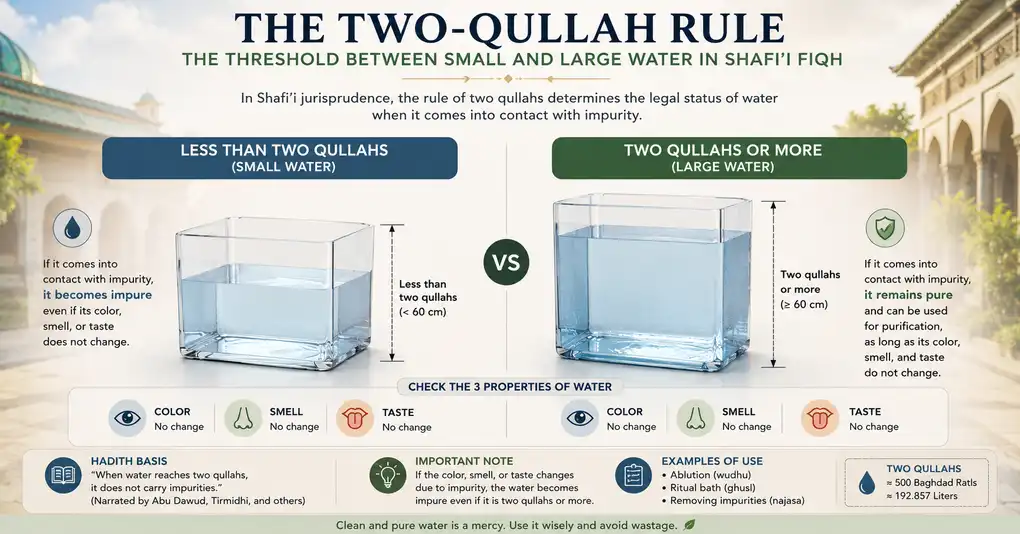
Still water below two qullahs is treated as small water. In the Shafi’i school, small water that meets an impurity which has legal effect in causing contamination becomes impure even when its color, taste, and smell have not changed.
«وَدُونَهُمَا أَيْ وَدُونَ الْقُلَّتَيْنِ مِنْ مَاءٍ قَلِيلٍ فَيَنْجُسُ … بِمُلَاقَاةِ نَجَاسَةٍ مُؤَثِّرَةٍ وَإِنْ لَمْ يَتَغَيَّرْ»
Meaning: “Water below the two qullahs is small water. It becomes impure through contact with an impurity that has effect in causing contamination, even if it does not change.”[1]
A simple example is a small bucket of water that is known to have received an impure substance. It should no longer be used for ablution, ritual bathing, or removing impurity.
Its small volume alone does not make it impure. Before impurity reaches it, small water can still be used for purification.
What If You Are Unsure of the Volume?
Doubt alone does not establish impurity. The text states:
«لَا إِنْ شَكَّ فِي قِلَّتِهِ أَيْ الْمَاءِ فَلَا يَنْجُسُ بِذَلِكَ لِأَنَّ الْأَصْلَ طَهَارَتُهُ»
Meaning: “Not so when one doubts the smallness of the water; it does not become impure because of that, since its original ruling is purity.”[1]
Do not judge water impure merely from anxiety. Measure the container where possible, and first establish that impurity actually entered it.
The text also mentions an exception for trace impurity too small for the eye to perceive, such as impurity carried by a fly:
«وَلَا يَنْجُسُ الْمَاءُ … بِمَا لَا يُدْرِكُهُ طَرْفٌ … كَنَجِسٍ يَحْمِلُهُ ذُبَابٌ»
Meaning: “Water is not rendered impure by that which the eye cannot perceive, such as impurity carried by a fly.”[3]
This exception should not be stretched to cover impurity that is visible or known to have entered the water.
When Is Water Considered Large?



Water is treated as large water once it reaches two qullahs or more. If impurity enters a large amount of water, its ruling does not change immediately. The key question is whether impurity has changed its color, taste, or smell.
«وَلَا يَنْجُسُ الْمَاءُ الْكَثِيرُ إِلَّا بِتَغَيُّرٍ وَإِنْ قَلَّ بِـنَجَاسَةٍ مُلَاقِيَةٍ»
Meaning: “Large water is not rendered impure except through a change, even if the change is slight, caused by impurity that comes into contact with it.”[4]
Therefore, water at or above two qullahs remains pure and purifying when the impurity does not change one of its properties. If its color, taste, or smell changes because of impurity, it becomes mutanajjis water.
For the detailed topic, see water that has come into contact with impurity.
Unqualified Water, Used Water, and Impure Water
These terms should not be treated as interchangeable.
| Term | Brief explanation | Status for ritual purification |
|---|---|---|
| Unqualified water | Water that still carries the basic name “water” | Pure and purifying |
| Used water (musta’mal) | A small amount of water used for an obligatory act of removing ritual impurity or filth | Pure, but not reused for purification in that specific ruling |
| Impure water (mutanajjis) | Water that contacts impurity and is legally judged impure | Not used for ritual purification |
Concerning used water, the book says:
«لَا قَلِيلٌ مُسْتَعْمَلٌ فِي فَرْضٍ مِنْ رَفْعِ حَدَثٍ أَوْ خَبَثٍ فَلَا يُطَهِّرُ شَيْئًا»
Meaning: “A small amount of water used in an obligatory act of lifting ritual impurity or removing filth does not purify anything.”[5]
The two-qullah rule belongs to the discussion of impure water. It does not replace every condition for valid ablution or ritual bathing.
Measuring Two Qullahs: Baghdad Ratls, Liters, and Tank Dimensions
The Original Measurement in the Book
The original measure is approximately 500 Baghdad ratls. The book also gives physical dimensions for containers.
«وَمِقْدَارُ الْقُلَّتَيْنِ بِالْمِسَاحَةِ فِي الْمُرَبَّعِ ذِرَاعٌ وَرُبْعٌ طُولًا وَعَرْضًا وَعُمْقًا، وَفِي الْمُدَوَّرِ ذِرَاعَانِ طُولًا وَذِرَاعٌ عَرْضًا»
Meaning: “The measure of two qullahs by dimensions, in a square container, is one and a quarter cubits in length, width, and depth. In a round container, it is two cubits in depth and one cubit in width.”[1]
The text explains that “length” for a round container means depth, while “width” is the distance between the two sides of the container, or its diameter.
How Many Liters Are Two Qullahs?
The book does not state liters. For household measurement, 216 liters can be used as a practical approximation when the following conversion is chosen:
- one cubit = 48 cm;
- one and a quarter cubits = 60 cm;
- inner square tank dimensions = 60 cm × 60 cm × 60 cm;
- volume = 216,000 cm³ = 216 liters.
Because classical cubits and ratls can be converted by more than one technical route, 216 liters should be presented as a practical estimate, not as the only possible figure in every conversion method.
A Square Water Tank
| Inner part of the tank | Practical estimate |
|---|---|
| Length | 60 cm |
| Width | 60 cm |
| Depth | 60 cm |
| Volume | ±216 liters |
Use the inner dimensions. Concrete, tiles, and external wall thickness do not count as water volume.
A Round Tank or Well
According to the explanation in the book, a round container is measured through:
- diameter: one human cubit;
- depth: two carpenter’s cubits, which the text explains as approximately one and a quarter human cubits for each carpenter’s cubit.[1]
When one human cubit is set at 48 cm for a practical conversion, this yields a diameter of about 48 cm and a depth of about 120 cm. The resulting cylinder is close to 217 liters.
Do not use the square-tank formula for a round tank. A square tank uses length × width × height; a round tank uses the area of a circle × depth.
How Many Dippers or Buckets Make Two Qullahs?
There is no single dipper count for every home. Dippers and buckets have different capacities.
Use this formula:
216 liters ÷ container capacity = estimated number of dippers or buckets.
For example:
- 1.5-liter dipper: about 144 dippers.
- 2-liter dipper: about 108 dippers.
- 10-liter bucket: about 22 buckets.
- 20-liter bucket: about 11 buckets.
These figures only help estimate volume. Measuring the inside of a tank is usually easier and more accurate.
The Ruling on Two Qullahs or More When Impurity Enters
Large Water Does Not Become Impure Immediately
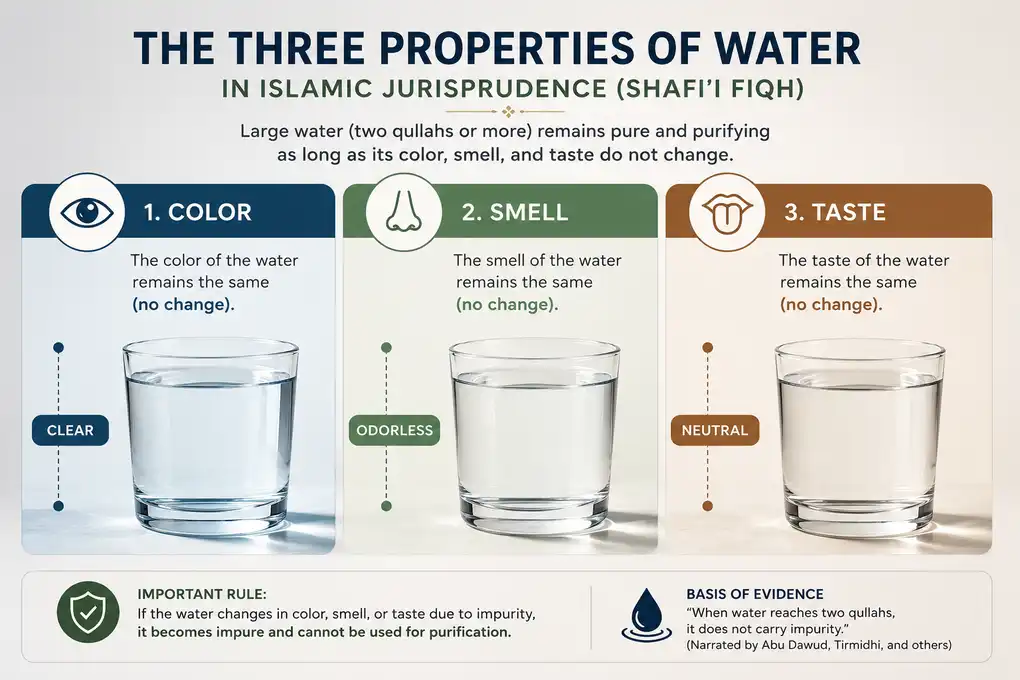
Water at or above two qullahs is not rendered impure merely because impurity falls into it. What matters is whether impurity changes one of its properties.
The three properties are:
- color;
- taste;
- smell.
If one of them changes because of impurity, the water cannot be used for purification. If none changes, large water remains pure and purifying.
The book distinguishes this from change caused by a carcass merely near the water rather than one actually contacting it.[4]
When Only Part of the Water Changes
The book states:
«وَإِنْ تَغَيَّرَ بَعْضُهُ فَالْمُتَغَيِّرُ كَنَجَاسَةٍ جَامِدَةٍ … وَالْبَاقِي إِنْ قَلَّ فَنَجِسٌ وَإِلَّا فَطَاهِرٌ»
Meaning: “If part of it changes, the changed part is treated like solid impurity. The remainder, if small, is impure; otherwise it is pure.”[4]
With a large tank, do not take water from the changed area or from the area directly mixed with the impurity. The unchanged remainder must also be assessed: does it still reach two qullahs or not?
A Tank Exactly at Two Qullahs When Water Is Drawn
The book discusses a specific case: water exactly at two qullahs with a solid impurity in it. If a bucket of water is drawn without taking the impurity, the inside of the bucket remains pure because that water separated before the remaining water dropped below two qullahs.
«فَبَاطِنُ الدَّلْوِ طَاهِرٌ»
Meaning: “The inside of the bucket is pure.”[4]
This is a narrow technical case. It should not be used to ignore the condition of the container, the location of the impurity, or the remaining water volume.
Restoring Small Water That Has Become Impure
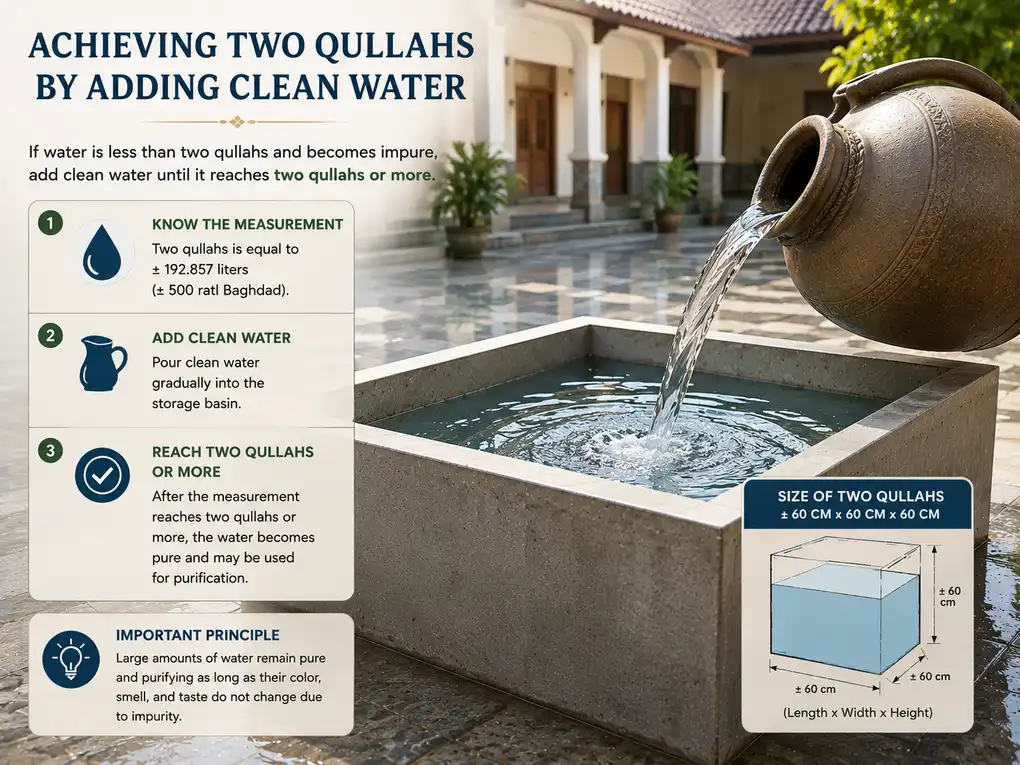
Small water that has become impure may become pure again through increasing the water (takthīr al-mā’) until it reaches two qullahs with water.
«لَوْ كَثُرَ قَلِيلٌ … مُتَنَجِّسٌ لَمْ يَطْهُرْ حَتَّى يَبْلُغَهُمَا بِالْمَاءِ … لَا إِنْ بَلَغَهُمَا بِمَائِعٍ آخَرَ فَلَا يَطْهُرُ»
Meaning: “When a small amount of impure water is increased, it does not become pure until it reaches the two qullahs with water. If it reaches the two qullahs with another liquid, it does not become pure.”[6]
Use this order:
- Establish that impurity actually entered the water.
- Add water, not tea, coffee, liquid soap, fragrance, or another liquid.
- Ensure the total reaches two qullahs or more.
- Ensure that any color, taste, or smell caused by impurity has disappeared.
- Do not use the water for purification until these conditions are met.
When the change disappears on its own, through water added to it, or because the water decreases, the text judges it pure.[4] A change that has merely been covered by another substance is not enough.
«لَا إِنْ زَالَ حِسًّا بِعَيْنٍ سَاتِرَةٍ لَهُ كَالتُّرَابِ وَالْجِصِّ فَلَا يَطْهُرُ»
Meaning: “Not if the apparent change disappears only through something that covers it, such as soil or gypsum; then it does not become pure.”[6]
Fragrance that covers an odor, or another substance that covers a color, is therefore not a method for restoring impure water.
Combining Water
The book states:
«وَيَكْفِي الضَّمُّ وَإِنْ لَمْ يَمْتَزِجْ صَافٍ بِكَدِرٍ»
Meaning: “Joining them is sufficient, even if clear water has not fully mixed with turbid water.”[6]
There are further details when two containers are connected by a barrier or a narrow opening. For ordinary household practice, use one sufficiently large reservoir, add water until the required amount is reached, and verify that the effects of impurity have actually disappeared.
A Small Well That Becomes Impure
For a small well that becomes impure, the book says:
«إِذْ قَلَّ مَاءُ الْبِئْرِ وَتَنَجَّسَ لَمْ يَطْهُرْ بِالنَّزْحِ بَلْ بِالتَّكْثِيرِ»
Meaning: “When the water of a well is small and becomes impure, it is not restored by drawing water out, but by increasing it.”[6]
Drawing water alone does not always solve the problem. In complex real cases, especially where there is a carcass, waste, or a strong change in the water, the water and the source of impurity need careful assessment.
For changes caused by pure substances, see the ruling on changed water.
Ablution, Ritual Bathing, and Running Water
Ablution with a Small Amount of Water
A small amount of clean water can still be used for ablution. Two qullahs are not the minimum amount for ablution. The issue arises when small still water is known to have contacted impurity.
With a small container, use a dipper or pouring vessel so that the source water remains protected. Water that has separated from the body after use has its own ruling as used water.[5]
Ritual Bathing from a Tank
A tank below two qullahs is not automatically prohibited for ritual bathing. The way the water is used has further rulings, particularly when a person immerses in a small amount of water.
For a straightforward practical method, draw water with a dipper and pour it over the whole body while fulfilling the intention and essential requirements of ritual bathing. This does not replace a dedicated guide to ritual bathing.
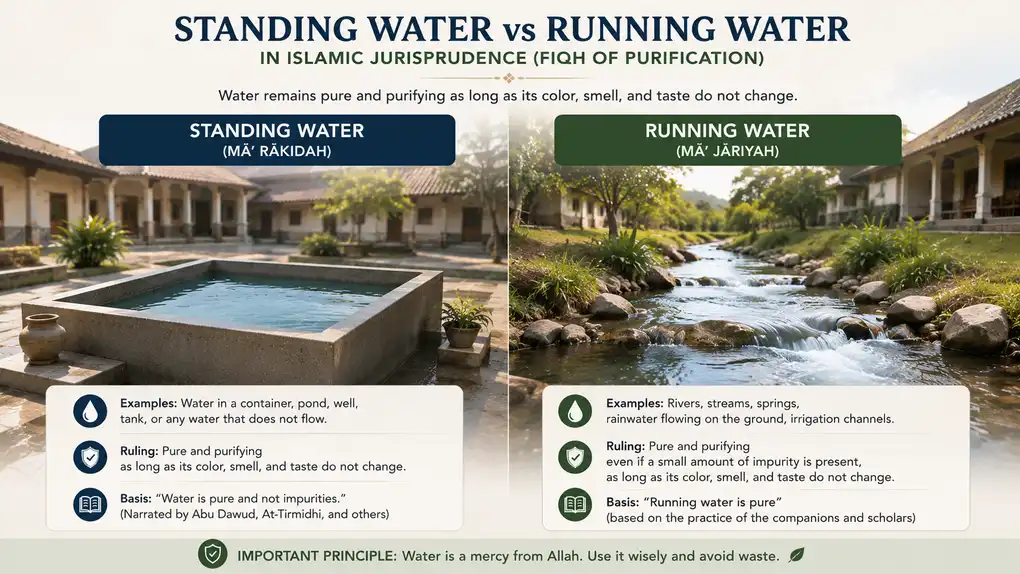
Running Water
River water, ditches, and channels are not treated exactly like still water. The book explains:
«الْمَاءُ الْجَارِي … مُتَفَاصِلٌ جَرَيَانُهُ حُكْمًا وَإِنِ اتَّصَلَتْ حِسًّا»
Meaning: “Running water is legally regarded as divided in its flow, even though it appears physically connected.”[6]
The text also explains that the flow before and after the location of impurity is originally pure, while the flow in which the impurity lies receives the ruling of still water.[6]
Do not treat an entire river as one stationary tank. For the detailed topic, see the ruling on running water in purification.
Checklist Before Using Water for Purification
- Confirm that it remains unqualified water.
- Establish whether impurity is actually present from clear evidence.
- For still water, measure whether it is below or at least two qullahs.
- When large water contacts impurity, check its color, taste, and smell.
- Do not restore impure water by adding liquids other than water.
- Do not treat a change as gone if it has only been covered by fragrance, soil, or another substance.
- Distinguish certainty from doubt so that anxiety does not create unnecessary rulings.
FAQ: Two Qullahs
What is the two-qullah measurement in classical fiqh?
The original standard is approximately 500 Baghdad ratls. For a square container, it is one and a quarter cubits in length, width, and depth. For a round container, it is two cubits in depth and one cubit in diameter.[1]
The figure of 216 liters is a modern estimate derived from choosing 60 cm × 60 cm × 60 cm. It is not a liter figure stated directly in the book.
Does water below two qullahs become impure as soon as it contacts impurity?
In the Shafi’i school’s detailed ruling, still water below two qullahs becomes impure when it truly contacts an impurity that has legal effect in causing contamination, even when its properties have not changed.[1]
Do not establish impurity from a mere suspicion. The original ruling of water is purity until a clear basis changes it.
Does water at two qullahs remain pure when impurity falls into it?
Yes, as long as the impurity does not change the water’s color, taste, or smell. If one of these properties changes because of impurity, the water becomes impure.[4]
What if I am not sure whether the water reaches two qullahs?
Doubt about whether the water is small does not itself make the water impure. Measure the container where possible, then retain the original ruling of purity until clear evidence establishes otherwise.[1]
Can a small amount of impure water become pure again?
Yes. Add water until it reaches two qullahs or more, and make sure any change caused by impurity has disappeared. Adding another liquid does not meet this rule.[6]
Footnotes
Reference
Zakariyā al-Anṣārī, Asnā al-Maṭālib fī Sharḥ Rawḍ al-Ṭālib, with a ḥāshiyah by Aḥmad al-Ramlī, edited by Muḥammad az-Zuhrī al-Ghamrāwī (Cairo: al-Maṭbaʿah al-Maymānīyah, 1313 AH; repr. Dār al-Kitāb al-Islāmī), vol. 1, pp. 5-17.


