

Did you know that performing Tayammum on a wall or a car window might be invalid if the surface is too clean? Or did you know that Tayammum does not actually “lift” the state of ritual impurity (Hadath)?
Many of us are forced to perform Tayammum in emergency situations, yet unknowingly make mistakes in practicing its pillars and intentions. Do not let your obligatory prayers (Fard) be rendered invalid due to a lack of understanding. Let us thoroughly explore the rules of Tayammum based on the book Asna al-Matalib by Shaykh al-Islam Zakariyya al-Ansari!
What is Tayammum? Linguistic and Terminological Definitions
In Islamic teachings, Allah constantly provides ease for His servants in their worship. When water is unavailable or impossible to use, the Shari’ah provides a solution in the form of Tayammum.
For those who wish to study this concept from the basics, understanding the complete definition of Tayammum within Islamic jurisprudence (Fiqh) is essential. Generally speaking, Tayammum is a form of concession (Rukhsah) that allows one to continue performing obligatory worship. Below are the specific definitions detailed by the scholars.
Tayammum Linguistically (Al-Qasd / To Intend)
From the perspective of the Arabic language, the fundamental meaning of Tayammum is to intend or to aim at something (al-qasd). Imam Zakariyya al-Ansari explains this in the book Asna al-Matalib:
قوله: (كتاب التيمم) هو لغة القصد يقال: تيممت فلانا ويممته وتأممته وأممته أي قصدته ومنه قوله تعالى {ولا تيمموا الخبيث منه تنفقون} [البقرة: 267]
Translation/Explanation: “(The Book of Tayammum) linguistically means to intend (al-qasd). It is said in Arabic: tayammamtu fulanan, yammamtu, ta’ammamtu, or ammamtu, all of which mean ‘I intended him’ (headed towards him). From this meaning also comes the word of Allah the Exalted: {And do not aim/intend at the defective therefrom, spending [from it]} (QS. Al-Baqarah: 267).”[1]
This linguistic meaning aligns with the intention of a servant who consciously aims to find earth or dust to fulfill the command of Allah.
Tayammum According to Shafi’i Terminology
In the lens of the Shari’ah, Tayammum is purification using dust. Fiqh scholars provide a very clear boundary regarding what must be done for this act of worship to be valid.
وشرعا إيصال التراب إلى الوجه واليدين بشرائط مخصوصة
Translation/Explanation: “In Shari’ah terminology, (Tayammum) is conveying dust to the face and both hands with specific conditions.”[2]
From the definition above, it is clear that Tayammum utilizes pure dust as its primary instrument of purification. Unlike Wudu, which involves washing multiple body parts, Tayammum is strictly limited to only two body parts: the face and both hands.
The Evidences for Tayammum in the Quran and Sunnah
The legislation of Tayammum has a very strong legal foundation. This basis is derived directly from the revelation of Allah and the sayings of Prophet Muhammad ﷺ. If you trace various textual evidences regarding purification, Tayammum occupies the primary position as a Rukhsah (concession).
Quranic Evidence — QS. An-Nisa: 43 & Al-Maidah: 6




Several verses regarding Tayammum were revealed in response to the difficulties faced by the companions when they ran out of water during a journey. The primary foundation is the word of Allah:
قال تعالى {وإن كنتم مرضى أو على سفر} [النساء: 43] إلى قوله {فتيمموا صعيدا طيبا} [النساء: 43]
Translation/Explanation: “{And if you are ill or on a journey} [QS. An-Nisa: 43] up to His word {then seek clean earth and wipe over your faces and hands with it} [QS. An-Nisa: 43].”[3]
The phrase sha’idan thayyiban in the verse is interpreted by Shafi’i scholars as pure, clean dust. This verse acts as an absolute decree that the states of illness and travel are strong reasons that permit Tayammum.
Hadith Evidence — “The entire earth has been made a mosque for us…”
In addition to the Quran, this foundation is reinforced by the Messenger of Allah ﷺ through a Sahih Hadith that explains the function of the earth for Muslims.
«جعلت لنا الأرض كلها مسجدا وتربتها طهورا»
Translation/Explanation: “The entire earth has been made a mosque (a place of prostration) for us, and its soil (dust) a means of purification.”[4]
This Hadith, narrated by Imam Muslim, provides a guarantee that wherever a Muslim may be, the earth of Allah always provides the facilities for purification.
Tayammum as a Concession (Rukhsah): The Privilege of the Ummah of the Prophet ﷺ
Tayammum is a special gift. The nations of the previous prophets did not have this legislation; if they could not find water, they were not permitted to use dust.
وخصت به هذه الأمة وهو رخصة وقيل: عزيمة وأجمعوا على أنه مختص بالوجه واليدين
Translation/Explanation: “And this (legislation) is specialized for this Ummah, it is a Rukhsah (concession). Some argue it is an Azimah (original obligation). And the scholars have reached a consensus (Ijma’) that Tayammum is specifically for the face and both hands.”[5]
This demonstrates how profoundly Islamic law protects its followers so that they never sever their establishment of prayer, no matter how difficult their conditions may be.
The Position of Tayammum in the System of Taharah
For anyone studying the complete guide to Taharah (purification), Tayammum holds a unique position. It is not an ordinary form of physical cleaning, but rather purely an act of worship (ta’abbudi).
Tayammum as a Substitute for Wudu and Ghusl
Tayammum fully functions as a means of purification besides water. Its status becomes an alternative substitute (badal) when Wudu (ablution) (for minor ritual impurity) or the obligatory ritual bath (Ghusl) (for major ritual impurity) cannot be performed due to valid Shari’ah obstacles.
Important Note — Tayammum Permits (Istibahah), It Does Not Lift Impurity
There is one crucial maxim in Shafi’i Fiqh that distinguishes between water and dust. Unlike water, whose nature is to “lift/remove” ritual impurity (raf’ul hadath), the nature of dust in Tayammum is solely to “permit” acts of worship (istibahah).
This means the status of ritual impurity on a person actually remains, but the Shari’ah grants permission for them to pray. Therefore, the intention (Niyyah) in Tayammum must not be worded as “nawaitu raf’al hadath” (I intend to lift ritual impurity), rather it must strictly be to “permit the prayer” (istibahatash shalah).
7 Causes that Permit Tayammum (Asbab al-‘Ajz)
In Islamic law, a person cannot arbitrarily substitute water with dust. There are very strict conditions for when Tayammum is permissible. These rules center on one main principle: the inability to use water (al-‘ajz ‘an isti’mal al-ma’).
So, when is Tayammum allowed? Shaykh al-Islam Zakariyya al-Ansari explains these causes in Asna al-Matalib:
وأسباب العجز سبعة هذا ما في الأصل والمصنف كالمنهاج جعل المبيح السبعة نظرا للظاهر فقال (وهو سبعة: الأول فقد الماء)
Translation/Explanation: “The causes of inability (to use water) are seven; this is what is mentioned in the original book (ar-Rawd). The author (Ibn al-Muqri), similar to the book al-Minhaj, listed the permitting causes for Tayammum as seven by looking at the apparent circumstances. He stated: ‘(The causes are seven: the first is the absence of water)…'”[6]
In summary, the various conditions that permit Tayammum include: the absence of water, fear of harm if water is used, needing water for drinking, up to severe illness. All of these are recognized obstacles to using water and are tolerated by the Shari’ah.
Cause 1 — Absence of Water & The Obligation to Search for It First
The foremost reason is the lack of water (faqdul ma’). However, a person cannot simply slap their hands onto the dust right away.
One has an obligation to search for water first (talab) once the prayer time has entered. Only if one is absolutely certain that water truly does not exist in the area does the obligation to search drop.
قوله: (الأول فقد الماء فإن تيقن فقده) فلا طلب عليه (وإلا) وجب عليه طلبه في الوقت
Translation/Explanation: “(The first is the absence of water. If he is certain of its absence) then there is no obligation upon him to search. (If he is in doubt or suspects there is water) then he must search for it when the time of prayer enters.”[7]
What is the standard method of searching? The scholars detail it as follows:
قوله: (فيطلبه بأن) يفتش رحله (ثم ينظر حواليه) إن كان في مستو… (إلى حد تسمع استغاثته) مع ما الرفقة فيه… (بحد القرب وهو ما يقصده الرفقة للاحتطاب ونحوه)
Translation/Explanation: “(He is obliged to search for water by) checking his belongings, (then looking around him) if he is on flat land… (up to the distance where a cry for help can be heard / hadd al-ghawth) taking into account the noise of the caravan… and (if he is certain there is water, he must search up to hadd al-qurb, which is the distance usually traveled by the caravan to gather firewood and the like).”[8]
In the context of modern travel, such as performing Tayammum on an airplane, car, train, or bus, ensure you check the water supply in the vehicle’s lavatory first or ask the crew about the availability of water before resorting to Tayammum.
Cause 2 — Illness (Tayammum due to Sickness/Wounds)
Another major cause is a disease that prevents the skin from coming into contact with water. This concession is given so that an illness does not worsen and healing is not delayed.
قوله: (الثاني الخوف فإن خاف) على محترم من نفس أو عضو أو مال… (تيمم) لفقده شرعا، ولقوله تعالى {وما جعل عليكم في الدين من حرج} [الحج: 78]
Translation/Explanation: “(The second cause is fear. If he fears) for something respected, be it a life, an organ, or wealth… (then he performs Tayammum) because water is considered legally absent, and based on the word of Allah the Exalted: {And He has not placed upon you in the religion any difficulty} [QS. Al-Hajj: 78].”[9]
The same rule applies as a substitute for a major bath for a sick person. If pouring water has a strong potential to damage organ functions, threaten life safety, or slow down healing, Tayammum becomes a valid prescribed solution.
Validity Conditions for Tayammum
Before performing Tayammum, several crucial elements must be met. Just like the validity conditions of Wudu, the conditions for Tayammum are strictly detailed.
The Prayer Time Must Have Entered
Tayammum is Taharah Darurah (purification out of necessity). Therefore, an absolute prerequisite before Tayammum is that one must wait for the obligatory worship time to begin. You cannot perform Tayammum for a Fard prayer unless the time for that specific prayer has arrived.
Removing Physical Impurities (Najasah) First
A person must remove any physical impurity (najasah) from their body before applying dust. Imam Zakariyya al-Ansari asserts this in Asna al-Matalib:
قوله: (ويجب غسلها) أي النجاسة (قبل التيمم) فلو تيمم قبل إزالتها لم يجز
Translation/Explanation: “(And it is obligatory to wash it) meaning the najasah (before performing Tayammum). So if he performs Tayammum before removing it, his Tayammum is invalid.”[10]
Because Tayammum aims to “permit” (istibahah) the prayer, the prayer will not be valid if najasah is still attached to the body.
Conditions for the Dust/Earth
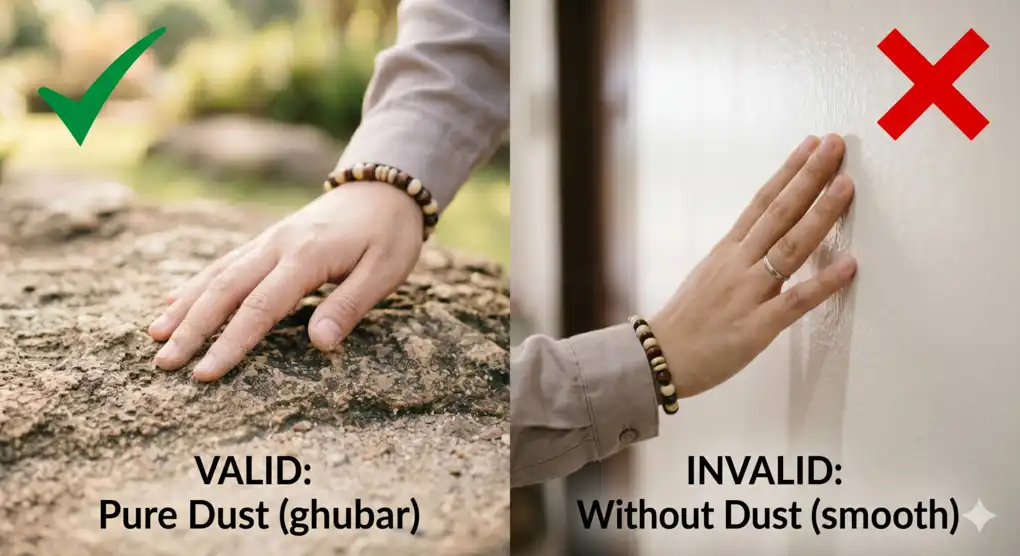
The dust medium used for Tayammum has its own rules:
- Must be Pure, Unmixed, and Unused (Ghair Musta’mal) The dust must be unmixed with other pure substances like flour or crushed chalk. Moreover, the pure earth must not have been previously used to wipe a face or hands in a prior Tayammum.
(الأول التراب الطاهر الخالص غير المستعمل… فيصح ببطحاء وسبخ… لا برمل بلا غبار)
Translation/Explanation: “(The first pillar is pure, unmixed dust that has not been used… thus it is valid to perform Tayammum with bathha’ (fine gravelly soil) and sabkh (salty marsh soil)… but it is invalid with sand that has no flying dust).”[11] An absolute condition for valid dust is that it must contain ghubar (fine dust particles that can stick to the hands and become airborne). - Valid in All Soil Colors As long as the medium is purely an element of earth, its color does not matter (red, white, black, or yellowish).
- Dust on Walls, Car Windows, or Airplane Cabins The practice of Tayammum on walls, bus windows, or airplanes is fundamentally permissible, but strictly on one condition: there must be fine dust sticking to the surface. If the wall is entirely clean and smooth, Tayammum without visible dust is legally invalid. Ensure there are dust particles (ghubar) on your palms before intending Tayammum.
The Pillars of Tayammum
In the Shafi’i school, there are minor differences in enumerating the pillars (Arkan), though the essence remains the same. The book ar-Rawd mentions 7 pillars. Imam al-Nawawi mentions 6 in al-Majmu’, and shortens it to 5 in al-Minhaj. Here is the breakdown of the 7 pillars according to Imam Zakariyya al-Ansari:
- Pure and Unmixed Dust: (الركن الأول التراب الطاهر الخالص) — “The first pillar is pure and unmixed dust.”[12]
- Transferring the Dust (An-Naql):
- Intending it (Al-Qasd): (الثاني والثالث النقل والقصد) — “The second and third pillars are transferring the dust (to the body parts) and consciously intending it.”[13] You must intentionally move the dust with your own hands.
- The Intention (Niyyah): (الرابع النية) — “The fourth pillar is the intention.”[14]
- Wiping the Face: (الخامس مسح الوجه) — “The fifth pillar is wiping the face.”[15] Dust must cover the entire facial area.
- Wiping Both Hands up to the Elbows: (السادس مسح اليدين) — “The sixth pillar is wiping both hands (up to the elbows).”[16] The boundary is identical to Wudu.
- Order (Tartib): (السابع الترتيب) — “The seventh pillar is to follow the proper sequence.”[17] Face first, then hands.
The Correct Niyyah (Intention) for Tayammum
The Shari’ah views dust as an emergency purification medium. Hence, you cannot intend to lift the state of ritual impurity (raf’al hadath).
قوله: (الركن الرابع النية)… (ولا تجزيه إلا نية الاستباحة) لمفتقر إلى طهر
Translation/Explanation: “(The fourth pillar is the intention)… (and nothing suffices him except the intention of istibahah / permitting the prayer) for someone in dire need of purification.”[18]
The standard Niyyah wording:
نَوَيْتُ التَّيَمُّمَ لِاسْتِبَاحَةِ الصَّلَاةِ فَرْضًا لِلَّهِ تَعَالَى
Nawaitut tayammuma li-istibahatish shalaati fardhan lillahi ta’alaa. “I intend to perform Tayammum to permit the obligatory prayer, for the sake of Allah the Exalted.”
Important Rules Regarding Niyyah:
- Timing: The intention must be present in the heart exactly when your hands strike the earth. It must be maintained until the dust is transferred and wiped onto the face (qarn an-niyyah bin-naql).
- Wudu vs. Ghusl Substitute: Whether Tayammum is substituting Wudu or substituting Ghusl (such as for Janabah/Menstruation), the intention remains exactly the same: to permit the prayer. You do not need to rub dust all over your body for a Ghusl substitute; the face and hands suffice.
Step-by-Step Procedure of Tayammum
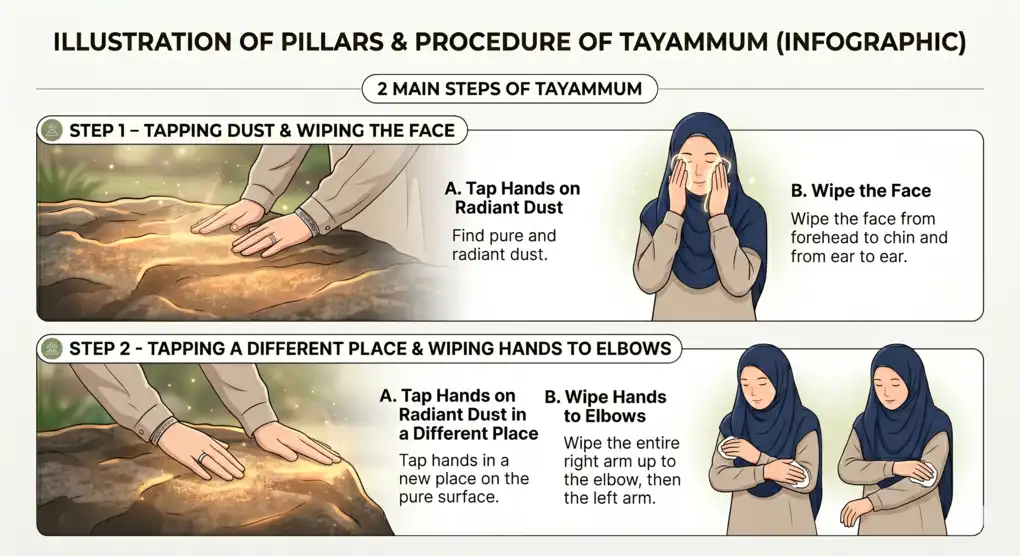
- Step 1 — The First Strike: Place both palms simultaneously onto the pure dust. As your skin touches the dust, you must formulate the intention in your heart to permit the prayer (istibahatish shalah).
- Step 2 — Wiping the Entire Face: Lift your hands and wipe them over your entire face (from the hairline to the chin, and from ear to ear).[19]
- Step 3 — The Second Strike: Strike both palms again onto a different spot of dust. This new dust is specifically for the hands.
- Step 4 — Wiping the Hands to the Elbows: Wipe the dust from the fingertips of your right hand all the way past the elbow (ma’a al-mirfaqain), then do the same for the left arm.
Mandatory Rule: You must transfer dust twice (an-naql marratain). One strike is exclusively for the face, and the second strike is exclusively for the hands.
Sunnahs of Tayammum
- Saying Bismillah.
- Starting from the top of the face downwards.
- Preferring the right hand over the left.
- Intertwining the fingers (Takhleel).
- Blowing off excess dust from the hands if it is too thick before wiping.
Timing and Repetition Rules
Invalid Before Prayer Time Enters
Tayammum is strictly forbidden before the time for an obligatory prayer has begun.
قوله: (والتيمم للصلاة) ولو نافلة (قبل وقتها باطل)
Translation/Explanation: “(And Tayammum for a prayer), even for a Sunnah prayer, (if performed before its time enters, is null and void).”[20]
One Tayammum for One Obligatory (Fard) Prayer
Can you combine two obligatory prayers with one Tayammum? The Shafi’i Fiqh firmly states no.
قوله: (الثاني أنه لا يستبيح بالتيمم) للفريضة (إلا فريضة واحدة مكتوبة أو طوافا أو منذورة)
Translation/Explanation: “(The second rule is that one cannot be permitted by a single Tayammum) for obligatory acts (except for exactly one prescribed Fard prayer, or one obligatory Tawaf, or one vowed act of worship).”[21]
However, one Tayammum allows you to pray unlimited Sunnah prayers, provided it has not been invalidated.
Ruling on Repeating/Making Up (Qada) the Prayer
Do you have to repeat the prayer once you find water?
- General Excuse (Traveler / Scarce Water Area): No Qada required.
قوله: (الثالث القضاء ولا قضاء) على المصلي (مع العذر العام)
Translation/Explanation: “(The third rule is regarding Qada. And there is no obligation of Qada) upon the one praying with Tayammum (due to a general excuse).”[22] - Resident & Sinful Traveler: Qada is required. If a resident in an area that usually has water performs Tayammum, they must repeat the prayer once water is available, as this is a rare excuse (nadir).[23]
- Wiping over Bandages (Jabirah): If a bandage was placed while the person was in a state of purity, no Qada is needed, unless the bandage is on the limbs of Tayammum (face and hands); then they must repeat the prayer as a precaution.[24]
Things That Invalidate Tayammum
You can check the list of things that invalidate Wudu (like passing gas, deep sleep, touching private parts), as they automatically invalidate Tayammum. However, there are specific invalidators exclusively for Tayammum:
- Seeing or Presuming Water (Ru’yat al-Ma’ / Tawahhum al-Ma’): Seeing water before starting the prayer completely invalidates Tayammum.
قوله: (ويبطل التيمم برؤية الماء الناقص) عن تكميل الطهر وبتوهمه
Translation/Explanation: “(And Tayammum is invalidated by seeing water, even if it is less) than the amount needed to complete purification, and it is also invalidated by merely presuming (the presence of water).”[25] (Note: If you are already in the middle of a Fard prayer when you see water, you may complete it). - Apostasy (Riddah): Leaving Islam immediately nullifies Tayammum.[26]
FAQ Around Tayammum
Does Tayammum lift ritual impurity like Wudu?
No. It only serves as an emergency permission to perform worship (istibahah), while the state of impurity technically remains. “Because Wudu truly lifts the ritual impurity… while Tayammum does not lift it, it merely permits the prayer.”[27]
How many strikes are required?
Exactly two strikes (an-naql marratain): One strike for the face, and a second fresh strike for the hands.
Can one Tayammum be used for multiple Fard prayers?
No. One Tayammum is strictly for one obligatory prayer.[28] But it can be used for unlimited Sunnah prayers.
Is Tayammum broken by seeing water?
Yes. Seeing water or strongly presuming its presence before the opening Takbir invalidates Tayammum instantly.[29]
Is Tayammum on a wall or vehicle window valid?
Only if there is tangible dust (ghubar) on the surface that can stick to the hands.[30] If it is totally clean and smooth, the Tayammum is invalid.
In conclusion, the Sunnah supplication after Tayammum is exactly the same as the supplication after Wudu. It is recommended to face the Qiblah, recite the two testimonies of faith (Shahadah), and pray that Allah ﷺ makes us among His servants who continuously repent and purify themselves.
Footnotes
Reference
Zakariyā al-Anṣārī, Asnā al-Maṭālib fī Sharḥ Rawḍ al-Ṭālib, with marginalia by Aḥmad al-Ramlī, edited by Muḥammad az-Zuhrī al-Ghamrāwī (Cairo: al-Maṭbaʿah al-Maymānīyah, 1313 AH; repr. Dār al-Kitāb al-Islāmī), vol. 1, pp. 29-93.


