The Complete Guide to Sunnah Prayers Shafi’i Fiqh: Procedures, Virtues, and Evidence

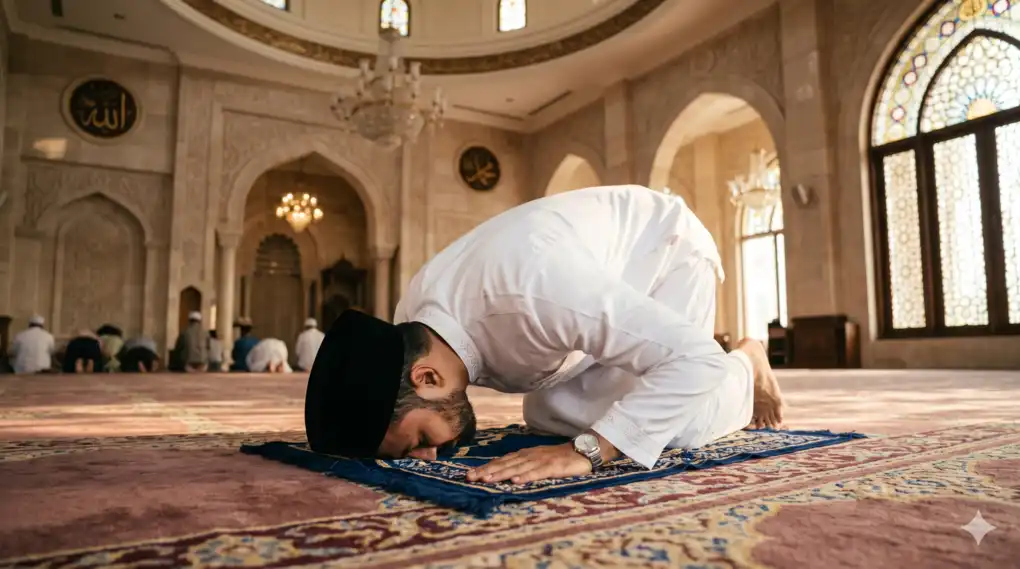
A Muslim in deep prostration during sunnah prayer in a grand mosque at dawn, symbolizing the essence of voluntary worship.

Prayer (salah) holds the highest and most noble position among physical acts of worship in Islamic law, second only to the declaration of faith (Shahadah). For Muslims seeking to perfect their daily worship, understanding the Sunnah prayers Shafi’i fiqh is profoundly essential. In the extensive literature of Shafi’i jurisprudence, specifically as expounded by Shaykh al-Islam … Read more

The Complete Guide to Salatul Hajah (Prayer of Need): Intention, Dua & Steps

A lone Muslim kneeling in supplication on a prayer mat inside a mosque courtyard during the last third of the night, representing Salatul Hajah.

Every human being undoubtedly experiences desires and faces challenges. Sometimes, physical effort alone feels insufficient without knocking on the doors of heaven. This is where the profound significance of Salatul Hajah (The Prayer of Need) comes into play. For those seeking a way out of a difficult situation or yearning for a specific blessing, this … Read more

Rules of I’tikaf Nadhr & Consecutive Worship (Shafi’i Fiqh)

A Muslim man sitting devoutly in a sunlit mosque, symbolizing the solemn intention of making an i'tikaf nadhr (vow).

The worship of i’tikaf is originally established as a highly recommended sunnah (sunnah muakkadah). However, a servant of Allah may oblige this act upon themselves through a verbal commitment, known in Islamic jurisprudence as nadhr (a vow). Once an individual makes a vow to perform i’tikaf, its legal status shifts from sunnah to obligatory (wajib). … Read more

Rules of I’tikaf for Women in Shafi’i Fiqh: A Complete Guide

A documentary-style photograph of Muslim women in hijabs quietly reading the Quran and praying behind wooden mashrabiya screens in the dedicated women's section of a historic mosque.

The worship of I’tikaf is a magnificent spiritual practice for drawing closer to Allah the Exalted. The opportunity to attain its immense virtues is not limited to men; it is also widely open to Muslim women. Nevertheless, the Islamic Shari’ah establishes specific guidelines (dhawabith) and rules for women to preserve their honor and ensure the … Read more

Invalidators of I’tikaf and Rulings on Leaving the Mosque (Shafi’i Fiqh)

A contemplative photograph from inside a dimly lit mosque showing the silhouette of a Muslim man standing near an arched window looking outside, symbolizing the spiritual boundary of I'tikaf.

Performing the worship of I’tikaf demands purity of intention and physical discipline. A person who has anchored their heart to stay in the mosque must recognize the boundaries of the Sharia so that their worship is not ruined halfway through. In the literature of Shafi’i Fiqh, scholars have formulated strict guidelines regarding the invalidators of … Read more

The Etiquette of I’tikaf: Permissible & Disliked Acts in the Mosque

A Muslim man sitting silently in a grand mosque, demonstrating the proper etiquette of I'tikaf through quiet contemplation and reverence.

The presence of a servant inside the mosque with the intention of drawing closer to Allah the Exalted demands the observance of a noble etiquette of I’tikaf (adab). Nevertheless, the pure (hanif) Islamic Shari’ah does not strip humans of their natural disposition. There are various permissible (mubah) activities allowed by the jurists (fuqaha), as well … Read more

The Valid Conditions and 4 Pillars of I’tikaf in Shafi’i Fiqh

A Muslim man sitting alone reading the Quran inside a grand mosque, representing the primary pillar of I'tikaf (al-mukth).

The worship of I’tikaf (spiritual retreat) is a noble practice that brings a servant closer to their Creator. For a Muslim seeking to attain the virtues of performing I’tikaf, understanding its precise rules is an absolute necessity. The validity of this worship relies heavily on fulfilling the valid conditions of I’tikaf and its pillars as … Read more

The Complete Guide to the Fiqh of I’tikaf (Shafi’i School)

A Muslim man is reverently reading the Quran while observing i'tikaf in the mosque at dawn.

The worship of I’tikaf is one of the great symbols of Islam; it is a profound manifestation of a servant isolating themselves to draw closer to Allah ﷻ. Within the Islamic scholarly tradition, specifically the rules and procedures of I’tikaf according to the Shafi’i school of thought, this act of worship possesses highly precise pillars … Read more

Does Kissing While Fasting Invalidate the Fast? The Islamic Ruling

A Muslim husband respectfully kisses his wife's forehead as a permissible (mubah) form of affection during the Ramadan fast.

The worship of fasting (al-ṣawm) is a medium for disciplining the soul and body. Its main essence lies in al-imsāk, namely refraining from everything that invalidates the fast from dawn until sunset. For individuals who are married, the challenge of fasting extends to the manner of physical interaction with their lawful spouses during the day. … Read more

The Complete Guide to the Iftitah Prayer: Rulings & Authentic Variations

A Muslim standing humbly with folded hands, showing the correct posture while reciting the Iftitah prayer during Salah.

For a Muslim, prayer is the most intimate moment to communicate with the Creator. One of the sunnahs that we often practice at the beginning of prayer is reciting the iftitah. However, did you know that there are many variations of the iftitah recitation taught by the Prophet? In fact, under certain conditions, we are … Read more