
Sun-heated water, known in classical fiqh as mushammas water or al-mā’ al-mushammas, is water warmed by direct sunlight. In Shafi‘i fiqh, it remains pure and purifying, but its use on the body can be disliked when specific conditions are present.
This topic often raises practical questions. Can sun-heated water be used for wudu? Is water in a rooftop tank considered mushammas? Does sunlight make water impure?
The answer is clear: sun-heated water is not najis merely because it was exposed to sunlight. Wudu and ghusl with it are valid as long as the water remains mutlaq water and has not become impure. The disliked ruling relates to certain uses and certain conditions, not to impurity.
What Is Mushammas Water?
The word mushammas is related to shams, meaning the sun. In fiqh, mushammas water refers to water whose state changes because of the sun’s heat.
Imam Zakariyya al-Anshari gives this boundary:
وضابط المشمس على ما أفهمه كلام الماوردي أن ينتقل بالشمس عن حالته إلى حالة أخرى حتى لو كان شديد البرودة فخف برده بالشمس فمتشمس
“The limit of mushammas water, as understood from al-Mawardi’s wording, is that it moves from one state to another because of the sun. Even if it was extremely cold and its coldness lessened because of the sun, it is considered mushammas.”[1]
So the issue is not simply that water is placed outdoors. What matters is that the sun affects the water’s state. For example, water that was cool and then becomes warm because of direct sunlight may fall under this discussion.
This is why people often describe it as water exposed to sunlight, water left in the sun, or water heated by the sun.
Mushammas Water Is Different from Fire-Heated Water
Mushammas water is heated by the sun. Water heated by fire, a stove, an electric heater, or a water dispenser is not called mushammas in this ruling.
In Asna al-Mathalib, water heated by fire is treated differently from water heated by the sun. The reason behind the disliked ruling on mushammas water does not apply in the same way to water heated by fire.[2]
The practical distinction is:
- Heated by sunlight: it may enter the ruling of mushammas water.
- Heated by fire or a device: it is not mushammas water.
- Naturally warm because of room temperature: it is not automatically mushammas water.
This distinction matters because rulings in fiqh often depend on the cause behind the ruling.
Why Is Mushammas Water Discussed under Purification?
Mushammas water belongs to the chapter of purification because it concerns water used for wudu, ghusl, and removing impurity.
In Asna al-Mathalib, Imam Zakariyya al-Anshari states:
المطهر للحدث … والخبث … الماء المطلق
“What purifies from ritual impurity and physical impurity is mutlaq water.”[3]
This means that as long as mushammas water remains mutlaq water, it can still be used for purification. Sunlight alone does not remove its purifying quality.
For that reason, this topic belongs under the broader discussion of types of water for purification. Its category is not “impure water,” but pure and purifying water that may be disliked for bodily use.
What Category Does Mushammas Water Belong To?
In Shafi‘i fiqh, mushammas water belongs to the category of pure and purifying water that is disliked when its conditions are met.
Al-Fiqh al-Manhaji summarizes it as follows:
الطاهر المطهر المكروه: وهو الماء المشمس الذي سخنته الشمس
“Pure and purifying water that is disliked is mushammas water, which is water heated by the sun.”[4]
So the status of mushammas water is:
- pure, because it is not najis;
- purifying, because it can still remove ritual impurity and physical impurity;
- disliked, when the juristic conditions are present.
In other words, mushammas water is pure and purifying but disliked in a specific use. It is not the same as used water in purification, and it is not the same as najis-contaminated water.
Mushammas Water, Used Water, and Najis-Contaminated Water
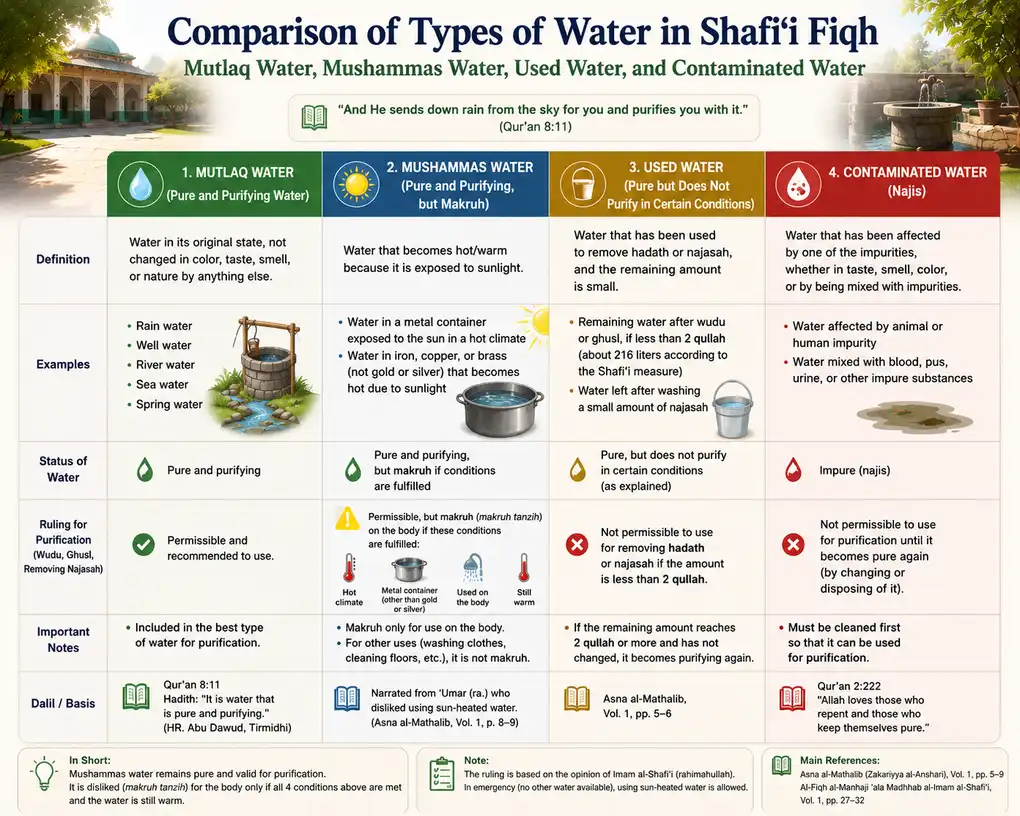
These three types of water should not be confused.
| Type of Water | Cause of the Ruling | Basic Status | Can It Be Used for Purification? |
|---|---|---|---|
| Mushammas water | Heated by the sun under specific conditions | Pure and purifying, disliked on the body | Valid, but disliked when conditions exist |
| Used water | Already used for obligatory purification in certain cases | Pure, but not purifying in its specific ruling | Not used to lift hadath according to its details |
| Najis-contaminated water | Affected by impurity according to fiqh rules | Impure | Not valid for purification |
A common mistake is to think mushammas water is impure. That is not correct. It became warm because of the sun; it did not become najis.
Another mistake is to assume wudu with mushammas water is invalid. That is also incorrect. Wudu remains valid if the water is still mutlaq and the conditions for valid wudu are fulfilled.
When Is Sun-Heated Water Disliked?
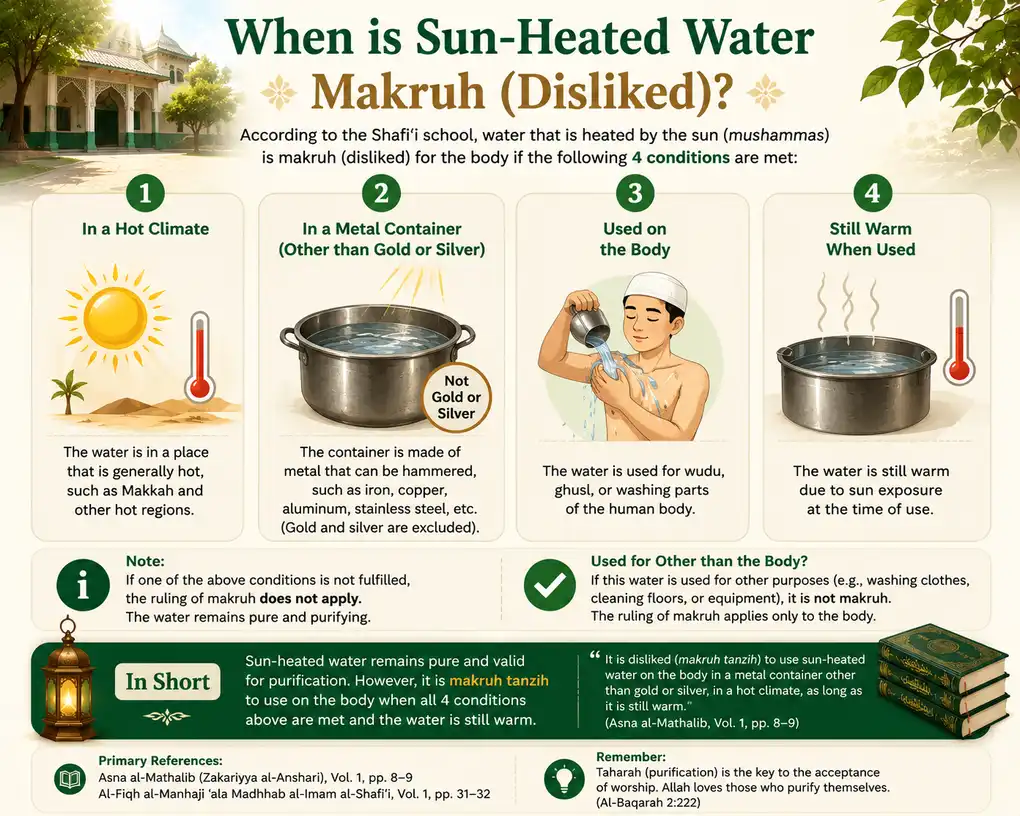
Not every kind of water left in the sun is disliked. In the Shafi‘i school, the disliked ruling has conditions.
Imam Zakariyya al-Anshari writes:
وكره شرعا تنزيها استعمال متشمس في البدن بمنطبع أي مطرق من غير النقدين كالحديد في قطر حار كمكة ما لم يبردوكره شرعا تنزيها استعمال متشمس في البدن بمنطبع أي مطرق من غير النقدين كالحديد في قطر حار كمكة ما لم يبرد
“It is legally disliked, as a tanzih type of dislike, to use sun-heated water on the body when it is in a malleable metal vessel other than gold and silver, such as iron, in a hot land such as Makkah, as long as it has not cooled.”[5]
From this passage, the main conditions are as follows.
1. The Water Is Heated by the Sun
The heat must come from the sun. If the water is heated by fire, a stove, or an electric heater, it is not mushammas water for this ruling.
In everyday life, this may happen when water is left in direct sunlight. Still, not every outdoor container of water becomes disliked. The rest of the conditions must also be checked.
2. It Is in a Hot Region
The text gives Makkah as an example of a hot land. This shows that the climate matters.
In tropical countries, the ruling should be applied carefully. If the place is very hot and the sun’s effect is strong, the case is closer to the classical discussion. If the climate is mild or the sun’s effect is weak, the condition is not clearly present.
3. It Is in a Metal Vessel Other Than Gold or Silver


The vessel must be a malleable metal vessel, such as iron or copper. The Arabic term used is منطبع, meaning metal that can be shaped or hammered.
Gold and silver are excluded in this discussion due to the refinement of their substance in the explanation of the jurists. Plastic containers, clay vessels, pools, and large basins are not the same as the metal vessel mentioned in the text.
This relates to the broader issue of rulings on vessels for purification, because the container is part of the ruling.
4. It Is Used on the Body
The disliked ruling applies when the water is used on the body, such as for:
- wudu,
- obligatory ghusl,
- ordinary bathing,
- washing a limb.
If it is used for something other than the body, the ruling is different.
5. It Is Still Hot When Used
The text says ما لم يبرد, meaning “as long as it has not cooled.” This shows that the ruling is connected to the state of the water at the time of use.
If the water has cooled and the effect of solar heat is gone, the practical basis of dislike is not the same. There are details in the school, but a safe practical rule is: avoid using it on the body while it is still hot from the sun if another normal water source is available.
It Is Not Disliked for Non-Bodily Use
Mushammas water is disliked when used on the body under its conditions. If used for something other than the body, it is not disliked.
Imam Zakariyya al-Anshari says:
فلو استعمله في غير البدن كالثوب … لم يكره
“If it is used for something other than the body, such as clothing, it is not disliked.”[6]
Therefore, it may be used for:
- washing clothes,
- cleaning floors,
- washing vehicles,
- rinsing containers,
- cleaning objects.
This shows again that the ruling is not based on impurity. It is based on a specific bodily use under specific conditions.
Why Is Mushammas Water Disliked?
The reason mentioned in classical fiqh is concern for possible harm to the body. The jurists connect it to the sun’s heat and certain metal vessels.
In Asna al-Mathalib, it says:
لما روى الشافعي عن عمر أنه كان يكره الاغتسال بالماء المشمس، وقال أنه يورث البرص
“Because al-Shafi‘i narrated from Umar that he disliked bathing with sun-heated water, and he said that it may cause baras.”[7]
The same passage explains that the sun’s heat may separate certain elements from the vessel which rise to the surface of the water. If they meet the body while warm, harm is feared.[8]
The careful way to express this is: according to the jurists, mushammas water is disliked because harm to the body is feared. It should not be stated as though every kind of water exposed to sunlight certainly causes illness.
This cautious approach fits the wisdom of purification in Islam: purification is not only about ritual validity, but also about cleanliness, care, and proper etiquette before worship.
A Note on Imam al-Nawawi’s Chosen View
There is a juristic detail here. The well-known position in the Shafi‘i school states that mushammas water is disliked when its conditions are met. This position is reported as the famous relied-upon view.
However, Asna al-Mathalib also records Imam al-Nawawi’s selected view from the standpoint of evidence:
والمختار عند النووي دليلا عدم الكراهة مطلقا
“The view selected by al-Nawawi, in terms of evidence, is that it is not disliked at all.”[9]
This means the issue has nuance. For practical Shafi‘i writing, one may say: the famous view considers it disliked under its conditions, while Imam al-Nawawi has an evidential preference that does not consider it disliked.
For ordinary practice, the safer route is simple. If normal water is available, use it. If only mushammas water is available, use it and do not move directly to tayammum.
Can Mushammas Water Be Used for Wudu?
Yes. The ruling on using sun-heated water for purification is that the purification is valid, as long as the water remains mutlaq and is not impure.
Wudu with mushammas water is valid. Ghusl with mushammas water is also valid. Removing impurity with it is valid if the water meets the requirements of purifying water.
The key is to distinguish validity from dislike:
- Valid means the act meets its legal conditions.
- Disliked means it is better to avoid it when an easy alternative exists.
- Disliked is not the same as prohibited.
- Disliked does not automatically invalidate wudu or ghusl.
So, if someone makes wudu with mushammas water, the wudu is valid. If all the disliked conditions are present and other water is available, it is better to use other water.
If There Is No Other Water, Can One Make Tayammum?
If only mushammas water is available and it can still be used, one does not move directly to tayammum.
In Asna al-Mathalib, Imam Zakariyya al-Anshari states:
ولو عدم غيره استعمله وجوبا إن ضاق الوقت ولم يتيمم لقدرته على ماء مطهر
“If he has no other water, he must use it when the prayer time has become tight, and he does not make tayammum, because he is able to use purifying water.”[10]
This shows that mushammas water is still counted as purifying water. Tayammum is not taken as an option while a person can still use valid water for purification.
The practical rule is:
- If normal water is available, use normal water.
- If only mushammas water is available, use it.
- If using the water would genuinely harm a specific person, then the issue moves to the separate fiqh discussion of inability to use water.
Is Rooftop Tank Water Considered Mushammas Water?
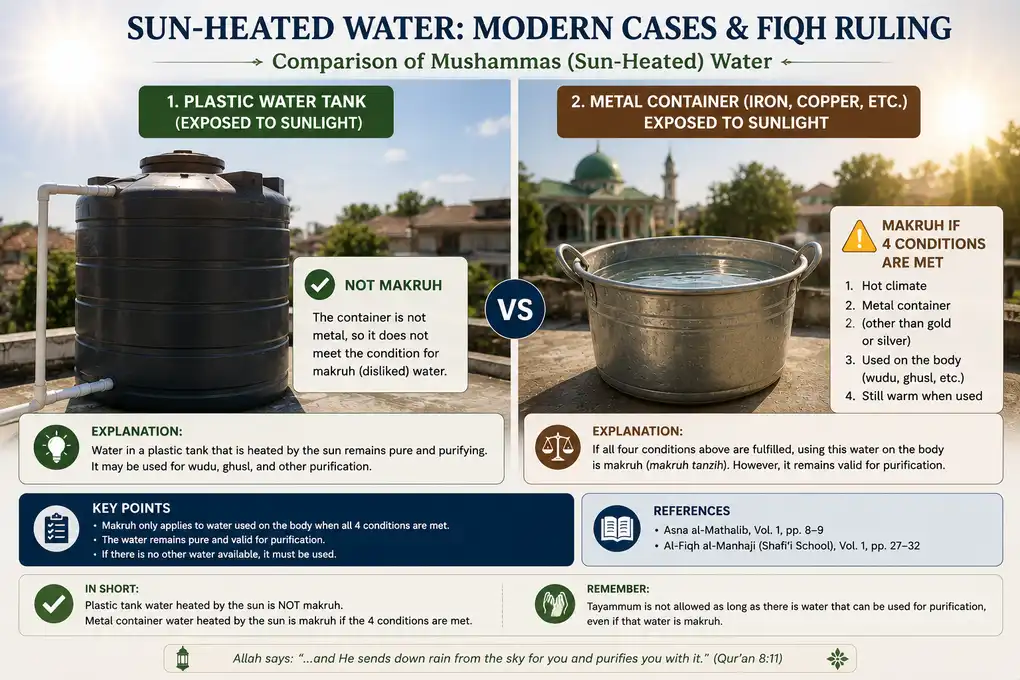
Modern cases should be checked against the fiqh conditions, not only by the general phrase “left in the sun.”
Water in a Plastic Tank
Water in a plastic rooftop tank is not automatically treated as the disliked form of mushammas water in the classical discussion. One of the key conditions is a malleable metal vessel.
For purification, plastic-tank water may be used as long as it remains mutlaq water and is not impure. This connects to the meaning of mutlaq water.
Water in a Plastic Bucket
A plastic bucket is also not a metal vessel. Therefore, water in a plastic bucket warmed by sunlight is not automatically treated like water heated in an iron or copper vessel.
The cleanliness of the water still matters. If impurity enters the water, the issue is no longer mushammas water; it becomes the ruling of najis-contaminated water.
Water in an Iron Drum or Metal Vessel
Water in an iron drum or another metal container is closer to the classical case. Still, the full conditions must be checked:
- Is the region hot?
- Is the vessel a metal other than gold or silver?
- Was the water heated by the sun?
- Will it be used on the body?
- Is it still hot at the time of use?
If all conditions are met, then using it on the body is disliked according to the famous Shafi‘i view.
Bottled Water Left in the Sun
Bottles and water gallons are usually not metal vessels. From the perspective of purification law, bottled water left in sunlight is not automatically included in the classical disliked ruling of mushammas water.
The safety of drinking bottled water after long sun exposure is a separate topic. This article only discusses water for wudu, ghusl, and purification.
Examples of Mushammas Water
The following examples help clarify the ruling.
Examples Close to Disliked Mushammas Water
- Water in an iron drum exposed to strong sun in a hot region.
- Water in a copper vessel heated by sunlight.
- Water in a metal vessel used for wudu while still hot.
Examples Not Automatically Disliked
- Water in a plastic rooftop tank.
- Water in a plastic bucket warmed by weather.
- Well water that feels warm because of the environment.
- Water heated on a stove.
- Hot water from a dispenser.
These examples matter because legal conditions must be checked one by one.
Common Mistakes
Thinking Mushammas Water Is Najis
This is incorrect. Mushammas water is not najis unless impurity actually affects it according to fiqh rules.
Sunlight does not make water impure. The jurists discuss disliked bodily use under specific conditions.
Thinking All Sun-Heated Water Is Disliked
Not all sun-heated water is disliked. The conditions must be present: a hot region, a specific metal vessel, bodily use, and the water still being hot.
Thinking Wudu with Mushammas Water Is Invalid
Wudu remains valid if the water is still mutlaq. Disliked does not mean invalid.
Thinking Mushammas Water Is the Same as Used Water
Mushammas water is heated by the sun. Used water in purification is water already used for obligatory purification in specific conditions.
Summary of the Ruling
What is the ruling on using mushammas water for purification? It is valid, but disliked if the conditions of dislike are present.
The practical summary is:
- Mushammas water is water heated by the sun.
- It remains pure and purifying.
- It is not najis.
- It is not the same as used water.
- The disliked ruling concerns bodily use.
- The conditions are: hot region, metal vessel other than gold or silver, heat from the sun, bodily use, and still being hot.
- If no other water is available, it is used.
- Tayammum is not taken while this water can still be used.
A quick checklist:
- Was the water really heated by the sun?
- Is the place a hot region?
- Is the vessel metal, other than gold and silver?
- Will the water be used on the body?
- Is the water still hot when used?
If all answers are yes, then using it on the body is makruh tanzih according to the famous Shafi‘i position.
FAQ on Mushammas Water
Can sun-heated water be used for wudu?
Yes. Wudu with mushammas water is valid as long as the water remains mutlaq water and is not impure.
If the disliked conditions are present, its use on the body is disliked, but that does not invalidate wudu.
Is mushammas water najis?
No. Mushammas water is not najis merely because it was exposed to the sun.
Water becomes najis because of impurity according to fiqh rules, not because of sunlight alone.
Is rooftop tank water considered mushammas water?
If the tank is plastic, it is not automatically included in the classical disliked ruling. The jurists mention a malleable metal vessel as a condition.
As long as the tank water remains mutlaq and is not impure, it may be used for purification.
What is an example of mushammas water?
A close example is water in an iron drum exposed to strong sunlight in a hot region, then used on the body while still hot.
Water in a plastic tank, plastic bucket, or plastic gallon is not automatically included in the classical disliked conditions.
Is ghusl with mushammas water valid?
Yes. Ghusl with mushammas water is valid. If the conditions of dislike are met and other water is available, using other water is better.
If there is no other water and the prayer time is tight, mushammas water is still used, and one does not move directly to tayammum.
Why is sun-heated water discouraged in this ruling?
According to the jurists, it is disliked because harm to the body is feared under specific conditions.
The careful wording is “harm is feared according to the juristic explanation,” not that every form of water exposed to sunlight certainly causes harm.
Footnotes
References
- Zakariyā al-Anṣārī, Asnā al-Maṭālib fī Sharḥ Rawḍ al-Ṭālib, with ḥāshiyah by Aḥmad al-Ramlī, edited by Muḥammad az-Zuhrī al-Ghamrāwī (Cairo: al-Maṭbaʿah al-Maymānīyah, 1313 AH; repr. Dār al-Kitāb al-Islāmī), vol. 1, pp. 5-9.
- Al-Khin, Muṣṭafā, Muṣṭafā Dīb al-Bughā, and ʿAlī al-Syarbajī. Al-Fiqh al-Manhajī ʿalā Madzhab al-Imām al-Syāfiʿī. Damascus: Dār al-Qalam li al-Ṭibāʿah wa al-Nasyr wa al-Tawzīʿ, 4th ed., 1413 AH/1992 CE, vol. 1, p. 32.


