
Eid al-Adha is not merely a festival. Behind the echoing takbir and the steaming aroma of meat lies a magnificent act of worship that requires careful fiqh understanding: qurban (udhiyah). This worship is not just about slaughtering an animal — it is a form of servitude that possesses highly specific conditions, timings, and procedures within the Shafi’i school. To understand the difference between udhiyah and aqiqah, you can read about it in the difference between udhiyah & aqiqah.
For some, qurban feels like an annual ritual performed as a matter of routine. However, mistakes in selecting the animal, determining the time, or distributing the meat can render an act of worship worth millions of rupiahs invalid as a qurban — turning it into a mere ordinary charity (sadaqah).
This article presents a complete guide to qurban according to the Shafi’i school, sourced directly from the classic text Asna al-Mathalib by Zakariyya al-Anshari. Every legal point is accompanied by the original Arabic text and footnotes to ensure academic accountability. To further understand the academic context of Islamic fiqh, you can read the in-depth definition of fiqh here.
What is Qurban (Udhiyah)? Definition & Legal Basis
Definition of Udhiyah According to the Shafi’i School
Linguistically, the word udhiyah (أُضْحِيَّة) or dhahiyah (ضَحِيَّة) is derived from the time of its execution, which is the dhuha time on the day of Eid al-Adha. In fiqh terminology, udhiyah is:
مَا يُذْبَحُ مِنَ النَّعَمِ تَقَرُّبًا إِلَى اللهِ تَعَالَى مِنْ يَوْمِ الْعِيدِ إِلَى آخِرِ أَيَّامِ التَّشْرِيقِ
“Livestock slaughtered as a means of drawing closer to Allah SWT, starting from the day of Eid al-Adha until the end of the days of Tashriq.” [1]
It is important to distinguish between three frequently mixed-up terms:
- Udhiyah: The slaughter on the day of Eid al-Adha and the days of Tashriq as a form of taqarrub (drawing closer to Allah).
- Hadyu: The slaughter associated with the Hajj and Umrah pilgrimages, brought to the Haram.
- Aqiqah: The slaughter to express gratitude for the birth of a child, performed on the seventh day of birth. For a complete aqiqah guide, see the article on aqiqah and qurban.
Legal Basis of Qurban in the Qur’an and Hadith
The primary foundation for the legislation of qurban in the Shafi’i school refers to two sources:
First, the word of Allah in QS. Al-Hajj verse 34:
{وَلِكُلِّ أُمَّةٍ جَعَلْنَا مَنسَكًا لِّيَذْكُرُوا اسْمَ اللَّهِ عَلَى مَا رَزَقَهُم مِّن بَهِيمَةِ الأَنْعَامِ}
“And for every nation We have appointed religious ceremonies, that they may mention the Name of Allah over the beast of cattle that He has given them for food.”
Second, the hadith from Anas bin Malik narrated by Bukhari and Muslim:
«ضَحَّى النَّبِيُّ صَلَّى اللهُ عَلَيْهِ وَسَلَّمَ بِكَبْشَيْنِ أَمْلَحَيْنِ أَقْرَنَيْنِ ذَبَحَهُمَا بِيَدِهِ وَسَمَّى وَكَبَّرَ وَوَضَعَ رِجْلَهُ عَلَى صِفَاحِهِمَا»
“The Prophet ﷺ sacrificed two horned rams with white wool mixed with black spots; he slaughtered them with his own hands, recited the basmalah, uttered the takbir, and placed his foot on the sides of their faces.” [2]
The Ruling of Qurban: Sunnah Mu’akkadah or Obligatory?


The official position of the Shafi’i school is that qurban is sunnah mu’akkadah (a highly recommended sunnah), not obligatory. The book Asna al-Mathalib states:
وَهِيَ سُنَّةٌ مُؤَكَّدَةٌ عَلَى الْكِفَايَةِ
“Udhiyah is a sunnah mu’akkadah that bears the nature of fard kifayah.” [3]
The evidence that qurban is not obligatory is derived from a hadith narrated by Abu Dawud:
«مَنْ أَحَبَّ أَنْ يَنْسُكَ عَنْ وَلَدِهِ فَلْيَفْعَلْ»
“Whoever likes to offer a sacrifice on behalf of his child, let him do so.”
The use of the word “likes” (ahabb) indicates a recommendation, not an obligation. Qurban is also analogous (qiyas) to aqiqah: both are slaughters without the cause of a crime (jinayah) or vow (nadhr), hence they are not obligatory. [4]
Nevertheless, it is makruh (disliked) for a capable person to abandon it. Qurban only becomes obligatory if someone makes a vow (nadhr) or says: “Let this animal be a qurban.”
To further understand the intricacies of qurban rulings, read also: definition and ruling of qurban according to Islamic fiqh and ruling of qurban: obligatory or sunnah?
First Condition — Types of Animals Valid for Qurban
Qurban Animals Must be of the An’am Species
The first condition that must be understood: the qurban animal must be of the an’am species (بَهِيمَةُ الأَنْعَامِ). The book Asna al-Mathalib emphasizes:
الأَوَّلُ كَوْنُهَا مِنَ النَّعَمِ، وَهِيَ الإِبِلُ وَالبَقَرُ وَالغَنَمُ بِسَائِرِ أَنْوَاعِهَا بِالإِجْمَاعِ
“The first condition is that the animal must be from the an’am, namely camels, cattle, and sheep/goats with all their varieties — by scholarly consensus (ijma’).” [5]
Animals valid for qurban:
- Camels (ibil) — including all its varieties.
- Cattle (baqar) — including regular cows.
- Goats (ma’iz) and sheep (dha’n) — including all their types.
Animals that are invalid:
- Deer, gazelles, and other wild animals.
- Wild cattle (baqar al-wahsy).
- Donkeys (himar).
A special note regarding animals crossbred from two different species (mutawalid bayna jinsain): Zakariyya al-Anshari mentions that the most logical approach is to refer to the minimum age of the older parent species. So if a sheep is crossbred with a goat, its minimum age follows the goat (2 years). [6]
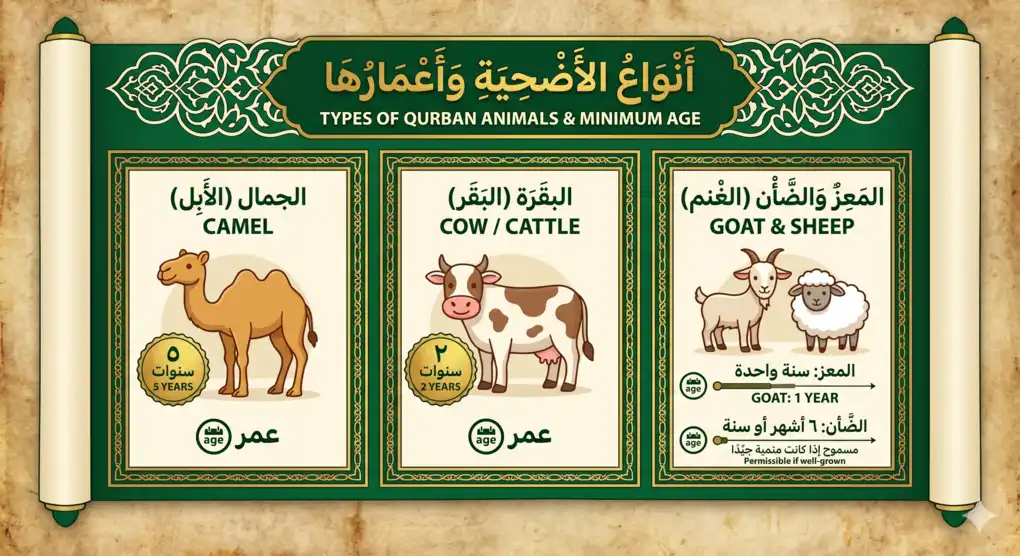
Minimum Age Limits for Qurban Animals
| Animal Type | Term | Minimum Age |
| Sheep (dha’n) | Jadha’ al-Dha’n | 1 full year (or if its teeth have fallen out) |
| Goats (ma’iz) | Tsaniy al-Ma’iz | 2 full years |
| Cattle (baqar) | Tsaniy al-Baqar | 2 full years |
| Camels (ibil) | Tsaniy al-Ibil | 5 full years |
The basis for this determination is a hadith narrated by Muslim:
«لاَ تَذْبَحُوا إِلاَّ مُسِنَّةً إِلاَّ إِنْ تَعَسَّرَ عَلَيْكُمْ فَاذْبَحُوا جَذَعَةً مِنَ الضَّأْنِ»
“Do not slaughter except a musinnah (an animal of sufficient age). If it is difficult for you, then slaughter a jadha’ah from the sheep.” [7]
A sheep whose teeth have fallen out (ajdha’) before the age of one year is still valid, similar to a child who experiences physical puberty prematurely.
One Animal for How Many People?
This provision is often an important question:
- Goat/sheep: Valid for 1 person — but it may be intended for the entire family within one household, or to include others in its reward. [8]
- Cattle or camel: Valid for 7 people (7 shares), based on a hadith narrated by Muslim from Jabir:
«نَحَرْنَا مَعَ رَسُولِ اللهِ ﷺ بِالحُدَيْبِيَةِ البَدَنَةَ عَنْ سَبْعَةٍ وَالبَقَرَةَ عَنْ سَبْعَةٍ»
“We slaughtered with the Messenger of Allah ﷺ at Hudaibiyah: one camel for seven persons and one cow for seven persons.” [9]
For detailed information on the conditions of qurban animals, read: conditions of qurban that must be fulfilled before Eid al-Adha.
Second Condition — Physical Conditions of Valid and Invalid Animals
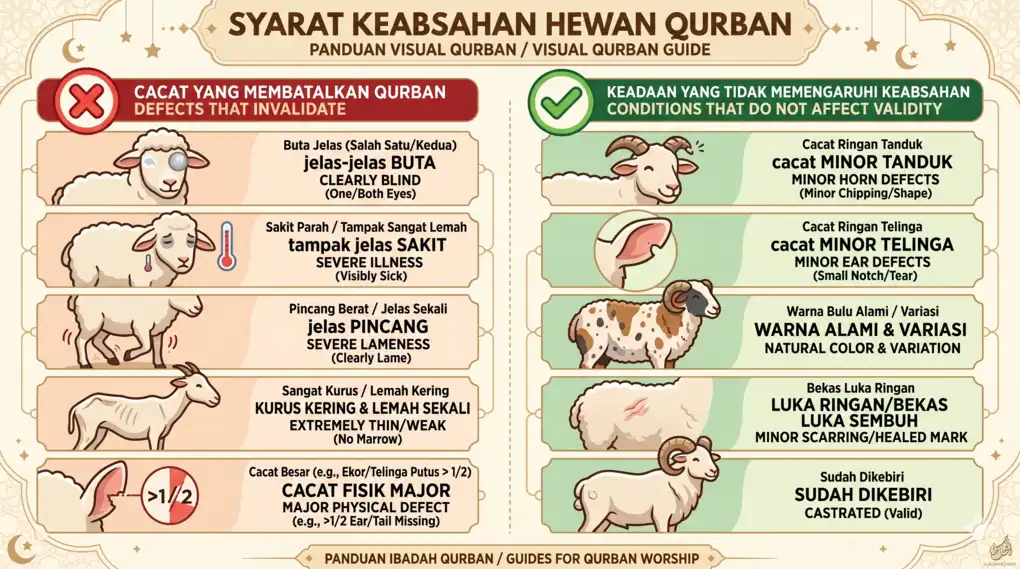
Defects That Render an Animal Invalid (Four Major Defects)
Based on a hadith narrated and authenticated by Tirmidhi, there are four defects that explicitly render an animal invalid for qurban:
«أَرْبَعٌ لاَ تُجْزِئُ فِي الأَضَاحِي: الْعَوْرَاءُ الْبَيِّنُ عَوَرُهَا، وَالْمَرِيضَةُ الْبَيِّنُ مَرَضُهَا، وَالْعَرْجَاءُ الْبَيِّنُ عَرَجُهَا، وَالْعَجْفَاءُ الَّتِي لاَ تُنْقِي»
“Four (defects) that do not suffice in sacrifices: the one-eyed whose defect is obvious, the sick whose sickness is obvious, the lame whose limp is obvious, and the emaciated one that has no marrow.” [10]
Explanation of each defect:
- Al-‘Awaraa’ al-Bayyin ‘Awruhaa — Blind in one eye where the defect is clear, and the light of the eye is completely gone.
- Al-Maridhah al-Bayyin Mardhuhaa — Sick in a way that causes the animal to lose weight and reduces the quality of its meat.
- Al-‘Arjaa’ al-Bayyin ‘Arjuhaa — Lame to the extent that the animal is left behind by the herd when walking to the pasture.
- Al-‘Ajaafaa’ allati laa tunqi — Extremely emaciated to the point of having no bone marrow at all.
Additional Defects That Nullify the Validity of Qurban
Besides the four defects above, Asna al-Mathalib details other defects that also render a qurban invalid: [11]
- Completely blind (al-‘amaa) or blind in one eye even if the eyeball is still present.
- Scabies/mange (al-jarab) even slightly — because it damages the meat and fat.
- Limping that occurs while under the knife (tahta al-sikkiin) — remains invalid even if the defect appears just moments before slaughter.
- Ears completely cut off or born without ears — due to the loss of an edible part.
- Extreme emaciation without marrow (haziilah dzahaba mukhkhuhaa).
- Madness/abnormality that causes it to rarely eat (majnuunah) — because it leads to emaciation.
Defects That Do Not Nullify Validity (Still Valid)
There are also conditions that do not diminish the validity of the qurban: [12]
| Condition | Explanation |
| Weak eyesight (al-‘amsyaa’) | Can still see while grazing |
| Branding marks (al-mukawwiyah) | Does not affect meat quality |
| Night blindness (al-‘asywaaa’) | Can still see during the day |
| Slit ears (masyquuqah al-udzun) | Its ruling is makruh tanzih, not haram |
| Hornless (‘adam al-qarn) | Has no effect on the meat |
| Castrated (khashi) | Actually enhances the deliciousness of the meat |
Third Condition — The Time of Slaughtering Qurban
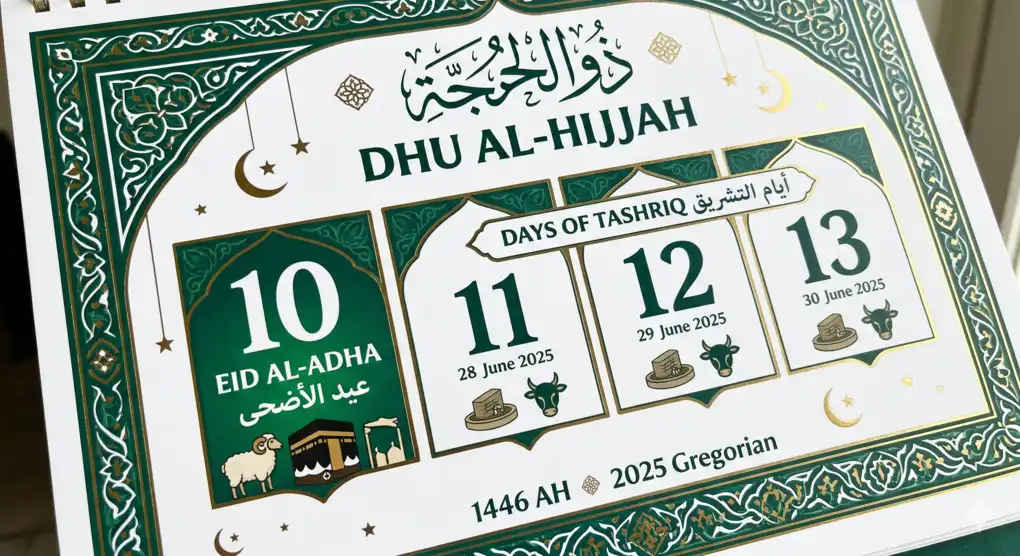
When Does the Qurban Time Begin?
One of the most frequently misunderstood points is how to calculate the start time of the slaughter. The book Asna al-Mathalib explains:
الشَّرْطُ الثَّانِي الْوَقْتُ: وَهُوَ مِنْ حِينِ يَمْضِي قَدْرُ رَكْعَتَيْنِ وَخُطْبَتَيْنِ خَفِيفَتَيْنِ مِنْ طُلُوعِ شَمْسِ يَوْمِ النَّحْرِ
“The second condition is the time, which is from the passing of a duration equivalent to two rak’ahs of prayer and two brief khutbahs, calculated from the rising of the sun on the day of Nahr (10 Dhu al-Hijjah).” [13]
It should be noted: the benchmark is the calculation of time, not the factual completion of the Eid prayer. This is intentional so that the rule can apply uniformly to all regions — including areas where there is no congregational Eid prayer. The evidence is the hadith of Bukhari and Muslim:
«أَوَّلُ مَا نَبْدَأُ بِهِ فِي يَوْمِنَا هَذَا نُصَلِّي ثُمَّ نَرْجِعُ فَنَنْحَرُ»
“The first thing we begin with on this day of ours is to pray, then we return and slaughter.” [14]
When Does the Qurban Time End?
The qurban time ends at sunset on the 13th of Dhu al-Hijjah (the end of the days of Tashriq). The total time available is 4 days: the 10th, 11th, 12th, and 13th of Dhu al-Hijjah. The evidence is a hadith narrated by Ibn Hibban:
«فِي كُلِّ أَيَّامِ التَّشْرِيقِ ذَبْحٌ»
“In every day of Tashriq there is slaughtering (qurban).” [15]
For a more detailed guide on the timing of slaughter, read: time of slaughtering qurban according to fiqh.
It is Makruh to Slaughter at Night
Slaughtering qurban at night is absolutely makruh (disliked, not haram), for two reasons: [16]
- There is a risk of making mistakes in the proper slaughtering process.
- The poor and needy will not be as present as they are during the day, hindering the distribution.
Exception: This makruh ruling is dropped if there is a pressing need — for example, fearing that the qurban time will expire, having guests that need to be served, or if the poor in the vicinity are in dire need.
Consequences of Slaughtering Outside the Time
What happens if the qurban is slaughtered outside its designated time?
- A sunnah qurban (tathawwu’) slaughtered outside the time: automatically becomes an ordinary charity, not a qurban. There is no qadha (makeup).
- A vowed qurban (nadhr) slaughtered outside the time: must be made up (qadha), because the obligation of a vow does not drop simply because its time has passed. [17]
Fourth Condition — Who May Slaughter?
The Most Preferred: The Owner Slaughters it Themselves
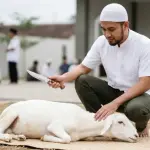
The strongest sunnah in this matter is for the qurban owner to slaughter it themselves, following the example of the Messenger of Allah ﷺ. The book Asna al-Mathalib mentions:
الأَفْضَلُ أَنْ يَذْبَحَ الْمُضَحِّي بِنَفْسِهِ لِلاتِّبَاعِ
“The most preferred is for the one offering the sacrifice to slaughter it themselves, in order to follow (the Prophet’s sunnah).” [18]
In a hadith narrated by Bukhari and Muslim, the Prophet ﷺ slaughtered 63 camels himself out of the 100 he brought, and then delegated the remaining 37 to Ali bin Abi Thalib RA.
Delegating to Others (Tawkil)
It is permissible to delegate the slaughter to another person. The order of preference is: [19]
- Most preferred: A Muslim who is faqih (understands the chapter on slaughtering).
- Permissible: An ordinary Muslim who knows how to slaughter.
- Permissible, but less preferred: People of the Book (Jews/Christians).
- Makruh: A young child (shabiy) and a blind person (a’maa).
- Absolutely not permissible: Magians, idol worshipers, and apostates.
- Menstruating women: It is not makruh, merely khilaful aula (permissible but less preferred).
The Sunnah of Witnessing the Slaughter
Even if delegated, the qurban owner is recommended to be present and witness the slaughter. The evidence is a hadith narrated by Al-Hakim with an authentic chain, that the Prophet ﷺ said to Fatimah RA:
«قُومِي إِلَى أُضْحِيَتِكِ فَاشْهَدِيهَا فَإِنَّهُ بِأَوَّلِ قَطْرَةٍ مِنْ دَمِهَا يُغْفَرُ لَكِ مَا سَلَفَ مِنْ ذُنُوبِكِ»
“Stand by your sacrifice and witness it, for verily with the first drop of its blood, your past sins are forgiven.” [20]
Intention in the Worship of Qurban
Intention is a Condition for the Validity of Qurban
Qurban is an act of worship (‘ibadah), so an intention (niyyah) must be present. Without intention, the slaughtered animal does not count as a qurban. Asna al-Mathalib states:
وَلاَ بُدَّ فِي التَّضْحِيَةِ مِنَ النِّيَّةِ؛ لأَنَّهَا عِبَادَةٌ
“Intention is obligatory in the execution of udhiyah, because it is an act of worship.” [21]
The intention can be made prior to the slaughter, at least at the time of ta’yin (designation of the animal). The intention from the owner is sufficient — it does not have to be from the person slaughtering. Even if the proxy does not know that the animal is a qurban, the worship remains valid.
Regarding the importance of intention in every Islamic worship, read: meaning of the hadith innamal a’malu binniyyat.
How to Designate (Ta’yin) a Qurban Animal
The ta’yin of a qurban animal must be done through verbal utterance, for example: “I designate this animal as a qurban.”
قوله: (وإذا نوى) جعل هذه الأضحية مثلا (بغير لفظ لم تصر أضحية، وإن ذبحها) هذا قدمه أول الباب وظاهر أن إشارة الأخرس المفهمة كنطق الناطق كما قاله الأذرعي
“If one merely intends in their heart (that this animal will be made a qurban) without a verbal utterance, the animal does not become a (vowed) qurban — even if it has been slaughtered.” [22]
After being verbally designated, the ownership of the animal transfers to the rightful recipients (mustahiq – the poor and needy). The owner can no longer sell or arbitrarily transfer the animal because its status has become a vowed qurban.
Sunnahs During the Slaughtering of Qurban
Sunnahs Before Slaughtering
Before the knife is swung, there are several recommended etiquettes: [23]
- Facing the animal towards the Qibla.
- Leading the animal gently and laying it down carefully.
- Giving the animal water to drink beforehand.
- Sharpening the knife away from the sight of the animal to be slaughtered.
- Not slaughtering another animal in the presence of the animal to be slaughtered.
For a complete guide on etiquettes before qurbani, read: etiquettes before qurban according to fiqh.
Supplications and Recitations During Slaughtering
The recitations when slaughtering a qurban are based on a hadith narrated by Muslim: [24]
- Basmalah: “Bismillah”Read also: ruling on reciting basmalah when slaughtering
- Takbir three times: “Allahu Akbar, Allahu Akbar, Allahu Akbar”
- Followed by: “Walillahil hamd”
- Supplication of the qurban intention:
«اللَّهُمَّ مِنْكَ وَإِلَيْكَ فَتَقَبَّلْ مِنِّي»
“Allahumma minka wa ilaika fataqabbal minni”
“O Allah, this is from You and (I offer it back) to You, so accept it from me.”
In a narration by Muslim, the Prophet ﷺ recited while slaughtering:
«بِسْمِ اللهِ وَاللهُ أَكْبَرُ، اللَّهُمَّ تَقَبَّلْ مِنْ مُحَمَّدٍ وَآلِ مُحَمَّدٍ وَمِنْ أُمَّةِ مُحَمَّدٍ»
“Bismillahi wallahu akbar, Allahumma taqabbal min Muhammadin wa aali Muhammadin wa min ummati Muhammadin”
Prohibitions in the First 10 Days of Dhu al-Hijjah
For those who intend to offer a qurban, there is an important prohibition: it is makruh to cut hair and nails from the entry of the 1st of Dhu al-Hijjah until the qurban is completed. The basis is a hadith narrated by Muslim:
«إِذَا رَأَيْتُمْ هِلاَلَ ذِي الحِجَّةِ وَأَرَادَ أَحَدُكُمْ أَنْ يُضَحِّيَ فَلْيُمْسِكْ عَنْ شَعْرِهِ وَأَظْفَارِهِ»
“If you see the crescent of Dhu al-Hijjah and one of you intends to offer a sacrifice, then let him refrain from (cutting) his hair and his nails.” [25]
The ruling is makruh — not haram. This is part of the symbols of worship, resembling the condition of a person in ihram.
Rulings on the Distribution of Qurban Meat
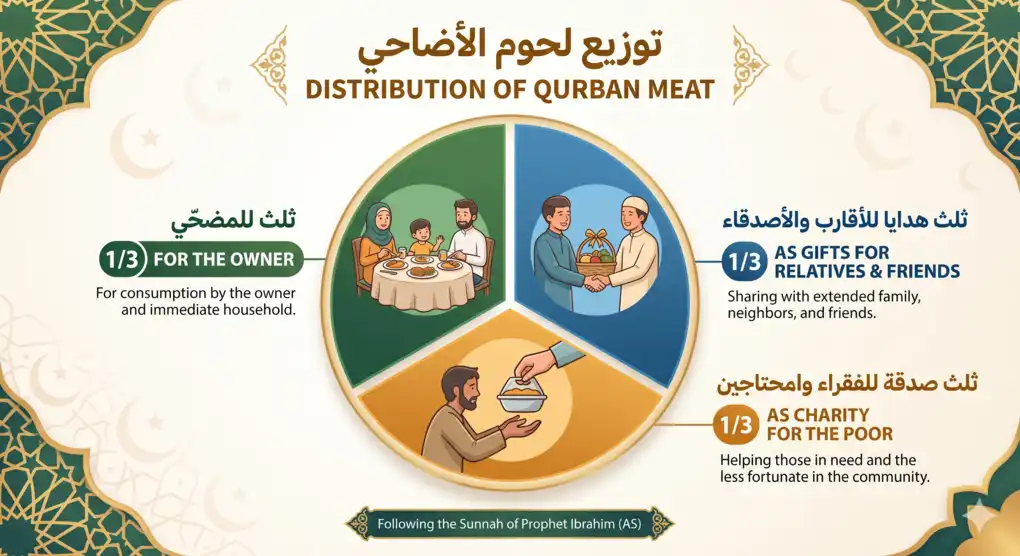
Three Channels of Meat Distribution
The meat of a sunnah qurban (tathawwu’) is recommended to be divided into three channels. Allah SWT says in QS. Al-Hajj: 28:
{فَكُلُوا مِنْهَا وَأَطْعِمُوا الْبَائِسَ الْفَقِيرَ}
“Then eat thereof and feed therewith the poor unfortunate.”
The three distribution channels: [26]
- Eaten by oneself — sunnah, at least one bite to seek blessings (tabarruk).
- Gifted (al-hadiyyah) — to relatives, neighbors, and those who are well-off.
- Given as charity (at-tashadduq) — to the poor and needy; this is the most preferred.
Ideal Distribution Portions
Asna al-Mathalib provides a detailed guide: [27]
وَيُسْتَحَبُّ إِذَا أَكَلَ وَأَهْدَى وَتَصَدَّقَ أَنْ لاَ يَزِيدَ أَكْلُهُ عَلَى الثُّلُثِ وَأَنْ لاَ تَنْقُصَ صَدَقَتُهُ عَنْهُ
“It is recommended if one eats, gifts, and gives in charity, that their eating portion does not exceed a third, and their charity does not fall below a third.”
The most virtuous (afdhal): giving it all in charity, except for one or a few bites for tabarruk.
Is it Permissible to Store Qurban Meat?
It is permissible to store qurban meat — this is not makruh. The prohibition against storing for more than three days found in an older hadith has been abrogated (naskh). The Prophet ﷺ said in a narration by Muslim:
«كُنْتُ نَهَيْتُكُمْ عَنْهُ مِنْ أَجْلِ الدَّافَّةِ وَقَدْ جَاءَ اللهُ بِالسَّعَةِ فَادَّخِرُوا مَا بَدَا لَكُمْ»
“I used to forbid you (from storing it) because of the caravans (who were starving). Now Allah has brought abundance, so store whatever seems good to you.” [28]
However, the stored portion should be taken from the one-third designated for personal consumption — not from the charity or gift portions.
What is Prohibited with Qurban Meat and Skin
Several prohibitions related to qurban meat and skin: [29]
- It is prohibited to sell both the meat and the skin of the qurban.
- It is prohibited to use them as butcher’s wages — it is haram to give meat/skin as payment to the slaughterer.
What is permissible to do with the skin:
- Utilized for personal needs (buckets, sandals, etc.) — following the actions of the Companions.
- Lent (‘ariyah) — permissible.
- It cannot be rented out (ijaarah).
For a complete guide on qurban meat distribution: provisions for distributing qurban meat according to fiqh.
Can the Owner Eat a Vowed (Nadhr) Qurban?
This is a point often overlooked:
- Sunnah Qurban (tathawwu’): The owner is allowed to eat it.
- Vowed Qurban (nadhr): The owner is absolutely not allowed to eat it; the entire meat must be given in charity. [30]
Qurban for Others and Lost Animals
Qurban on Behalf of Another Person or the Deceased
This provision needs to be understood carefully:
وَلاَ يُضَحِّي أَحَدٌ عَنْ غَيْرِهِ بِلاَ إِذْنٍ مِنْهُ وَلَوْ مَيِّتًا
“It is not valid for anyone to offer a sacrifice on behalf of another without their permission, even if they are deceased.” [31]
To offer a qurban on behalf of someone who has passed away, the conditions are:
- There is a will (wasiyyah) from the deceased before death, or
- There was prior permission given.
The evidence is a hadith narrated by Abu Dawud and Tirmidhi: Ali bin Abi Thalib RA sacrificed two rams on behalf of the Prophet ﷺ every year, because the Prophet commanded him to do so before his death.
Ruling on a Lost Qurban Animal
| Condition | Ruling |
| Lost without negligence before its time | Not obligated to compensate |
| Lost due to negligence | Obligated to search, even at an expense |
| Certain it won’t be found before time expires | Slaughter a replacement animal; if the original is found, slaughter it too |
| Found after the qurban time has expired | Slaughter it as a makeup (qadha) [32] |
Conclusion and Practical Qurban Checklist
Understanding the fiqh of qurban is not merely an academic matter — it directly touches the validity of an act of worship that holds immense value in the sight of Allah. Here is a practical checklist to consider before performing qurban according to the Shafi’i school:
✅ Before Buying the Animal:
- Ensure the animal type: camel, cattle, or goat/sheep.
- Check the minimum age: sheep 1 year, goat/cattle 2 years, camel 5 years.
- Check physical condition: free from the 4 major defects and additional defects.
✅ Starting 1st of Dhu al-Hijjah:
- Refrain from cutting hair and nails (makruh if cut).
✅ During Slaughter:
- Time: after the passing of a duration equivalent to two rak’ahs and two brief khutbahs from the sunrise of the 10th of Dhu al-Hijjah.
- Recite basmalah, takbir three times, and the supplication “Allahumma minka wa ilaika fataqabbal minni”.
- Face the animal towards the Qibla.
- It is better to witness it yourself even if delegating the slaughter.
✅ After Slaughter:
- Distribute: eat, gift to relatives, and give charity to the poor.
- Do not exceed 1/3 for personal consumption; charity should not be less than 1/3.
- Do not sell the meat or skin, and do not use them as wages for the butcher.
- It is prohibited to eat a vowed (nadhr) qurban.
Increase acts of worship in the first 10 days of Dhu al-Hijjah — because the Prophet ﷺ said that there are no days in which righteous deeds are more beloved to Allah than these ten days.
FAQ: Questions About Qurban According to the Shafi’i School
Is qurban obligatory or sunnah according to the Shafi’i school?
According to the Shafi’i school, qurban is sunnah mu’akkadah (a highly recommended sunnah), not obligatory. However, for a capable person who abandons it without a valid excuse, it is makruh. Qurban only becomes obligatory if someone makes a vow (nadhr) or designates a specific animal as a qurban verbally.
What is the minimum valid age for a qurban animal?
A sheep must be at least 1 year old (or its teeth have fallen out), a regular goat at least 2 years old, cattle at least 2 years old, and a camel at least 5 years old. Animals that do not meet the minimum age are invalid for qurban.
Can one goat be sacrificed for a whole family?
Yes. One goat/sheep is valid for one person, but the owner may intend the reward for the entire family within one household, or include others in its reward. As for one cow or camel, it can be divided among seven people (7 shares).
Can the qurban owner eat their own sacrificed meat?
Yes, it is even recommended to eat at least one bite to seek blessings (tabarruk). However, it should not exceed one-third of the total meat. One-third is gifted to relatives and neighbors, and the other one-third is given in charity to the poor. Exception: the owner of a vowed (nadhr) qurban cannot eat its meat at all.
Is it permissible to offer qurban on behalf of someone who has passed away?
Yes, provided there is a will (wasiyyah) from the deceased or prior permission was given. Without permission or a will, a qurban on behalf of another person — including the deceased — is not valid as a qurban on their behalf.
Footnotes
Reference
Zakariyā al-Anṣārī, Asnā al-Maṭālib fī Sharḥ Rawḍ al-Ṭālib, with annotations by Aḥmad al-Ramlī, edited by Muḥammad az-Zuhrī al-Ghamrāwī (Cairo: al-Maṭbaʿah al-Maymānīyah, 1313 H; repr. Dār al-Kitāb al-Islāmī), vol. 1, pp. 534-548.


