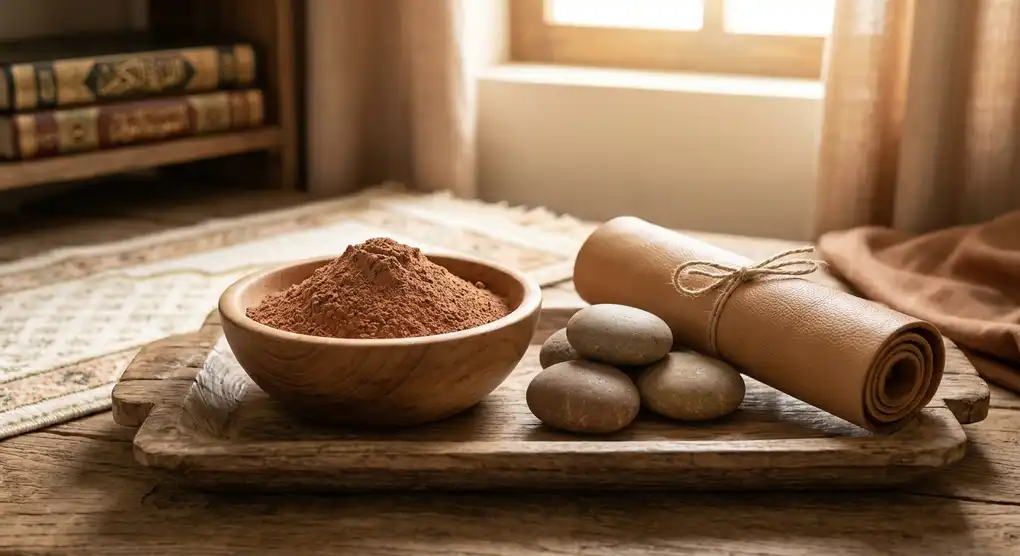
Water is the purification tool we know best. Yet in Shafi’i fiqh there is also soil for tayammum, stones for istinja, and tanning agents for the hide of carrion. The question is this: if the general purifier is only water, what is the standing of these three?
This article answers from Asna al-Mathalib by Shaykh al-Islam Zakariyya al-Ansari. We begin with the basic rule, then take soil, stones, and tanning one at a time.
Introduction: Water Is the Main Purifier, But Not the Only Medium
Many people ask: what are the purification tools other than water? It is a fair question. We are used to seeing water as the only way, yet the Law provides several materials that can be used for purification. Each has its own task, conditions, and limits.
Before going through them, we need to know what purification means in fiqh. From there we can see what work each tool is given.
Two Categories of Purification Tools: Lifting Hadath and Removing Impurity
Imam Zakariyya al-Ansari defines tahara (purity) in the technical sense of the Law as follows:
وشرعا رفع حدث أو إزالة نجس أو ما في معناهما، وعلى صورتهما كالتيمم، والأغسال المسنونة، وتجديد الوضوء، والغسلة الثانية، والثالثة[1]
It means: in the Law, tahara is lifting a hadath (ritual impurity) or removing najasah (physical impurity), or something close in meaning and similar in form. Examples are tayammum, recommended ghusl, renewing wudu, and the second and third washes.
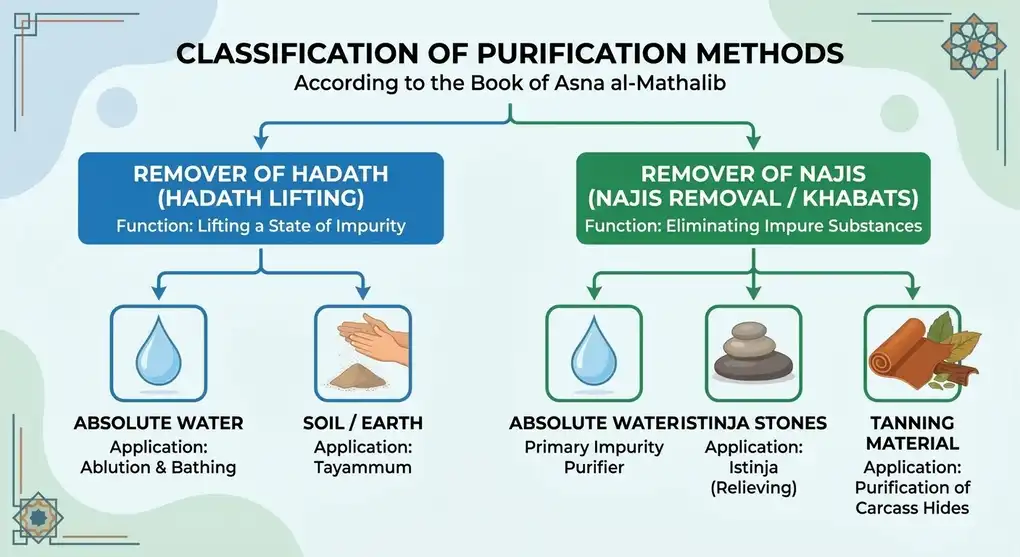
From this definition, purification tools fall into two kinds according to their task:
- Tools for hadath: water in wudu and ghusl, and soil in tayammum.
- Tools for impurity (khabath): water, istinja stones, and tanning agents.
The book describes both terms briefly:
قوله: (المطهر للحدث) ، وهو هنا أمر اعتباري يقوم بالأعضاء يمنع صحة الصلاة حيث لا مرخص (والخبث) ، وهو مستقذر يمنع صحة الصلاة حيث لا مرخص[2]
Hadath is a state recognized by the Law (amr i’tibari) that rests on the limbs and blocks the validity of prayer when there is no concession. Khabath is something filthy (mustaqdhar) that also blocks the validity of prayer when there is no concession.
Map of the Article: Soil (Tayammum), Stones (Istinja), Tanning Agents (Hides)
We cover three purification tools besides water, in this order:
- Soil (turab): used in tayammum and in washing dog impurity. Soil is one of the purification tools other than water that the Qur’an and hadith name directly.
- Stones (hajar): used in istinja, along with other things that stand in the same position.
- Tanning agents (adwiyat al-dabagh): used to purify the hide of carrion.
To get to know water, the main purifier, first read our guide to the types of water for purification.
The Shafi’i Basis: Only Absolute Water Purifies in General
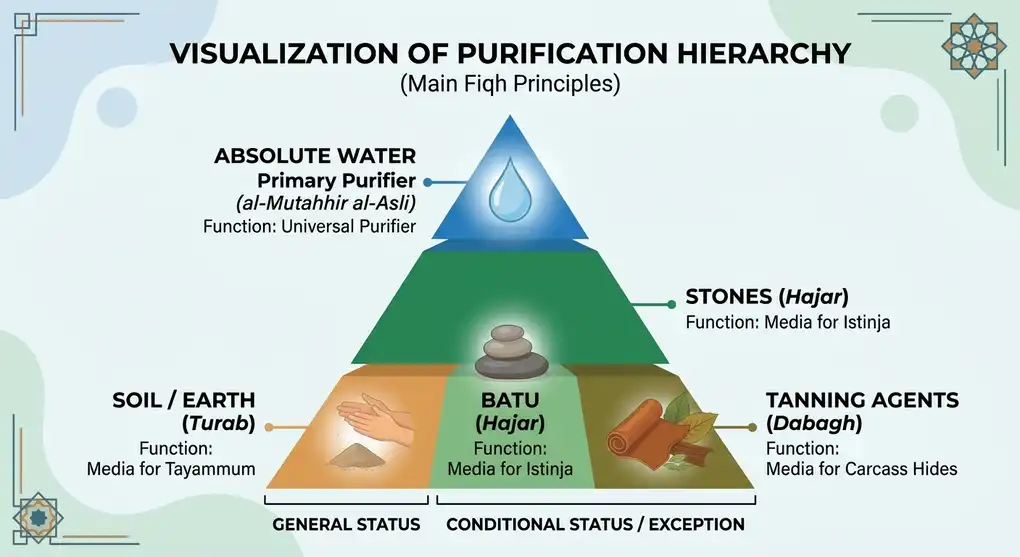
Before looking at the role of soil, stones, and tanning agents, we need the parent rule. The Shafi’i school holds that the general purifier, for both hadath and impurity, is only absolute water (ma’ mutlaq). In everyday speech this is pure and purifying water: only water that is pure and purifying can do both tasks at once.
The Rule as Quoted in Asna al-Mathalib


Allah says {وينزل عليكم من السماء ماء ليطهركم به} (al-Anfal: 11), that He sends water down from the sky to purify you. After citing this verse, the Shaykh al-Islam limits the purifier with the following sentence:
قوله: (الماء المطلق) أي لا غيره من تراب تيمم، وحجر استنجاء، وأدوية دباغ، وشمس، وريح، ونار، وغيرها حتى التراب في غسلات الكلب فإن المزيل هو الماء بشرط امتزاجه بالتراب في غسله منها كما سيأتي في بابه فالجملة مفيدة للحصر بتعريف طرفيها[2]
It means: the purifier is absolute water, and nothing else. This leaves out tayammum soil, istinja stones, tanning agents, the sun, wind, fire, and the like. Even the soil used in washing dog impurity is no exception: what removes the impurity is still water, on condition that the water is mixed with the soil.
The book then explains that this sentence gives the meaning of restriction (hasr), because both of its parts are made definite (ta’rif). So we may not simply hand water’s task to something else.
The Evidence: “Fa lam tajidu ma’an fa tayammamu” and the Hadith of Pouring Water
There are two pieces of evidence for this rule:
- The Qur’an: {فلم تجدوا ماء فتيمموا} (an-Nisa’: 43). Tayammum is ordered only when water is not found.
- The hadith in the two Sahihs: the saying of the Prophet ﷺ when a Bedouin urinated in the mosque, «صبوا عليه ذنوبا من ماء». Dhanub means a bucket full of water.
“Pour a full bucket of water over it.” The Prophet ﷺ ordered water to remove that impurity, not anything else.
Why the Restriction to Water: Ta’abbudi or the Gentleness of Water
The book states that the command in this evidence means obligation. It follows that, if something other than water could lift a hadath, tayammum would not be obligatory when water is missing. Washing urine with water would not be obligatory either.
So why is water alone chosen? Imam Zakariyya reports two reasons:
والأمر للوجوب فلو رفع غير الماء لم يجب التيمم عند فقده، ولا غسل البول به، ولا يقاس به غيره لأن اختصاص الطهر به عند الإمام تعبد، وعند غيره لما فيه من الرقة، واللطافة التي لا توجد في غيره[2]
Meaning: nothing else may be measured against water by analogy. According to al-Imam, water’s exclusive role is ta’abbudi, a rule of worship we follow without demanding its reason. According to other scholars, the reason is water’s gentleness (riqqa) and fineness (latafa), which nothing else has.
Why the Sun, Wind, and Fire Do Not Purify Impurity
From the rule above, the book names three things that are not purifiers: the sun (shams), wind (rih), and fire (nar). Since the Law limits the purifier to water, none of them can replace water in lifting a hadath or removing impurity. Under this rule, impurity is not counted as gone merely because the sun dried it or the wind blew over it.
The rule is wide. Even purification that is only recommended is bound by it:
وإلا فالطهارة المسنونة مثلا كالغسلة الثانية، والثالثة لا تحصل إلا بالماء المطلق[2]
“Recommended purification, such as the second and third washes, is not obtained except with absolute water.”
A Common Objection: “Isn’t Soil a Purifier, Not Water?”
Many people ask: if only water is allowed, why do the Qur’an and hadith call soil a purifier? Imam Zakariyya raises this objection himself.
The Book’s Answer: Soil Lifts Hadath, Not Impurity
فإن قلت بل يحتاج إليه لإخراج التراب فإنه مطهر، وليس بماء قلت مسلم أنه مطهر لكنه مطهر للحدث لا للخبث، والكلام في المطهر لكل منهما مع أن كلامنا في الرافع لا في المبيح فقط[2]
It means: if you say, “Isn’t soil a purifier even though it is not water?”, the answer is that we admit soil is a purifier. But it purifies hadath, not impurity. Our discussion is about the purifier for both. The book adds that the discussion concerns what lifts (rafi’), not merely what permits (mubih).
So there is no contradiction. The book limits only the general purifier to water. Soil still works, but with a narrower reach: hadath only, and only when water cannot be used.
Why the Salaf Did Not Collect Used Water and Turned to Tayammum Instead
The book also brings evidence from the practice of the first generations. In its discussion of used water (ma’ musta’mal: a small amount of water already used for an obligatory act, whether lifting hadath or removing impurity), Imam Zakariyya gives two reasons why such water no longer purifies:
فلا يطهر شيئا لانتقال المنع إليه، ولأن السلف لم يجمعوه في أسفارهم لاستعماله ثانيا مع احتياجهم إليه، وعدم استقذاره في الطهارة بل عدلوا إلى التيمم[2]
It means: that water purifies nothing, because the prohibition (man’) has moved onto it. The salaf also did not collect it on their journeys to use again, though they badly needed water and it was not repulsive. They turned to tayammum instead.
We learn two things from this practice:
- A small amount of used water is not used again for purification, even though the water itself is pure.
- When suitable water is missing, the way out is tayammum, not reusing used water.
This fits the parent rule. Absolute water is the main purifier, and when there is none, the Law provides a limited and clear way out.
Soil in Place of Water for Hadath: Tayammum
Tayammum is the way out when water cannot be used. Imam Zakariyya al-Ansari defines it like this:
قوله: (كتاب التيمم) هو لغة القصد … وشرعا إيصال التراب إلى الوجه واليدين بشرائط مخصوصة وخصت به هذه الأمة وهو رخصة وقيل: عزيمة[3]
It means: in the Law, tayammum is bringing soil to the face and both hands under specific conditions. This ruling was given specially to the community of the Prophet Muhammad ﷺ, and it is a rukhsa (concession). Some scholars call it an ‘azima. The book adds that scholars agree tayammum is only for the face and both hands, even when the hadath is a major one.
The Evidence: Soil Made Pure
قوله {فتيمموا صعيدا طيبا} [النساء: 43] أي ترابا طاهرا وقيل ترابا حلالا وخبر مسلم «جعلت لنا الأرض كلها مسجدا وتربتها طهورا»[3]
- The Qur’an: {فتيمموا صعيدا طيبا} (an-Nisa’: 43). Sa’id tayyib is explained as pure soil. Some explain it as lawful soil.
- The hadith in Muslim: the Prophet ﷺ said, “The earth was made for us entirely a place of prostration, and its soil a purifier.”
Notice that the hadith says turbatuha (its soil), not everything on the earth. We return to this limit when we look at which soils are valid.
The Book’s Conditions for Soil: Pure, Unmixed, and Unused
The book names soil as the first pillar of tayammum, while some scholars count it as a condition. Whatever the label, the qualities of the soil are the same:
قوله: (الأول) من السبعة (التراب الطاهر الخالص) لقوله تعالى {فتيمموا صعيدا طيبا} [النساء: 43] أي ترابا طاهرا وهو متضمن لخلوصه (غير المستعمل) كما في الماء[4]
These three qualities make up the conditions for tayammum dust. We take them one by one.
1. Pure (Tahir)
Soil touched by impurity is not valid for tayammum. The book gives an easy example:
قوله: (ولا بمتنجس كمقبرة تيقن نبشها) لاختلاطها بصديد الموتى[4]
It means: tayammum is not valid with impure soil, such as the soil of a graveyard known to have been dug up, because it is mixed with the pus of the dead. If it is not certain the graveyard was dug up, the soil stays pure by default. The book says such soil is valid to use without disapproval, since it remains pure soil (tanah yang suci).
2. Unmixed (Khalis)
The soil must be unmixed with anything else:
قوله: (ولا بمختلط بدقيق وزعفران ونحوه) أي نحو كل منهما كرمل ناعم يلصق بالعضو (ولو قل) الخليط بأن لم يظهر في التراب لمنعه وصوله إلى العضو لكثافته بخلافه في الماء[4]
It means: soil mixed with flour, saffron, or fine sand that sticks to the skin is not valid, even when the mixture is small and does not show. The reason is that the mixture keeps the soil from reaching the limb because of its density. The book sets this apart from water.
There is one exception. Soil kneaded with vinegar so that it changed, and then dried, is still valid:
قوله: (فلو عجن التراب بخل فتغير) به (ثم جف لم يضر) فيصح التيمم به[4]
3. Unused (Ghayr Musta’mal)
As with water, only unused soil may be used:
قوله: (ولا بمستعمل ولو متناثرا) من العضو بعد مسه كالماء لأنه قد تأدى به فرض[4]
It means: tayammum is not valid with soil already used, even if what was used is only the dust that fell from the limb after wiping. The reason is that an obligation has already been performed with it. Imam ar-Rafi’i adds that fallen dust counts as used only once it has fully separated and the person has turned away from it.
Soils That Are Valid and Invalid
The book lists the kinds of soil with examples. We separate them into valid and invalid.
Valid: Bat’ha and Sabkh Soils
قوله: (بأي لون كان) كما في الماء (فيصح ببطحاء) وهو تراب بمسيل الماء فيه دقاق حصى (وسبخ) بكسر الموحدة وهو ما لا ينبت هذا إذا (لم يعله الملح) فإن علاه لم يصح التيمم به لأن الملح ليس بتراب[4]
- Soil of any color is valid, as with water.
- Bat’ha, soil in a water channel containing fine gravel, is valid.
- Sabkh, soil where nothing grows, is valid as long as salt does not cover it, because salt is not soil.
Clay that was baked and turned black is also valid, on one condition:
قوله: (ولو شوي) الطين (وتسود) فإنه يصح التيمم به إذا سحق لأنه تراب (لا ما صار رمادا أو خرفا أو آجرا) لأنه لا يسمى ترابا[4]
Such clay is valid if it is ground, because it is still soil. But once it has become ash, potsherds, or brick, it is no longer called soil.
Invalid: Sand Without Dust, Nurah, Zirnikh, and Jiss
قوله: (ولا) يصح التيمم (برمل) ولو ناعما (بلا غبار) أو بغبار لكن الرمل يلصق بالعضو بخلافه إذا لم يلصق به … (ولا بمعدن كنورة وزرنيخ) وجص لأنه لا يسمى ترابا[4]
It means: tayammum is not valid with sand without dust, or dusty sand whose grains stick to the limb (unlike when they do not stick). Nor is it valid with minerals such as lime (nura), arsenic (zirnikh), and gypsum (jiss), because none of them is called soil.
The book also gives a reason why this limit makes sense:
ولو جاز التيمم بجميع الأرض لما عدل عنها إلى التراب في خبر مسلم «جعلت لنا الأرض كلها مسجدا وتربتها طهورا» وطهارة التيمم تعبدية فاختصت بما ورد كالوضوء بخلاف الدباغ فإنه نزع الفضول وهو يحصل بأنواع[4]
It means: if tayammum were allowed with the whole earth, the hadith in Muslim would not single out turba (soil) and would simply say “earth”. Tayammum is also ta’abbudi worship: it follows what the evidence names, as wudu does. Tanning is different, because its aim is to strip out residues (naz’ al-fudul), and many materials can do that.
For the full conditions of tayammum dust, including tayammum where there is no soil, read the valid dust for tayammum. A complete guide is on the page tayammum with dust.
Soil in Washing Dog Impurity (Soil Does Not Work Alone)
The second role of soil is in dog impurity. In tayammum, soil deals with hadath; here it deals with impurity. But soil does not work alone. The question is how to remove dog impurity with soil. The book answers through the rule of seven washes.
Dog Impurity: Seven Washes, One of Them with Soil
قوله: (فصل لا يطهر متنجس بكلب، وخنزير، وفرع كل) أي بواحد منها (أو بمتنجس بذلك إلا بسبع) من الغسلات بالماء (إحداهن بالتراب) لقوله صلى الله عليه وسلم «إذا، ولغ الكلب في الإناء فاغسلوه سبع مرات أولاهن بالتراب» رواه مسلم[5]
It means: something touched by a dog, a pig, or the offspring of either is not purified except by seven washes with water, one of them with soil. The basis is the hadith in Muslim: “When a dog licks a vessel, wash it seven times, the first with soil.”
On which wash gets the soil, the book gives two notes. The narrations differ on where the soil goes (the first, the seventh, or an eighth), so its place is not fixed and it is enough that soil is present in one of the seven washes. What is recommended is the first wash:
قوله: (، ويسن) جعل التراب (في غير الأخيرة، والأولى أولى) لعدم احتياجه بعد ذلك إلى تثريب ما يترشش من جميع الغسلات[5]
The reason is that when soil is used in the first wash, splashes from the later washes need no further soiling.
The Role of Soil: What Removes the Impurity Is Still Water
We must read the book carefully here. Soil in this hadith is not a purifier on its own. Imam Zakariyya already made this plain at the opening of the chapter on purity:
فإن المزيل هو الماء بشرط امتزاجه بالتراب في غسله منها[2]
It means: what removes the impurity is water, on condition that it is mixed with soil. So soil is a condition of the washing. The purifier is still water.
Conditions for the Soil: Pure and Unused
A question that often comes up: what soil is used to clean dog impurity? The book answers with these conditions:
قوله: (وليكن التراب) الذي يغسل به ذلك (طاهرا غير مستعمل) في حدث أو خبث كالماء … (يعم محل النجاسة) بأن يكون قدرا يكدر الماء، ويصل بواسطته إلى جميع أجزاء المحل، وليكن (ممزوجا بالماء) قبل وضعهما على المحل أو بعده[5]
From this sentence we take four conditions for the soil used to clean dog impurity:
- Pure: impure soil may not be used.
- Not yet used: soil already used to lift hadath or remove impurity may not be used again.
- Enough of it: enough to cloud the water and reach every part touched by the impurity.
- Mixed with water: soil mixed with water, either before or after the soil is placed on the spot, as long as it is before the wash.
Soil Cannot Be Replaced by Soap or Ushnan
The next question: may soil be replaced by soap because it feels cleaner? The book answers firmly:
ولا يقوم غير التراب كأشنان، وصابون مقامه (وإن أفسد الثوب، وزاد في الغسلات) فجعلها ثمانيا مثلا لأن القصد به التطهير الوارد، وهو لا يحصل بذلك[5]
It means: nothing besides soil takes its place, including ushnan (a traditional cleansing plant) and soap. Soil is still used even if it spoils the cloth and adds to the number of washes, say to eight, because the aim is the purification that was commanded, and that is not reached with anything else.
The book names one combination that is enough: soil mixed first with something else (Ibn as-Salah gives vinegar as an example), then mixed with water. The condition is that the water is not changed too far by that mixture.
Exception: Ground Surfaces Need No More Soiling
قوله:(نجسا آخر، ويسقط تتريب أرض ترابية) … إذ لا معنى لتتريب التراب[6]
It means: when dog impurity lands on natural soil, pouring water seven times is enough with no added soil, since there is no sense in soiling soil.
Dog Impurity Without Soil: What Is the Ruling?
For those looking for how to remove dog impurity without soil, the book’s answer is clear: there is no substitute for soil, and neither soap nor ushnan replaces it. The full method is in the article on how to purify dog impurity.
Stones: The Istinja Tool the Law Permits
A Short Definition of Istinja
Many ask: what does istinja mean? Imam Zakariyya al-Ansari explains the meaning of istinja together with two terms of similar sense:
هو مأخوذ من نجوت الشجرة، وأنجيتها إذا قطعتها كأنه يقطع الأذى عنه … وهو والاستطابة والاستجمار بمعنى إزالة الخارج من الفرج عنه لكن الثالث مختص بالحجر مأخوذ من الجمار وهي الحصى الصغار[7]
It means: istinja, istitaba, and istijmar all mean removing what comes out of the private part. The difference is that istijmar is only with stones, taken from jimar, small pebbles. The word istinja itself comes from najawtu ash-shajara (“I cut the tree”), as if the person cuts the filth away from his body.
Istinja and istitaba apply to both water and stones. Only istijmar is limited to stones. The details of the method are in the article on istinja with stones.
Stones Are Enough Without Water: “Wa Yujzi’u al-Hajar”
The book lays down the basis of istinja in one sentence:
قوله: (يجب الاستنجاء) لا على الفور بالماء على الأصل في إزالة النجاسة أو بالحجر لأنه صلى الله عليه وسلم جوزه به حيث فعله كما رواه البخاري، وأمر بفعله بقوله فيما رواه الشافعي، وغيره «، وليستنج بثلاثة أحجار»[8]
It means: istinja is obligatory, though not at once. It is done with water, as the original way of removing impurity, or with stones. The Prophet ﷺ allowed stones by his action (narrated by al-Bukhari) and ordered them by his words (narrated by ash-Shafi’i), “Let him clean himself with three stones.”
Another hadith supports this:
إذا ذهب أحدكم إلى الغائط فليذهب معه بثلاثة أحجار يستطيب بهن فإنها تجزئ عنه[9]
“When one of you goes to relieve himself, let him take three stones to clean himself. They suffice for him.” From the word tujzi’u (suffice) comes the book’s rule: ويجزئ الحجر في الخارج من المعتاد, “stones suffice for what comes out of the usual passage.”[8]
This answers the question about cleaning without water. The Law allows it, but within clear limits. Stones are not enough in three cases:
- Impurity comes out of another opening than the usual passage, even if the usual passage is blocked: water is required.
- The impurity is broken up, moved from where it came out, goes past the usual limit, or has dried: water is required. The usual limit is the hashafa (head of the penis) for urine and the safhatayn (the two sides of the buttocks that meet when standing) for stool.
- The impurity meets other impurity from outside, or meets something wet: water is required.
قوله: (ويجزئ الحجر) في الخارج من المعتاد لما مر (لا من منفتح) آخر (ولو انسد المعتاد) لندرته بل يتعين فيه الماء على الأصل[8]
The details are covered in the articles on the obligation of istinja and the conditions for istinja with stones.
The Minimum Condition: Three Wipes (Mashat)
Stones are enough only when two conditions are met:
قوله: (ويشترط إنقاء) للمحل بحيث لا يبقى إلا أثر لا يزيله إلا الماء أو صغار الخزف (و) يشترط (ثلاث مسحات، ولو) كانت (بجوانب حجر) للأخبار السابقة، ولخبر مسلم عن سلمان «نهانا رسول الله صلى الله عليه وسلم أن نستنجي بأقل من ثلاثة أحجار»[10]
- Cleanness (inqa’): the place is clean, leaving only a faint trace that only water or small potsherds would remove.
- Three wipes (mashat), which may be made with three sides of one stone.
The evidence is the hadith of Salman al-Farisi: “The Messenger of Allah ﷺ forbade us to clean ourselves with fewer than three stones.” What is counted is the number of wipes, not the number of stones:
وفي معناها ثلاثة أطراف حجر بخلاف رمي الجمار لا يكفي حجر له ثلاثة أطراف عن ثلاث رميات لأن المقصود ثم عدد الرمي، وهنا عدد المسحات[11]
One stone with three sides is enough for three istinja wipes, but not for three throws at the jamarat, because there the number of throws is what counts.
If three wipes have not cleaned the place, add more until it is clean:
قوله: (فإن لم ينق) المحل بالثلاث (زاد) عليها إلى أن يحصل الإنقاء[11]
Once it is clean, it is recommended that the total be odd. If it is clean at the fourth wipe, add one more to make five, based on the Prophet’s ﷺ words «من استجمر فليوتر» (narrated by al-Bukhari and Muslim).[11]
Besides Stones: The Rule for Substitutes
The hadith names stones, but stones are not the only istinja material. The book gives a clear rule for deciding on a substitute for stones.
The General Rule: Solid, Pure, Cleaning, and Not Honored
قوله: (وكل جامد طاهر قالع) غير محترم كما يعلم مما يأتي كخشب، وخزف، وحشيش (كالحجر) في أنه يجزئ الاستنجاء به[12]
It means: anything with these four qualities stands like a stone:
- Solid (jamid): not a liquid.
- Pure (tahir).
- Removes the filth (qali’).
- Not honored (ghayr muhtaram).
Examples in the book: wood, potsherds, and grass.
Why does the word “stone” in the hadith not bind us? The book answers with the story of Ibn Mas’ud:
والتنصيص على الحجر في الأخبار جرى على الغالب بدليل خبر البخاري عن ابن مسعود قال «أتى النبي صلى الله عليه وسلم الغائط فأمرني أن آتيه بثلاثة أحجار فوجدت حجرين، والتمست الثالث فلم أجده فأخذت روثة فأتيته بها فأخذ الحجرين، وألقى الروثة، وقال هذا ركس» فتعليله منع الاستنجاء بالروثة بكونها ركسا لا بكونها غير حجر دليل على أن ما في معنى الحجر كالحجر فيما ذكر[12]
Ibn Mas’ud found two stones and not the third, so he took animal dung. The Prophet ﷺ took the two stones, threw away the dung, and said, “This is riks.” Imam Zakariyya concludes: the Prophet ﷺ rejected the dung because it is impure, not because it is not a stone. So what does the same job as a stone has the same ruling.
The book also explains why substitution is allowed here but not elsewhere:
وفارق تعينه في رمي الجمار، وتعين التراب في التيمم بأن الرمي لا يعقل معناه بخلاف الاستنجاء، والتراب فيه الطاهرية، والطهورية، وهما مفقودتان في غيره بخلاف الإنقاء يوجد في غير الحجر[12]
- Throwing at the jamarat: its meaning cannot be reasoned out, so stones must be used exactly.
- Tayammum: soil has two qualities, being pure and purifying, that nothing else has.
- Istinja: the aim is only to clean (inqa’), and that quality is found in many things besides stones.
What Is Permitted
قوله: (ويجوز) الاستنجاء (بذهب، وفضة، وجوهر) ، وبقطعة ديباج نعم حجارة الحرم، والمطبوع من الذهب، والفضة قال الماوردي والروياني يمتنع الاستنجاء بهما لحرمتهما فإن استنجى بهما أساء، وأجزأه[12]
It means: istinja is allowed with gold, silver, gems, and a piece of silk brocade (dibaj). The exceptions are stones of the Haram and minted gold and silver. According to al-Mawardi and ar-Ruyani, both are forbidden because of their sanctity. If someone uses them anyway, he does wrong, but his istinja is valid.
Some other examples from the book:
قوله: (فيجوز برمانة قالعة لم تكسر و) لكنه (يكره) فإن كسرت، وانفصل حبها فلا كراهة (ويجوز بقشر موز يبس)[13]
- A whole pomegranate whose skin can clean: permitted, but disliked. If it is broken and its seeds have come apart, it is not disliked.
- Dried banana peel: permitted.
- Food meant only for animals: permitted.
- Tanned hide: permitted. Tanning removes its residual fat. Untanned hide is not allowed, because it is still oily and does not dry, and it is impure if it is not from a lawful animal, or honored if it is from a lawful animal.
The hide of carrion is what we look at further in the section on tanning.
What Is Not Valid
Wet (Ratb) and Impure (Mutanajjis) Things
قوله: (لا رطب) لأن رطوبته تنجس بملاقاة النجاسة، ويعود شيء منها إلى محل الخارج فتصير كنجاسة أجنبية (و) لا (متنجس) كما في الطهر بالماء، وللنهي عن الاستنجاء بالروث[12]
A wet thing is not valid because its moisture is made impure by the contact, and some of it returns to the place, becoming extra impurity from outside. A thing that is already impure is also invalid, as in the conditions for water, and because istinja with dung is forbidden.
Slippery Things
قوله: (و) لا (أملس كزجاج، وتراب، وفحم رخوين) لأنه غير قالع بخلاف التراب والفحم الصلبين[12]
A slippery thing such as glass is not valid because it does not clean. Soil and charcoal that are crumbly are also invalid. Soil and charcoal that are hard are valid, because they can remove the filth.
Honored Things (Muhtaram): Food, Bone, Animal Parts, Written Knowledge
قوله: (لا بمحترم كمطعوم) للآدمي كالخبز أو للجن كالعظم كما سيأتي لما روى مسلم «أنه صلى الله عليه وسلم نهى عن الاستنجاء بالعظم، وقال إنه زاد إخوانكم يعني من الجن» فمطعوم الآدمي أولى، ولأن المسح بالحجر رخصة، وهي لا تناط بالمعاصي[14]
Two reasons appear in this quotation:
- The evidence: the Prophet ﷺ forbade istinja with bone because bone is the food of the jinn. If even the jinn’s food is forbidden, human food such as bread is all the more so.
- The rule: wiping with stones is a rukhsa (concession), and a concession is not tied to disobedience.
The book’s list of honored things:
قوله: (لا عظم) ، وإن أحرق حتى خرج عن حاله … (ولا جزء حيوان متصل) كيده وعقبه وصوفه ووبره بخلاف ما إذا انفصل عنه[13]
- Bone, even if burned until its form changed, because it is still food for the jinn.
- Animal parts still attached, such as a hand, a heel, wool, and fur. Once detached, they are allowed.
- Paper with knowledge written on it: «ومن المحترم ما كتب عليه علم كحديث، وفقه», “among the honored is what has knowledge written on it, such as hadith and fiqh.”
If someone has already used an honored thing, stones afterward can still be enough:
قوله: (ويجزئ الحجر بعد) الاستنجاء بشيء (محترم، وزجاج لم ينقلا) النجاسة فإن نقلاها تعين الماء كما مر[13]
The condition is that the first thing did not move the impurity from its place. If the impurity moved, water is required.
The Ban on Rawth (Animal Dung): “Hadha Riks”
Rawth (روث) is animal dung. From Ibn Mas’ud’s hadith above, we know the Prophet ﷺ rejected it. Imam ash-Shirbini explains the meaning of the word he used:
هذا ركس والركس النجس[15]
“This is riks, and riks means impure.” Dung is banned not for its shape but because it is impure, and an impure thing cannot clean another impurity. This rule agrees with the condition of “pure” in the general rule above.
Stones May Be Reused After Washing and Drying
The three wipes need not be with three stones. The book says a stone that has been washed and dried may be used again:
قوله: (أو غسل) الحجر (وجف) فإنه يجوز استعماله ثانيا كدواء دبغ به، وتراب استعمل في غسل نجاسة الكلب[11]
Such a stone is likened to a tanning agent and to soil used in washing dog impurity, both of which may be used again. Even if the stone is not soiled in the second and third wipes, it may be used again without washing:
ولو لم يتلوث الحجر في غير الأولى جاز استعماله أيضا كما صرح به الأصل[11]
This reuse is not disliked. It differs from stones thrown at the jamarat, because the purpose of that throwing is the count of the throws.
Why Stones Are Not “Water”: How They Differ from Washing
Earlier we read that the istinja stone does not belong among the general purifiers:
«قوله: (الماء المطلق) أي لا غيره من تراب تيمم، وحجر استنجاء، وأدوية دباغ».[2]
Stones are still allowed for istinja, but their standing is a concession, not a purifier that replaces water. The book explains the difference:
وفارق الماء بأنه لم يزل حكم النجاسة بل خففها بدليل أنه تنجس ما لاقاها مع رطوبة بخلاف الماء فإنه أزال حكم الحدث[11]
- Water removes the ruling of impurity.
- Stones only lighten the impurity. The sign: if a place wiped with stones touches something wet, that thing becomes impure too.
Stones are also set apart from tayammum soil:
ويفارق تراب التيمم أيضا بأن التراب طهور كالماء، وبدل عنه فأعطي حكمه بخلاف الحجر[11]
Tayammum soil is given the ruling of water because it is a purifier and a substitute for water, while stones are not. This is why the book judges water better when used alone:
قوله: (فإن اقتصر) على أحدهما (فالماء أفضل) لأنه يزيل العين، والأثر[16]
“If only one is used, water is better, because water removes both the substance and the trace.” The best way is to combine the two:
قوله: (والأفضل إتباعه) أي الحجر (بالماء) أي الجمع بينهما بأن يقدم الحجر أفضل من الاقتصار على أحدهما لأن العين تزول بالحجر، والأثر بالماء من غير حاجة إلى مخامرة عين النجاسة[16]
It means: the best is stones first, then water. The stones remove the substance of the impurity, then water removes the trace, without the hand touching the impurity directly. The method of istinja with water, including its recommended acts, is in the article on istinja with water.
Tanning (Dabagh): Tanning Agents as a Purifier of Hides
Why does the hide of carrion need purifying? Because carrion is impure, and so is its hide.
قوله: (و) لا (ميتة) ، وإن لم يسل دمها لحرمة تناولها قال تعالى {حرمت عليكم الميتة} [المائدة: 3][17]
It means: carrion is impure, even if its blood does not flow, because eating it is forbidden. Allah says, “Forbidden to you is carrion” (al-Ma’ida: 3).
A lawful animal slaughtered according to the Law is different. Slaughter preserves the purity of that animal, including its hide:
قوله: (الذكاة) أي الآتي بيانها في محلها (تحفظ طهارة المأكول) حتى جلده لما سيأتي من حل أكله (فقط) أي دون طهارة غير المأكول[18]
Slaughter preserves only the purity of an animal that is lawful to eat, down to its hide. An animal that is not lawful to eat does not become pure by being slaughtered.
So what of the hide of an animal that died without slaughter? This is where the tanning of carrion hide comes in. The book calls it dabagh. The full discussion is in the article on tanning carrion hide.
The Evidence: “Idha Dubigha al-Ihab” and “Yutahhiruha al-Ma’u wal-Qarad”
قوله: (يطهر) أي الاندباغ (جلد غير كلب، وخنزير، وفرعهما) أي فرع كل منهما مع غيره لخبر مسلم «إذا دبغ الإهاب فقد طهر» ، وخبر أبي داود بإسناد حسن «أنه صلى الله عليه وسلم قال في شاة ميتة لو أخذتم إهابها قالوا إنها ميتة فقال يطهرها الماء، والقرظ»[18]
- Narrated by Muslim: “When a hide is tanned, it is pure.”
- Narrated by Abu Dawud (good chain): the Prophet ﷺ said of a dead sheep, “Why do you not take its hide?” They said, “It is carrion.” He ﷺ said, “Water and qarad purify it.” Qarad is a tanning agent commonly used at the time.
Conditions for the Tanning Agent: Draw Out Residues Without Spoiling the Hide
Not every material is a tanning agent. The book gives clear marks:
قوله: (والدباغ) بمعنى الاندباغ (ولو بإلقاء الريح) لما يدبغ فيما يدبغ به أو بالعكس (بحريف) بكسر الحاء (نازع للفضول بحيث لا يفسده)[18]
Three qualities need to be understood:
- Sharp (harif): the tanning agent is pungent or astringent.
- Draws out residues (nazi’ lil-fudul): it removes the fat, blood, and mucus left in the hide.
- Does not spoil it (bi-haythu la yufsiduhu): the book explains this as an agent that does not make the hide smell rotten.
The book reads dabagh as indibagh, the process of the hide becoming tanned. For this reason tanning is valid even if it happens through wind, for instance wind blowing a tanning agent onto the hide, or carrying the hide into the agent.
Valid Even with Impure Things and Without Water
These two points often surprise readers:
قوله: (ولو) كان الاندباغ (بنجس كذرق حمام) بذال معجمة (وبغير ماء) في أثناء الدباغ[18]
It means: tanning is valid even with an impure thing, for example pigeon droppings. Tanning is also valid with something other than water in the middle of the process. This differs from every purification tool we have covered: washing impurity may not use an impure thing, and tayammum may not use impure soil. So why is tanning allowed?
Why Water Is Not Needed: Dabagh Is Ihala (Change of Substance)
ولكون الدبغ إحالة لم يجب فيه الماء، ولهذا جاز بالنجس المحصل لذلك كما تقرر[19]
It means: because tanning is ihala (a change of substance), water is not obligatory. For this reason tanning is also allowed with an impure thing that produces that change.
The book adds another reason in the chapter on istinja:
وإنما جاز الدبغ بالنجس لأنه عوض الذكاة الجائزة بالمدية النجسة بخلاف الحجر[12]
“Tanning is allowed with an impure thing because it stands in for slaughter, which is allowed with an impure knife, unlike a stone.” So washing with water works by cleaning impurity off an object, while tanning works by changing the hide, so any agent that brings about that change can be used.
What Is Not Valid: Merely Salting or Sun-Drying
The book rejects two methods often mistaken for tanning:
لا بتمليح، وتشميس[18]
Salting (tamlih) and sun-drying (tashmis) do not tan. The reason is stated directly:
وقيس به ما في معناه مما يحصل به الإحالة من طاهر، ونجس بخلاف الملح، والشمس، ونحوهما إذ ليس فيها ذلك[18]
What may be used is what produces ihala, whether that agent is pure or impure. Salt and the sun do not have that quality. This agrees with the opening section: the sun does not purify impurity, and sun-drying does not replace tanning.
The Ruling on a Hide After Tanning
A hide is pure after tanning, but there are specific rules about its status. The book names three points.
Like an Impure Garment That Has Been Washed
قوله: (، ويصير) المندبغ (كثوب نجس) في أنه (يصلي فيه إن غسل، ويباع) ، وإن لم يغسل ما لم يمنع مانع (ولا يحل أكله) لخبر الصحيحين «إنما حرم من الميتة أكلها»[20]
A tanned hide has the status of an impure garment in three respects:
- It may be prayed in once washed.
- It may be sold, even unwashed, as long as nothing prevents it.
- It is not lawful to eat, based on the hadith in the two Sahihs, “What is forbidden of carrion is only eating it.”
The book also forbids slaughtering an animal that is unlawful to eat merely for its hide, such as a mule or a donkey:
قوله: (ويحرم ذبح ما لا يؤكل) كبغل، وحمار، ولو (لجلده) أي لدبغ جلده[20]
Hair Does Not Become Pure, A Small Amount Is Excused
قوله: (لا شعره) فلا يطهره الاندباغ لعدم تأثره به[20]
Tanning works only on the hide. Hair or wool does not become pure because it is not affected by tanning. Imam an-Nawawi says a small amount of hair is excused, so it becomes pure as a follower of the hide. Imam as-Subki held another view:
على أن السبكي قال بطهارة الشعر مطلقا أخذ بخبر في صحيح مسلم قال، وهذا لا شك عندي فيه، وهو الذي اختاره، وأفتى به[20]
Imam as-Subki held that hair is pure without restriction, based on a hadith in Sahih Muslim. He said, “I have no doubt about this,” and he chose it and gave his fatwa by it.
The Hides of Dogs, Pigs, and Their Offspring Cannot Be Purified by Tanning
The hides that can be purified by tanning are those of animals other than dogs, pigs, and their offspring. So for those asking is pig skin impure, the book’s answer is yes: tanning does not purify it. The book gives a logical reason:
أما جلد الكلب، ونحوه فلا يطهره ذلك لأن سبب نجاسة الميتة تعرضها للعفونة، والحياة أبلغ في دفعها فإذا لم تفد الطهارة فالاندباغ أولى[20]
Carrion is impure because of its tendency to rot. Life is the strongest guard against rotting. A dog’s hide stays impure even while the animal is alive, so tanning, which only holds off rotting, cannot be stronger than life. The ruling on dog impurity can be read in the article on dog licks and the seven washes.
Tanning and Other Changes of Substance (Istihala)
Tanning belongs to a larger family called istihala, a change in a thing’s nature that changes its ruling. The book gives several examples:
قوله: (ويطهر كل نجس استحال حيوانا) كدم بيضة استحال فرخا على القول بنجاسته (ولو) كان الحيوان (دود كلب) لأن للحياة أثرا بينا في دفع النجاسة … (لا) إن استحال (رمادا، وملحا) ، ونحوهما فلا يطهر[21]
Every impure thing that turns into an animal becomes pure, for example blood in an egg that becomes a chick, because life has a clear effect in repelling impurity. An impure thing that turns into ash or salt stays impure. That means carrion burned to ash does not automatically become pure.
Another example is khamr (wine) that turns into vinegar:
قوله: (وتطهر خمر) ، ولو غير محترمة (تخللت، ولو بتشميس) أو فتح رأس الدن لزوال الشدة من غير نجاسة حلتها[20]
Khamr becomes pure when it turns into vinegar, even when this happens because it was left in the sun or the jar’s mouth was opened. The condition is that no other thing enters and taints it. The full discussion is in the article on istihala in fiqh.
Table of Purification Tools Other Than Water
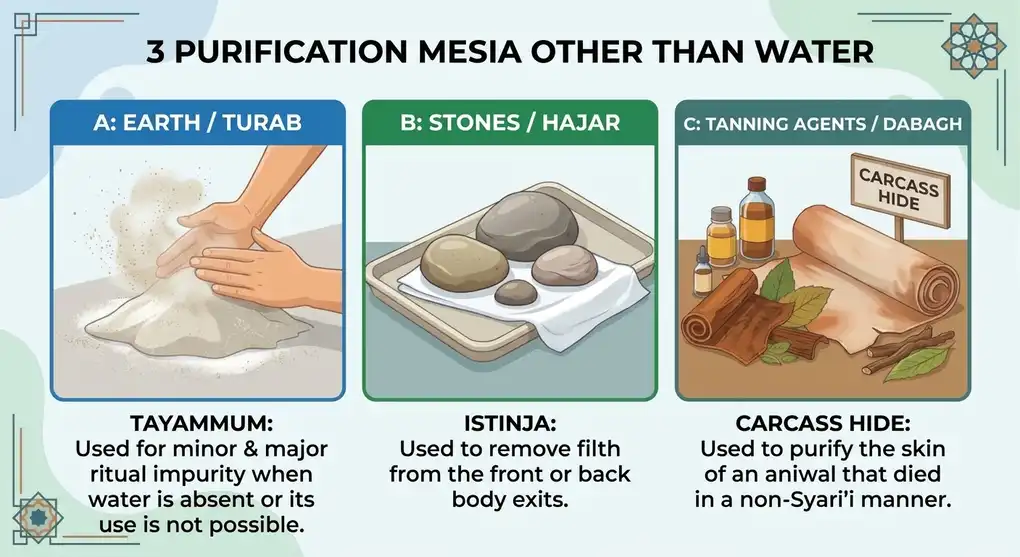
All the purification tools below are allowed by the Law within clear limits. None of them displaces absolute water as the main purifier.
| Tool | Works on | Main conditions | Basis in the book |
|---|---|---|---|
| Soil (tayammum) | Hadath | Pure, unmixed, unused | {فتيمموا صعيدا طيبا} (an-Nisa’: 43) |
| Soil (dog washing) | Dog impurity, together with water | Pure, unused, mixed with water | «أولاهن بالتراب» |
| Stones and solid things (istinja) | Impurity from the front and back passages | Solid, pure, removes filth, not honored, three wipes | «وليستنج بثلاثة أحجار» |
| Tanning agents | Hide of carrion | Sharp, draws out residues, does not rot the hide | «إذا دبغ الإهاب فقد طهر» |
This table shows that purification tools fall into two kinds according to their target: those that lift hadath and those that remove impurity. The three are the materials that can be used for purification besides water, and each works on a different target.
FAQ on Purification Tools Other Than Water
Can soil replace water in removing impurity?
No. The book limits the general purifier to absolute water alone.[2]
- Soil purifies only hadath, and then only through tayammum when water is missing.[2]
- In dog impurity, soil is a condition, while what removes the impurity is still water mixed with soil.[2]
What kind of soil is valid for tayammum?
Tayammum soil must be pure, unmixed, and unused.[4]
- Valid: soil of any color, bat’ha, and sabkh not covered by salt.[4]
- Not valid: sand without dust, and minerals such as lime, arsenic, and gypsum.[4]
What may be used for istinja besides stones?
Anything that is solid, pure, removes filth, and is not honored.[12]
- Permitted: wood, potsherds, grass, gold, silver, gems, and dried banana peel.[12] [13]
- Not permitted: wet or impure things, slippery things, food, bone, animal parts still attached, and paper with religious knowledge written on it.[12] [13]
Is the hide of carrion pure after tanning?
Yes, except the hides of dogs, pigs, and their offspring.[18]
- Conditions for the tanning agent: sharp, draws out residues, and does not rot the hide.[18]
- After tanning, the hide may be prayed in once washed and may be sold, but it is not lawful to eat.[20]
May soap replace soil in washing dog impurity?
No. The book states that nothing takes the place of soil, including soap and ushnan.[5]
- The soil must be pure, unused, and mixed with water.[5]
- Soil is still used even if it spoils the cloth or adds to the number of washes.[5]


