
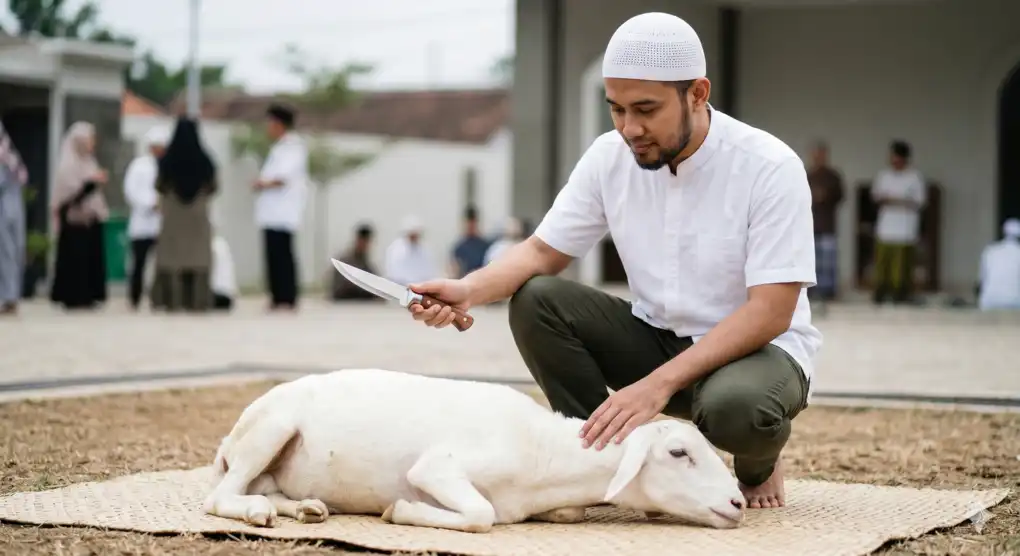
Every year, as Eid al-Adha arrives, millions of Muslims worldwide execute the ritual sacrifice known as qurban (Udhiyah). However, many fail to recognize that the precise manner in which the sacrificial animal is slaughtered determines the validity of this profound act of worship—and fundamentally dictates whether the meat is legally lawful (halal) for human consumption.
Are camels and goats slaughtered using the identical technique? What mandatory or recommended recitations must be pronounced during the cut? What constitutes the correct physical positioning for each type of livestock? All of these practical inquiries are addressed with meticulous detail within the Shafi’i school of law (madhhab) through the classical text Asnā al-Maṭālib authored by the eminent scholar Zakariyyā al-Anṣārī.
This comprehensive article synthesizes the complete statutory regulations governing ritual slaughter (dhakāh) from this authoritative standard reference—spanning the legal prerequisites of the slaughterer, precise cutting techniques, to the highly recommended (sunnah) invocations. For a more exhaustive exploration of the sacrifice, read our complete guide to qurban according to the Shafi’i madhhab and the requirements and age of sacrificial animals.
The Definition of Ritual Slaughter (Dhakāh) in Islamic Shariah
Linguistic and Legal Meaning of Dhakāh
Linguistically, dhakāh (ذكاة) signifies purification, refinement, or completion. In shariah terminology, dhakāh refers to the specific, lawful action that renders an animal’s meat permissible (halal) for human consumption by satisfying all established statutory conditions and structural cuts.
Ritual slaughter (dhabh or nahr) is far more than a simple act of cutting an animal’s neck. It constitutes a structured act of devotion governed by its own essential pillars (arkān), strict prerequisites (shurūṭ), and recommended etiquettes (ādāb).
Legal Foundations of Slaughter in the Qur’an
Allah the Exalted states in Surah Al-An’am [6:118]:
فَكُلُوا مِمَّا ذُكِرَ اسْمُ اللهِ عَلَيْهِ
“So eat of that [meat] upon which the name of Allah has been mentioned.”
Furthermore, Allah commands in Surah Al-Ma’idah [5:4]:
فَكُلُوا مِمَّا أَمْسَكْنَ عَلَيْكُمْ وَاذْكُرُوا اسْمَ اللهِ عَلَيْهِ
“So eat of what they catch for you and mention the name of Allah upon it.”
Why the Slaughtering Procedure Determines the Halal Status of Meat



In Asnā al-Maṭālib, Zakariyyā al-Anṣārī emphasizes that an animal within human control (maqdūr ‘alayh) is strictly unlawful for consumption unless it undergoes a proper, swift execution (tadhfīf). This requires completely severing the entirety of both the ḥalqūm (windpipe/throat) and the marī’ (esophagus/gullet) in a single, continuous cutting motion, provided that the animal possesses stable life (ḥayāt mustaqirrah) at the exact moment the incision begins.[1]
If these fundamental conditions are violated, the animal’s meat is legally classified as carrion (maitah), rendering it completely prohibited (haram) to consume or distribute.
The Two Methods of Slaughter: Nahr and Dzabh
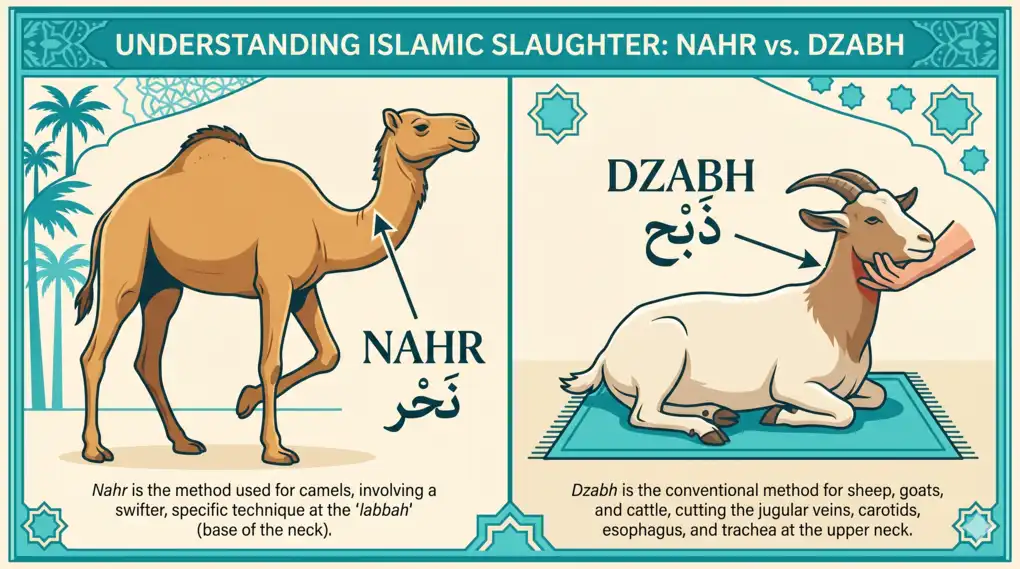
Definition of Nahr — Specifically for Camels and Long-Necked Animals
Nahr (نحر) is the specific method of ritual slaughter performed by swiftly plunging a knife or a specialized sharp weapon into the labbah—which is the distinct hollow depression situated at the base of the neck where it connects directly to the chest (tsughratu asfali al-‘unuq).
This technique is legally mandated as the superior method specifically for camels and all long-necked creatures, such as ostriches and geese. The anatomical rationale is that an elongated neck renders this method far more efficient in rapidly ending the animal’s life and draining the blood compared to standard dhabh.[2]
Definition of Dzabh — For Cattle, Goats, and Similar Animals
Dzabh (ذبح) is the standard method of slaughter executed by making a clean, transverse cut across the upper portion of the neck (a’lā al-‘unuq). This method is prescribed for cattle (cows/bulls), goats, sheep, horses, and wild donkeys.[3]
Scriptural Evidences for Distinguishing Nahr and Dzabh in Jurisprudential Texts
Zakariyyā al-Anṣārī draws directly upon authentic historical narrations compiled by Imams al-Bukhari and Muslim as the foundation for separating these two methods. The Prophet ﷺ and his Companions consistently slaughtered camels via nahr, while executing dhabh upon goats, sheep, and cattle. Read our article on a group sacrifice of a cow by seven people.
Legal Ruling If a Camel is Subjected to Dzabh or a Goat to Nahr
If a camel is slaughtered via dhabh (instead of nahr), or conversely, a goat is slaughtered via nahr, the resulting meat remains perfectly halal and the act is not strictly forbidden or offensive (makruh). However, it is classified as khilāf al-awlā (contrary to the optimal choice). No direct text explicitly bans it, but it runs counter to the strongly encouraged prophetic practice.[4]
Positioning the Animal During Slaughter
Camels: Standing on Three Legs (Shawāff) with the Front Left Leg Bound
The recommended legal posture for a camel during the execution of nahr is to remain standing upright upon three legs, with its front left leg bent backward and securely bound at the knee joint (ma’qūlah fī al-rukbah). This is directly derived from the divine text:
فَاذْكُرُوا اسْمَ اللهِ عَلَيْهَا صَوَافَّ
“So mention the name of Allah upon them lined up [in standing position].” (Surah Al-Hajj [22:36]).
The Companion Ibn ‘Abbas interpreted the word “shawāff” explicitly as “standing upright upon three legs.” The mandatory requirement to bind the front left limb is established by a narration recorded in Sunan Abī Dāwūd with a Sahih chain of transmission matching the standard of Imam Muslim.[5]
In circumstances where a standing slaughter is impossible, it is entirely permissible to perform nahr while the camel is in a resting, kneeling position (bārikah).
Cattle, Goats, and Sheep: Laid Upon Their Left Sides
For cattle, goats, sheep, and similar livestock subjected to dhabh, the established sunnah requires laying the animal down gently upon its left lateral side (muḍja’ah ‘alā janbihā al-aysar). This is grounded in the explicit text found in Ṣaḥīḥ al-Bukhārī detailing the Prophet’s practical method of slaughtering rams, which is then extended via legal analogy (qiyās) to cover all similar livestock.[6]
Wisdom and Evidence Behind Laying the Animal on Its Left Side
The underlying jurisprudential and practical wisdom for prioritizing the left side involves:
- It provides maximum physical ease for a right-handed slaughterer to wield the knife with their dominant right hand while firmly securing the animal’s head with their left hand.
- This positioning is markedly gentler and more comfortable (arfaq) for the animal itself, minimizing stress.
Three Legs Secured, the Rear Right Leg Left Free
When laying the animal down, its limbs should be gently bound to prevent excessive thrashing—thereby shielding the slaughterer from slipping—with the strict exception of the rear right leg. This specific leg must be left entirely unbound and free to move, allowing the animal to naturally extend and flex it as its soul departs, which provides a degree of physical relief.[7]
Prerequisites of the Slaughterer (Al-Dzābiḥ)
The Slaughterer Must Be a Knowledgeable Muslim or a Person of the Book (Ahl al-Kitāb)
For any ritual slaughter to be valid under Shariah, the slaughterer must belong to one of the following two groups:
- A Muslim who is knowledgeable (faqīh): One who understands the core rules of qurban, its mandatory components, and slaughtering boundaries. This is the most excellent and recommended option.
- A Person of the Book (Ahl al-Kitāb): Specifically a free Jew or Christian whose ancestral lineage adheres to these faiths. Their slaughter is legally valid because they belong to a group whose marriages are recognized and whose meat is explicitly permitted by the Qur’an.
It is strictly prohibited to delegate the sacrifice to Magians (Zoroastrians), idolaters, or apostates (murtadd); meat cut by them is unlawful carrion.[8]
Rulings on Slaughter by Intoxicated Persons, the Insane, or Minors
Delegating the slaughter to a discerning child (ṣabī) or a visually impaired person is legally offensive (makruh), rather than strictly forbidden (haram). However, if forced to choose between the two, employing a Muslim child is vastly superior to employing a non-Muslim Person of the Book.
As for delegating the task to a menstruating woman (ḥā’iḍ) or a woman experiencing post-natal bleeding (nufasā’), it is not deemed makruh in the Shafi’i madhhab, though it remains khilāf al-awlā.[9]
Recommendation for the Animal Owner to Perform the Slaughter Personally
It is highly meritorious for the owner of the sacrificial animal (ṣāḥib al-uḍḥiyah) to execute the physical slaughter themselves, in direct emulation (ittibā’) of the Messenger of Allah ﷺ as recorded in Ṣaḥīḥ al-Bukhārī and Ṣaḥīḥ Muslim. Because qurban is an act of devotional proximity (taqarrub), performing it personally is superior.[10] And it is recommended (Sunnah) to eat a few bites of the sacrificial animal, as explained in the article regarding the division of Qurban meat into thirds.
For women, hermaphrodites (khunthā), individuals incapacitated by severe illness, or the visually impaired, it is highly recommended to appoint a qualified proxy to perform the cut.
Delegating the Slaughter to an Agent (Tawkīl)
The owner is fully empowered to delegate the slaughtering task to an agent (tawkīl). In instances of delegation, it remains highly recommended for the owner to be physically present to witness the process. The scriptural proof lies in the Prophet’s explicit command to his daughter Fatimah (radhiyallāhu ‘anhā):
“Stand up and witness your sacrifice, for indeed, with its first dropping of blood, Allah forgives your past sins.” (Reported by al-Ḥākim, who authenticated its chain)[11]
The Mandatory Anatomical Structures to Be Severed
The Compulsory Severing of the Ḥalqūm (Windpipe) and Marī’ (Esophagus)
Severing these two internal structures completely is an absolute, non-negotiable prerequisite for the meat to be halal. Zakariyyā al-Anṣārī declares:
وَلَا يَحِلُّ حَيَوَانٌ مَقْدُورٌ عَلَيْهِ… إِلَّا بِالتَّذْفِيفِ بِقَطْعِ جَمِيعِ الْحَلْقُومِ وَالْمَرِيءِ
“An animal within human control is not lawful… except through a swift slaughter consisting of severing the entirety of the ḥalqūm and the marī’.”
- Ḥalqūm (حَلْقُوم): The respiratory tract (the tube through which air enters and exits).
- Marī’ (مَرِيء): The digestive tract (the channel through which food and fluids pass).[12]
If either of these two structures is not fully cut, or if even a tiny thread of either remains intact at the moment the animal passes away, the animal is legally deemed carrion (maitah) and its consumption is completely forbidden.[13]
The Sunnah of Severing the Two Jugular Veins (Wadajain)
The wadajayn (ودجين) are the two primary lateral blood vessels flanking the windpipe and esophagus on both sides of the neck. Severing them during the cut is a highly recommended sunnah, not a strict obligation (wājib), because these blood vessels can sometimes be removed without causing immediate death, meaning they do not form a primary condition of kehalalan.
The core benefit of slicing the wadajayn is that it accelerates exsanguination, thereby ensuring an immediate, humane death.[14]
Legal Ruling If Only One Jugular Vein is Severed
If the slaughterer limits the incision strictly to the mandatory structures (the ḥalqūm and marī’) while omitting or only slicing one of the wadajayn, the slaughter remains fully valid and halal. However, the most perfect method is to slice all four structures simultaneously in a single swift stroke.
Supplications and Recitations During Slaughter
The Mention of Allah’s Name (Tasmiyah): A Highly Recommended Sunnah
In Asnā al-Maṭālib, reciting the tasmiyah (pronouncing Bismillāh) during the incision is a sunnah, not an absolute obligation. Intentionally leaving it out is disliked (makruh), but it does not invalidate the halal status of the meat under the Shafi’i madhhab.[15]
The scriptural proof is Surah Al-An’am [6:118] and a narration in Ṣaḥīḥ al-Bukhārī from ‘Aishah (radhiyallāhu ‘anhā), where the Prophet ﷺ clarified that invoking Allah’s name is an injunction signifying a recommendation rather than a binding obligation.
The Sunnah of Reciting the Takbir Three Times Before and After the Tasmiyah
It is sunnah to pronounce the takbīr three times both before and after the tasmiyah:
اللهُ أَكْبَرُ، اللهُ أَكْبَرُ، اللهُ أَكْبَرُ، وَلِلهِ الْحَمْدُ
Allāhu akbar, Allāhu akbar, Allāhu akbar, walillāhil-ḥamd.
“Allah is the Greatest, Allah is the Greatest, Allah is the Greatest, and to Allah belongs all praise.”
This practice is rooted in a narration by Imam Muslim stating that the Prophet ﷺ uttered “Bismillāh wallāhu Akbar” during his sacrifice, and classical commentaries confirm that the takbīr is likewise repeated after sending blessings upon the Prophet ﷺ.[16]
The Sunnah of Sending Blessings Upon the Prophet ﷺ
Invoking blessings (ṣalawāt) upon the Prophet Muhammad ﷺ during the slaughter is a recommended sunnah. The underlying reasoning is that the moment of slaughter is a time wherein remembrance (dhikr) of Allah is highly encouraged, and mentioning His Messenger ﷺ is a natural extension of that remembrance, analogous to its role in the adhān and prayers.[17]
Intentionally omitting the ṣalawāt is also considered makruh.
Specific Supplications for the Qurban Sacrifice
Following the takbīr and tasmiyah, it is sunnah to recite the following specific invocation:
اَللَّهُمَّ مِنْكَ وَإِلَيْكَ فَتَقَبَّلْ مِنِّي
Allāhumma minka wa ilaika fataqabbal minnī.
“O Allah, this is from You and to You, so accept it from me.”
This prayer signifies: “O Allah, this animal is a bounty granted entirely by You, and its slaughter is executed solely to draw closer to You.”[18]
Furthermore, the precise supplication narrated from the Prophet ﷺ when he offered his own sacrifice is:
بِسْمِ اللهِ، اَللَّهُمَّ تَقَبَّلْ مِنْ مُحَمَّدٍ وَآلِ مُحَمَّدٍ وَمِنْ أُمَّةِ مُحَمَّدٍ
Bismillāh, Allāhumma taqabbal min Muḥammadin wa āli Muḥammadin wa min ummati Muḥammad.
“In the name of Allah. O Allah, accept from Muhammad, from the family of Muhammad, and from the ummah of Muhammad.”[19]
Alternative Supplications Noted by the Jurists
In a text cited by Imam al-Rāfi’ī, scholars note that it is not offensive to recite:
تَقَبَّلْ مِنِّي كَمَا تَقَبَّلْتَ مِنْ إِبْرَاهِيمَ خَلِيلِكَ وَمُوسَى كَلِيمِكَ وَعِيسَى رُوحِكَ وَمُحَمَّدٍ عَبْدِكَ وَرَسُولِكَ
Taqabbal minnī kamā taqabbalta min Ibrāhīma khalīlika wa Mūsā kalīmika wa ‘Īsā rūḥika wa Muḥammadin ‘abdika wa rasūlika.
“Accept from me just as You accepted from Ibrahim Your intimate friend, Moses whom You spoke to directly, Jesus Your spirit, and Muhammad Your servant and Messenger ﷺ.”
While permissible, this specific formulation is not heavily emphasized because it requests a level of acceptance equal to that of the Prophets, whereas ordinary creation cannot match their exceptional status in merit.[20]
For an aqīqah sacrifice (celebrating a newborn), the recommended supplication is:
اَللَّهُمَّ لَكَ وَإِلَيْكَ عَقِيقَةُ فُلَانٍ
Allāhumma laka wa ilaika ‘aqīqatu [fulan].
“O Allah, this is for You and to You, the aqīqah of [mention the child’s name].” [21] (Read the Shafi’i guide on aqīqah for more).
Recommended Etiquettes (Ādāb) of Slaughter
Utilizing an Exceptionally Sharp Knife
The Messenger of Allah ﷺ stated (as recorded in Ṣaḥīḥ Muslim):
“When you slaughter, excel in slaughtering. Let one of you sharpen his blade and give relief to his sacrificial animal.”
A sharp blade ensures an instantaneous death and minimizes physical suffering. If a knife is so dull that slaughter can only be achieved through heavy, violent sawing pressure, the validity of the slaughter is legally compromised.[22]
Refraining from Sharpening the Blade in the Animal’s Presence
It is strictly discouraged to sharpen knives directly in front of the animal selected for slaughter. This embodies the essential mercy mandated toward Allah’s creation and prevents the animal from experiencing psychological distress prior to its death.[23]
Leading the Animal Gently to the Slaughter Site
Livestock must be guided to the slaughter site calmly and gently (bi-rifqin). They must never be dragged roughly, pulled by their ears or horns, or beaten.
Providing Drink Prior to Slaughter
It is highly recommended to provide the animal with water to drink before commencing the slaughter. This constitutes an act of iḥsān (excellence/kindness) toward animals, aligning with the comprehensive prophetic injunction to show kindness in every circumstance.[24]
Concealing the Slaughter from Other Animals
It is forbidden to slaughter an animal in front of other animals that are penned or waiting for their turn. This induces profound fear and psychological trauma in the remaining livestock.[25]
Facing the Kiblah
It is a recommended sunnah to position the animal toward the direction of the Kiblah during slaughter, and the slaughterer should likewise face the Kiblah. However, the animal’s face itself should not be forced directly toward the Kiblah in a manner that prevents the slaughterer from maintaining a perfect, stable stance facing the Kiblah.
This etiquette is far more emphasized for qurban and pilgrimage sacrifices (hadyu) than for ordinary daily meat production.[26]
Avoiding Pre-Mortem Slicing or Dismemberment
Four actions are highly recommended to be completely avoided after the throat-cut until the animal’s body has completely cooled down and life has fully departed:
- Do not sever the head completely (jangan memisahkan kepala).
- Do not skin or flay the hide (jangan menguliti).
- Do not move the animal to another location (jangan memindahkan ke tempat lain).
- Do not forcefully restrain the animal from free thrashing (jangan menahan hewan dari meronta).
Engaging in these practices prior to the total cessation of life is highly disliked (makruh).[27]
Strict Prohibition of Breaking the Neck Bone or Flaying Before Complete Death
The text of Asnā al-Maṭālib explicitly clarifies that it is impermissible to snap the cervical spinal cord, amputate limbs, or begin skinning the animal before its body has fully cooled down (signaling absolute death).[28]
Emergency Slaughtering Methods (Dzabāih al-Dharūrah)
Animals That Have Fallen, Sustained Severe Injury, or Become Inaccessible
If an animal is severely wounded by a sharp object or trapped under debris, yet still possesses stable life (ḥayāt mustaqirrah)—which is legally indicated by robust reflex movements or forceful blood spurts—and is then reached and slaughtered, its meat is perfectly halal.
If its life is no longer stable (i.e., it is in its final death throes), subsequent slaughter does not render the meat lawful.[29]
Emergency Wounding of Any Viable Body Part in Uncontrollable Situations
In a state of absolute necessity where an animal has broken free and cannot be restrained for a standard neck cut, piercing or wounding it with a sharp weapon in any accessible part of its body—provided it punctures deep enough to cause fatal blood loss while stable life exists—renders the animal halal. However, if a regular cut is attempted from the back or side of the neck, it remains halal only if the blade successfully reaches and cuts the ḥalqūm and marī’ while stable life is intact. If it fails to sever them before death, it is deemed carrion.[30]
Continuous Requirement of the Tasmiyah
Even in emergency or distress slaughter conditions, pronouncing the tasmiyah remains a recommended sunnah. Intentionally omitting it remains makruh, though it does not compromise the legal kehalalan of the meat under the Shafi’i madhhab.
Prohibited Categories of Slaughter
Slaughtering for Other Than Allah (Idols, Jinn, or Rulers as Ritual Homage)
It is strictly forbidden (haram) to slaughter an animal as an act of devotion (taqarrub) to anyone or anything other than Allah. This includes:
- Slaughtering for stone idols (ṣanam).
- Slaughtering for ancient mythological deities.
- Slaughtering as a ritual homage to welcome a political ruler or dignitary upon their arrival (taqarruban ilā al-sulṭān).
If the slaughter is executed as an act of worship or divine veneration for an entity other than Allah, it can expel the perpetrator from the fold of Islam into outright disbelief (kufr).[31]
Crucial Distinction: Welcoming Guests vs Ritual Veneration
Islamic jurisprudence draws a vital distinction between two intents:
- Slaughtering to honor a guest: Slicing meat to feed and joyfully welcome an arriving human guest is perfectly permissible and commendable (lā ba’sa bihi). It is akin to preparing food for celebration, similar to an aqīqah for a newborn child.
- Slaughtering as a ritual devotion to a ruler: Slaughtering an animal specifically at the feet of a ruler as an act of ritual submission or spiritual exaltation is strictly haram because it mimics the pagan veneration reserved exclusively for God.[32]
Slaughtering to Ward Off Jinn
Slaughtering livestock with the intent of offering a pacifying blood sacrifice to appease or seek protection from the jinn is strictly haram. However, if the act is reframed with a correct monotheistic intention—meaning one slaughters an animal solely for Allah and distributes its meat to the poor as an act of charity, praying that Allah shields them from the malice of the jinn—then it is fully permissible.[33]
Conclusion — Summary Table of Jurisprudential Rules for Slaughter
| Jurisprudential Aspect | Statutory Legal Regulation (Shafi’i Madhhab) |
|---|---|
| Method for Camels | Nahr (plunging blade into the labbah / base hollow of the neck) |
| Method for Cattle & Goats | Dzabh (transverse cut across the upper portion of the neck) |
| Recommended Recitations | Tasmiyah + Takbīr 3x + Ṣalawāt + Sacrificial Supplication |
| Positioning for Camels | Standing on three legs, front left leg bent and bound at the knee |
| Positioning for Cattle/Goats | Laid gently on the left side, three legs bound, rear right leg free |
| Valid Slaughterer | A practicing Muslim or a chaste Person of the Book (Ahl al-Kitāb) |
| Mandatory Anatomical Cuts | Ḥalqūm (windpipe) + Marī’ (esophagus) must be completely severed |
| Recommended Auxiliary Cuts | The two jugular veins (wadajayn) |
| Prohibited Slaughter | Sacrificing for other than Allah (idols, jinn, or ritualistic homage to rulers) |
FAQ: Frequently Asked Questions Regarding Qurban Slaughter
1. Is the recitation of the basmalah mandatory when slaughtering a qurban animal?
According to the Shafi’i school of law as articulated in Asnā al-Maṭālib, reciting the basmalah (tasmiyah) at the moment of slaughter is a highly recommended sunnah, not a mandatory obligation (wājib). Intentionally omitting it is considered offensive (makruh), yet the meat remains completely halal. Pronouncing the takbīr and sending ṣalawāt upon the Prophet ﷺ are likewise highly encouraged sunnah actions.
2. Is it permissible to delegate the qurban slaughter to a non-Muslim?
It is legally permissible to delegate the task only to a qualified Person of the Book (Ahl al-Kitāb—a practicing Jew or Christian). It is strictly forbidden to delegate the slaughter to a Magian, an idolater, or an apostate, as their slaughtered meat is legally invalid and unlawful under Shariah.
3. Is facing the Kiblah an absolute requirement during slaughter?
Directing both the animal and the slaughterer toward the Kiblah is an established sunnah, not an absolute obligation. This practice is significantly more emphasized for ritual sacrifices like qurban and hadyu than for ordinary commercial slaughter.
4. What is the ruling if the animal thrashes violently after being cut?
Violent reflex movements by the animal immediately following the cut are completely normal and have no negative bearing on the halal status of the meat. In fact, robust movement and a forceful jet of blood following the severing of the ḥalqūm and marī’ serve as reliable indicators that stable life (ḥayāt mustaqirrah) was present when the cut began. What is discouraged is manually pinning down the animal to forcefully prevent it from thrashing before it has fully cooled down.
5. Is it permissible to slaughter sacrificial animals at night?
Slaughtering livestock at night is generally deemed offensive (makruh), and this dislike is magnified in the context of qurban. The primary reasons are that darkness increases the likelihood of a slaughterer making a structural error during the cut, and the poor and needy cannot easily gather to receive the fresh meat at night as they would during the day. However, if a pressing necessity arises—such as fearing the animal will die of an ailment before morning or the sudden arrival of guests—the offensiveness is entirely lifted. Read more on the time for Qurban slaughter: start and end limits.
Footnotes
Reference:
Zakariyā al-Anṣārī, Asnā al-Maṭālib fī Sharḥ Rawḍ al-Ṭālib, with a ḥāshiyah (marginal gloss) by Aḥmad al-Ramlī, edited by Muḥammad az-Zuhrī al-Ghamrāwī (Cairo: al-Maṭbaʿah al-Maymānīyah, 1313 AH; repr. Dār al-Kitāb al-Islāmī), Vol. 1, pp. 537-541.


