

The Maghrib adhan has just been called. On the dining table, a warm meal is already served. Your stomach is hungry. Almost everyone has experienced a situation like this. Then arises a seemingly simple question that often causes confusion: should you pray first or eat first?
This question is not about wanting to belittle the prayer, but about understanding the correct fiqh principles. The Shafi’i school, through the book Asna al-Mathalib by Shaykh Zakariyya al-Anshari, provides a detailed and reassuring answer.
The General Rule: Hastening Prayer at the Beginning of Its Time is Afdhal
Before discussing exceptions, it is important to understand the original rule. In Shafi’i fiqh, hastening the prayer at the beginning of its time is the most virtuous (afdhal) — applicable to all prayer times, including Isha. A complete explanation of the evidence can be found in the article “Why is Praying at the Beginning of Its Time More Afdhal?“
Quranic Evidence — The Command to Guard Prayers
Allah ﷻ says in Surah Al-Baqarah: 238:
{حَافِظُوا عَلَى الصَّلَوَاتِ}
“Guard strictly (all) your prayers.”
Shaykh Zakariyya al-Anshari affirms in Asna al-Mathalib that one of the tangible forms of guarding the prayer is hastening it (ta’jil). Guarding something does not only mean not abandoning it, but also not neglecting its time.[1]
The Hadith of Ibn Mas’ud — The Most Virtuous Deed
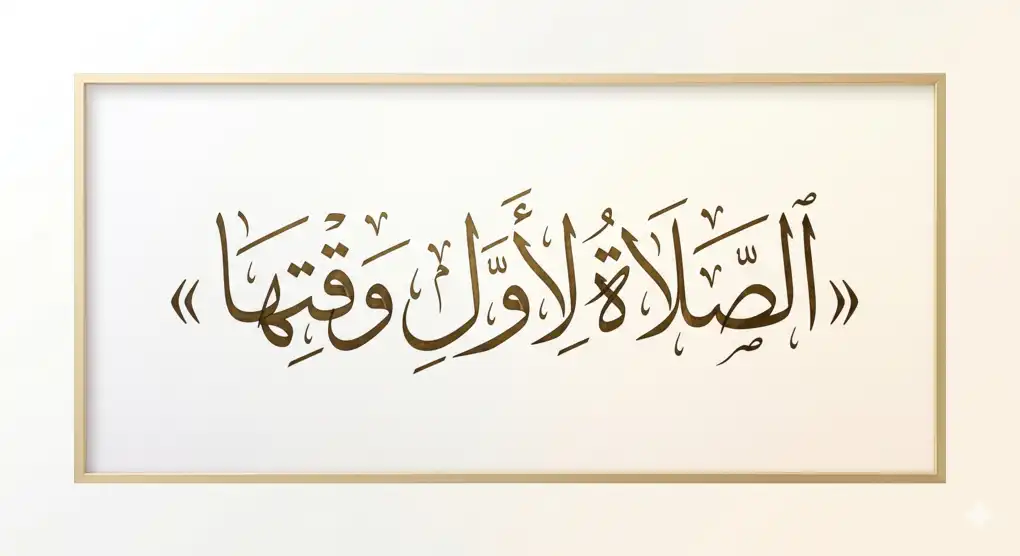
The next evidence is the hadith narrated by Ibn Mas’ud رضي الله عنه:
«سَأَلْتُ النَّبِيَّ ﷺ أَيُّ الْأَعْمَالِ أَفْضَلُ؟ قَالَ: الصَّلَاةُ لِأَوَّلِ وَقْتِهَا»
“I asked the Prophet ﷺ: ‘Which deed is the most virtuous?’ He answered: ‘Prayer at the beginning of its time.'” — Narrated by al-Daraqutni and others, and they authenticated it.[2]
This hadith is clear: praying at the beginning of its time is the best deed, surpassing other noble deeds.
What is the Meaning of “Afdhal at the Beginning of Its Time”?




It must be understood that “afdhal” here means virtue (fadhilah), not an absolute obligation. The prayer remains valid and is not sinful if performed at any time as long as its time has not expired — subject to terms and conditions that will be explained. Read the article on the conditions for the validity of prayer for further understanding.
The difference lies in the level of reward and status in the sight of Allah ﷻ. Performing the prayer at the beginning of its time achieves the highest rank. Delaying it — as long as it is still within the permissible time — remains valid, but one misses out on that virtue.
Is It Permissible to Delay Prayer to Eat? The Answer of Asna al-Mathalib
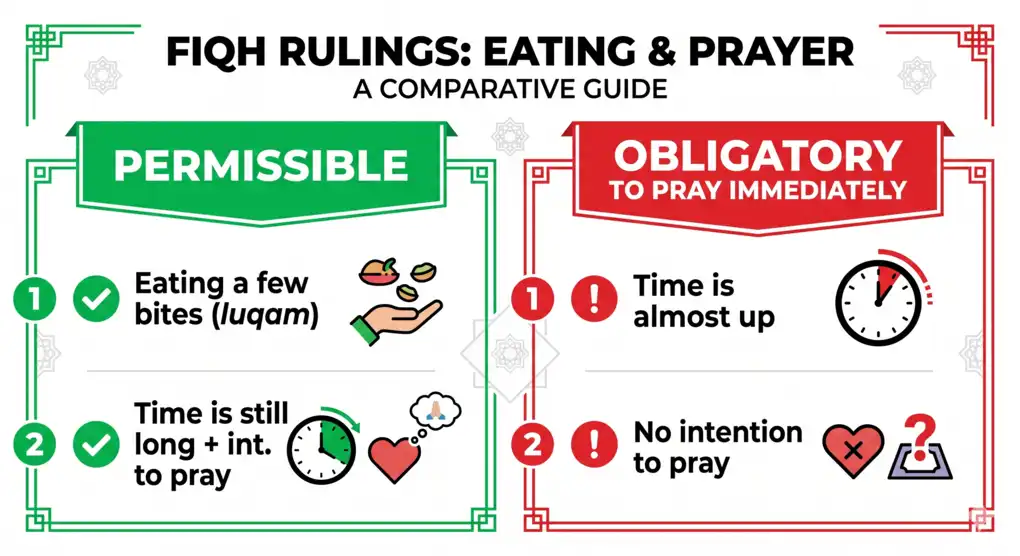
This is the core of the most searched question. Shaykh Zakariyya al-Anshari provides a very clear answer in his book.
Text of Asna al-Mathalib — “It is Not Detrimental to Delay for a Few Bites”
The original text states:
«وَلَا يُكَلَّفُ عَجَلَةً غَيْرَ الْعَادَةِ وَلَا يَضُرُّ التَّأْخِيرُ لِأَكْلِ لُقَمٍ وَكَلَامٍ قَصِيرٍ»
“A person is not burdened to rush beyond their usual habit. And it is not detrimental (to the virtue of the beginning of the time) to delay the prayer to eat a few bites, or to speak briefly.”[3]
The phrase “لَا يَضُرُّ” (not detrimental) here does not merely mean “it is just permissible.” This is a firm statement that the virtue of praying at the beginning of its time is not lost simply because one delays for a moment to eat a few bites.
What is Meant by “لُقَم” (Luqam / A Few Bites)?
The term “لُقَم” is the plural form of luqmah (a bite/morsel). This refers to a few bites of food — not a full plate, not eating until full, and not a complete banquet.
This is a proportional measure and does not cause a long delay from the beginning of the prayer time. The point is: eat just enough so that the stomach no longer disrupts concentration, then pray immediately.
Other Things That Allow Prioritization
The book Asna al-Mathalib also mentions several other similar conditions — it is not detrimental to the virtue of the beginning of the time if someone delays the prayer because of:
- Ensuring the entry of the prayer time (تَحَقُّق دُخُول الوَقْت) — for those who doubt whether the time has truly entered.
- Obtaining water for wudu (تَحْصِيل المَاء) – obtaining water for wudu.
- Removing urgent filth (إِخْرَاج خَبَثٍ يُدَافِعُهُ) — when someone wants to relieve themselves or there is filth that needs to be cleaned immediately.
- Speaking briefly (كَلَام قَصِير) — for example, finishing a brief, important matter.[4]
An Important Principle — Khusyu’ (Devotion) as a Consideration

Behind the provisions above, there is a major principle that binds them all: khusyu’ (devotion and focus) in prayer is the primary consideration.
The Analogy of Ibrad and Desired Food
Asna al-Mathalib discusses the ruling of ibrad — delaying the Zuhr prayer when the weather is very hot so that the congregation coming from afar is not tormented. Then, this book uses a highly relevant analogy:
«كَمَنْ حَضَرَهُ طَعَامٌ يَتُوقُ إِلَيْهِ»
“(Like) a person who has food presented before him and he desires it.”[5]
This means: if there is something that disrupts the khusyu’ of the prayer — whether it is the scorching heat or appetizing food — the sharia provides a concession to wait for a moment.
A prayer performed with thoughts drifting to the dish on the dining table is clearly imperfect. Therefore, eating a few bites first so one can pray calmly and with khusyu’ is a choice supported by this sharia principle. Understand the provisions and guidelines of fard prayer so that your prayer is valid and accepted.
Not Burdened to Rush Beyond Habit
Another important principle is also enshrined in the same text:
«وَلَا يُكَلَّفُ عَجَلَةً غَيْرَ الْعَادَةِ»
“A person is not burdened to rush beyond their normal habit.”[6]
This means someone is not obligated to abandon all their activities abruptly and run to the prayer place as soon as the adhan echoes. The existing obligation is to perform the prayer within its time — in a reasonable manner and according to general human habits.
When is it Haram to Delay Prayer?
The concession above is not without limits. Asna al-Mathalib also affirms the conditions where delaying the prayer becomes haram.
If It is Feared the Prayer Time Will Expire
This is the most important boundary. If a person eats until the prayer time is almost up, or there is a strong fear that continuing to eat will cause the prayer to be missed, then it is obligatory to stop eating and pray immediately.
The book Asna al-Mathalib emphasizes that taking a portion of the prayer out of its time causes a sin, even though the prayer is still counted as ada’ (within the time) if there is still time for one rak’ah.[7]
If Delaying Without the Intention (Azzam) to Pray at All
Asna al-Mathalib explains that the obligation of prayer is muwassa’ (flexible) — meaning it can be performed at any time as long as its time has not expired. However, there is an important condition:
«لَا يَأْثَمُ بِتَأْخِيرِهَا إِلَى آخِرِهِ إِنْ عَزَمَ فِي أَوَّلِهِ عَلَى فِعْلِهَا فِيهِ»
“One does not sin by delaying it until the end of the time, provided that they intend (azzam) at the beginning of the time to perform it within it.”[8]
Therefore, anyone who delays the prayer is obligated to have a firm intention and determination to perform it within that time. If one delays without any intention to pray at all, then delaying the prayer beyond its time is ruled as a sin.
Practical Legal Conclusion — A Brief Guide

Here is a summary of the rulings based on various possible conditions:
| Condition | Ruling |
| Eating a few bites (luqam), then praying immediately | Permissible — the virtue of the beginning of the time is not lost. |
| Eating until full, prayer is still far from the deadline | Permissible — but leaves the virtue of the beginning of the time. |
| Eating while not intending to pray within that time | Sinful — if the prayer time is missed. |
| Eating until the prayer time is almost expired | Obligatory to stop and pray immediately. |
| Eating until the prayer time is completely expired without a valid excuse | Sinful — the prayer must be made up (qadha) immediately. |
Footnotes
FAQ: Questions About Praying First or Eating First
1. Is there a hadith that specifically allows eating before praying?
In the reference of Asna al-Mathalib used in this article, the legal basis is the fiqh principle of maintaining khusyu’ (devotion) in prayer — not a hadith that specifically mentions “eating before prayer”. The analogy used is the principle of ibrad (delaying prayer during scorching heat) which aims to maintain khusyu’, and the principle that delaying for luqam (a few bites) does not destroy the virtue of the beginning of the time.
2. How many “few bites” are allowed before praying?
The book Asna al-Mathalib uses the term luqam — plural of luqmah (a bite/morsel). This refers to eating just enough so as not to disrupt khusyu’, not eating until full or finishing a full plate. The measure is that which does not cause a long delay from the beginning of the prayer time.
3. Does this concession apply to all prayer times, including Fajr (Subuh)?
Based on Asna al-Mathalib, the principle of the virtue of the beginning of the time applies to all prayers, including Isha. Thus, the concession of delaying for luqam also applies to all prayer times. The important thing is that the prayer is still performed within its time.
4. What if you are eating with guests or family and the adhan echoes?
Asna al-Mathalib asserts that a person is not burdened to rush beyond their normal habit (لَا يُكَلَّفُ عَجَلَةً غَيْرَ الْعَادَةِ). Eating with guests in normal conditions is included in this concession — as long as the prayer is still performed within its time and there is an intention to perform it within the time.
5. Is someone sinful if they delay the prayer even though there is still plenty of time?
It is not sinful, provided that they have the determination (azzam) at the beginning of the time to perform it before the time runs out. Asna al-Mathalib affirms: “One does not sin by delaying it until the end of the time, provided they intend at the beginning of the time to perform it within it.” Without such an intention, a person can be sinful even if the time has not yet expired.
Reference
Zakariyā al-Anṣārī, Asnā al-Maṭālib fī Sharḥ Rawḍ al-Ṭālib, with marginalia by Aḥmad al-Ramlī, edited by Muḥammad az-Zuhrī al-Ghamrāwī (Cairo: al-Maṭbaʿah al-Maymānīyah, 1313 AH; repr. Dār al-Kitāb al-Islāmī), vol. 1, pp. 118-120.


