

The time for Dhuhr prayer has commenced. Due to a brief errand, there was no time to perform ablution (wudu)—then menstruation suddenly begins. A question immediately arises: is the Dhuhr prayer simply waived? Or does an obligation to make it up (qada) remain after becoming pure? For a deep understanding of the meaning of prayer, read the complete guide to obligatory prayers.
This is no trivial question. The answer depends on one crucial detail: how much menstruation-free time was available from the very beginning of the prayer time. This article answers this question in detail based on the book Asna al-Mathalib by Shaykh Zakariyya al-Ansari—one of the primary references in the Shafi’i school of jurisprudence (madhhab).
Why Does Menstruation Waive the Obligation of Prayer?

Prerequisites for the Obligation of Prayer: Muslim, Pubescent, Sane, and Pure (Thahir)
In the Shafi’i madhhab, obligatory prayer is not merely a matter of its validity or invalidity during execution—but first and foremost about whether a person is subject to the legal burden of obligation at all, which is commonly termed as the prerequisites for the obligation of prayer. Asna al-Mathalib explicitly states:
وَتَجِبُ عَلَى كُلِّ بَالِغٍ عَاقِلٍ ذَكَرًا أَوْ أُنْثَى أَوْ خُنْثَى طَاهِرٍ بِخِلَافِ الصَّبِيِّ وَالْمَجْنُونِ لِعَدَمِ تَكْلِيفِهِمَا وَبِخِلَافِ الْحَائِضِ وَالنُّفَسَاءِ بِالْإِجْمَاعِ
“Prayer is obligatory upon every pubescent, sane individual—whether male, female, or intersex (khuntha)—who is pure (thahir). This is in contrast to a child and an insane person, due to the absence of legal accountability (taklif) upon them; and it is also in contrast to a menstruating woman or one experiencing post-natal bleeding, by consensus (ijma’).”[1]
The word thahir (pure) here is not merely a condition for the validity of prayer. More than that, it is a prerequisite for its obligation. A menstruating woman is not just unable to pray—she is not required to pray at all during that period.
Menstruation is Not an Ordinary Excuse—It Concerns the Waiver of Legal Accountability
There is a common misconception: people often assume that the waiving of prayer during menstruation is a form of “concession” (rukhsah), similar to a sick person being permitted to pray while sitting. Asna al-Mathalib explicitly clarifies this:
لأَنَّ إِسْقَاطَ الصَّلَاةِ عَنْهَا عَزِيمَةٌ لأَنَّهَا مُكَلَّفَةٌ بِالتَّرْكِ
“Because the waiving of prayer from her is a strict command (ʿazimah), since she is actually legally commanded to refrain from it.”[2]
ʿAzimah means an original ruling that applies without exception—not a rukhsah that can be chosen or ignored. A menstruating woman is not merely “permitted” to skip prayer; she is legally commanded to leave it. This also applies to a woman who hastens the onset of menstruation using medication:
كَمُسْتَعْجِلَةِ الْحَيْضِ بِدَوَاءٍ
“Just like a woman who hastens menstruation with medication.”[3]
Menstruation Onset in the Middle of Prayer Time—When Does the Prayer Remain Obligatory?
Fundamental Principle: Having Sufficient Time at the Beginning Before Menstruation Arrives




The issue arises when menstruation starts after the prayer time has already entered. This is where Islamic jurisprudence speaks with extreme precision. Asna al-Mathalib mentions the fundamental rule:
وَإِنْ طَرَأَ الْمَانِعُ فِي الْوَقْتِ بَعْدَ أَنْ خَلَا عَنْهُ الشَّخْصُ أَوَّلَ الْوَقْتِ قَدْرَ مَا يَسَعُ تِلْكَ الصَّلَاةَ دُونَ طَهَارَةٍ يُمْكِنُ تَقْدِيمُهَا عَلَيْهِ حَالَةَ كَوْنِ تِلْكَ الصَّلَاةِ مُخَفَّفَةً وَلَوْ مَقْصُورَةً لِلْمُسَافِرِ لَزِمَتْ وَحْدَهَا
“If an impediment (such as menstruation) occurs within the prayer time—after the person was free from it at the beginning of the time for a duration sufficient to accommodate that prayer, excluding the time for purification that could be performed beforehand, provided that the prayer is performed in its lightened form (mukhaffafah), even if it is the shortened version (maqsurah) for a traveler—then that single prayer alone becomes binding (without including another prayer).”[4]
Simple Formula: Menstruation-free time at the beginning ≥ Duration of a lightened prayer (mukhaffafah) + Purification time that can be done beforehand → Qada is obligatory.
If that free time is insufficient, the obligation does not arise.
Strict Requirement: Prayer in a “Lightened” Condition (Mukhaffafah)
The keyword that often goes unnoticed is mukhaffafah—a prayer performed briskly, lightly, and without prolongation. The measure of “sufficiency” is not based on the personal habit of someone who loves to recite long surahs or lengthen their movements.
Even for a traveler, the benchmark is the duration of a shortened prayer (qashr—two rak’ahs), not four. This means the standard is objective and cannot be manipulated by personal habits. A person cannot claim that “time was insufficient” simply because they are accustomed to praying very slowly.
Concrete Scenario Examples Per Prayer Time
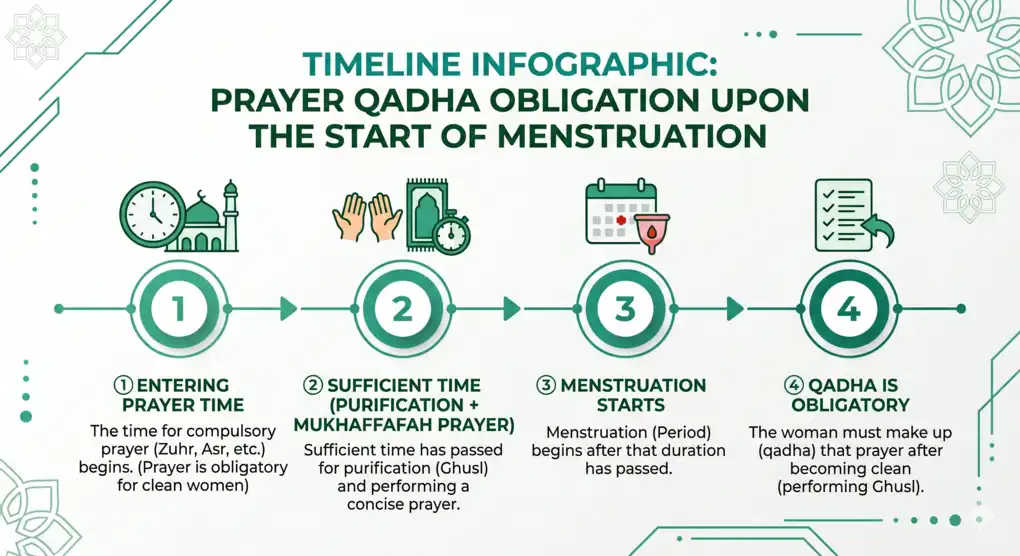
The following are practical illustrations based on the aforementioned rulings:
- Scenario 1: The time for Dhuhr begins, the woman is free from menstruation, and there is sufficient time for purification + a lightened prayer → then menstruation begins. Ruling: Making up (qada) Dhuhr is obligatory after becoming pure.
- Scenario 2: The time for Asr begins, and menstruation starts almost immediately so that the free time is insufficient. Ruling: Making up (qada) the prayer is not obligatory.
- Scenario 3: The time for Fajr begins, there is sufficient time, and then menstruation begins. Ruling: Making up (qada) the Fajr prayer is obligatory. No other prayer becomes obligatory because Fajr cannot be combined (jam’) with another prayer.
The Subsequent Prayer (The Combination Pair)—Is It Also Obligatory or Not?
Dhuhr Has Not Been Performed, Then Menstruation Begins at the Start of Asr Time—Is Asr Also Obligatory to Make Up?
This is an equally important follow-up question. Imagine: the time for Asr enters, while Dhuhr has not yet been performed during the menstruation-free period, and then menstruation begins exactly as the Asr time enters. Is she obligated to make up both Dhuhr and Asr?
Asna al-Mathalib answers decisively:
قوله: (ولو اتسع) زمن الخلو من وقت الأولى (للثانية) فإنها لا تجب مع الأولى وفارق العكس بأن وقت الأولى لا يصلح للثانية إلا إذا صلاهما جمعا بخلاف العكس وبأن وقت الأولى في الجمع وقت للثانية تبعا بخلاف العكس بدليل عدم جواز تقديم الثانية في جمع التقديم وجواز تقديم الأولى بل وجوبه على وجه في جمع التأخير
“His saying: ‘Even if the duration of being free from the impediment during the time of the first prayer extends [into the time of the second prayer],’ the second prayer does not become obligatory to perform or make up along with the first prayer. This differs from the reverse case [where the impediment disappears during the time of the second prayer].
The difference is that the time of the first prayer is not valid for the second prayer unless they are performed combined (jam’), unlike the reverse. Furthermore, because the time of the first prayer in a combined prayer serves as the time for the second prayer merely by extension (tab’an), unlike the reverse case.
The evidence for this is the impermissibility of advancing the second prayer in an advance combination (jam’ taqdim), whereas it is permissible to advance the first prayer—indeed, obligatory in one view—in a delayed combination (jam’ ta’khir).”[5]
Prayers That Can Be Combined: Dhuhr-Asr and Maghrib-Isha
The relevant combination pairs in this context are:
وَتَلْزَمُ الظُّهْرُ مَعَ الْعَصْرِ وَالْمَغْرِبُ مَعَ الْعِشَاءِ
“Dhuhr is binding along with Asr, and Maghrib is binding along with Isha.”[6]
Those that do not form a combination pair are: Asr with Maghrib, Fajr with Dhuhr, and Isha with Fajr. This provision is important to avoid the misconception that all missed prayers must be made up together.
Special Case—Prolonging the Duration of Prayer, Then Menstruation Begins
If the Time Was Sufficient for a Brief Prayer, but She Prolonged Its Duration
This case is highly relevant to daily habits. A person begins their prayer, recites a long surah, slows down their movements—and then, in the middle of that prayer, menstruation begins. The question is: is there an obligation to make it up (qada)?
Asna al-Mathalib answers:
فلو طولت صلاتها فحاضت فيها وقد مضى من الوقت ما يسعها لو خففت أو مضى للمسافر من وقت المقصورة ما يسع ركعتين لزمهما القضاء
“If she prolongs her prayer and then menstruates during it, whereas the time that passed was actually sufficient for her had she lightened it… then making it up (qada) is obligatory upon her.”[7]
This is an important lesson: slowing down (prolonging the duration of) the prayer does not waive the obligation. The standard used remains the duration of a lightened prayer (mukhaffafah)—not the duration of the prayer she actually performed.
Female Traveler (Musafirah)—Special Calculation for Shortened Prayer (Qashr)
For a woman who is traveling (musafir), the measure of “sufficiency” is calculated to be shorter. Asna al-Mathalib stipulates:
أَوْ مَضَى لِلْمُسَافِرِ مِنْ وَقْتِ الْمَقْصُورَةِ مَا يَسَعُ رَكْعَتَيْنِ لَزِمَهُمَا الْقَضَاءُ
“Or if, for a traveler, a duration sufficient for two units (rak’ahs) has passed from the time of the shortened prayer, then making it up (qada) is obligatory upon them.”[8]
Thus, for a traveler, the benchmark is only two rak’ahs—shorter compared to the four-rak’ah prayer for a resident (muqim).
Post-Natal Bleeding (Nifas)—The Same Rulings Apply

Post-Natal Bleeding is Equivalent to Menstruation in All These Provisions
All the above provisions apply exactly the same to women experiencing post-natal bleeding (nifas). Asna al-Mathalib asserts:
والنفساء كالحائض في ذلك
“And the woman experiencing post-natal bleeding is like the menstruating woman in that regard.”[9]
There is no ruling difference between menstruation (hayd) and post-natal bleeding (nifas) in this chapter. The principle of sufficient time at the beginning, the measure of a lightened prayer (mukhaffafah), the rules for combination pairs—all apply identically to both.
Important Message: Hasten to Pray at the Beginning of the Time
Examining the jurisprudential provisions above, there is one practical implication that needs careful attention. The condition for the emergence of the obligation of qada is the presence of sufficient time at the beginning of the prayer period—meaning, the obligation is born precisely when the prayer time enters and a person is free from any impediment.
This means: the earlier a person performs the prayer, the clearer and more protected their status becomes. This is not in the sense of it being a sin to delay it—that is a separate discussion not covered in this section. However, from a fiqh perspective, delaying prayer until near the end of its time, only for an excuse to arrive, can carry unexpected consequences regarding the obligation of qada.
A person who is accustomed to praying at the beginning of the time does not need to worry about this issue. The obligation is already fulfilled before the excuse has a chance to arrive.
Summary of Rulings in a Table
| Scenario | Ruling |
|---|---|
| Menstruation arrives after there is sufficient time (lightened prayer + purification) from the beginning of the time | Qada is obligatory |
| Menstruation arrives almost simultaneously with the entry of the time; there is insufficient time | Qada is not obligatory |
| Prolonging the prayer and then menstruation begins; the time was actually sufficient for a lightened version | Qada is obligatory |
| Prayer combination pair (e.g., Dhuhr) when menstruation arrives at the beginning of Asr, with time only sufficient for Asr | Dhuhr does not become obligatory |
| Post-natal bleeding (nifas)—all scenarios above | Same as menstruation |
FAQ: Frequently Asked Questions About Menstruation Arriving During Prayer Time

1. If the prayer time has entered and I haven’t prayed yet, and then menstruation arrives, is qada obligatory?
The answer depends on the duration of the free time at the beginning of the period. If from the very start of the prayer time until the onset of menstruation, there is a duration sufficient to perform purification and a lightened prayer (mukhaffafah)—then making it up (qada) is obligatory after becoming pure. If there is insufficient time, it is not obligatory.
2. How many minutes is the minimum for “sufficient time”?
There is no fixed benchmark in minutes. The standard is the duration of a lightened prayer (mukhaffafah)—a prayer performed lightly without being slowed down—plus the time for purification that can be done beforehand. This measure is relative depending on an individual’s condition, rather than a fixed minute count.
3. Does this provision apply to the Fajr prayer as well?
Yes, it applies. If since the entry of Fajr time there is sufficient time for purification and a two-rak’ah lightened prayer before menstruation begins, then making up Fajr is obligatory. The difference is that Fajr does not have a combination pair, so no other prayer becomes obligatory along with it.
4. What if menstruation is hastened with medication—is qada still obligatory?
Based on the provisions of Asna al-Mathalib, a woman who hastens her period with medication is subject to the exact same rulings as a woman with a natural period. The waiving of prayer for her is a strict command (ʿazimah), not a concession (rukhsah). Therefore, all the above rules—including whether there is sufficient time at the beginning—still apply to her.[10]
5. Is Dhuhr prayer automatically obligatory to make up if menstruation arrives during Asr time?
No, not automatically. Dhuhr only becomes obligatory to make up if the time free from impediments at the beginning of Dhuhr time was sufficient for both prayers (Dhuhr and Asr). If the free time was only sufficient for one prayer, then only that specific prayer is obligatory—Dhuhr does not become obligatory in this scenario.
Footnotes:
Reference:
Zakariyā al-Anṣārī, Asnā al-Maṭālib fī Sharḥ Rawḍ al-Ṭālib, with ḥāsyiyah by Aḥmad al-Ramlī, edited by Muḥammad az-Zuhrī al-Ghamrāwī (Cairo: al-Maṭbaʿah al-Maymānīyah, 1313 AH; repr. Dār al-Kitāb al-Islāmī), vol. 1, pp. 121-123.


