
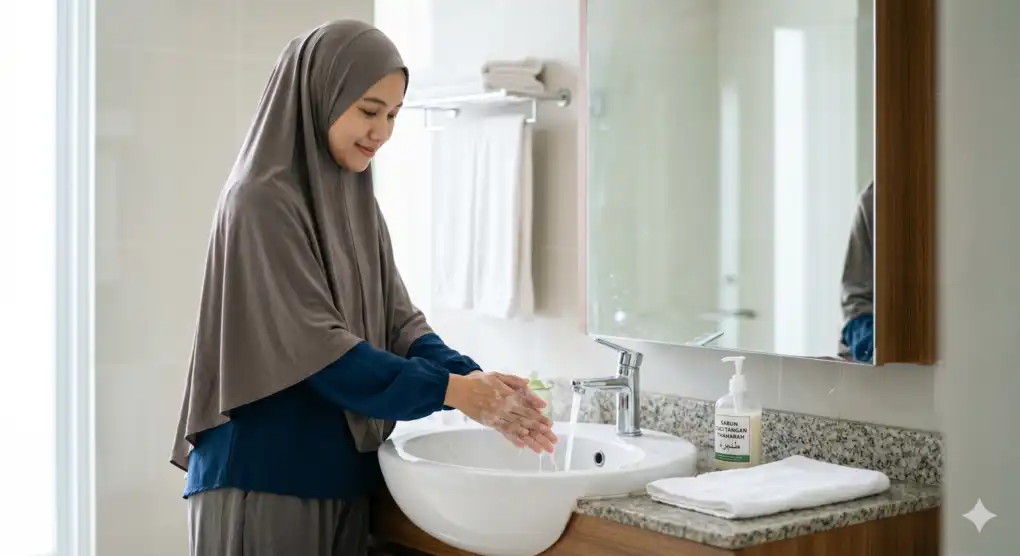
Have you ever realized that whether or not the daily prayers (Salah) we perform are valid depends heavily on our routine activities in the restroom? Cleansing oneself after nature’s call, known in Islamic Fiqh literature as Istinja, is not merely a routine of physical hygiene. Rather, it is the opening key and an absolute prerequisite for our worship to be accepted in the presence of Allah.
Unfortunately, many of us might still take this lightly or do not fully understand the correct method of cleansing according to the guidance of the Shari’ah. To ensure our primary worship is not rendered in vain due to hidden impurity (najis), let us thoroughly examine the comprehensive guide to Istinja—ranging from its legal rulings, alternative media to water, to its proper etiquettes—based on the explanations of the scholars of the Shafi’i madhhab.
The Definition and Ruling of Istinja in Islam
The Concept of Istinja, Istijmar, and Istithabah
Many Muslims still wonder about the exact meaning of Istinja in Islamic jurisprudence. This discussion is vital because Istinja is the act of cleansing impurities (najis) that exit from the private parts, which serves as a condition for the validity of core acts of worship like prayer. In the Shafi’i school, this chapter is detailed meticulously to guide every Muslim’s daily life within the broader framework of Islam.
To grasp the exact meaning of Istinja, we must refer to the linguistic origins of the word and the commentary of the classical scholars (Salaf). You can deepen your insight into Istinja through a linguistic analysis of Arabic and its technical Shari’ah boundaries.
Definition of Istinja in Language and Fiqh Terminology
Etymologically, Imam Zakariyya al-Ansari outlines the origin of the word Istinja in his book:
هو مأخوذ من نجوت الشجرة، وأنجيتها إذا قطعتها كأنه يقطع الأذى عنه، وقيل من النجوة، وهي ما ارتفع من الأرض لأنه يستتر عن الناس بها
“Istinja is derived from the phrase ‘najawtu ash-shajarah,’ which means ‘I cut the tree,’ as if a person is cutting off (removing) harm or impurity from themselves. Another opinion states it comes from ‘an-najwah,’ meaning an elevated piece of land, because a person hides behind it from the sight of people.” [1]
Therefore, if anyone asks what Istinja means linguistically, the answer centers on the meaning of cutting or cleansing oneself from something filthy. In Fiqh terminology, Istinja means the process of removing impure substances (najis) exiting from the two channels (qubul and dubur) using water, stones, or any other pure, solid substance.
Fundamental Differences Between Istinja, Istijmar (Stones), and Istithabah



In classical Islamic legal texts, we often see the terms istithabah and istijmar paired alongside Istinja. What do these mean, and how do they differ? The author summarizes the differences between these three terms as follows:
وهو والاستطابة والاستجمار بمعنى إزالة الخارج من الفرج عنه لكن الثالث مختص بالحجر مأخوذ من الجمار وهي الحصى الصغار
“Istinja, istithabah, and istijmar share the same meaning, which is removing what exits from the private parts. However, the third term (istijmar) specifically utilizes stones, derived from the word ‘al-jimar,’ which means small pebbles.” [2]
Thus, Istinja and istithabah have a broader scope of meaning, as they can be performed using either water or stones. Meanwhile, istijmar strictly refers to the practice of ritual cleansing that exclusively uses stones or other solid, pure objects as the primary cleaning agent.
The Legal Ruling of Istinja According to Shafi’i Fiqh
After understanding its meaning, we are obliged to know its legal status. Shafi’i scholars categorize the ruling of Istinja based on the type of impurity or najis that exits.
Is Istinja Obligatory (Wajib)?
The foundational ruling for performing Istinja is obligatory (wajib) for anyone who has finished relieving themselves. This obligation remains active as long as there is an impure substance exiting the private parts and moistening the surrounding area. The text Asna al-Matalib confirms this mandatory status:
قوله: (يجب الاستنجاء) لا على الفور بالماء على الأصل في إزالة النجاسة أو بالحجر لأنه صلى الله عليه وسلم جوزه به
“(Istinja is obligatory) though not necessarily instantaneous, using water as the default principle in removing impurities, or using stones because the Prophet ﷺ permitted it.” [3]
Although this obligation is not demanded instantaneously (as long as one does not intend to perform prayer immediately), delaying it is highly discouraged. Delaying Istinja risks letting the impurity dry out or spread to clothing unknowingly.
Types of Impurities That Render Istinja Obligatory
The rule making Istinja obligatory is tightly bound to the condition of the impurity exiting from a normal exit point (makhraj). The impurity must be wet or contaminate its point of exit. The commentary (sharh) by Imam Zakariyya al-Ansari limits this clearly:
قوله: (وإنما) يجب الاستنجاء إذا كان الخارج (ملوثا، ولو نادرا كدم، ومذي) ، وودي
“(And it is only) obligatory to perform Istinja if the exiting substance is contaminating (wet/sticky), even if it occurs rarely, such as blood, madzi, and wadi.” [4]
Based on this explanation, we are required to cleanse ourselves after urinating, defecating, or when sticky fluids like madzi and wadi exit. Even though madzi and wadi fluids rarely exit compared to urine, their wet physical presence necessitates total purification. Read more about the difference between mani, wadi, and madzi.
Exceptions: Dry Impurities and Wind That Do Not Require Istinja
Not everything exiting the qubul and dubur obligates the doer to perform Istinja. Several things are excluded from this obligation, namely:
- Passing wind (flatulence): Wind has no physical substance that moistens or soils the anal area, so washing it is not an obligation.
- Purely dry solid objects: For example, whole undigested seeds or dried stool that leaves absolutely no liquid stain or moisture behind.
- Worms or parasites: Any organism exiting in a completely dry state without impure moisture does not necessitate Istinja.
The exception regarding dry substances is explained directly in the original text:
قوله: (لا) نحو (دود، وبعر جافين) فلا يجب بهما الاستنجاء لفوات مقصوده من إزالة النجاسة
“(It is not obligatory to perform Istinja) for something like worms or dung that are dry. Neither of them obligates Istinja because the objective of Istinja—which is the removal of the substance of impurity—is absent.” [5]
Although not legally required in these cases, cleaning the private areas during the above conditions remains recommended (sunnah). This aims to eliminate doubt and maintain complete bodily hygiene.
Media and Tools for Performing Istinja
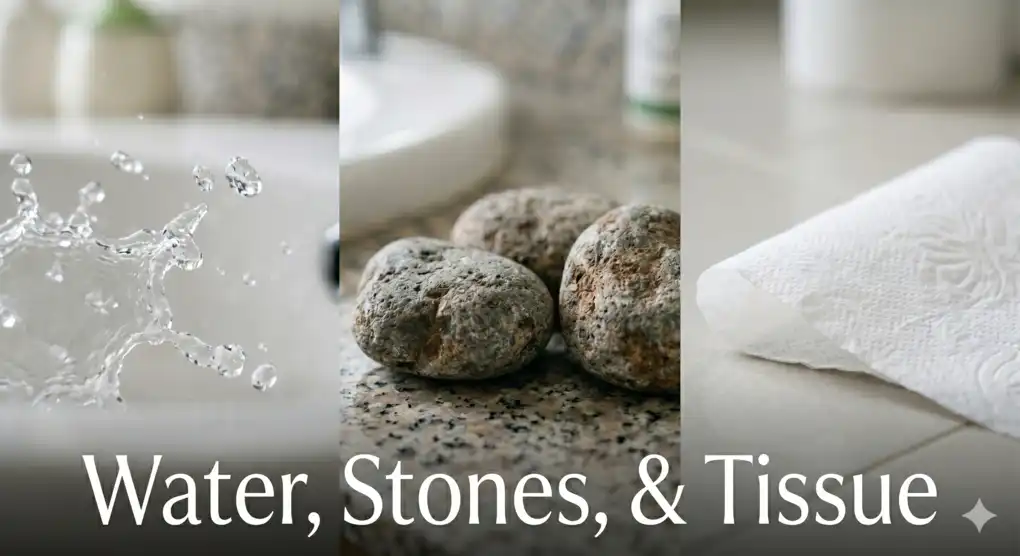
Types of Purifying Media (Water and Non-Water)
Islamic Shari’ah is highly flexible in providing ease for its Ummah to maintain cleanliness. Generally, media for cleansing after relieving oneself are divided into two: absolute water (air mutlak) and non-water solid purifying tools. Both share the same primary function, which is washing and cleaning the area where impurities exit so that the body returns to a state of ritual purity.
The Virtue of Using Water as the Primary Medium (Al-Asl)
Even though the religion permits solid objects, water still holds the highest rank as the most ideal cleaning agent. Water possesses an inherent nature capable of completely erasing the physical substance of filth while entirely eliminating its color, odor, and taste. Imam Zakariyya al-Ansari explains the superior position of water clearly:
فإن اقتصر على أحدهما (فالماء أفضل) لأنه يزيل العين، والأثر
“(If one restricts) to just one of them, (then water is better) because water removes both the substance and its trace.” [6]
Therefore, if you are faced with a choice between stones or water, washing it with pure and purifying water is the most virtuous option (afdal). This aligns with Allah’s praise for the people of Quba’ who loved to purify themselves using water.
Conditions for Valid Istinja Using Stones (Istijmar)
If you are traveling or in a place where water is scarce, the Shari’ah permits the practice of Istinja with stones. However, not just any solid object can be used carelessly. Fiqh scholars have formulated strict rules that must be met for this waterless cleansing to be considered valid.
The 3 Primary Conditions for Istijmar Tools (Pure, Solid, and Removing)
To ensure standardized cleanliness, any alternative to water must meet specific physical criteria. The formula regarding the conditions for performing Istinja with stones is outlined in the following text:
قوله: (وكل جامد طاهر قالع) غير محترم كخشب، وخزف، وحشيش (كالحجر)
“And every solid, pure substance that removes, and is non-venerated, such as wood, earthenware, and dry grass, holds the same status (as a stone).” [7]
From the reference text above, we can detail three absolute requirements for an Istinja stone:
- Solid (Jamid): The object must not be liquid, wet, or damp.
- Pure (Thahir): It is invalid to cleanse using animal dung or an object that is mutanajjis (contaminated with impurity).
- Capable of removing impurity (Qali’): The object’s surface must be slightly rough and able to scrape off filth, not merely smear or spread it.
Consequently, objects that are wet or too smooth are automatically rejected by Fiqh laws:
قوله: (لا رطب) … (ولا متنجس) … (ولا أملس كزجاج)
“(It is invalid to use) a wet object… a mutanajjis object… or a smooth object like glass.” [8]
Forbidden Objects (Food, Bones, and Venerated Items)
Besides meeting physical criteria, Islamic law also regulates etiquette toward certain items. Anything that holds a position of honor or respect in the eyes of religion is forbidden (haram) to be used as a medium for cleaning filth. This prohibition is explicitly recorded:
قوله: (لا بمحترم كمطعوم) للآدمي كالخبز أو للجن كالعظم
“(It is invalid to cleanse) with a venerated object, such as food for humans like bread, or for the Jinn like bones.” [9]
Using food or sheets of paper containing Islamic religious knowledge for Istinja is a form of major disrespect. The Prophet ﷺ also strictly forbade his companions from using bones or dried animal dung, because those objects are the designated food provisions for our brothers from among the Muslim Jinn.
Can Dry Tissues Replace Stones?
Many people today ask about the ruling on performing Istinja with toilet tissue. If we measure it against the Shari’ah maxim (kullu jamidin thahirin qali’in) outlined above, dry tissue perfectly meets those criteria.
Toilet tissue is solid, pure, does not hold a venerated status like food, and its material is excellent at absorbing and removing residual impurity. For these reasons, Islamic law validates the use of dry tissue as a substitute for stones. You simply wipe the private area with clean sheets of tissue at least three times until the area is completely dry and stainless.
The Correct Method of Istinja According to the Sunnah
Comprehensive Guide to the Process of Istinja
Islamic Shari’ah has formulated a perfect sequence and method for Istinja to guarantee the cleanliness and health of its practitioner. This step cannot be underestimated because correct purification is the foundation for the acceptance of Salah and other obligatory worships. Practicing the correct method of Istinja must follow the manner taught by the Prophet ﷺ and passed down by the scholars of the Shafi’i madhhab.
Method of Istinja with Water for Men and Women
Using water is the most recommended method because it is the most effective in completely removing impurities. Its execution heavily emphasizes washing with the left hand while ensuring water reaches all external parts of the exit point. The book Asna al-Matalib records specific guidelines for women and men:
قوله: (ويكفي المرأة) بكرا أو ثيبا في استنجائها بالماء (غسل ما يظهر) منها (بجلوس على القدمين)
“(And it suffices a woman) whether a virgin or previously married, in her Istinja with water, (to wash what is apparent) of her (by sitting upon her feet).” [10]
The correct way for a woman to wash her private parts is to thoroughly wash the external part (the outer labia) while squatting resting on her feet. The Shari’ah prohibits scrubbing water deep into the internal cavity because this is not part of the obligation of Istinja and can disrupt the natural flora or trigger waswas (obsessive doubts).
This also aligns with the rules for washing the anus (dubur):
قوله: (وأن يعتمد في الغسل) للدبر (على أصبعه الوسطى) لأنه أمكن (ولا يتعرض للباطن) فإنه منبع الوسواس
“And it is sunnah to rely during washing the anus (upon the middle finger) because it is more capable, (and he should not approach the inside) for it is the source of obsessive doubts.” [11]
The method of Istinja for both women and men on the rear channel (anus) should be wiped gently using the middle finger (or other fingers) accompanied by pouring water until it feels clean. The standard is to clean the impurity on the outer surface of the anal skin without inserting the fingertip into the sphincter muscle canal.
Method of Istinja with Stones (Minimum of Three Wipes on Different Sides)
If you are forced to use stones or dry tissue, there are specific rules for wiping with them, known as the pillar of odd-numbered wipes (at least three wipes) using clean surfaces of the stone. The requirement of three wipes is detailed as follows:
قوله: (ويشترط إنقاء) للمحل بحيث لا يبقى إلا أثر لا يزيله إلا الماء أو صغار الخزف (و) يشترط (ثلاث مسحات، ولو) كانت (بجوانب حجر)
“(And cleansing is required) for the location such that nothing remains except a trace that can only be removed by water or small pieces of earthenware, (and) there are required (three wipes, even if) they are (with different sides of a single stone).” [12]
How to clean impurities after defecating with tissue or stones:
- The first wipe moves from top to bottom.
- The second wipe moves from bottom to top.
- The third wipe goes around the entire perimeter of the exit point.
If three wipes of the stone/tissue still cannot fully remove the impurity, you must increase the number of wipes (e.g., to four times), and it is sunnah to add one more wipe so that the final count ends on an odd number (becoming five wipes).
The Virtue of Combining Both Stones and Water
The most ideal (afdal) sequence of Istinja from both a medical and religious standpoint is combining stone/tissue and water together. Imam Zakariyya al-Ansari explains the wisdom behind this combination:
قوله: (والأفضل إتباعه) أي الحجر (بالماء) أي الجمع بينهما بأن يقدم الحجر أفضل من الاقتصار على أحدهما لأن العين تزول بالحجر، والأثر بالماء من غير حاجة إلى مخامرة عين النجاسة
“(And what is most virtuous is following) the stone (with water) meaning combining both by using the stone first; this is better than restricting to just one of them. Because the substance of the impurity is removed by the stone, and its trace is cleansed by water without requiring the hand to directly touch the original substance of filth.” [13]
This is the most perfect method of cleansing according to the Sunnah. You wipe off the residual filth using tissue first until its wet mass is gone, then rinse with running water. This method prevents our hands from directly touching the raw impurity.
The Sunnah Acts of Istinja
To ensure this act of purification yields rewards, Islam provides a set of recommended actions and etiquettes (sunnah), including using the left hand and ensuring the complete cessation of urine flow.
The Obligation to Use the Left Hand and the Dislike of the Right Hand
Islamic teachings on cleanliness are highly detailed in allocating roles to the hands. The right hand is honored for eating and holding holy books, while the left hand is tasked with cleaning dirty areas. This rule of sequence using bodily limbs is strongly mentioned in the commentary text:
قوله: (و) أن (يمسح) في استنجائه بالحجر (ويغسل) في استنجائه بالماء (بيساره) لأنها الأليق بذلك، ولخبر أبي داود عن عائشة «كانت يد رسول الله صلى الله عليه وسلم اليمنى لطهوره، وطعامه، وكانت اليسرى لخلائه، وما كان من أذى»
“(And) it is recommended (that he wipes) during his Istinja with stones (and washes) during his Istinja with water (with his left hand) because it is more fitting for that. This is based on the narration of Abu Dawud from ‘Aishah: ‘The right hand of the Messenger of Allah ﷺ was used for his purification and food, while his left hand was used for his toilet activities and dealing with harmful/dirty things.'” [14]
Islam strictly discourages using the right hand for Istinja, whether for holding the private organ or wiping away filth with stones/water, because doing so diminishes the honor of the right hand.
Performing Istibra’ (Ensuring Total Cessation of Urine)
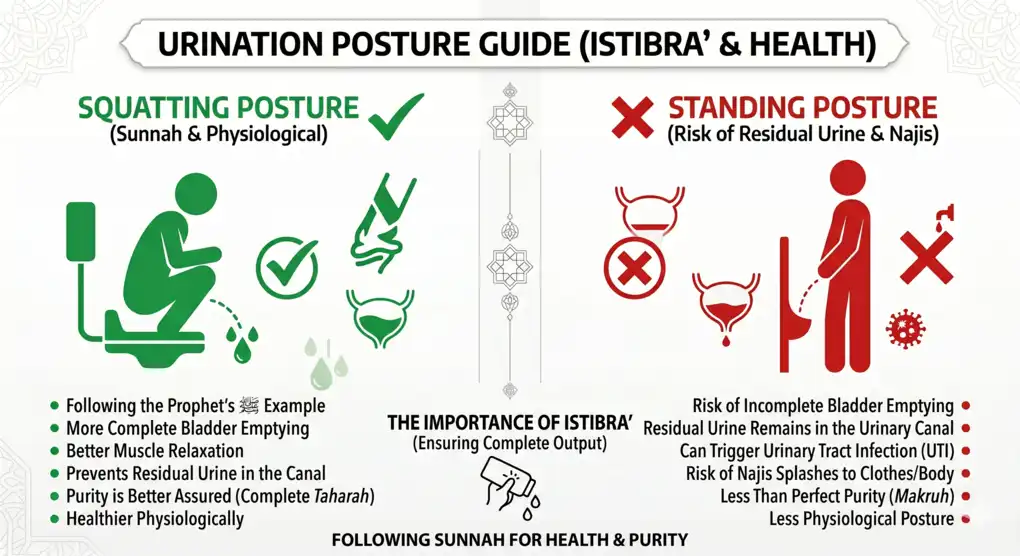
Istibra’ means to free or ensure complete discharge. This sunnah practice is highly crucial, especially for men, to guarantee that no residual drops of urine remain inside the urethra right before performing Istinja, which if leaked out later, could secretly invalidate their Wudu. The commentary explains:
قوله: (ويستبرئ) ندبا (من البول) عند انقطاعه، وقبل قيامه إن كان قاعدا لئلا يقطر عليه… ويحصل (بتنحنح، ونتر) للذكر ثلاثا (ومشي)
“(And he should perform istibra’) as a recommendation (from urine) when its flow stops, and before he stands up if he was sitting, so that it does not drip on him… And this is achieved by (clearing the throat/light coughing, gently squeezing/stroking) the male organ three times, (and walking).” [15]
The steps for istibra’ can differ from person to person; some feel completely clear by clearing their throat lightly, gently massaging the underside of the private organ outward 3 times, or simply waiting a brief moment for the final drop. Neglecting istibra’ is one of the primary triggers for the punishment of the grave due to hidden splashes of impurity.
Etiquettes of Relieving Oneself (Qadha al-Hajah) in Islam
Supplications for Entering and Leaving the Restroom
In addition to the rules for removing impurities, Islamic Shari’ah equips its Ummah with daily etiquettes, including the acts of relieving oneself in the bathroom or toilet. These etiquettes are structured to maintain modesty, keep a distance from satanic harms, and maximize physical cleanliness.
These etiquettes begin before one even steps inside the restroom. Islam teaches that toilets or bathrooms are inherently filthy spaces inhabited by impure spirits, meaning we require protection.
Advancing the Left Foot When Entering and the Right Foot When Exiting
The Shari’ah distinguishes the use of the left and right feet based on the sanctity of the place being entered or the activity being performed. Since the bathroom is a place for discarding filth (a non-noble place), it is sunnah to lead with the left side of the body when entering.
قوله: (و) يقدم (رجله اليسرى دخولا) لمحل قضاء الحاجة… (و) يقدم (اليمنى خروجا) من المحل
“(And) it is sunnah that he advances (his left foot when entering) the place of relieving oneself… (and) advances (the right foot when exiting) from the place.” [16]
This etiquette applies in reverse when leaving. When exiting toward a more honorable space (leaving the latrine), it is recommended to use the right foot. This simple step is an expression of love in reviving the Sunnah.
Covering the Head and the Prohibition of Entering Barefoot
The Shari’ah strongly dislikes negligence in maintaining physical health, especially when entering a zone filled with bacteria and impurities like the toilet. Therefore, we are discouraged from entering the bathroom with an uncovered head or bare feet.
قوله: (ولا يدخل المحل حافيا ولا حاسرا) أي مكشوف الرأس
“(And he should not enter the place barefooted nor with an uncovered head) meaning with his head bare.” [17]
Covering the head while relieving oneself aims to maintain modesty, avoid foul odors sticking to the hair, and ward off the whispers of the Jinn. The discouragement against entering barefoot is highly rational, as toilet floors are centers for impurity accumulation, whether visible (‘ayniyyah) or non-visible (hukmiyyah).
Prohibitions and Disliked Acts While Relieving Oneself
While relieving oneself, there are strict boundaries that must be observed. These prohibitions concern the sanctity of the Shari’ah and maintaining the comfort of public facilities.
Facing or Backing the Qiblah While Relieving Oneself
This is an important point that frequently escapes attention. Facing the Qiblah while defecating or urinating has specific legal breakdowns. The commentary sets forth these details:
قوله: (أما استقبال القبلة واستدبارها بلا حائل قريب)… (أو بلا بنيان يمكن تسقيفه) فحرام
“(As for facing the Qiblah or turning one’s back to it without a close barrier)… (or without a structure that can be roofed) then it is haram.” [18]
The prohibition against facing or backing the Qiblah applies when relieving oneself occurs in an open space (like a field or desert) without any screen (wall or object) in front of the person. However, if you are using a modern toilet located inside a roofed building (or there is a close barrier wall), it is permissible, though avoiding it remains superior (khilaf al-awla).
Prohibition Against Bringing the Name of Allah, the Qur’an, or Prophetic Names Into the Latrine
This is closely tied to our veneration of the sacred symbols of religion. It is highly disliked (makruh), and can even become forbidden (haram), to bring anything bearing the name of Allah or a prophet into a filthy place.
قوله: (ويكره) عند قضاء الحاجة (حمل مكتوب قرآن، واسم لله) تعالى (و) اسم (لنبي)
“(And it is disliked) when relieving oneself (to carry any writing of the Qur’an, the name of Allah) Exalted is He, (and) the name (of a prophet).” [19]
Items forbidden to be brought inside include religious books, rings engraved with the name of Allah, or talismanic necklaces. The solution is to leave these items outside the bathroom, or if it is an emergency or there is fear of theft, hide them securely (deep inside pockets) within one’s clothing.
Disliking Speech Without Pressing Necessity
The toilet is not a place for socializing. It is disliked for a person to speak, sing, or answer greetings while they are relieving themselves.
قوله: (ولا يتكلم) بذكر، ولا غيره… (إلا لضرورة)
“(And he should not speak) whether with dhikr or anything else… (except out of necessity).” [20]
Except in critical situations—such as guiding a blind person who is about to fall, or warning someone of an immediate danger (like a snake or fire)—silence is golden when relieving oneself. Even when sneezing, one is recommended to praise Allah only within their heart.
Prohibitions on Careless Waste Disposal (Stagnant Water, Pathways, and Holes)
Islam cares deeply about ecology and public comfort. Consequently, relieving nature’s call must not be done in public spaces that harm the community. The prohibition explicitly details several locations:
- In stagnant water (not flowing), as it directly contaminates it.
- On pathways walked by people or underneath trees commonly used for shade.
- In holes in the ground.
قوله: (ولا يبول في) مكان (صلب)… (و) لا في (ثقب)…
“(And he should not urinate in) a (hard place)… (nor) inside a (hole)…” [21]
The prohibition of urinating in holes is based on the Hadith stating that holes are animal burrows (like snakes) or dwellings for the Jinn. Urinating on hard surfaces is also avoided to prevent splashes of impurity from returning onto one’s clothing.
The Ruling on Urinating While Standing (Without an Excuse)
Although common for men in modern restrooms equipped with urinals, the default ruling for urinating while standing in the Shafi’i madhhab is highly disliked (makruh) if done without a valid Shari’ah excuse.
قوله: (ولا) يبول (قائما)… (إلا لعذر)
“(And he should not) urinate (standing up)… (except due to an excuse).” [22]
The ideal and healthier position to urinate is squatting, following the example of the Prophet ﷺ. The squatting position maximizes bladder pressure to expel residual fluid completely and is safer from urine splashes hitting the trousers. Urinating while standing is only justified during emergencies (such as a knee injury or in an extremely filthy/muddy toilet where squatting would soil one’s clothes worse).
Rulings on Intentions and Supplications Surrounding Istinja
Is It Obligatory to Formulate an Intention (Niyyah) for Istinja?
In the Shafi’i school, making an intention is a condition for the validity of ritual acts of worship (like Wudu and Salah) because it distinguishes acts of devotion from ordinary habits. However, for Istinja, the situation differs slightly. Scholars agree that Istinja is an act of “tark” (an act of leaving off or removing filth); therefore, whether Istinja requires an intention specifically voiced before washing is answered in the negative—it is not a condition for validity.
This is touched upon by Imam Zakariyya al-Ansari at the beginning of the chapter on removing impurities:
قوله: (ولا يشترط فيها النية) لأنها ترك كترك الزنا، والغصب بخلاف الوضوء
“(And intention is not required for it) because it is an act of leaving off (something forbidden), just like leaving off fornication or usurpation, unlike Wudu.” [23]
Nevertheless, some scholars deem it recommended to voice an intention internally to align the body with the heart while executing obedience to the Shari’ah.
The Verbiage of Intention for Urination and Defecation (For Those Who Practice It)
Regarding purification practices, some communities might have heard or been taught by religious teachers to articulate an intention before performing Istinja. The verbiage often taught is:
نَوَيْتُ الِاسْتِنْجَاءَ مِنَ الْبَوْلِ اوَالْغَائِطِ فَرْضًا لِلَّهِ تَعَالَى
Nawaitu al-istinjā’a min al-bawli aw al-ghā’iṭi farḍan lillāhi taʿālā
Meaning: “I intend to perform Istinja from urine or feces as an obligation for Allah the Exalted.”
Or a shorter version:
نَوَيْتُ الِاسْتِنْجَاءَ مِنَ الْبَوْلِ اوَالْغَائِطِ
Nawaitu al-istinjā’a min al-bawli aw al-ghā’iṭi
Meaning: “I intend to perform Istinja from urine and feces.”
Although these phrases are spoken with good intent to preserve cleanliness, in the scales of Fiqh—especially according to the vast majority of scholars—cleansing impurities fundamentally requires no intention. Purification is considered completely valid even if a person reads no intention whatsoever while cleaning filth. Rather than focusing on an unrequired intention for Istinja, the highly emphasized sunnah is reciting the protective supplication when about to enter the bathroom and the prayer of forgiveness/gratitude upon leaving.
The Jurisprudential Foundation (Text, Translation, and Commentary)
The inaccuracy of claiming that Istinja requires an intention or counts as a specific ritual worship can be examined through the explanations of classical scholars, particularly in the Shafi’i school. Removing impurity (izalat al-najasah) falls into a different category than purifying oneself from ritual blocks (hadath), such as Wudu or Ghusl.
1. Explanation of Imam Al-Mawardi in Al-Hawi al-Kabir
«قال الْمَاوَرْدِيُّ: وَهَذَا كَمَا قَالَ: الطَّهَارَةُ ضَرْبَانِ مِنْ نَجَسٍ وَحَدَثٍ. فَأَمَّا طَهَارَةُ النَّجَسِ فَلَا تَفْتَقِرُ إِلَى نِيَّةٍ إِجْمَاعًا لِأَمْرَيْنِ: أَحَدُهُمَا: أَنَّ إِزَالَةَ النَّجَاسَةِ إِنَّمَا هُوَ تَعَبُّدُ مُفَارَقَةٍ وَتَرْكٍ، وَالتُّرُوكُ لَا تَفْتَقِرُ إِلَى نِيَّةٍ كَسَائِرِ مَا أُمِرَ بِاجْتِنَابِهِ فِي عِبَادَاتِهِ. وَالثَّانِي: أَنَّهُ لَمَّا طَهَّرَ ما أصبته النَّجَاسَةُ مِنَ الْأَرْضِ وَالثَّوْبِ بِمُرُورِ السَّيْلِ عَلَيْهِ وَإِصَابَةِ الْمَاءِ لَهُ عُلِمَ أَنَّ الْقَصْدَ فِيهِ غَيْرُ مُعْتَبَرٍ، وَأَنَّ النِّيَّةَ فِي إِزَالَتِهِ غَيْرُ وَاجِبَةٍ.»
Translation: Imam Al-Mawardi said: “And this is exactly as he said: Purification (thaharah) is of two types, from impurity (najas) and from ritual impurity (hadath). As for purification from physical impurity, it does not stand in need of an intention by consensus (ijma’), owing to two matters:
First: Removing an impurity is essentially an act of worship based on separation and leaving off (turuk). Actions of leaving off do not stand in need of an intention, just like all other things commanded to be avoided in acts of worship.
Second: When an object struck by impurity—whether land or a garment—becomes pure simply by the passing of a torrent (like rain) over it and water hitting it, it is known that conscious intent (qasd) is unconsidered therein, and intention in removing it is not mandatory.” [30]
Explanation: Imam Al-Mawardi logically establishes that Istinja concerns discarding physical filth, not an abstract ritual like Wudu. Concrete proof that intention is unneeded is that if an impure garment is left outside and accidentally washed clean by rainfall, the garment automatically becomes pure. Purity is achieved solely due to the disappearance of the impure substance, not because anyone intended to purify it.
2. Explanation of Imam Al-Haramain Al-Juwaini in Nihayat al-Matlab
«ونسب بعض الأصحاب إلى ابن سُريج وجهاً في اشتراط النيّة في إزالة النجاسة، وهذا غلط، وسنذكر in أحكام النجاسات سببَ هذا الغلط»
Translation: “Some of the companions (scholars of the Shafi’i school) attributed to Ibn Surayj a view requiring an intention for removing impurities, and this is an error (ghalath). We shall mention in the rulings of impurities the cause of this error.” [31]
Explanation: Imam Al-Juwaini corrects a mistaken transmission circulating among some scholars who thought removing impurity required an intention. He explicitly labels that view a ghalath (conceptual error).
Supplications for Entering and Leaving the WC (Bathroom)
The supplications surrounding relieving oneself were closely observed by the Messenger of Allah ﷺ. As his Ummah, we are recommended to recite a prayer seeking protection when entering the WC, and a prayer of gratitude upon leaving.
Supplication for Entering the Bathroom and Its Meaning
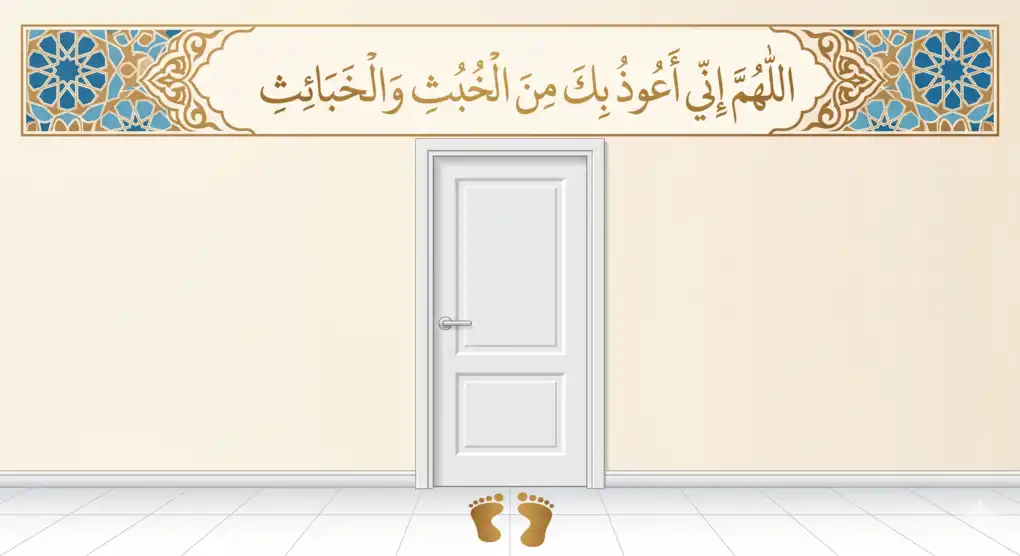
Before stepping into the bathroom (with the left foot), it is sunnah to recite the Basmalah and the protective prayer from the wickedness of male and female devils. The text of the book mentions:
قوله: (ويقول) ندبا (عند) إرادة (الدخول) لذلك (بسم الله) رواه ابن السكن في صحاحه
(اللَّهُمَّ إِنِّي أَعُوذُ بِكَ مِنَ الْخُبُثِ وَالْخَبَائِثِ)
“(And he says) out of recommendation (when) wishing (to enter) that place: Bismillah (In the name of Allah), narrated by Ibn al-Sakan in his authentic collections.
Allāhumma innī aʿūdzu bika minal-khubutsi wal-khabā’its
(O Allah, I seek refuge in You from the male and female devils).” [24]
Why do we seek refuge from devils? Imam Zakariyya al-Ansari explains it is because places for discarding waste are the natural havens (ma’wa) for devils; even an open space will become their haven if human waste is present there.
Supplication for Leaving the Bathroom and Its Meaning
After discarding waste and exiting the bathroom (using the right foot), our bodies have returned to a clean and healthy state because toxic substances were expelled. At this moment, it is sunnah to recite a prayer of praise to Allah Ta’ala. The supplications for entering and leaving the restroom are as follows:
قوله: (و) يقول ندبا (عند الخروج) أي عقبه (غُفْرَانَكَ، الْحَمْدُ لِلَّهِ الَّذِي أَذْهَبَ عَنِّي الْأَذَى وَعَافَانِي)
“(And) he says out of recommendation (upon exiting) meaning immediately following it:
Ghufrānak, al-ḥamdu lillāhilladhī adzhaba ʿannī al-adzā wa-ʿāfānī
(I ask for Your forgiveness. All praise is due to Allah who has removed harm from me and granted me health).” [25]
The word “Ghufranak” is read two or three times. The reason behind this is beautiful: while relieving oneself, our tongues are forbidden from making dhikr of Allah. Therefore, upon exiting, we ask for forgiveness because there was a period where our tongues were absent from remembering Him, while simultaneously thanking Him for the blessing of digesting food and smoothly expelling waste.
Special Supplication After Completing Istinja
In addition to the prayers for entering and leaving the WC, some scholars of Tasawwuf and Fiqh, such as Imam al-Ghazali, taught a specific prayer after washing to seek the purification of the heart.
Supplication After Cleansing and Asking for Purity of Heart From Hypocrisy
In the text Asna al-Matalib, this teaching from Imam al-Ghazali is cited to complete the spiritual etiquette:
قال الغزالي في الإحياء، ومن الآداب أن يقول عند الفراغ من الاستنجاء
اللَّهُمَّ طَهِّرْ قَلْبِي مِنَ النِّفَاقِ، وَحَصِّنْ فَرْجِي مِنَ الْفَوَاحِشِ
“Imam al-Ghazali said in the book Ihya: ‘Among the etiquettes (of relieving oneself) is to say upon completing Istinja:
Allāhumma ṭahhir qalbī min an-nifāq, wa-ḥaṣṣin farjī min al-fawāḥish
(O Allah, purify my heart from hypocrisy, and protect my private parts from immoral acts).'” [26]
This prayer is read silently within the heart if you are still inside the bathroom. Its purpose is to ensure physical cleansing (Istinja) goes hand-in-hand with spiritual purification from sinful deeds.
FAQ Surrounding Istinja
Many practical daily issues regarding purification invite questions. Equipped with the guidance from the Shafi’i madhhab, here are answers to the most frequently asked questions about Istinja.
What is the ruling on performing Istinja using wet wipes?
The ruling on performing Istinja with wet wipes triggers discussion, because the combination of tissue and water inside alters its status from a “dry solid object” to a “wet object.”
According to Fiqh principles, performing Istinja with wet wipes alone is invalid. The reason is that wet wipes cannot scrape or absorb the impurity properly; instead, they widen the contaminated area (because they are wet but do not stream water like an absolute water wash). Valid solutions include:
- Use dry tissues first until the impurity is completely lifted, then finish with water.
- Or, use absolute water completely from the start.
If forced by circumstances, wet wipes may only be used to clean the skin around the private parts, but the core exit point (makhraj) must be rinsed with pure water.
Is Istinja valid using stones or tissue if the impurity has already dried?
If the impurity has completely dried without leaving any trace of moisture or stickiness, cleansing with solid objects (like stones or tissue) is no longer valid. Dried impurity must be removed using absolute water. This is based on the rule:
(أو جف تعين الماء)
“Or if it has dried, then water becomes specified/mandatory.” [27]
Stones or dry tissues are permitted by the Shari’ah because their function is to absorb wet, sticky masses. When waste has already dried up, wiping it with dry tissue will only irritate the skin and fail to purify it.
Is it permissible to urinate while standing in modern toilets?
Although modern restrooms frequently design standing urinals, the default ruling in the Shafi’i madhhab remains disliked (makruh) if done without a valid Shari’ah excuse. The example of the Prophet ﷺ affirms that the squatting position is superior.
قوله: (ولا) يبول (قائما)… (إلا لعذر)
“(And he should not) urinate (standing up)… (except due to an excuse).” [28]
You are allowed to urinate standing if your knees are aching, or if the toilet condition is so foul and dirty that squatting would cause your clothes or body to get splashed with worse impurities. Always prioritize sitting or squatting whenever possible.
What should be done if one forgets to remove a ring inscribed with Allah’s name before entering the WC?
Islam highly upholds the veneration of Allah’s names, Qur’an verses, and the names of His messengers. If you mistakenly enter the bathroom wearing a ring with such inscriptions, the rapid step taught by the Shari’ah is:
قوله: (فإن نسي) ذلك أي تركه، ولو عمدا حتى قعد لقضاء حاجته (ضم كفه عليه) أو، وضعه في عمامته أو غيرها
“(Then if he forgets) that, meaning he left it on, even if done intentionally until he has already sat down to relieve himself, (let him close his palm over it) or place it inside his turban (or other closed garments).” [29]
Therefore, immediately turn the ring stone bearing the holy words toward the inside of your palm, and close your fist tightly. Alternatively, conceal it deeply behind folds of clothing so it is not exposed to the foul air of the toilet.
Conclusion
Istinja is the central foundation of thaharah (purification) that determines the validity of every Muslim’s obligatory worship. Cleaning and freeing oneself from residual filth exiting the private parts is a Shari’ah obligation demanding high precision.
Here are the key points we can conclude:
- Priority of Purifying Media: Although Islam provides a relaxation (rukhsah) by allowing solid, pure, and scraping objects like stones or dry tissue (istijmar), absolute water remains the most perfect and virtuous agent because it completely obliterates both the substance and qualities of the impurity.
- Perfection of Method: Ideal purification requires us to pay attention to sunnah details, such as the obligation of using the left hand, practicing istibra’ (ensuring urine is fully cleared), and combining dry tissue wipes followed by a water rinse.
- Etiquettes Bring Blessings: The acts of discarding waste in Islam are inseparable from spiritual manners. Developing the habit of leading with the left foot when entering the toilet, avoiding facing the Qiblah without a barrier, and routinely reciting the entering and leaving supplications serves as a safeguard against devilish harm and a proof of faith.
In the end, the perfection of Istinja does not merely impact the cleanliness and health of private areas medically, but also acts as a means to purify the heart. By preserving bodily cleanliness according to the Sunnah, we prepare ourselves to stand before the Creator in the purest state, both outwardly and inwardly.
Footnotes
References
- Zakariyā al-Anṣārī, Asnā al-Maṭālib fī Sharḥ Rawḍ al-Ṭālib, with ḥāshiyah by Aḥmad al-Ramlī, edited by Muḥammad az-Zuhrī al-Ghamrāwī (Cairo: al-Maṭbaʿah al-Maymānīyah, 1313 AH; repr. Dār al-Kitāb al-Islāmī), Vol. 1, pp. 44-53.
- Al-Juwainī, ʿAbd al-Malik bin ʿAbdullāh bin Yūsuf bin Muḥammad, Abū al-Maʿālī Imām al-Ḥaramain. Nihāyat al-Maṭlab fī Dirāyat al-Madhhab. Edited and indexed by ʿAbd al-ʿAẓīm Maḥmūd al-Dīb. Jeddah: Dār al-Minhāj, 1st edn, 1428 AH/2007 CE, Vol. 1, p. 51.
- Al-Māwardī, Abū al-Ḥasan ʿAlī bin Muḥammad bin Muḥammad bin Ḥabīb al-Baṣrī al-Baghdādī. Al-Ḥāwī al-Kabīr fī Fiqh Madhhab al-Imām al-Syāfiʿī wa Huwa Syarḥ Mukhtaṣar al-Muzanī. Edited by ʿAlī Muḥammad Muʿawwaḍ and ʿĀdil Aḥmad ʿAbd al-Mawjūd. Beirut: Dār al-Kutub al-ʿIlmiyyah, 1st edn, 1419 AH/1999 CE, Vol. 1, p. 87.


