
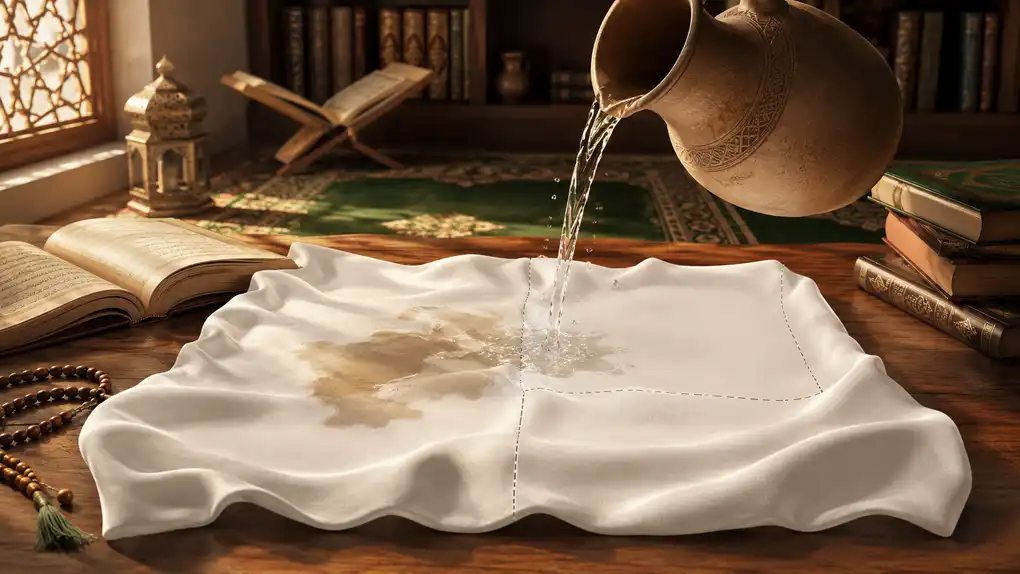
Najis mutawassithah, often written as najis mutawasitah, refers to a moderate impurity. Its classification falls between a light impurity (najis mukhaffafah) and a heavy (or severe) impurity (najis mughallazhah).
The primary discussion revolves not only around its “moderate” status but also its physical state. Najis mutawassithah is divided into two categories: najis ‘ainiyah, which still retains perceptible physical traces (such as color, smell, or taste), and najis hukmiyah, where the physical substance is no longer visible, but its legal status as an impurity remains.
Read this article together with the complete guide to najis in Islam and the overview of the levels of najis. Those pages place intermediate najis within the wider structure of ritual purification.
What Is Najis Mutawassithah?
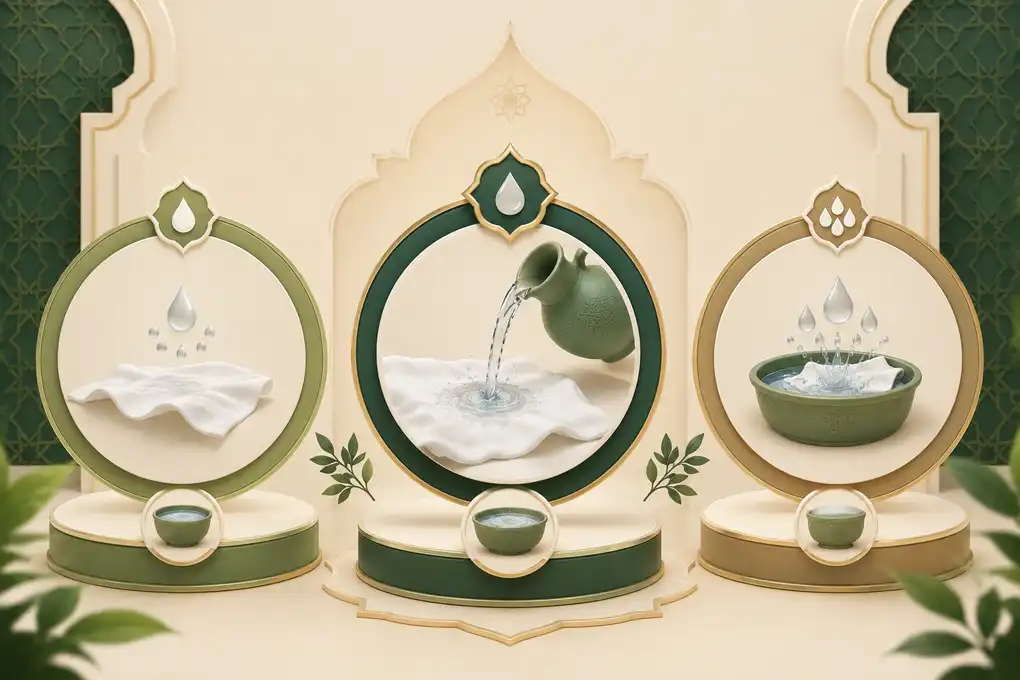
Intermediate najis is impurity other than mukhaffafah and mughallazhah. It is often called “medium” or “intermediate” impurity because its purification rules stand between those two categories.
Al-Khatib al-Shirbini identifies urine and feces as examples of this intermediate category:
«أَرَادَ بِهِ النَّجَاسَةَ الْمُتَوَسِّطَةَ كَالْبَوْلِ وَالْغَائِطِ»
Translation: “What is meant is intermediate impurity, such as urine and feces.”[1]
“Intermediate” does not mean that it may be overlooked. It must be removed from the body, clothing, and the place of prayer when it prevents the validity of prayer.
The Two Forms of Intermediate Najis
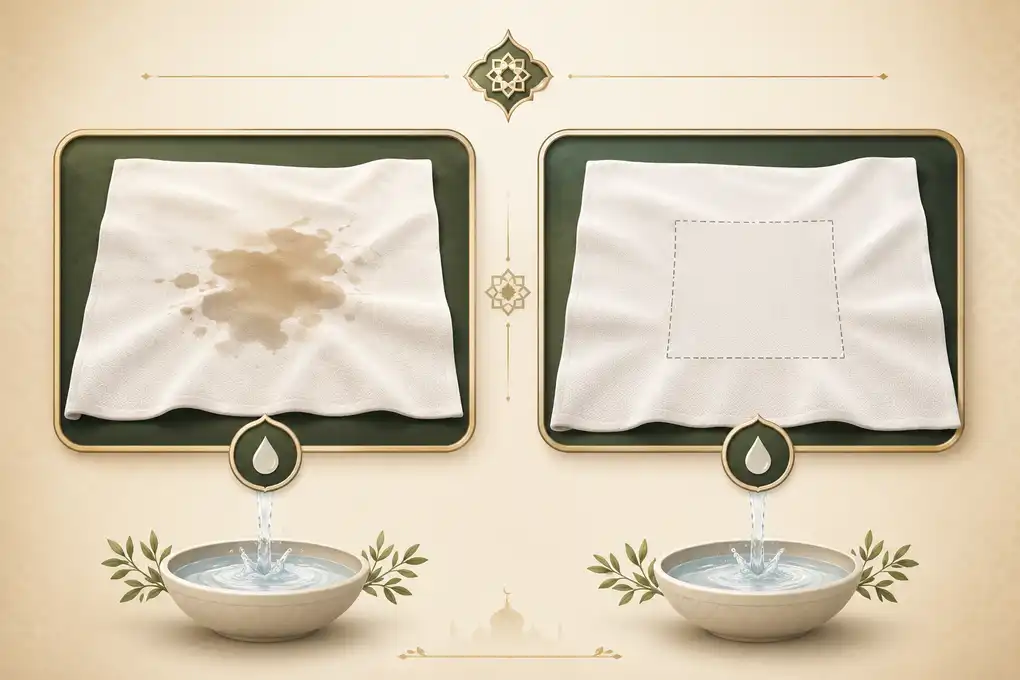
For purification, the condition of the impurity matters. It may still be perceptible, or its physical trace may have disappeared even though the place is known to have been affected.
Zakariyya al-Anshari explains:
«ثُمَّ النَّجَاسَةُ إِمَّا عَيْنِيَّةٌ، وَهِيَ الَّتِي تُحَسُّ، أَوْ حُكْمِيَّةٌ، وَهِيَ بِخِلَافِهَا كَبَوْلٍ جَفَّ، وَلَمْ يُوجَدْ لَهُ أَثَرٌ، وَلَا رِيحٌ»
Translation: “Impurity is either ‘ainiyyah, which can still be perceived, or hukmiyyah, its opposite, such as urine that has dried and leaves neither trace nor smell.”[2]
| Form | Condition of the impurity | Core method of purification |
|---|---|---|
| ‘Ainiyyah | The substance itself or a trace such as colour or smell remains | Remove the substance and the traces that must be removed |
| Hukmiyyah | The substance, colour, and smell are gone, but the affected place is known | Run water over the affected place |
‘Ainiyyah: Impurity with a Remaining Substance or Trace
‘Ainiyyah impurity is impurity that can still be identified by its substance or a remaining quality. In ordinary situations, this can be the visible substance, colour, or smell.
Examples include feces still attached to footwear, wet urine on fabric, vomit on a floor, or menstrual blood that still leaves a colour. These cases are treated as impurity with a remaining trace.
Dried menstrual blood is still intermediate najis. When its colour remains on cloth, it is ‘ainiyyah impurity; drying alone does not make the area pure.
Hukmiyyah: Impurity that Remains as a Legal Status
Hukmiyyah impurity is present when the substance, colour, and smell have disappeared. Its legal status remains because one knows with certainty that the place was affected and has not yet been purified.
For example, urine may have touched a floor, then dried without any colour or smell. This is an example of hukmiyyah intermediate najis, and its purification is simpler than that of ‘ainiyyah impurity.
Doubt alone should not be used to declare a place impure. Hukmiyyah applies when there is clear knowledge or evidence that the place was affected by najis.
Examples of Intermediate Najis
The following are common examples of intermediate najis in Shafi’i fiqh, provided that they do not fall under a recognised exception or special category:
- Urine and feces.
- Blood, pus, and vomit.
- Madhy and wady.
- Khamr according to the Shafi’i school.
- Carcasses other than those excluded by the Sacred Law.
Zakariyya al-Anshari names several of these in his discussion of impure substances:
«فَرْعُ الْمُسْتَحِيلِ فِي الْبَاطِنِ نَجِسٌ كَدَمٍ … وَقَيْحٍ … وَقَيْءٍ … وَعَذِرَةٍ وَبَوْلٍ وَرَوْثٍ … وَمَذْيٍ وَوَدْيٍ»
Translation: “What is transformed inside the body is impure, such as blood, pus, vomit, feces, urine, animal droppings, madhy, and wady.”[3]
This list does not make every situation identical. For instance, fiqh discusses a small excused amount of some impurities separately. This article explains the general rule for purifying an object that is actually affected by intermediate najis.
How to Purify ‘Ainiyyah Impurity
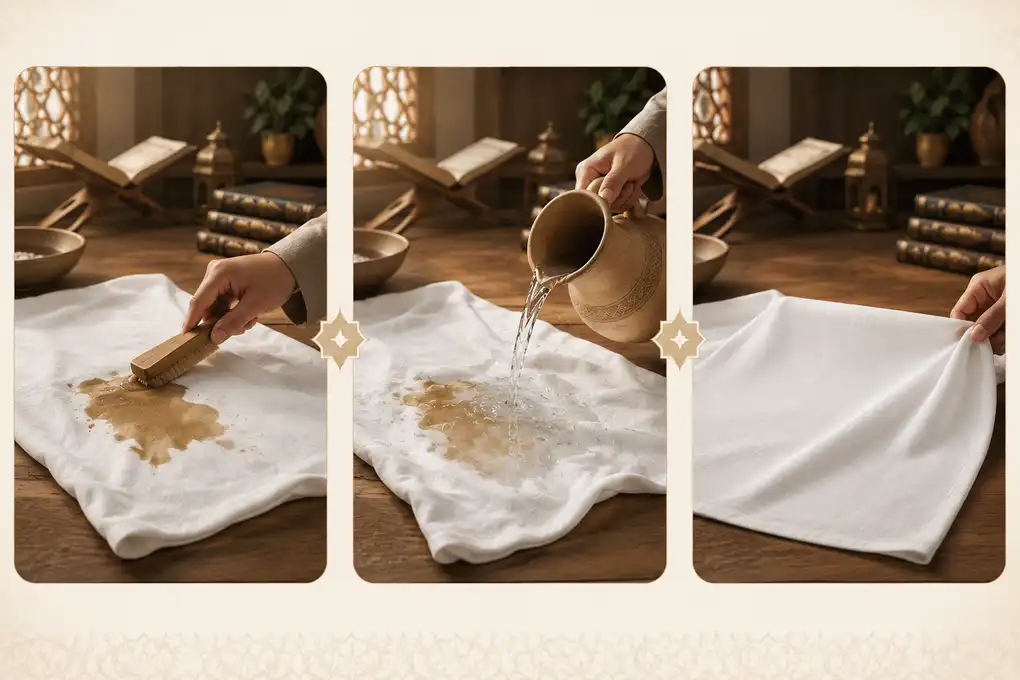
Purifying ‘ainiyyah impurity requires removing the substance itself and its relevant qualities according to the details of fiqh. The water used must be unrestricted water (al-mā’ al-muṭlaq), meaning water that is pure and purifying.
«وَيُطَهَّرُ مُتَنَجِّسٌ بِعَيْنِيَّةٍ بِغَسْلٍ مُزِيلٍ لِلطَّعْمِ … وَكَذَا مُزِيلٍ لِلَّوْنِ وَرِيحٍ سَهْلَيْنِ»
Translation: “An object affected by ‘ainiyyah impurity is purified by washing that removes the taste; likewise, it must remove colour and smell when they are easy to remove.”[4]
Follow these practical steps:
- Remove the physical substance first, such as feces, vomit, or clotted blood.
- Wash the affected area with unrestricted water until the water reaches the entire affected place.
- Remove the taste of the impurity in the legal sense. In practice, never taste an impure object; the jurists mention taste to show that its persistence indicates the substance remains.
- Remove colour and smell when they are easy to remove. If both remain together, the object is not yet pure.
- A concession applies when only one trace remains. When only colour or only smell remains and it is genuinely difficult to remove after reasonable effort, the object is deemed pure.[4]
One washing that actually removes the impurity fulfils the obligation. Washing up to three times is recommended as a measure of care, not an obligatory condition for intermediate impurity.[5]
How to Purify Hukmiyyah Impurity
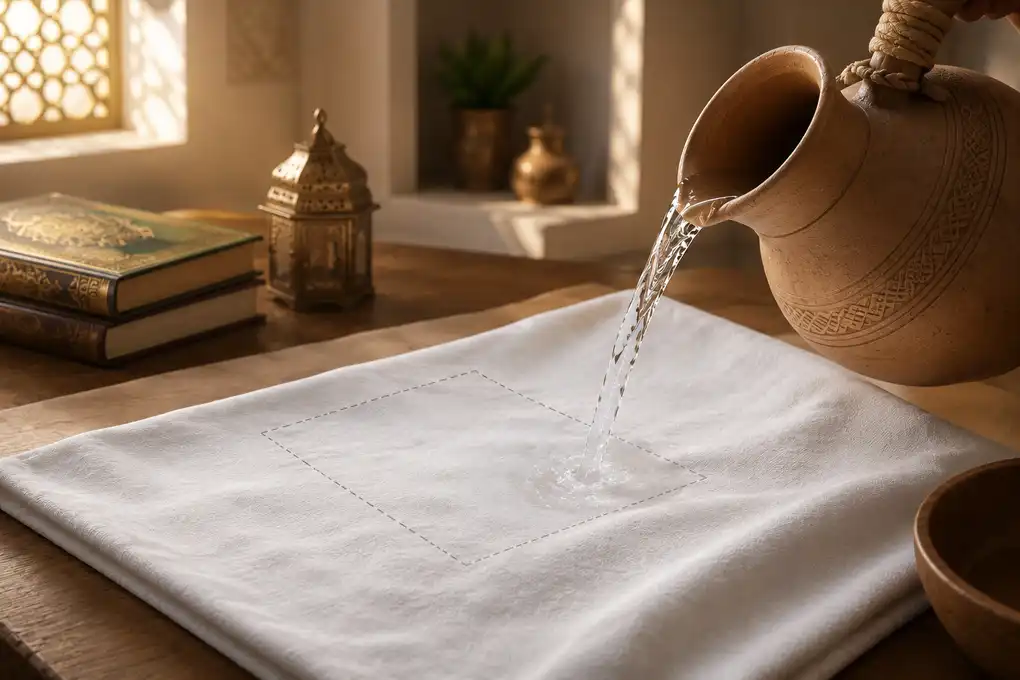
Hukmiyyah impurity does not require searching for a substance or colour that is no longer there. Water must simply run over the area known to have been affected.
«وَيُطَهَّرُ الْمُتَنَجِّسُ فِي الْحُكْمِيَّةِ بِجَرَيَانِ الْمَاءِ عَلَيْهِ، وَلَوْ لَمْ يُعْصَرْ»
Translation: “An object affected by hukmiyyah impurity is purified by water running over it, even if it is not wrung out.”[6]
Therefore, clothing affected by urine that has already dried can be purified by running water over the affected area. Wringing out the clothing is not a condition of validity, though it may be done to help it dry.
When using a small amount of water, bring the water to the impure place. Do not reverse the process by dipping the impure object into a small container of water.
«وَالْمَاءُ الْوَارِدُ عَلَى الْمُتَنَجِّسِ طَهُورٌ مَا لَمْ يَتَغَيَّرْ أَوْ يَنْفَصِلْ عَنْهُ»
Translation: “Water that comes onto an impure object is pure and purifying so long as it does not change or separate from it.”[7]
Applying the Rule to Clothing, Floors, and Smooth Objects
Clothing and Fabric


For clothing affected by ‘ainiyyah impurity, remove the substance first and then wash the affected part. For hukmiyyah impurity, run water over the area known to have been affected.
There is no need to wash all of a garment when the impurity touched only one identifiable area. Clean that area until the conditions of purification are met.
Floors or Ground
Impurity on a floor is purified by pouring water until it covers the affected area. The juristic text states:
«وَلَوْ صُبَّ عَلَى مَوْضِعِ بَوْلٍ أَوْ خَمْرٍ أَوْ نَحْوِهِمَا مِنْ أَرْضٍ مَا أَغْمَرَهُ طَهُرَ، وَلَوْ لَمْ يَنْضُبْ»
Translation: “If water that covers it is poured onto a place on the ground affected by urine, khamr, or the like, it becomes pure even if the water does not soak in.”[8]
Apply this principle to an affected floor: remove any visible substance first, then pour water so that it covers the area.
Smooth Objects
A smooth surface such as glass, ceramic, a knife, or metal is not purified by wiping alone after najis touches it. It must be washed with water.
«وَالصَّقِيلُ مِنْ سَيْفٍ، وَسِكِّينٍ، وَنَحْوِهِمَا كَغَيْرِهِ فِي أَنَّهُ لَا يَطْهُرُ إِلَّا بِغَسْلِهِ فَلَا يَطْهُرُ بِمَسْحِهِ»
Translation: “A smooth object, such as a sword, knife, and the like, is like other objects: it is not purified except by washing, so it is not purified by wiping.”[6]
Intermediate Najis Compared with Light and Severe Najis
| Level | Basic example | Method of purification |
|---|---|---|
| Mukhaffafah | Urine of a baby boy who has not begun eating food for nourishment, with its conditions | Sprinkle water until it covers the affected place |
| Mutawassithah | Urine, feces, blood, vomit, madhy, and wady | Remove the substance when it remains; for hukmiyyah, run water over the place |
| Mughallazhah | Dog, pig, and their offspring | Seven washes, one of them with soil |
This comparison answers the question, “What is medium impurity washed with?” It is washed with unrestricted water, without the seven-wash condition. For a step-by-step guide, read how to clean intermediate impurity.
Mistakes to Avoid
- Assuming that dried impurity automatically becomes pure.
- Treating dry tissue alone as sufficient purification for clothing or a place of prayer.
- Treating intermediate najis like dog or pig impurity and requiring seven washes.
- Using sprinkling for every intermediate impurity; sprinkling is a special rule for mukhaffafah impurity under its conditions.
- Declaring something impure because of intrusive doubt without certainty that it was actually affected.
Footnotes
[1]: Muhammad al-Khatib al-Shirbini, Al-Iqna’ fi Hall Alfaz Abi Syuja’, Vol. 1, p. 89.
[2]: Zakariyya al-Anshari, Asna al-Mathalib, Vol. 1, p. 19.
[3]: Ibid., pp. 12–13.
[4]: Ibid., p. 19.
[5]: Muhammad al-Khatib al-Shirbini, Al-Iqna’ fi Hall Alfaz Abi Syuja’, Vol. 1, pp. 93–94.
[6]: Zakariyya al-Anshari, Asna al-Mathalib, Vol. 1, p. 19.
FAQ
What is najis mutawassithah?
Name three examples of intermediate najis.
Three easy examples are urine, feces, and blood. Other examples include vomit, pus, madhy, and wady.
Their condition must still be assessed: the impurity may remain perceptible or may remain only as a legal status.
What category does dried menstrual blood belong to?
Dried menstrual blood remains intermediate najis. When its colour remains, it is ‘ainiyyah impurity, and the colour should be removed when it is easy to remove.[4]
When no substance, colour, or smell remains, but the place is known to have been affected and not purified, it is treated as hukmiyyah impurity.
How many times should intermediate najis be washed?
One wash that removes the impurity is obligatory and sufficient. Three washes are recommended, but they are not a condition for valid purification of intermediate najis.
When an impurity remains visible, the number of pours is not the main issue. The required result is removal of the substance and the qualities that must be removed.[4]
References
- al-Shirbīnī, Shams al-Dīn Muḥammad ibn Aḥmad. Al-Iqnāʿ fī Ḥall Alfāẓ Abī Shujāʿ. Edited by Maktab al-Buḥūth wa al-Dirāsāt, Dār al-Fikr. Beirut: Dār al-Fikr, vol. 1, pp. 89-94.
- Zakariyā al-Anṣārī, Asnā al-Maṭālib fī Sharḥ Rawḍ al-Ṭālib, with ḥāsyiyah (marginal gloss) by Aḥmad al-Ramlī, edited by Muḥammad az-Zuhrī al-Ghamrāwī (Cairo: al-Maṭbaʿah al-Maymānīyah, 1313 AH; repr. Dār al-Kitāb al-Islāmī), vol. 1, pp. 12-20.


