Prayer (salat) is the pillar of religion, but the standing of this pillar relies heavily on an absolute foundation: ritual purity. Ironically, in daily practice, many Muslims still mistakenly equate a merely “dirty” or “disgusting” object with “najis” (ritual impurity). Furthermore, quite a few are still confused about distinguishing between najis and hadas (ritual impurity state). In fact, a small mistake in identifying the purity status of the body or clothing can have fatal consequences, rendering the worship we perform invalid. So, what exactly are the precise boundaries of najis from the perspective of Islamic law (Shari’ah), and how do we distinguish it from ordinary dirt or the state of hadas?
Introduction & Basic Definition of Najis
The Meaning of Najis in Islam According to the Shafi’i School
Every Muslim needs to understand the complete guide to thaharah (purification) so that their methods of worship are valid in the eyes of Shari’ah. One of the core elements of the science of purification is recognizing what najis is and its boundaries. Islamic teachings pay great attention to physical cleanliness from impurities that can hinder the validity of prayer.
For those who are still wondering about the meaning of najis, the Shafi’i scholars have formulated its boundaries in detail. When viewed from the definition of najis according to language and terminology, we find a very cautious explanation. Etymologically (linguistically), najis means anything that is dirty and repulsive to normal human nature.
Meanwhile, from the perspective of fiqh (jurisprudence), the definition of najis is analyzed with strict parameters to distinguish it from ordinary dirty items. In the book Asna al-Mathalib, Imam Zakariya al-Anshari cites the scholars’ formulation regarding the essence of najis:
عرفها بعضهم بكل عين حرم تناولها مطلقا في حالة الاختيار مع سهولة تمييزها، وإمكان تناولها لا لحرمتها، ولا لاستقذارها، ولا لضررها في بدن أو عقل
“Every substance whose consumption is absolutely prohibited under normal circumstances (not out of necessity or emergency), is easily distinguishable, and is possible to consume; its prohibition is not due to its sacredness or honorable status, not because it is merely repulsive, and not because it is harmful to the body or mind.” [1]
Let us unpack the commentary (syarah) of the formulation above so that the meaning of the word najis becomes clearer:
- Absolutely prohibited for consumption: The substance is forbidden to be eaten, whether in small or large quantities. This excludes certain poisonous plants which are sometimes allowed to be consumed in very small doses for medical treatment.
- Under normal circumstances and easily distinguishable: The status of najis is assessed under normal conditions, not in emergencies. The condition “easily distinguishable” excludes small worms inside fruits that are difficult to separate, which are therefore forgiven if swallowed along with the fruit.
- Possible to consume: This criterion excludes hard objects such as stones.
- Not due to its sacredness or honorable status: Human flesh is prohibited because of its inherent honor (hurmatil adami), not because it is najis.
- Not because it is merely repulsive: Fluids like nasal mucus or phlegm are forbidden to be swallowed because normal human nature finds them repulsive (istiqdzar), yet their substance remains ritually pure.
- Not because of harm: Substances like soil, intoxicating plants, or poison are prohibited from entering the body because they damage organs and the mind, not because their physical substance is najis.
Based on this profound explanation, najis is a substance that is purely prohibited because Islamic law deems it inherently unclean, such as animal waste, blood, or carcasses.
The Fundamental Difference Between Najis and Hadas
Muslims often confuse the difference between hadas and najis. Although hadas and najis both hinder the validity of acts of worship like prayer, the two have distinct natures. Understanding the difference between hadas and najis will guide us to the correct and targeted methods of purification.
Imam Zakariya al-Anshari in his book clearly distinguishes these two matters when explaining the function of absolute water. He formulated:
قوله: (المطهر للحدث) ، وهو هنا أمر اعتباري يقوم بالأعضاء يمنع صحة الصلاة حيث لا مرخص (والخبث) ، وهو مستقذر يمنع صحة الصلاة حيث لا مرخص
“(Water that purifies hadas), and hadas here is an abstract or incorporeal matter that resides in the limbs, which prevents the validity of prayer unless there is a dispensation. (And water that purifies khabats or najis), which is a dirty substance that prevents the validity of prayer unless there is a dispensation.” [2]
Referring to the text, the difference between hadas and najis can be summarized into the following legal points:
- Nature and Manifestation: Hadas is an abstract state of impurity (maknawi) affecting the body. On the contrary, najis is a physical impurity whose substance can be seen, felt, or smelled.
- Method of Purification: Removing hadas requires a specific ritual, namely wudhu (ablution) or ghusl (ritual bath), which must include an intention. Meanwhile, purifying the body or clothing from najis does not require an intention; it is purely the act of removing the physical impurity using water.
- Case Example: We can see examples of hadas and najis from the act of relieving oneself. The excretion of urine causes a person to enter a state of hadas, making wudhu mandatory. Meanwhile, the urine that drops onto their thigh or clothing is a physical manifestation of najis that must be washed away.
A precise understanding of these boundaries will safeguard the perfection and quality of our daily worship.
Classification and Levels of Najis
Types of Najis and Their Examples



In the study of Shafi’i fiqh, to answer the basic question of how many types of najis there are, scholars categorize them into three levels of measurement. This division of najis is based on the level of difficulty in purifying them. Recognizing the types of najis is extremely vital so that our worship is valid and accepted.
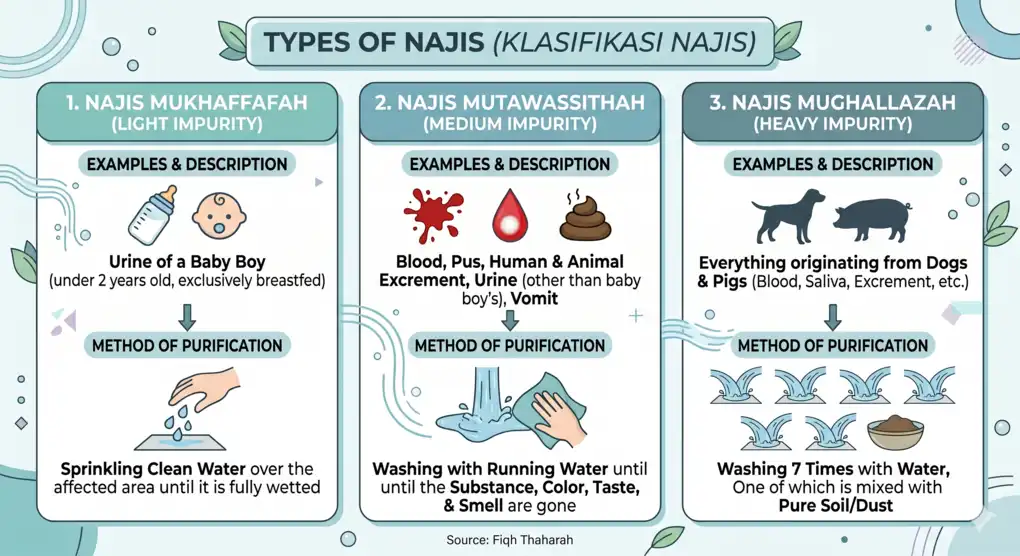
These various impurities are very close to daily life. If someone asks to list the types of najis, in short, najis is divided into three categories: light, medium, and heavy. Although in specific details scholars sometimes mention 7 major types of najis (such as blood, pus, urine, feces, vomit, intoxicants, and the saliva of a dog/pig), all these substances ultimately boil down to three major categories.
1. Najis Mukhaffafah (Light Impurity)
Najis mukhaffafah is a type of impurity that receives special leniency in its handling. This impurity is also widely referred to by the general public as light najis. Referring to fiqh literature such as the book Asna al-Mathalib, the definition of najis mukhaffafah is specifically restricted to the urine of a baby boy. Let us look at the original text of the ruling:
قوله: (ويكفي في تطهير بول صبي لم يطعم غير اللبن) للتغذي (لا صبية، وخنثى نضح بالماء بشرط غلبته، وإن لم يسل)
“And it is sufficient in purifying the urine of a baby boy who has not consumed anything other than milk (as primary nourishment)—not the urine of a baby girl or a hermaphrodite (khuntsa)—by sprinkling water on it with the condition that the water is dominant, even if it does not flow.” [3]
The only valid example of najis mukhaffafah is the urine of an infant boy under two years old. However, the condition for this baby boy’s urine to fall into the category of najis mukhaffafah is that the baby solely consumes exclusive breast milk. Once he begins eating porridge or bananas, the status of his urine escalates to ordinary light impurity, which is medium najis (mutawassithah). It should be noted that this leniency does not apply to the urine of a baby girl.
2. Najis Mutawassithah (Medium Impurity)
The second level, which encompasses the majority of impurities, is najis mutawassithah. By definition, najis mutawassithah is an impurity at the intermediate level; it does not receive leniency like the urine of a baby boy, but it is not as heavy as the impurity of a dog. This medium najis is the variety of dirt we encounter most frequently every day.
Various examples of najis mutawassithah include blood, pus, vomit, human excrement, animal droppings, madzi fluid, wadi fluid, and intoxicating drinks. To avoid mistakes in cleaning it, scholars establish that najis mutawassithah is divided into two categories based on its manifestation.
The Division of Najis Mutawassithah: ‘Ainiyah and Hukmiyah
This separation is purely to measure whether the impurity’s physical substance is still visible to the senses or has faded. Imam Zakariya al-Anshari explains this very clearly:
ثم النجاسة إما عينية، وهي التي تحس أو حكمية، وهي بخلافها كبول جف، ولم يوجد له أثر، ولا ريح
“Then najis is either ‘Ainiyah, which is an impurity whose manifestation can be perceived by the senses, or Hukmiyah, which is its opposite, such as urine that has dried up and no trace of its color or smell is found.” [4]
From this text, we can immediately conclude the difference between ‘ainiyah and hukmiyah. In principle, najis ‘ainiyah is an impurity whose physical form is still attached, whether in terms of color, smell, or taste. Conversely, najis hukmiyah is an impurity whose physical form has vanished and dried up, but the location is still legally considered unclean.
An example of najis hukmiyah is a drop of urine on a mosque carpet that has dried due to the air. Because it is invisible, this imperceptible and odorless impurity is called najis hukmiyah, which is prone to making our prayers invalid without us realizing it.
3. Najis Mughallazhah (Heavy Impurity)
The final group with the strictest rules is najis mughallazah. As the name suggests, najis mughallazah is a heavy-grade impurity that requires extra strict cleaning procedures. Some people occasionally refer to it by the term major najis.
The primary source of najis mughallazah centers on pigs and dogs. Imam Zakariya al-Anshari details this strictness in Asna al-Mathalib:
قوله: (لا كلب) ولو معلما لخبر مسلم «طهور إناء أحدكم إذا ولغ فيه الكلب أن يغسله سبع مرات أولاهن بالتراب» … (و) لا (خنزير) لأنه أسوأ حالا من الكلب … (و) لا (فرع كل) منهما مع الآخر أو غيره تغليبا للنجاسة
“(And the impure substance is) a dog, even a trained dog, based on the hadith of Muslim: ‘The purification of the vessel of one of you when a dog licks it is to wash it seven times, the first of which is mixed with soil’… (And also impure is) a pig, because its condition is worse than a dog… (And also impure is) the offspring of either of them with the other or with another animal, prioritizing the ruling of its impurity.” [5]
The text above seals the conclusion that pigs and dogs are heavy impurities, where their impurity is transmitted to all parts of their body, saliva, and even their sweat. Another example of najis mughallazah to watch out for is crossbred animals, for example, a dog mating with a sheep. The offspring still inherits the heavy impurity status for the sake of religious precaution (taghliban lin-najasah).
Guide on How to Purify Najis
How to Purify Najis Based on Its Level
Knowing the types of najis and how to purify them is a fundamental requirement for the validity of a Muslim’s worship. In fiqh law, the procedure for purifying najis is very different from removing hadas like wudhu. Removing najis is purely an effort to clean the physical impurity, so it does not require an intention in the heart.
Imam Zakariya al-Anshari explains this basic principle in the chapter Izalatun Najasah:
قوله: (باب بيان إزالة النجاسة) تجب إزالتها للصلاة، ونحوها… (ولا يشترط فيها النية) لأنها ترك كترك الزنا
“Chapter Explaining the Removal of Najis. It is mandatory to remove it for prayer and its like… (And intention is not required in it) because removing najis falls under the category of ‘abandonment or avoidance’ just like abandoning adultery.” [6]
This text directly answers the question of whether istinja’ requires an intention. Therefore, the correct way to purify najis relies entirely on the disappearance of the form or characteristics of the impurity. Whether you are looking for ways to remove najis from clothes or building floors, the rule goes back to the level of the najis. Below is a detailed review of how to clean and remove najis according to the guidance of the Shafi’i school.
How to Clean Najis Mukhaffafah (Light)
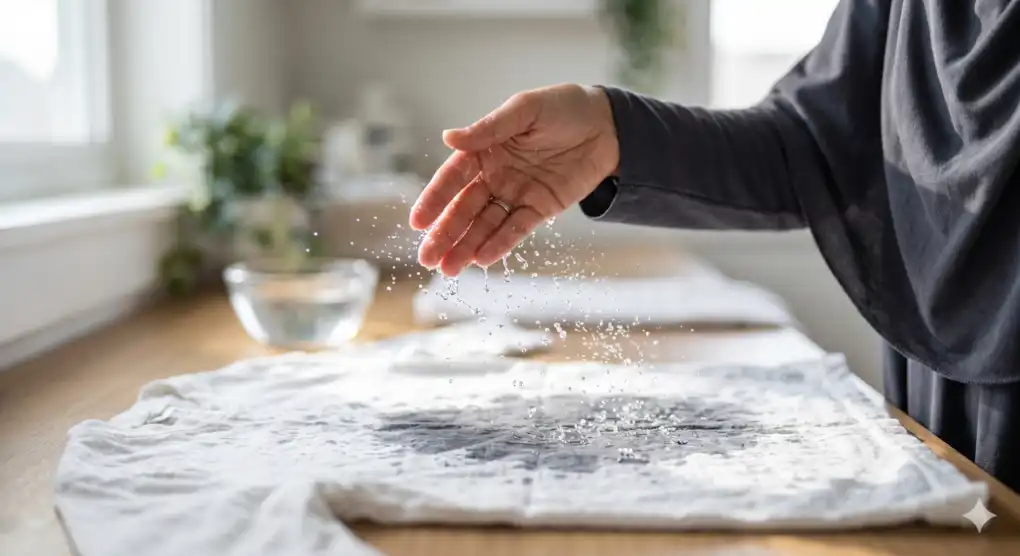
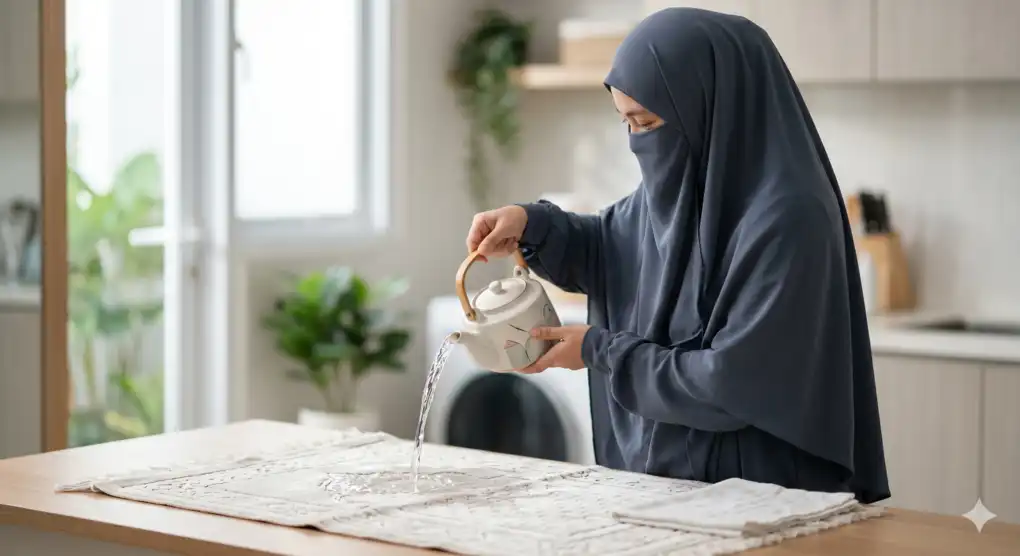
The purification process for this category is very easy and full of concession. You simply need to sprinkle water (nadzah) onto the fabric area affected by the impurity. Fiqh guidance establishes that the urine of a baby boy only needs to be sprinkled with water evenly until the volume of water exceeds the volume of the urine, even if the water does not flow or drop off.
The absolute condition for cleaning this light najis is mentioned in the book Asna al-Mathalib:
قوله: (ويكفي في تطهير بول صبي لم يطعم غير اللبن) للتغذي (لا صبية، وخنثى نضح بالماء بشرط غلبته، وإن لم يسل)
“And it is sufficient in purifying the urine of a baby boy who has not eaten anything other than milk for nourishment—not a baby girl or a hermaphrodite—by sprinkling water with the condition that the water is more dominant, even if it does not flow.” [7]
This provision is highly limited and only applies to baby boys who exclusively drink breast milk. If you are looking for how to purify clothes affected by a baby girl’s urine, the treatment falls under the medium najis category (requiring water to be washed until it flows).
How to Purify Najis Mutawassithah (Medium)
Najis mutawassithah is the variety of dirt most commonly encountered daily. The basic step to clean najis mutawassithah depends heavily on the form of the impurity, whether it is ‘ainiyah (visible) or hukmiyah (invisible). Regarding how to purify najis ‘ainiyah, the main requirement is that the properties of the najis—taste, smell, and color—must be completely eliminated from the fabric or place.
The fiqh statement is affirmed by Imam Zakariya al-Anshari:
قوله: (ويطهر متنجس بعينية بغسل مزيل للطعم)… (وكذا) مزيل (للون وريح سهلين)
“(And an object affected by najis ‘ainiyah becomes pure by a washing that removes its taste)… (and likewise) a washing that removes the color and smell that are easy to eliminate.” [8]
Conversely, purifying najis hukmiyah is much simpler. This case often arises when an impurity dries up after being stepped on until its physical traces disappear over time. You only need to run water (jaryan al-ma’) once over the spot without needing to scrub or wring it out.
How to Purify Heavy Najis (Dogs & Pigs)
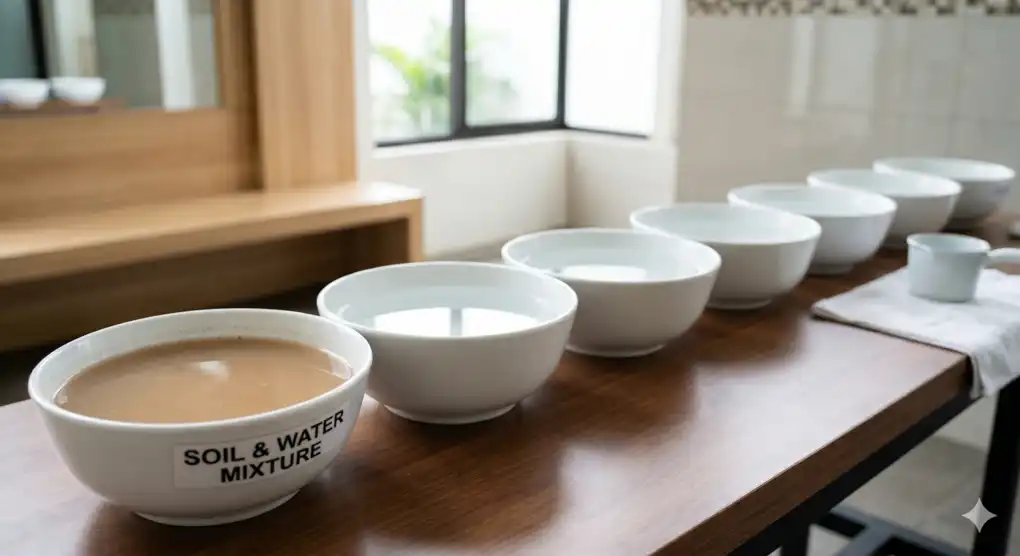
The level of najis mughallazah applies to dogs, pigs, and their offspring. Shari’ah provides a clear line for cleaning dog impurity, which is washing it 7 times with water, one of which must be mixed with soil. If anyone is looking for alternative ways to clean dog impurity without soil, such as replacing it with modern soap, it does not satisfy the Shari’ah standards of the Shafi’i school.
The mandatory rule for removing dog impurity is clearly summarized:
فصل: (لا يطهر متنجس بكلب، وخنزير… إلا بسبع) من الغسلات بالماء (إحداهن بالتراب)… (وليكن التراب) الذي يغسل به ذلك (طاهرا غير مستعمل)
“(Section: An object contaminated by a dog or pig cannot become pure… except with seven) washings with water (one of which is mixed with soil)… (And let the soil) used for washing be pure and not used (musta’mal).” [9]
The pure soil or dust must be mixed with water so that it blends when washed over the contaminated area. This method is the only valid way to purify heavy najis.
Intention and Prayers for Removing Heavy Najis
Some Muslims occasionally busy themselves searching for specific prayers or intentions to remove dog impurity. In reality, Islamic teachings emphasize the empirical aspect of cleanliness in this chapter. As explained at the beginning of the section, the act of cleaning dirt does not require any specific intention at all.
You are not burdened with the obligation of memorizing specific verbal intentions or formulas. The main focus is to eliminate the physical form of the najis through 7 washings and a mixture of pure soil. Of course, starting every good deed by uttering Bismillah is a noble etiquette, and you can learn more about the ruling on reciting basmalah, but reading a specific intention to clean dog najis is not a valid requirement for an object to become pure.
Status of Objects, Fluids, and Animals (Basic Sub-Issues)
Objects, Body Fluids, and Animals Judged as Najis
In daily life, we often encounter various forms of objects and fluids excreted from the body. Questions like whether vomit is najis, or whether pus is najis, often confuse the public. This is where the importance of recognizing the status of impure substances in Islam based on standard fiqh principles lies.
As a general rule, fluids processed or altered in nature inside human bodily organs are judged as najis excretions. Imam Zakariya al-Anshari in the book Asna al-Mathalib confirms this principle:
(فرع المستحيل في الباطن نجس كدم… وقيح، وماء قرح تغير… وقيء)
“Sub-issue: Everything that is transformed (changes form) within the interior of the body is najis, such as blood… pus, blister water that has changed its smell/color… and vomit.” [10]
Based on this principle, let us answer questions regarding the status of body fluids:
- Vomit: Many breastfeeding mothers ask whether vomit is najis or not; they can refer to the comprehensive guide to fiqh thaharah for breastfeeding mothers. The answer is that all types of vomit are najis because they have been processed in the stomach, even if it is the vomit of a baby who only drinks breast milk.
- Blood: If anyone asks whether blood is najis, the answer is yes. All blood, including menstrual blood, is legally najis, except for a small amount of blood that is forgiven (ma’fu), such as mosquito blood or a tiny amount of acne blood.
- Pus: Pus is decayed blood, so its status is the same as blood, which is najis.
The Legal Ruling on Semen (Mani), Madzi, and Wadi
Doubts often arise among young people regarding biological fluids. Many mistakenly equate these three types of fluids. Understanding the difference between mani and madzi as well as wadi is crucial because their legal impacts differ regarding our worship procedures.
So, is semen (mani) najis? This is the most common misconception. Contrary to some people’s views, human semen is basically ritually pure. The question of whether sperm is najis is answered clearly by the scholars of the Shafi’i school. Let us look at the details from the book Asna al-Mathalib:
قوله: (ومذي) بالمعجمة للأمر بغسل الذكر منه… (، وودي) بالمهملة إجماعا… (، ومني غير الكلب، والخنزير) ، وفرع أحدهما أي كل منها (طاهر)
“(And madzi fluid) is considered najis because of the command to wash the male organ from it… (and wadi fluid) is najis according to scholarly consensus… (As for semen other than that of a dog and a pig), and the offspring of either of them, it is pure.” [11]
Here are the detailed rulings to answer your doubts:
- Semen (Mani): For those asking whether mani is najis, the ruling is that it is pure. If there is a semen stain on a prayer garment, the garment is valid to be used for prayer, although it is sunnah to wash or scrape it off if it has dried for the sake of cleanliness.
- Madzi Fluid: A clear, sticky fluid emitted when sexual arousal rises (without ejaculation). It is a medium najis (mutawassithah) that must be washed away and invalidates wudhu.
- Wadi Fluid: A thick, cloudy fluid that usually comes out after urinating or due to exhaustion from lifting heavy loads. Its ruling is also najis and it must be washed away.
Legal Rulings on Animals: Dogs, Pigs, Cats, and Small Creatures
In fiqh, the pure or unclean status of an animal determines the ruling on the fluids and body parts separated from it. The answers to whether dogs are najis and whether pigs are najis are very clear; both are sources of heavy najis (mughallazah).
However, what about cats? The status of this pet is often questioned, such as whether cat fur is najis or whether cat saliva is najis. Cats are ritually pure animals. Their sweat, saliva, and tears follow the purity status of their body. This relies on the principle:
قوله: (فرع للمترشح) أي لما يغلب ترشيحه (حكم حيوانه) طهارة، ونجاسة (وهو كدمع) ، ومخاط، وعرق (ولعاب)
“Sub-issue: Exuded fluids (from an animal’s body) follow the status of the animal itself in terms of purity or impurity, such as tears, mucus, sweat, and saliva.” [12]
As long as cat fur sheds in small amounts, it is forgiven and does not invalidate worship. You can read the specific ruling on cat fur in Islam.
On the other hand, gecko or lizard droppings are classified as medium najis (mutawassithah). Unlike lizard droppings on clothes, the carcass of a lizard or fly itself does not contaminate water if it falls into it, because they belong to animals whose blood does not flow when killed.
The Ruling on Intoxicating Drinks (Khamr)
Islam strictly forbids the distribution and consumption of intoxicating drinks. Many know that getting drunk is haram, but are still unsure whether alcoholic beverages are physically najis or merely forbidden to drink.
In the Shafi’i school, khamr is judged as inherently impure in its physical substance. Notice the following quote:
قوله: (الأعيان جماد، وحيوان فالجماد طاهر)… (لا خمر) ، وهي المشتد من ماء العنب… (و) لا (نبيذ مسكر)
” (All physical objects are either inanimate matter or animals. Inanimate matter is basically pure)… (except khamr), which is the fermented juice of grapes that becomes intoxicating… (and) not pure either is intoxicating nabidh (fermented juice other than grapes).” [13]
Based on this text, liquor is legally najis in its essence, just like urine. Therefore, containers previously holding khamr must be washed thoroughly before being used for other purposes. Regarding modern issues like alcohol in perfumes, contemporary scholars distinguish between medical/synthetic alcohol and original fermented khamr.
Exemptions and Leniencies in the Chapter of Najis
Najis Ma’fu (Excused Impurities)
The religion of Islam is built upon the foundation of ease and rationality. In the realm of fiqh, not all dirt impacts the validity of worship. There is a special category where Shari’ah provides leniency, namely excused impurities (najis ma’fu). This leniency is usually granted because such dirt is very difficult for humans to avoid during normal activities.
Thus, najis ma’fu consists of dirt that remains legally najis in substance, but its presence on clothing or the body is forgiven (tolerated) so that prayers remain valid. One of the strong references in the Shafi’i school regarding the concept of umumul balwa (unavoidable widespread conditions) is explained by Imam Zakariya al-Anshari:
قوله: (فإن ابتلي به شخص) لكثرته منه (فالظاهر العفو) كدم البراغيث
“If a person is tested with it because of its abundance (making it hard to avoid), then the apparent ruling is forgiveness, like flea blood.” [14]
Learning about whether mosquito carcasses and flea blood are najis helps answer practical everyday questions. In manifestation, mosquito blood remains najis. However, because its size is very small and its presence is difficult to prevent, it is excused when you accidentally carry it into prayer.
The criteria for minor splatters of najis that fall under the ma’fu category include:
- Blood from one’s own acne, boils, or small wounds that does not flow severely.
- Blood from mosquitoes, fleas, or flies attached to clothes.
- Splashes of street mud that are hard to avoid and where the color of the najis is not clearly visible.
Mempelajari batasan najis yang dimaafkan sangat penting agar ibadah kita tidak diliputi perasaan waswas (ragu-ragu) yang berlebihan.
Istihalah: The Transformation of an Impure Substance into a Pure One
The next exception is the concept of istihalah. In Shafi’i fiqh, the status of an impure substance changes to purely ritually pure due to a natural transformation of form and properties. However, Shari’ah restricts this, stating that not all chemical or physical changes make a substance pure.
The clearest agreed-upon example of an impurity turning pure is khamr turning into vinegar. Imam Zakariya al-Anshari documented this standard rule:
قوله: (وتطهر خمر) ، ولو غير محترمة (تخللت… ولو بتشميس) أو فتح رأس الدن لزوال الشدة من غير نجاسة حلتها
“Khamr becomes pure—even unrespected khamr—if it turns into vinegar, even if by exposure to the sun or opening the lid of the vessel, due to the disappearance of the intoxicating property without any other impurity entering it.” [15]
Apart from khamr, another justified transformation of form is a carcass or blood metamorphosing into a new living creature. He continued:
قوله: (ويطهر كل نجس استحال حيوانا) كدم بيضة استحال فرخا… (لا) إن استحال (رمادا، وملحا) ، ونحوهما فلا يطهر
“Every impure thing that transforms into an animal becomes pure, like the blood of an egg that transforms into a chick… (It does not become pure) if it transforms into ashes, salt, and their likes.” [16]
Based on the above rule, burning animal feces into ashes does not purify the feces.
Dabbagh: Purifying the Skin of a Carcass (Tanning)
What about the skin of a dead animal or a carcass? Can it be utilized? Shari’ah provides a way out through the process of dabbagh (tanning). Tanning the hide of a carcass using sharp, acrid substances can remove moisture, impurities, and foul odors, rendering the leather pure and permissible to use.
Let us examine the conditions of dabbagh from the book Asna al-Mathalib:
قوله: (والدباغ)… (بحريف) بكسر الحاء (نازع للفضول بحيث لا يفسده)… (يطهر) أي الاندباغ (جلد غير كلب، وخنزير، وفرعهما)
“Tanning… using an acrid substance that removes excess matter in a way that does not spoil it… tanning purifies the skin of anything other than a dog, a pig, and their offspring.” [17]
Here are the legal points for using it:
- Carcass Skin of Cow/Goat: If tanned correctly, wearing leather shoes from a dead cow or a belt from a dead goat is pure and valid to be carried into prayer.
- Dog and Pig Skin: The essence of dogs and pigs cannot be purified by any means. Therefore, using bags made of pigskin remains haram and heavily impure, even if it has passed through the most advanced tanning factories.
FAQ Regarding Types of Najis and How to Purify Them
In the question-and-answer session of fiqh thaharah, many Muslims ask various questions about najis. This is common because our interactions with the environment often give rise to doubts regarding the cleanliness of clothing or the body. The following is a summary of concise question-and-answer sessions based on Shafi’i fiqh.
1. What is the main difference between hadas and najis?
Hadas is an abstract state of ritual impurity on the body that requires a person to perform wudhu or ghusl.
Najis is a physical dirty substance attached to the body, clothing, or place of prayer.
Imam Zakariya al-Anshari emphasizes this difference by detailing the function of water:
قوله: (المطهر للحدث) ، وهو هنا أمر اعتباري يقوم بالأعضاء يمنع صحة الصلاة حيث لا مرخص (والخبث) ، وهو مستقذر يمنع صحة الصلاة
“Purifying hadas, which is an abstract matter residing in the limbs that prevents the validity of prayer… and khabats (najis), which is a dirty substance that prevents the validity of prayer.” [18] Cleaning hadas requires an intention, while purifying physical najis is a purely physical cleaning without requiring an intention.
2. Is the vomit of a breastfeeding baby considered a light impurity (mukhaffafah)?
Many parents think infant vomit has a light status. In fiqh, all types of vomit (al-qay’) absolutely hold the status of medium najis (mutawassithah), even if the baby only consumes breast milk and has not eaten other foods.
قوله: (وقيء) ، وإن لم يتغير
“(Among the impurities is vomit), even if its form and smell have not changed from its original state.” [19] The leniency of najis mukhaffafah solely applies to the urine of a baby boy who only drinks breast milk. If your clothes are affected by baby vomit, they must be washed thoroughly until water flows, not just sprinkled.
3. How do you purify a najis whose form, color, and smell are no longer visible (Najis Hukmiyah)?
Najis hukmiyah is the remaining impurity whose physical form, color, smell, and taste have completely disappeared (e.g., urine on a carpet that dried without a trace). The method to purify it is very easy and practical:
- Ensure no physical substance of the najis remains.
- Simply run absolute water evenly over the area once.
The technical evidence is mentioned in Asna al-Mathalib:
قوله: (ويطهر) المتنجس (في الحكمية بجريان الماء عليه، ولو لم يعصر)
“And an object contaminated by najis hukmiyah becomes pure by simply running water over it, even if it is not wrung out.” [20]
4. Does mosquito blood attached to clothing invalidate prayer?
No, it does not. Mosquito blood, flea blood, and small amounts of acne blood are classified under Najis Ma’fu (excused impurities). This leniency is granted because such dirt is very difficult to avoid (umumul balwa) in daily life. Scholars equate its ruling to flea blood, which is hard to separate from clothing:
قوله: (فإن ابتلي به شخص) لكثرته منه (فالظاهر العفو) كدم البراغيث
“If a person is tested with it because of its abundance, then the apparent ruling is forgiveness, like flea blood.” [21] You do not need to worry or change clothes; your prayer is still considered valid.
5. Are cat saliva and fur judged as najis if they get on clothes?
Cats hold the status of animals whose bodies are pure. Any bodily fluids that naturally come out of them are also pure. So, is nasal mucus najis? Mucus, whether from humans or from pure animals like cats, is legally pure.
The fiqh rule reads:
قوله: (فرع للمترشح) أي لما يغلب ترشيحه (حكم حيوانه) طهارة، ونجاسة (وهو كدمع) ، ومخاط، وعرق (ولعاب)
“Sub-issue: Exuded fluids have a ruling of purity or impurity according to their animal source, such as tears, mucus (mukhat), sweat, and saliva.” [22] Meanwhile, for cat fur that sheds and attaches to clothes in small amounts, it is excused (ma’fu) because it is very difficult for cat owners to avoid.
6. What is the ruling if one is doubtful about whether they were exposed to najis or not before praying?
Often, whispers of doubt (waswas) arise. If faced with doubt about being exposed to najis, Shari’ah directs us to return to the original principle: everything is originally pure (al-ashlu at-thaharah).
قوله: (لا إن شك في قلته) أي الماء فلا ينجس بذلك لأن الأصل طهارته
“(It does not become impure if there is doubt) regarding the water, because the original principle is its purity.” [23] As long as you do not clearly see the physical form of the najis, smell it, or taste it, ignore the doubt. Pray with peace of mind because doubt cannot defeat the initial certainty that your clothes are pure.
Conclusion
Understanding the fiqh of thaharah (purification) proves that Islamic law is very meticulous and rational in setting cleanliness standards. From the explanation above, we can draw the following key conclusions:
- Specific Boundaries of Najis: Not everything that is dirty, repulsive, or forbidden to eat is automatically najis. Najis is a physical form (‘ain) absolutely prohibited by Shari’ah because its substance is unclean, not due to honor, mere repulsiveness (like phlegm), or bodily harm (like poison).
- Clear Difference Between Najis and Hadas: Hadas is an abstract state of impurity on the body and is purified through ritual actions with an intention (wudhu/ghusl), whereas najis is physical dirt on the body, clothing, or place that must be removed using water (without requiring an intention).
Ultimately, distinguishing between ordinary dirt, najis, and hadas is not just a theory of Islamic law, but a practical key that determines the validity of our worship. By understanding these boundaries accurately, we can maintain perfect purity so that every prostration and prayer we offer can be fully accepted by Allah SWT.
Footnotes
Reference
Zakariyā al-Anṣārī, Asnā al-Maṭālib fī Sharḥ Rawḍ al-Ṭālib, with ḥāsyiyah by Aḥmad al-Ramlī, edited by Muḥammad az-Zuhrī al-Ghamrāwī (Cairo: al-Maṭbaʿah al-Maymānīyah, 1313 AH; repr. Dār al-Kitāb al-Islāmī), vol. 1, pp. 5-22.


