
Water is used for ablution, ritual bathing, and removing impurity. Yet water is not judged only by how clear it looks. In Shafi’i fiqh, its ruling depends on its original state, contact with impurity, changes in its qualities, and its amount.
This article explains impure water, commonly called mutanajjis water, according to Shafi’i fiqh. It follows Asna al-Mathalib by Zakariyya al-Anshari and keeps the legal distinctions clear in plain English.
What Is Impure Water?
The fiqh meaning of impure water
Impure water is water that may no longer be used to remove ritual impurity or physical impurity. In fiqh terminology, mutanajjis water is water that was originally pure and then became affected by najasah.
The basic rule is that ritual purification requires unrestricted water (al-ma’ al-mutlaq). Zakariyya al-Anshari writes:
لَا يَجُوزُ رَفْعُ حَدَثٍ وَلَا إِزَالَةُ نَجَسٍ إِلَّا بِالْمَاءِ الْمُطْلَقِ
“Ritual impurity may not be lifted, and physical impurity may not be removed, except with unrestricted water.”[1]
Therefore, water known to be impure is not used for wudu, ghusl, or washing an impure object. Water may look clear and still be unsuitable for purification when the cause of impurity is established.
Why it is called mutanajjis water
Mutanajjis comes from المتنجس, meaning something that becomes impure by contact with impurity. It is not necessarily impure in its original state; it acquires that ruling after contact with najasah.
So, when someone asks, “What is water that has been touched by impurity called?” the answer is mutanajjis water. This must be distinguished from the impure substance itself.
Why mutanajjis water cannot be used for purification


Mutanajjis water no longer meets the condition of unrestricted water required for purification. That is why it cannot be used for wudu, ghusl, or removing najasah.
Do not use water whose impurity is established for ritual purification. In Shafi’i fiqh, using it does not fulfil the requirement of purification.
Where impure water fits among the categories of water
In the wider discussion of types of water used for purification, impure water belongs to the category that does not purify. The following quick guide prevents confusion:
- Unrestricted water: pure and purifying.
- Changed water (mutaghayyir): changed by a pure substance; it is not automatically impure, though it can cease to be purifying.
- Used water (musta’mal): water used for an obligatory act of purification in a specific Shafi’i discussion; its ruling differs from impure water.
- Mutanajjis water: water affected by impurity and not purifying.
Dirty-Looking Water Is Not Always Impure Water
Water that looks dirty may still be pure
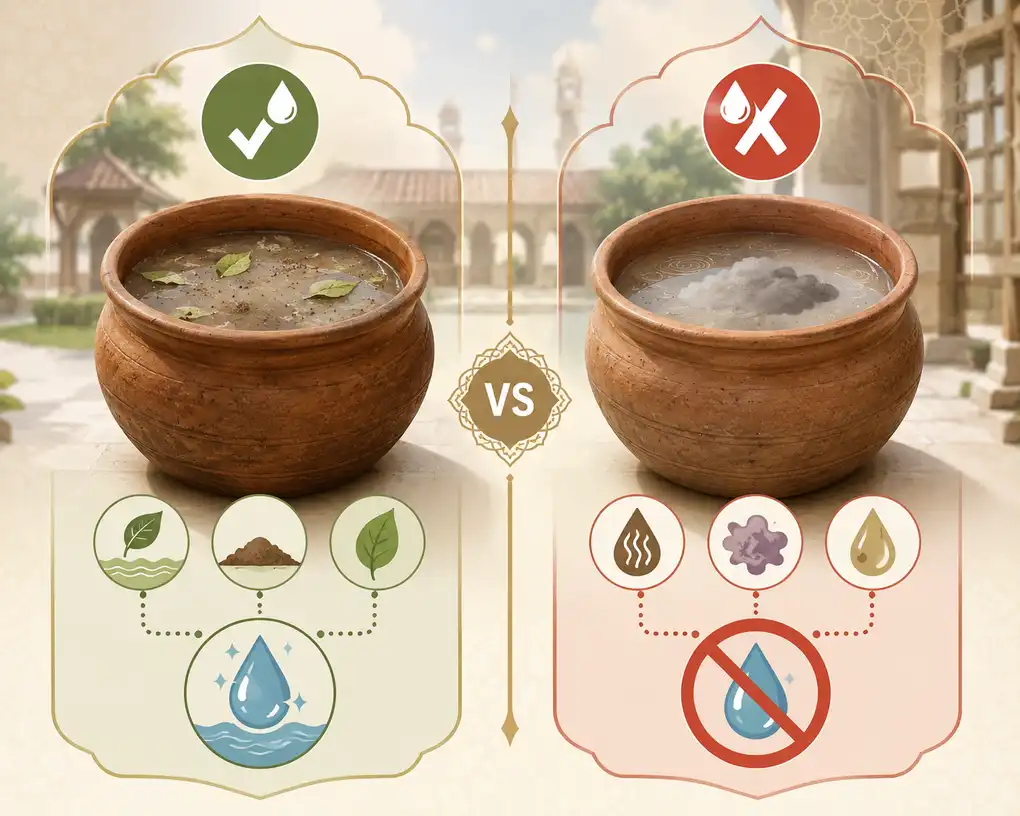
Cloudy water is not automatically impure. It can change because of soil, mud, algae, leaves, or a long period of standing. Such changes must be distinguished from changes caused by najasah.
The text explains that changes caused by matters difficult to avoid in water’s source or route do not remove its purity, including algae and changes from prolonged standing.[2] A well with water that is slightly cloudy because of soil should not be ruled impure without further proof.
Water touched by impurity can become mutanajjis
Water that comes into contact with impurity can become mutanajjis, but the ruling depends on its volume. Small water has a stricter ruling than water that has reached two qullahs.
Zakariyya al-Anshari states:
وَدُونَهُمَا مِنْ مَاءٍ قَلِيلٍ فَيَنْجُسُ … بِمُلَاقَاةِ نَجَاسَةٍ مُؤَثِّرَةٍ وَإِنْ لَمْ يَتَغَيَّرْ
“Water below two qullahs becomes impure upon contact with an impurity that is legally consequential, even if it does not change.”[3]
The phrase “legally consequential” excludes traces that are excused in the detailed discussion of the text. A ruling should not be built on suspicion or recurring doubt.
Physical cleanliness and ritual purity are different
Physical cleanliness concerns what is seen or smelled. Ritual purity concerns whether the water may be used for an act of worship.
Water can look less clean yet remain pure, such as water changed by soil or algae. By contrast, a small amount of water can become impure after established contact with najasah even when its color, smell, and taste seem unchanged.
Signs of Impure Water in Shafi’i Fiqh
Established contact with an impure substance
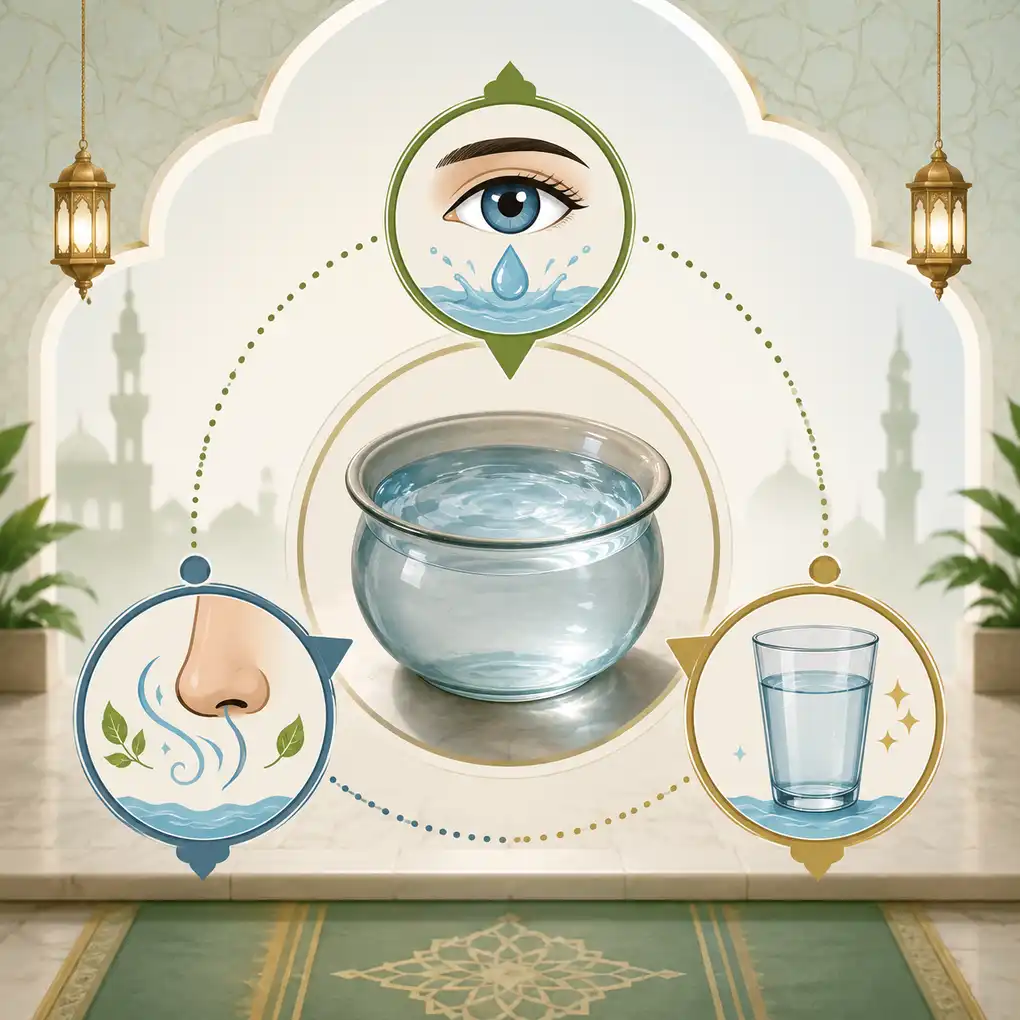
The first sign is that an impure substance is known to have reached the water. Examples include a small bucket containing an impure substance, a basin touched by urine, or stored water mixed with a carcass.
Possibility alone is not enough. Where there is no proof or strong indication, the original ruling of purity remains.
A change in color caused by impurity
For a large amount of water, a change of color caused by impurity indicates that the water has become impure. For example, stored water may visibly change color because najasah mixed into it.
The cause matters. Yellowish water caused by soil, rust, or minerals does not automatically establish impurity.
A change in smell caused by impurity
A smell caused by najasah is also a sign of impure water. But a smell coming from something near water does not, by itself, make the water impure.
The text says:
لَا بِجِيفَةٍ بِقُرْبِهِ
“Not because of a carcass near it.”[4]
Therefore, water that smells because of its surroundings should be investigated. Establish whether the carcass or other impurity actually reached the water.
A change in taste caused by impurity
Taste is one of the qualities considered in fiqh. Do not test water that may be contaminated by tasting it; use safe observations and reliable information about the source of the change.
When large water changes in taste because of impurity, it becomes impure. A change caused by a pure substance or by the setting of the water requires a different ruling.
What to Check Before Giving Water a Ruling
Check whether impurity actually reached it
First determine whether impurity truly entered or touched the water. Water merely located near an unclean place is not automatically mutanajjis.
If there is doubt whether water is below two qullahs, the text supports retaining the original ruling of purity.[3] This prevents baseless doubt from disrupting worship.
Check color, smell, and taste
For large water, a change in one of three qualities—color, smell, or taste—caused by impurity is the legal basis for impurity. For small water, established contact with a legally consequential impurity is enough even when the three qualities have not changed.
This also answers the practical question, “What does impure water mean?” It is not merely water that looks dirty; it is water affected by a legally recognized cause of impurity.
Check whether it is small water or two qullahs
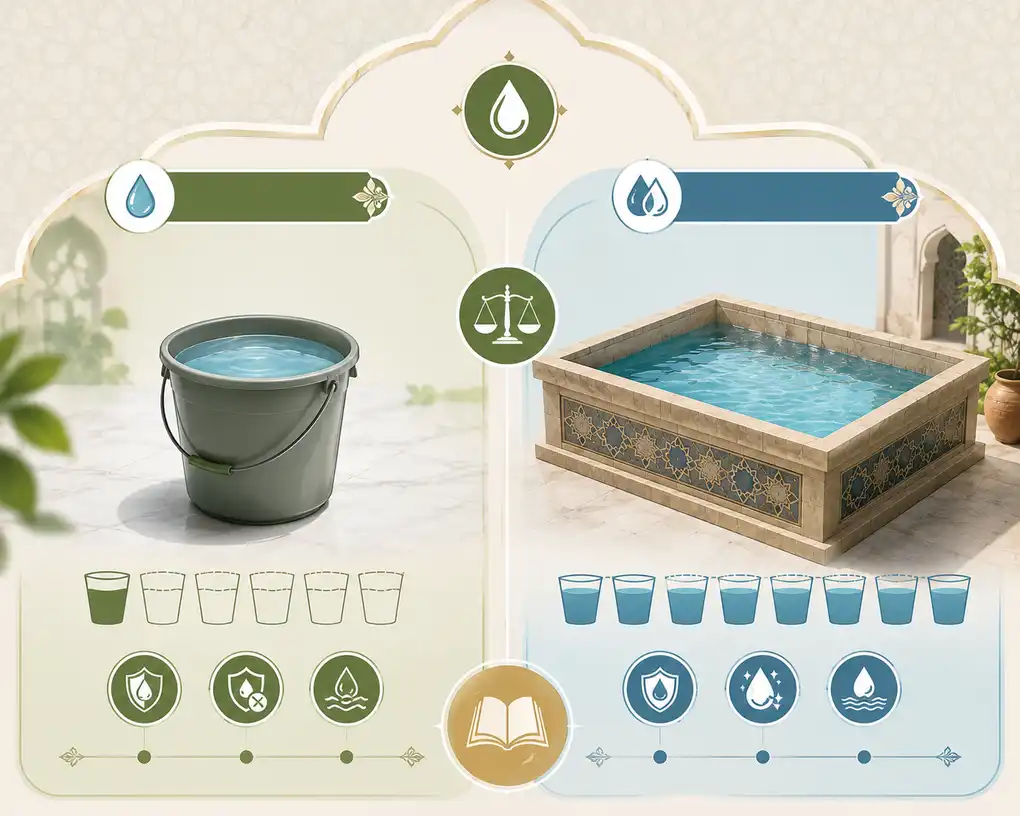
This discussion divides water into small water and large water. Small water is less than two qullahs, while large water is two qullahs or more.
The text gives the original measure of two qullahs as:
وَهُمَا خَمْسُمِائَةِ رِطْلٍ بِغْدَادِيٍّ تَقْرِيبًا
“They are approximately five hundred Baghdad ratls.”[3]
See the two-qullah threshold in fiqh for measuring a container. Modern litre conversions may vary by method, so do not rely on an unexplained fixed number.
Check the setting of the water
Water in a scoop, bucket, basin, or small bath tank is usually small water. Water in a pool, roof tank, or large storage unit should be measured rather than judged by appearance alone.
Flowing water has its own detailed rulings. A river, ditch, narrow channel, and drain should not all be treated as though they were water in a single container.
Small and Large Water When Touched by Impurity
The ruling for small water
Small impure water is water below two qullahs that has been touched by a legally consequential impurity. According to the text, it becomes impure even if its qualities have not changed.[3]
Common examples include:
- a small bucket into which impurity falls;
- a scoop of water touched by impurity;
- a small bath tank mixed with impurity;
- a basin or water container affected by impurity.
In these cases, color alone is not the test. The amount of water and established contact with impurity also matter.
The ruling for large water
Water at two qullahs or more does not become impure merely because impurity reaches it. It becomes impure when it changes because of that impurity, even if the change is slight.
وَلَا يَنْجُسُ الْمَاءُ الْكَثِيرُ إِلَّا بِتَغَيُّرٍ وَإِنْ قَلَّ بِنَجَاسَةٍ مُلَاقِيَةٍ لَهُ
“Large water does not become impure except through a change, even if slight, caused by an impurity contacting it.”[4]
A large pool therefore does not automatically become impure because something impure falls into it. But if its color, smell, or taste changes because of impurity, it is not used for purification.
When only part of large water changes
In a large pool or storage tank, only part of the water may change. The text treats the changed part as the part affected by impurity, then assesses the remaining water again according to the required amount.[4]
Such cases should not be settled by a rough guess. When the water serves many people, inspect the volume, the location of the change, and the source of impurity carefully.
Impure Water, Changed Water, and Used Water
Impure water and changed water
Changed water (mutaghayyir) is water changed by a pure substance. When the change is substantial enough that the water is no longer called unrestricted water, it no longer purifies, but it is not automatically impure.
The text states:
الْمَاءُ الْمُتَغَيِّرُ طَعْمًا أَوْ لَوْنًا أَوْ رِيحًا بِمُخَالِطَةِ طَاهِرٍ … غَيْرُ طَهُورٍ
“Water whose taste, color, or smell changes by mixing with a pure substance … is not purifying.”[2]
The decisive difference is the cause of the change. Impure water changes because of impurity or is touched by it under the relevant conditions; changed water is altered by a pure substance. Further detail is available in changed water in fiqh.
Impure water and used water
Used water (musta’mal) is not water touched by impurity. In the Shafi’i discussion, a small amount of water used for an obligatory act of purification has a distinct ruling and is not reused to purify something else.[6]
So, do not treat water used for purification as identical to mutanajjis water. The cause of each ruling is different.
A quick comparison
| Water type | Reason for its status | May it be used for purification? |
|---|---|---|
| Unrestricted water | It remains in water’s original state | Yes |
| Changed water | It changes because of a pure substance | Not when the change removes the status of unrestricted water |
| Used water | It has been used in an obligatory purification in a specific case | Not for further purification in the Shafi’i discussion |
| Mutanajjis water | It has been touched by impurity | No |
Everyday Examples of Impure Water
Examples involving small water
A simple example is a small bucket of water touched by impurity. Other examples are a small bath tank into which impurity falls or water in a washing container mixed with impurity.
A scoop of water touched by impurity is another example. In all such cases, check the amount of water and whether impurity is established, not only how the water looks.
Examples involving large water
A pool whose smell changes because of impurity is mutanajjis. Well water or a large storage tank whose color or taste changes because of a carcass or another impurity is also not used for purification.
If large water does not change because of impurity, its ruling is not the same as that of small water. One answer cannot be applied to every source and container.
Cases that should not be called impure at once
The following are not enough, by themselves, to declare water impure:
- water with algae because it has stood for a long time;
- cloudy water caused by soil or mud;
- water affected by leaves or flowers;
- water changed by the nature of its soil or source route;
- water that smells because of something nearby without proof that it reached the water.
Return to the cause of the change. For the substance itself, read the meaning of najasah in Islam and types of najasah with examples.
How to Purify Impure Water in Shafi’i Fiqh
The basic principle
Impure water is not treated as pure merely because its color or smell has been hidden. The relevant issue is that the cause of impurity has gone and, where applicable, that the change caused by impurity has truly disappeared.
This is the practical ruling for mutanajjis water: it is not used for purification until it once again meets the conditions of purity in the fiqh discussion.
When the change disappears by itself
When a change caused by impurity disappears on its own—such as over time, without a substance merely covering it—the water can return to purity. The text says:
وَلَوْ زَالَ التَّغَيُّرُ الْحِسِّيُّ أَوِ التَّقْدِيرِيُّ بِنَفْسِهِ أَوْ بِمَاءٍ … طَهُرَ
“If the perceptible or estimated change disappears by itself or through water, it becomes pure.”[4]
An estimated change is one that cannot be directly perceived, but comparable circumstances show that it has gone. This is different from simply hoping the water is clean.
Adding water until two qullahs are reached
Small impure water can be purified by adding water until the total reaches two qullahs, provided any change caused by impurity has disappeared. The text says:
لَوْ كَثُرَ قَلِيلٌ مُتَنَجِّسٌ لَمْ يَطْهُرْ حَتَّى يَبْلُغَهُمَا بِالْمَاءِ
“Small impure water does not become pure until it reaches two qullahs through water.”[4]
The addition must be water, not another liquid. Soap, fragrance, a clarifying agent, or other household liquids do not replace this condition.
What does not suffice
Water is not purified where the change caused by impurity is merely covered by another substance. The text gives soil and gypsum as examples:
لَا إِنْ زَالَ حِسًّا بِعَيْنٍ سَاتِرَةٍ لَهُ كَالتُّرَابِ وَالْجِصِّ
“Not if the change only appears to disappear because an object covers it, such as soil or gypsum.”[4]
Removing a smell with fragrance or hiding a color with another material is not enough. The change caused by impurity must be truly gone, not merely concealed.
A well affected by impurity
When a small amount of water in a well becomes impure, simply draining it is not the purification method described in the text. The bottom and sides of the well may retain the effect of impurity.
إِذْ قَلَّ مَاءُ الْبِئْرِ وَتَنَجَّسَ لَمْ يَطْهُرْ بِالنَّزْحِ بَلْ بِالتَّكْثِيرِ
“When the water in a well is small and becomes impure, it is not purified by draining it, but by increasing it.”[5]
For objects and places affected by najasah, see how to remove najasah correctly. That is different from restoring water’s status.
Flowing Water, Wells, and Storage Tanks
Flowing water
The text explains that flowing water is treated as legally distinct sections even when it appears physically connected. In cases where impurity is carried with the flow, the sections before and after the point of impurity are not given the same ruling as the section directly opposite it.[5]
الْمَاءُ الْجَارِي مُتَفَاصِلٌ جَرَيَانُهُ حُكْمًا وَإِنِ اتَّصَلَتْ حِسًّا
“Flowing water is treated as separate in its flow by legal ruling, even though it is physically connected.”[5]
For rivers, ditches, and channels, read the ruling of flowing water in purification. A polluted drain should not be treated like a clean water source without checking.
Buckets, bath tanks, and roof tanks
Buckets, scoops, and basins usually hold small water. If impurity enters them, do not use the water for wudu or ghusl.
Bath tanks and roof tanks must be assessed by their real volume. Do not assume a tank has two qullahs merely because it looks large.
Checklist Before Performing Wudu or Ghusl
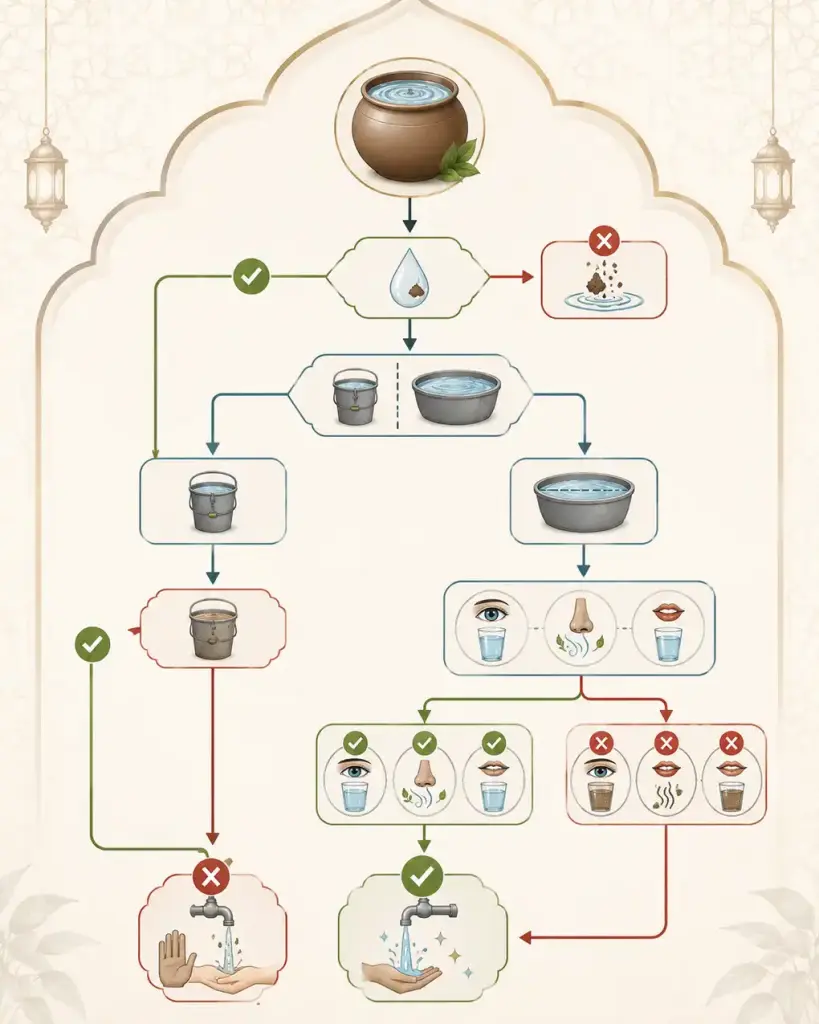
Use this checklist before taking water for purification:
- Confirm whether an impurity actually reached the water.
- Determine whether the water is below two qullahs or has reached that amount.
- Check changes in color, smell, and taste through safe means.
- Distinguish changes caused by impurity from changes caused by soil, algae, leaves, or pure substances.
- Do not use water when its impurity is established.
- When no impurity is established, retain the original ruling of purity; when the situation cannot be determined, use another water source for peace of mind in worship.
The final step relates to the conditions for a valid wudu. Water used for purification must have the status required by Islamic law.
FAQ About Impure Water
What is impure water or mutanajjis water?
Does small water become impure even when it does not change?
In Shafi’i fiqh, water below two qullahs becomes impure when touched by a legally consequential impurity, even when its color, smell, and taste do not change.[3] Very slight traces that are excused are not treated the same way.
Does water at two qullahs remain pure if impurity touches it but nothing changes?
Yes. Water at two qullahs or more does not become impure merely by contact with impurity as long as its color, smell, and taste do not change because of that impurity.[4]
Give two examples of impure water.
How can impure water be purified?
Impure water may return to purity when the change caused by impurity disappears on its own or disappears through adding water under the stated conditions. Small impure water needs to reach two qullahs through water, and the change caused by impurity must not merely be covered by another substance.[4]
Footnotes
Reference
Zakariyā al-Anṣārī, Asnā al-Maṭālib fī Sharḥ Rawḍ al-Ṭālib, with ḥāshiyah (marginal gloss) by Aḥmad al-Ramlī, edited by Muḥammad az-Zuhrī al-Ghamrāwī (Cairo: al-Maṭbaʿah al-Maymānīyah, 1313 AH; repr. Dār al-Kitāb al-Islāmī), vol. 1, pp. 5-17.


