

Why Dhikr with Asmaul Husna Is Not the Same for Everyone
Many people ask the same thing: out of the 99 names of Allah, which one should I recite? The short answer is that no single name suits everyone. Shaykh Ahmad Zarruq gives one simple guideline, and it is the backbone of this article. For the wider picture of how to make dhikr with Asmaul Husna, read the parent article first, then come back here for the question of choosing a name.
We are not looking for the “most powerful name”. We are learning to choose the name that fits best with the state of our soul today. That is the heart of how to do dhikr with Asmaul Husna according to Shaykh Zarruq, and it is why this article covers the state of the soul, jalal, and jamal together.
“Out of 99 Names, Which One?” Why the Answer Differs
Two people can recite the same name and feel different things. One has a tight, trembling heart; the other has an open heart full of hope. If both are told to recite the same name in the same way, the result will naturally differ.
Shaykh Zarruq treats this as a fact of life, not a problem. Because people’s natures differ, choosing an Asmaul Husna practice must start from knowing oneself.
Zarruq’s Principle: Know Your Nature and Condition First
In the conclusion of his book, Shaykh Zarruq writes:
ثم إذا أردت السلوك باسم على طريق الذكر فحقق طبعك وحالك، ثم انظر من الأسماء ما يناسبه معنى.
Meaning: “Then, if you wish to travel with one name by way of dhikr, examine your nature and condition carefully, and then look for the name whose meaning suits it.”[1]
The order is clear. Know yourself first, then choose the name. Not the other way around, where we choose a name because others do and then force the heart to adapt.
What This Article Covers, and What It Does Not
This article covers etiquette and how to choose a name: recognizing jalal, jamal, and kamal, how to pronounce the names, the setting of dhikr, and the role of a teacher. It does not include wird counts, written formulas or talismans, or promises of special benefits.
The reason is simple honesty. Shaykh Zarruq himself admits that most of the special properties he mentions come from Ibn al-‘Arabi’s Kimiya’ al-Sa’ada and some from al-Buni, which he had no time to verify.[1] We follow that caution.
The Names of Allah in the Qur’an and Hadith: The Command to Supplicate and Remember Him by Them
Before choosing a name, we need to know why we may, and are even commanded to, call upon Allah by His names. The basis is in the Qur’an and hadith. The evidence and the manners of supplication are covered in detail in the article on the etiquette of supplicating with Asmaul Husna, so here we keep it brief.
The Basic Evidence: The Command to Call upon Allah by His Names
Shaykh Zarruq cites this verse when he opens the discussion of Allah’s names:
وَلِلَّهِ الْأَسْمَاءُ الْحُسْنَىٰ فَادْعُوهُ بِهَا
“To Allah belong the most beautiful names (Asmaul Husna), so call upon Him by them.” (Q 7:180)[2]
Another verse he mentions in the chapter on Ar-Rahman is Q 17:110: “Call upon Allah or call upon Ar-Rahman. Whichever you call upon, to Him belong the most beautiful names.”[3] From these two verses we see that the evidence for dhikr with Asmaul Husna rests on the command to call upon Allah by His names.
The Supplication “As’aluka bi Kulli Ismin Huwa Laka” as a Gateway
There is one supplication that serves as a gateway to calling upon Allah by the name that fits one’s need. The editor records it in a footnote in the introduction. The Messenger of Allah ﷺ taught that a servant struck by worry and grief should pray:
أَسْأَلُكَ بِكُلِّ اسْمٍ هُوَ لَكَ سَمَّيْتَ بِهِ نَفْسَكَ أَوْ أَنْزَلْتَهُ فِي كِتَابِكَ أَوْ عَلَّمْتَهُ أَحَدًا مِنْ خَلْقِكَ أَوِ اسْتَأْثَرْتَ بِهِ فِي عِلْمِ الْغَيْبِ عِنْدَكَ
“I ask You by every name that is Yours, by which You have named Yourself, or revealed in Your Book, or taught to any of Your creation, or kept to Yourself in the knowledge of the unseen with You.”[4]
This supplication shows two things. First, there is a supplication by the names of Allah taught directly by the Prophet ﷺ. Second, Allah’s names are more numerous than the ones we have memorized, and we may ask by all of them, including those we do not know.
The Hadith of the 99 Names and the Meaning of Ihsa’ as Background
The hadith of the 99 names also forms part of the background. The Messenger of Allah ﷺ said that Allah has 99 names, and whoever ahsaha (enumerates them) will enter Paradise. Imam al-Tirmidhi narrated it (no. 3507), and the editor lists the names found in that narration.[5]
The scholars agree that this hadith does not limit Allah’s names to ninety-nine. Its meaning is that these ninety-nine carry a particular promise of reward.[5] We will not discuss its authentication here.
What we need is the meaning of ihsa’. Shaykh Zarruq gives five aspects: memorizing, remembering, knowing, ta’alluq, and takhalluq.[6] The last two will appear often in what follows. Ta’alluq means the heart attaches itself to the meaning of the name, and takhalluq means adorning oneself with character that matches that meaning.
The Three Purposes of Dhikr According to Zarruq: Worship, Tawassul, or Special Properties
Three Purposes, Three Sets of Rules
In the introduction, Shaykh Zarruq divides the purposes of dhikr into three. He writes:
ثم الذكر: إما للتعبد أو للتوسل أو لطلب الخاصية، ولكل شرط ووجه ومادة
“Then dhikr is either for ta’abbud (worship), for tawassul, or for seeking a special property. Each has its conditions, form, and material.”[6]
That means someone who makes dhikr as worship does not follow the same rules as someone who makes dhikr for a particular need. Mixing the three without realizing it is a source of much confusion.
Why This Article Chooses Worship and Purification of the Soul
We focus on the first purpose: dhikr as worship and purification of the soul. There are two reasons. First, the material in the book’s conclusion deals precisely with choosing a name according to the state of the soul. Second, the area of special properties mentioned in the sources is one Shaykh Zarruq himself admits he had no time to examine.[1]
This way, ordinary readers are not tempted to turn dhikr into a tool for forcing results. The main aim remains to know Allah and draw near to Him.
Five Kinds of Dhikr by the Strength of Their Effect
Shaykh Zarruq also describes the kinds of dhikr by the depth of their effect, from the one that sinks deep to the one that merely passes over the tongue. Among the kinds he mentions:
- Dhikr like a mark that dyes the reality of the heart, penetrating the outer and the inner without effort.
- Dhikr like a point that opens the heart and expands it in its worlds.
- Dhikr like a form that occupies the outer self with its wording and directs the inner self to its meaning.
- Dhikr that is mere habit: useless and insufficient, running on the tongue without presence of heart, without meaning, and without awareness of the One remembered.
At the end of this series Shaykh Zarruq says that habitual dhikr “counts for nothing, since it is not dhikr in reality” (thumma la ‘ibrata, idh laysa bi-dhikrin haqiqatan).[7]
The lesson is simple. Before asking “which name?”, first ask “is my heart present as I say it?”
The Meaning of Jalal, Jamal, and Kamal in Asmaul Husna
Before choosing a name, we need a map. The map Shaykh Zarruq uses is made of three words: jalal (majesty), jamal (beauty), and kamal (perfection). The full discussion of the three groups of meaning in Asmaul Husna is in a separate article. Here we take only what is directly useful for dhikr.
Zarruq Opens His Book with These Three Groups
From the opening lines of the introduction, Shaykh Zarruq states that Allah’s secrets are deposited in His names. He writes that among His names are those:
ما للجمال وما للجلال وما للكمال، وما للتجلي والتحلي والتملي
“… some for jamal, some for jalal, some for kamal, and some for tajalli, tahalli, and tamalli.”[8]
This sentence matters because it shows that the division into jalal, jamal, and kamal is not a later addition. It is already at the entrance of the book. Shaykh Zarruq goes on to mention some of their uses: some for seeking high stations, some for filling empty hearts, some for uniting the lover with the Beloved, and some for purification from all kinds of inner impurities.[8]
Allah Is the Absolute Source of Jamal, Jalal, and Kamal
The editor’s footnote in the chapter on Al-Malik explains a foundation we should hold firmly:
إن الله ذو الجلال والإكرام مطلق الجمال مطلق الجلال مطلق الكمال، فلا جمال ولا جلال ولا كمال إلا منه
“Indeed Allah, the Lord of Majesty and Generosity, is absolute beauty, absolute majesty, and absolute perfection. So there is no beauty, majesty, or perfection except from Him.”[9]
In other words, when we sense beauty or dignity in creation, it is a reflection of the source. None of the three exists in anyone other than Allah except as coming from Him. This understanding protects dhikr from self-regard, because we are mentioning the true Owner.
How the Three Relate: Jalal Is Born of Jamal and Kamal
These three attributes do not stand apart. In the chapter on Al-Jalil, the editor’s footnote says:
فالجلال وليد الجمال والكمال معًا، وهو نور وهيبة ينبثق منهما
“So jalal is born of jamal and kamal together. It is light and awe (haiba) that radiate from both.”[10]
The footnote adds that jalal makes hearts more attached. So jalal is not a “frightening side” separated from mercy. Right awe grows out of knowing the One who is beautiful and perfect.
Equivalent Terms: Qahr and Qabd for the Side of Jalal
In the book, the side of jalal has its own terms. In the section on the wording of the names, Shaykh Zarruq speaks of asma’ al-qahr (names of subduing), and in the conclusion he speaks of someone in whom jalal and qabd predominate.[11] The two terms appear side by side: qahr for the quality of a name, qabd for the state of the heart.
Three Colors of Names: Jalali, Jamali, and Kamali
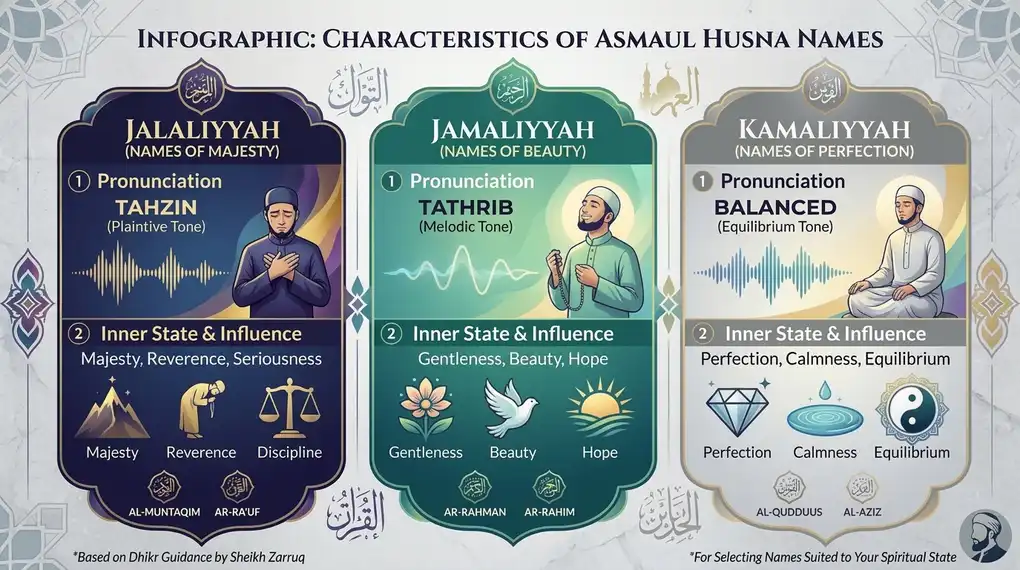
Imagine three colors. Each name of Allah has a meaning that leans toward one of them, although all remain the one same Essence.
The Jalali Group: Power, Majesty, and Subduing
Jalali names are names whose meaning stresses power, majesty, and subduing. The feeling they bring is usually a dignified awe, not a fear that leads to despair. Shaykh Zarruq calls this group asma’ al-qahr.[11]
The Jamali Group: Gentleness, Mercy, and Forgiveness
Jamali names are names whose meaning stresses gentleness, mercy, and forgiveness. The feeling they bring is openness, closeness, and hope. Shaykh Zarruq calls them asma’ al-jamal.[11]
The Kamali Group: Outside Both
Then there are the asma’ al-kamal. Shaykh Zarruq writes that the names of kamal are “outside the two” (kharija ‘anhuma), and there he gives the key word i’tidal, balance.[11] So kamal does not lean to either side. It is more like a middle point that unites.
An Honest Note: The Book Gives No Fixed List
Something we should admit at the outset. Shaykh Zarruq’s book contains no fixed list saying “this name is jalali, that name is jamali, that one kamali”. It gives only principles and guidance.
For that reason, the example names below are read from the meaning of each chapter. Readers should not take them as an official list from Shaykh Zarruq. If you study under a teacher, ask that teacher or murshid about how the names are grouped.
Why One Name Can Feel Different to Two People
The Principle of the Knowers on the Effect of Names
This question arises naturally. If the name of Allah is the same, why does the experience differ? Shaykh Zarruq answers by citing the principles of the knowers (‘arifin) at the end of the introduction:
فمن قواعدهم: أن كل اسم خاصيته في معناه … وسره في عدده، وتأثيره على قدر المتأثر به، وذلك بقدر الفيض والقصد والهمة. وذلك يختلف باختلاف الطباع والأرواح والأحوال
“Among their principles: every name, its property lies in its meaning … and its effect is according to the capacity of the one affected, that is, according to the outpouring of grace, the intention, and the aspiration (himma). That differs according to differences in natures, spirits, and conditions.”[12]
One part of that principle mentions numbers. This article deliberately leaves it alone. We take only the lesson that the effect of a name depends on the one receiving it.
Differences in Nature, Spirit, and Condition
People’s natures differ. Some are hard by temperament and easily awed; others are gentle and easily moved to longing. Conditions also change: open today, tight tomorrow. The three things Shaykh Zarruq names, nature, spirit, and condition, work together.
So it is natural that dhikr suited to one’s character feels different from one person to another. That is not a sign of error. It is a sign that each person needs to weigh their own state.
The Lesson: Not “Most Powerful”, but “Best Suited”
One sentence from Shaykh Zarruq in the second section is very firm on this: the dhikr whose effect is nearest is the one that nature supports (aqrab al-adhkar ta’thiran ma a’anat ‘alayhi al-tiba’).[13]
So the right question is not “which name is the most powerful?” but “which name best suits my condition right now?” The second question forces us to assess ourselves honestly, and that is what we turn to next.
Step One: Recognizing Your Nature and Condition
The map is ready. Now we ask ourselves: where am I standing? This step is often skipped, yet it is the very first thing Shaykh Zarruq asks. Dhikr suited to the state of the soul begins with honest self-examination, not with a list of names.
“Haqqiq Tab’aka wa Halaka”: Examine Carefully
Shaykh Zarruq’s instruction is short: fa-haqqiq tab’aka wa halaka, “examine your nature and your condition”.[1] The word tahqiq means to verify, not to guess. We need to know our dominant tendency: more often awed, more often hopeful, or fairly balanced.
An important note on the indicators below. Shaykh Zarruq’s book does not detail the signs of qabd, bast, or balance in this passage. The terms qabd (the heart feeling constricted) and bast (the heart feeling expanded) are commonly understood terms in tasawwuf, but their detailed explanation should be sought in other books and asked of a murshid. Treat the signs below as a general picture, not a fixed measure.
Signs That Jalal and Qabd Predominate
Someone in whom jalal and qabd predominate is roughly like this: the heart feels tight, easily afraid, easily awed and trembling, and inclined to be alone. On the good side, they are sensitive to Allah’s greatness. On the side to be guarded, their fear can grow into gloom if it is not guided.
The Qur’an describes this quality in believers: “The believers are only those who, when Allah is mentioned, their hearts tremble” (Q 8:2). The editor’s footnote on p. 172 explains that this trembling is fear and awe.[14]
Signs That Jamal Predominates
Someone in whom jamal predominates is different. The heart is open, gentle, easily moved to longing, and full of hope. They become close to Allah easily and are easily touched by His mercy. What needs guarding: that closeness must not make them forget reverence.
Signs That Kamal Predominates
A balanced person does not lean hard to one side. The heart is neither too tight nor too loose. Shaykh Zarruq prepared a specific instruction for this condition, namely i’tidal (balanced) dhikr, as we will see later.[15]
Be Careful in Judging Yourself
Judging oneself is slippery work. Someone who feels awe may think they are in “jalal” when they are simply tired, and someone who feels open may think they are in “jamal” when they are simply heedless. That is why the next section deals specifically with teachers and istikhara.
If Jalal and Qabd Predominate: Choosing Jalali Names
Zarruq’s Instruction: Jalali Names, Tahzin, Zuhd, Khalwa, Jam’iyya
Shaykh Zarruq’s instruction for the first condition reads:
فإذا كان الغالب عليك الجلال والقبض، فخذ من الأسماء الجلالية، واذكرها بالتحزين، على حالة زهدية، بخلوة وإجماع
“If jalal and qabd predominate in you, take from the jalali names, and recite them with tahzin (a sorrowful tone), in a state of zuhd (detachment), with khalwa (seclusion) and concentration of the heart.”[1]
Example Names Whose Meaning Leans toward Jalal
Here are a few names whose meaning leans toward jalal, quoted briefly from their chapters. These are examples from reading the meaning of each chapter, not a fixed list from Shaykh Zarruq.[16]
- Al-Qahhar (p. 60): “The One who has complete victory over the outer and inner of every matter” (huwa alladhi lahu al-ghalaba al-tamma ‘ala zahir kulli amrin wa batinihi). The meaning of Al-Qahhar is often understood as the All-Subduing.
- Al-Jabbar (p. 49): Shaykh Zarruq gives two meanings, from jabr (mending what is broken) and from ijbar (carrying out a ruling by power). The meaning of Al-Jabbar therefore has two sides: strengthening and subduing.
- Al-Mutakabbir (p. 50): “The One who displays His grandeur to His servants until no grandeur is left to anyone else.”
- Al-‘Azim (p. 108): also described as a name that is “comprehensive” (jami’).
Matching Takhalluq and Ta’alluq
At the end of each chapter, Shaykh Zarruq usually adds a tanbih and a taqarrub. An example is Al-Muntaqim (p. 151). He writes:
من عرف أنه المنتقم خاف انتقامه فلم ينتقم من عباده، ولم يسترسل في معصيته
“Whoever knows that Allah is Al-Muntaqim fears His retribution, so he does not take revenge on His servants and does not keep sinking into disobedience.”[17]
Notice the direction. Awe changes conduct: submission, keeping within Allah’s limits, and holding oneself back from wronging others.
The Lesson: Fear That Becomes Submission
Jalali dhikr is not meant to darken the heart further. Its aim is to turn fear into submission, not despair. In the end, someone who was once only trembling becomes more diligent in guarding what Allah holds sacred.
If Jamal Predominates: Choosing Jamali Names
Zarruq’s Instruction: Jamali Names with Tathrib
For the second condition, Shaykh Zarruq advises:
وإن كان الغالب عليك الجمال، فخذ من الجمالية، واذكرها بالتطريب … على حالة زهدية بخلوة مناسبة
“If jamal predominates in you, take from the jamali names, and recite them with tathrib (a melodious tone) … in a state of zuhd, with suitable khalwa.”[15]
Example Names Whose Meaning Leans toward Jamal
The following are also from reading the meaning of each chapter, not a fixed list from Shaykh Zarruq:[18]
- Ar-Rahman (p. 29): Shaykh Zarruq explains rahma as Allah’s affair becoming manifest to creation through gentleness and kindness. The meaning of Ar-Rahman is described as belonging to Allah alone. He adds that attachment to this name brings intimacy, hope, and trusting familiarity with Allah (al-uns wa al-raja’ wa al-idlal, p. 30).
- Ar-Rahim (p. 32): “more intensive in form”, and specific to the believers in Q 33:43.
- Al-Wadud (p. 103): “The One who has abundant love for His servants, and shows it through successive blessings and by turning away harm.” The meaning of Al-Wadud is often translated as the All-Loving.
- Al-Latif (p. 79): it may mean the One hidden from perception, the One who knows subtle matters, or the One who delivers benefits through narrow and unexpected ways.
Matching Takhalluq: Compassion toward Others
On Al-Wadud, Shaykh Zarruq writes that its takhalluq is to be a person full of love toward the believers, and even toward all creatures. He spells it out: hoping for faith for the disbeliever, repentance for the sinner, and steadfastness for the righteous (p. 104).[19]
So jamali dhikr does not stop at a warm feeling. It continues as gracious conduct toward Allah’s servants.
The Lesson: Jamal Does Not Mean Dropping Reverent Fear
Someone close to the names of mercy still needs to keep their awe. In the chapter on Dhu al-Jalal wa al-Ikram (p. 155), Shaykh Zarruq himself writes that whoever knows this name stays “between fear and hope, gratitude and constant refuge”.[20] This balance protects jamali dhikr from false security.
If Balanced: Choosing Kamali Names
Zarruq’s Instruction: A Balanced Voice
For the third condition, Shaykh Zarruq writes:
وإن كان الغالب عليك الكمال فخذ من الأسماء الكمالية ما يناسب ذاتك، واذكره باعتدال في الصوت على هيئة اعتدالك، دون تقشف ولا ترفه ولا تطريب ولا تحزين
“If kamal predominates in you, take from the kamali names that suit your self, and recite them with a balanced voice matching your balance, without excessive hardness (taqashshuf), without excessive laxity (tarafuh), without tathrib, and without tahzin.”[15]
The point is clear: not leaning to the sorrowful, not leaning to the melodious, not extreme.
Example Names Whose Meaning Leans toward Kamal
These too are from reading the meaning of each chapter, not a fixed list from Shaykh Zarruq:[21]
- Al-‘Alim (p. 66): the One who knows His essence, His attributes, and everything that has happened or may happen. The meaning of Al-‘Alim is that His knowledge reaches the necessary, the possible, and the impossible.
- Al-Hakim (p. 102): “The One who perfects all things until they become firm according to His knowledge and will.” The meaning of Al-Hakim is the All-Wise.
- Al-Hayy and Al-Qayyum (p. 130): Shaykh Zarruq describes Al-Hayy as “the One whose perfection is complete and who perfects everything”, and Al-Qayyum as “the Self-Subsisting, in need of nothing besides Him”.
Three Types in One Table
| Dominant condition | Group of names | How to recite | Setting |
|---|---|---|---|
| Jalal and qabd (tight, awed) | Jalali | Tahzin (sorrowful tone) | Zuhd, khalwa, gathered heart |
| Jamal (open, hopeful) | Jamali | Tathrib (melodious tone) | Zuhd, suitable khalwa |
| Kamal (balanced) | Kamali | Balanced voice, no excess | Not specified; a gathered heart remains a condition |
This table summarizes pp. 171–172.[1] [15]
How to Recite the Names: Tahzin, Tathrib, and I’tidal
Once the name is chosen, a practical question follows: how do we recite it? Many people search for how to recite Asmaul Husna and how to do dhikr with Asmaul Husna correctly. Shaykh Zarruq does not answer with counts or extra formulas. He answers with the tone and wording that fit the soul.
The Second Section: Every Name Has a Fitting Sigha
At the end of the discussion of Allah, Shaykh Zarruq writes three short sections. The second reads:
لكل اسم صيغة تناسبه، مما يقع أثره في النفس
“Every name has a sigha (wording) that suits it, in terms of its effect on the soul.”[13]
Sigha here means the manner of pronouncing: tone, softness, and form. So choosing a name is only half the work. The other half is saying it in a fitting form.
Names of Qahr with Tahzin, Names of Jamal with Tathrib
Shaykh Zarruq continues:
فأسماء القهر: التحزين، وأسماء الجمال: التطريب، وأسماء الكمال: خارجة عنهما للاعتدال
“Names of qahr with tahzin (sorrowful tone), names of jamal with tathrib (melodious tone), and names of kamal outside the two, that is, for balance.”[13]
This fits the instruction in the conclusion that we have just read. Jalali names are recited with a lowered tone, jamali names with an open tone, and kamali names with a middle tone.
The Most Effective Dhikr Is the One Nature Supports
Then Shaykh Zarruq gives the reason:
فإن أقرب الأذكار تأثيرًا ما أعانت عليه الطباع، والله تعالى أعلم
“For the dhikr whose effect is nearest is the one that nature supports. And Allah knows best.”[13]
This answers an old question: why does one person’s dhikr feel alive and another’s feel dry? One answer is that the dhikr is unknowingly running against the person’s nature. In line with this, the conclusion says that whoever travels to Allah according to their nature arrives sooner, while whoever travels by departing from their nature arrives in proportion to how far they are from it. Shaykh Zarruq adds that this last path does not take hold in many seekers.[15] [22]
Mentioning the Name Together with Words That Explain Its Meaning
The first section mentions one way to strengthen the effect. As we read it, when a name is mentioned together with words that open up its meaning, whether other names or meanings that return to it, its effect on the soul grows stronger and its benefit comes nearer.[13]
For example, someone who recites a name of mercy while recalling the meaning of His mercy is touched more easily than someone who merely repeats a sound.
The Setting of Dhikr: Khalwa, Zuhd, and a Gathered Heart
“Al-Jam’ fi Dhalika Kullihi Shart”
Shaykh Zarruq closes the instructions for the three conditions with one general condition:
والجمع في ذلك كله شرط، وعدم الاستعجال أصل
“A gathered heart in all of this is a condition, and not being hasty is the foundation.”[15]
The first key word is jam’iyya, the gathered heart. Whether the name is of jalal, jamal, or kamal, if the heart is scattered everywhere, the dhikr only passes over the tongue. This condition applies to all.
Withdrawing from Worldly Distractions for a While
Shaykh Zarruq also mentions the need to keep away from distracting causes. This fits the mention of khalwa in the instructions for jalal and jamal.[15]
There is no need to picture a cave. For everyday people, it can mean silencing notifications, choosing a quiet time and place, and setting other matters aside for a moment. For a more detailed account of khalwa, consult a murshid.
Zuhd as the Setting of Dhikr
For the conditions of jalal and jamal, Shaykh Zarruq uses the phrase ‘ala halatin zuhdiyya, “in a state of zuhd”.[23] It means the dhikr is carried out with a heart not clinging to the world. For a fuller explanation of zuhd, ask a teacher.
As a general basis, the Qur’an commands dhikr with a soft voice and a humble heart: “And remember your Lord within yourself in humility and fear” (Q 7:205). This verse and other verses on dhikr, such as Q 2:152 and Q 33:41, are cited by the editor on p. 172.[24]
Dhikr with Presence of Heart, Meaning, and the One Remembered
In the introduction, Shaykh Zarruq warns of one danger: dhikr that has become habit. He writes that this kind “runs on the tongues of the common people without awareness, without sensing the dhikr, the meaning, or the One remembered”.[6]
Compare this with this guidance. Choosing the name, setting the tone, and keeping the setting are really one aim: to bring together the heart, the meaning, and the One remembered.
Do Not Rush: Patience, Taqwa, and Steadfastness
“‘Adam al-Isti’jal Asl”
Many people stop making dhikr because they “feel nothing” after a few days. Shaykh Zarruq has already answered: not being hasty is the foundation.[15] In this context, patience is not decoration but foundation.
The question “why don’t I feel my dhikr” often comes from haste. Chasing a feeling shifts the goal from Allah to our own interests.
Haste Does Not Bear Fruit
Shaykh Zarruq then states the consequence on the following page:
وبالاستعجال وإهمال الجمع وتحقيق المادة لم تتحصل الفائدة
“With haste, neglecting the gathered heart, and not examining the material of the dhikr, no benefit is obtained.”[22]
Calm persistence outlasts a burst of enthusiasm that quickly dies out.
Taqwa and Steadfastness as Conditions
After that Shaykh Zarruq writes that taqwa and steadfastness are conditions: fa-al-taqwa wa al-istiqama shart.[22] The meaning is that dhikr does not stand alone. It must be supported by daily obedience and firmness in carrying it out.
Shaykh Zarruq also says that help comes from the Owner of the path itself. What is certain is that the result is not in the hands of the practitioner, but in the hands of Allah.
Completing What Was Intended
Shaykh Zarruq states one principle: completing the amount one intended is the key to the self’s firm establishment (wa al-furagh min al-‘adad miftah al-tamakkun min al-nafs).[15] This principle is about commitment, not about numbers. This article gives no particular count, because the book does not give one in this passage either.
If you intend a certain duration or amount, complete that intention. If you cannot, make the intention smaller from the start rather than breaking it midway. Ask your teacher about the measure that suits you.
Knowledge from Fath and from Ta’lim: Why a Teacher Matters
Earlier we noted that judging oneself is hard. Shaykh Zarruq was aware of the same thing. That is why, in the middle of the guidance on choosing a name, he slips in a discussion of the sources of knowledge and the role of a guide. A wider discussion is in the article on the role of a teacher in the dhikr of the Names.
Fath, Ta’lim, and the Combination of Both
Shaykh Zarruq writes that knowledge from fath (opening from Allah) is, in this subject, more complete than knowledge from ta’lim (instruction), because instruction is deficient. Then he adds:
والعلوم إن لم تكن منك ومنها كنت بعيدًا عنها، فمنك بلا منها ضلال وإهمال، ومنها بلا منك تلبس وجمود
“Knowledge, if it is not from you and from it, you are far from it. From you alone without it is misguidance and neglect. From it alone without you is confusion and rigidity.”[1]
Shaykh Zarruq then places tahqiq at the meeting of the two. The practical lesson: one’s own thinking alone is not enough, and “feeling” or inspiration alone is not enough either. Both need to meet guidance.
The Condition of Guidance: A Sincere Shaykh and a Righteous Brother

On the last page of the conclusion, Shaykh Zarruq advises:
فالتقوى والاستقامة شرط، ولا بد من مشاركة شيخ ناصح وأخ صالح بما يصلح، وإلا وقع الغلط
“Taqwa and steadfastness are conditions, and there must be the involvement of a sincere shaykh and a righteous brother in what sets things right, otherwise error occurs.”[22]
Notice the word nasih, one who advises sincerely. Not merely someone famous or with many followers. And notice “a righteous brother”: guidance does not always come from one person alone.
For Those Who Do Not Yet Have a Teacher
What if there is no teacher yet? Shaykh Zarruq answers clearly:
فإن لم يكن فلا تقدم على شيء إلا بالاستخارة مرارًا
“If there is none, do not step forward on anything except with istikhara, repeatedly.”[22]
In other words, not having a teacher yet is no reason to be reckless. It is a reason to ask, to read from trustworthy sources, and to seek Allah’s guidance again and again before moving ahead.
Limits: This Is Not a Promise of Special Benefits
Zarruq’s Admission about the Source of Special Properties
This writing deliberately makes no promise of results. Shaykh Zarruq himself gives the reason:
وغالب ما اعتمدته في الخواص إنما هو من كتابي «كيمياء السعادة» للإمام محيي الدين بن العربي، وبعضه لأبي العباس البوني. ولم يمكنني تصحيح ذلك للعجلة التي صحبتني في وقته
“Most of what I relied on regarding special properties is from the book Kimiya’ al-Sa’ada by Imam Muhyi al-Din Ibn al-‘Arabi, and some from Abu al-‘Abbas al-Buni. I was not able to verify it because of the haste that accompanied me at the time.”[1]
This admission is rare and valuable. A great author says plainly that some parts he has not verified. We follow that attitude by not spreading these as promises.
What Zarruq Left Out
Shaykh Zarruq also writes that he left out some elaboration and expansion because of the shortness of time and a preoccupied mind. He also kept away from certain matters because of something that seemed mistaken to him.[1]
From this comes a simple reason why this article contains no wird counts, written formulas, or ritual procedures: the author himself had not examined his sources for them.
Dhikr Is Not a Tool for Forcing Results
Dhikr is not a button that guarantees results if pressed in a certain way. According to Shaykh Zarruq in the introduction, the effect of a name depends on the capacity of the one receiving it.[12] The final outcome remains Allah’s affair. The main aim of dhikr remains drawing near to Allah and improving oneself.
If someone offers the special properties of Asmaul Husna with absolute certainty, hold back first. Ask for the source, ask about the teacher, and compare it with Shaykh Zarruq’s caution.
The Principle of Caution
If you are unsure about a particular practice, ask a scholar or murshid you trust. The ruling on Asmaul Husna practices and more specific procedures are not discussed here. You can look into them on this blog when needed.
Closing: Choosing a Name by Knowing Yourself
Points to Take Home
A few things to take home from this article:
- Know your nature and condition before choosing a name.[23]
- Choose the group of names to match your condition: jalali, jamali, or kamali.[23]
- Recite according to the sigha: tahzin for jalal, tathrib for jamal, balanced for kamal.[25]
- Keep the heart gathered and do not rush.[26]
- Seek guidance from a teacher and righteous brothers; if there is none, make istikhara often.[22]
One Invitation
The simplest step after this: learn the meaning of the name you feel suits you. Study its meaning through the post on Asmaul Husna, read them one by one, and ask a teacher if anything is unclear. Knowing the meaning before making dhikr is part of knowing Allah.
FAQ on Choosing an Asmaul Husna for Dhikr
How do I choose an Asmaul Husna for dhikr?
First know your nature and condition, then choose the name whose meaning suits it. Shaykh Zarruq says that anyone who wishes to travel with one name by way of dhikr must examine their nature and condition before choosing.[23]
Jalal and qabd predominate: take jalali names.
Jamal predominates: take jamali names.
Kamal predominates: take kamali names that suit you.
What is the difference between dhikr with names of jalal, jamal, and kamal?
The difference lies in how they are recited and in the setting.[25]
Jalal: with tahzin (sorrowful tone), in a setting of zuhd and khalwa.
Jamal: with tathrib (melodious tone), in a setting of zuhd and suitable khalwa.
Kamal: with a balanced voice, without excess in either direction.
May I make dhikr with Asmaul Husna without a teacher?
There should be a guide. Shaykh Zarruq says one should consult a sincere shaykh and a righteous brother in what sets things right, otherwise error occurs.[22]
If there is none, do not step forward before repeated istikhara. In other words, not having a teacher means being more careful, not freer.
Why should dhikr not be rushed?
Are the special properties of Asmaul Husna certainly proven?
There is no guarantee. Shaykh Zarruq admits that most of the special properties he mentions come from Kimiya’ al-Sa’ada and some from al-Buni, and that he had no time to verify them.[1]
For that reason this article promises no results. The safe aim to hold on to in dhikr is drawing near to Allah and improving oneself.
Footnotes
1 : Ahmad Zarruq, Sharh Asma’ Allah al-Husna, ed. Sayyid Yusuf Ahmad (Beirut: Dar al-Kutub al-‘Ilmiyya, 2007), p. 171. ↩
2 : Zarruq, Sharh Asma’ Allah al-Husna, p. 25. ↩
3 : Zarruq, Sharh Asma’ Allah al-Husna, p. 29. ↩
4 : Zarruq, Sharh Asma’ Allah al-Husna, pp. 20 and 171, editor’s footnotes: the hadith of Ibn Mas’ud, narrated by Ahmad in the Musnad (1/391), and also by al-Hakim and Ibn Hibban. ↩
5 : Zarruq, Sharh Asma’ Allah al-Husna, p. 170, editor’s footnote: al-Tirmidhi no. 3507; al-Nawawi, Sharh Sahih Muslim, 17/5. ↩
6 : Zarruq, Sharh Asma’ Allah al-Husna, p. 20. ↩
7 : Zarruq, Sharh Asma’ Allah al-Husna, pp. 20–21. ↩
8 : Zarruq, Sharh Asma’ Allah al-Husna, p. 15. ↩
9 : Zarruq, Sharh Asma’ Allah al-Husna, p. 35, editor’s footnote. ↩
10 : Zarruq, Sharh Asma’ Allah al-Husna, p. 94, editor’s footnote. ↩
11 : Zarruq, Sharh Asma’ Allah al-Husna, pp. 28, 171–172. ↩
12 : Zarruq, Sharh Asma’ Allah al-Husna, p. 21. ↩
13 : Zarruq, Sharh Asma’ Allah al-Husna, p. 28. ↩
14 : Zarruq, Sharh Asma’ Allah al-Husna, p. 172, editor’s footnote, quoting Ibn Kathir, Tafsir. ↩
15 : Zarruq, Sharh Asma’ Allah al-Husna, p. 172. ↩
16 : Zarruq, Sharh Asma’ Allah al-Husna, pp. 60 (Al-Qahhar), 49 (Al-Jabbar), 50 (Al-Mutakabbir), 108 (Al-‘Azim). ↩
17 : Zarruq, Sharh Asma’ Allah al-Husna, p. 151 (Al-Muntaqim). ↩
18 : Zarruq, Sharh Asma’ Allah al-Husna, pp. 29–30 (Ar-Rahman), 32 (Ar-Rahim), 103 (Al-Wadud), 79 (Al-Latif). ↩
19 : Zarruq, Sharh Asma’ Allah al-Husna, p. 104 (Al-Wadud). ↩
20 : Zarruq, Sharh Asma’ Allah al-Husna, p. 155 (Dhu al-Jalal wa al-Ikram). ↩
21 : Zarruq, Sharh Asma’ Allah al-Husna, pp. 66 (Al-‘Alim), 102 (Al-Hakim), 130–131 (Al-Hayy and Al-Qayyum). ↩
22 : Zarruq, Sharh Asma’ Allah al-Husna, p. 173. ↩
23 : Zarruq, Sharh Asma’ Allah al-Husna, pp. 171–172. ↩
24 : Zarruq, Sharh Asma’ Allah al-Husna, p. 172, editor’s footnote: Q 3:191; 3:41; 7:205; 2:152; 33:41. ↩
25 : Zarruq, Sharh Asma’ Allah al-Husna, pp. 28, 172. ↩
26 : Zarruq, Sharh Asma’ Allah al-Husna, pp. 172–173. ↩
Aḥmad ibn Aḥmad ibn Muḥammad ibn ʿĪsā al-Zarrūq al-Fāsī. Sharḥ Asmāʾ Allāh al-Ḥusnā, Yalīhi Sharḥ Manẓūmat al-Dimyāṭī li-Khawāṣṣ Asmāʾ Allāh. Edited by al-Sayyid Yūsuf Aḥmad. Beirut: Dār al-Kutub al-ʿIlmiyyah, 1428 AH/2007 CE, pp. 6–177.


