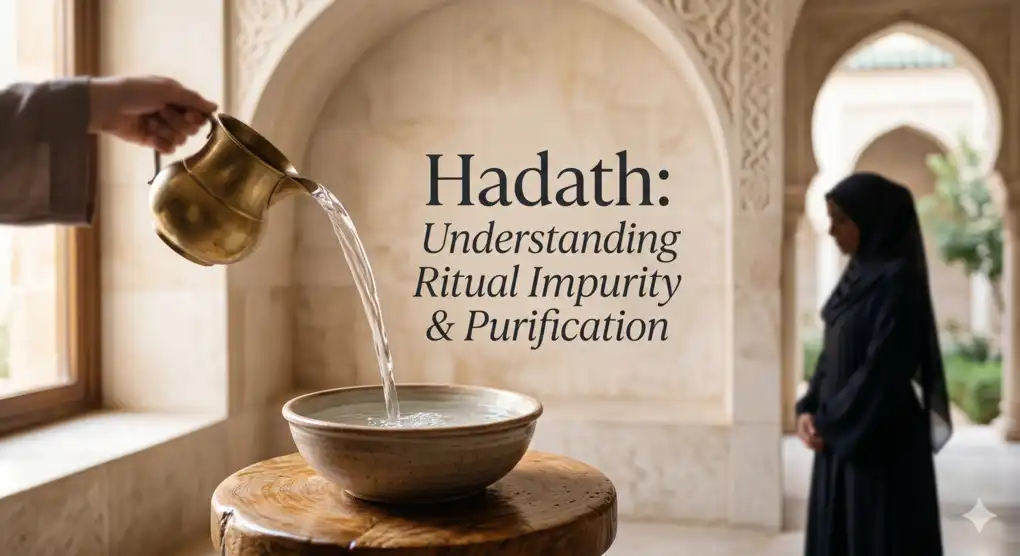
Every Muslim who is about to establish prayer must have asked: “Is my ablution still valid?” or “Am I currently in a state of ritual impurity (hadath)?”
This question is not merely a technicality of ritual. It is the very foundation of all our worship. If someone prays while in a state of hadath, their prayer is invalid—regardless of how khusyu’ (devout) they stand before Allah.
Ironically, many Muslims still confuse hadath with najāsah (physical impurity). Both are often considered identical, even though their legal rulings and methods of purification differ fundamentally. This article is here to clarify this understanding thoroughly, based on the principles of ṭahārah (purification) in Islam according to the Shafi’i Madhhab.
What Is Hadath? Definition According to Language and Fiqh Terminology
In understanding the sharia of purification in Islam, it is mandatory for us to know the root causes that require us to purify ourselves. Many Muslims are still unfamiliar with the basic understanding of fiqh regarding the core definitions of najāsah and hadath in daily worship. Yet, mastering this is a prerequisite for the validity of obligatory worship such as prayer and ṭawāf.
To acquire a comprehensive understanding of both minor and major hadath, we need to examine the detailed explanations of classical scholars. Correct comprehension of hadath is the first step toward worship that is accepted by Allah ﷻ. Let us examine its meaning systematically.
Hadath Literally: The Meaning of the Word “الحَدَث”
Linguistically, the word al-hadath (الحَدَث) refers to a newly occurred matter, event, or phenomenon that previously did not exist and then emerged or took place.
Hadath Technically (Shara’): The Complete Definition According to Shafi’i Scholars
In the jurisprudence literature of the Shafi’i madhhab, hadath holds a specific meaning related to the obligation of purification. Imam Zakariyya al-Anshari expounds on this definition as follows:
قوله: (باب الأحداث) جمع حدث، ويطلق كما في الأصل على ما يوجب الوضوء وعلى ما يوجب الغسل فيقال: حدث أصغر وحدث أكبر
Translation: “(Chapter of Ahdāth), it is the plural form of the word hadath. It is defined—as stated in the foundational text—as anything that necessitates wuḍūʾ and anything that necessitates ghusl. Thus, it is divided into: minor hadath and major hadath.” [1]
The statement above confirms that every matter demanding a Muslim to perform ablution or an obligatory bath is classified as hadath. This classification helps us determine the appropriate method of purification.
Hadath is Not a Physical Substance — Understanding Its Legal (Ma’nawi) Nature


Many people mistakenly assume that hadath is identical to physical filth. In reality, hadath is abstract or conceptual (maʿnawi / iʿtibārī). This is reinforced in the scholarly commentary (sharaḥ) concerning the water used for purification:
المطهر للحدث، وهو هنا أمر اعتباري يقوم بالأعضاء يمنع صحة الصلاة حيث لا مرخص
Translation: “(Something that) purifies from hadath, and it (hadath) here is a legal/abstract matter (amr iʿtibārī) that resides within the bodily limbs, which prevents the validity of prayer unless a rukhṣah (legal concession) exists.” [2]
This means that when a person passes gas, their physical body might remain clean without any tangible dirt. However, legally (iʿtibārī), their body bears the status of being in hadath. It is this abstract status that prevents the validity of their prayer until they purify themselves.
Difference Between Hadath and Najasah: Do Not Mix Them Up!
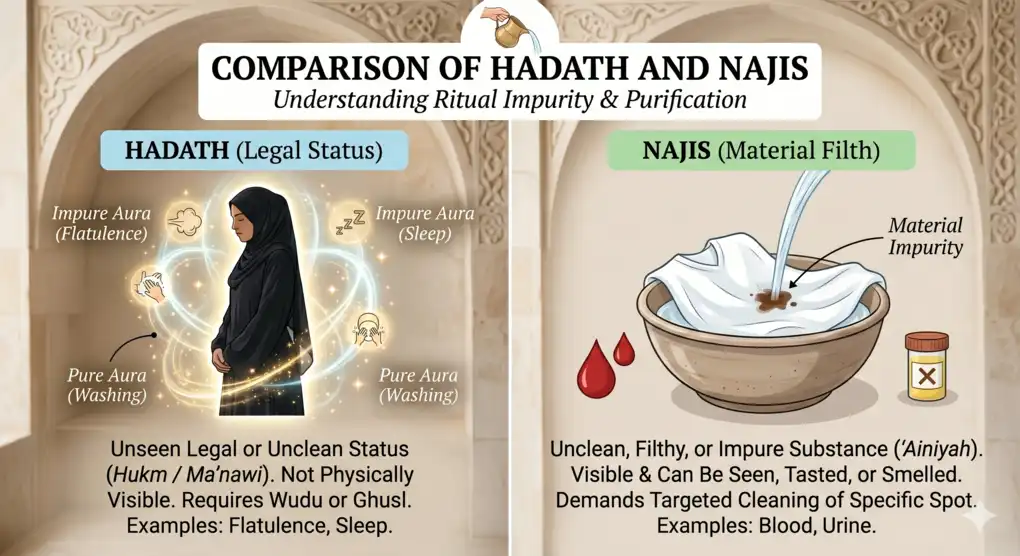
Many Muslims still question the precise difference between hadath and najāsah in daily life. While both prevent the validity of prayer, their core realities are entirely distinct.
We must be able to explain the difference between hadath and najāsah clearly so that we do not err in choosing the correct tools and methods of purification. To explore the physical forms of filth and the general categories of purification, you can refer to our dedicated guides.
Definition of Najasah and How It Differs from Hadath
Unlike hadath, which is an abstract legal status, najāsah is a tangible, physical substance that is legally filthy. Imam Zakariyya al-Anshari defines it as:
والخبث، وهو مستقذر يمنع صحة الصلاة حيث لا مرخص
Translation: “And khabath (najāsah), which is a loathsome substance that prevents the validity of prayer unless a rukhṣah exists.” [3]
From this, the difference between hadath and najāsah becomes clear. Najāsah demands the removal of the physical substance itself (its odor, taste, and color) from the body, clothing, or place. Conversely, hadath requires a specific ritual act of worship—either wuḍūʾ (ablution) or ghusl —without the need to look for a specific spot of dirt on the body.
Comparison Table: Hadath vs. Najasah (5 Key Differences)
Here is a summary of the differences between the two for easier comprehension:
| Aspect | Hadath | Najasah |
|---|---|---|
| Nature | Abstract / Legal Status / Maʿnawī | Physical / Tangible Substance / ʿAynī |
| Location | Resides within the bodily limbs (partially or the entire body) | Attaches to clothing, body, or the place of worship |
| Method of Purification | Performing wuḍūʾ, an obligatory bath, or tayammum | Washing/removing the substance with water until it disappears |
| Detection Method | Remembering the occurrence of an invalidating event | Visible to the eye, detectable by smell, or tasted |
| Examples | Passing gas, sleeping, ejaculation, ritual impurity (janābah) | Blood, urine, animal feces, canine saliva |
Why Is It Important to Distinguish Hadath and Najasah?
Knowledge regarding the distinction between najāsah and hadath is highly emphasized in practical fiqih. A person can be completely pure from najāsah but still bear the status of hadath, or vice versa.
For instance, if someone has just taken a shower and put on clean clothes but has not yet performed ablution, they are pure from najāsah, yet barred from praying due to hadath. On the other hand, if a person who already has wuḍūʾ accidentally steps on chicken droppings, they only need to wash their foot without needing to repeat their entire ablution.
What is the Term for “Purifying from Hadath and Najasah”?
For beginners learning the religion, the question often arises: what is the comprehensive term used for purifying oneself from both hadath and najāsah? In the science of fiqh, the precise term for this entire process of purification is ṭahārah.
Ṭahārah encompasses all efforts to clean oneself, whether from physical impurities or abstract states of impurity. Feel free to explore its rules further in our guide on the types of purification.
Types of Hadath: Minor and Major
Knowledge regarding the types of hadath is directly tied to their respective methods of purification. In studying Islamic jurisprudence, Muslims frequently ask about the various types of hadath to avoid using the wrong purification method. We will break down this classification completely according to sharia.
Broadly speaking, hadath is divided into two types: minor hadath (hadath asghar) and major hadath (hadath akbar). Each carries distinct legal rulings and consequences regarding the validity of a servant’s worship.
Minor Hadath (Hadath Asghar): Definition and Characteristics
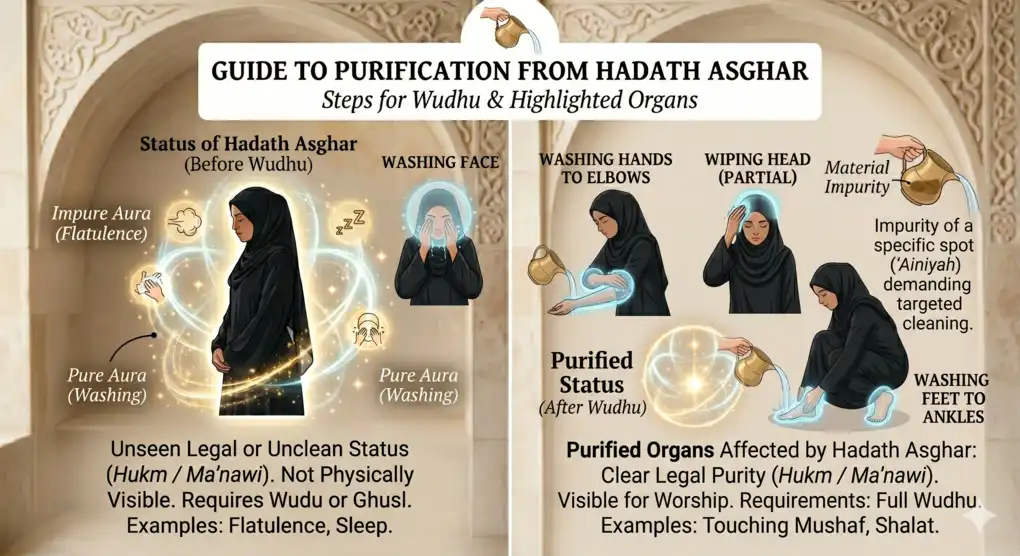
The legal nature of minor hadath does not spread to the entire body; rather, it is restricted to the specific organs of ablution. Imam Zakariyya al-Anshari explains this limitation:
قوله: (والحدث الأصغر لا يحل كل البدن) بل أعضاء الوضوء خاصة كما صححه في التحقيق، والمجموع لأن وجوب الغسل مختص بها
Translation: “(As for minor hadath, it does not settle upon the entire body) but is specifically confined to the limbs of wuḍūʾ alone, as validated by Imam al-Nawawi in al-Taḥqīq and al-Majmūʿ, because the obligation of washing (for minor hadath) is exclusive to those limbs.” [4]
Based on this text, hadath asghar is a state of ritual impurity where the legal restoration is directed only at specific ablution organs. For a deeper understanding, you can refer to our wudu guide.
Examples of Minor Hadath in Daily Life
Several occurrences instantly cause a person to enter a state of minor hadath:
- Urinating or defecating.
- The passing of gas (flatulence) from the anus.
- Sleeping in a position where the buttocks are not firmly seated on the ground.
- Direct skin-to-skin contact between an adult man and woman who are non-mahram.
- Touching the human private parts with the bare inner palm.
Body Parts Affected by Minor Hadath
Although the status of ritual impurity attaches to the individual as a whole, the legal purification is focused purely on the standard limbs of ablution: the face, both arms up to the elbows, a portion of the head (hair/scalp), and both feet up to the ankles.
Major Hadath (Hadath Akbar): Definition and Characteristics
In contrast to the previous category, major hadath requires a person to distribute water over their entire body. This naming is based on the consensus of jurisprudence scholars:
ويطلق كما في الأصل على ما يوجب الوضوء وعلى ما يوجب الغسل فيقال: حدث أصغر وحدث أكبر
Translation: “And it is defined as stated in the foundational text (namely) everything that necessitates wuḍūʾ and necessitates ghusl, so it is called: minor hadath and major hadath.” [5]
Thus, hadath akbar is a state that obligates a Muslim to perform the major ritual bath (ghusl) so that their worship becomes valid again. Please check the detailed legal explanations in our complete guide to obligatory bath.
Examples of Major Hadath in Daily Life
The following conditions establish the status of major hadath upon an individual:
- The emission of semen (manī) due to a wet dream or other causes, and janābah (sexual intercourse).
- Menstruation (ḥayḍ) in women.
- Postpartum bleeding (nifās).
- Childbirth (wilādah), even if unaccompanied by blood.
- Death (for a Muslim who did not die as a martyr).
Why Is It Called “Major”? — The Entire Body Is Affected
The designation “major” is given because of the comprehensive requirement of its purification. The entire surface of the skin and hair must be washed without exception, from the top of the head to the tips of the toes. It is legally invalid if one only washes certain parts of the body.
Detailed Table: Differences Between Minor and Major Hadath
| Aspect | Minor Hadath | Major Hadath |
|---|---|---|
| Causes | Passing gas, using the restroom, deep sleep, contact with non-mahram | Semen emission, intercourse, menstruation, postpartum bleeding, childbirth |
| Method of Purification | Performing wuḍūʾ (or tayammum as a substitute) | Performing ghusl / obligatory bath (or tayammum as a substitute) |
| Body Parts Washed | Only the ablution limbs (face, arms, head, feet) | The entire body from head to toe |
| Arabic Terminology | Hadath Asghar | Hadath Akbar |
Minor Hadath: Comprehensive Understanding, Examples, and Purification
In daily routines, examples of minor hadath are encountered very frequently, such as routine trips to the restroom. Islamic sharia provides a light and accessible method for this purification. Purifying oneself from minor hadath is carried out by washing specific organs according to the regulations of the Qur’an and Sunnah.
Why Ablution is the Solution for Minor Hadath
The sharia has established that performing wuḍūʾ is the dedicated method to remove ritual impurity in the asghar category. The flow of water over the face, arms, head, and feet is sufficient to lift this status. As long as its pillars (rukun) are met, ablution removes the hadath absolutely.
Tayammum as a Substitute for Ablution During Minor Hadath
If water is completely unavailable or if there is a medical prohibition preventing the body from coming into contact with water, the sharia provides a concession via clean earth. Learning how to perform tayammum correctly ensures that it can be validly used as a temporary substitute for ablution until the impediment to using water is resolved. This understanding guarantees that your obligatory prayer remains valid even in restricted or emergency circumstances.
Major Hadath: Comprehensive Understanding, Examples, and Purification
Every cause of major hadath, such as menstruation or the emission of semen, requires a more comprehensive method of purification. Executing the method of purifying oneself from major hadath must satisfy specific criteria to be valid. The most critical component is a sound intention; you are required to make the intention for the obligatory bath at the exact moment water first touches any part of your body.
To ensure the validity of your purification, it is crucial to know the correct intention for the obligatory bath as well as the exact timing of the intention.
Why the Obligatory Bath (Ghusl) is the Solution for Major Hadath
Water must be poured and ensured to reach every fold of the body without anything being left out. Undergoing the Shafi’i ghusl janabah requires fulfilling all the foundational pillars of the bath and ensuring no barriers block water from absorbing into the skin.
Is It Permissible to Remove Major Hadath Without an Obligatory Bath?
Laypeople often search for shortcuts on how to lift major hadath without performing ghusl. It must be understood that this is only permissible through tayammum when water cannot be found in the surrounding environment or when one is suffering from a severe illness. As long as water is accessible and physical health permits, washing the entire body via ghusl cannot be abandoned.
Causes of Minor Hadath: 4 Nullifiers of Ablution According to the Shafi’i Madhhab
Understanding the exact matters that invalidate wuḍūʾ in our daily worship is vital. Given that ablution is a prerequisite for prayer, knowing what compromises it is mandatory for every believer.
Imam Zakariyya al-Anshari states that there are 4 things that invalidate ablution in his text:
قوله: (نواقض الوضوء) يعني ما ينتهي به الوضوء (أربعة) ثابتة بالأدلة الآتية
Translation: “(The nullifiers of ablution), meaning the matters that terminate the state of ablution, are four, established by the forthcoming evidences.” [6]
These four matters encompass every cause of invalidation in jurisprudence.
Cause 1 — Anything Exiting the Two Paths (Qubul & Dubur)
The most frequent cause of invalidating ablution is the exiting of any substance from the anterior or posterior private parts.
قوله: (الأول الخارج) … (من أحد السبيلين) القبل والدبر (ولو ريحا من قبل)
Translation: “(The first is anything that exits) … (from either of the two pathways), which are the qubul (front part) and the dubur (rear part), (even if it is gas from the qubul).” [7]
Every substance that leaves the front path (qubul) or the rear path (dubur) instantly disrupts a person’s state of purity. This rule applies whether the exiting substance is liquid, solid, or gas.
- What Exits the Qubul: The exit of urine, madhy, wadī, or blood invalidates ablution immediately. Even if a tiny stone exits, the ablution is broken and must be renewed.
- What Exits the Dubur: Anything such as stool, wind, worms, or blood exiting the rear pathway terminates a person’s state of purity.
- Does Passing Gas Invalidate Ablution? For those wondering, passing gas breaks ablution absolutely. The certain exit of wind from the anus invalidates the state of purity, unless it is mere doubt unsupported by sound or smell. There is no such thing as a type of flatulence that does not break ablution, provided it is certain that wind did exit the anus.
- Does Vaginal Discharge Invalidate Ablution? Women frequently ask about vaginal discharge. If this fluid exits beyond the internal threshold of the private part (reaching the visible external area of the vulva), the ablution is invalidated. The woman must clean the area and perform a new ablution.
Cause 2 — Loss of Intellect/Consciousness: Sleep, Fainting, and Intoxication
The intellect acts as the tether of human awareness. When consciousness is lost, a person cannot tell whether something has exited their body or not.
قوله: (الثاني زوال العقل) … سواء أزال بجنون … أم بإغماء … أم بسكر … أم بنوم
Translation: “(The second is the loss of intellect) … whether the loss is due to insanity … or fainting … or intoxication … or sleep.” [8]
Does Sleeping Invalidate Ablution? When and How?
The ruling depends heavily on the posture of the person sleeping. Generally, sleeping breaks ablution due to the relaxation of the sphincter muscles controlling the anal region.
Sleeping Postures That Do and Do Not Invalidate Ablution
A specific exception applies if a person sleeps while firmly seated with their buttocks pressed flat against the ground or floor:
قوله: (لا بنوم ممكن مقعده) من مقره فلا ينتقض وضوءه
Translation: “(Not due to the sleep of one who firmly establishes their buttocks) upon their seating place, for then their ablution is not invalidated.” [9]
If there is any gap between the buttocks and the seating surface due to shifting, that posture shifts into a sleep that invalidates the ablution.
Do Fainting and Intoxication Invalidate Ablution?
Fainting, intoxication, and insanity compromise human awareness more severely than ordinary sleep. Therefore, these medical conditions invalidate ablution absolutely, regardless of the person’s physical posture.
Cause 3 — Skin-to-Skin Contact Between a Man and a Woman (Ajnabiyyah)
Direct contact without any barrier between two mature individuals of the opposite sex invalidates the ablution of both.
قوله: (الثاني التقاء بشرته) أي الذكر (وبشرتها) أي الأنثى (ولو) كان الذكر (ممسوحا)
Translation: “(The third is the contact of his skin), meaning the male, (with her skin), meaning the female, (even if) the male’s private parts (have been completely severed).” [10]
The Shafi’i Opinion on Physical Contact Invalidating Ablution
In the guidelines of the Shafi’i madhhab, direct skin-to-skin contact between opposite sexes who are not mahram definitely breaks the ablution. This rule applies whether the contact was intentional or accidental, and whether it occurred with or without sexual desire (shahwah).
Does Touching One’s Spouse Invalidate Ablution?
Married couples often face uncertainty regarding this. By blood lineage, a husband and wife are not mahram. Therefore, according to the relied-upon (muʿtamad) position of the Shafi’i school, touching your spouse skin-to-skin invalidates ablution.
Who Are the Mahrams Whose Touch Does Not Invalidate Ablution?
Only family members categorized as mahram are exempt from this invalidation rule:
قوله: (لا) إن كان (محرما لها) بنسب أو رضاع أو مصاهرة فلا ينقض الالتقاء
Translation: “(It is not invalidated) if he is (a mahram for her) due to lineage, fosterage (breastfeeding), or marriage alliance (such as a mother-in-law or daughter-in-law); then the contact does not invalidate.” [11]
A biological mother, daughter, sister, aunt, and mother-in-law are clear examples of family members whose direct touch does not break one’s ablution.
Does Touching Hair, Nails, or Teeth Invalidate Ablution?
This contact is only considered invalidating if it happens strictly skin-to-skin. If what is touched is the hair, nails, teeth, or if it is intentionally blocked by a layer of clothing fabric, the ablution remains perfectly intact.
Cause 4 — Touching Human Private Parts with the Inner Palm
Touching human genitalia using the inner surface of the hand or fingers is the fourth nullifier of ablution.
قوله: (الرابع مس فرج آدمي) قبل أو دبر من نفسه أو غيره … ببطن كف
Translation: “(The fourth is touching the private parts of a human being), whether the front or rear part, of oneself or someone else… with the inner palm.” [12]
Why Does Touching the Private Parts Invalidate Ablution?
The texts establish this restriction explicitly. Direct contact using the inner palm or the inner side of the fingers to the opening of the genitalia or the anus will immediately disrupt ritual purity.
Does Touching Someone Else’s Private Parts Also Invalidate Ablution?
This jurisprudence rule is universal. Touching a child’s private parts while bathing them or touching the private parts of any other person still breaks the ablution of the person doing the touching.
FAQ: Do These Actions Invalidate Ablution?
Aside from the 4 primary causes detailed above, there are other everyday actions whose legal status is frequently questioned by Muslims.
Do Eating and Drinking Invalidate Ablution?
Shafi’i scholars state with clarity:
قوله: (و) لا (أكل مطلقا) ولو لما مسته النار
Translation: “(And ablution) is not (invalidated by eating absolutely), even if (one consumes) something that has been touched by fire (cooked).” [13]
Based on this reference, eating and drinking do not invalidate ablution whatsoever.
Does Crying Invalidate Ablution?
The shedding of tears does not originate from the two pathways (qubul or dubur). Thus, your ablution remains fully valid and can be used for prayer.
Does Vomiting Invalidate Ablution?
Vomiting expels content from the stomach through the mouth. Although the vomited substance itself is legally categorized as najāsah (filth), the act of vomiting does not break your ablution. You simply need to rinse your mouth and clean the affected area.
Does Smoking Invalidate Ablution?
The assumption that smoking breaks ablution is a misconception. Smoking does not fall under any of the 4 causes of minor hadath. However, you are highly encouraged to clean your mouth afterwards so that the odor does not disturb others during congregational prayer.
Causes of Major Hadath: Janabah, Haid, Nifas, and Others
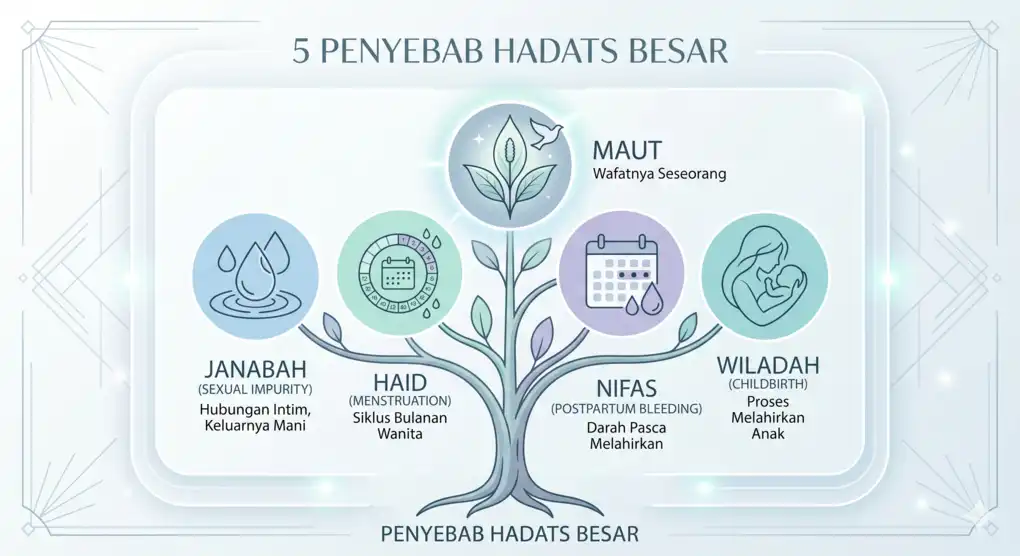
Studying the precise causes of the obligatory bath is highly emphasized so that we do not make mistakes in determining our spiritual and physical purity. Shafi’i scholars have summarized the foundational causes of hadath akbar.
Imam Zakariyya al-Anshari outlines the circumstances that necessitate a ritual bath for a Muslim:
قوله: (موجبه) … خمسة (موت) … (وخروج حيض أو نفاس بانقطاعه) … (و) خروج (ولد ولو علقة ومضغة) و (بلا بلل) … (وجنابة)
Translation: “(The causes that necessitate ghusl) … are five: (death) … (and the exiting of menstruation or postpartum bleeding along with its cessation) … (and) the exiting of (a child, even if it is in the form of a clot of blood or a lump of flesh) and (even if it occurs without wetness) … (as well as janābah).” [22]
To resolve these five occurrences, an individual must execute the obligatory bath in full accordance with its essential pillars.
Cause 1 — Janabah (Junub): Intercourse and Semen Emission
Two distinct events place a person into the status of junub: engaging in sexual relations (jimāʿ) and the emission of semen or sperm (manī).
Hadath Summary for Sexual Intercourse (Jima’)
The mere encounter or penetration of the glans (ḥashafah) into the female private part establishes the status of major hadath upon both parties. This obligation to bathe is absolute, even if the process is not accompanied by any ejaculation.
Major Hadath Due to the Emission of Semen (Mani)
The discharge of reproductive fluid obligates the person to perform ghusl. To identify semen accurately, classical commentaries provide specific criteria:
قوله: (ويعرف) المني (بتدفق) … (أو تلذذ) … (أو ريح طلع أو عجين رطبا و) ريح (بياض بيض يابسا)
Translation: “(And it is recognized) that it is semen (by its emission with force/spurts) … (or by gratification) … (or by an odor resembling palm spadix or moist dough when wet, and) the odor of (egg whites when dry).” [23]
Signs That Differentiate Mani, Madhi, and Wadi
You must familiarize yourself with the aroma, color, and character of these discharges so that you apply the correct ruling. Manī must be purified with a full ritual bath, whereas madhy and wadī are physical impurities (najāsah) that only necessitate washing and a normal ablution. A detailed guide is available on the difference between mani and madhi.
Does having a wet dream cause major hadath?
A person who wakes up from sleep and finds their clothing wet with semen has experienced iḥtilām (a wet dream). This condition stands as a definitive cause for the obligatory bath, even if the individual does not recall any dream upon waking.
Cause 2 — Menstruation (Haid): The Monthly Bleeding
Almost every healthy, adult female experiences a monthly blood cycle. This blood is an inherent biological nature (jibillah) decreed by Allah ﷻ for women.
Is Menstruation Classified as Major Hadath?
Yes, the flow of menstrual blood automatically prevents the validity of fundamental worship acts like prayer and fasting. Its state of impurity is major, requiring the woman to perform ghusl once the bleeding has completely stopped.
When Is Menstruation Considered Finished?
Menstrual bleeding is confirmed to have stopped when a piece of cotton or cloth inserted into the external tract comes out entirely clean—free from red, yellow, or murky discoloration. For guidance on when to begin the bath, please see when menstruating or postpartum women start ghusl.
Cause 3 — Postpartum Bleeding (Nifas)
The blood that discharges from a woman’s uterus immediately after it is emptied of a fetus is termed nifās.
How Long Does Postpartum Bleeding Last in Shafi’i Fiqh?
Generally, postpartum bleeding lasts around 40 days, with a maximum legal limit of 60 days. If bleeding continues past the 60-day mark, the status of the blood shifts into chronic medical bleeding (istiḥāḍah).
Rulings for Postpartum Women: Identical to Menstruation
All religious prohibitions applicable to menstruating women apply equally to postpartum women. As soon as the postpartum bleeding ends, she is required to perform ghusl to lift the major hadath instantly.
Cause 4 — Childbirth (Wiladah)
Occasionally, there are cases of clean delivery where a child is born without being accompanied by any fluids or blood. Nonetheless, the sharia establishes the act of giving birth itself as a cause that obligates ghusl.
قوله: (و) خروج (ولد ولو علقة ومضغة) و (بلا بلل)
Translation: “(And) the exiting of (a child, even if it is merely a clot of blood or a lump of flesh), and (even if it exits without any wetness of blood).” [24]
Why Does Childbirth (Even Without Blood) Obligate a Bath?
Even if the child is delivered dry without any accompanying postpartum discharge, the mother still bears major hadath. From the perspective of human creation, a fetus is formed from condensed semen; therefore, its passage through the birth canal warrants the major bath.
Cause 5 — Death (Maut)
The departure of the soul from the body establishes a communal obligation upon the living to wash the deceased’s body.
Why Must a Deceased Person Be Washed?
A deceased individual has physically lost the capacity to purify themselves. Islam mandates washing the body as a profound act of honor and sanctification (tashrīf) for a Muslim body being prepared to meet its Creator.
Who Bears the Obligation to Wash the Deceased?
This task falls upon the living members of the Muslim community under the status of Farḍ Kifāyah (communal obligation). The only exception is made for individuals who die as martyrs (shuhadāʾ) on the battlefield; they are buried in their clothes and wounds without being washed.
Summary of Causes: Minor Hadath vs. Major Hadath
| Hadath Type | Causes of Hadath | Primary Purification Method | Arabic Terminology |
|---|---|---|---|
| Minor Hadath | Passing gas, using the restroom, loss of consciousness (sleep/fainting), touching private parts, skin contact with non-mahram | Wuḍūʾ (or Tayammum if water is unavailable) | Hadath Asghar |
| Major Hadath | Semen emission, sexual relations, menstrual bleeding, postpartum bleeding, childbirth (wilādah), death | Ghusl / Obligatory Bath (or Tayammum in severe illness) | Hadath Akbar |
Prohibitions While in a State of Hadath
Bearing the status of hadath places specific boundaries on a Muslim’s devotional acts. Being pure from both hadath and najāsah is a non-negotiable condition for prayer. Imam Zakariyya al-Anshari outlines what is forbidden when an individual is in hadath:
فصل: (يحرم بالحدث) صلاة ولو nafلة وصلاة جنازة وطواف… (وسجود) لتلاوة أو شكر… (ومس مصحف)
Translation: “(Section: It is prohibited due to hadath) to perform prayer, even if it is a supererogatory prayer or a funeral prayer, and ṭawāf… and (prostration) whether for recitation or gratitude… and touching a muṣḥaf.” [25]
These prohibitions are divided into two distinct levels based on the intensity of the impurity.
Prohibitions During Minor Hadath (Lacking Ablution)
The following acts of worship are strictly unlawful for anyone whose ablution has been invalidated:
- Prayer (Obligatory and Optional): It is forbidden to perform any type of prayer, including obligatory prayers, regular sunnah prayers, and the funeral prayer.
- Ṭawāf Around the Ka’bah: Circumambulating the Ka’bah holds a legal status equivalent to prayer regarding purification; hence, the performer must have valid wuḍūʾ.
- Prostrations of Recitation and Gratitude: Prostrating outside of prayer due to reciting a verse of prostration (sajdah) or out of gratitude requires the person to be pure from hadath.
- Touching and Carrying the Muṣḥaf of the Qur’an: Touching the pages, the attached cover of a physical Qur’an, or carrying it is prohibited. If you are inquiring about touching the Qur’an on a digital screen (smartphone), it is permissible because it does not share the physical status of a muṣḥaf.
- Note on Reading: Reading or reciting the Qur’an from memory or looking at a screen without touching a physical muṣḥaf is entirely permissible while in minor hadath.
Additional Prohibitions During Major Hadath (Junub/Haid/Nifas)
In addition to the four restrictions above, there are further prohibitions specific to major hadath.
1. Reciting the Qur’an Audibly
For individuals in a state of janābah, menstruation, or postpartum bleeding, it is unlawful to articulate verses of the Qur’an with the explicit intention of recitation (qirāʾah).
(يحرم على الجنب ما يحرم على المحدث وشيئان أحدهما القراءة للقرآن بقصدها ولو بعض آية)
Translation: “(Prohibited for the person in janābah is whatever is prohibited for the person in minor hadath, plus two additional things: first is reciting the Qur’an with the intention to recite it, even if it is only a partial verse).” [26]
2. Staying Inside the Masjid
An individual in major hadath is prohibited from sitting, remaining still, or purposefully pacing back and forth inside the prayer hall of a mosque.
(الثاني المكث والتردد في المسجد لا عبوره)
Translation: “(Second: Remaining still and pacing back and forth within the masjid, though it is not prohibited merely to pass through it).” [27]
3. Fasting (Exclusive to Menstruation and Postpartum Bleeding)
For women going through their cycles, there is an additional absolute prohibition regarding fasting.
فصل: (يحرم) على المرأة (به) أي بالحيض (وبالنفاس ما يحرم بالجنابة)… (مع زيادة تحريم الصوم)
Translation: “(Section: Prohibited) for a woman (because of it), meaning because of menstruation (and because of postpartum bleeding, is whatever is prohibited because of junub)… (with the addition of the prohibition of fasting).” [28]
4. Marital Intimacy
For women experiencing menstruation or postpartum bleeding, it is also strictly prohibited to engage in sexual intercourse until the flow has ceased and she has performed the major ritual bath.
Practical Methods of Purification from Hadath: A Quick Summary
In Islamic sharia, ablution is the primary method to lift minor hadath. The flow of water over the designated organs removes the impurity, provided it is executed with the proper sequence and pillars.
For states of janābah or nifās, ablution alone cannot remove the impurity. People often mistakenly search for terms like “ablution intention for major hadath,” whereas the only accurate term is “the intention for the obligatory bath (ghusl).”
You can consult our practical guidelines for execution:
Practical Summary Table: Wuḍūʾ, Ghusl, and Tayammum
| Hadath Type | Purity Scope | Primary Method | Emergency/Alternative Method |
|---|---|---|---|
| Minor Hadath | Centered only on the 4 ablution limbs | Ablution (wuḍūʾ) using purifying water | Tayammum (if water is absent or medically forbidden) |
| Major Hadath | Covers the entire physical body | Obligatory Bath (ghusl) to wet all skin and hair | Tayammum (with the explicit intention to replace ghusl) |
FAQ Regarding Hadath
What is the core difference between hadath and najasah?
Hadath is a non-physical legal status affecting a person that restricts specific acts of worship. It is lifted via ablution or an obligatory bath. Najāsah is a physical, material filth (like blood or urine) attaching to a surface. It is purified by physically removing the substance using water.
What actions trigger minor hadath?
Minor hadath (which invalidates your ablution) is triggered by four things: anything exiting the two private parts, loss of consciousness (like deep sleep), direct skin contact between a non-mahram man and woman, or touching the private parts with the inner palm.
Do eating and drinking break my ablution?
No. Eating and drinking do not break your ablution whatsoever. You can pray immediately after eating, though rinsing your mouth with water is highly recommended to remove any food remnants.
What are the primary causes of major hadath in Islam?
According to Shafi’i jurisprudence, there are 5 core causes: sexual relations (junub), emission of semen, menstrual bleeding, postpartum bleeding, childbirth (wilādah), and death.
Am I allowed to read the Qur’an while in a state of hadath?
The ruling depends on the type of hadath:
- Minor Hadath: You are permitted to recite the Qur’an from memory or read from a screen, but it is strictly forbidden to touch the physical pages of a muṣḥaf.
- Major Hadath: It is completely forbidden to recite any verses of the Qur’an with the intention of recitation, and it is also forbidden to touch the physical muṣḥaf.
Footnotes
Reference
Zakariyā al-Anṣārī, Asnā al-Maṭālib fī Sharḥ Rawḍ al-Ṭālib, with ḥāshiyah by Aḥmad al-Ramlī, edited by Muḥammad az-Zuhrī al-Ghamrāwī (Cairo: al-Maṭbaʿah al-Maymānīyah, 1313 AH; repr. Dār al-Kitāb al-Islāmī), Vol. 1, pp. 5-100.


