

Have you ever wondered why sometimes your Salah (prayer) feels lacking in khushu’ (solemnity) or feels somewhat empty? The ultimate key to the acceptance of a prayer and the presence of khushu’ actually begins long before we raise our hands for the Takbirat al-Ihram—it starts at the ablution area.
Wudu (ablution) is not merely a random routine of washing body parts with water; rather, it is a ritual of purifying the soul and body where minor sins fall away with every drop of water. Unfortunately, many of us still rush through or neglect the perfect method of performing Wudu. Let us re-evaluate: does our ablution align with the perfect guidance inherited from the Messenger of Allah ﷺ?
The Meaning of Wudu Linguistically and Terminologically
Knowing the meaning of Wudu according to language and terminology is the fundamental foundation before a Muslim performs this act of worship. Etymologically, Wudu is derived from the word al-wadha’ah, which means goodness and beauty. Terminologically, Wudu is a ritual of worship involving the use of pure water on specific body parts, initiated with an intention (niyyah).
Let us observe the explanation of Imam Zakariyya al-Ansari in the book Asna al-Matalib:
قوله: (باب صفة الوضوء) أي كيفيته، وهو من الوضاءة، وهي الحسن، وفي الشرع استعمال الماء في أعضاء مخصوصة مفتتحا بنية
“The chapter on the attribute of Wudu, meaning its procedure. Wudu comes from the word al-wadha’ah, which is goodness or beauty. In the Shari’ah, Wudu is the use of water on specific body parts, commencing with an intention.” [1]
Through this definition, we understand that the correct practice of Wudu is not just a physical washing activity. This ritual is a purely spiritual act of worship (mahdhah) that cleanses the stains of sin while beautifying the soul of the one who is about to face Allah ﷻ.
Evidence for the Obligation of Wudu
The command to purify oneself through Wudu originates directly from the Qur’an. Allah ﷻ says in Surah Al-Ma’idah, verse 6, which serves as the primary basis for this obligation. The verse commands believers who intend to establish prayer to wash their faces, their hands up to the elbows, wipe their heads, and wash their feet.
Furthermore, the Sunnah of the Prophet ﷺ strictly states that prayer will not be accepted without Taharah (purification). Therefore, the ruling of Wudu becomes an individual obligation (fard ‘ayn) for anyone who is about to perform an act of worship that necessitates a state of purity from minor ritual impurity (hadath).
Conditions for a Valid Wudu
An act of purification will not be deemed valid if it ignores its essential conditions. There are several conditions for a valid Wudu that are strictly agreed upon in the Shafi’i madhhab (school of thought). Below is the reference text that details these conditions:
فشروطه ماء مطلق، والعلم بأنه مطلق، وإسلام، وتمييز، ومعرفة كيفية الوضوء… وعدم الحائل، وجري الماء على العضو
“Thus, the conditions for its validity are: absolute water, knowing that it is absolute water, being a Muslim, tamyiz (age of discretion), knowing the method of Wudu… the absence of a barrier, and the flowing of water over the limb.” [2]
The details of the aforementioned conditions include:
- Islam and Tamyiz: Purification is only valid when performed by a Muslim who has the mental capacity to distinguish between good and bad (mumayyiz).
- Using Absolute Water: The water used must be legally pure and purifying. Read more about the essence of absolute water.
- Knowing the Rulings: A Muslim must be able to differentiate between the obligatory pillars (fard) and the recommended acts (sunnah).
- Free from Barriers (Ha’il): The surface of the skin and nails must be free from any substance that prevents water from penetrating, such as paint, nail polish, or tree sap.
- Flowing Water (Jari al-Ma’): Water must flow over the skin of the limbs; simply wiping with a damp hand is insufficient.
Niyyah of Wudu: Essence, Valid Wordings, and Timing

All acts of worship in Islam boil down to the sincerity of the doer’s intention. The very first pillar of Wudu is to consciously bring this intention into the heart.
قوله: ، وفروضه ستة الأول النية) لخبر الصحيحين «إنما الأعمال بالنيات»
“The obligatory acts of Wudu are six. The first is the intention, based on the hadith from the two Sahihs: ‘Actions are only by intentions.'” [3]
A person may choose one of the following three options for the intention of Wudu for their purification to be valid:
- Intention to Remove Impurity: Intending to eliminate the state of minor ritual impurity from the body (rafa’ al-hadath).
- Intention to Permit Prayer: Intending to become permissible to perform worship that requires purity (istibahat as-salah).
- Intention to Fulfill the Obligation: Intending to discharge the obligation of Wudu itself (ada’ al-wudu).
The timing of this intention is strictly tied to the beginning of washing the first obligatory limb.
(، وتجب عند غسل أول جزء من الوجه)
“And it (the intention) is obligatory at the moment of washing the first part of the face.” [4]
If the intention is only uttered by the tongue before the water touches the face, then legally, that intention is not yet sufficient. The servant’s heart must be conscious and hold the intention at the precise moment the first drop of water touches the skin of the face.
The 6 Pillars of Wudu: Sequence and Detailed Explanation
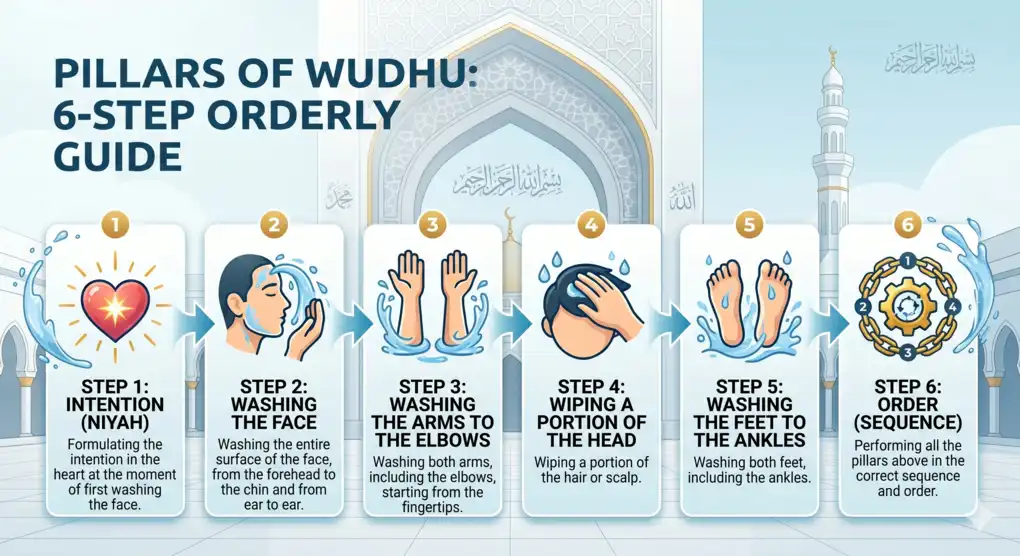
For a Muslim, a fundamental question often arises: how many pillars of Wudu are there? In the jurisprudence of the Shafi’i Madhhab, there are exactly 6 (six) pillars. Some classical scholars use the term fard. Thus, if asked how many fard of Wudu there are, the answer remains the same: there are 6.
Terminologically, the pillars of Wudu are the core actions that are obligatory (fard) and cannot be omitted. If any of these pillars are missed, the Wudu is considered invalid. Therefore, we must correctly understand the sequence of the pillars in the Shafi’i school, differentiating clearly between the obligatory (fard) and the recommended (sunnah) acts of Wudu. Obligatory acts determine validity, while sunnah acts add reward and perfection.
Here are the details of the six obligatory pillars based on the explanation of Imam Zakariyya al-Ansari:
1. Niyyah (Intention)
As discussed in the intention section, the first pillar of Wudu is to formulate the intention in the heart. This must occur simultaneously when the water first touches any part of the face. Uttering it verbally is a sunnah, but its essence must reside in the heart.
2. Washing the Face
The second pillar is washing the entire face. Regarding the boundaries of the face, Imam Zakariyya al-Ansari details them in his book:
قوله: (الثاني غسل الوجه)… (وهو) طولا ظاهر (ما بين منابت شعر الرأس غالبا، وأسفل المقبل من الذقن) و (من) اللحيين… و عرضا ظاهر (ما بين أذنيه)
“The second pillar is washing the face. Its vertical boundary is outwardly from where the hair of the head usually grows, down to the lowest frontal part of the chin and the two jawbones… And its horizontal boundary is outwardly between the two ears.” [5]
Water must flow evenly across all the skin and hair within this facial area. If a person has a thin beard, water must penetrate to the underlying skin. However, if the beard is thick, washing the exterior portion is sufficient.
3. Washing Both Hands Up to the Elbows




The third pillar is washing both arms from the fingertips to just above the elbows.
قوله: (الثالث غسل اليدين مع المرفقين) قال تعالى {وأيديكم إلى المرافق}
“The third pillar is washing the two hands along with the elbows. Allah ﷻ says: ‘And your hands up to the elbows’.” [6]
All fingernails, the spaces between the fingers, and the hair growing on the arms must be washed. If there is dirt under the nails that blocks water from reaching the skin, the Wudu is invalid, and the dirt must be removed first.
4. Wiping a Part of the Head
Unlike the face and arms which must be “washed” (ghasl / flowing water), this fourth pillar only requires being “wiped” (mash / wiping with wet hands).
قوله: (الرابع مسح الرأس) قال تعالى {وامسحوا برءوسكم}… (ويجزئه) المسح (ولو بعض شعرة) واحدة
“The fourth pillar is wiping the head. Allah ﷻ says: ‘And wipe your heads’… The wiping is sufficient even if it is only a part of a single strand of hair.” [7]
The condition for the validity of this wiping is that the wiped hair must not extend beyond the boundary of the head. If a person wipes the ends of long hair that reaches down to their back, the wiping is invalid.
5. Washing Both Feet Up to the Ankles
The fifth pillar is washing both feet thoroughly, covering the two ankles.
قوله: (الخامس غسل الرجلين مع الكعبين)… وهما العظمتان الناتئان عند مفصل الساق والقدم
“The fifth pillar is washing the two feet along with the ankles. The ankles are the two prominent bones at the joint of the lower leg and the foot.” [8]
One must ensure the water reaches the spaces between the toes and the heels, as the heels are often accidentally neglected.
6. Sequence (Tartib)
The final pillar in this worship is tartib, which means performing all the aforementioned obligatory actions in their precise sequential order. The practice of Wudu must begin with the intention and washing the face, then proceed to the subsequent pillars without altering their positions.
قوله: (السادس الترتيب) في أفعاله لفعله صلى الله عليه وسلم المبين للوضوء المأمور به
“The sixth pillar is the sequence in its actions, based on the action of the Prophet ﷺ which clarified the commanded Wudu.” [9]
If a person washes their arms before their face, the washing of the arms is deemed invalid, and they must repeat it after washing their face. Understanding the pillars of Wudu sequentially will perfect the daily ablution guide that we implement.
The Complete and Correct Procedure of Wudu from Start to Finish
To attain the full merit of this worship, we must practice a Wudu procedure that integrates both the obligatory pillars (fard) and the recommended acts (sunnah). These steps must be performed in chronological order.
Here is the correct sequence of Wudu movements from beginning to end according to the Shafi’i guidance:
- Using the Miswak (tooth-stick) before touching the water.
- Reciting the Basmalah concurrently with washing both hands.
- Rinsing the mouth and inhaling water into the nose (istinshaq).
- Formulating the intention in the heart exactly as the first drop of water washes the face.
- Washing both arms up to and slightly past the elbows.
- Wiping the entire head (sunnah) or at least a portion of it (obligatory).
- Wiping the outer and inner parts of both ears.
- Washing both feet up to and including the ankles.
It is crucial to be mindful of how we use water so as not to be wasteful (israf). Perform each washing and wiping mentioned above exactly three times consecutively.
The Sunnah Acts of Wudu: From Miswak to the Threefold Washing
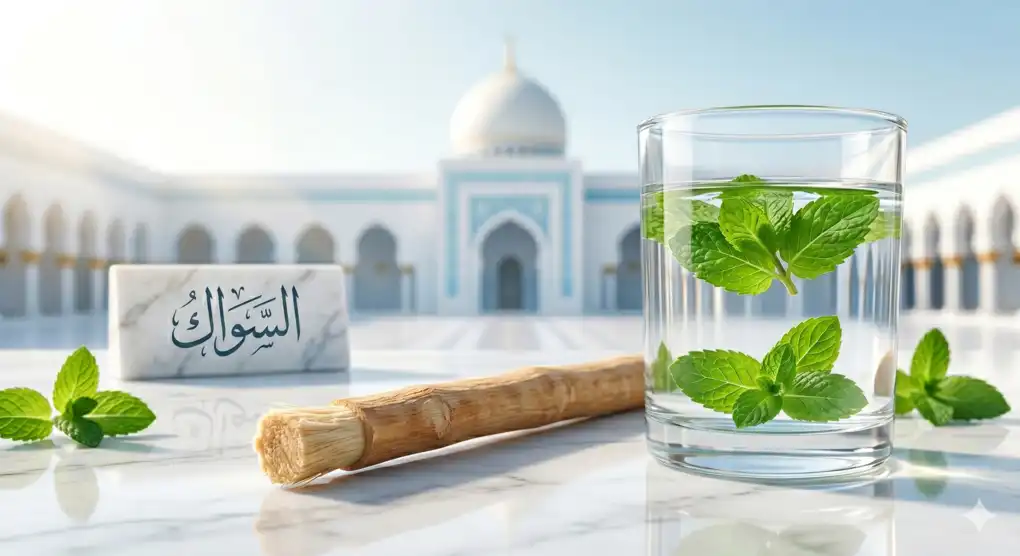
Performing the Sunnah acts of Wudu will multiply the rewards of our purification. One of the highly emphasized sunnahs prior to ablution by the Prophet ﷺ is the use of the Miswak.
قوله: (ومن سننه السواك… وهو سنة مطلقا) لخبر «السواك مطهرة للفم مرضاة للرب»
“And among its sunnahs is the siwak… It is an absolute sunnah based on the hadith: ‘The siwak is a purification for the mouth and pleasing to the Lord.'” [10]
Next, you are encouraged to understand the ruling on reciting the Basmalah at the very beginning of washing the hands.
قوله: (و) من سننه (التسمية) أوله… وأكملها بسم الله الرحمن الرحيم
“And among its sunnahs is reciting the Name of Allah (Tasmiyah) at its beginning… and its most perfect form is ‘Bismillahir-Rahmanir-Rahim’.” [11]
Following this, the perfect Wudu proceeds with rinsing the mouth and inhaling water into the nose. Both are done before washing the face.
قوله: (و) من سننه (مضمضة ثم استنشاق) للاتباع
It is a sunnah to wash each limb three times. This rule applies to both the limbs that are washed and those that are wiped.
قوله: (و) من سننه (تثليث مغسول، وممسوح) مفروض، ومسنون للاتباع
“And among its sunnahs is doing it three times (tathlith) for what is washed and wiped, whether obligatory or recommended, out of adherence to the Prophet ﷺ.” [13]
Supplication (Du’a) After Wudu: Arabic, Transliteration, and Meaning

As a beautiful conclusion, we are highly encouraged to recite a supplication after Wudu. This practice carries an extraordinary virtue: the opening of the eight gates of Paradise for the one who recites it. It is sunnah to recite the du’a during and after Wudu while standing and facing the Qiblah.
Here is the transliteration of the du’a after Wudu according to the guidance in Asna al-Matalib:
قوله: (و) أن (يقول بعده)… (أشهد أن لا إله إلا الله، وحده لا شريك له، وأشهد أن محمدا عبده، ورسوله)… (اللهم اجعلني من التوابين، واجعلني من المتطهرين)… (سبحانك اللهم وبحمدك أشهد أن لا إله إلا أنت أستغفرك، وأتوب إليك)
“And it is sunnah to say after it: Ashhadu an la ilaha illallah, wahdahu la sharika lah, wa ashhadu anna Muhammadan ‘abduhu wa rasuluh. Allahummaj’alni minat-tawwabina waj’alni minal-mutatahhirin. Subhanakallahumma wa bihamdika ashhadu an la ilaha illa anta astaghfiruka wa atubu ilaik.” [14]
The meaning is as follows:
“I bear witness that there is no deity worthy of worship except Allah alone, with no partner or associate. And I bear witness that Muhammad is His slave and Messenger. O Allah, make me among those who constantly repent, and make me among those who purify themselves. Glory is to You, O Allah, and praise is to You. I bear witness that there is none worthy of worship but You. I seek Your forgiveness and repent to You.”
4 Matters That Invalidate Wudu According to the Shafi’i Madhhab
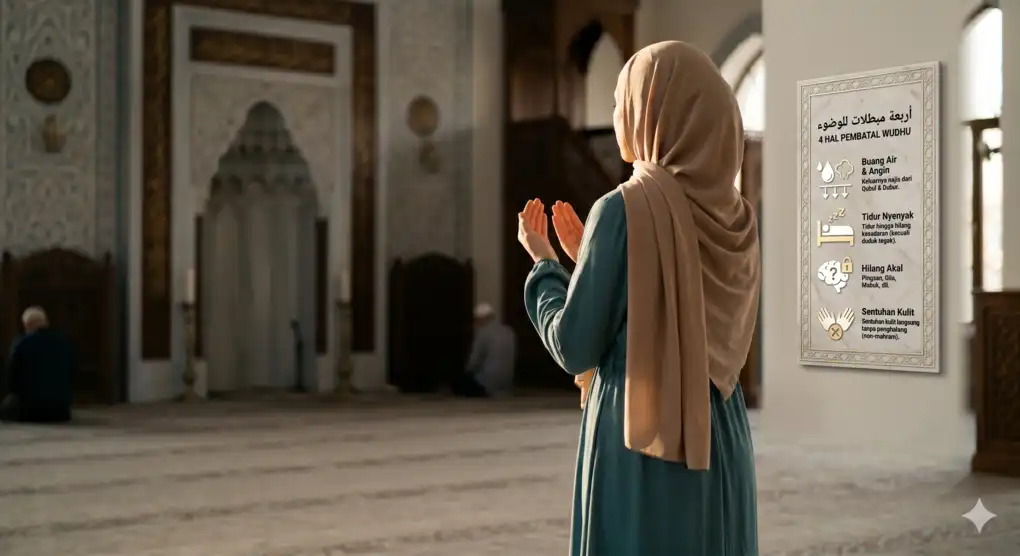
Basic questions frequently emerge in society regarding the matters that invalidate Wudu. Knowing the nullifiers of ablution (nawaqid al-wudu) is extremely essential to ensure our worship remains valid. In the Shafi’i Madhhab, there are four primary things that break a person’s state of purity from minor impurity.
Imam Zakariyya al-Ansari clarifies these boundaries in his book:
قوله: (باب الأحداث)… (نواقض الوضوء) يعني ما ينتهي به الوضوء (أربعة) ثابتة بالأدلة الآتية
“Chapter on Minor Impurities (Hadath). The nullifiers of Wudu, meaning that which terminates the Wudu, are four, established by the following evidences.” [15]
Here are the details of the four matters that invalidate Wudu:
1. Emission of Anything from the Front or Back Passages (Qubul and Dubur)
Anything that exits from the front passage (qubul) or the back passage (dubur) absolutely invalidates the Wudu, whether it is a solid, liquid, or gas.
قوله: (الأول الخارج) (من أحد السبيلين) القبل والدبر (ولو ريحا من قبل)
“The first is the emission (of anything) from either of the two passages, the front and the back, even if it is wind from the front.” [16]
This includes urine, feces, madzi, wadi, istihadhah blood, as well as passing gas (flatulence). If a congregant asks whether passing gas invalidates wudhu, the answer is absolutely yes.
Furthermore, according to the rulings of the Shafi’i school, as affirmed in the text above (walau rihan min qubul), this invalidation also applies to the emission of gas from the front passage or female genitalia (for detailed rulings on this matter, please read the specific discussion regarding whether queefing invalidates wudhu).
The same applies to vaginal discharge or worms exiting from that passage. The only exception is the emission of semen (mani); the emission of mani does not invalidate wudhu, but rather immediately necessitates the major ritual bath (janabah).
2. Loss of Intellect (Including Sleep)
Losing consciousness due to insanity, fainting, intoxication, or sleep is a nullifier of Wudu because the individual no longer has control over their physical body.
قوله: (الثاني زوال العقل)… (لا بنوم ممكن مقعده) من مقره فلا ينتقض وضوءه
“The second is the loss of intellect… Not by the sleep of one who firmly establishes his buttocks on his seat; thus, his Wudu is not invalidated.” [17]
Many are uncertain: does sleeping invalidate Wudu in all positions? An exception is granted to a person who sleeps in a sitting position with their buttocks pressed firmly against the seat (mumakkin maq’adahu). This position is considered secure from the risk of unknowingly passing wind.
3. Skin-to-Skin Contact Between a Male and a Female
Direct skin-to-skin contact between an adult male and female who are non-mahram (marriageable relatives) without a barrier (ha’il) invalidates the Wudu of both individuals.
قوله: (الثالث التقاء بشرته) أي الذكر (وبشرتها) أي الأنثى… (لا) إن كان (محرما لها) بنسب أو رضاع أو مصاهرة فلا ينقض
“The third is the meeting of his skin (the male) and her skin (the female)… (It does not invalidate) if she is a mahram to him by blood, fosterage (milk), or marriage.” [18]
A highly prevalent question is: does a husband and wife touching each other break Wudu? According to Shafi’i fiqh rules, skin contact between husband and wife does invalidate Wudu. A wife is not a mahram to her husband (she is a lawful spouse); therefore, the rule of nullification due to touching the opposite gender applies to spouses.
4. Touching the Private Parts (Farj)
Touching human genitals, whether one’s own or someone else’s, using the inner palm of the hand invalidates purity.
قوله: (الرابع مس فرج آدمي) قبل أو دبر من نفسه أو غيره عمدا أو سهوا… (ببطن كف ولو) كانت (شلاء)
“The fourth is touching the private part of a human, front or back, of oneself or another, intentionally or forgetfully… with the inner palm, even if it is paralyzed.” [19]
Therefore, does touching the genitals break Wudu? Yes, Wudu is broken if touched by the inner part of the palm without any layer of cloth. Touching with the back of the hand or the outer part of the fingers does not break the Wudu.
The Ruling on Eating, Drinking, and Crying Regarding Wudu
Mistaken beliefs often circulate in society regarding Wudu breaking due to everyday activities. The most frequently asked question is: does eating break Wudu? Let us refer to the explanation in Asna al-Matalib:
قوله: (و) لا (أكل مطلقا) ولو لما مسته النار لأنه صلى الله عليه وسلم «أكل كتف شاة وصلى ولم يتوضأ»
“And eating absolutely does not (invalidate it), even of what has been touched by fire (cooked), because the Prophet ﷺ ate a sheep’s shoulder, then prayed, and did not perform Wudu again.” [20]
According to the relied-upon (mu’tamad) view in the Shafi’i Madhhab, activities such as eating, drinking, crying, vomiting, and smoking do not invalidate Wudu at all. Nevertheless, if one has just consumed fatty or greasy foods, it is recommended (sunnah) to rinse the mouth to clear away food residue before performing the prayer.
FAQ about the Complete Guide to Wudu
What are the things that invalidate Wudu according to the Shafi’i Madhhab?
There are 4 main matters that invalidate Wudu:
- The emission of liquid, solid, or gas from the front or back passages.
- The loss of consciousness due to sleep (except in a firmly seated position), fainting, insanity, or intoxication.
- Skin-to-skin contact between a male and a female who are non-mahram, without a barrier.
- Touching the genitals (farj) with the inner palm of the hand.
Does sleep break Wudu? Does sleep break Wudu?
Yes, sleep breaks Wudu because it causes a person to lose consciousness of their body. The only exception is for someone who sleeps in a seated position with their buttocks firmly planted on the floor (mumakkin maq’adahu), as this posture prevents passing wind unconsciously.
Does skin contact between husband and wife break Wudu?
Yes, direct skin-to-skin contact between a husband and wife invalidates Wudu in the Shafi’i Madhhab. Spouses are not considered mahram, so touching without a cloth barrier will break the Wudu of both parties.
Does eating break Wudu?
No. Activities like eating, drinking, smoking, crying, or vomiting do not ruin one’s Wudu. The Prophet ﷺ once ate cooked meat and immediately performed Salah without repeating his Wudu. However, it is highly recommended to rinse the mouth to remove food remnants before praying.
Conclusion: Perfecting Wudu, Opening the Gates of Paradise
The perfection of our daily prayers relies heavily on how well we maintain the quality of our Wudu. By integrating the obligatory pillars and reviving the frequently neglected sunnah acts—such as using the Miswak, washing three times (tathlith), and avoiding the waste of water—we do more than merely check off an obligation.
Furthermore, a sequentially correct Wudu, concluded with a solemn supplication, serves as the key to unlocking the eight gates of Paradise, allowing us to enter through whichever gate we please on the Day of Judgment. Starting today, let us refine our Wudu procedure and turn this moment of purification into a means of garnering maximum rewards and attaining the pleasure of Allah the Almighty.
Footnotes
Reference
Zakariyā al-Anṣārī, Asnā al-Maṭālib fī Sharḥ Rawḍ al-Ṭālib, with ḥāshiyah by Aḥmad al-Ramlī, edited by Muḥammad az-Zuhrī al-Ghamrāwī (Cairo: al-Maṭbaʿah al-Maymānīyah, 1313 AH; repr. Dār al-Kitāb al-Islāmī), vol. 1, pp. 28-57.


