
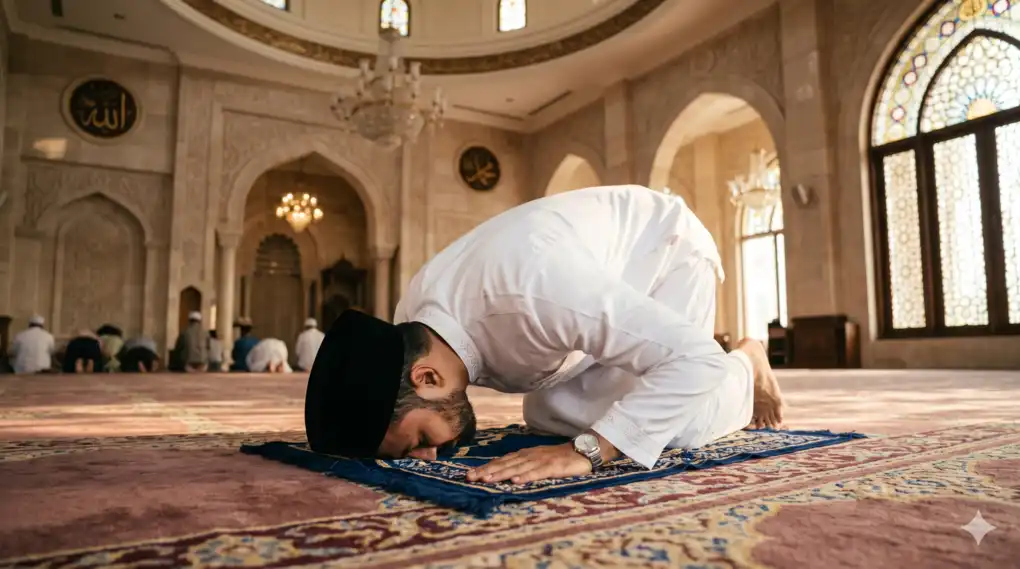
Performing acts of worship in Islam must be based on correct knowledge. Understanding the basics of prayer is closely linked to seeking goodness from the Creator. Prayer (Salah) is the most magnificent pillar of Islam after the testimony of faith (Shahada).
Every Muslim must understand the wisdom of obligatory prayers and how to perform them correctly. We will thoroughly discuss the rulings, times, and various provisions of prayer according to the Shafi’i Madhhab.
What is Salah? Definitions in the Shafi’i Madhhab
Understanding the definition of Salah is the first step before diving into its detailed rulings. The Shafi’i Madhhab formulates this definition clearly from both linguistic and legal perspectives.
Linguistic Meaning of Salah
Linguistically, Salah means a prayer for goodness. This is based on the Quranic command to pray for the community.
هي لغة الدعاء بخير قال تعالى {وصل عليهم} [التوبة: ١٠٣] أي ادع لهم
“Salah linguistically is a prayer for good. Allah Ta’ala said: {And pray for them} [QS. At-Taubah: 103], meaning supplicate for them.” [1]
Legal Definition of Salah
In the view of the Shariah, this worship consists of specific physical actions and utterances. It must begin with the opening Takbir and end with the Salam.
وشرعا أقوال وأفعال مفتتحة بالتكبير مختتمة بالتسليم
“Legally, it is specific words and actions beginning with Takbir and ending with Taslim (Salam).” [2]
Legal Basis for Obligatory Prayer




The command to establish the five daily prayers is based on definitive (qath’i) texts from the Quran and Hadith. This obligation stems from the Great Night Journey (Isra’ and Mi’raj) of Prophet Muhammad ﷺ.
والأصل فيها قبل الإجماع آيات كقوله تعالى {وأقيموا الصلاة} … وأخبار كخبر الصحيحين «أنه – صلى الله عليه وسلم – قال فرض الله على أمتي ليلة الإسراء خمسين صلاة فلم أزل أراجعه وأسأله التخفيف حتى جعلها خمسا في كل يوم وليلة»
“The basis before consensus (ijma’) are verses such as Allah’s word: {And establish the prayer}… and reports like the Hadith in the two Sahihs: ‘The Prophet ﷺ said: Allah obligated fifty prayers on my Ummah on the night of Isra’, then I kept returning to Him asking for reduction until He made them five in a day and night.'” [3]
Rulings on Obligatory Prayer: Who is Obligated?
Not everyone is immediately subject to the obligation of performing obligatory prayers. There are specific criteria that make an individual a mukallaf (accountable person).
Conditions for Obligation
This duty falls upon individuals who meet the Shariah criteria. The primary conditions are Islam, reaching puberty (baligh), being sane, and being in a state of purity.
وتجب على كل بالغ عاقل طاهر
“And prayer is obligatory upon every person who has reached puberty, is sane, and is pure.” [4]
Ruling for Non-Muslims
Non-Muslims are still subject to this obligation in the afterlife as a form of punishment. However, they are not demanded to perform it in this world because it would not be valid. Their past obligations are automatically forgiven upon embracing Islam.
فالكافر مخاطب بها خطاب عقاب عليها في الآخرة… وتسقط عنه بإسلامه لقوله تعالى {قل للذين كفروا إن ينتهوا يغفر لهم ما قد سلف}
“The non-believer is addressed by it as an address of punishment in the Hereafter… and it falls from him upon his Islam due to Allah’s word: {Say to those who have disbelieved, if they cease, what has previously passed will be forgiven for them}.” [5]
Ruling for Apostates (Murtad)
Unlike an original non-Muslim, a person who leaves Islam (apostate) is subject to much stricter rules. If they return to Islam, they are obligated to make up (qadha) all the prayers they missed while they were away from the faith.
لا عن المرتد فيلزمه قضاؤها بعد إسلامه تغليظا عليه ولأنه التزمها بالإسلام فلا تسقط عنه بالجحود
“It does not fall from the apostate; he must make them up after his Islam as a form of severity upon him, and because he committed to it through Islam, so it does not fall from him by denial.” [6]
Ruling for Children (Shabiy)
Children who have not yet reached puberty are not obligated to perform prayer. However, parents or guardians must train and command them. If a child reaches puberty while performing the prayer, they must complete it, and their prayer is valid.
ولا صلاة على صبي… وعلى أبويه أو القيم أمره بها… وإن صلى صبي وظيفة الوقت ثم بلغ أجزأته صلاته
“There is no prayer obligation on a child… but it is duty upon his parents or guardian to command him… If a child performs the prayer of the time and then reaches puberty, it suffices him.” [7]
Ruling for Insanity, Fainting, and Intoxication
Loss of sanity results in the suspension of the obligation. Those who are insane or unconscious do not need to make up missed prayers. Conversely, those who become intoxicated by intentionally consuming forbidden substances must make up all missed prayers.
أما زوال العقل فإن كان بمحرم كخمر وحشيشة… فلا يسقطها إلا إن جهل كونه محرما… فإن علم وظنه لا يزيل وجبت
“As for the loss of sanity, if it is due to a forbidden thing like wine or hashish… it does not fall unless he was ignorant of it being haram… If he knew and thought it would not remove his sanity but then it did, he must (make it up).” [8]
Prayer Times According to the Shafi’i Madhhab
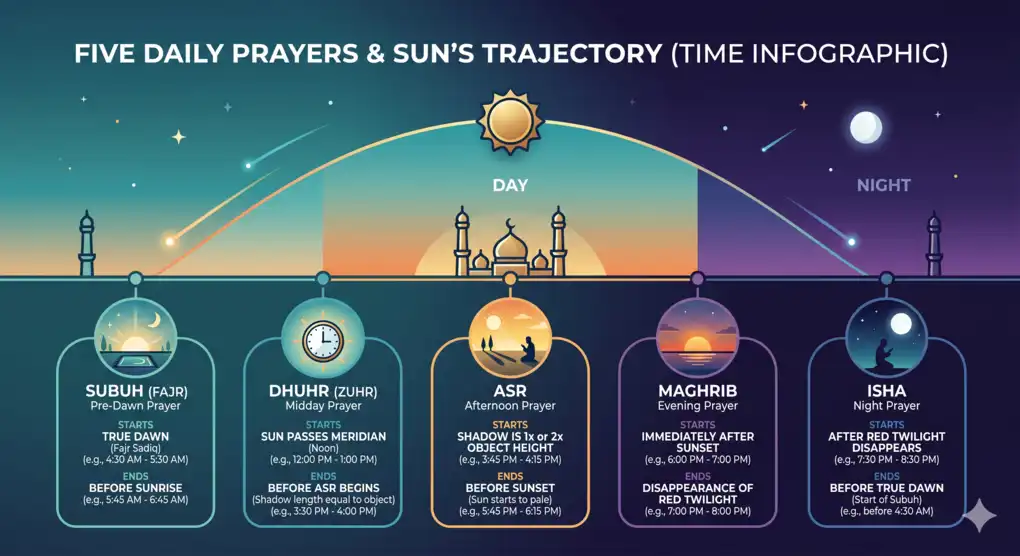
Knowing the time limits is a condition for the validity of prayer. Shariah has set specific durations for each of the five obligatory times.
Dhuhr Prayer Time
Dhuhr time begins when the sun starts to decline toward the west. The preferred time (ikhtiyar) ends when the shadow of an object is equal to the object’s height.
وأول وقت الظهر زوال الظل… وسائر وقته اختيار إلى أن يصير ظل الشيء مثله غير ظل الاستواء
“The start of Dhuhr time is the sun’s decline (zawal)… and the rest of its time is the preferred time until the shadow of an object becomes like it, excluding the shadow of the zenith (istiwa’).” [9]
Asr Prayer Time
Asr time begins immediately after Dhuhr time ends. This time extends until the sun sets on the western horizon.
ثم يدخل العصر لا بحدوث زيادة… ويمتد إلى الغروب… والاختيار منه إلى مصير الظل مثليه
“Then Asr enters without needing an increase (in shadow)… and it extends to sunset… and the preferred time is until the shadow becomes twice its size.” [10]
Maghrib Prayer Time
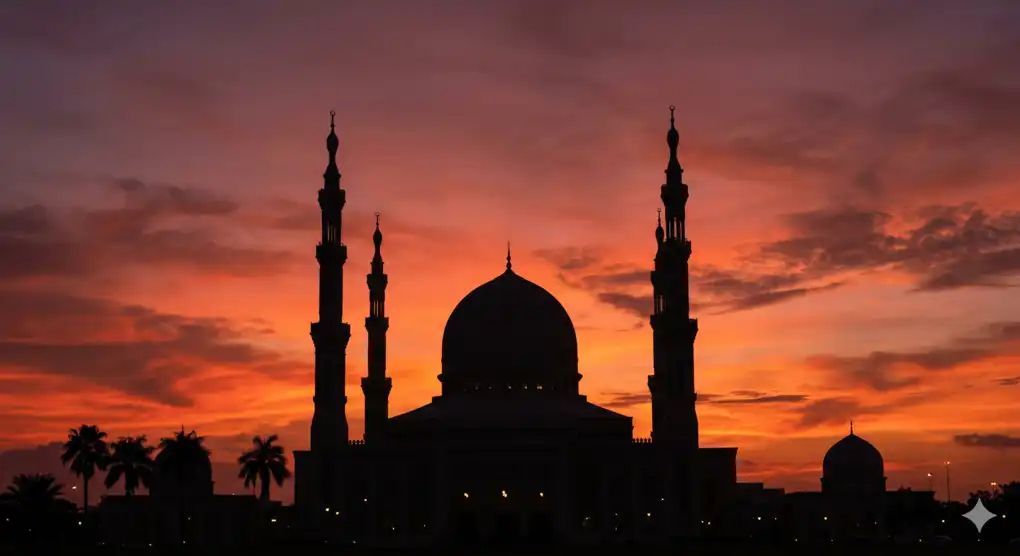
The start of Maghrib is marked by the complete setting of the sun’s disc. In the strong opinion (Qawl Jadid) of the Shafi’i Madhhab, this time lasts until the red glow in the sky disappears.
والمغرب بسقوط قرص الشمس… والقديم وهو المختار… امتداده إلى مغيب الشفق الأحمر
“Maghrib begins with the setting of the sun’s disc… and the ‘Old View’ which is the chosen one (mukhtar)… is that its duration extends until the disappearance of the red glow (syafaq).” [11]
Isha Prayer Time
Isha time begins exactly after the red glow in the western sky vanishes. The deadline for performing it extends until the true dawn (fajar shadiq) rises in the eastern horizon.
قوله: (أول) وقت (العشاء ومن لا عشاء لهم) … والاختيار إلى ثلث الليل والجواز إلى الفجر الصادق
“The start of Isha (is the disappearance of the red glow)… and the preferred time is until a third of the night, while the permissible time (jawaz) is until the true dawn.” [12]
Subuh Prayer Time
The appearance of the true dawn that spreads across the horizon marks the start of Subuh. This time ends when the sun begins to show its light.
وهو أي الفجر الصادق أول وقت الصبح… والاختيار إلى الأسفار
“It—meaning the true dawn—is the start of Subuh time… and the preferred time is until isfar (the sky becomes bright).” [13]
Types of Times in Salah: Fadhilah, Ikhtiyar, Jawaz, and Dharurah
In Shafi’i jurisprudence, the duration of prayer is further divided into several legal categories.
Fadhilah Time (Most Excellent)
The Fadhilah time is the most virtuous time to worship. It is at the very beginning of the time, once the Adhan is called and a person has prepared themselves.
وللظهر ثلاثة أوقات وقت فضيلة أوله
“Dhuhr has three times: the time of fadhilah is at its beginning.” [14]
Ikhtiyar Time (Preferred)
This is the range of time where it is still highly recommended to perform the prayer. For example, in Asr, the Ikhtiyar time lasts until the object’s shadow is twice its length.
Jawaz Time without Makruh (Permissible)
The Jawaz (permissible) time is the remaining duration before entering the disliked (makruh) time. At this stage, the prayer is legally valid and not considered disliked at all.
Jawaz Time with Makruh (Karhah Time)
There are specific limits where delaying worship is disliked. An example is when the sunlight begins to turn yellow (isfirar) before sunset for Asr, or when the horizon starts to turn red before sunrise for Subuh.
ثم الكراهة وهي وقت الاصفرار منهما
“Then the disliked time (makruh), which is the time of yellowing for both (Subuh and Asr).” [15]
Dharurah Time (Emergency/Necessity)
The Dharurah time is intended for those whose obstacles suddenly disappear (zawa’il mawani’). For example, a woman who becomes pure from menstruation at the end of a prayer time is obligated to perform that prayer.
وإذا زالت الأعذار المانعة… وقد بقي من الوقت قدر تكبيرة فأكثر لزمت الصلاة
“And when the preventing excuses are removed… and there remains of the time the extent of one Takbir or more, the prayer becomes obligatory.” [16]
Ruling on Hastening Prayer at the Start of Time
Islam highly honors those who safeguard the timing of their worship. Promptly responding to Allah’s call is a sign of strong faith.
The Virtue of Hastening Prayer (Ta’jil)
Fulfilling the obligation at the start of the time is the deed most beloved to Allah. Scholars agree that delaying without a valid excuse is highly discouraged.
وتعجيلها أي الصلاة أول الوقت (أفضل ولو عشاء) لقوله تعالى {حافظوا على الصلوات} [البقرة: ٢٣٨]
“And hastening it is better, even for Isha, due to Allah’s word: {Guard the prayers}.” [17]
Exceptions: When is Delaying Prayer Recommended?
There are specific conditions where delaying worship is actually sunnah. Among them is the Ibrad method (waiting for the heat to cool) for Dhuhr prayer in very hot regions for those walking to the mosque.
قوله: (ويستحب في شدة حر بقطر حار إبراد بظهر) أي تأخيره (لجماعة تقصد) المسجد أو نحوه
“It is recommended in severe heat in hot regions to perform ibrad (delaying Dhuhr until it cools) for a group heading to the mosque.” [18]
Ruling on Delaying Prayer Until the Time Ends
Intentionally delaying worship until the time expires is a major sin. However, if a person manages to complete one full unit (raka’at) before the time ends, the prayer is legally counted as Ada’ (on time).
وبإخراج بعضها عن الوقت يأثم… لا إن اتسع فطولها… وأتى بركعة فيه
“By taking part of it out of the time, one sins… but not if the time was wide and he lengthened it… and performed one raka’at within it.” [19]
Prohibited Times for Prayer
Not every moment of the day is free for performing voluntary (sunnah) prayers. Shariah has established prohibitions at specific moments to avoid resembling (tasyabbuh) sun worshippers.
Three Forbidden Times (Makruh Tahrim)
There are three specific points in time where it is strictly forbidden (makruh tahrim) to perform voluntary prayers.
وتكره تحريما الصلاة في ثلاثة أوقات عند طلوع الشمس حتى ترتفع رمحا وعند استوائها حتى تزول وعند اصفرارها حتى تغرب
“It is strictly disliked (makruh tahrim) to pray at three times: when the sun rises until it is the height of a spear, when the sun is at the zenith (istiwa’) until it declines, and when the sun turns yellow until it sets.” [20]
Two Times Forbidden After Fardhu Prayers
Besides the three times above, there is a prohibition linked directly to a person finishing their own performance of a specific obligatory prayer.
وبعد فعلين بعد صلاة العصر… وبعد صلاة الصبح
“And after two actions: after Asr prayer… and after Subuh prayer.” [21]
Exceptions to Prohibited Times
The prohibitions mentioned above have strong exceptions. These apply to certain locations, specific days, and types of worship that have a “preceding cause” (mutaqaddim).
قوله: (ولا تكره) الصلاة (في شيء من ذلك) أي من الأوقات الخمسة (بمكة وسائر الحرم)… ولا عند الاستواء يوم الجمعة… ولا ما لها سبب متقدم أو مقارن كالجنازة والمنذورة
“Prayer is not disliked at any of these times in Makkah and all of the Haram… nor at the zenith (istiwa’) on Friday… nor for that which has a preceding or accompanying cause, such as funeral prayer and vowed prayer.” [22]
Idrak — Provisions for Catching the Prayer Time

The term Idrak refers to situations where a person encounters part of the prayer time, either at the beginning or the end. This often happens to women who just became pure from menstruation.
Minimum Idrak to Obligate Prayer
A person is considered obligated to perform a prayer if they find a remaining time that is only enough to say the opening Takbir before the time ends. If they complete one raka’at before the Adhan of the next prayer, the entire worship is counted as Ada’ (on time).
قوله: (ولو أدرك في الوقت ركعة لا دونها فالكل أداء) لخبر الصحيحين «من أدرك ركعة من الصلاة فقد أدرك الصلاة» أي مؤداة
“If he catches one raka’at within the time, not less, then all of it is on time (Ada’).” [23]
Catching Two Prayers Simultaneously
This condition occurs if a legal obstacle (like menstruation) disappears during Asr time. If the remaining time is sufficient to perform ritual purity and pray both Dhuhr and Asr, then it is obligatory to perform both because their times can be combined (jamak).
مع التي قبلها إن صلحتا لجمع بشرط أن يخلو من الموانع قدرا يسع الطهارة وقضاء ما لزمه
“Along with the one before it if they can be combined, provided the obstacles are removed for a duration that accommodates purification and making up what is due.” [24]
Ijtihad in Determining Prayer Times During Cloudy Weather
Sometimes nature is not friendly, so the sun or dawn is not visible due to thick clouds. Here, Shariah provides guidance for Ijtihad (legal reasoning).
Permissibility of Ijtihad
A healthy-sighted Muslim is obligated to look for signs of the prayer time if the weather is cloudy. They can use verified habits or signs.
وللبصير والأعمى وإن قدرا على اليقين بالصبر الاجتهاد للوقت في الغيم بمغلب ظنا كالأوراد وصوت الديك المجرب
“For the sighted and the blind, even if they can wait for certainty, it is permissible to perform ijtihad for the time during cloudiness using what strengthens the assumption, like regular litanies (wirid) or the sound of a tested rooster.” [25]
Rulings on Following (Taqlid) for Prayer Times
For those unable to perform Ijtihad, such as the general public or the blind, they are allowed to follow (taqlid) the Adhan from a trustworthy caller (muazin) who understands the science of timing.
وأذان العدل العارف بالمواقيت كالإخبار عن علم
“The Adhan of an upright person who knows the times is like reporting based on certain knowledge.” [26]
Conclusion and Practical Guidance

As a Muslim, maintaining the obligatory five daily prayers by fulfilling all conditions and provisions is absolute. This duty requires high discipline regarding its timing.
Ensure you know the start and end limits of each prayer time. For those wishing to deepen other aspects, always ensure your ritual purity is complete. Always pay attention to when the prohibited prayer times apply so your voluntary deeds are accepted optimally.
FAQ: Questions About Obligatory Prayer Times and Conditions
When does Subuh prayer time end according to the Shafi’i Madhhab?
Subuh prayer time ends absolutely when the sun rises (syuruq). It is highly recommended to perform it immediately after the true dawn rises, before the sky becomes too bright (isfar).
Is the prayer of someone who slept until the time ended valid?
The prayer is still valid but has the status of Qadha (makeup). A person who truly slept without intention is not sinning, but they are obligated to perform that prayer immediately upon waking up.
Is it permissible to perform voluntary prayers after Asr?
In general, voluntary prayers are Makruh Tahrim (strictly disliked) after performing Asr prayer until the sun sets. Exceptions are made for prayers that have a specific preceding cause, such as funeral prayers or Tahiyyatul Masjid.
If a woman becomes pure from menstruation at the end of Asr time, which prayers must she perform?
If the remaining Asr time is enough to say at least the opening Takbir before sunset, she must perform a ritual bath and then make up both Dhuhr and Asr prayers, as their times can be combined.
Is a child who has not reached puberty obligated to perform prayer?
A child is not legally obligated to perform prayer. However, parents are obligated to command their child to pray when they are 7 years old and may discipline them (with a non-painful, educational strike) if they leave it at age 10.
Footnotes:
Reference
Zakariyā al-Anṣārī, Asnā al-Maṭālib fī Sharḥ Rawḍ al-Ṭālib, with ḥāsyiyah by Aḥmad al-Ramlī, edited by Muḥammad az-Zuhrī al-Ghamrāwī (Cairo: al-Maṭbaʿah al-Maymānīyah, 1313 H; repr. Dār al-Kitāb al-Islāmī), vol. 1, p. 115-124.


