
Short Answer
A carcass (maytah) is impure. The exceptions are the carcass of fish, locusts, humans, game that died before it could be slaughtered, and the fetus of a slaughtered animal.
That is the ruling on carcass in Islam according to the Shafi’i school. Every exception is pure. Everything else stays impure, including a dead chicken, goat, or any small animal whose blood does not flow. The levels of impurity are covered in the article on types of impurity.
What Is a Carcass (Maytah)?
In fiqh, a carcass is not simply an animal that died. Al-Iqna’ requires that the death came without a valid Shariah slaughter:
«قوله: (وَالْميتَة) وَهِي مَا زَالَت حَيَاتهَا لَا بِذَكَاة شَرْعِيَّة كذبيحة الْمَجُوسِيّ وَالْمحرم بِضَم الْمِيم وَمَا ذبح بالعظم وَغير الْمَأْكُول إِذا ذبح»
Meaning: “A carcass is an animal whose life ended other than by a valid slaughter, such as the slaughter of a Magian, the slaughter of a person in ihram, an animal slaughtered with a bone, and an animal that is not lawful to eat even if slaughtered.”[1]
So a goat slaughtered correctly is pure. A goat that died on its own, or was slaughtered by a Magian, is a carcass.
Evidence That a Carcass Is Impure
Asna al-Mathalib lists the carcass among impurities, even when its blood does not flow:
«قوله: (و) لا (ميتة) ، وإن لم يسل دمها لحرمة تناولها قال تعالى {حرمت عليكم الميتة} [المائدة: 3] ، وتحريم ما ليس بمحترم، ولا بمستقذر، ولا ضرر فيه يدل على نجاسته، والميتة مازال حياته لا بذكاة شرعية»
Meaning: “(And not pure) is a carcass, even if its blood does not flow, because it is forbidden to consume. Allah says: ‘Forbidden to you is the carcass’ (al-Ma’idah: 3). That something is forbidden when it is neither honored, nor disgusting, nor harmful indicates that it is impure.”[2]
The reasoning is simple. If a thing is forbidden to eat, and not because it is honored, repulsive, or harmful, then the reason is impurity. Fath al-Qarib puts it briefly:
«(والميتة كلها نجسة إلا السمك والجراد والآدمي).»
Meaning: “Every carcass is impure, except fish, locusts, and humans.”[3]
The Pure Exceptions
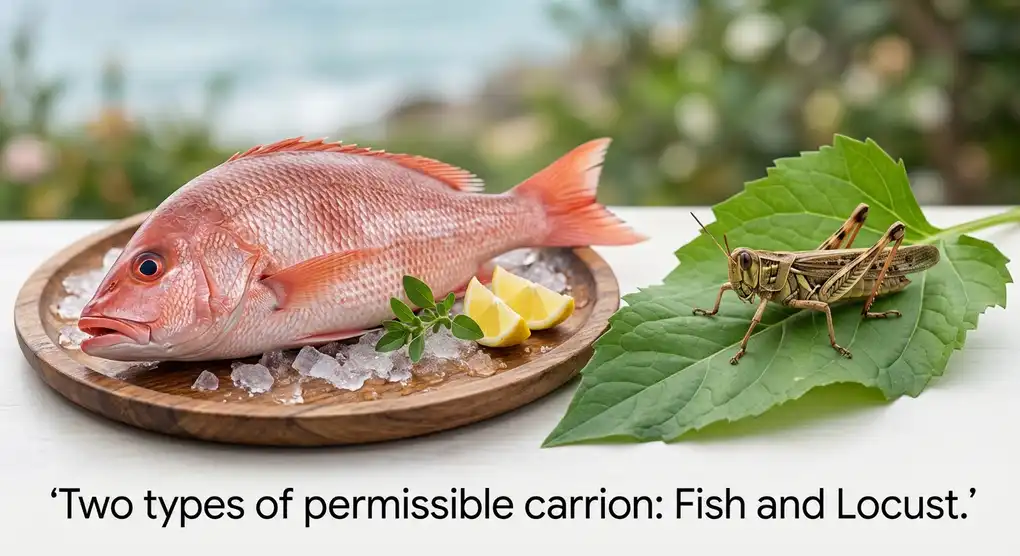
Asna gives the full list in one sentence:
«قوله: (غير) ميتة (آدمي، وسمك، وجراد، وصيد لم تدرك ذكاته) ، وإن مات بالضغطة (وجنين مذكاة)»
Meaning: “Except the carcass of a human, fish, locusts, game that could not be slaughtered (even if it died by pressure), and the fetus of a slaughtered animal.”[2]
1. Carcass of Fish and Locusts
Al-Iqna’ says both are pure by consensus, then cites the hadith:
«(إِلَّا) ميتَة (السّمك و) ميتَة (الْجَرَاد) فطاهرتان بِالْإِجْمَاع وَلقَوْله صلى الله عليه وسلم أحلّت لنا ميتَتَانِ وَدَمَانِ السّمك وَالْجَرَاد والكبد وَالطحَال»
Meaning: “Except the carcass of fish and locusts, both are pure by consensus, and because of the words of the Prophet ﷺ: ‘Two carcasses and two bloods have been made lawful for us: fish and locusts, the liver and the spleen.'”[4]
For the sea there is another hadith: «هُوَ الطّهُور مَاؤُهُ الْحل ميتَته», “Its water is purifying and its dead are lawful.”[4]
“Fish” here means every sea animal that may be eaten, even if it is not called a fish.[4] So a fish carcass is pure, and so is a locust carcass, even when the fish is floating in a pond. Pure does not mean fit to eat, though: a rotten, harmful fish still must not be eaten.
2. Human Carcass
A human corpse is pure, Muslim or not. A Muslim body being washed does not make the washer impure:
«قوله: (و) إِلَّا ميتَة (الْآدَمِيّ) فَإِنَّهَا طَاهِرَة لقَوْله تَعَالَى {وَلَقَد كرمنا بني آدم} وَقَضِيَّة التكريم أَنه لَا يحكم بِنَجَاسَتِهِ بِالْمَوْتِ وَسَوَاء الْمُسلم وَغَيره»
Meaning: “Except the carcass of a human, for it is pure, because Allah says: ‘We have honored the children of Adam’ (al-Isra’: 70). Honoring them means they are not judged impure by death, whether Muslim or otherwise.”[5]
On the verse «إِنَّمَا الْمُشْركُونَ نجس», al-Iqna’ explains that it means impurity of belief, not impurity of the body.[5]
3. Game and the Fetus of a Slaughtered Animal
These two are not really carcasses, because the Shariah treats their state as slaughter:
«لحل تناولها في غير الآدمي على أن الأخيرين ليسا ميتة بل جعل الشارع هذا ذكاتهما، ولهذا صرح في خبر الجنين بأنه مذكى، وإن لم تباشره السكين»
Meaning: “Because it is lawful to consume, other than a human. The last two (game and fetus) are not carcasses; the Lawgiver made this their slaughter. That is why the hadith of the fetus states that it is mudzakka (slaughtered), even if the knife did not touch it.”[2]
Al-Iqna’ adds that the slaughter of the mother counts as the slaughter of the fetus.[1]
Hair, Bones, and Other Parts
The whole carcass is impure, including parts that look hard and lifeless:
«قوله: (و) لا (شعرها) ، وعظمها لأن كلا منهما تحله الحياة لأنه ينمو، والعظم يحس، ويألم، وفي معناه الصوف، والوبر، والريش»
Meaning: “(And not pure) are its hair and bones, because life reaches each of them: hair grows, and bone feels and hurts. Wool, camel hair, and feathers are the same.”[2]
So the bones and raw hide of a dead chicken are impure. A carcass hide can become pure through tanning, which is discussed in the article on dabbagh: tanning carcass hides.
Dead Animals Without Flowing Blood
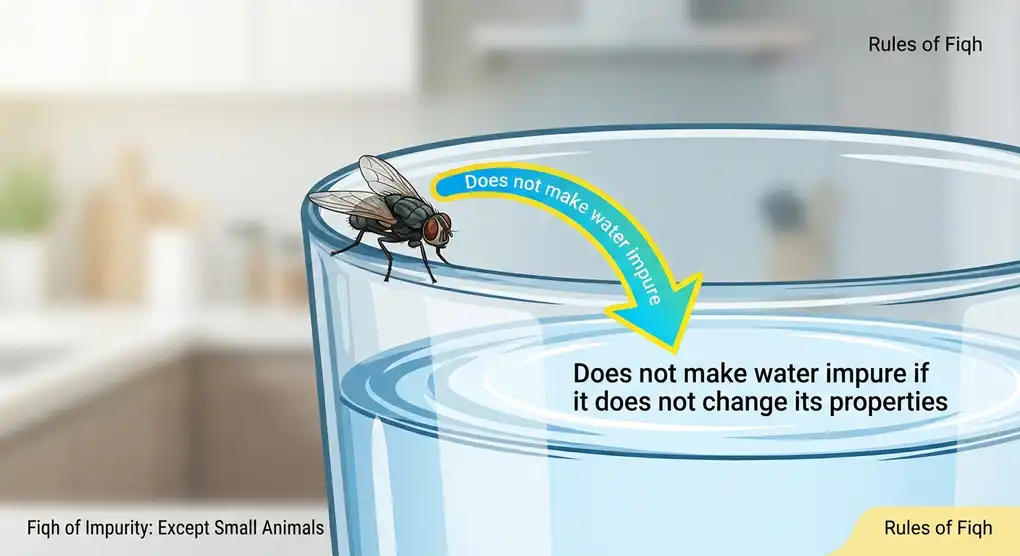
Flies, ants, beetles and the like are impure carcasses too, but with a concession. Asna says that water or another liquid does not become impure from the carcass of an animal with no flowing blood, such as a wasp, scorpion, gecko, or fly:
«قوله: (، ولا ينجس ماء و) لا (مائع) غيره (بميتة لا نفس لها سائلة)… (كزنبور) بضم أوله (وعقرب) ، ووزغ، وذباب، ونحل، وقمل، وبرغوث»
Meaning: “Water and other liquids do not become impure by a carcass without flowing blood, such as a wasp, scorpion, gecko, fly, bee, louse, and flea.”[6]
The evidence is the hadith in al-Bukhari about a fly falling into a drink. Fath al-Qarib adds two limits: if such carcasses are many and change the liquid, it becomes impure. If the creature grew inside the liquid itself, like worms in vinegar, it does not make it impure.[3]
A carcass with flowing blood, such as a snake, mouse, turtle, or frog, does make the liquid impure.[6] See the full discussion in the article on small animals without flowing blood.
Quick Reference
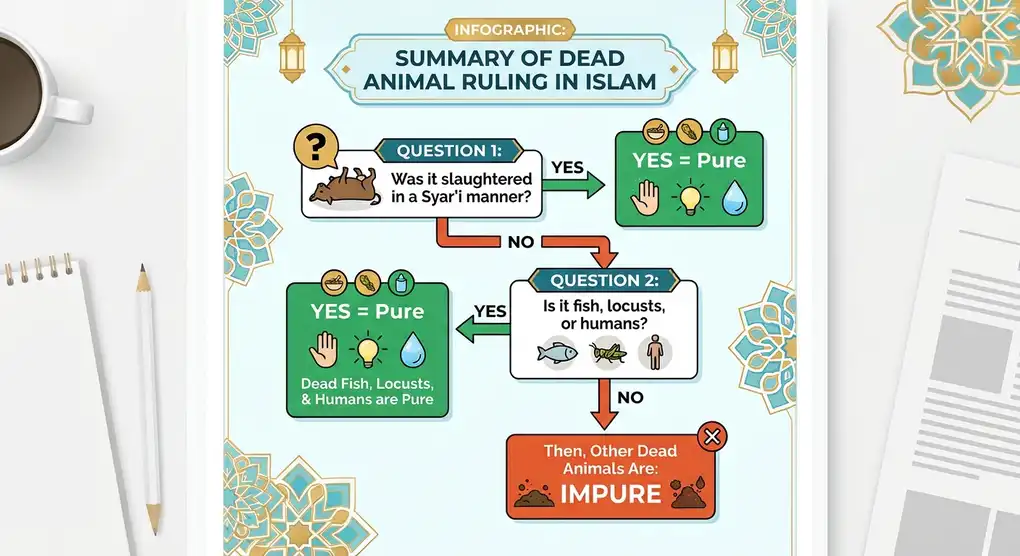
- Impure: the carcass of a goat, cow, chicken, cat, mouse, snake, and other land animals, with their bones and hair.
- Pure: the carcass of fish, locusts, humans, game that died before slaughter, and the fetus of a slaughtered animal.
- Concession: the carcass of an animal without flowing blood does not make water impure unless it changes it.
FAQ on the Ruling on Carcass
Is a carcass impure?
Is a fish or locust carcass pure?
Yes, both are pure by consensus.
The evidence: “Two carcasses have been made lawful for us: fish and locusts.”[4]
Is a human corpse impure?
No. A human corpse is pure, Muslim or not, because Allah honored the children of Adam.[5]
Are the bones and hair of a carcass impure?
Yes. Life reaches them, so they are impure, except in the exempted animals above.[2]
Footnotes
1 : Muhammad al-Syirbini al-Khathib, al-Iqna’, vol. 1, p. 92. ↩
2 : Zakariyya al-Anshari, Asna al-Mathalib, vol. 1, p. 10. ↩
3 : Ibn Qasim al-Ghazzi, Fath al-Qarib al-Mujib, p. 58. ↩
4 : Muhammad al-Syirbini al-Khathib, al-Iqna’, vol. 1, p. 92. ↩
5 : Muhammad al-Syirbini al-Khathib, al-Iqna’, vol. 1, p. 92. ↩
6 : Zakariyya al-Anshari, Asna al-Mathalib, vol. 1, p. 10. ↩
- Zakariyā al-Anṣārī, Asnā al-Maṭālib fī Sharḥ Rawḍ al-Ṭālib, with a ḥāshiyah by Aḥmad al-Ramlī, edited by Muḥammad az-Zuhrī al-Ghamrāwī (Cairo: al-Maṭbaʿah al-Maymānīyah, 1313 AH; repr. Dār al-Kitāb al-Islāmī), vol. 1, p. 10.
- Syamsuddin Muḥammad ibn Aḥmad al-Khaṭīb al-Syirbīnī, Al-Iqnā‘ fī Ḥall Alfāẓ Abī Syujā‘, edited by Maktab al-Buḥūts wa al-Dirāsāt (Beirut: Dār al-Fikr, n.d.), vol. 1, p. 92.
- Muḥammad bin Qāsim al-Ghazzī, Fatḥ al-Qarīb al-Mujīb fī Syarḥ Alfāẓ al-Taqrīb, ed. Bassām ʿAbd al-Wahhāb al-Jābī (Beirut: Dār Ibn Ḥazm, 1425 AH/2005 CE), vol. 1, p. 58


