
Blood on the body, clothing, prayer garments, bedding, or a mattress can raise three different questions: is blood impure, is it excused, and does it invalidate wudu?
These questions must not be merged. Blood may be legally impure, while a small trace can still be excused in prayer. Likewise, contact with blood does not automatically invalidate wudu.
This article follows Shafi‘i fiqh. It deals with purification and prayer, not with medical diagnosis for wounds, bleeding, or health conditions.
The Prophet Muhammad ﷺ said:
«الطُّهُورُ شَطْرُ الإِيمَانِ»
Meaning: “Purification is half of faith.”[1]
Is Blood Impure in Islam? The Basic Rule in Shafi‘i Fiqh
What Is Najis, and Why Is Blood Discussed in Purification?
In fiqh, najis is not simply whatever people find dirty. It is a substance with a legal effect on purification, so it must be removed from the body, clothing, and prayer place when no exemption applies.
Ibn Qasim al-Ghazzi writes:
«وَشَرْعًا كُلُّ عَيْنٍ حَرُمَ تَنَاوُلُهَا عَلَى الْإِطْلَاقِ»
Meaning: “In Sacred Law, [an impurity is] every substance whose consumption is absolutely prohibited.”[2]
Blood is discussed in the chapters of purification because prayer requires freedom from legally relevant impurity. The question “is blood impure?” therefore includes the method of removing a stain and the limits of legal concession in prayer.
Zakariyya al-Ansari states:
«الْمُسْتَحِيلُ فِي الْبَاطِنِ نَجِسٌ كَدَمٍ»
Meaning: “What changes within the body is impure, such as blood.”[3]
He also includes:
«وَقَيْحٍ، وَمَاءِ قَرْحٍ تَغَيَّرَ»
Meaning: “Pus and altered fluid from a wound.”[3]
Thus, the basic Shafi‘i ruling is that human blood is impure. Blood, pus, and altered wound fluid are treated under the rules of impurity, subject to the exemptions explained below.
Three Terms That Must Be Kept Separate
Blood that is impure
As a starting rule, blood that leaves the body is impure. Blood found on the body or clothing should therefore be considered before prayer.
That basic rule does not mean that every tiny speck necessarily invalidates a prayer. Fiqh distinguishes between small traces, blood from a difficult wound, and blood from tiny insects.
Excused blood, or najis ma‘fu
Najasah ma‘fu ‘anha is an impurity excused in a defined situation, so that its presence does not prevent a valid prayer. It does not become pure.
For that reason, “excused” does not mean “clean.” When the trace can be washed easily, washing it remains the better course.
A pure object that becomes contaminated
A shirt, trousers, prayer garment, prayer mat, mattress, and skin are pure in origin. When blood transfers to them, they become mutanajjis: pure objects contaminated by impurity.
This distinction matters when cleaning a stain. The aim is to remove the blood from the affected area, rather than treating the entire item as unusable when that is unnecessary.
The difference between impurity and invalidating wudu
Impurity concerns the cleanliness of the body, clothing, or prayer place. What invalidates wudu concerns hadath, a state that prevents certain worship until wudu is renewed.
Zakariyya al-Ansari identifies the first nullifier of wudu:
«الْأَوَّلُ الْخَارِجُ مِنْ أَحَدِ السَّبِيلَيْنِ»
Meaning: “The first is something that exits from one of the two private passages.”[4]
Blood from a hand wound, the nose, a pimple, or the gums does not exit through the front or rear private passage. It therefore does not invalidate wudu in the Shafi‘i school, though its impurity must still be considered.
Evidence and Legal Basis for the Ruling on Blood


The discussion of blood rests on Qur’anic evidence, Prophetic reports, and the explanations of jurists. Zakariyya al-Ansari connects the rule to the prohibition of blood and to this Prophetic instruction:
«فَاغْسِلِي عَنْكِ الدَّمَ، وَصَلِّي»
Meaning: “Wash the blood from yourself, then pray.”[3]
This report directly joins blood stains to the condition of purity for prayer. Classical fiqh texts also provide relief when a trace is extremely small or genuinely difficult to avoid.
This article addresses purification only. Persistent, heavy, or medically concerning bleeding should be assessed by an appropriate healthcare professional.
Types of Blood Covered Here
The sections below address:
- Wound blood: cuts, abrasions, boils, pimples, scabs, and gum bleeding.
- Mosquito and tiny-insect blood: minute traces on the body or clothing.
- Menstrual blood: stains on the body, clothes, bedding, and mattresses.
- Small or unavoidable traces: the scope of excused impurity.
Wound Blood: Is It Impure, and Can One Pray?
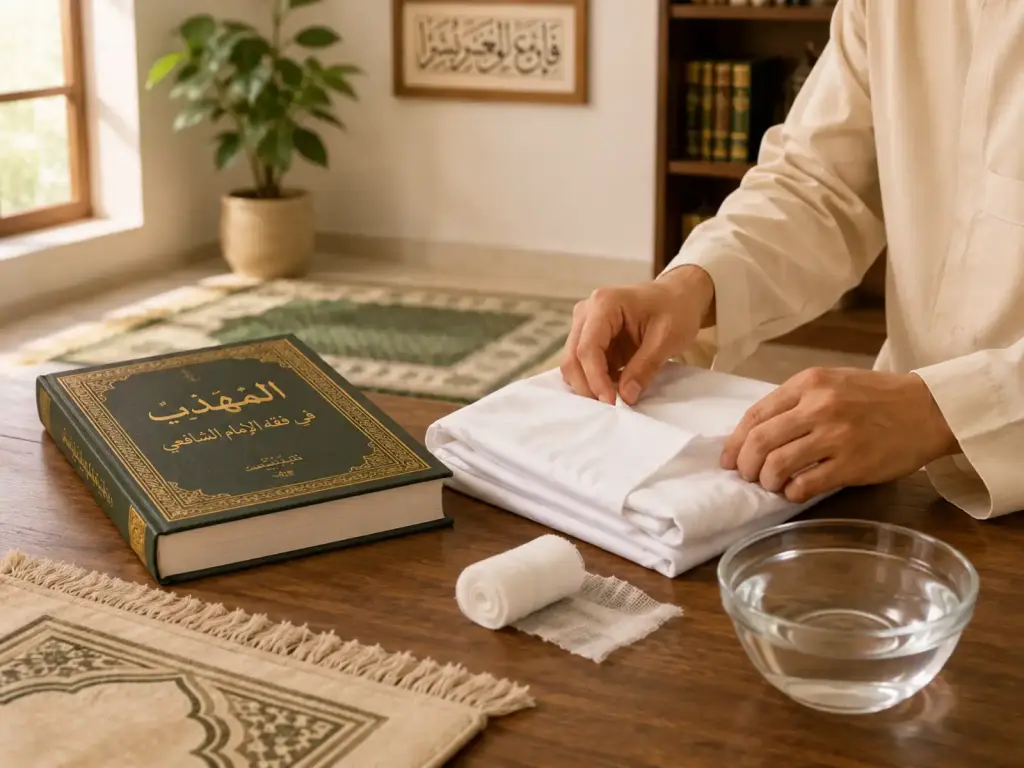
The Basic Ruling on Blood from a Wound
The answer to “is wound blood impure?” is yes, as a starting rule. Blood from a cut, abrasion, boil, pimple, or broken scab follows the general ruling on blood.
Pus and altered wound fluid are also discussed alongside blood in Shafi‘i references.[3] Yet wound blood is not the same as menstrual blood in its consequences for worship.
Wound blood does not place someone in menstruation and does not require a ritual bath. It also does not invalidate wudu when it exits from somewhere other than the front or rear private passage.[4]
Wound Blood on the Body and Clothing During Prayer
Al-Khatib al-Shirbini explains the case of a person’s own blood that has not separated from the wound site:
«فَيُعْفَى عَنْ قَلِيلِهِ وَكَثِيرِهِ»
Meaning: “Its small and large amount is excused.”[7]
This comes after examples such as blood from boils, wounds, bloodletting, and cupping. The concession concerns one’s own blood that remains connected to the wound site and is difficult to avoid.[7]
This concession should not be used to leave a large transferred stain on clothing when it can be washed easily. The actual case matters: the amount, how the blood spread, and whether cleaning it would involve real hardship.
Can Clothing with Wound Blood Still Be Worn for Prayer?
If clothing is stained by wound blood, the clothing has been contaminated by impurity. The validity of prayer then depends on further detail.
Ibn Qasim al-Ghazzi states:
«وَلَا يُعْفَى عَنْ شَيْءٍ مِنَ النَّجَاسَاتِ إِلَّا الْيَسِيرُ مِنَ الدَّمِ وَالْقَيْحِ»
Meaning: “Nothing of impurities is excused except a small amount of blood and pus.”[6]
Use the following practical guide before prayer:
- A small and difficult-to-avoid trace may fall under excused impurity.
- A clear, substantial stain that is easy to wash should be cleaned before prayer.
- Blood from a wound that continues to flow has its own allowance where small transfers are difficult to prevent.
- Blood deliberately smeared on the body or clothing is not treated like accidental wound blood.[7]
A tiny accidental trace is not the same as a large stain. At the same time, the concession should not be stretched to avoid easy cleaning.
Dried Blood, Old Stains, and How to Purify Them
Is dried blood impure? Yes. Drying does not turn impure blood into something pure. A blood stain whose substance remains visible is called najasah ‘ayniyyah.
Ibn Qasim al-Ghazzi explains:
«تَكُونُ بِزَوَالِ عَيْنِهَا»
Meaning: “[Purification] is achieved by removing its substance.”[5]
For blood on clothing or bedding:
- Remove the attached blood with water and ordinary rubbing.
- Run purifying water over the stained area until the substance of the blood is gone.
- Soap may be used to lift the stain, then rinse the area with water.
- If a color or smell remains after reasonable effort and is genuinely difficult to remove, that remainder is excused.[5]
Drying the garment or adding fragrance is not enough. The goal is removal of the blood itself.
Blood from the Gums, Pimples, and Small Wounds
Blood from a pimple, scab, or small abrasion follows the general ruling on blood. Where the trace is very small and hard to prevent, it may fall within the discussion of excused impurity.[6]
Gum bleeding requires added care. Al-Khatib al-Shirbini gives gum blood mixed with something else as a case that should not be treated like blood still attached to a wound site.[7]
When the gums bleed, clean the mouth until visible blood is gone before prayer. Gum blood does not invalidate wudu in the Shafi‘i school, but blood mixed with saliva or water should not be carried deliberately onto clothing or the prayer place.
For related rulings, see impure body fluids.
Mosquito Blood: Is It Impure, and Does It Invalidate Wudu?
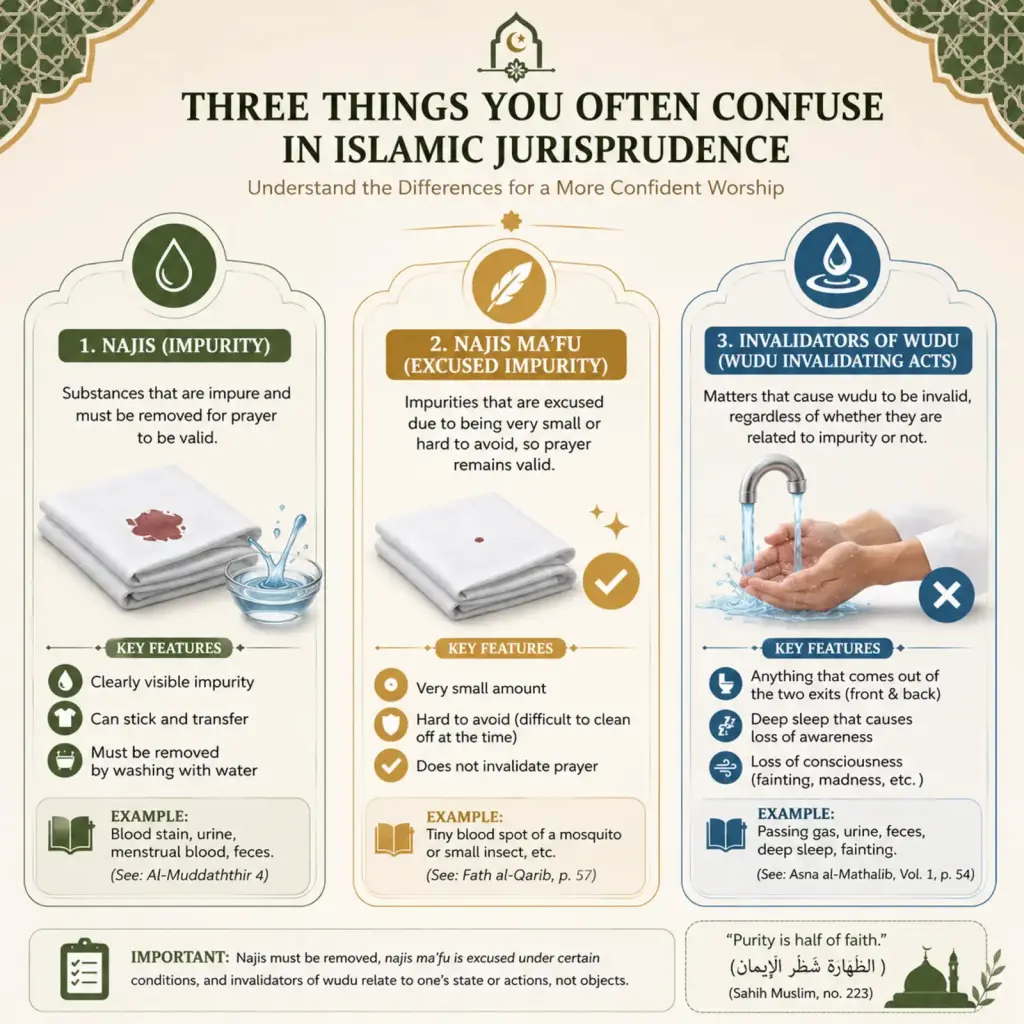
Impurity, excused impurity, and nullifiers of wudu are three different legal categories in fiqh. Blood may be impure, may be excused in limited cases, but does not automatically invalidate wudu.Why Mosquito Blood Is a Distinct Question
A person may swat a mosquito and find a tiny red mark on a hand, shirt, or prayer garment. Such marks are often extremely small and unintentional.
This case should not simply be treated as identical to a large human wound stain. Classical texts separately discuss blood from fleas, lice, bedbugs, and tiny insects that are difficult to avoid.
The Textual Basis for Tiny-Insect Blood
Al-Khatib al-Shirbini writes:
«وَيُعْفَى عَنْ دَمِ الْبَرَاغِيثِ وَالْقَمْلِ وَالْبَقِّ وَوَنِيمِ الذُّبَابِ»
Meaning: “The blood of fleas, lice, bedbugs, and fly specks is excused.”[7]
He gives the reason that such matters are widespread and difficult to avoid. He also explains that flea blood and similar traces can be drops of human blood that the insects have drawn.[7]
The texts also state that the corpse of a small creature without flowing blood, such as a fly or an ant, does not contaminate a liquid when it falls in and dies there, as long as it does not change the liquid.[8] The rule on an insect corpse in liquid is distinct from the rule on an insect-blood mark on clothing.
Is Mosquito Blood Impure, Pure, or Excused?
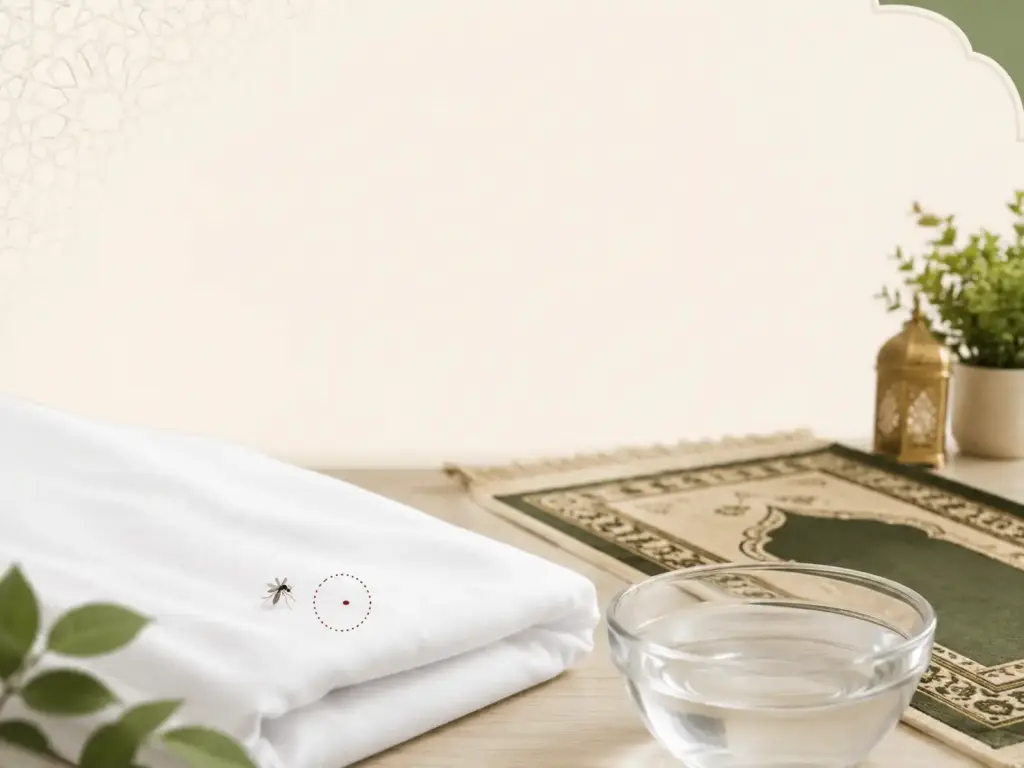
The cited text explicitly names fleas, lice, bedbugs, and fly specks; it does not literally name mosquitoes.[7] Applying the rule to an extremely small mosquito-blood mark should therefore be described as a careful application of the legal principle, not as a claim that the text uses the word “mosquito.”
When the trace is tiny, accidental, and hard to avoid, it may be treated within the allowance for small-insect blood. In that limited situation, it is excused in prayer.
That concession does not declare all mosquito blood absolutely pure. When the mark can be washed easily, washing it remains better.
Does Killing a Mosquito Invalidate Wudu?
Does killing a mosquito invalidate wudu? No. Swatting a mosquito is not a nullifier of wudu.
Does mosquito blood invalidate wudu? No. Wudu is invalidated by the recognized causes, and blood exiting from somewhere other than the front or rear private passage is not one of them in the Shafi‘i school.[4]
Before prayer after swatting a mosquito:
- Wash the visible mark if it is easy to do so.
- If only a tiny, hard-to-avoid trace remains, apply the concession in its proper limits.
- There is no need to renew wudu simply for swatting a mosquito or touching its blood mark.
Menstrual Blood: What Kind of Impurity Is It, and How Is It Removed?
The Place of Menstrual Blood in Purification
Menstrual blood is impure. In addition, menstruation has a separate consequence: a menstruating woman does not perform prayer until the bleeding ends and the required ritual bath is completed.
In the hadith concerning Fatimah bint Abi Hubaysh, the Prophet Muhammad ﷺ said:
«إِذَا أَقْبَلَتِ الْحَيْضَةُ فَدَعِي الصَّلَاةَ»
Meaning: “When menstruation comes, leave the prayer.”[9]
He also said:
«فَاغْسِلِي عَنْكِ الدَّمَ وَصَلِّي»
Meaning: “Wash the blood from yourself, then pray.”[9]
Menstrual blood differs from wound blood not because one is impure and the other is not. The difference is that menstruation involves major ritual impurity and the duty of ghusl after it ends.
Menstrual Blood on Clothes, Sheets, and Mattresses
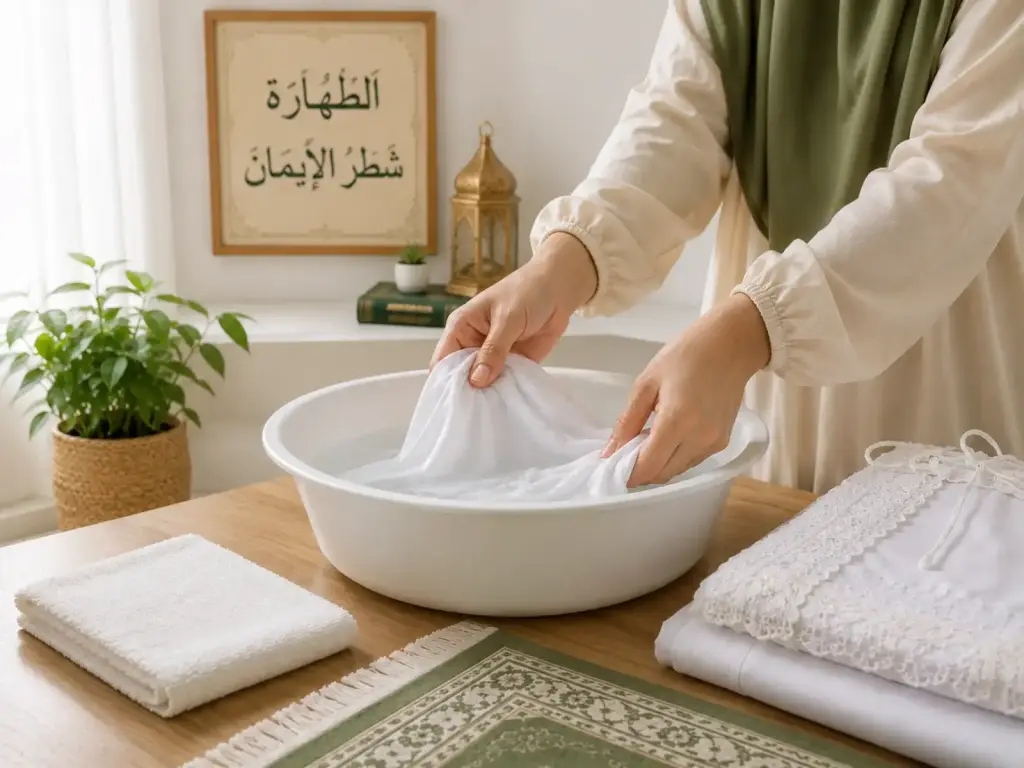
A menstrual-blood stain on clothing, a prayer garment, sheets, or a mattress must be purified before the item is used for prayer. When the stain is still wet, removing the substance of the blood is usually easier.
Dried menstrual blood on a mattress remains impure. The entire mattress does not need washing; clean the affected spot.
For a mattress stain:
- Remove the substance of the blood from the affected area.
- Pour or run water on that spot until the blood substance is gone.
- Absorb the water with a clean cloth or a suitable absorbent material.
- Repeat as needed without spreading water to unaffected areas.
For clothes and sheets, wash the stained section until the blood substance is removed. The fabric may then be used for prayer.
The Standard of Purity After Cleaning Menstrual Blood
For a visible impurity, the central requirement is removal of the substance itself. One should also seek to remove color, smell, and taste as far as reasonably possible.[5]
If a color or odor remains after reasonable effort and is truly difficult to remove, it is excused. But when the substance of the blood remains visibly present or transferable, cleaning should continue.[5]
An old stain does not become pure merely because it has dried or faded.
Menstruation, Postpartum Bleeding, and Istihadah
Not every discharge of blood from the vagina is menstruation. There is postpartum bleeding after childbirth, and there is istihadah, which has its own rules for purification and prayer.
The Prophet ﷺ said about istihadah:
«لَا، إِنَّمَا ذَلِكِ عِرْقٌ وَلَيْسَتْ بِالْحَيْضَةِ»
Meaning: “No, it is only bleeding from a vein and is not menstruation.”[9]
This article does not set out the durations, colors, or signs of menstruation. For that related subject, see menstruation rulings.
Excused Impurity in Prayer: How Much Blood Is Tolerated?
What Is Najis Ma‘fu?
Najasah ma‘fu is an impurity excused by Sacred Law in a defined circumstance. It remains impure, but its presence does not prevent a valid prayer within the stated limits.
This concession exists so that people facing minute traces or genuine difficulty are not put into undue hardship. It is not permission to postpone cleaning without reason.
Read the related discussion on excused impurities.
What Counts as a “Small” Amount of Blood or Pus?
The texts describe a “small” amount of blood and pus, but do not give one numerical size for every case.[6] One should not create a fixed measurement and apply it mechanically in all situations.
The assessment returns to ordinary judgment, the appearance of the stain, and the condition of the person affected. A pinprick-sized trace is not the same as a clearly visible stain that is easy to wash.
When uncertain, choose the cleaner option when water and a change of clothing are available. This protects the prayer without turning the subject into excessive doubt.
Blood Excused Because It Is Difficult to Avoid
The allowance often applies to situations such as:
- a small trace from a cut, pimple, scab, or abrasion;
- blood still connected to a wound site;
- blood from boils, wounds, bloodletting, or cupping that is difficult to contain;
- an extremely small trace from a tiny insect;
- a stain that happens unintentionally and is hard to avoid.[6][7]
In the case of one’s own blood that has not separated from a wound, al-Khatib al-Shirbini describes a broader concession.[7] That detail should not be extended carelessly to every kind of blood stain on clothing.
Blood That Must Not Be Treated Lightly
Do not use the idea of excused impurity for:
- a large blood stain that is easy to wash;
- blood deliberately left on the body or clothing;
- blood intentionally smeared on the body or clothing;
- dog, pig, or crossbred impurity, which has separate rules.[7]
Al-Khatib al-Shirbini states that foreign blood intentionally smeared is not excused.[7] The allowance depends on a real circumstance, not on treating purity casually.
A Pre-Prayer Checklist for Blood Stains
- Is the blood still visible? If the substance remains visible, remove it when able.
- Can it be washed now? If so, wash it before prayer.
- Is it from a wound that keeps bleeding? Consider the specific allowance for a difficult wound.
- Is the amount small by ordinary judgment? Do not invent an artificial measurement.
- Could the stain spread? Cover the wound or change clothing when that is easier.
Frequently Asked Questions About Blood in Islam
Is all blood impure in the Shafi‘i school?
Can clothing stained with wound blood be worn for prayer?
Is mosquito blood or tiny-insect blood excused?
The texts expressly discuss fleas, lice, bedbugs, and fly specks. A minute mosquito-blood mark may be treated cautiously through the same principle when it is accidental and hard to avoid.[7]
It should not be called absolutely pure simply because it is excused. Wash it when doing so is easy.
Does blood invalidate wudu?
Blood from a wound, pimple, gums, or nose does not invalidate wudu in the Shafi‘i school. The first nullifier named by the text is what exits from one of the two private passages.[4]
Therefore, killing a mosquito or touching a trace of its blood does not require new wudu.
How do I purify clothes or a mattress stained with menstrual blood?
Remove the blood substance, then run water over the affected area until that substance is gone. For a mattress, clean only the stained spot and absorb the water as needed.[5]
A color or smell that truly remains after reasonable effort is excused. But an evident blood trace should be washed further.
Footnotes
References
- Zakariyā al-Anṣārī, Asnā al-Maṭālib fī Sharḥ Rawḍ al-Ṭālib, with marginal notes by Aḥmad al-Ramlī, edited by Muḥammad az-Zuhrī al-Ghamrāwī (Cairo: al-Maṭbaʿah al-Maymānīyah, 1313 AH; repr. Dār al-Kitāb al-Islāmī), vol. 1, pp. 12-64.
- Al-Syarbīnī, Syams al-Dīn Muḥammad bin Aḥmad. Al-Iqnāʿ fī Ḥall Alfāẓ Abī Syujaʿ. Edited by Maktab al-Buḥūts wa al-Dirāsāt, Dār al-Fikr. Beirut: Dār al-Fikr, vol. 1, p. 90.
- Muḥammad ibn Qāsim al-Ghazzī, Fatḥ al-Qarīb al-Mujīb fī Sharḥ Alfāẓ al-Taqrīb = al-Qawl al-Mukhtār fī Sharḥ Ghāyat al-Ikhtiṣār, ed. Bassām ʿAbd al-Wahhāb al-Jābī, 1st ed., vol. 1 (Beirut: al-Jafān wa-al-Jābī, Dār Ibn Ḥazm, 2005), 55-58.
- Al-Khin, Muṣṭafā, Muṣṭafā Dīb al-Bughā, and ʿAlī al-Syarbajī. Al-Fiqh al-Manhajī ʿalā Madzhab al-Imām al-Syāfiʿī. Damascus: Dār al-Qalam li al-Ṭibāʿah wa al-Nasyr wa al-Tawzīʿ, 4th ed., 1413 AH/1992 CE, vol. 1, p. 28.


