
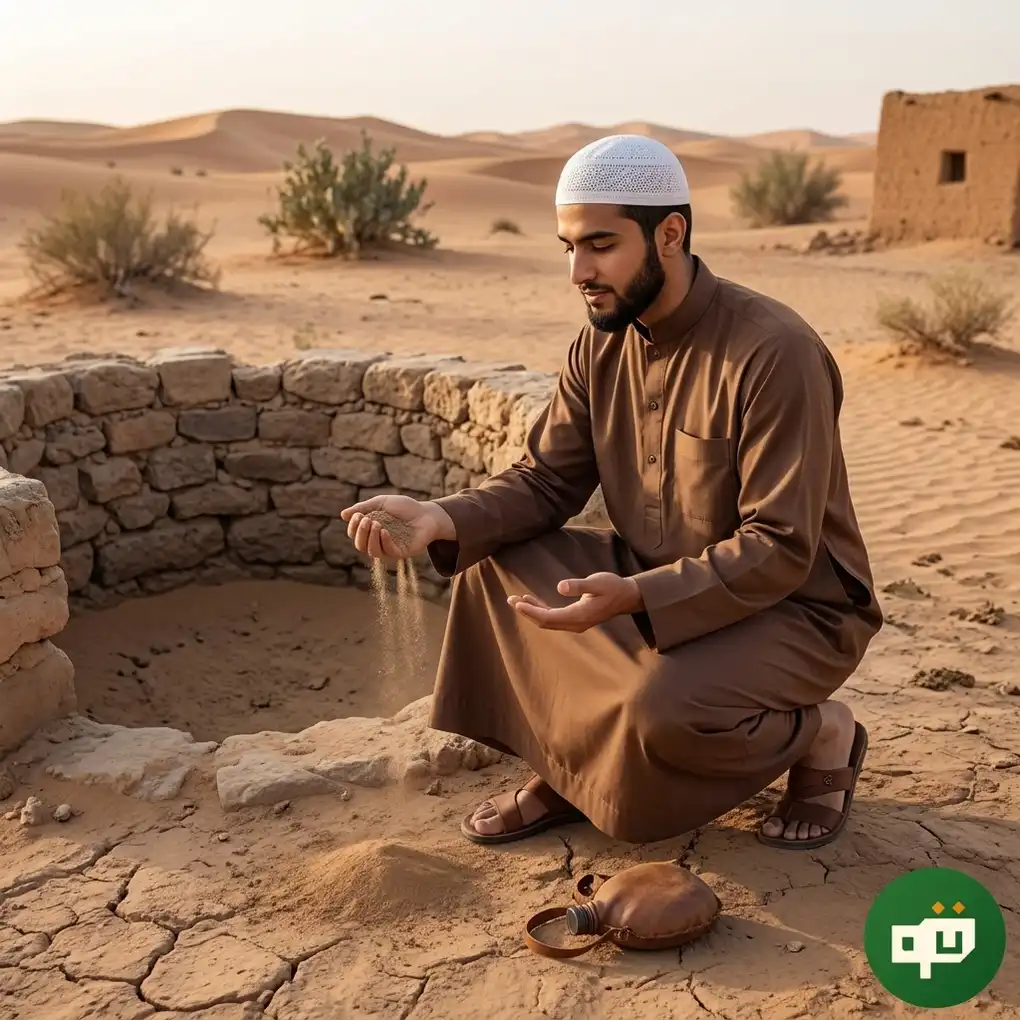
Short Answer: Seven Situations That Permit Tayammum
Many people ask, when is tayammum permitted? The answer is not limited to “when there is no water.” According to the Shafi’i school, there are seven reasons that permit a person to perform tayammum:
- No water (faqd al-ma’)
- Fear of harm when searching for or using water (al-khauf)
- Water needed for drinking (al-‘athsh)
- Not knowing or forgetting that water is available (al-jahl)
- Illness (al-maradh)
- Jabirah, a splint for a broken bone
- Lushuq, an adhesive dressing on a wound
These seven follow the count in Asna al-Mathalib. Each reason has its own conditions and consequences, and this article goes through them one by one. If you want the full picture of tayammum first, start with the tayammum guide, then come back here for the reasons.
Tayammum Is a Substitute, Not an Option
Before the reasons, we need to understand where tayammum stands. Scholars explain the meaning of tayammum in two ways. Linguistically, tayammum means al-qashd (to intend or head toward). In the Shariah, tayammum is conveying dust to the face and both hands under specific conditions. The details are in the article on the meaning of tayammum.
Zakariyya al-Ansari wrote:
«قوله: (كتاب التيمم) هو لغة القصد … وشرعا إيصال التراب إلى الوجه واليدين بشرائط مخصوصة وخصت به هذه الأمة وهو رخصة»
Meaning: “The Book of Tayammum. Linguistically it means al-qashd (heading toward). In the Shariah, tayammum is conveying dust to the face and both hands with specific conditions. It is particular to this Ummah, and it is a rukhshah (a concession).”[1]
The word rukhshah matters here. A concession applies only when there is a reason for it. A person who can still use water may not switch to dust just because it feels easier.
The Evidence for Tayammum
The basis for tayammum is in the Qur’an and the hadith. In Asna al-Mathalib, Zakariyya al-Ansari mentions the verse and the hadith together:
«والأصل فيه قبل الإجماع قوله تعالى {وإن كنتم مرضى أو على سفر} [النساء: 43] إلى قوله {فتيمموا صعيدا طيبا} [النساء: 43] أي ترابا طاهرا وقيل ترابا حلالا وخبر مسلم «جعلت لنا الأرض كلها مسجدا وتربتها طهورا»»
Meaning: “Its basis, before consensus, is the word of Allah Ta’ala: ‘And if you are ill or on a journey’ (an-Nisa: 43) up to His words: ‘then perform tayammum with clean earth’, meaning pure dust. It was also said: lawful dust. And the hadith narrated by Muslim: ‘The whole earth has been made for us a place of prostration, and its soil a means of purification.’“[1]
Notice that the verse mentions two situations: illness and travel. From these two, scholars derived the seven reasons. Illness gives rise to reasons 5 to 7. Travel, which often makes water hard to find, gives rise to reasons 1 to 4.
The Basic Rule: Being Unable to Use Water
How does the book divide the reasons? Zakariyya al-Ansari gives one formula that governs the whole chapter:
«قوله: (وفيه ثلاثة أبواب الأول فيما يبيحه) وهو العجز عن استعمال الماء بتعذره أو تعسره لخوف ضرر ظاهر وأسباب العجز سبعة»
Meaning: “The Chapter of Tayammum has three parts. The first is about what permits it, namely being unable to use water, either because it cannot be obtained or because it is difficult, due to fear of clear harm. The causes of this inability are seven.”[1]
So every condition that permits tayammum comes down to one key word: inability (al-‘ajz). It has two forms:
- Inability because there is truly no water (ta’adzdzur), such as in the middle of a desert.
- Inability because using water is hard or harmful (ta’assur), such as when water is present but a wound could worsen if it gets wet.
This also answers the most basic condition for tayammum. It is not ordinary difficulty, but difficulty tied to real harm. The reason is that tayammum is valid only when there is genuine need. The book states the reason in its discussion of the first cause:
«ولأن التيمم طهارة ضرورة ولا ضرورة مع إمكانها بالماء»
Meaning: “Because tayammum is purification out of necessity, and there is no necessity as long as purification with water is possible.”[1]
Map of the Seven Reasons
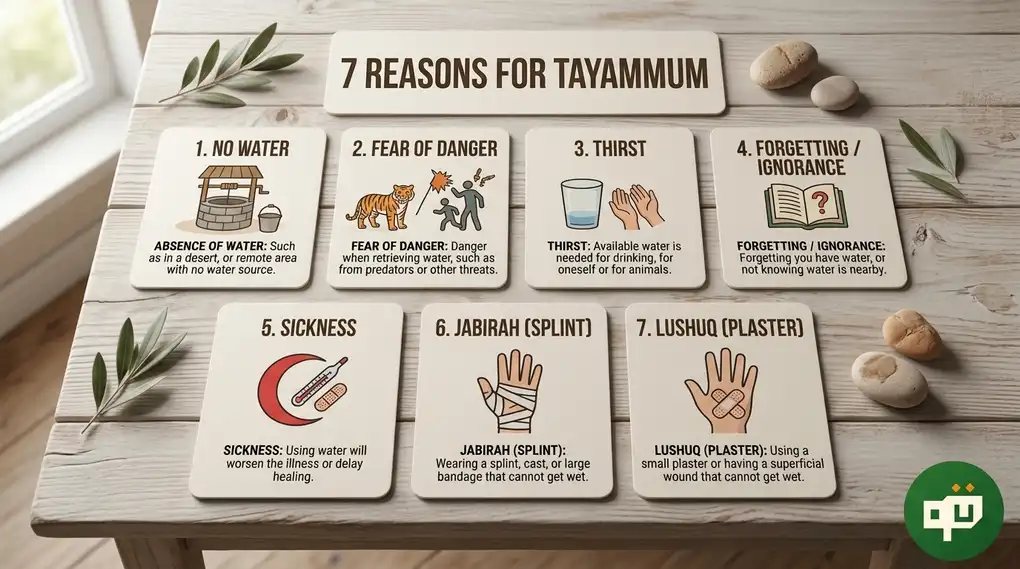
For easy tracking, here is the map of the seven reasons:
| # | Reason | In brief |
|---|---|---|
| 1 | No water | One must search first before tayammum |
| 2 | Fear of harm | Life, limbs, property, or being left behind by the group |
| 3 | Water needed for drinking | Thirst now or later, for people and respected animals |
| 4 | Not knowing or forgetting | May lead to repeating the prayer |
| 5 | Illness | Also applies to someone staying at home |
| 6 | Jabirah | A broken bone that is tied or splinted |
| 7 | Lushuq | A wound covered with an adhesive dressing |
From the next section, we cover the first reason: no water. It is the one asked about most, and it carries a duty to search for water that people often overlook.
Reason 1: No Water (Faqd al-Ma’)
This is the best-known reason. Unfortunately, many assume it is enough to say “there is no water” and go straight to tayammum. In Shafi’i fiqh, tayammum because of no water becomes valid only after its conditions are met, and the first condition is searching for water first.
Zakariyya al-Ansari presents the first reason in the following sentence:
«قوله: (وهو سبعة: الأول فقد الماء فإن تيقن فقده) حوله (فلا طلب عليه) لأنه عبث (وإلا) بأن جوز وجوده (وجب عليه طلبه في الوقت أو) طلب (مأذونه) كذلك لقوله تعالى {فلم تجدوا ماء فتيمموا} [النساء: 43] ولا يقال لم يجد إلا بعد الطلب»
Meaning: “The first reason is no water. If he is certain there is no water around him, he does not have to search, because that would be pointless. If not (meaning water may be present), he must search for it within the prayer time, or have someone he authorised search for him, based on the word of Allah Ta’ala: ‘and you do not find water, then perform tayammum.’ A person is not described as not finding until after searching.”[1]
So there are two situations:
- Certain there is no water. No need to search; tayammum is permitted straight away.
- Water may be present. He must search within the prayer time, himself or through someone he authorises.
One point is often missed: searching for water or performing tayammum before the time enters is not valid. The book states that whoever performs tayammum or searches before the time, or doubts whether the time has entered, his tayammum is not valid.[1]
How and How Far to Search for Water
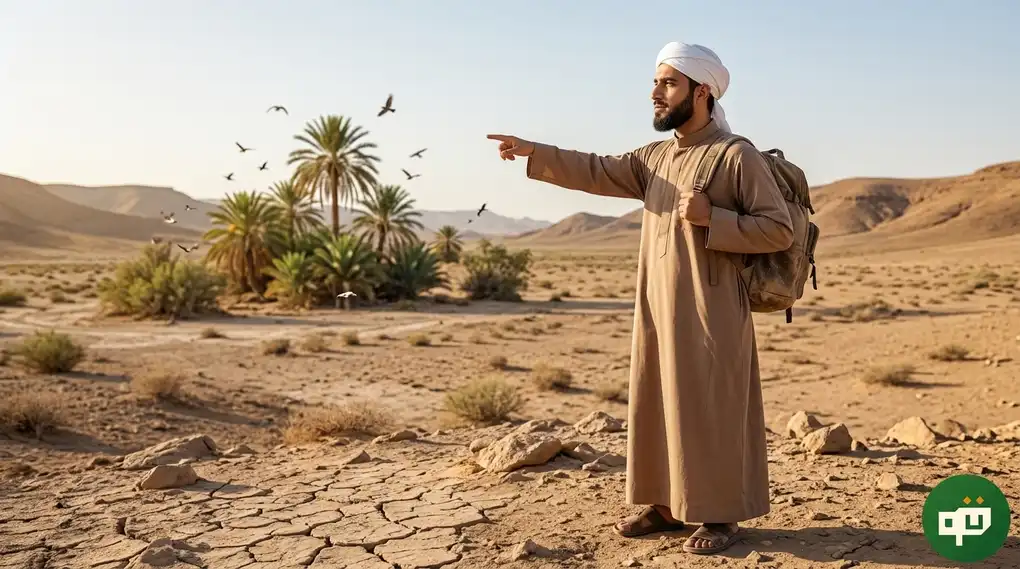
How should one search? The book gives a practical order, especially for tayammum while travelling:
«قوله: (فيطلبه بأن) يفتش رحله (ثم ينظر حواليه) يمينا وشمالا وأماما وخلفا إن كان (في مستو) من الأرض (ويتأمل موضع الخضرة والطير)»
Meaning: “He searches for it by checking his luggage, then looking around him: right, left, front, and back if he is on level ground, and paying attention to green spots and places where birds gather.”[2]
The steps:
- Check your own supplies.
- Look in four directions. On level ground, look for greenery and birds, since both usually point to water.
- On uneven ground (a valley or a hill), go back and forth to search as long as it is safe for life, property, and limbs, he is not left behind by the group, and the prayer time is not short.
- Ask the group. It is enough to call out, “Who has water?” He need not go to each person.
How far? The book mentions the hadd al-ghauts, the distance within which the group can still hear a cry for help:
«قوله: (إلى حد تسمع استغاثته) بأن يسمعها رفقته … ويسمى ذلك حد الغوث»
Meaning: “Up to the limit where he calls for help and his group hears him … that distance is called hadd al-ghauts.”[2]
If he is certain water is farther away, at the hadd al-qurb (the distance where the group normally goes for firewood or grass), he must go there as long as it is safe and time allows. Beyond that he is not required, because of the hardship.[2]
Keep in mind that this section is only an overview. The full technical discussion on searching for water is in the article on tayammum because of no water.
Wait for Water or Perform Tayammum Right Away?
Another question: may one wait until the end of the time if water is expected to arrive? The book distinguishes by level of certainty:
«قوله: (ومن تيقن الماء) أي وجوده (آخر الوقت فانتظاره أفضل) من تعجيل التيمم لأن الوضوء هو الأصل والأكمل»
Meaning: “Whoever is certain that water will be available at the end of the time, waiting for it is better than hurrying to tayammum, since wudhu is the origin and the most complete.”[3]
On the other hand, if he is certain there will be no water at the end of the time, or only thinks so, doubts it, or imagines it:
«قوله: (وإلا) بأن تيقن عدمه آخر الوقت أو ظنه أو شك فيه أو توهمه (فالتعجيل) أفضل»
Meaning: “If not, meaning he is certain there will be no water at the end of the time, or he thinks so, doubts it, or imagines it, then performing tayammum early is better.”[3]
There is an exception for someone who is resident (mukim):
«قوله: (أما المقيم فلا يتيمم وعليه أن يسعى) إلى الماء (وإن فات به الوقت)»
Meaning: “As for a resident, he does not perform tayammum and must make an effort to reach water, even if the prayer time passes because of it.”[4]
The reason is that in a place of residence water is generally available. If he performs tayammum out of fear of the time running out although he can perform wudhu, he must still repeat the prayer.
Water Is Present but Not Enough
What if water is present but only a little? Do not go straight to tayammum. The book requires using that water as far as possible:
«قوله: (وعليه شراء ماء لا يكفيه) لطهارته (ليستعمل)»
Meaning: “He must buy water that is not enough for his purification, in order to use it.”[5]
The reason is the hadith the book mentions: «إذا أمرتكم بأمر فأتوا منه ما استطعتم» (“When I command you to do something, do of it what you are able”).[5] The method: someone with a minor hadath uses the water in the order of wudhu, then performs tayammum for the remaining limbs. The book says:
«قوله: (والمحدث) الواجد لماء لا يكفيه (يرتب) … (ثم يتيمم للباقي)»
Meaning: “A person in a state of hadath who has water that is not enough does it in order … then performs tayammum for the remaining parts.”[5]
The Sin of Wasting or Selling the Water
What if the water is deliberately used up? The ruling depends on the reason and the timing:
«قوله: (وإن أتلف الماء في الوقت لغرض كتبرد وتنظف وتحير مجتهد لم يعص) للعذر (أو) أتلفه (عبثا لا قبل الوقت) بل فيه أو بعده (عصى)»
Meaning: “If he uses up the water within the time for a purpose, such as cooling off or cleaning himself, he is not sinful because there is an excuse. If he wastes it for nothing, not before the time but within it or after it, he is sinful.”[6]
In both cases, he need not repeat the prayer if he performs tayammum, because at the time of tayammum he truly had no water.[6] The book adds that selling or gifting water within the time without a need is not valid, and if he cannot take it back, he performs tayammum and then makes up that prayer.[6]
Reason 2: Fear of Harm (Al-Khauf)
The first reason deals with water that is not there. The second is different: water is present, even close, but getting it means bearing harm. In the books this is called al-khauf. The ruling is the same as for someone with no water, namely that tayammum because of fear is permitted.
Zakariyya al-Ansari wrote:
«قوله: (الثاني الخوف فإن خاف) من بقربه ماء (على) محترم من (نفس أو عضو أو مال) ولو قليلا … (أو) خاف (من انقطاع رفقة) … (إن طلبه) … (تيمم) لفقده شرعا»
Meaning: “The second reason is fear. If someone with water nearby fears for something respected (muhtaram), namely life, limb, or property, even a little, or fears being left behind by his group, if he looks for it, then he performs tayammum, because the water is considered absent in the Shariah.”[6]
The key phrase is “considered absent in the Shariah” (faqdan syar’an). The water exists but cannot be reached without harm, so the ruling is the same as no water.
What Is Feared?
The book names four things that make tayammum permitted:
- Nafs (life). For example, an enemy or wild animal near the water source.
- ‘Udhw (a limb). Fear of losing or injuring a part of the body.
- Mal (property). Property he carries, or leaves at the campsite, even if small.
- Inqitha’ rufqah (being left behind). The book treats the loneliness of being separated from the group as a valid reason for tayammum, even if the person suffers no injury.
The evidence is the word of Allah Ta’ala:
«{وما جعل عليكم في الدين من حرج}»
Meaning: “And He has not placed upon you in the religion any hardship.” (al-Hajj: 78)[6]
The book also notes that fear of being left behind applies to purification but not to the Friday prayer. The reason is that purification is only a means (wasilah), while Friday is a primary obligation. A means may be given a leniency that a primary obligation is not.[6]
Fear on a Ship
The book gives one specific example:
«قوله: (وكذا) يتيمم (من في سفينة وخاف من البحر لو استقى)»
Meaning: “Likewise, someone on a ship who fears the sea when drawing water performs tayammum.”[6]
Water exists and is even visible, but taking it risks falling into the sea. In that situation he may perform tayammum.
Application to Travel Today
The book does not mention modern examples. What follows is only the author’s application of the rule above, not a citation from the book:
- The only watered place is in an area unsafe at night, and he fears for his safety.
- The only route to the water passes through a dangerous path.
If such a condition truly exists, the rule of khauf can be applied. The measure remains real harm, not reluctance or laziness. If in doubt, ask a local scholar.
Water Is Present but Must Be Bought, Borrowed, or Requested
There is another case in the same group: water exists, but belongs to someone else. Must one pursue it? The book answers with details.
1. Accepting a gift of water: obligatory.
«قوله: (ويجب اتهاب الماء) على عادمه بقيد زاده تبعا للماوردي بقوله (في الوقت)»
Meaning: “Someone without water must accept a gift of water, on condition that it is within the prayer time.”[6] This duty applies if the giver does not need it and the time is not too short to search for water.
2. Borrowing a drawing tool: obligatory. Accepting a gift of the tool: not obligatory.
«قوله: (و) يجب (اقتراضه واستعارة الآلة) … (لا اتهابها) أي الآلة فلا يجب لثقل المنة»
Meaning: “One must borrow water and borrow the drawing tool … but one need not accept the tool as a gift, because of the weight of obligation to the giver (the risk of being reminded of the favour later, undat-undat).”[7]
3. Accepting a gift of money for buying water: not obligatory.
«قوله: (ولا يجب قبول هبة الثمن) أي ثمن الماء أو الآلة (و) لا قبول (قرضه)»
Meaning: “One need not accept a gift of money for buying water or the tool, nor accept a loan of money for it.”[8]
4. Buying water at a fair price: obligatory. At an excessive price: not obligatory.
«قوله: (ويجب شراء الماء وآلة السقي واستئجارها) … (بعوض المثل) من ثمن وأجرة (هناك) … (لا) إن بيع أو أوجر (بزيادة) على عوض المثل فلا يجب شراء ولا استئجار»
Meaning: “One must buy water and a drawing tool, or rent it, at the equivalent price in that place … but if it is sold or rented with an addition over the equivalent price, buying or renting is not obligatory.”[8]
The pattern is easy to remember. If the facility does not burden, it must be taken. If it burdens, such as bearing an obligation to someone or an excessive price, it is not required, and tayammum is permitted.
The book also cites al-Mawardi: if water can be reached by digging in that place, and the digging is close and not hard, digging is obligatory. If hard, it is not.[8]
Reason 3: Water Needed for Drinking (Al-‘Athsh)
Imagine you are travelling, the water in your bottle is nearly finished, and the journey is still long. Use it for wudhu or keep it for drinking? Shafi’i fiqh gives a clear answer: drinking water comes first, and wudhu is replaced by tayammum because of thirst.
Zakariyya al-Ansari wrote:
«قوله: (الثالث العطش فلا يتوضأ به) أي بالماء أي لا يجوز له … (وهو يخاف عطش) حيوان (محترم) من نفسه وغيره (في الحال أو المآل وإن رجا) أي ظن (وجوده) بل يتيمم دفعا لما يلحقه من الضرر»
Meaning: “The third reason is thirst. He may not perform wudhu with that water if he fears the thirst of a respected living being, himself or another, now or later, even if he expects to find water again. He performs tayammum to avert the harm that would reach him.”[9]
Three lessons come from this sentence:
- The protected one is a respected living being (hayawan muhtaram): oneself, other people, and animals such as livestock or pets.
- Thirst now or later is the same. A person who is not yet thirsty but fears thirst on the next stretch may protect his water.
- It applies even if he expects to find water again. An expectation does not cancel the duty to protect life.
According to al-Mawardi, Imam al-Shafi’i also said something similar in al-Umm: there is no difference between thirst that occurs now and thirst that is feared later.[9]
Limit of the Need: Is Only Drinking Water Prioritised?
A common question: what if the water is used for other needs, such as cooking? The book explains:
«قوله: (ولا يدخره) أي الماء (لطبخ بل كعك وفتيت) بل يتوضأ ويأكل ذلك يابسا»
Meaning: “He does not store water for cooking, but makes do with dry bread or crumbs. He performs wudhu and eats that dry food.”[9]
That is, the need for drinking outranks cooking. If there is dry food, wudhu is not to be skipped for the sake of cooking.
The book also cites the view of Waliyuddin al-‘Iraqi:
«قول الفقهاء إن حاجة العطش مقدمة على الوضوء ينبغي أن يكون مثالا ويلحق به حاجة البدن بغير الشرب كالاحتياج للماء لعجن دقيق ولت سويق وطبخ طعام بلحم وغيره»
Meaning: “The statement of the jurists that the need for thirst takes priority over wudhu should be only an example. Bodily needs other than drinking are analogous to it, such as water for kneading flour, moistening sawiq, and cooking food with meat.”[9]
This is described as a view worth considering. In practice, be careful and ask a scholar if the situation is unclear.
Pets and Hunting Dogs
The book also sets the order of buying water:
«قوله: (ويقدم) وجوبا (شراء الماء لعطش بهيمته وكلب صيده)»
Meaning: “It is obligatory to prioritise buying water to quench the thirst of his livestock and his hunting dog over buying water for purification.”[9]
This is not limited to livestock and hunting dogs. It applies to every respected living being he has with him. If the owner of the water will only sell at a price above the market, and the buyer is forced to buy, the buyer must pay the extra because the contract is valid.[9]
May Water Be Taken from Its Owner?
A heavier question: what if the owner refuses to give water while someone is dying of thirst? The book answers:
«قوله: (وله) أي للعطشان (أخذه) أي الماء من مالكه (قهرا) إذا امتنع من بذله بيعا وغيره لحرمة الروح … (لا) أخذه (من) مالك (عطشان) لأن المالك أحق ببقاء مهجته»
Meaning: “A thirsty person may take water from its owner by force if the owner refuses to give it, whether by sale or otherwise, because the sanctity of life takes priority … but not from an owner who is also thirsty, since the owner has more right to his own survival.”[9]
This ruling addresses a genuine emergency in the desert in the past. As the author’s application: today, with shops, fuel stations, and authorities, the route should be to ask, buy, or seek help from others, not to take matters into one’s own hands.
Further Provisions
- He is not required to use water for wudhu and then drink it. The reason is that human nature finds it repulsive.[9]
- Someone travelling for a sinful purpose who is thirsty while carrying water may not perform tayammum until he repents.[9] The book says: if he violates this, drinks it before repenting, and performs tayammum after repenting, he need not make up the prayer but he is sinful.[9]
- If a group is thirsty and a deceased person has water, the water may be drunk and replaced by its value to the heirs.
«قوله: (ولو عطشوا ولميت ماء شربوه) وضمنوه للوارث (بقيمته هناك)»
Meaning: “If they are thirsty and a deceased person has water, they may drink it and owe the heirs its value in that place.”[10]
Reason 4: Not Knowing or Forgetting That Water Exists (Al-Jahl)
Have you ever forgotten that you had a bottle of water in your bag? Or not known that there was a well near your stopping place? Shafi’i fiqh treats this as the fourth reason. Unlike the previous three, this one carries a consequence of repeating the prayer in some cases.
Zakariyya al-Ansari wrote:
«قوله: (الرابع الجهل) بالماء وأراد بالجهل ما يشمل النسيان بقرينة قوله»
Meaning: “The fourth reason is not knowing about water. What is meant by jahl (not knowing) here also includes nisyan (forgetting), according to the statement that follows.”[11]
So the word jahl in this chapter is wider than its usual meaning. It consists of two things:
- Not knowing at all that water exists.
- Forgetting that he has, or knows of, water.
When Must the Prayer Be Repeated?
A person who performed tayammum for this reason often wonders: is my prayer valid? The book distinguishes by whether there was negligence (taqshir).
1. Forgetting or Losing It Himself: Must Repeat
«قوله: (فإذا نسي بئرا هناك) أي بمحل نزوله (أو ماء في رحله أو ثمنه أو أضلهما فيه وتيمم) وصلى ثم تذكره ووجده (أعاد) الصلاة (وإن أمعن في الطلب) لوجود الماء معه ونسبته في إهماله حتى نسيه أو أضله إلى تقصير»
Meaning: “If he forgets a well at the place where he stopped, or forgets water or the money to buy water in his luggage, or loses them in his luggage, then performs tayammum and prays, then remembers and finds it, he must repeat the prayer, even if he searched seriously. The reason is that the water was with him, and by neglecting it until he forgot or lost it, he is considered negligent.”[11]
The key to the ruling: the water was his, but he was careless in looking after it. That is why he is considered negligent.
2. Not Knowing at All: No Need to Repeat
«قوله: (فإن أضل رحله) في رحال وأمعن في الطلب كما ذكره الأصل (أو أدرج فيه) أي في رحله (ماء ولم يشعر) به (أو لم يعلم بئر خفية هناك) فتيمم وصلى (فلا إعادة) وإن وجد ذلك لعدم تقصيره»
Meaning: “If he loses his luggage among the group’s luggage and searched seriously, or water was slipped into his luggage without his awareness, or there was a hidden well there that he did not know of, then performs tayammum and prays, he does not have to repeat, even if he later finds that water, because he was not negligent.”[11]
The book adds that if the well was plainly visible (not hidden), he must repeat.[11]
Comparison Table of Cases
| Case | Must repeat? | Reason |
|---|---|---|
| Forgot a well at the stopping place | Yes | Considered negligent |
| Forgot water in his luggage | Yes | Considered negligent |
| Forgot money for buying water | Yes | Considered negligent |
| Lost the water or money inside his own luggage | Yes | Considered negligent |
| Lost a bag among the group’s luggage, searched seriously | No | Not negligent |
| Someone slipped water in without his awareness | No | Not negligent |
| A hidden well he did not know about | No | Not negligent |
| A well in plain view that he did not notice | Yes | Considered negligent |
A pattern to remember: if the cause is his own negligence, the prayer is repeated. If the cause is beyond his control, it is not repeated.
On the difference between the two cases of loss, the book explains that the group’s campsite is larger than one person’s tent. Losing something among the group is farther from negligence than losing it among one’s own belongings.[11]
Practical Lessons
What can we take from this?
- Check your supplies first before performing tayammum. This matches the duty to search for water already discussed.
- Note where you keep your water. If it turns out to exist, a prayer performed with tayammum must be repeated.
- Do not rush, especially when the prayer time is still wide.
For more on repeating the prayer after tayammum, read the article on the ruling on repeating the prayer after tayammum.
Reason 5: Illness (Al-Maradh)
The fifth reason may be the one people experience most: illness. The question is, does every illness permit tayammum? No. The measure is not the name of the illness, but the harm feared from using water. The full details are in the article on tayammum because of illness. Here we cover the outline.
Zakariyya al-Ansari wrote:
«قوله: (الخامس المرض) ولو في الحضر لآية {وإن كنتم مرضى} [النساء: 43] أي وخفتم من استعمال الماء محذورا فتيمموا بقرينة تفسير ابن عباس المرض بالجرح والجدري ونحوهما ولما في استعمال الماء مع ذلك من الضرر»
Meaning: “The fifth reason is illness, even for a resident, based on the word of Allah: ‘And if you are ill’ (an-Nisa: 43), meaning if you fear something undesirable from using water, then perform tayammum. Its meaning is supported by Ibn Abbas’s explanation that illness means wounds, smallpox, and the like, and because using water in that condition causes harm.”[11]
Two important lessons come from this sentence:
- Illness permits tayammum even when not travelling. A sick person at home may also perform tayammum.
- The measure is the harm from water, not merely the illness. A sick person who can safely use water must still perform wudhu.
Which Illness Permits It?
The book formulates the conditions that permit tayammum as follows:
«قوله: (فيتيمم مريض خاف تلف نفس أو عضو أو منفعته) أي العضو»
Meaning: “A sick person performs tayammum if he fears the destruction of life, a limb, or the function of that limb.”[11]
The book then adds other conditions that also permit it:
«قوله: (وكذا) يبيح التيمم لمريده (خوف مرض مخوف أو) خوف (زيادة فيه)»
Meaning: “Likewise, what permits tayammum is fear of a dangerous illness, or fear that the illness will worsen.”[11]
So there are several forms of illness that permit tayammum:
- Fear of destruction: of life, a limb, or its function.
- Fear that a dangerous illness will arise.
- Fear that the illness will worsen, even if its duration does not increase.
- Fear that the illness will last longer, even if the pain does not increase.
- Fear of an ugly and clear mark (syin qabih) on a visible part of the body.
For the fifth point, the book explains the reason:
«قوله: (أو) خوف (حصول شين قبيح) أي فاحش (في عضو ظاهر) لأنه يشوه الخلقة ويدوم ضرره»
Meaning: “Or fear of an ugly mark, meaning a glaring one, on a visible limb, because it disfigures the body and its blemish lasts.”[11]
A visible limb, according to al-Rafi’i, is one that usually shows during work, such as the face and hands.[11] A slight mark does not permit it:
«قوله: (ولا يبيحه) أي التيمم (شين يسير كأثر جدري) … (ولا) شين (قبيح في) عضو (مستور) لستره عن أعين الناس غالبا»
Meaning: “Tayammum is not permitted by a slight mark, such as the mark of smallpox, nor by an ugly mark on a covered limb, because it is generally hidden from people’s sight.”[12]
Who Determines the Harm?
How does someone know water will harm them? The book gives two routes:
«قوله: (إن أخبره) بكونه مخوفا (طبيب مقبول الرواية) ولو عبدا أو امرأة (أو عرف) هو (ذلك وإلا) بأن لم يخبره من ذكر ولا كان عارفا بذلك (فلا) يتيمم»
Meaning: “(Tayammum is permitted) if a doctor whose reports are accepted, even a slave or a woman, informs him that it is dangerous, or he knows it himself. If not, meaning no one informed him and he himself does not know, then he does not perform tayammum.”[13]
The two routes are the statement of a trusted doctor or his own knowledge from experience. A female doctor’s statement is also accepted.
And if there is no doctor and he does not understand himself? The book mentions a difference of opinion, then favours al-Baghawi’s view as cited in al-Muhimmat:
«لكن جزم البغوي في فتاويه بأنه يتيمم … فنستخير الله تعالى ونفتي بما قاله البغوي»
Meaning: “But al-Baghawi, in his fatwa, was firm that he may perform tayammum … so we seek guidance from Allah Ta’ala and give a fatwa with what al-Baghawi said.”[12]
The reason: obligating purification with water, while not knowing the state of an illness that could endanger life, runs against the beauty of the Shariah.[12] There is a consequence, however:
«قال البغوي وإذا صلى بالتيمم أعاد إذا وجد المخبر»
Meaning: “Al-Baghawi said: if he prays with tayammum (without any information), he must repeat if he later finds someone to inform him.”[12]
The book likens this to a person confused about the qiblah who finds no one to show it to him.[12]
Practical Lessons
- Do not assume by yourself that every illness permits tayammum. The reason is the harm from water.
- Ask a trusted Muslim doctor, or rely on personal experience if it is clear.
- A mild illness without harm does not permit tayammum.
- A major ritual bath for a sick person follows the same rule. The major ritual bath has its own article.
Reasons 6 and 7: Jabirah and Lushuq
The last two reasons concern a limb that is covered with a dressing. Zakariyya al-Ansari mentions both in one sentence:
«قوله: (السادس والسابع الجبيرة) وهي أخشاب ونحوها تربط على الكسر والانخلاع (واللصوق) بفتح اللام وهو ما كان على جرح من قطنة أو خرقة أو نحوهما»
Meaning: “The sixth and seventh reasons are the jabirah, which is wood or the like tied onto a broken bone or dislocated joint, and the lushuq, which is something applied to a wound, such as cotton, cloth, or the like.”[12]
In other words:
- Jabirah = a support for a broken bone or dislocated joint. Modern examples: a cast and a splint.
- Lushuq = a dressing or adhesive for a wound. Modern examples: a bandage and a wound plaster.
Matching these to modern examples is the author’s application; the definitions follow the book. The details on wiping over a dressing are in the article on wiping over a bandage (jabirah).
Conditions for Applying a Dressing
If a person needs to apply a jabirah or lushuq, he applies it as follows:
«قوله: (فليضعهما على طهر) كالخف (ويستر) من الصحيح تحتهما (قدر الحاجة) للاستمساك»
Meaning: “He should apply them while in a state of purity, like putting on a khuff, and cover the healthy part beneath them only as much as needed so that the dressing holds.”[12]
The two conditions: applied in a state of purity and covering only as much healthy skin as needed. If it is applied without wudhu, or covers more healthy skin than needed, the book requires the dressing to be removed if that is not harmful. If removing it is harmful, he leaves it, prays, and repeats that prayer:
«قوله: (فإن خاف) منه (ترك) ها للضرورة وصلى لحرمة الوقت (وقضى)»
Meaning: “If he fears from removing it, he leaves it because of necessity, prays out of respect for the time, then makes it up.”[14]
Three Steps When the Dressing Cannot Be Removed
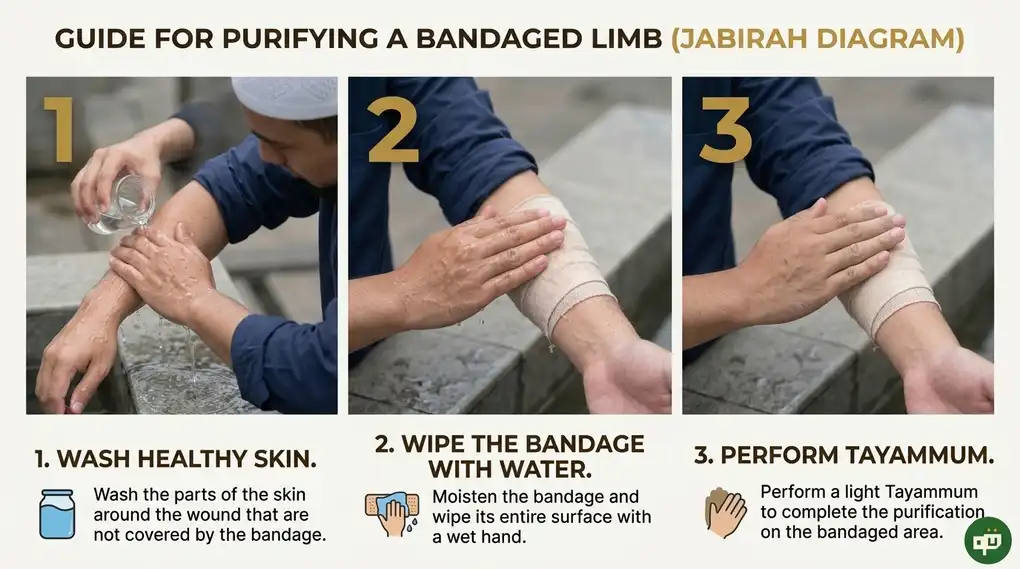
If removing the dressing is harmful, the book gives three steps done together.
1. Wash the Healthy Parts
«قوله: (فإن خاف من نزعهما ما ذكرناه) من الخوف على شيء مما مر (غسل وجوبا ما يمكن)»
Meaning: “If he fears from removing them what has been mentioned, he must wash what can be washed.”[12]
2. Wipe the Dressing with Water
«قوله: (ويجب استيعابهما) أي الجبيرة واللصوق إذا كانا بأعضاء الطهر (مسحا بالماء حين يغسل المحدث العضو) العليل للترتيب بخلاف الجنب يمسح متى شاء»
Meaning: “It is obligatory to wipe the whole dressing with water if it is on the limbs of purification, at the time a person in hadath washes the affected limb, because of the order. A person in janabah, by contrast, may wipe at any time.”[14]
3. Then Perform Tayammum
«قوله: (ثم) بعدما تقرر نقول: (يجب التيمم)»
Meaning: “After that, tayammum is obligatory.”[14]
Here, tayammum replaces washing the affected limb. Meanwhile wiping the dressing replaces washing the healthy skin beneath the edges of the dressing.[14]
The evidence for wiping and tayammum comes from the words of the Prophet ﷺ about a man with a head wound:
«فلقوله صلى الله عليه وسلم في مشجوج احتلم واغتسل فدخل الماء شجته ومات إنما كان يكفيه أن يتيمم ويعصب رأسه بخرقة ثم يمسح عليها ويغسل سائر جسده» رواه أبو داود وغيره
Meaning: “Based on the words of the Prophet ﷺ about a man with a head wound who had a wet dream and bathed, water entered his wound, and he died: ‘It would have been enough for him to perform tayammum, bind his head with a cloth, wipe over it, and wash the rest of his body.’ (Narrated by Abu Dawud and others).”[14]
One more point on wiping over a dressing:
«قوله: (ولا يتقدر المسح) بمدة»
Meaning: “Wiping over the dressing is not limited by time.”[14]
Unlike the khuff, which has a time limit for wiping, a dressing may be wiped as long as the reason remains.
Additional Rules to Know
- A dressing on the tayammum limbs (face and hands): it is not wiped with dust. The reason is that dust is weak and has no effect over a barrier.[14]
- An uncovered wound: it is not obligatory to wipe the wound with water. Only tayammum is required, and the dust is passed over the wound area if possible.[15]
- It is not obligatory to apply a dressing just so it can be wiped.[15]
- Bloodletting (fashd) is treated like a wound.
«قوله: (والفصد كالجرح) الذي يخاف من غسله ما مر فيتيمم له»
Meaning: “Bloodletting is like a wound that one fears to wash, as mentioned earlier, so he performs tayammum for it.”[15]
- Wounds on several limbs: if wounds are on all four wudhu limbs but not spread over them, three tayammums are required (face, hands, feet). If the wound also covers the head, four. If it covers all, one is enough.[14]
Common Misunderstandings
- “If I’m sick, I don’t need to purify myself.” Wrong. Healthy limbs are still washed, the dressing is wiped, and tayammum is still performed.
- “Tayammum is allowed out of laziness or cold.” No. What permits it is real harm, as in the conditions of each reason.
- “Drinking water can be used without limits.” No. It has conditions, as under the third reason.
- “It’s enough to say ‘there is no water.'” No. There is a duty to search first, as under the first reason.
Key Points of the Seven Reasons for Tayammum
- No water: one must search within the prayer time before performing tayammum.
- Fear of harm: to life, limb, property, or being left behind by the group.
- Water for drinking: thirst now or later, for respected living beings.
- Not knowing or forgetting: the prayer is repeated if there was negligence.
- Illness: applies at home too, as long as water brings harm.
- Jabirah: wash the healthy parts, wipe the dressing, then perform tayammum.
- Lushuq: the same rules as the jabirah.
Once you know the reasons, the next step is to understand the pillars and the method. For that, read the tayammum guide again.
FAQ on the Reasons for Tayammum
What are the reasons that permit tayammum?
There are seven reasons according to Asna al-Mathalib:
- No water
- Fear of harm
- Water needed for drinking
- Not knowing or forgetting that water exists
- Illness
- Jabirah
- Lushuq
All return to one rule: being unable to use water, either because it cannot be obtained or because of real harm.[1]
May I perform tayammum if water is present but needed for drinking?
Yes. In fact, wudhu with it is not permitted if he fears thirst, now or later, for himself or a respected living being. This applies even if he expects to find water again.[9]
May a sick person at home perform tayammum?
Yes, if he fears that water will endanger life, a limb, or its function, make the illness worse or longer, or leave an ugly mark on a visible limb. The book says this applies “even for a resident.”[11]
What if I forgot there was water, then already performed tayammum and prayed?
If he forgot a well, water, or money to buy water, he must repeat the prayer.
If water was slipped in without his awareness, or the well was hidden and he did not know of it, he does not have to repeat.[11]
How do I purify a limb that is bandaged?
If the bandage cannot be removed because it is harmful:
Wash the healthy parts.
Wipe the whole bandage with water.
Perform tayammum for the affected limb.[14]
Footnotes
1 : Zakariyya al-Ansari, Asna al-Mathalib, Vol. 1, p. 72. ↩
2 : Zakariyya al-Ansari, Asna al-Mathalib, Vol. 1, p. 73. ↩
3 : Zakariyya al-Ansari, Asna al-Mathalib, Vol. 1, p. 73–74. ↩
4 : Zakariyya al-Ansari, Asna al-Mathalib, Vol. 1, p. 74. ↩
5 : Zakariyya al-Ansari, Asna al-Mathalib, Vol. 1, p. 75. ↩
6 : Zakariyya al-Ansari, Asna al-Mathalib, Vol. 1, p. 76. ↩
7 : Zakariyya al-Ansari, Asna al-Mathalib, Vol. 1, p. 76–77. ↩
8 : Zakariyya al-Ansari, Asna al-Mathalib, Vol. 1, p. 77. ↩
9 : Zakariyya al-Ansari, Asna al-Mathalib, Vol. 1, p. 78. ↩
10 : Zakariyya al-Ansari, Asna al-Mathalib, Vol. 1, p. 79. ↩
11 : Zakariyya al-Ansari, Asna al-Mathalib, Vol. 1, p. 80. ↩
12 : Zakariyya al-Ansari, Asna al-Mathalib, Vol. 1, p. 81. ↩
13 : Zakariyya al-Ansari, Asna al-Mathalib, Vol. 1, p. 80–81. ↩
14 : Zakariyya al-Ansari, Asna al-Mathalib, Vol. 1, p. 82. ↩
15 : Zakariyya al-Ansari, Asna al-Mathalib, Vol. 1, p. 83. ↩
Zakariyyā al-Anṣārī, Asnā al-Maṭālib fī Sharḥ Rawḍ al-Ṭālib, with the ḥāshiyah of Aḥmad al-Ramlī, edited by Muḥammad az-Zuhrī al-Ghamrāwī (Cairo: al-Maṭbaʿah al-Maymānīyah, 1313 AH; repr. Dār al-Kitāb al-Islāmī), vol. 1, pp. 72–83.


