
Short Answer
In the Shafi’i school, ivory taken from a dead elephant, a slaughtered elephant, or cut from a living elephant is impure. A smoking pipe made from that ivory is impure too. Using it in a wet mouth is forbidden according to every opinion in the school. Using dry ivory on the body is disputed: forbidden according to Zakariyya al-Ansari, disliked (makruh) according to an-Nawawi.
A living elephant stays pure. What changes the ruling is the ivory once it is separated from the elephant’s body. This article answers only the question of purity (taharah). The ruling on smoking itself is a separate topic, and the ruling on buying and selling ivory belongs to the chapters on transactions. The basis is found in the discussions of the types of impurity and the ruling on carcass.
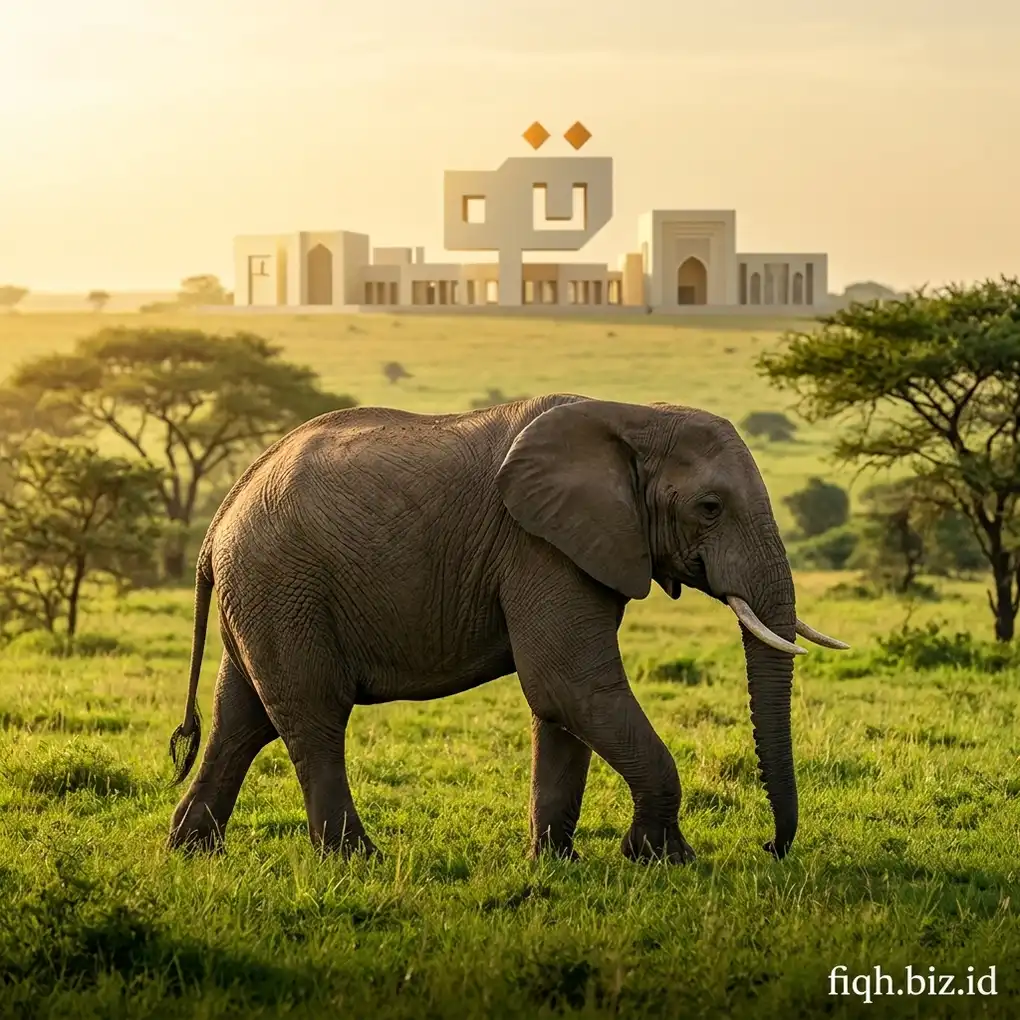
A Living Elephant Is Pure
Many people assume ivory must be impure because it comes from a large animal whose meat is forbidden. Yet every living animal is pure, except dogs, pigs, and their offspring. Fath al-Qarib states:
«(والحيوان كله طاهر إلا الكلب والخنزير وما تولد منهما أو من أحدهما)»
Meaning: “All animals are pure, except the dog, the pig, and what is born from the two of them or from one of them.”[1]
So a living elephant is pure. Touching it, riding it, or being splashed by its saliva does not make a body or clothing impure. The problem begins only when a part of the elephant is separated, or when the elephant dies.
When Does an Elephant Become a Carcass?
In fiqh, a carcass (maytah) is not only an animal that died by itself. Al-Iqna’ explains the limits:
«قوله: (وَالْميتَة) وَهِي مَا زَالَت حَيَاتهَا لَا بِذَكَاة شَرْعِيَّة كذبيحة الْمَجُوسِيّ وَالْمحرم بِضَم الْمِيم وَمَا ذبح بالعظم وَغير الْمَأْكُول إِذا ذبح (كلهَا نَجِسَة)»
Meaning: “A carcass is an animal whose life ended without a lawful slaughter, such as the slaughter of a Magian, the slaughter of a person in ihram, an animal slaughtered with a bone, and an animal that is not lawful to eat even if slaughtered. All of them are impure.”[2]
The last point decides the case of the elephant. In the Shafi’i school, elephant meat is not lawful to eat. So an elephant that is hunted and then slaughtered still counts as a carcass, because slaughter purifies only an animal that is lawful to eat.
Imam ash-Shafi’i himself lists the elephant among animals whose meat is not eaten, and states that its bone cannot be purified:
«ولا يتوضأ ولا يشرب في عظم ميتة ولا عظم ذكي لا يؤكل لحمه مثل عظم الفيل والأسد وما أشبهه؛ لأن الدباغ والغسل لا يطهران العظم روى عبد الله بن دينار أنه سمع ابن عمر يكره أن يدهن في مدهن من عظام الفيل؛ لأنه ميتة»
Meaning: “Do not perform wudhu or drink from the bone of a carcass, nor from the bone of a slaughtered animal whose meat is not eaten, such as the bone of the elephant, the lion, and the like, because tanning and washing do not purify bone. Abdullah ibn Dinar narrated that he heard Ibn Umar dislike using oil from a container made of elephant bone, because it is a carcass.”[12]
Three lessons come from this text. First, the bone of a slaughtered elephant is still not pure, because its meat is not eaten. Second, bone cannot be purified by any method, so ivory cannot be washed until it becomes pure. Third, Ibn Umar (may Allah be pleased with him) already called elephant bone a carcass.
This gives three ways ivory becomes impure:
- The elephant dies by itself, and its ivory is taken.
- The elephant is slaughtered or hunted, because its meat is not lawful.
- The ivory is cut or pulled out while the elephant is still alive.
Ivory Is a Bone, So It Is Impure
Ivory is the elongated tusk of the elephant. It is a kind of bone or tooth, not a dead stone. Asna al-Matalib rules that the bone of a carcass is impure, and gives the reason:
«قوله: (و) لا (شعرها) ، وعظمها لأن كلا منهما تحله الحياة لأنه ينمو، والعظم يحس، ويألم، وفي معناه الصوف، والوبر، والريش»
Meaning: “(And not pure) are its hair and its bone, because life dwells in each of them: it grows, and bone feels and hurts. Wool, camel hair, and feathers share the same ruling.”[3]
Ivory grows throughout the elephant’s life, and it contains nerves and blood vessels. For this reason ivory takes the ruling of a carcass bone: it is impure. Ivory is named directly in al-Misbah as «العاج أنياب الفيل», “ivory is the tusks of the elephant.”[9]
If you want to compare with other materials, a carcass hide is different because it can become pure through tanning. See dabbagh: tanning carcass hides.
Ivory Cut from a Living Elephant
Some ivory used for pipes comes from an elephant that was still alive when the ivory was taken. The ruling stays the same. Asna states the rule for a part separated from a living animal:
«قوله: (المبان من حي، ومشيمته) … (كميتته) أي كميتة ذلك الحي طهارة، ونجاسة لخبر «ما قطع من حي فهو ميت» رواه الحاكم، وصححه على شرط الشيخين فاليد من الآدمي طاهرة، ومن البقر نجسة»
Meaning: “A part separated from a living animal, and its afterbirth, takes the ruling of that animal’s carcass in purity and impurity, based on the hadith: ‘What is cut from a living animal is a carcass.’ So the hand (cut) from a human is pure, while the hand of a cow is impure.”[4]
The only exception is the hair and feathers of an animal lawful to eat (la sha’ra ma’kul wa rishahu), which stay pure even when plucked.[4] The elephant is not lawful to eat, and ivory is not hair. So the exception does not apply. Ivory cut from a living elephant is impure, like the severed hand of a cow.
Is It Forbidden or Disliked to Use Ivory?
Once ivory is known to be impure, a second question arises: may such an object be used? Shafi’i scholars discuss it through the example of an ivory comb (mushti ‘aj). Asna al-Matalib states that impure objects are forbidden to use on a person’s body, hair, and clothing, including a dry ivory comb:
«قوله: (ولا يحرم جلد الميتة) قبل الدبغ (وسائر الأعيان النجسة) غير ما مر (إلا على) بمعنى في (بدن آدمي وشعره) وثوبه … (ولو) كان النجس (مشط عاج كاف) فإنه يحرم استعماله»
Meaning: “It is not forbidden (to use) the hide of a carcass before tanning, or other impure objects, except on the body of a human, his hair, and his clothing, … even if the impure object is a dry ivory comb, using it is forbidden.”[10]
This differs from an-Nawawi in al-Majmu’. In his view, using ivory on the head and beard when there is no moisture is only disliked, not forbidden. Al-Asnawi rejected this firmly:
«فإن هذا التفصيل إنما ذكره الأصحاب في وضع الشيء في الإناء منه فالتبس عليه ذلك بالاستعمال في البدن»
Meaning: “This distinction (dry and wet) was mentioned by the scholars only for placing something in a container made of ivory, and an-Nawawi confused it with use on the body.”[10]
Zakariyya al-Ansari then turned the charge around: it is al-Asnawi’s objection that is mistaken, because ash-Shafi’i himself in al-Buwayti stated this distinction for the comb and the container, and he was followed by al-Qadi Abu at-Tayyib, Abu Ali at-Tabari, and al-Mawardi. Their reason:
«وكأنهم استثنوا العاج لشدة جفافه مع ظهور رونقه»
Meaning: “It is as if they made an exception for ivory because of its extreme dryness, along with its visible shine.”[10]
The “disliked” opinion is the one followed in I’anat at-Talibin when it explains the text of Fath al-Mu’in: «ويحل مع الكراهة استعمال العاج», “Using ivory is permissible with dislike.”[11] Ali ash-Shibramallisi (abbreviated «ع ش»), quoted there, adds that carrying ivory in order to use it when needed is allowed, but not during prayer:
«ومعلوم أن محل ذلك في غير الصلاة ونحوها، أما فيهما فلا يجوز، لوجوب اجتناب النجاسة فيهما في الثوب والبدن والمكان»
Meaning: “It is known that this permission applies outside prayer and the like. In prayer it is not permitted, because avoiding impurity on the clothing, body, and place is obligatory in prayer.”[11]
In short:
- Dry ivory on the body: forbidden according to Zakariyya al-Ansari, disliked according to an-Nawawi and the opinion followed in I’anat at-Talibin.
- Wet ivory, or ivory meeting moisture: no concession. The condition “no moisture” in an-Nawawi’s own opinion shows that with moisture it is forbidden.
- During prayer: it is not permitted to carry or wear it.
From Ivory to Smoking Pipe: What Changes?
Carving ivory into a smoking pipe or any other accessory does not change its ruling. The pipe is still a part of the elephant, only in a different shape. Two points need to be understood.
1. Impurity Transfers Through Moisture
In the Shafi’i school, impurity transfers when an impure object meets something wet. Asna explains that a dry solid with no moisture is not affected:
«وخرج بالرطب الجامد الخالي عن رطوبة عند الملاقاة»
Meaning: “And excluded from (the ruling on) liquids is a dry solid, free of moisture at the moment of contact.”[5]
Elsewhere, when discussing mercury, Asna gives a similar rule: something «ولا ينجس إلا بتوسط رطوبة», “does not become impure except through moisture.”[6]
A smoker’s mouth is wet with saliva. The end of an ivory pipe that goes into the mouth becomes wet too, and so does moist tobacco. So the impurity of the pipe transfers to the lips, the saliva, and the tobacco that touches it. Because a smoking pipe is used with a wet mouth, an ivory pipe falls under the “with moisture” condition that both sides above forbid, not under the concession of dislike for dry ivory.
2. Purifying the Mouth and the Equipment
Any part of the body or any object touched by wet impurity must be cleaned. The method is explained in the article on purifying medium impurity. The ivory pipe itself cannot be purified by washing, because its impurity lies in the substance of the ivory, not in something that touched it from outside. Imam ash-Shafi’i states that washing does not purify bone.[12]
If you are unsure whether a pipe is really ivory, remember the basic rule: something whose status is doubtful is treated as pure, because the original ruling is purity («لأن الأصل الطهارة»).[8]
What About Pipes Made of Other Materials?
A pipe made of wood or metal has no such problem. Both are inanimate objects (jamad), and Asna rules that inanimate objects are pure by default.[7]
What should be avoided is only material that comes from a carcass or an impure animal:
- Elephant ivory and other ivory from animals that are not lawful to eat.
- Bones of animals that died without lawful slaughter, including the horns of a dead cow or buffalo.
- Parts of the dog and the pig, whose impurity is the heaviest.
Points to Remember
- A living elephant is pure, but ivory separated from it is impure.
- Ivory is a growing bone, so it follows the ruling of a carcass bone.
- Ivory cut from a living elephant is still like a carcass.
- An ivory pipe makes the mouth and tobacco impure because it meets moisture.
- Using dry ivory on the body: forbidden according to Zakariyya al-Ansari, disliked according to an-Nawawi.
- Using wet ivory, such as a pipe in the mouth: forbidden.
- The ruling on smoking and on trading ivory is discussed separately.
FAQ on the Ruling on an Ivory Smoking Pipe
Is elephant ivory impure?
Is a living elephant impure?
No. A living elephant is pure, because every animal is pure except the dog, the pig, and their offspring.[1]
Does slaughter make an elephant pure?
Is ivory cut from a living elephant still impure?
Yes. A part separated from a living animal takes the ruling of its carcass, except the hair and feathers of animals lawful to eat.[4]
May I use items such as necklaces, bracelets, and combs made of ivory?
Footnotes
1 : Ibn Qasim al-Ghazzi, Fath al-Qarib, p. 58. ↩
2 : Muhammad ash-Shirbini al-Khatib, al-Iqna’, vol. 1, p. 92. ↩
3 : Zakariyya al-Ansari, Asna al-Matalib, vol. 1, p. 10. ↩
4 : Zakariyya al-Ansari, Asna al-Matalib, vol. 1, p. 11. ↩
5 : Zakariyya al-Ansari, Asna al-Matalib, vol. 1, p. 14. ↩
6 : Zakariyya al-Ansari, Asna al-Matalib, vol. 1, p. 20. ↩
7 : Zakariyya al-Ansari, Asna al-Matalib, vol. 1, p. 9. ↩
8 : Zakariyya al-Ansari, Asna al-Matalib, vol. 1, p. 11. ↩
9 : Quoted in Sayyid Bakri Shata, I’anat at-Talibin, vol. 2, p. 94 (from al-Misbah al-Munir). ↩
10 : Zakariyya al-Ansari, Asna al-Matalib, vol. 1, p. 277. ↩
11 : Sayyid Bakri Shata, I’anat at-Talibin, vol. 2, p. 94. ↩
12 : Muhammad ibn Idris ash-Shafi’i, al-Umm, vol. 1, p. 23. ↩
- Zakariyyā al-Anṣārī, Asnā al-Maṭālib fī Sharḥ Rawḍ al-Ṭālib, with marginal notes (ḥāshiyah) by Aḥmad al-Ramlī, edited by Muḥammad az-Zuhrī al-Ghamrāwī (Cairo: al-Maṭbaʿah al-Maymanīyah, 1313 AH; repr. Dār al-Kitāb al-Islāmī), vol. 1, pp. 10–277.
- Shams al-Dīn Muḥammad ibn Aḥmad al-Khaṭīb al-Shirbīnī, Al-Iqnāʿ fī Ḥall Alfāẓ Abī Shujāʿ, edited by Maktab al-Buḥūth wa al-Dirāsāt (Beirut: Dār al-Fikr, n.d.), vol. 1, p. 92.
- Muḥammad ibn Qāsim al-Ghazzī, Fatḥ al-Qarīb al-Mujīb fī Sharḥ Alfāẓ al-Taqrīb, ed. Bassām ʿAbd al-Wahhāb al-Jābī (Beirut: Dār Ibn Ḥazm, 1425 AH/2005 CE), vol. 1, p. 58.
- Abū Bakr ʿUthmān ibn Muḥammad Shaṭā al-Dimyāṭī, Iʿānat al-Ṭālibīn ʿalā Ḥall Alfāẓ Fatḥ al-Muʿīn (Beirut: Dār al-Fikr, 1418 AH/1997 CE), vol. 2, p. 94.
- Abū ʿAbd Allāh Muḥammad ibn Idrīs al-Shāfiʿī, Al-Umm (Beirut: Dār al-Fikr, 1403 AH/1983 CE), vol. 1, p. 23.


