
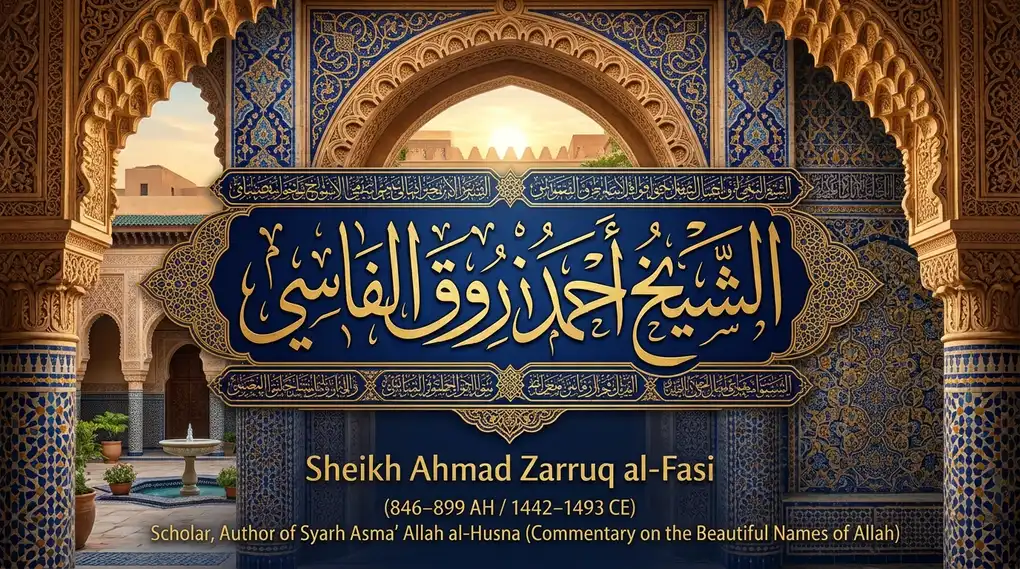
Who Is Shaykh Ahmad Zarruq al-Fasi?
Shaykh Ahmad Zarruq was a Moroccan scholar of the ninth Islamic century who wrote a commentary on the Asmaul Husna in the book Sharh Asma’ Allah al-Husna. He was a Maliki jurist, a hadith scholar, and a figure of Sufism. His name is also written Ahmad Zarruq al-Fasi, after the city of Fes where he was born.
This biography of Shaykh Ahmad Zarruq runs from his name and titles, through his birth and travels, to his writings and thought, and ends with the book Sharh Asma’ Allah al-Husna and his legacy.
A Short Portrait: Jurist, Hadith Scholar, and Sufi
The editor of the book, Sayyid Yusuf Ahmad, introduces Zarruq by quoting Mu’jam al-Mu’allifin by Umar Rida Kahhalah. There Zarruq is called a Sufi, a jurist, and a hadith scholar, born in 846 AH and died in 899 AH.[1]
Al-Zirikli, in al-A’lam, adds a more detailed judgment. According to him Zarruq wrote many works that are concise yet careful, and excelled in the quality of his writing on Sufism.[2]
Why Knowing the Author Matters before Reading His Book
A book on the names of Allah should not be read casually. The reader needs to know who the author was, which tradition he studied in, and what his scholarly temperament looked like. That lets us weigh the book fairly, neither too suspicious nor too credulous.
So this biography serves as a doorway. After it, you can read Asmaul Husna and the discussion of each name with better preparation.
Sources and Limits of This Article
We built this biography from three sources. First, the editor’s and author’s introductions in Sharh Asma’ Allah al-Husna (edited by Sayyid Yusuf Ahmad, Dar al-Kutub al-‘Ilmiyyah, 2007). Second, al-Murshid al-Mu’arrif bi-Ma’ani wa Asrar Qawa’id al-Tasawwuf by Prof. Dr. Taha al-Dasuqi Habishi, volume one, which gives a long biography of Zarruq. Third, the introduction of ‘Uddat al-Murid al-Sadiq, which we use for the origin of his nisba and nickname.
We only write what has a source. Miracle stories and unreferenced anecdotes are left out on purpose. Where the sources disagree, we say so.
Full Name, Nisba, and the Nickname “Zarruq”
The questions people ask most are the full name of Ahmad Zarruq and the meaning of Zarruq. Let us take them one at a time.
The Name According to the Editor
The editor writes his name as follows:
هو الإمام أحمد بن أحمد بن محمد بن عيسى، البرنسي، الفاسي، المالكي، الشهير بزروق، شهاب الدين أبو الفضل.
Meaning: “He is the Imam Ahmad ibn Ahmad ibn Muhammad ibn ‘Isa al-Burnusi al-Fasi al-Maliki, famous as Zarruq, with the honorific Shihab al-Din and the kunya Abu al-Fadl.”[3]
One thing makes people ask: why “Ahmad son of Ahmad”? Habishi quotes Zarruq’s own personal notes. The baby was first named Muhammad. His parents died within days of his birth, and his name was changed to Ahmad so that his father’s name would stay remembered.[4]
Two Kunyas: Abu al-Fadl and Abu al-‘Abbas
Besides Abu al-Fadl, we also find the kunya Abu al-‘Abbas. Zarruq himself uses it in the introduction of his book. The opening line gives his name like this:
أبو العباس أحمد بن أحمد بن محمد بن عيسى البرنسي الفاسي، المشهور بأحمد زرّوق
Meaning: “Abu al-‘Abbas Ahmad ibn Ahmad ibn Muhammad ibn ‘Isa al-Burnusi al-Fasi, famous as Ahmad Zarruq.”[5]
Al-Zirikli in al-A’lam also uses Abu al-‘Abbas.[2] So both kunyas are known, and they do not contradict each other.
The Meaning of the Nisba: al-Fasi, al-Burnusi, and al-Maliki
The three attributions after his name point to his origin and his school:
- Al-Fasi: from Fes (Fas) in Morocco. Al-Zirikli calls him “from the people of Fes in the Maghrib”.[2]
- Al-Burnusi: attributed to the Burnus tribe (al-Baranis). Al-Hajwi describes al-Baranis as a Berber tribe near Fes.[6] Habishi also notes that Zarruq came from this tribe, and that the tribe later founded a zawiya in his name once he became famous.[7]
- Al-Maliki: follower of the Maliki school of fiqh, as stated by Kahhalah and al-Sakhawi.[1][8]
Where Does the Nickname “Zarruq” Come From?
We found the explanation of the meaning of Zarruq in the introduction of ‘Uddat al-Murid al-Sadiq (vol. 1, p. 7), in the section on the author’s lineage. The writer explains the nisba and the nickname together:
هو شهاب الدين أبو العباس أحمد بن أحمد بن محمد بن عيسى البرنسي الفاسي، اشتهر بزروق، و(برنسي) نسبة إلى عرب بالمغرب كما جاء عن رفيق المؤلف ابن غازي في نيل الابتهاج، وقال الحجوي في الفكر السامي: البرانس قبيلة بربرية قرب فاس، و(زروق) لقب أتاه من جهة جده لأمه الذي كان أزرق العينين.
Meaning: “He is Shihab al-Din Abu al-‘Abbas Ahmad ibn Ahmad ibn Muhammad ibn ‘Isa al-Burnusi al-Fasi, famous as Zarruq. Burnusi is attributed to Arabs in the Maghrib, as reported from the author’s companion Ibn Ghazi in Nayl al-Ibtihaj. Al-Hajwi said in al-Fikr al-Sami: al-Baranis is a Berber tribe near Fes. As for Zarruq, it is a nickname that came to him from his maternal grandfather, who had blue eyes (azraq).”[6]
So the meaning of Zarruq relates to eye colour: azraq means blue, and the nickname came down from his grandfather on his mother’s side. The book refers to al-Bustan (p. 45) and Nayl al-Ibtihaj (p. 85).
How to read it is recorded by al-Sakhawi in al-Daw’ al-Lami’: a fatha on the letter za, a doubled ra, then waw, then qaf.[8] So the correct pronunciation is Zarruq.
Spelling Variants: Zarruq, Zaruq, and Zarrouk
Online you will find several spellings: Zarruq, Zaruq, and, in French-language writing, sometimes Zarrouk. They all refer to the same man. The spelling Zarruq is closest to the Arabic pronunciation, so we use it throughout.
Honorific Titles from the Author and the Editor
Anyone who opens Sharh Asma’ Allah al-Husna meets a row of titles on the page of the author’s introduction. The titles of Shaykh Zarruq read:
قال الشيخ الإمام العالم العلامة، الولي الصالح، العارف بالله تعالى، الناصح المحقق الراسخ، أبو العباس أحمد بن أحمد بن محمد بن عيسى البرنسي الفاسي، المشهور بأحمد زرّوق
Meaning: “The Shaykh, the Imam, the learned, the great scholar, the righteous friend of Allah (wali), the knower of Allah (‘arif billah), the sincere adviser, the firmly grounded verifier, Abu al-‘Abbas Ahmad ibn Ahmad ibn Muhammad ibn ‘Isa al-Burnusi al-Fasi, famous as Ahmad Zarruq, said:”[5]
In short:
- Al-‘Alim al-‘Allamah: a person of wide and deep learning.
- Al-Wali al-Salih: a righteous servant close to Allah.
- Al-‘Arif billah: one who knows Allah through knowledge and inner experience.
- Al-Nasih: a sincere adviser.
- Al-Muhaqqiq al-Rasikh: a careful researcher with firm knowledge.
Similar respect comes from al-Munawi in Tabaqat al-Shadhiliyyah. Habishi quotes him:
عابد من بحر العبر يغترف، وعالم بالولاية متصف، تحلّى بعقود القناعة والعفاف، وبرع في معرفة الفقه والتصوف والأصول والخلاف
Meaning: “A worshipper who draws from the sea of lessons, a scholar described with sainthood, adorned with contentment and chastity, and excelling in fiqh, Sufism, usul, and the study of disagreement.”[9]
Reading the Titles Fairly
Titles such as Zarruq, friend of Allah or al-‘arif billah are expressions of respect in the book-writing tradition. They were written by followers or students who loved their teacher, and we read them as scholarly praise, not as a guarantee of absolute holiness. Only Allah knows the state of His servants’ hearts.
What we can judge directly are his works and his scholarly character. Even so, we should also think well of him as a servant of Allah who is close to Him, given the righteousness of his deeds and the depth of his learning.
In the next sections we see when he was born, who his teachers were, where he died, and what he wrote.
Zarruq’s Birth in Fes
The first question, where and when was Shaykh Zarruq born, has a fairly clear answer. He was born in Fes, Morocco, on a Thursday in the month of Muharram, 846 AH. The exact day differs between two groups of sources, and we report that difference as it is.
Date and Place of Birth
The first source is Zarruq’s own note. Habishi quotes it from the Shaykh’s kunnash (personal notebook):
كان مولدي عند طلوع الشمس من يوم الخميس الثاني والعشرين من شهر محرم سنة ست وأربعين وثمانمائة
Meaning: “I was born at sunrise on Thursday, 22 Muharram 846 AH.”[10] The book ‘Uddat al-Murid al-Sadiq says the same:
ولد المؤلف يوم الخميس في الثاني والعشرين من محرم عام ٨٤٦ من الهجرة
Meaning: “The author was born on Thursday, 22 Muharram in the year 846 of the Hijra.”[11]
The second source says 28 Muharram. The editor of Sharh Asma’ Allah al-Husna quotes Mu’jam al-Mu’allifin, which says “born in Fes on 28 Muharram 846 AH”, and al-Sakhawi in al-Daw’ al-Lami’ writes “Thursday, 28 Muharram 846 AH”.[12] We follow 22 Muharram because it comes from Zarruq’s own note and is supported by two books.
Conversion to the Common Era
Habishi writes that his birth year corresponds to 1442 CE.[10] We recalculated with the tabular Hijri calendar. The result: 22 Muharram 846 AH falls around 1 June 1442 CE (Julian calendar) and is indeed a Thursday. Habishi writes “7 June”, a date closer to 28 Muharram. Since tabular conversion can be off by a day or two, it is enough to note: born in early summer of 1442 CE.
Childhood: An Orphan from the First Day
Zarruq was born in a plague year. Habishi says the plague known as the “plague of ‘Azzuna” struck the Maghrib at that time.[13] His mother died on the third day after giving birth, and his father followed before the seventh day. Zarruq grew up as an orphan.[11]
His grandmother raised him. Here the two sources differ again. ‘Uddat al-Murid says he was raised by his paternal grandmother according to his father’s will.[11] Habishi, based on Zarruq’s notes, writes that his father asked for the paternal grandmother to raise him, but in the end it was his maternal grandmother, Umm al-Banin, who cared for him. Zarruq calls her a learned and pious woman.[13]
From his grandmother he learned prayer from the age of five, then tawhid and trust in Allah. She told him: “learn to read for religion, and a skill for earning a living.” Zarruq completed memorizing the Qur’an at ten, then worked as an apprentice cobbler (kharraz) until he was 16.[14]
His Journey in Seeking Knowledge and His Teachers
The search for the teachers of Shaykh Ahmad Zarruq has a rich answer, because he recorded his teachers’ names himself.
Fes as a Centre of Learning
At 16 Zarruq left the cobbler’s shop and joined the students of the Qarawiyyin Mosque and the ‘Inaniyya Madrasa in Fes. There he studied the core books of the Maliki school, hadith, usul, and the rules of Arabic.[15]
Teachers in Fiqh and Hadith
Zarruq noted about thirty of his teachers. Habishi copies the list with names such as Abdullah al-Qawri (d. 872 AH), Muhammad al-Qalsawi, Abd al-Rahman al-Tha’alibi (d. 873 AH), Muhammad al-Rassa’, and Muhammad al-Zaytuni.[16] Among the books he read were the Risala of Ibn Abi Zayd al-Qayrawani, Sahih al-Bukhari, Jami’ al-Tirmidhi, and the Qur’an recitation in the Nafi’ reading.[17] His reading list also includes the Sufi work al-Tanwir by Ibn ‘Ata’illah.
Teachers in Sufism and the Shadhili Tradition
His Sufi teacher in Fes was Muhammad al-Zaytuni, a blind Sufi figure. Their relationship broke for a time in 870 AH, and Zarruq spent about 40 days wandering. Habishi says the cause of the rupture is unclear and the stories in circulation come in two versions, so we do not use them as fact.[18]
In Cairo, Zarruq met al-Sakhawi and Ahmad ibn ‘Uqba al-Hadrami. Habishi names al-Hadrami as an important figure who brought Zarruq into the Shadhili and Qadiri paths.[19] Zarruq’s Shadhili chains have several routes, which Habishi discusses separately.[20]
Al-Sakhawi wrote about their meeting:
وارتحل إلى الديار المصرية فحج وجاور بالمدينة وأقام بالقاهرة نحو سنة مديمًا للاشتغال عند الجوجري وغيره في العربية والأصول وغيرهما وقرأ عليَّ بلوغ المرام وبحث علىَّ في الاصطلاح بقراءته ولازمني في أشياء
Meaning: “He travelled to Egypt, performed the pilgrimage, stayed in Medina, and lived in Cairo for about a year, studying Arabic and usul with al-Jawjari and others. He read Bulugh al-Maram with me, studied the science of hadith terminology, and kept my company in several matters.”[21]
Travels to Many Lands

This is Zarruq’s route according to Habishi:
- 873 AH (1468 CE): left Fes after asking permission from his teacher Ahmad al-Ghumari. He performed Hajj and stayed in Mecca and Medina.[22]
- 876 AH (1471 CE): arrived in Cairo and studied at al-Azhar with about eighteen teachers. A year later he left Egypt with his companion, passing through Libya and Tunis.[23]
- Bijaya (Algeria), around 879–880 AH: stayed several years, then returned to Fes. According to Habishi the welcome in Fes was cold, and he left the city after about four years.[24]
- 884 AH: returned to Cairo and met al-Hadrami again, this time in a better atmosphere.[25]
- 886 AH (1481 CE): settled in Misrata, Libya, until his death. There he married Amat al-Jalil bint Ahmad ibn Zakariyya al-Ghalbani and had two sons and a daughter.[26]
Zarruq’s Death and the Place Where He Rests
Died in Safar 899 AH at Takrin
Shaykh Zarruq died in the month of Safar, 899 AH (1493 CE).
Kahhalah in Mu’jam al-Mu’allifin writes:
وتوفى في صفر بتكرين من عمل طرابلس الغرب
Meaning: “He died in Safar at Takrin, in the district of Western Tripoli.”[27] Al-Zirikli in al-A’lam writes: “He died at Takrin, one of the villages of Misrata, in the district of Western Tripoli.”[28] So the place of death is Takrin (not “Takrit”), and the year 899 AH is confirmed by al-A’lam, Mu’jam al-Mu’allifin, and Shadharat al-Dhahab.[28]
Lifespan and Output
The difference between his death year and his birth year is 899 − 846 = 53 Hijri years. In that span Zarruq studied, travelled, taught, and wrote. Habishi records that his commentaries on al-Hikam alone number more than thirty.[29] We discuss these works in the next section.
Habishi also writes that Zarruq asked Allah to take his soul before the tenth century AH and that he died in his place of seclusion. What he left behind was half a horse, a rosary, and his personal clothes.[30]
The Grave and the Tradition of Visiting
Zarruq’s grave is in Misrata, Libya. Habishi states that Zarruq died and was buried there, and that his grave is still known.[31] His followers cared for the grave, led at first by Shams al-Din al-Laqqani. The zawiya complex in Misrata consists of a mosque, the tomb, a library, and a Qur’an school.[32]
Habishi also records a report that the grave was damaged by a group of people in 1433 AH. This is news that reached him, not something he saw himself, so we mention it only as a report.[33] We have not found any statement about a haul (annual commemoration) or a yearly visiting tradition in the two books, so we do not write about it.
We now know the course of his life. Next come his works and his thought.
The Works of Shaykh Zarruq
Readers looking for the books of Shaykh Ahmad Zarruq usually want to know one thing: what did he write besides the commentary on the names of Allah? The answer is long, because Zarruq was a productive author. Al-Zirikli says his works are many, tend to be concise, and are careful.[34]
Three Works Named by the Editor
In the short biography in the introduction, the editor of Sharh Asma’ Allah al-Husna names three works of Zarruq:
من مؤلفاته: شرح الحكم العطائية. قواعد التصوف على وجه يجمع بين الشريعة والحقيقة. واعتنام الفوائد في التنبيه على معاني قواعد العقائد للغزالي.
Meaning: “Among his works: Sharh al-Hikam al-‘Ata’iyya; Qawa’id al-Tasawwuf, which joins sharia and reality (haqiqa); and I’tinam al-Fawa’id fi al-Tanbih ‘ala Ma’ani Qawa’id al-‘Aqa’id, on al-Ghazali’s work.”[35]
We can meet them one by one:
- Sharh al-Hikam al-‘Ata’iyya: a commentary on the collection of wisdoms of Ibn ‘Ata’illah al-Iskandari. According to Shadharat al-Dhahab, Zarruq wrote more than thirty commentaries on al-Hikam. Al-Sakhawi agrees: Zarruq “wrote on the wisdoms of Ibn ‘Ata’illah”.[36] That is why people search for Zarruq’s commentary on al-Hikam.
- Qawa’id al-Tasawwuf: the principles of Sufism. Its full title already states the aim, which is to join sharia and reality. Shadharat al-Dhahab says Zarruq “composed it very well”.[36] This is the book that Habishi comments on in al-Murshid al-Mu’arrif.
- I’tinam al-Fawa’id: a commentary on al-Ghazali’s work on the principles of creed.
Other Works Recorded in the Sources
Besides those three titles, the sources we hold mention some other works:
- Commentaries on al-Qurtubiyya (fiqh), on the Risala of Ibn Zaydun al-Qayrawani, and on the Hizb al-Bahr of al-Shadhili. All three are mentioned in Shadharat al-Dhahab.[36]
- An urjuza (teaching poem) on the Fusul of al-Sulami, mentioned by al-Sakhawi.[37]
- Risalat Usul al-Tariq, which sets out Zarruq’s five principles of the path: taqwa, following the Sunna, turning away from creation, contentment with Allah, and returning to Him.[38]
We do not claim this list is complete. Other titles may be in sources we have not opened.
Sharh Asma’ Allah al-Husna: Marks of Its Writing
The work that this series relies on is Sharh Asma’ Allah al-Husna. You can read a dedicated discussion of the book Sharh Asma’ Allah al-Husna in its own article.
In each chapter the pattern repeats: meaning and root of the word, evidence, the view of “some of the masters”, then a warning (tanbih), drawing near to Allah (taqarrub), and special properties where they exist. A fuller treatment follows in the last section of this article.
His Thought: Joining Sharia and Reality
If asked to sum up Shaykh Zarruq’s thought in a single sentence, the answer is: sharia and Sufism walk together. Habishi writes that Zarruq became known as “al-Jami’ bayna al-Shari’a wa al-Haqiqa”, the one who joins sharia and reality.[39]
Sufism Not Detached from Sharia
Habishi describes Zarruq’s stance like this:
فهو لا يرى لأهل التصوف سلامة، ولا سببًا في البقاء إذا انفصلوا عن الشريعة، ففي الشريعة زاد الراكب إلى الله
Meaning: “He saw no safety, and no reason to endure, for the people of Sufism if they separated from sharia, for in sharia lies the provision of the traveller to Allah.”[40]
This also shows in the title Qawa’id al-Tasawwuf and in the five principles of the path in Risalat Usul al-Tariq, which put taqwa and following the Sunna first.[38] He himself studied with two kinds of teachers: jurists such as al-Qawri and masters of the path such as al-Zaytuni (see the section on his birth and teachers above).
His Creedal Stance in the Introduction
The introduction of Sharh Asma’ Allah al-Husna opens with a sentence of tanzih (declaring Allah transcendent):
الحمد لله الذي تقدس في تنزيهه، وتنزه في تقديسه
Meaning: “Praise be to Allah, who is most holy in His transcendence and free of all likeness in His holiness.”[41]
In the section on the names of Allah, Zarruq sets two positions:
الثانية: إن الأسماء توقيفية، فلا تثبت إلا بنص أو إجماع على الصحيح
Meaning: “Second: the names of Allah are tawqifi (fixed by revelation); they are not established except by a text or by consensus, according to the sound view.”[42]
On whether the name is the same as the named (al-ism wa al-musamma), he says the Salaf did not discuss it:
ولكن السلف لم يتكلموا في الاسم ولا في المسمّى، ولا في الصفة والموصوف، ولا في التلاوة والمتلو؛ طلبًا للسلامة
Meaning: “But the Salaf did not speak about the name and the named, the attribute and the one described, the recitation and the recited, seeking safety.”[42]
These three quotations show the Sunni Sufi character of Zarruq: careful in creed and attached to the texts.
Knowledge from Fath and Ta’lim
In the concluding section (p. 171), Zarruq speaks about the sources of knowledge:
ثم اعلم موارد العلم من الفتح في هذا الباب أتم من موارد التعليم، لأن التعليم ناقص بخلاف الفتح والإلهام
Meaning: “Know that the sources of knowledge from fath (an opening from Allah) in this field are more complete than the sources of ta’lim (instruction), because instruction is incomplete, unlike fath and inspiration.”[43]
He then ties knowledge to personal effort: knowledge that comes from yourself alone, without an opening, leads to error and neglect; knowledge from an opening without your own part leads to rigidity; and knowledge from both becomes verification (tahqiq). From this comes our own advice (not Zarruq’s text): the parts on practising the names of Allah are best read with a knowledgeable companion.
What Scholars Said about Zarruq
Several scholarly tributes are recorded in our sources. Al-Munawi judged Zarruq outstanding in fiqh, Sufism, usul, and the study of disagreement (see the section on names and titles above). Al-Zirikli calls him unique in the quality of his writing on Sufism.[34] On the other side, Habishi notes that Zarruq’s relations with his teacher and with some scholars of Fes were not always smooth (see the section on his life above). We report both so that the picture is whole.
Zarruq’s Scholarly Caution in Mentioning the Special Properties of Allah’s Names
This part matters for readers searching for Zarruq’s special properties of Asmaul Husna. Zarruq himself wrote an honest note at the end of his discussion of the names of Allah.
Zarruq’s Admission about the Source of the Properties
وغالب ما اعتمدته في الخواص إن هو من كتابي «كيمياء السعادة» للإمام محيي الدين بن العربي، وبعضه لأبي العباس البوني. ولم يمكنني تصحيح ذلك للعجلة التي صحبتني في وقته.
Meaning: “Most of what I relied on regarding the special properties comes from the book Kimiya’ al-Sa’ada by Imam Muhyi al-Din Ibn ‘Arabi, and some from Abu al-‘Abbas al-Buni. I could not verify it, because of the haste that accompanied me at the time.”[43]
(Note: the text here has small errors, for example “للومام” and “وم يمكنني”. We corrected them to “للإمام” and “ولم يمكنني” from context. Please check against the printed book.)
So, in the author’s own words, the section on special properties was not verified and is not the result of his own examination of the chains. This is why the topic must be handled carefully.
Lessons for the Reader
Three lessons can be taken:
- The experience of Sufi scholars is not sharia evidence. The evidence remains the Qur’an, the hadith, consensus, and analogy.
- The admission “I did not have time to verify” is an example of scholarly honesty worth imitating.
- A story about a certain benefit does not guarantee a result for anyone who practises it.
A fuller discussion is in the article on the special properties of Asmaul Husna according to the scholars.
This Site’s Editorial Stance
This site quotes the notes on special properties only as a study of their sources and standing. We do not give procedures, wird counts, or instructions for writing the names of Allah as a practical guide. Those who want to study it further should go to a knowledgeable and trustworthy teacher.
The Book Sharh Asma’ Allah al-Husna and How It Was Composed
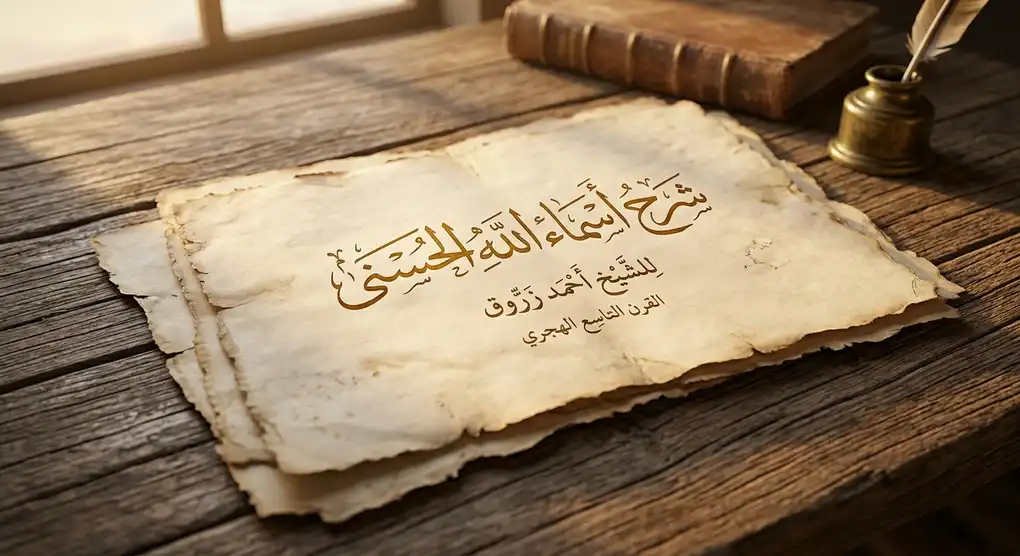
Having seen Zarruq’s works, we now come to one of his books that this series relies on: Sharh Asma’ Allah al-Husna. People often search for it as Zarruq’s Asmaul Husna book. The edition we use is edited by Sayyid Yusuf Ahmad, published by Dar al-Kutub al-‘Ilmiyyah, Beirut, first printing 2007 (1428 AH), 220 pages.
“Kulliyat”: How Zarruq Describes His Book
Zarruq himself describes the book in the introduction:
فهذه كليات تفاسير على الأسماء الحسنى حسب الطاقة
Meaning: “This is a broad outline (kulliyat) of commentary on the Asmaul Husna, according to ability.”[44] He also writes that whatever has come regarding a name, he presents according to capacity and ease (‘ala hasab al-wus’ wa al-taysir).[44]
This sentence shows humility: the book is not an encyclopedia but an outline composed within its author’s limits. In each chapter the pattern is meaning and root of the word, evidence, the view of some masters, then tanbih, taqarrub, and special properties where known.
The Editor’s Work
The editor explains his own steps, among them:
1- تفسير الآيات الواردة في النص. 2- تخريج الأحاديث من كتب الصحاح. 3- شرح ما جاء في الأحاديث من كتب الشرح وخاصة شرح الإمام النووي لصحيح مسلم. 4- ترجمة ما ورد من الرجال بالكتاب.
Meaning: “(1) interpreting the verses that appear in the text; (2) tracing the hadiths to the sound collections; (3) explaining the hadiths from the commentary books, especially Imam al-Nawawi’s commentary on Sahih Muslim; (4) giving biographies of the men mentioned in the book.”[45]
Next come the supplication hadiths that fit the events the author recounts, especially in the commentary on the poem of al-Dimyati, and explaining the names of Allah by reference to the scholars’ books, above all Silah al-Mu’min (written «سلاح المؤمن») by Ibn al-Imam.[45]
Appendix: Commentary on the Poem of al-Dimyati
After the 84 chapters and the conclusion, the book contains an appendix on pages 175 to 214: Zarruq’s commentary on al-Dimyati’s poem about the special properties of the names of Allah. Zarruq opens it with:
فها أنا أذكر شيئًا من خواص نظم الشيخ الولي الصالح الصوفي نور الدين، سيدنا ومولانا الشهير بالدمياطي، نفعنا الله به وبأمثاله على وجه الاختصار
Meaning: “Here I mention something of the special properties of the poem of the righteous friend of Allah, the Sufi Nur al-Din al-Dimyati, briefly.”[46]
This part contains many practical instructions. Because of Zarruq’s own note on page 171 about the source of the properties (see above), this site treats it as a study of sources and standing, not as an amal guide.
Scholarly Legacy and Lessons from Zarruq’s Life
An Example for the Ordinary Reader
From Zarruq’s life, a few lessons can be drawn by readers today:
- Being an orphan is no reason to stop learning. Zarruq lost both parents in his first week of life, worked as a cobbler’s apprentice, then changed course at 16.
- Knowledge and livelihood go together. His grandmother’s advice, “read for religion, a skill for a living”, he lived out.
- Joining sharia and Sufism. He studied fiqh, hadith, and the spiritual path together.
- Honesty about the limits of one’s knowledge. He admitted he had not had time to verify the sources of the special properties.
All of this comes from the sources quoted in the sections above, not from new additions.
Reading Zarruq with a Companion
Zarruq wrote that knowledge only “from yourself” leads to error and knowledge only “from an opening” leads to rigidity (p. 171). He places verification (tahqiq) where the two meet.[47] As readers we can apply this by reading the creed sections and the names of Allah in order, then asking a teacher when something is unclear.
An Invitation to Keep Reading
If you want to continue, read the discussions of the names of Allah on this blog one by one, starting from the introduction to Asmaul Husna, then the pillars on tawhid, mercy, and majesty. Knowing the author lets us read his work with a calmer mind.
FAQ about the Biography of Shaykh Ahmad Zarruq
What is Shaykh Ahmad Zarruq’s full name, and what do his nisbas mean?
His full name is Ahmad ibn Ahmad ibn Muhammad ibn ‘Isa al-Burnusi al-Fasi al-Maliki, with the honorific Shihab al-Din and the kunya Abu al-Fadl or Abu al-‘Abbas.[48] His nisbas:
- Al-Fasi: from Fes, Morocco.
- Al-Burnusi: from the Berber al-Baranis tribe near Fes.
- Al-Maliki: follower of the Maliki school.
The nickname Zarruq comes from his maternal grandfather, who had blue eyes (azraq), according to ‘Uddat al-Murid al-Sadiq.[49]
When and where was Shaykh Zarruq born and when did he die?
He was born in Fes on Thursday, 22 Muharram 846 AH (around 1442 CE) according to Zarruq’s own note. Some sources write 28 Muharram. He died in Safar 899 AH (around 1493 CE) at Takrin, a village of Misrata in the district of Western Tripoli, Libya.[50]
Which school of fiqh did Shaykh Zarruq follow?
He followed the Maliki school and is described as a jurist and a hadith scholar.[51] He was also known as a Shadhili Sufi who joined sharia and reality.
What are the works of Shaykh Zarruq?
The works named in this book:
- Sharh al-Hikam al-‘Ata’iyya: a commentary on the wisdoms of Ibn ‘Ata’illah.
- Qawa’id al-Tasawwuf: the principles of Sufism, joining sharia and reality.
- I’tinam al-Fawa’id: a commentary on al-Ghazali’s work on creed.
- Sharh Asma’ Allah al-Husna: the commentary on the names of Allah.[51]
Other sources also mention commentaries on al-Qurtubiyya and Hizb al-Bahr.
Is every special property of Asmaul Husna in Zarruq’s book confirmed as true?
No. Zarruq wrote that most of the properties he mentions were taken from Kimiya’ al-Sa’ada by Ibn ‘Arabi, and some from al-Buni, and that he did not have time to verify them.[52]
So these properties are not a sharia ruling and do not guarantee any result. This site does not make them a practical guide.
Footnotes
1 : Ahmad Zarruq, Sharh Asma’ Allah al-Husna, ed. Sayyid Yusuf Ahmad (Beirut: Dar al-Kutub al-‘Ilmiyyah, 2007), Editor’s Introduction, p. 6, citing Umar Rida Kahhalah, Mu’jam al-Mu’allifin, vol. 1, p. 155. The same quotation is given by Taha Habishi, al-Murshid al-Mu’arrif bi-Ma’ani wa Asrar Qawa’id al-Tasawwuf li-Syaikh Ahmad Zarruq, vol. 1, p. 49: «الشهير بزروق (شهاب الدين أبو الفضل) صوفي فقيه محدث». ↩
2 : Taha Habishi, al-Murshid al-Mu’arrif, vol. 1, pp. 49 and 77, citing al-Zirikli, al-A’lam, vol. 1, pp. 87–88. ↩
3 : Zarruq, Sharh Asma’ Allah al-Husna, Editor’s Introduction, p. 6 (section “al-Ta’rif bi al-Musannif”). ↩
4 : Habishi, al-Murshid al-Mu’arrif, vol. 1, p. 8, quoting Zarruq’s personal notebook (kunnash). Habishi gives three reasons for the change of name, one being to keep his father’s name alive in memory. ↩
5 : Zarruq, Sharh Asma’ Allah al-Husna, Author’s Introduction, p. 15. ↩
6 : ‘Uddat al-Murid al-Sadiq, vol. 1, p. 7 (Introduction on the author and the book, first: the author, his lineage), citing Ibn Ghazi, Nayl al-Ibtihaj, p. 85; al-Hajwi, al-Fikr al-Sami; and al-Bustan, p. 45. ↩
7 : Habishi, al-Murshid al-Mu’arrif, vol. 1, pp. 121 and 123, on the zawiya of Tliwan in the territory of the al-Baranis tribe. ↩
8 : Habishi, al-Murshid al-Mu’arrif, vol. 1, pp. 48–49, citing al-Sakhawi, al-Daw’ al-Lami’ li-Ahl al-Qarn al-Tasi’, vol. 1, p. 222. ↩
9 : Habishi, al-Murshid al-Mu’arrif, vol. 1, p. 77, citing al-Munawi, Tabaqat al-Shadhiliyya. ↩
10 : Habishi, al-Murshid al-Mu’arrif, vol. 1, pp. 7–8, quoting Zarruq’s kunnash. ↩
11 : ‘Uddat al-Murid al-Sadiq, vol. 1, p. 7 (Introduction, the author, his birth and upbringing). ↩
12 : Zarruq, Sharh Asma’ Allah al-Husna, ed. Sayyid Yusuf Ahmad, Editor’s Introduction, p. 6, citing Mu’jam al-Mu’allifin. Al-Sakhawi, al-Daw’ al-Lami’, vol. 1, p. 222, as quoted by Habishi, al-Murshid, vol. 1, p. 48. ↩
13 : Habishi, al-Murshid al-Mu’arrif, vol. 1, pp. 7–9. ↩
14 : Habishi, al-Murshid al-Mu’arrif, vol. 1, pp. 9–12, 14–15. ↩
15 : Habishi, al-Murshid al-Mu’arrif, vol. 1, p. 29. ↩
16 : Habishi, al-Murshid al-Mu’arrif, vol. 1, pp. 30–31 (list of 30 teachers from Zarruq’s notes). ↩
17 : Habishi, al-Murshid al-Mu’arrif, vol. 1, p. 32. ↩
18 : Habishi, al-Murshid al-Mu’arrif, vol. 1, pp. 33–38. ↩
19 : Habishi, al-Murshid al-Mu’arrif, vol. 1, pp. 44–46 and 85–86. ↩
20 : Habishi, al-Murshid al-Mu’arrif, vol. 1, pp. 80–83. ↩
21 : Al-Sakhawi, al-Daw’ al-Lami’, vol. 1, p. 222, as quoted by Habishi, al-Murshid al-Mu’arrif, vol. 1, pp. 48–49. ↩
22 : Habishi, al-Murshid al-Mu’arrif, vol. 1, p. 40. ↩
23 : Habishi, al-Murshid al-Mu’arrif, vol. 1, pp. 41–44. ↩
24 : Habishi, al-Murshid al-Mu’arrif, vol. 1, pp. 54–60. ↩
25 : Habishi, al-Murshid al-Mu’arrif, vol. 1, p. 63. ↩
26 : Habishi, al-Murshid al-Mu’arrif, vol. 1, pp. 64, 68. ↩
27 : Umar Rida Kahhalah, Mu’jam al-Mu’allifin, vol. 1, p. 155, as quoted by Habishi, al-Murshid, vol. 1, p. 49. ↩
28 : Al-Zirikli, al-A’lam, vol. 1, pp. 87–88, as quoted by Habishi, al-Murshid, vol. 1, pp. 49 and 77. The year 899 AH is also given in the quotation from Shadharat al-Dhahab on p. 77 of the same book. ↩
29 : Habishi, al-Murshid al-Mu’arrif, vol. 1, p. 77, citing Shadharat al-Dhahab. ↩
30 : Habishi, al-Murshid al-Mu’arrif, vol. 1, p. 69 (section “al-Rahil”). ↩
31 : Habishi, al-Murshid al-Mu’arrif, vol. 1, p. 122. ↩
32 : Habishi, al-Murshid al-Mu’arrif, vol. 1, pp. 113, 119–120. ↩
33 : Habishi, al-Murshid al-Mu’arrif, vol. 1, p. 121. ↩
34 : Al-Zirikli, al-A’lam, vol. 1, pp. 87–88, as quoted by Taha Habishi, al-Murshid al-Mu’arrif, vol. 1, p. 77. ↩
35 : Zarruq, Sharh Asma’ Allah al-Husna, ed. Sayyid Yusuf Ahmad (Beirut: Dar al-Kutub al-‘Ilmiyyah, 2007), Editor’s Introduction, p. 6. ↩
36 : Habishi, al-Murshid al-Mu’arrif, vol. 1, p. 77, citing Shadharat al-Dhahab and al-Sakhawi, al-Daw’ al-Lami’. ↩
37 : Al-Sakhawi, al-Daw’ al-Lami’, vol. 1, p. 222, as quoted by Habishi, al-Murshid, vol. 1, p. 49. ↩
38 : Habishi, al-Murshid al-Mu’arrif, vol. 1, p. 91 (Risalat Usul al-Tariq). ↩
39 : Habishi, al-Murshid al-Mu’arrif, vol. 1, p. 47. ↩
40 : Habishi, al-Murshid al-Mu’arrif, vol. 1, p. 75. ↩
41 : Zarruq, Sharh Asma’ Allah al-Husna, Author’s Introduction, p. 15. ↩
42 : Zarruq, Sharh Asma’ Allah al-Husna, Author’s Introduction, p. 17. ↩
43 : Zarruq, Sharh Asma’ Allah al-Husna, Conclusion, p. 171. ↩
44 : Zarruq, Sharh Asma’ Allah al-Husna, ed. Sayyid Yusuf Ahmad (Beirut: Dar al-Kutub al-‘Ilmiyyah, 2007), Author’s Introduction, p. 16. ↩
45 : Zarruq, Sharh Asma’ Allah al-Husna, Editor’s Introduction, p. 7 (work plan). ↩
46 : Zarruq, Sharh Asma’ Allah al-Husna, Appendix: Commentary on the Poem of al-Dimyati, p. 177 (title page at p. 175). ↩
47 : Zarruq, Sharh Asma’ Allah al-Husna, Conclusion, p. 171. ↩
48 : Zarruq, Sharh Asma’ Allah al-Husna, Editor’s Introduction, p. 6; Author’s Introduction, p. 15. ↩
49 : ‘Uddat al-Murid al-Sadiq, vol. 1, p. 7. ↩
50 : Taha Habishi, al-Murshid al-Mu’arrif, vol. 1, pp. 7–8, 49, 77; Zarruq, Sharh Asma’ Allah al-Husna, Editor’s Introduction, p. 6. ↩
51 : Zarruq, Sharh Asma’ Allah al-Husna, Editor’s Introduction, p. 6. ↩
52 : Zarruq, Sharh Asma’ Allah al-Husna, Conclusion, p. 171. ↩
- Al-Zarrūq, Shihāb al-Dīn Abū al-ʿAbbās Aḥmad ibn Aḥmad ibn Muḥammad ibn ʿĪsā al-Barnusī al-Fāsī. ʿUddat al-Murīd al-Ṣādiq. Edited by al-Ṣādiq ibn ʿAbd al-Raḥmān al-Ghiryānī. Beirut: Dār Ibn Ḥazm, 1st ed., 1427 AH/2006 CE. 313 pages.
- Aḥmad ibn Aḥmad ibn Muḥammad ibn ʿĪsā al-Zarrūq al-Fāsī, Sharḥ Asmāʾ Allāh al-Ḥusnā, Yalīhi Sharḥ Manẓūmat al-Dimyāṭī li-Khawāṣṣ Asmāʾ Allāh, edited by al-Sayyid Yūsuf Aḥmad (Beirut: Dār al-Kutub al-ʿIlmiyyah, 1428 AH/2007 CE), pp. 6–177.
- Ṭāhā Ḥabīshī, Al-Murshid al-Muʿarrif bi-Maʿānī wa Asrār Qawāʿid al-Taṣawwuf, edited by Aḥmad Zarrūq, 1st ed. (Dār al-Imām al-Rāzī li al-Nashr wa al-Tawzīʿ, 2001), vol. 1, pp. 8–222.


