

Have you ever imagined a mighty king, whose dominion encompassed humans, jinn, and the wind, standing still to listen to the advice of a tiny insect? The story of Prophet Solomon (Sulaiman) and the ant is one of the most magnificent moments in the history of the prophets. This event holds profound messages about justice, leadership, and the fleeting reality of worldly life.
This story, immortalized in Surah An-Naml of the Quran, is beautifully detailed by Quranic exegetes. Based on the references from the tafsir book Al-Bahr Al-Madid fi Tafsir Al-Qur’an Al-Majid (Vol. 4, Pages 184-186) by Sheikh Ibn ‘Ajiba, there are various fascinating details and wisdom-filled dialogues. Let us dive into the journey of the conqueror of the wind as he passed through the Valley of the Ants (Wadi An-Naml).
The Airborne Army Above Wadi An-Naml
The grand journey of Prophet Solomon, peace be upon him, and his army was not taken on conventional land routes, but through the air. Sheikh Ibn ‘Ajiba explains that the Quran states hatta idza ataw ‘ala wadi an-naml (Until, when they came upon the valley of the ants). The use of the word ‘ala (upon/above) indicates that Solomon and his army approached from above, sailing through the sky. They intended to land at the highest peak of the valley.
Where was Wadi An-Naml located? There are several opinions among the early scholars:
- According to Muqatil, the valley was in Ash-Sham (Greater Syria).
- According to Ka’b, the location was in Ta’if, specifically in a valley called Wadi As-Sadir.
- Another opinion states that it was a valley inhabited by Jinn, and the ants there served as their mounts. Nauf Al-Himyari noted that the ants in that valley were the size of flies.
The Panic of the Ant and the Warning to Her People
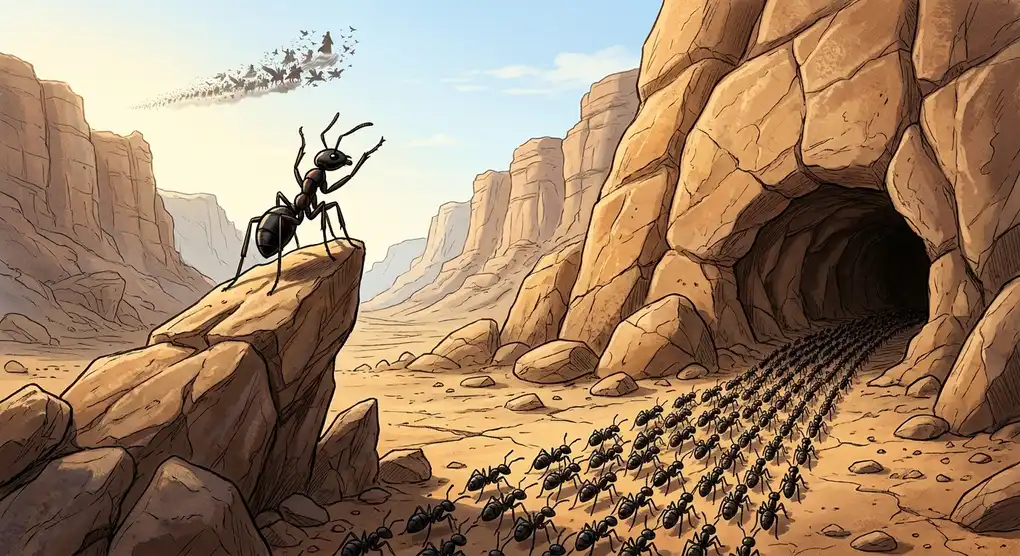
Seeing the massive army descending from the sky, a single ant realized the looming danger. Ka’b described this ant as walking with a limp (tarjaa) like a wolf. Scholars like Adh-Dhahhak mentioned her name was Tahiyah. Others said her name was Mundhirah (The Warner) or Jarmi.
She fled and shouted a stern warning to her colony:
“An ant said, ‘O ants, enter your dwellings that you not be crushed by Solomon and his soldiers while they perceive not.'” (Surah An-Naml: 18).
The Quran uses the pronoun for rational beings (udkhulu masakinakum instead of udkhulna). Sheikh Ibn ‘Ajiba explains that because this ant was speaking and issuing instructions like a rational human, the pronoun used reflects that of intellectual beings.
The Ant’s Brilliance in Good Assumption (Husnuzhan)
The ant’s phrase, “that you not be crushed…”, was not a prohibition directed at Solomon, but rather an instruction to her own people not to stand in the army’s path.
Brilliantly, she concluded with wahum la yasy’urun (while they perceive not). This was an excuse made by the ant, attributing justice to Prophet Solomon. It was as if she was saying, “If they were aware and saw us, they would certainly not crush us, because they are just people.”
Was the Ant Male or Female?

Regarding the gender of this ant, there is a famous anecdote involving Imam Qatadah and a young Imam Abu Hanifah.
It is narrated that Imam Qatadah once visited Kufa and challenged the people, “Ask me about anything you wish!”
The young Abu Hanifah stepped forward and asked, “Regarding the ant of Prophet Solomon, was it male or female?”
Taken aback, Imam Qatadah was speechless. Abu Hanifah then answered his own question, “The ant was female.”
When asked how he knew, Abu Hanifah brilliantly replied, “From the word of Allah: ‘Qalat namlatun’ (A female ant said). Had it been male, Allah would have said: ‘Qala namlatun’.”
A Spiritual Dialogue: The Profound Advice from the Ant
By the power of Allah, the wind carried the ant’s shout directly to Prophet Solomon’s ears from three miles away. It is narrated in tafsir literature that a spiritual dialogue took place.
Prophet Solomon asked, “Why did you warn the ants, did you fear my oppression? Did you not know that I am a just Prophet?”
The ant replied, “Did you not hear my statement: ‘while they perceive not’? Furthermore, I did not mean that your troops would physically crush us (hatm an-nufus). What I feared was the crushing of our hearts (hatm al-qulub). I was afraid my people would be distracted by the splendor of your kingdom and forget to glorify Allah.”
Amazed, Prophet Solomon requested, “Give me some advice!”
The ant asked, “Do you know why your father was named Dawud (David)?”
Solomon answered, “No.”
The ant explained, “Because he healed his inner wound (dawwa harajahu – cured himself from remorse).”
She asked again, “Do you know why you are named Sulaiman (Solomon)?”
“No.”
The ant elaborated, “Because you are Salim (sound/safe). You did not let wealth blind you, due to the soundness of your heart.”
The ant threw a final question, “Do you know why Allah subjugated the wind for you?”
“No.”
The ant delivered a profound spiritual strike, “Allah wanted to inform you that this entire world is nothing but passing wind.”
A Prayer of Gratitude at the Peak of Glory

Listening to this profound advice, Prophet Solomon showed a beautiful reaction: “So he smiled, amused at her speech…” (Surah An-Naml: 19).
Sheikh Ibn ‘Ajiba explains that the laughter of the Prophets is mostly smiling. He commanded the wind to pause so the ants wouldn’t be terrified until they safely entered their homes. In that miraculous moment, he prayed:
“My Lord, awzi’ni (inspire me/restrain me) to be continuously thankful for Your favor which You have bestowed upon me and upon my parents…”
The word awzi’ni originally means “to prevent/restrain,” meaning: Restrain me from everything except thanking You. Solomon fully realized that ultimate salvation and entry to paradise are solely by Allah’s mercy.
Valuable Lessons
- A Leader Protects Subordinates: The ant risked herself to warn her colony.
- The Beauty of Good Assumption (Husnuzhan): The ant made an excuse by saying “while they perceive not”.
- The Fleeting World: The advice that “the world is like the wind” reminds us that all worldly grandeur will pass.
- The Danger of Glamour: The ant’s fear that her people would forget to glorify Allah because of military might is highly relevant today. Material obsession can crush our spiritual hearts (hatm al-qulub).
- Gratitude When at the Top: Prophet Solomon remained humble and prayed for guidance to remain grateful.
Because of this ant’s nobility, the Prophet Muhammad ﷺ forbade Muslims from killing four animals: the hoopoe bird, the shrike, the bee, and the ant (Narrated by Ibn Abbas).
⚠️ Verification Note: The specific dialogue containing advice about the names Dawud, Sulaiman, and the wind originates from tafsir narrations (wisdom tales) used by scholars for spiritual lessons, not from the explicit text of the Quran itself.
Aḥmad ibn Muḥammad ibn al-Mahdī ibn ʿAjībah, Al-Baḥr al-Madīd fī Tafsīr al-Qurʾān al-Majīd, ed. Aḥmad ʿAbd Allāh al-Qurashī Raslān (Cairo: Dr. Ḥasan ʿAbbās Zakī, 1419 AH), vol. 4, pp. 184–186.


