
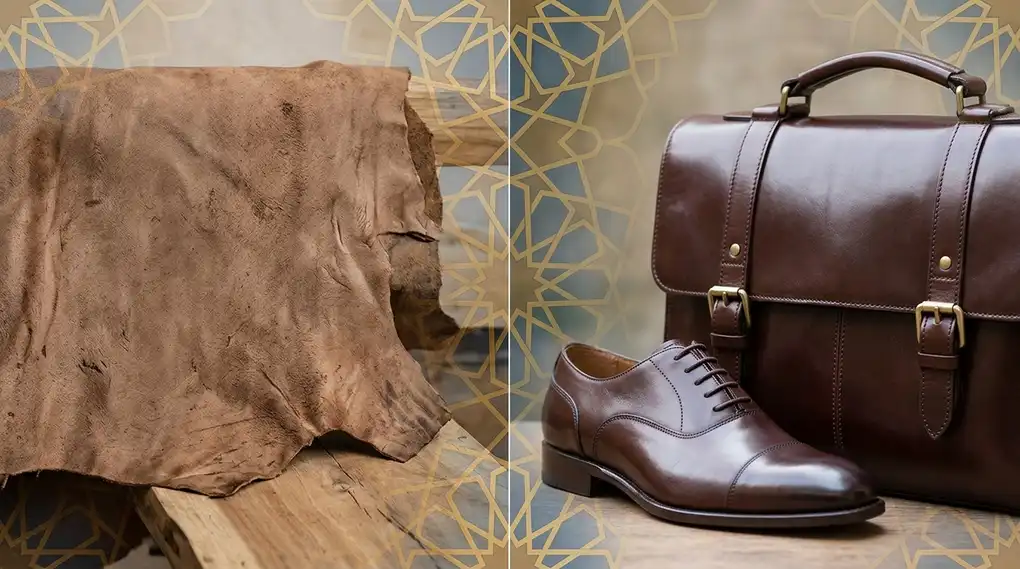
Why Do Carcass Hides Raise Questions?
Bags, Shoes, Belts, and Jackets: Where Does the Leather Come From?
Take a quick look at what you are wearing. Leather shoes on your feet, a belt at your waist, a wallet in your pocket, or a leather jacket hanging in the closet. Almost everyone owns at least one item made from animal hide.
But which animal did the hide come from, and how did that animal die? Not every leather bag or shoe comes from a cow slaughtered in line with the Shariah. Some come from the hides of dead animals that were never slaughtered, and some from animals that are not lawful to eat at all.
In the pesantren, our teachers have long covered this when studying the chapter on impurities. In the past, hides were used for water skins, seats, and sandals. Today they come as factory products, but the fiqh question is the same.
The Core Question: Pure or Impure? Can It Be Purified?
Three questions come up again and again:
- Is the hide of an animal that died without slaughter impure?
- If it is impure, is there a way to purify it?
- Can every kind of hide be purified in the same way?
All three lead to one topic in the fiqh books: dabbagh (الدباغ), or tanning. Understanding the ruling on carcass hides also means knowing when shoes made from carcass leather may be worn in prayer and when they may not.
Short Answer
A carcass hide is impure by default, but it becomes pure once it is tanned (dabagh). The exceptions are the hides of dogs, pigs, and their offspring: these stay impure even after tanning.
Carcass Hides Are Impure, but Tanning Purifies Them
Shaykh al-Islam Zakariyya al-Anshari states in Asna al-Mathalib that tanning purifies a carcass hide:
«قوله: (يطهر) أي الاندباغ (جلد غير كلب، وخنزير، وفرعهما) أي فرع كل منهما مع غيره»
Meaning: “Being tanned purifies the hide of anything other than a dog, a pig, and their offspring, that is, the offspring of either one with another animal.”[1]
So the hide of a cow, goat, or camel that died as a carcass still has a way back to purity. That way is tanning with a material and method that meet the conditions, which we cover in detail below.
The Exception: Hides of Dogs, Pigs, and Their Offspring
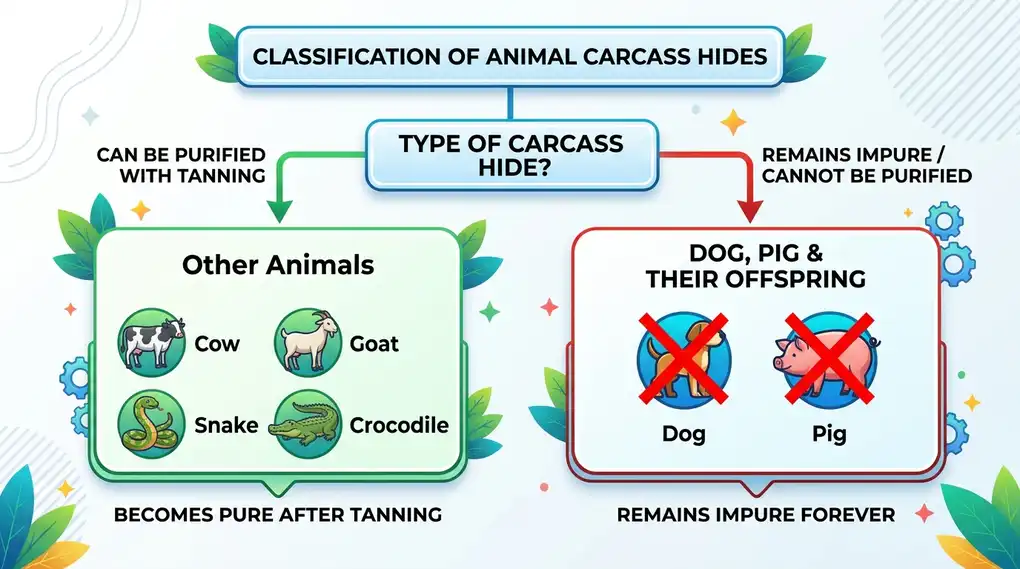
The same text also sets a limit. The hide of a dog, a pig, or an animal born from one of them and another animal cannot be purified by tanning. We explain the reasoning in the section on which hides can and cannot be purified.
The Meaning of Dabbagh (الدباغ) in Language and in Fiqh
Dabagh Means al-Indibagh (Becoming Tanned)
In Arabic, dabagh means to tan, that is, to treat a raw hide until it lasts and no longer rots. In fiqh terms, al-Anshari adds a subtle note about the word:
«قوله: (والدباغ) بمعنى الاندباغ»
Meaning: “(Dabagh) means al-indibagh (the hide’s state of having become tanned).”[1]
The difference between dabagh and indibagh looks small but has a legal effect. Dabagh sounds like an act done by the tanner. Indibagh points to the result: a hide that has truly been tanned.
Because the result is what counts, a hide is still ruled pure even when the process happens without any human action. The same book says dabagh is valid even if it happens by the wind (ولو بإلقاء الريح), for example when the wind drops a hide into the tanning material.[1]
Related Terms: Ihab and Jild
Two words come up often in this topic:
- Jild (جلد): a hide in general, tanned or not. This is the word al-Anshari uses in «يطهر… جلد غير كلب».
- Ihab (إهاب): a hide that has not yet been tanned. This word appears in the hadith of Muslim, the main evidence for dabagh. We discuss its full text below.
Dabagh as a Form of Istihalah (Change of Nature)
The Shafi’i scholars see dabagh as ihalah, a change in the hide’s nature. A hide that rots easily becomes a stable material, like cloth.
This reasoning explains why water is not required in tanning and why salt or sunlight is not considered enough. We go through it in the section on evidence.
Why Is a Carcass Hide Impure to Begin With?
Definition of a Carcass (Maytah)
Before we talk about tanning, we need to know what a carcass is. Al-Anshari gives a short definition:
«والميتة مازال حياته لا بذكاة شرعية»
Meaning: “A carcass is an animal whose life has gone, but not through a Shariah-valid slaughter.”[2]
Al-Syirbini gives the same definition in al-Iqna’, together with examples:
«قوله: (وَالْميتَة) وَهِي مَا زَالَت حَيَاتهَا لَا بِذَكَاة شَرْعِيَّة كذبيحة الْمَجُوسِيّ وَالْمحرم بِضَم الْمِيم وَمَا ذبح بالعظم وَغير الْمَأْكُول إِذا ذبح»
Meaning: “A carcass is an animal whose life has gone, but not through a Shariah-valid slaughter, such as the slaughter of a Magian, the slaughter of a person in ihram, an animal slaughtered with a bone, and an animal not lawful to eat that has been slaughtered.”[3]
So an animal that dies without a Shariah-valid slaughter, for example from illness or an accident (causes given as examples by the author), is a carcass. So is an animal slaughtered in an invalid way. Its hide takes the status of a carcass too.
Carcasses Are Impure
The basis for the impurity of a carcass is the verse of Surah al-Ma’idah, verse 3. Al-Anshari writes:
«قوله: (و) لا (ميتة) ، وإن لم يسل دمها لحرمة تناولها قال تعالى {حرمت عليكم الميتة}»
Meaning: “And (not pure is) a carcass, even if its blood does not flow, because eating it is forbidden. Allah Most High says: ‘Forbidden to you is the carcass.’“[2]
He then explains his reasoning. Something forbidden that is neither honored, nor disgusting, nor harmful points to that thing being impure by its forbiddance.[2] Since the hide is part of the carcass, the hide is impure too.
Three Exceptions: Fish, Locusts, and Human Beings
Not every carcass is impure. Fath al-Qarib states:
«(والميتة كلها نجسة إلا السمك والجراد والآدمي)»
Meaning: “Every carcass is impure except fish, locusts, and human beings.”[4]
You can read the full discussion of which carcasses are pure, with evidence, in our article on the ruling on carcasses. For now, hold on to one point: any carcass other than these three is impure, and its hide can become pure only through dabagh.
So what evidence tells us that a carcass hide can be purified by tanning? That is next.
The Hadiths on Tanning Carcass Hides
We now know a carcass hide is impure but can become pure by tanning. What is the evidence for dabagh? Is there a clear hadith?
There is. Shaykh al-Islam Zakariyya al-Anshari cites two hadiths in Asna al-Mathalib as the main basis, right after he establishes that tanning purifies every hide except that of a dog or a pig.
The Hadith of Muslim: «إذا دبغ الإهاب فقد طهر»
The first is narrated by Imam Muslim. Al-Anshari writes:
«لخبر مسلم «إذا دبغ الإهاب فقد طهر»»
Meaning: “Based on the hadith of Muslim: ‘When the hide (ihab) has been tanned, it has become pure.’“[1]
Text, Narrator, and the Meaning of Ihab
The hadith is short but dense. Three points stand out:
- Ihab (إهاب) is a hide that has not been tanned. The hadith uses ihab, not jild, because it speaks of a raw hide that is still impure.
- The word dubigha (دُبِغَ, “was tanned”) is followed straight away by fa qad tahura (“then it has become pure”). Purity arrives once the tanning is complete, with no extra condition.
- The hadith is general and applies to the hide of any animal. The exception for dogs and pigs comes from other evidence, covered below.
This is the hadith on tanning carcass hides that Shafi’i jurists quote most often. Al-Anshari attributes it to Imam Muslim.
The Hadith of Abu Dawud on the Dead Sheep
The second hadith is more concrete, because it comes from an event. Al-Anshari relates it like this:
«وخبر أبي داود بإسناد حسن «أنه صلى الله عليه وسلم قال في شاة ميتة لو أخذتم إهابها قالوا إنها ميتة فقال يطهرها الماء، والقرظ»»
Meaning: “And the hadith of Abu Dawud with a good (hasan) chain: that the Prophet ﷺ said about a dead sheep, ‘If only you had taken its hide.’ They said, ‘It is a carcass.’ He said, ‘Water and qaradh purify it.’“[1]
The Story in Brief and Its Chain
The story is simple. A sheep had died, and the Messenger of Allah ﷺ regretted that its hide was simply left. The Companions were puzzled, since they knew a carcass is impure and forbidden.
His answer corrected that assumption. A carcass hide does not have to be thrown away, because there is a way to purify it. Al-Anshari rates the chain of this hadith as hasan, so it is fit to be used as evidence.[1]
The Meaning of Qaradh and al-Ma’
Two materials are named in this hadith:
- Al-Qaradh (القرظ): a kind of leaf the Arabs commonly used to tan hides. (Language note from the author, not quoted from Asna.)
- Al-Ma’ (الماء): water.
This raises two fiqh questions: is water required in tanning, and is qaradh the only permitted material? We answer both below.
A Supporting Hadith: «إنما حرم من الميتة أكلها»
One more hadith is cited by al-Anshari on the next page. He uses it to show that a tanned hide is still not lawful to eat:
«قوله: (ولا يحل أكله) لخبر الصحيحين «إنما حرم من الميتة أكلها»»
Meaning: “(And eating it is not lawful) based on the hadith of the two Sahihs: ‘What is forbidden of a carcass is only eating it.’“[5]
The word innama (“only”) limits the prohibition to one thing: eating. From this we understand that benefiting from a tanned carcass hide, for example making shoes or a container from it, is not what is forbidden. The full ruling on tanned hides is covered further on.
Dabagh as Istihalah: The Logic Behind the Ruling
The hadiths are clear. But scholars do not stop at the text. They also ask why tanning purifies, so the ruling can be applied to cases the hadith does not mention.
Dabagh Is Ihalah, So Water Is Not Required
The Shafi’i scholars treat tanning as a change of nature. This is close to istihalah of impurities, where an impure substance becomes pure because its essence changes. Al-Anshari writes:
«ولكون الدبغ إحالة لم يجب فيه الماء، ولهذا جاز بالنجس المحصل لذلك كما تقرر»
Meaning: “Because tanning is ihalah (a change of nature), water is not required in it. For the same reason it is permitted to tan with an impure material that produces that change, as has been established.”[6]
The logic goes like this. If tanning were a kind of washing away impurity, water would be a condition. But tanning works by changing the hide, not by rinsing it. So what counts is the resulting change, not the tool.
Why Qiyas Extends to Materials Other Than Water and Qaradh
The hadith of Abu Dawud names only water and qaradh. Does that make other materials invalid? Al-Anshari answers with qiyas:
«وقيس به ما في معناه مما يحصل به الإحالة من طاهر، ونجس بخلاف الملح، والشمس، ونحوهما إذ ليس فيها ذلك»
Meaning: “And analogy is made to qaradh for whatever shares its meaning, that is, whatever brings about the change, whether pure or impure. This differs from salt, the sun, and the like, since they do not have that effect.”[1]
So the test is not the name of the material but its function. Any material that changes the hide the way qaradh does is valid for tanning. Salt and sunlight, in contrast, only dry or preserve for a while without changing the hide’s basic nature. The conditions are detailed below.
How the Hadith «يطهرها الماء والقرظ» Is Understood
If water is not required, why did the Messenger of Allah ﷺ mention it? Al-Anshari offers two possible readings:
«وأما خبر «يطهرها الماء، والقرظ» فمحمول على الندب أو على الطهارة المطلقة»
Meaning: “As for the hadith ‘Water and qaradh purify it,’ it is istihalah of impurities,taken to mean recommendation, or complete purity.”[5]
The two readings can be explained like this:
- Taken as a recommendation: using water while tanning is sunnah, not obligatory.
- Taken as complete purity: a hide tanned without water is already pure in itself, but for complete purity, for instance to pray in it, the hide needs to be washed with water. This agrees with the statement that a tanned hide is like an impure garment that one may pray in once it has been washed, which we discuss below.
The Cause of a Carcass’s Impurity Is ‘Ufunah, and Tanning Removes It
The last key to the logic is the reason a carcass is impure in the first place. Explaining why a dog’s hide cannot be tanned, al-Anshari says:
«لأن سبب نجاسة الميتة تعرضها للعفونة»
Meaning: “Because the cause of a carcass’s impurity is its exposure to rot (‘ufunah).”[5]
With this, everything fits together. A carcass is impure because it rots. Tanning draws out the moisture and fat and keeps the hide from rotting. Once the cause is gone, the ruling changes with it: an impure thing turns pure.
The Shafi’i Position in Brief
Tanning Purifies Every Hide Except Dogs, Pigs, and Their Offspring
In the Shafi’i school, tanning applies to the carcass hide of any animal, lawful to eat or not. There are only three limits: dogs, pigs, and the offspring of either one with another animal.[1]
A Note on Scope
This section deliberately covers only the Shafi’i view, as found in Asna al-Mathalib. Other schools have their own details on dabagh, but we do not present them here because they are not in the references we use.
Having understood the evidence and the logic, we now turn to the most practical part: which materials and methods make tanning valid?
Conditions for Valid Tanning (Dabagh)
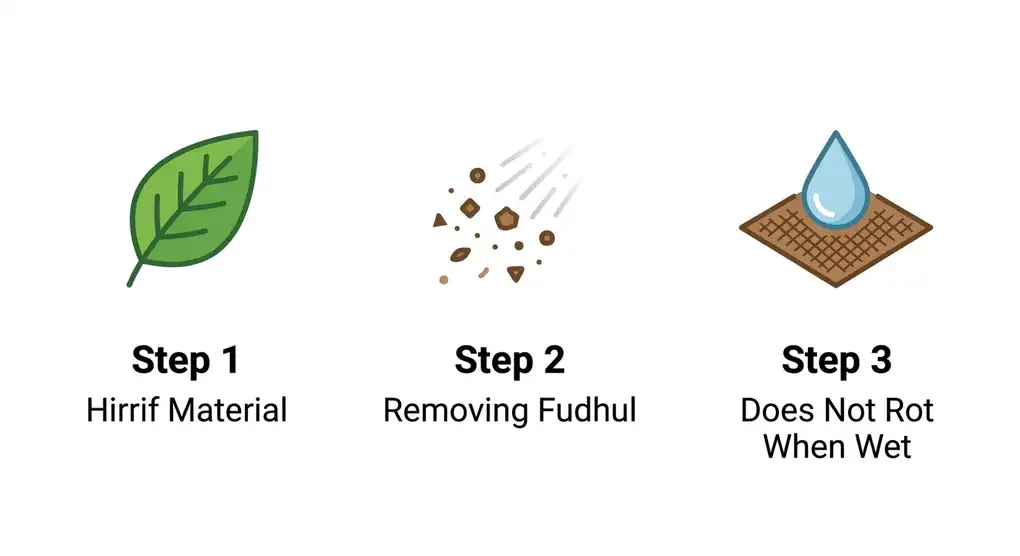
Because tanning purifies by changing the nature of the hide, not every way of treating a hide counts as dabagh. Conditions apply.
Al-Anshari sums up the conditions of dabagh in one dense sentence:
«قوله: (والدباغ) بمعنى الاندباغ (ولو بإلقاء الريح) لما يدبغ فيما يدبغ به أو بالعكس (بحريف) بكسر الحاء (نازع للفضول بحيث لا يفسده) أي لا ينتنه ما يقع هو فيه. (ولو) كان الاندباغ (بنجس كذرق حمام) بذال معجمة (وبغير ماء) في أثناء الدباغ (لا بتمليح، وتشميس) معطوف على بحريف»
Meaning: “(Dabagh) means becoming tanned, (even if it happens when the wind) drops what is to be tanned into the tanning material or the reverse, (with a hirrif material), pronounced with kasrah on the ha’, (that draws out the residues, such that it does not spoil it), meaning it does not begin to stink because of what it falls into. (Even if) the tanning is (with an impure material such as pigeon droppings), with a dotted dhal, (and without water) during the tanning, (not by salting and sun-drying), which is joined to the phrase ‘with a hirrif material.'”[1]
From this text we can map three main conditions for how to tan a hide in Islam.
Condition 1: The Material Is Hirrif (حريف)
The first condition is that the tanning material be hirrif. Al-Anshari notes the pronunciation: a kasrah on the ha’, read hirrīf.[1]
The Meaning of Hirrif and the Classic Example
In Arabic, hirrif refers to something sharp, astringent, or biting. Such a material works its way into the hide’s fibers and changes them, instead of only coating the surface. (Language note from the author.)
The clearest example is qaradh, the tanning leaf the Messenger of Allah ﷺ mentioned in the hadith of Abu Dawud discussed above. Every other material is judged by analogy to it, as long as it does the same job.[1]
So a material that only preserves the hide for a short time without changing it does not meet this condition.
Condition 2: The Material Is Nazi’ lil-Fudul
The second condition is that the material be nazi’ lil-fudul (نازع للفضول), meaning it can draw out the residues from the hide.
What Are Fudul?
Fudul are the residues left in a carcass hide that cause it to rot. In practice they include blood, fat, moisture, and smell. (Detailed examples from the author.)
Elsewhere, al-Anshari says that tanning removes the fat (ad-dusumah) in the hide.[7] This supports the point that what the tanning material draws out are the elements that make a hide spoil.
Remember the explanation above: a carcass is impure because of ‘ufunah, rot. So a material that removes the source of rot is what deserves to be called a tanning agent.
Condition 3: The Hide Does Not Rot Again When Touched by Water
The third condition concerns the result: bi-haythu la yufsiduhu, meaning to the point that the hide is no longer spoiled. Al-Anshari explains: it does not begin to stink because of what it falls into.[1]
A Practical Measure
How do we test it? A fully tanned hide, soaked or wetted, does not go back to smelling rotten and does not spoil. It stays stable like fabric.
This is the difference between a dried hide and a tanned hide. A merely dried hide looks durable, but once wet it can turn soft and smelly again. Such a hide is not considered tanned. (Practical explanation from the author, based on the conditions in the kitab.)
What Does and Does Not Affect the Validity of Dabagh
Besides the three main conditions, Asna mentions several situations that often cause doubt. Some do not invalidate dabagh, and others are not dabagh at all.
Allowed Without Water
Water is not a condition in tanning. Asna states it plainly: wa bi-ghayri ma’ (and without water) during the tanning.[1]
The reason was covered above. Dabagh is ihalah (a change of nature), not a washing. So water is not required in it.[6] Water is needed afterward, when the hide is to be worn in prayer, as explained below.
Allowed With an Impure Material
This part often surprises people. Tanning with an impure material is still valid. The kitab’s example is dharq hamam (ذرق حمام), pigeon droppings.[1]
The Reason: Dabagh Is Comparable to Slaughter
Why is an impure material allowed, when a stone for istinja must be pure? Al-Anshari answers in the chapter on istinja:
«وإنما جاز الدبغ بالنجس لأنه عوض الذكاة الجائزة بالمدية النجسة بخلاف الحجر»
Meaning: “Tanning with an impure material is permitted because it stands in for slaughter, and slaughter is valid with an impure knife. Unlike a stone (for istinja).”[8]
The logic is neat. A valid slaughter keeps a lawful animal pure. Dabagh is the substitute route for the hide of an animal that was not slaughtered. Since slaughter with an impure knife is still valid, tanning with an impure material is valid too.
Of course, after tanning with an impure material, the hide needs to be washed to clear it of that material’s traces. This falls under the description of “like an impure garment” discussed below.
Allowed When It Happens by the Wind
Dabagh does not have to be done by a person. Asna states wa law bi-ilqa’ir rih, even if it happens by the wind.[1]
This means the wind drops the hide into the tanning material, or drops the tanning material onto the hide. If the result is a truly tanned hide, the hide is pure.
This fits the meaning of dabagh as al-indibagh discussed earlier. What is judged is the end result, not who did the work.
Not Dabagh: Salt and Sun-Drying
Now the part most often misunderstood. Tamlih (salting) and tashmis (sun-drying) are not dabagh.[1]
The Reason: They Do Not Change the Hide’s Tendency to Rot
Al-Anshari explains:
«بخلاف الملح، والشمس، ونحوهما إذ ليس فيها ذلك، وهو مفهوم من قوله نازع إلخ فقوله لا بتمليح، وتشميس إيضاح»
Meaning: “Unlike salt, the sun, and the like, since they do not have that (effect). This is already understood from his words ‘that draws out…’ so his words ‘not by salting and sun-drying’ are only a clarification.”[1]
So salt is not a tanning agent in the fiqh sense, and a hide that is only sun-dried is not enough to count as pure. Both only dry and temporarily preserve the hide, without removing the source of rot from inside it.
The proof is that a hide only salted or sun-dried will rot again when wet. That means the third condition is not met.
Quick Table: Valid vs Invalid Tanning Methods
Here is a summary of the above, according to Asna al-Mathalib:
| Material / Method | Ruling | Short Reason |
|---|---|---|
| Qaradh (tanning leaf) | Valid | Named directly in the hadith of Abu Dawud |
| Other materials that are hirrif and draw out fudul | Valid | Analogy to qaradh, since they produce ihalah |
| Impure material (e.g. pigeon droppings) | Valid | Dabagh stands in for slaughter, which is valid with an impure knife |
| Without water during the process | Valid | Dabagh is ihalah, not washing |
| Tanned by the wind | Valid | What counts is the result, not who did it |
| Salting only (tamlih) | Not valid | Does not draw out the source of rot |
| Sun-drying only (tashmis) | Not valid | Does not draw out the source of rot |
| A hide that still rots when wet | Not yet tanned | The condition la yufsiduhu is not met |
With this table, we can judge whether a hide has gone through vegetable tanning or another method that meets the conditions. But can every kind of animal hide be purified this way? That is next.
The General Principle: Every Carcass Hide Can Be Tanned, Except…
After the conditions and methods of tanning, the next question arises by itself. Can every carcass hide be purified this way? A cow’s hide is clear, but what about the hide of a snake, a crocodile, or a pig?
The Shafi’i school uses a simple rule: everything is allowed, except what is excluded. The exclusions are few and clear.
The Rule of the Kitab: «يطهر جلد غير كلب وخنزير وفرعهما»
Shaykh al-Islam Zakariyya al-Anshari writes this rule in Asna al-Mathalib:
«قوله: (يطهر) أي الاندباغ (جلد غير كلب، وخنزير، وفرعهما) أي فرع كل منهما مع غيره»
Meaning: “Being tanned purifies the hide of anything other than a dog, a pig, and their offspring, that is, the offspring of either one with another animal.”[1]
Notice how the sentence is built. He does not list the hides that may be tanned. He names the ones that may not. So everything outside those three groups falls under the default ruling: it can become pure by tanning.
This agrees with the general wording of the hadith of Muslim discussed above, «إذا دبغ الإهاب فقد طهر». The word al-ihab there is general and not limited to any kind of animal.
The Hide of a Lawful Animal That Became a Carcass
The first group we meet most often is the hide of an animal lawful to eat, such as a cow, goat, sheep, or camel.
If these animals are slaughtered in line with the Shariah, the hide is already pure and needs no tanning. But if the animal dies without slaughter, for example from illness, it becomes a carcass and its hide is impure.
This is where dabagh does its work. The carcass hide of a cow or goat can become pure again once properly tanned. So if you buy a product made of halal cowhide but are unsure how the animal died, at least a fully tanned hide has left the status of impurity. The full comparison between slaughter and tanning is covered further on.
Hides of Animals Not Lawful to Eat, Other Than Dogs and Pigs
The second group is animals whose meat is not lawful to eat, but which are not dogs or pigs. By the rule above, the hides of this group can also be purified by tanning, since they are not among the exceptions.
Examples in daily life today:
- Snakeskin, often used for bags and wallets.
- Crocodile hide, for belts and expensive shoes.
- Monitor lizard hide, used by many local craftspeople.
- Hides of wild animals such as the lion or tiger.
Note
⚠️ The examples above are the author’s examples of application, not quotations from the kitab. The kitab gives only the general rule “other than a dog, a pig, and their offspring”. We derived these examples from that rule to make it easier to understand.
One thing to remember: being able to become pure by tanning does not mean it is permissible to slaughter a non-lawful animal for its hide. That prohibition is covered further on.
Hides of Dogs, Pigs, and Their Offspring: They Cannot Be Purified
Now the exceptions. These three groups never become pure, even when tanned with the best material and the most perfect method.
Dogs and Pigs Are Heavy Impurities (Mughallazah)
In Shafi’i fiqh, dogs and pigs fall under mughallazah, the heavy impurity. For those asking what mughallazah impurity is: it is the impurity whose purification is the heaviest, washed seven times with one of them using earth. Linguistically, mughallazah means “made heavy”.
A full discussion of this type of impurity and how to purify it is in our article on dog and pig impurity.
On the dog, al-Anshari uses the hadith of Muslim about washing a vessel a dog has licked seven times. On the pig, he writes:
«قوله: (و) لا (خنزير) لأنه أسوأ حالا من الكلب»
Meaning: “And (not pure is) the pig, because its condition is worse than the dog’s.”[2]
If the dog is impure, the pig is even more deserving of the ruling. Al-Anshari and al-Syirbini both explain that the pig’s condition is worse because it may not be kept in any circumstance (la yuqtana bi hal).[2][3] Al-Nawawi himself admits there is no clear evidence for the pig’s impurity.[2] Yet according to al-Syirbini, Ibn al-Mundhir reported a consensus on its impurity.[3]
The Reason in Fiqh: Even Life Does Not Purify, Let Alone Tanning
Why can the hides of dogs and pigs not be tanned? Al-Anshari gives a very logical reason:
«أما جلد الكلب، ونحوه فلا يطهره ذلك لأن سبب نجاسة الميتة تعرضها للعفونة، والحياة أبلغ في دفعها فإذا لم تفد الطهارة فالاندباغ أولى»
Meaning: “As for the hide of a dog and the like, tanning does not purify it. The cause of a carcass’s impurity is its exposure to rot, and life is stronger at repelling rot. So if life does not bring about purity, then tanning is even less able to.”[5]
Explaining ‘Ufunah Against Life
Let us take it step by step:
- A carcass is impure because of ‘ufunah, rot.
- Tanning purifies because it stops that rot.
- But something stronger than tanning keeps rot away: life. A living animal does not rot.
- Dogs and pigs are impure even while alive. So life cannot purify them.
- If life, the strongest, fails, then tanning, the weaker, fails all the more.
In usul al-fiqh, this style of reasoning is called qiyas awlawi, drawing a ruling on the basis of “all the more so”. (Usul term supplied by the author.)
Offspring of a Dog or Pig With Another Animal (Far’uhuma)
The third group is the offspring of a dog or pig with another animal. Al-Anshari writes:
«قوله: (و) لا (فرع كل) منهما مع الآخر أو غيره تغليبا للنجاسة»
Meaning: “And (not pure is) the offspring of either one with the other or with another animal, giving precedence to impurity.”[2]
The principle is taghliban lin-najasah: when purity and impurity are mixed in one offspring, impurity takes precedence. Al-Anshari adds that in matters of impurity, the offspring follows the lowest of its parents (akhassuhuma).[2]
Fath al-Qarib states the same:
«(والحيوان كله طاهر إلا الكلب والخنزير وما تولد منهما أو من أحدهما)»
Meaning: “(Every animal is pure except the dog, the pig, and what is born from the two or from one of them,)” that is, with a pure animal.[4]
Al-Syirbini gives a clear example: an animal born from a wolf (dhi’b) and a female dog.[3] So the hide of such an animal stays impure and cannot be tanned.
The Ruling on Products Made From Pigskin (Bags, Shoes, Wallets)
This question often reaches the study circle: what is the ruling on using a bag made of pigskin, or shoes or a wallet made from it?
What the Kitab Establishes
Based on Asna’s text above, the ruling is clear: pigskin is not pure even after tanning. Any product made from pigskin remains inherently impure (najis ‘ayni), because the substance of the hide itself is impure and cannot change.
So every ruling that applies to impure things still applies to a pigskin bag and similar products. Washing it many times will not purify it.
The details of using it in various situations, such as outside prayer or in case of necessity, are not discussed in the references we use. For cases like this, we advise readers to ask a trusted scholar or fatwa body directly.
Carcasses That Need No Tanning: Fish, Locusts, Humans
On the other side, some carcasses need no tanning at all, since the carcass is pure from the start.
Hides of Fish and Locusts
Al-Anshari lists the carcasses exempted from impurity, among them fish and locusts, since both are lawful to eat even without slaughter.[2]
Al-Syirbini adds that both carcasses are pure by consensus and by the words of the Prophet ﷺ:
«أحلّت لنا ميتَتَانِ وَدَمَانِ السّمك وَالْجَرَاد والكبد وَالطحَال»
Meaning: “Two carcasses and two bloods have been made lawful for us: fish and locusts, the liver and the spleen.”[3] By “fish” he means every sea animal that is eaten, even if it is not called a fish.[3]
Since the carcass is pure, so is its hide. Fish skin made into crafts, for example, does not need tanning to be pure. (Example of application by the author.)
Human Skin
The human body after death is also pure. Al-Anshari uses the words of Allah in Surah al-Isra’, verse 70:
«وأما الآدمي فلقوله تعالى {ولقد كرمنا بني آدم}»
Meaning: “As for the human being, it is because of the words of Allah Most High: ‘And We have certainly honored the children of Adam.’“[2]
This honor requires that a human not be ruled impure because of death. That is as far as we go here, since our focus remains tanning animal hides.
Now that we know which hides can and cannot be tanned, another question follows: what about the hair and fur still on the hide? Do they become pure too?
Does Hair or Fur on the Hide Become Pure After Tanning?
Many tanned carcass hides still carry fur. Think of a sheepskin jacket with thick lining or a goat-hide rug with its hair.
If the hide is pure through dabagh, is the hair of the carcass hide pure too? Here the Shafi’i scholars give a quite detailed answer.
The Kitab’s Rule: Tanning Does Not Purify Hair
Al-Anshari states that hair does not become pure:
«قوله: (لا شعره) فلا يطهره الاندباغ لعدم تأثره به»
Meaning: “(Not its hair), for tanning does not purify it since it is not affected by it.”[5]
The reason goes back to the logic above. Tanning purifies because it changes the hide. The tanning material soaks into the hide’s fibers and draws out the source of rot.
Hair undergoes no such change. It stays as it was, before and after tanning. With no change, the ruling stays: impure, as part of the carcass. This is what is meant by hair does not become pure.
Differences of Opinion Within the School
Although the base rule is clear, the Shafi’i scholars did not stop there. Al-Anshari relates three views, all worth knowing.
«قال النووي، ويعفى عن قليله فيطهر تبعا، واستشكله الزركشي بأن ما لا يتأثر بالدبغ كيف يطهر قليله، وأجاب بأن قوله يطهر أي يعطى حكم الطاهر انتهى … على أن السبكي قال بطهارة الشعر مطلقا أخذ بخبر في صحيح مسلم قال، وهذا لا شك عندي فيه، وهو الذي اختاره، وأفتى به»
Meaning: “Al-Nawawi said: a small amount of it is excused, so it becomes pure by following (the hide). Al-Zarkashi raised a difficulty: how can a small amount of what is not affected by tanning become pure? Then he answered that ‘becomes pure’ means ‘is given the ruling of something pure.’ … Moreover, al-Subki held that the hair is pure absolutely, based on a hadith in Sahih Muslim. He said: ‘I have no doubt about this; it is what I choose and give fatwa by.'”[5]
Al-Nawawi: A Small Amount of Hair Is Excused
Imam al-Nawawi takes a middle path. A small amount of hair on a tanned hide is excused (yu’fa ‘an qalilihi) and becomes pure by following its hide (taba’an).
The reason is easy to see. It is nearly impossible to clean every strand of hair off a tanned hide. If every remaining strand were ruled impure, people would face great hardship.
Al-Zarkashi: Raising a Difficulty, Then Answering It
Imam al-Zarkashi raised a sharp objection. If hair is not affected by tanning, how can it become pure, even a little?
He answered it himself. The word “pure” in al-Nawawi’s words does not mean its substance turns pure. It means the hair is given the ruling of a pure thing (yu’ta hukmat tahir), because it is excused.
Al-Anshari then adds support. The hair is pure by following the hide, to avoid hardship, just like a wine jar that becomes pure along with the wine inside once it turns to vinegar, even though the jar itself did not change.[5]
Al-Subki: Hair Is Pure Absolutely
Imam al-Subki went further. In his view, hair on a tanned hide is pure absolutely, little or much. He relied on a hadith in Sahih Muslim.
Al-Subki was very sure of this view. He said he had no doubt about it, chose it, and gave fatwa by it.[5]
Practical Impact on Fur Jackets and Rugs
⚠️ This section is the author’s application, not a quotation from the kitab.
How do we treat the fur on a tanned hide, such as a sheepskin jacket or a hide rug?
- If the fur is only a little, then by al-Nawawi’s view it is excused and becomes pure.
- If the fur is plentiful and thick, then by the school’s base rule it remains impure, since it comes from a carcass and is not changed by tanning.
- Al-Subki considered it pure absolutely. This view can be relied on by those who follow it, since he was a great Shafi’i scholar.
If the product comes from a lawful animal that was slaughtered, the issue does not arise, because the fur is pure from the start. We look at that next.
The Ruling on Hair and Fur of Animals in General
To understand the ruling on animal fur fully, we need the wider rule: the ruling on a part separated from an animal.
A Part Separated From a Living Animal Takes the Ruling of Its Carcass
Al-Anshari gives the following rule:
«قوله: (المبان من حي، ومشيمته) … (كميتته) أي كميتة ذلك الحي طهارة، ونجاسة لخبر «ما قطع من حي فهو ميت»»
Meaning: “(What is separated from a living animal, and its afterbirth) … (is like its carcass), that is, like the carcass of that living animal in purity and impurity, based on the hadith: ‘What is cut off from a living animal is a carcass.’“[9]
Al-Anshari says this hadith was narrated by al-Hakim, who graded it sound by the standard of the two Shaykhs.[9] So a human hand that is cut off is pure, since a human carcass is pure. A part cut from a living cow is impure, since a cow’s carcass is impure.
The Exception: Hair, Feathers, and Wool of Lawful Animals
This rule has an important exception. The same book continues:
«قوله: (لا شعر مأكول، وريشه) فطاهران (ولو انتتف) كل منهما أو نتف، وما في معناهما من صوف، ووبر قال تعالى {ومن أصوافها وأوبارها وأشعارها أثاثا ومتاعا إلى حين}»
Meaning: “(Except the hair and feathers of a lawful animal), for both are pure, (even if they fall out) or are plucked, and likewise their equivalents such as wool and camel hair. Allah Most High says: ‘And from their wool, their fur, and their hair, furnishings and enjoyment for a time.’ (an-Nahl: 80)”[9]
So the fur of a lawful animal is pure even if it comes off while the animal is alive. Sheep wool and wool sheared from a live sheep, for example, are pure.
Al-Anshari adds that the verse is understood for fur taken after slaughter or during life, as is customary.[9] Fur from the carcass of a lawful animal goes back to the ruling of a carcass.
When in Doubt: Return to the Default of Purity
What if we find hair or fur and do not know whether it is from a lawful animal? Al-Anshari answers:
«قوله: (ولا مشكوك فيه) أي في أن الشعر، ونحوه من مأكول أو غيره لأن الأصل الطهارة»
Meaning: “(And not what is doubtful), that is, hair and the like where it is doubtful whether it is from a lawful animal or not, because the default is purity.”[9]
A Note on Limits
⚠️ The reference mentions this rule, al-asl at-taharah, only for hair and fur of doubtful origin. We must not extend it to all doubtful hides, because the kitab does not state it that way.
Cat Fur: A Short Comparison
Many ask, is cat fur impure? Our reference does not discuss cats specifically. What it gives is a general rule: a small amount, by customary measure, of impure hair is excused, as long as it is not from a dog, a pig, or their offspring.[10] The full discussion of the question of cat fur being impure is in our dedicated article on cats.
Bones and Other Parts of the Carcass
Every Part of a Carcass Is Impure
If hair does not become pure, what about bones? Al-Anshari explains at the start of the chapter on impurities:
«قوله: (و) لا (شعرها) ، وعظمها لأن كلا منهما تحله الحياة لأنه ينمو، والعظم يحس، ويألم، وفي معناه الصوف، والوبر، والريش»
Meaning: “And (not pure is) a carcass’s hair and its bone, because life dwells in each of them: hair grows, and bone feels and hurts. Wool, camel hair, and feathers are included in the meaning of hair.”[2]
The same point is made in al-Iqna’:
«وَدخل فِي نَجَاسَة الْميتَة جَمِيع أَجْزَائِهَا من عظم وَشعر وصوف ووبر وَغير ذَلِك لِأَن كلا مِنْهَا تحله الْحَيَاة»
Meaning: “Included in the impurity of a carcass are all its parts, such as bone, hair, wool, camel hair, and others, because life dwells in each of them.”[3]
Dabagh Applies Only to the Hide
From these two texts we can take one important point. Dabagh purifies only the hide, not every part of the carcass.
Bones, hair, wool, and fur of a carcass stay impure. The kitab says dabagh is for the hide (jild) only, and it states that hair does not become pure because tanning does not affect it.
Once a hide has been successfully tanned, what is its status? May it be worn in prayer, sold, or eaten? That comes next.
The Status of a Tanned Hide
So far we know which hides can be tanned and how. Now the question most often asked in study circles is about the ruling on using a tanned carcass hide: once the hide is pure, what may be done with it?
Is praying in leather shoes made from a tanned carcass valid? May the hide be sold? May it even be eaten? Al-Anshari answers all of it in one sentence.
Like “an Impure Garment That Has Been Washed”
Shaykh al-Islam Zakariyya al-Anshari writes in Asna al-Mathalib:
«قوله: (، ويصير) المندبغ (كثوب نجس) في أنه (يصلي فيه إن غسل، ويباع) ، وإن لم يغسل ما لم يمنع مانع (ولا يحل أكله)»
Meaning: “(And the hide) that has been tanned (becomes like an impure garment) in that (one may pray in it if it is washed, and it may be sold), even if it is not washed, as long as nothing else prevents it, (and eating it is not lawful).”[5]
This comparison, a hide like an impure garment, is very apt. Picture a sarong that has touched impurity. The cloth itself is pure; only its surface touched the impurity. Once washed, the sarong can be worn in prayer again.
A tanned hide is the same. Its substance became pure through dabagh, but its surface may still hold traces of the tanning material, especially if the material was impure like the pigeon droppings mentioned earlier. So it is treated like a garment touched by impurity.
May Be Worn in Prayer After Washing
First point from the text: a tanned hide may be worn in prayer once washed (yusalla fihi in ghusila).[5]
This agrees with the reading of the hadith «يطهرها الماء والقرظ» above, that water is needed for complete purity (at-taharah al-mutlaqah). Without water, the hide is pure in substance but not yet ready for prayer.
Application to Shoes, Sandals, Belts, and Jackets
⚠️ The examples below are the author’s application of the kitab’s rule.
- Leather shoes and sandals from the carcass of a cow or goat that has been tanned may be worn in prayer after washing.
- A belt worn during prayer follows the same ruling.
- A leather jacket that is fully tanned and washed may be worn in prayer.
Note that this applies only to hides that can be tanned. Products from pig or dog hide are not included, as discussed above.
May Be Sold
Second point: a tanned hide may be sold (yuba’), even before being washed, as long as nothing else prevents it (ma lam yamna’ mani’).[5]
So a carcass hide may be sold once tanned, and the sale of carcass hides of this kind is valid. A leather craftsman or bag seller does not have to wash each piece before selling. What counts is the substance of the hide, which is already pure.
The phrase “as long as nothing prevents it” shows that the other conditions of sale still apply. (Explanation of the meaning by the author.)
Not Lawful to Eat, Even Though Pure
Third point, which often surprises people: a tanned hide is not lawful to eat, even though it is pure.[5]
Why Pure but Not Lawful?
Al-Anshari cites the hadith of the two Sahihs:
«لخبر الصحيحين «إنما حرم من الميتة أكلها»»
Meaning: “Based on the hadith of the two Sahihs: ‘What is forbidden of a carcass is only eating it.’“[5]
This hadith teaches two things. First, benefiting from a carcass hide is not forbidden. Second, eating a carcass is still forbidden, including its hide even after tanning.
Here we learn that pure and lawful are two different rulings. Something can be pure yet unlawful to eat. So the idea that a tanned hide may be eaten is mistaken.
May Be Used for Istinja, Unlike Raw Hide
There is one more benefit that is little known. In the chapter on istinja, al-Anshari says a tanned hide may be used for istinja (cleaning oneself after relieving oneself) in place of stones:
«قوله: (وجلد) أي وبجلد (مذكى) أو غيره دبغ لأن الدباغ يزيل ما فيه من الدسومة، ويقلبه عن طبع اللحوم إلى طبع الثياب بخلاف ما لم يدبغ»
Meaning: “(And with a hide) of a slaughtered animal or another, that has been tanned, because tanning removes the fat in it and turns it from the nature of meat to the nature of garments. Unlike one that has not been tanned.”[7]
The Kitab’s Reason: From the Nature of Meat to the Nature of Cloth
Al-Anshari then explains why a raw hide may not be used for istinja:[7]
- A raw hide still holds fat (dusumah) that keeps it from absorbing.
- If it is from a non-lawful animal, the raw hide is impure.
- If it is from a lawful slaughtered animal, the raw hide still counts as food deserving respect, since people customarily eat it.
After tanning, all three reasons disappear. The hide turns from the nature of meat into the nature of cloth. That sentence sums up the whole essence of dabagh beautifully.
Slaughter vs Tanning: Two Routes to a Pure Hide
Earlier we mentioned that dabagh is a “substitute” for slaughter (dhakah). Let us now see how the two relate.
Slaughter Only Preserves the Purity of Lawful Animals
Al-Anshari writes about slaughter:
«قوله: (الذكاة) أي الآتي بيانها في محلها (تحفظ طهارة المأكول) حتى جلده لما سيأتي من حل أكله (فقط) أي دون طهارة غير المأكول»
Meaning: “(Slaughter), whose explanation will come in its place, (preserves the purity of the lawful animal), including its hide, because eating it is lawful, (only), that is, not the purity of an animal that is not lawful to eat.”[1]
So if a cow is slaughtered in line with the Shariah, its entire body is pure, including its hide. A slaughtered cow’s hide needs no tanning to be pure. That is the true status of halal cowhide.
A Slaughtered Non-Lawful Animal Remains Impure
The word “only” (faqat) in the text above is very important. Slaughter does nothing for an animal that is not lawful to eat. If a donkey or mule is slaughtered, it is still ruled a carcass and its hide is impure.[1] Al-Syirbini says this directly in his definition of a carcass: an animal not lawful to eat, even if slaughtered, is still a carcass.[3]
Even so, the hide of such an animal can still be purified by the second route: dabagh, as long as the animal is not a dog, a pig, or their offspring.
Comparison Table of Hide Status
| Animal’s Condition | Hide Status Before Tanning | Route to Purity |
|---|---|---|
| Lawful animal, validly slaughtered (cow, goat) | Pure | No tanning needed |
| Lawful animal, died as a carcass | Impure | Dabagh |
| Non-lawful animal other than dog and pig (slaughtered or not) | Impure | Dabagh |
| Dog, pig, and their offspring | Impure | No route; stays impure |
| Fish and locusts | Pure | No tanning needed |
The Prohibition on Slaughtering Non-Lawful Animals for Their Hides
Someone might think: if the hide of a non-lawful animal can be tanned, may one slaughter a donkey or a wild animal to get the hide? The answer is firm: no.
The Evidence for the Prohibition
Al-Anshari writes:
«قوله: (ويحرم ذبح ما لا يؤكل) كبغل، وحمار، ولو (لجلده) أي لدبغ جلده (أو اصطياد بلحمه) للنهي عن ذبح الحيوان إلا لمأكله»
Meaning: “(And it is forbidden to slaughter what is not eaten), such as a mule or a donkey, even (for its hide), that is, to tan its hide, (or to hunt with its meat as bait), because of the prohibition on slaughtering an animal except to eat it.”[5]
Al-Anshari says this hadith was narrated by Ibn Hibban, who graded it sound.[5] The principle is clear: slaughtering an animal is justified only for eating.
Examples From the Kitab and Their Application Today
The examples named in the kitab are the mule (baghl) and the donkey (himar).[5]
⚠️ Application by the author: the same rule applies to wild animals or reptiles that are not lawful to eat, if they are deliberately slaughtered only for their hides. Slaughtering them is forbidden, even though their hides could later be purified by dabagh.
Hunting for the Meat as Bait
The text above also mentions the prohibition on slaughtering a non-lawful animal to use its meat as hunting bait (istiyad bi-lahmihi). Al-Anshari notes that the mention of this hunting issue is an addition by the author of the base text.[5]
So we may benefit from a tanned carcass hide, but that does not mean we may kill a non-lawful animal to obtain it.
With these basic rulings understood, how do they apply to leather products today, and what misunderstandings come up most often? Let us turn to that.
Application Today
The fiqh books were written centuries ago, when hides were still tanned with leaves and natural materials. Today, leather is processed in large factories and sold as shoes, bags, and jackets all over the world.
So how do we apply the rules of dabagh to this reality? This section tries to answer carefully.
Modern Leather: Vegetable Tanning and Chemical Tanning
Two main methods are known in the leather industry today:
- Vegetable tanning: uses tannin from bark, leaves, or fruit. This is the closest to the qaradh named in the hadith.
- Chemical tanning, mainly with chromium salts (chrome tanning): the most widely used in factories today because it is faster.
Author’s Note
⚠️ The reference kitab does not discuss modern tanning materials. This section is the author’s analysis of application.
The measure the kitab gives is not the name of a material but its function. Al-Anshari says what is joined by analogy to qaradh is whatever produces the change, whether pure or impure.[1] Then there are three conditions: the material is hirrif, it draws out fudul, and the hide does not rot again when wet.[1]
If a chemical process truly meets those three conditions, then by the rule it can fall within the meaning of dabagh. But the technical assessment of a specific material should be left to experts and trusted fatwa bodies, since it needs chemical knowledge we do not have here.
Leather Products Around Us
Almost every home has leather products: shoes, bags, belts, jackets, and leather wallets. With the rules from the earlier sections, we can map the rulings:
- From a lawful animal that was slaughtered: pure, with no tanning needed.
- From the carcass of an animal other than a dog or pig that has been fully tanned: pure, and may be worn in prayer after washing.
- From pigskin or dog hide: impure even if tanned.
So the questions about the ruling on leather shoes and the ruling on leather bags come down to two things: which animal the hide is from, and whether it has been properly tanned.
What If the Origin of the Hide Is in Doubt?
This is the case we meet most often. We buy a wallet or shoes but do not know what leather it is, especially if it is imported leather.
⚠️ Our reference does not discuss this case directly.
What the reference does contain is a rule for hair and fur of doubtful origin: it is pure, because the default is purity.[9] That rule is not stated for hides, so we do not dare apply it directly.
Our advice is to check the product label or ask the seller. If you are still unsure, ask a local scholar or fatwa body, especially for items to be worn in prayer.
Synthetic Leather Is Not Part of Dabagh
Synthetic leather or imitation leather (faux leather, PU, PVC) is made from plastic, not from animals. So it is entirely outside the topic of dabagh.
Synthetic leather is ruled like cloth or other materials in general: pure, as long as no outside impurity touches it. (Explanation by the author.)
Common Misunderstandings
Teaching the chapter on impurities, a few mistaken ideas come up almost every time. Here are five, with the answers from the kitab.
“Drying It or Salting It Makes It Pure”
Wrong. Sun-drying (tashmis) and salting (tamlih) are not dabagh.[1] They only dry the hide for a while, without drawing out the source of rot. Such a hide will rot again when wet.
“It Has to Be Tanned With Water”
Wrong. Water is not required in tanning, because dabagh is a change of nature (ihalah), not a washing.[6] Water is needed only afterward, when the hide is to be worn in prayer.
“Every Hide Can Be Tanned”
Not quite. Every hide can be tanned except the hide of a dog, a pig, and their offspring.[1] The hides of those three groups stay impure forever.
“A Tanned Hide Is Lawful to Eat”
Wrong. A tanned hide is pure but still not lawful to eat, based on the hadith «إنما حرم من الميتة أكلها».[5] Pure and lawful are two different rulings.
“The Hair Becomes Pure Automatically”
Not automatic. By the base rule, hair does not become pure because tanning does not affect it.[5] Imam al-Nawawi excuses a small amount of hair, while Imam al-Subki holds that hair is pure absolutely.[5] So there is a difference of opinion within the school.
Key Points of the Ruling on Dabagh
Main Points to Remember
- A carcass hide is impure, but can become pure by tanning (dabagh), based on the hadith of Muslim «إذا دبغ الإهاب فقد طهر».
- The hides of dogs, pigs, and their offspring cannot be purified, even if tanned.
- The conditions of dabagh are three: the material is hirrif, it draws out fudul, and the hide does not rot again when wet.
- Tanning is valid without water and valid with an impure material, but not valid with only salt or sun-drying.
- A tanned hide is like an impure garment: it may be worn in prayer after washing and may be sold, but it is not lawful to eat.
- Hair on the hide does not become pure by the base rule, with differences of opinion among Shafi’i scholars.
Related Articles
To round out your understanding, also read our articles on the ruling on carcasses, istihalah of impurities, and dog and pig impurity, whose links are given in the earlier sections.
FAQ on Dabbagh (Tanning Carcass Hides)
Can a carcass hide become pure after tanning?
Yes. A carcass hide becomes pure once properly tanned, based on the hadith of Muslim: “When the hide has been tanned, it has become pure.”[1]
This applies to every carcass hide, whether from a lawful animal or not, except dogs, pigs, and their offspring.
Which hides cannot be purified by tanning?
May one tan with an impure material or without water? Are salt and sun-drying enough?
May a tanned hide be worn in prayer, sold, or eaten?
Worn in prayer: allowed, after washing.
Sold: allowed, even if not yet washed.
Eaten: not lawful.
A tanned hide is treated like a garment touched by impurity.[5]
Does hair or fur on the hide become pure after tanning?
Footnotes
1 : Zakariyya al-Anshari, Asna al-Mathalib, vol. 1, p. 17. ↩
2 : Zakariyya al-Anshari, Asna al-Mathalib, vol. 1, p. 10. ↩
3 : Al-Khathib al-Syirbini, al-Iqna’ fi Halli Alfazh Abi Syuja’, vol. 1, p. 92. ↩
4 : Ibn Qasim al-Ghazzi, Fath al-Qarib al-Mujib, p. 58. ↩
5 : Zakariyya al-Anshari, Asna al-Mathalib, vol. 1, p. 18. ↩
6 : Zakariyya al-Anshari, Asna al-Mathalib, vol. 1, pp. 17–18. ↩
7 : Zakariyya al-Anshari, Asna al-Mathalib, vol. 1, p. 51. ↩
8 : Zakariyya al-Anshari, Asna al-Mathalib, vol. 1, p. 50. ↩
9 : Zakariyya al-Anshari, Asna al-Mathalib, vol. 1, p. 11. ↩
10 : Zakariyya al-Anshari, Asna al-Mathalib, vol. 1, p. 13. ↩
- Zakariyā al-Anṣārī, Asnā al-Maṭālib fī Sharḥ Rawḍ al-Ṭālib, with ḥāshiyah by Aḥmad al-Ramlī, edited by Muḥammad az-Zuhrī al-Ghamrāwī (Cairo: al-Maṭbaʿah al-Maymānīyah, 1313 AH; repr. Dār al-Kitāb al-Islāmī), vol. 1, pp. 10-51.
- Muḥammad bin Qāsim al-Ghazzī, Fatḥ al-Qarīb al-Mujīb fī Sharḥ Alfāẓ al-Taqrīb, ed. Bassām ʿAbd al-Wahhāb al-Jābī (Beirut: Dār Ibn Ḥazm, 1425 AH/2005 CE), vol. 1, p. 58.
- Shams al-Dīn Muḥammad ibn Aḥmad al-Khaṭīb al-Shirbīnī, Al-Iqnā‘ fī Ḥall Alfāẓ Abī Shujā‘, edited by Maktab al-Buḥūth wa al-Dirāsāt (Beirut: Dār al-Fikr, n.d.), vol. 1, p. 92.


