
What Is Asmaul Husna? Definition and the Meaning of “Al-Husna”
Many Muslims memorize Asmaul Husna as children, usually through a song or a recitation after prayer. But ask “what does Asmaul Husna actually mean?” and the answer often stops at “the 99 names of Allah”. Behind those two words lies a long and beautiful discussion of Islamic creed.
This article follows the explanation of Shaykh Ahmad Zarruq (846–899 AH) in his book Syarh Asma’ Allah al-Husna, edited by Sayyid Yusuf Ahmad. We start from the very basics: the definition of Asmaul Husna.
The Linguistic Meaning of “Asma'” and “Husna”
Asma’ is the plural of ism (name). Al-Husna is the feminine form of ahsan, meaning “the best”. So the meaning of Asmaul Husna is, linguistically, the most beautiful names.
In creed studies the term is also written al-asma’ al-husna. It refers to the names of Allah established by the Qur’an and the hadith. This linguistic explanation comes from general Arabic grammar, not from a direct quotation of Zarruq’s book.
The book’s editor opens his introduction with the verse that is the starting point of everything:
حَثَّ المَوْلَى عِبَادَهُ فِي كِتَابِهِ العَزِيزِ بِأَنْ نَدْعُوَهُ بِأَسْمَائِهِ الحُسْنَى، فَقَالَ تَعَالَى: ﴿وَلِلَّهِ الْأَسْمَاءُ الْحُسْنَىٰ فَادْعُوهُ بِهَا﴾ [الأعراف: 180]
Meaning: Allah urges His servants in the Qur’an to call upon Him by His most beautiful names. He says: “To Allah belong the best names (Asmaul Husna), so invoke Him by them.”[1]
Why Are Allah’s Names Called “the Best”?
They are called the best because every one of them points to perfection without any deficiency. Not one of His names carries a flaw. That is why the most beautiful names of Allah are fit to be a doorway to knowing Him.
The opposite of this perfection is the nature of creation: limited, needy, and changing. Allah is free of all that. We discuss how to keep our understanding from likening Allah to creation in the section on the framework of meaning.
The Relationship between Name, Attribute, and Essence




Each name of Allah points to the perfect Essence and, at the same time, carries a specific attribute. For example, Ar-Rahman points to Allah’s Essence with the attribute of compassion. Studying the names and attributes of Allah is therefore the closest road to knowing Allah.
Scholars once disagreed on whether the ism (the name) is identical to the musamma (the one named). Imam al-Qushayri, as quoted in the editor’s note, leaned toward saying they are the same:
قَالَ القُشَيْرِيُّ: فِيهِ دَلِيلٌ عَلَى أَنَّ الِاسْمَ هُوَ المُسَمَّى، إِذْ لَوْ كَانَ غَيْرَهُ لَكَانَتِ الأَسْمَاءُ لِغَيْرِهِ
Meaning: Al-Qushayri said this hadith is evidence that the name is the one named, because if the name were something other than Him, those names would belong to someone else.[2]
The Salaf’s Stance: Not Debating It
Shaykh Zarruq himself chose a calmer path. He stresses that the salaf did not enter this debate:
وَلَكِنَّ السَّلَفَ لَمْ يَتَكَلَّمُوا فِي الِاسْمِ وَلَا فِي المُسَمَّى، وَلَا فِي الصِّفَةِ وَالمَوْصُوفِ، وَلَا فِي التِّلَاوَةِ وَالمَتْلُوِّ؛ طَلَبًا لِلسَّلَامَةِ … وَهُوَ الوَرَعُ، وَاللهُ أَعْلَمُ
Meaning: The salaf did not discuss the name and the named, the attribute and the described, or the recitation and the recited. They sought safety, and that is wara’ (scrupulous caution). Allah knows best.[3]
The practical lesson is simple. We need not drown in debates over terminology. It is enough to know Allah’s names, understand their meanings, then call upon Him and act by them.
Asmaul Husna and Tawhid: Know Before You Practice
The editor reminds us that every discussion of Allah’s names rests on tawhid:
فَإِنَّ التَّوْحِيدَ أَصْلُ الدِّينِ
Meaning: Indeed, tawhid is the foundation of the religion.[1]
The order is clear. We first come to know Allah through His names, and only then make dhikr and supplication with them. Practicing without knowing is like calling out to someone without knowing who they are.
Why Is Understanding the 99 Names of Allah Important for Muslims?
There are three main reasons to study the 99 names of Allah.
Strengthening Faith and Knowledge of Allah
The more we understand Al-Ghaffar, Ar-Razzaq, or Al-Bashir, the more alive our trust in Allah becomes. Faith stops being only memorization and grows into a conviction we feel in daily life.
The Basis of Supplication, Dhikr, and Character
The verse we just discussed commands us to supplicate with Asmaul Husna. From this come three things: du’a, dhikr, and character that follows the noble attributes. All of them are elaborated in the section on understanding and practice, together with their etiquette and method.
Where Asmaul Husna Belongs: Creed and Tasawwuf
One note from us: this topic belongs to creed and tasawwuf, not to fiqh, which discusses rulings of the permissible and forbidden. So the discussion here focuses on meaning, evidence, and etiquette, not on whether a practice is obligatory or recommended. This approach matches how Shaykh Zarruq composed his book.
In the next part, we look at the Qur’anic and hadith evidence behind all of this.
Qur’anic Evidence for Asmaul Husna
Every discussion of Allah’s names stands on revelation, not on preference or guesswork. The editor of Syarh Asma’ Allah al-Husna opens his introduction with several verses. From these the evidence for Asmaul Husna in the Qur’an is assembled.
Surah Al-A’raf: 180
This verse carries both a command and a prohibition. The command: supplicate with Allah’s best names. The prohibition: do not deviate regarding His names.
وَلِلَّهِ الْأَسْمَاءُ الْحُسْنَىٰ فَادْعُوهُ بِهَا ۖ وَذَرُوا الَّذِينَ يُلْحِدُونَ فِي أَسْمَائِهِ ۚ سَيُجْزَوْنَ مَا كَانُوا يَعْمَلُونَ
Meaning: “To Allah belong the best names, so invoke Him by them. And leave those who deviate concerning His names. They will be recompensed for what they used to do.”[1]
This verse is also the basis of supplicating with the names of Allah. Its etiquette and method are discussed in the section on understanding and practice.
Surah Al-Isra’: 110 and Surah Ta-Ha: 8
Two further verses affirm that the best names belong to Allah alone.
قُلِ ادْعُوا اللَّهَ أَوِ ادْعُوا الرَّحْمَٰنَ ۖ أَيًّا مَا تَدْعُوا فَلَهُ الْأَسْمَاءُ الْحُسْنَىٰ
Meaning: “Say, ‘Call upon Allah or call upon Ar-Rahman. Whichever you call, to Him belong the best names.'” (Al-Isra’: 110)
اللَّهُ لَا إِلَٰهَ إِلَّا هُوَ ۖ لَهُ الْأَسْمَاءُ الْحُسْنَىٰ
Meaning: “Allah, there is no deity except Him. To Him belong the best names.” (Ta-Ha: 8)[4]
Surah Al-Hashr: 22–24
Surah Al-Hashr ends with a long series of Allah’s names, from Ar-Rahman, Ar-Rahim, Al-Malik, and Al-Quddus, to Al-Khaliq, Al-Bari’, and Al-Mushawwir. The editor quotes its closing verse:
هُوَ اللَّهُ الْخَالِقُ الْبَارِئُ الْمُصَوِّرُ ۖ لَهُ الْأَسْمَاءُ الْحُسْنَىٰ
Meaning: “He is Allah, the Creator, the Inventor, the Fashioner. To Him belong the best names.” (Al-Hashr: 24)[5]
So whoever asks for the verses of Asmaul Husna or the surah about Asmaul Husna will find the answer in four places: Al-A’raf: 180, Al-Isra’: 110, Ta-Ha: 8, and Al-Hashr: 22–24.
The Hadith “Indeed Allah Has 99 Names”
The Qur’an mentions the names, while the Sunnah explains their number. The main reference is the narration of Abu Hurayrah, may Allah be pleased with him. People often search for it as the hadith of the 99 names of Allah.
The Text of the Hadith and Its Narrators
The editor quotes the hadith as found in the two Sahih collections and elsewhere:
قَالَ رَسُولُ اللهِ ﷺ: «إِنَّ لِلَّهِ تِسْعَةً وَتِسْعِينَ اسْمًا، مِائَةً إِلَّا وَاحِدًا، مَنْ أَحْصَاهَا دَخَلَ الجَنَّةَ»
Meaning: The Messenger of Allah ﷺ said, “Indeed Allah has ninety-nine names, one hundred less one. Whoever performs their ihsha’ will enter Paradise.”
In a footnote, the editor gives its sources: Bukhari (6410), Muslim (2677), Tirmidhi (3507), and Ibn Majah (3861). It is also in Sahih Ibn Hibban and al-Hakim’s Mustadrak.[5]
Only Tirmidhi and Ibn Majah List the Names
The editor explains a point that is often overlooked:
وَلَمْ يَذْكُرْ أَحَدٌ مِنَ الكُتُبِ السِّتَّةِ الأَسْمَاءَ إِلَّا التِّرْمِذِيُّ وَابْنُ مَاجَه، وَطَرِيقُ التِّرْمِذِيِّ أَصَحُّ وَهُوَ المُعَوَّلُ
Meaning: Of the six major hadith books, only Tirmidhi and Ibn Majah list the names in detail. The Tirmidhi chain is stronger and is the one relied upon. Shaykh Zarruq himself relies on this chain in his commentary.[5]
In other words, the hadith about the number 99 is widely narrated, while the detailed list of names appears only in those two books. We discuss the differences between the lists in the section on the number and narrations of the names.
The Meaning of “Ahshaha”: What Does Counting Mean?
The key word of this hadith is ahshaha (أحصاها). Linguistically it can mean to count. Scholars differ on its meaning, and the editor summarizes them:
وَقِيلَ: أَحْصَاهَا: عَدَّهَا فِي الدُّعَاءِ بِهَا. وَقِيلَ: أَطَاقَهَا، أَيْ أَحْسَنَ المُرَاعَاةَ لَهَا وَالمُحَافَظَةَ عَلَى مَا تَقْتَضِيهِ وَصِدْقِ مَعَانِيهَا
Meaning: Some say it means to mention them one by one in supplication. Others say it means to be able to uphold them, that is, to pay attention to and preserve what the names require and to affirm the truth of their meanings.[5]
In short, there are several views:
- Memorizing. Imam Bukhari and other scholars take this from another narration that says “man hafizhaha” (مَنْ حَفِظَهَا).
- Counting them in supplication, mentioning each one while making du’a.
- Understanding and upholding what they require, including affirming their meanings in the heart.
- Practicing them and obeying Allah according to what each name requires.
Some also interpret it as memorizing the whole Qur’an. That view is considered weak, and the sound view is the first.[6]
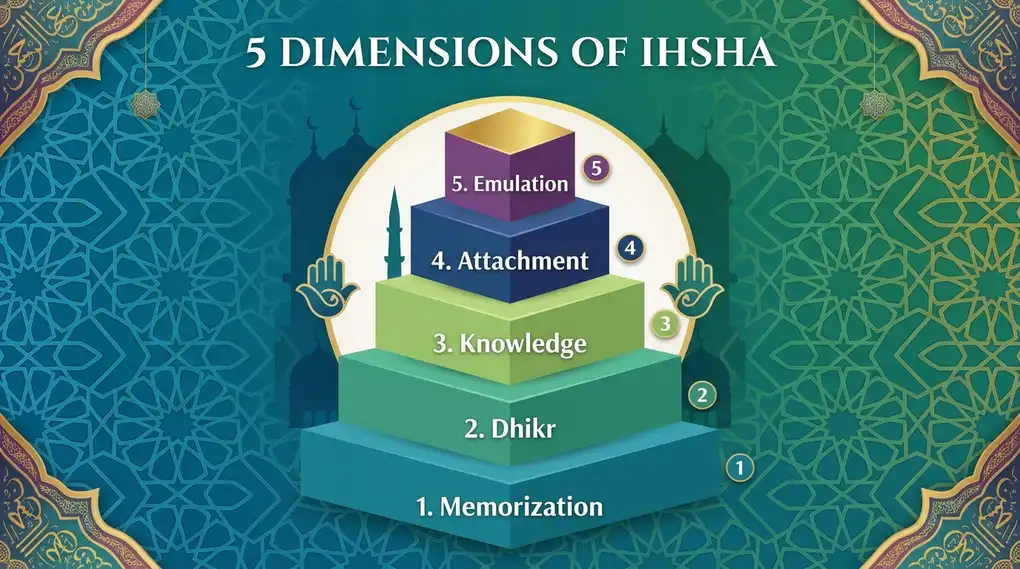
Zarruq himself expands the meaning of ihsha’ into five dimensions. We discuss them in the section on understanding and practice.
The Virtue of Preserving Asmaul Husna According to the Hadith
The hadith states the reward plainly: entering Paradise. This is the core of the virtue of Asmaul Husna according to the hadith. Note that the promise is for one who truly fulfills ihsha’, not for someone who merely reads the names in passing.
A fuller explanation of the sources and of the differing views on ihsha’ is in the dedicated discussion of the hadith of the 99 names of Allah and the meaning of ahshaha.
Once the evidence is clear, a big question follows: are Allah’s names only 99? We answer it in the section on the number and narrations of the names.
Are Allah’s Names Only 99? Imam An-Nawawi’s Explanation
This question almost always arises after people read the hadith of the 99 names. If it says “one hundred less one”, does that mean Allah’s names are only that many? The scholars’ answer: no. For a shorter treatment, see also the dedicated explanation of whether Allah’s names are only 99.
The Number 99 Is Not a Limit, but a Promise of Reward
The editor quotes the scholars’ consensus from Imam an-Nawawi in Syarh Sahih Muslim:
وَاتَّفَقَ العُلَمَاءُ عَلَى أَنَّ هَذَا الحَدِيثَ لَيْسَ فِيهِ حَصْرٌ لِأَسْمَائِهِ سُبْحَانَهُ وَتَعَالَى، فَلَيْسَ مَعْنَاهُ أَنَّهُ لَيْسَ لَهُ أَسْمَاءُ غَيْرُ هَذِهِ التِّسْعَةِ وَالتِّسْعِينَ، وَإِنَّمَا مَقْصُودُ الحَدِيثِ أَنَّ هَذِهِ التِّسْعَةَ وَالتِّسْعِينَ مَنْ أَحْصَاهَا دَخَلَ الجَنَّةَ
Meaning: The scholars agree that this hadith does not limit Allah’s names. It does not mean Allah has no names besides these ninety-nine. What the hadith intends is this: whoever fulfills the ihsha’ of these ninety-nine will enter Paradise.[5]
Zarruq uses the same logic. He explains that only the reward is limited, not the names:
فَحَصَرَ هَذَا الثَّوَابَ لِلتِّسْعَةِ وَالتِّسْعِينَ، وَلَمْ يَحْصُرِ الأَسْمَاءَ فِي التِّسْعَةِ وَالتِّسْعِينَ، فَجَازَ أَنْ يَكُونَ ثَمَّ غَيْرُهَا
Meaning: The hadith limits this reward to ninety-nine names, but it does not limit the names themselves to ninety-nine. So there may be others.[7]
Evidence for Other Names
An-Nawawi cites another hadith as proof. Its wording comes in a supplication narrated by Imam Ahmad from Ibn Mas’ud:
أَسْأَلُكَ بِكُلِّ اسْمٍ هُوَ لَكَ سَمَّيْتَ بِهِ نَفْسَكَ، أَوْ أَنْزَلْتَهُ فِي كِتَابِكَ، أَوْ عَلَّمْتَهُ أَحَدًا مِنْ خَلْقِكَ، أَوِ اسْتَأْثَرْتَ بِهِ فِي عِلْمِ الغَيْبِ عِنْدَكَ
Meaning: “I ask You by every name that is Yours, which You have named Yourself with, or revealed in Your Book, or taught to any of Your creation, or kept to Yourself in the knowledge of the unseen with You.”[8]
That last phrase shows there are names that only Allah knows.
Scholars on a Larger Number
The editor quotes Abu Bakr Ibn al-‘Arabi al-Maliki, who relays from some scholars that Allah has a thousand names. Ibn al-‘Arabi considers even that number small. Zarruq also mentions Shaykh Abu al-‘Abbas al-Buni, who arranged the names up to more than one hundred and fifty.[9]
Two Views on Names Beyond the 99
Zarruq summarizes two possibilities with care:
- The names beyond the 99 are unknown to us.
- Or we know them, but they carry no special reward like the 99.
Some also hold that these 99 were set aside specifically for worship and spiritual travel, unlike the others.[7]
Differences in the Narrations of the 99 Names
The hadith agrees on the number, but the list of names differs. This confuses people who find two sources with different arrangements. See also the discussion of differences in the narrations of the Asmaul Husna list.
The Lists in Tirmidhi and Ibn Majah
Zarruq notes in the closing section of his book:
وَقَدِ اخْتَلَفَتِ الرِّوَايَاتُ فِي تَعْدِيدِ الأَسْمَاءِ وَتَعْيِينِهَا بَعْدَ الِاتِّفَاقِ عَلَى أَنَّ المَوْعُودَ عَلَيْهَا الثَّوَابَ تِسْعَةٌ وَتِسْعُونَ. وَالَّذِي أَثْبَتَهُ فِي جَامِعِ التِّرْمِذِيِّ …
Meaning: The narrations differ in enumerating and identifying the names, even though all agree that the reward is promised for ninety-nine. What is established in Jami’ at-Tirmidhi is the reference.[10]
In the introduction, Zarruq adds that Ibn Majah’s narration contains differences and a changed order compared with Tirmidhi’s.
Is the Detailed List the Narrator’s Words, Not the Prophet’s?
The hadith scholars weigh whether the detailed names are the words of the Prophet ﷺ or the narrator’s explanation. Zarruq says:
فَرَجَّحَ الحُفَّاظُ أَنَّ سَرْدَهَا … مِنَ الرَّاوِي … وَقَالُوا: يُقْبَلُ فِيهَا خَبَرُ الوَاحِدِ؛ لِأَنَّهَا عِبَادَةٌ وَعَمَلٌ
Meaning: The hafiz scholars favored that the listing of the names comes from the narrator. They also said that a single-narrator report (khabar ahad) is accepted here because it concerns worship and practice.[11]
Names Outside the Tirmidhi List
In the editor’s note, another source (Ibn al-A’rabi in Mu’jam Shuyukh) mentions names that are not in Tirmidhi’s list, among them Ar-Rabb, Al-Hannan, Al-Mannan, Al-Kafi, Ad-Da’im, Al-Qarib, Ath-Thawab, Al-Jamil, Ash-Shadiq, Al-Muhith, Al-Qadim, and Al-Khallaq.[12]
How to Handle the Differences
The safest reference is the list used by Tirmidhi, because its chain is the strongest. We still respect the ijtihad of other scholars. These differences do not reduce the honor of Allah’s names in the slightest.
Are Asmaul Husna Established by Evidence Alone? (Tawqifiyyah)
One last question: may we give Allah a new name that seems beautiful to us?
The Rule: Allah’s Names Are Established by Text or Consensus
Zarruq states:
الأَسْمَاءُ تَوْقِيفِيَّةٌ، فَلَا تَثْبُتُ إِلَّا بِنَصٍّ أَوْ إِجْمَاعٍ عَلَى الصَّحِيحِ
Meaning: Allah’s names are tawqifi, established only by a text or by consensus (ijma’), according to the sound view.[3]
The View That Allows Deriving Names from Acts and Attributes
Some Sufi scholars, including Shaykh Abu al-‘Abbas al-Buni, established names by deriving words from Allah’s acts and attributes and from supplications in the Sunnah. Zarruq judges this view marjuh (weak) among scholars.[3]
With this rule, we do not invent names for Allah. Next, the section on the framework of meaning discusses the framework for understanding their meanings.
Classification of Asmaul Husna: Essence, Transcendence, and Acts
With the evidence and the number settled, we need a map to understand the content. Without one, the 99 names feel like a long list that is hard to remember. Shaykh Zarruq provides a simple map that anyone can use. This is the classification of Asmaul Husna according to him.
Groups of Names According to Zarruq
In his introduction, Zarruq divides Allah’s names into several groups. Below are the three classifications of Asmaul Husna according to his explanation.
Names of the Essence
أَسْمَاءُ الذَّاتِ: وَهِيَ الَّتِي يُقَالُ: هِيَ هُوَ، وَلَا هِيَ غَيْرُهُ، وَلَا هِيَ فِيمَا بَيْنَهُمَا اعْتِبَارٌ
Meaning: Names of the Essence are names of which one says, “it is He, and it is not other than Him.” An example is the word Allah.[7]
Names of Transcendence (Tanzih)
وَأَسْمَاءُ التَّنْزِيهِ: وَهِيَ مَا دَلَّ عَلَى التَّقْدِيسِ المُطْلَقِ كَالقُدُّوسِ وَنَحْوِهِ
Meaning: Names of transcendence indicate absolute sanctity, such as Al-Quddus and the like.[7]
Names of Acts (Af’al)
وَأَسْمَاءُ الأَفْعَالِ: قَالَ إِمَامُ الحَرَمَيْنِ: هِيَ كُلُّ مَا دَلَّتِ التَّسْمِيَةُ بِهِ عَلَى فِعْلٍ، كَالخَلْقِ وَالرِّزْقِ
Meaning: Names of acts, according to Imam al-Haramayn, are names that indicate an action, such as creating and providing. Examples are Al-Khaliq and Ar-Razzaq.[7]
Some teachers respond that the difference of meaning in this group lies in ishtiqaq (derivation), not in the name itself. Zarruq calls this the sound view.
The Meaning of Ishtiqaq in Allah’s Names
When the book mentions ishtiqaq, it means that a name carries a certain meaning. For example, As-Salam carries the meaning of safety, and Ar-Rahman the meaning of mercy. It does not mean Allah’s name “derives” from something that existed before it. Zarruq affirms:
وَأَسْمَاءُ اللهِ تَعَالَى قَدِيمَةٌ؛ لِأَنَّهَا مِنْ كَلَامِهِ … وَأَنْكَرَ قَوْمٌ إِطْلَاقَ الِاشْتِقَاقِ لِلْإِيهَامِ
Meaning: Allah’s names are eternal (qadim) because they are part of His speech. Some scholars reject using the term ishtiqaq because it can cause misunderstanding.[11]
Jalal, Jamal, and Kamal: Three Shades of Meaning in Asmaul Husna
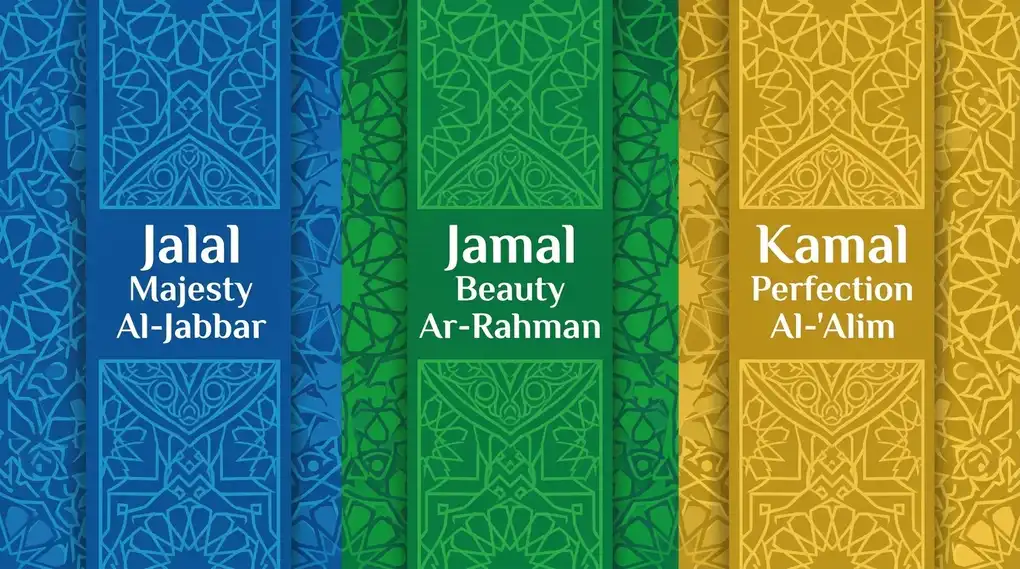
The second map is closer to the heart. You can read a longer discussion of jalal, jamal, and kamal in Asmaul Husna.
Zarruq’s Explanation
At the start of his book, Zarruq writes:
فَجَعَلَ مِنْ أَسْمَائِهِ مَا لِلْجَمَالِ وَمَا لِلْجَلَالِ وَمَا لِلْكَمَالِ
Meaning: Allah made some of His names relate to beauty (jamal), some to majesty (jalal), and some to perfection (kamal).[13]
In other words, the names of Allah with the attributes of jalal and jamal are two complementary sides. The attribute of majesty grows reverence and awe. The attribute of beauty grows closeness and love.
An Illustration of Each Group
The examples below are only a general illustration, not Zarruq’s fixed division:
- Jamal: Ar-Rahim, Al-Ghaffar, Al-Wadud. The heart feels at ease mentioning them.
- Jalal: Al-Jabbar, Al-Qahhar, Al-Mutakabbir. The heart feels humbled.
- Kamal: Al-‘Alim, Al-Qadir, Al-Hayy. The heart marvels at His perfection.
This division makes the meanings easier to remember. One name can be understood from several sides at once.
Its Link to the Condition of the Heart
Zarruq connects these groups to the state of the person making dhikr:
فَإِذَا كَانَ الغَالِبُ عَلَيْكَ الجَلَالَ وَالقَبْضَ، فَخُذْ مِنَ الأَسْمَاءِ الجَلَالِيَّةِ
Meaning: If what dominates you is majesty and qabdh (a contracted heart), take from the names of jalal.[14]
Fear (khawf), hope (raja’), and love grow from these three shades of meaning. How to choose the fitting name is discussed in the section on understanding and practice.
Tanzih: Guarding Understanding from Likening Allah to Creation
The better we know Allah’s names, the more we must guard one thing: do not imagine Allah like His creation. This is called tanzih. A further treatment is in the discussion of tanzih in understanding the names and attributes of Allah.
The Principle: Allah Is Not Like Creation
In the editor’s note, Imam al-Ghazali is quoted explaining that Allah is not a body, is not bounded by measure, and nothing resembles Him, with the evidence:
لَيْسَ كَمِثْلِهِ شَيْءٌ وَهُوَ السَّمِيعُ الْبَصِيرُ
Meaning: “There is nothing like Him, and He is the All-Hearing, the All-Seeing.” (Ash-Shura: 11)[15]
So Allah is not like creation. The “hearing” in As-Sami’ is not the same as our ears.
Two Approaches of the Scholars to Verses and Hadith on Attributes
The editor quotes Imam an-Nawawi on the two paths of the scholars:
أَحَدُهُمَا — وَهُوَ مَذْهَبُ مُعْظَمِ السَّلَفِ أَوْ كُلِّهِمْ —: أَنَّهُ لَا يُتَكَلَّمُ فِي مَعْنَاهَا، بَلْ يَقُولُونَ: يَجِبُ عَلَيْنَا أَنْ نُؤْمِنَ بِهَا وَنَعْتَقِدَ لَهَا مَعْنًى يَلِيقُ بِجَلَالِ اللهِ تَعَالَى وَعَظَمَتِهِ مَعَ اعْتِقَادِنَا الجَازِمِ أَنَّ اللهَ تَعَالَى لَيْسَ كَمِثْلِهِ شَيْءٌ
Meaning: First, the path of most of the salaf: do not discuss their meaning (tafwidh). We believe the attribute has a meaning fitting Allah’s majesty, with firm conviction that nothing is like Him.
وَالقَوْلُ الثَّانِي — وَهُوَ مَذْهَبُ مُعْظَمِ المُتَكَلِّمِينَ —: أَنَّهَا تُتَأَوَّلُ عَلَى مَا يَلِيقُ بِهَا عَلَى حَسَبِ مَوَاقِعِهَا، وَإِنَّمَا يَسُوغُ تَأْوِيلُهَا لِمَنْ كَانَ مِنْ أَهْلِهَا بِأَنْ يَكُونَ عَارِفًا بِلِسَانِ العَرَبِ
Meaning: Second, the path of most theologians: interpret (ta’wil) according to context. Interpretation is valid only for those qualified, namely those who master the Arabic language and the principles and branches of the law.[16]
How to Read the Meaning of Allah’s Names
When reading the meaning of Al-Qahir or Al-Basith, remember three things:
- The meaning is true and fits Allah’s majesty.
- Do not imagine form, direction, or size.
- If you are unsure about a verse on attributes, leave it to those qualified.
With this framework, we are ready to see the list of names and their meanings in the section on the list of 99 names.
The List of the 99 Names of Allah and Their Meanings by Theme
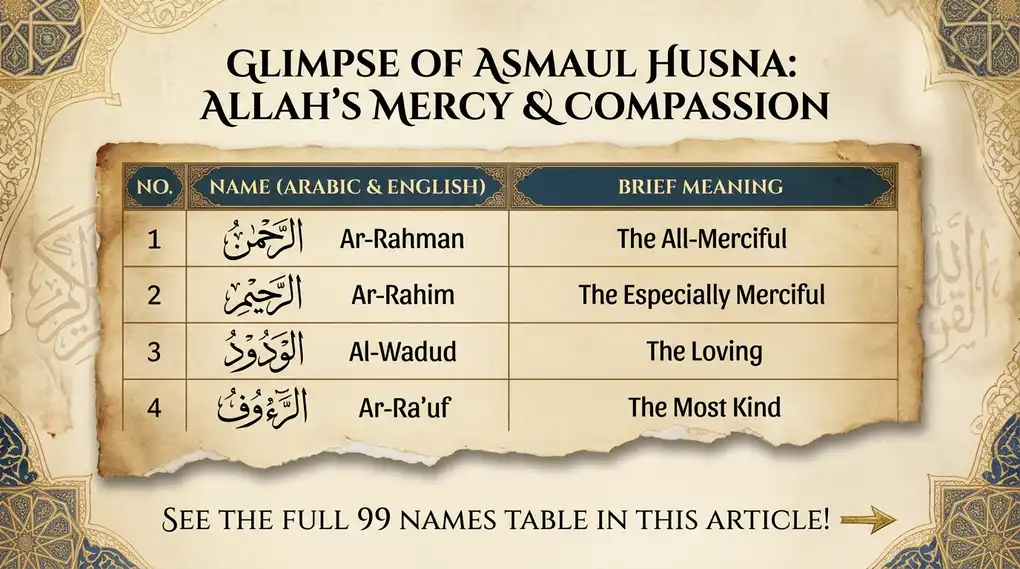
This is the most searched part: the complete list of Asmaul Husna with Arabic script, transliteration, and translation. To make them easier to study, we group the 99 names of Allah by theme rather than by the order in the hadith. That way, names with related meanings sit side by side.
The basis of this list is the Tirmidhi narration, which the editor considers the strongest and which Zarruq relies on. The editor quotes the beginning of that list in his footnote:
هُوَ اللهُ الَّذِي لَا إِلَهَ إِلَّا هُوَ الرَّحْمَنُ الرَّحِيمُ الْمَلِكُ الْقُدُّوسُ السَّلَامُ الْمُؤْمِنُ الْمُهَيْمِنُ الْعَزِيزُ الْجَبَّارُ الْمُتَكَبِّرُ الْخَالِقُ الْبَارِئُ الْمُصَوِّرُ الْغَفَّارُ الْقَهَّارُ الْوَهَّابُ الرَّزَّاقُ الْفَتَّاحُ الْعَلِيمُ …
Meaning: “He is Allah, there is no deity except Him; Ar-Rahman, Ar-Rahim, Al-Malik, Al-Quddus, As-Salam, Al-Mu’min, Al-Muhaymin, Al-‘Aziz, Al-Jabbar, Al-Mutakabbir, Al-Khaliq, Al-Bari’, Al-Mushawwir, Al-Ghaffar, Al-Qahhar, Al-Wahhab, Ar-Razzaq, Al-Fattah, Al-‘Alim …” and so on until the full ninety-nine.[17]
The meanings in the tables below are short meanings. A deeper explanation of each name will be given, God willing (in sha Allah), in its own article, which we will write separately.
Names about Tawhid, Oneness, and Eternity of Allah
This group affirms that Allah is one, living, and everlasting without beginning or end. Continue to the discussion of Asmaul Husna about Tawhid.
| No | Arabic | Transliteration | Short meaning |
|---|---|---|---|
| 1 | الله | Allah | The God worthy of worship |
| 2 | الواحد | Al-Wahid | The One |
| 3 | الأحد | Al-Ahad | The Unique |
| 4 | الصمد | Ash-Shamad | The Self-Sufficient, to whom all creatures turn |
| 5 | الحي | Al-Hayy | The Ever-Living |
| 6 | القيوم | Al-Qayyum | The Self-Subsisting who sustains all |
| 7 | الحق | Al-Haqq | The Truth |
| 8 | الوكيل | Al-Wakil | The Trustee, in whom we place our reliance |
| 9 | الأول | Al-Awwal | The First |
| 10 | الآخر | Al-Akhir | The Last |
| 11 | الظاهر | Azh-Zhahir | The Manifest |
| 12 | الباطن | Al-Bathin | The Hidden |
| 13 | الباقي | Al-Baqi | The Everlasting |
| 14 | الواجد | Al-Wajid | The Finder, never lacking |
| 15 | الوارث | Al-Warits | The Inheritor of all things |
Names about Mercy, Forgiveness, and Compassion
Here we meet the names that most soothe the heart. The full discussion is in Asmaul Husna about mercy and forgiveness.
| No | Arabic | Transliteration | Short meaning |
|---|---|---|---|
| 16 | الرحمن | Ar-Rahman | The Most Compassionate |
| 17 | الرحيم | Ar-Rahim | The Most Merciful |
| 18 | الغفار | Al-Ghaffar | The Oft-Forgiving, who covers sins |
| 19 | الغفور | Al-Ghafur | The Forgiving |
| 20 | الشكور | Asy-Syakur | The Appreciative of His servants’ deeds |
| 21 | التواب | At-Tawwab | The Acceptor of repentance |
| 22 | العفو | Al-‘Afuw | The Pardoner |
| 23 | الرؤوف | Ar-Ra’uf | The Most Kind |
| 24 | الودود | Al-Wadud | The Most Loving |
| 25 | الحليم | Al-Halim | The Forbearing |
| 26 | اللطيف | Al-Lathif | The Subtle and Gentle |
| 27 | البر | Al-Barr | The Most Righteous, abundant in goodness |
Names about Majesty, Holiness, and Honor
This group is closely tied to the attribute of jalal discussed in the section on the framework of meaning. Continue to Asmaul Husna about the majesty of Allah.
| No | Arabic | Transliteration | Short meaning |
|---|---|---|---|
| 28 | الملك | Al-Malik | The Sovereign |
| 29 | القدوس | Al-Quddus | The Most Holy |
| 30 | السلام | As-Salam | The Source of Peace, free of every flaw |
| 31 | المؤمن | Al-Mu’min | The Granter of security |
| 32 | المهيمن | Al-Muhaymin | The Guardian and Overseer |
| 33 | العزيز | Al-‘Aziz | The Almighty |
| 34 | الجبار | Al-Jabbar | The Compeller and Mender |
| 35 | المتكبر | Al-Mutakabbir | The Possessor of greatness |
| 36 | الجليل | Al-Jalil | The Majestic |
| 37 | الكريم | Al-Karim | The Most Generous and Noble |
| 38 | المجيد | Al-Majid | The Glorious |
| 39 | العلي | Al-‘Aliy | The Most High |
| 40 | العظيم | Al-‘Azhim | The Magnificent |
| 41 | الكبير | Al-Kabir | The Great |
| 42 | المتعالي | Al-Muta’ali | The Exalted above all |
| 43 | مالك الملك | Malikul Mulk | Owner of all sovereignty |
| 44 | ذو الجلال والإكرام | Dzul Jalali wal Ikram | Lord of Majesty and Honor |
| 45 | الحميد | Al-Hamid | The Praiseworthy |
Names about Creation, Provision, and Giving
These names are often recited when people ask for sustenance. They are discussed in Asmaul Husna about provision and creation.
| No | Arabic | Transliteration | Short meaning |
|---|---|---|---|
| 46 | الخالق | Al-Khaliq | The Creator |
| 47 | البارئ | Al-Bari’ | The Maker who brings into being |
| 48 | المصور | Al-Mushawwir | The Fashioner of forms |
| 49 | البديع | Al-Badi’ | The Originator without precedent |
| 50 | الوهاب | Al-Wahhab | The Bestower |
| 51 | الرزاق | Ar-Razzaq | The Provider |
| 52 | المقيت | Al-Muqit | The Sustainer who gives every creature its needs |
| 53 | الغني | Al-Ghani | The Self-Sufficient and Rich |
| 54 | المغني | Al-Mughni | The Enricher |
| 55 | المعطي | Al-Mu’thi | The Giver |
| 56 | المانع | Al-Mani’ | The Withholder |
| 57 | المبدئ | Al-Mubdi’ | The Originator of creation |
| 58 | المعيد | Al-Mu’id | The Restorer |
| 59 | المحيي | Al-Muhyi | The Giver of life |
| 60 | المميت | Al-Mumit | The Giver of death |
| 61 | الفتاح | Al-Fattah | The Opener |
Names about Knowledge, Hearing, and Oversight
This section holds the names that remind us Allah always knows. The further discussion is in Asmaul Husna about the knowledge and oversight of Allah.
| No | Arabic | Transliteration | Short meaning |
|---|---|---|---|
| 62 | العليم | Al-‘Alim | The All-Knowing |
| 63 | السميع | As-Sami’ | The All-Hearing |
| 64 | البصير | Al-Bashir | The All-Seeing |
| 65 | الخبير | Al-Khabir | The All-Aware |
| 66 | الرقيب | Ar-Raqib | The Watchful |
| 67 | الشهيد | Asy-Syahid | The Witness |
| 68 | الحسيب | Al-Hasib | The Reckoner who suffices |
| 69 | الحفيظ | Al-Hafizh | The Preserver |
| 70 | المحصي | Al-Muhshi | The Counter |
| 71 | الحكيم | Al-Hakim | The All-Wise |
Names about Power, Justice, and the Ordering of Destiny
This is the largest group, because it concerns Allah’s power over every matter. Read more in Asmaul Husna about the power and justice of Allah.
| No | Arabic | Transliteration | Short meaning |
|---|---|---|---|
| 72 | القهار | Al-Qahhar | The Subduer |
| 73 | القوي | Al-Qawiy | The All-Strong |
| 74 | المتين | Al-Matin | The Firm |
| 75 | القادر | Al-Qadir | The All-Powerful |
| 76 | المقتدر | Al-Muqtadir | The Determiner of power |
| 77 | المقدم | Al-Muqaddim | The Advancer |
| 78 | المؤخر | Al-Mu’akhkhir | The Delayer |
| 79 | القابض | Al-Qabidh | The Constrictor |
| 80 | الباسط | Al-Basith | The Expander |
| 81 | الخافض | Al-Khafidh | The Abaser |
| 82 | الرافع | Ar-Rafi’ | The Exalter |
| 83 | المعز | Al-Mu’izz | The Giver of honor |
| 84 | المذل | Al-Mudzill | The Giver of humiliation |
| 85 | الحكم | Al-Hakam | The Judge |
| 86 | العدل | Al-‘Adl | The Just |
| 87 | المقسط | Al-Muqsith | The Establisher of justice |
| 88 | المنتقم | Al-Muntaqim | The Avenger against wrongdoers |
| 89 | الضار | Adh-Dharr | The Creator of harm |
| 90 | النافع | An-Nafi’ | The Creator of benefit |
| 91 | الوالي | Al-Wali | The Master who governs affairs |
Names about Guidance, Help, and Supplication
The last group is close to a servant’s need for guidance and answered prayer. Please read Asmaul Husna about guidance and supplication.
| No | Arabic | Transliteration | Short meaning |
|---|---|---|---|
| 92 | المجيب | Al-Mujib | The Responder to prayer |
| 93 | الواسع | Al-Wasi’ | The All-Encompassing |
| 94 | الباعث | Al-Ba’its | The Resurrector |
| 95 | الجامع | Al-Jami’ | The Gatherer |
| 96 | الهادي | Al-Hadi | The Guide |
| 97 | النور | An-Nur | The Light |
| 98 | الرشيد | Ar-Rasyid | The Guide to what is right |
| 99 | الصبور | Ash-Shabur | The Most Patient |
A Note on Four Names Without a Chapter of Their Own
Four names are still listed but have no chapter of their own in Zarruq’s book: Al-Fattah, Al-Warits, Al-Barr, and Al-Hamid. All four appear in the Tirmidhi list. So their short meanings in the table are taken from general understanding.
One more thing: the arrangement of the 99 names above is by theme. The lists differ in several names, as discussed in the section on the number and narrations of the names. The thematic grouping is used for ease of study, not to claim it is the only correct order.
How to Read This List and Names with Close Meanings
Some names sound alike, and it is natural to ask what the difference is. There are two ways to read them.
Paired Names
Some names are best understood as pairs:
- Ar-Rahman and Ar-Rahim. Zarruq explains that Ar-Rahman comes from mercy, namely the appearance of Allah’s command toward creation with gentleness and kindness:
الرَّحْمَنُ: فَعْلَانُ مِنَ الرَّحْمَةِ، الَّتِي هِيَ: ظُهُورُ أَمْرِهِ تَبَارَكَ وَتَعَالَى لِخَلْقِهِ بِنَوْعٍ مِنَ الرِّفْقِ وَالْبِرِّ
Meaning: Ar-Rahman is the fa’lan form of mercy, that is, the manifestation of Allah’s command to His creation with gentleness and goodness.[18] In the editor’s note, Ibn Jarir relays that Ar-Rahman is for all creation, while Ar-Rahim is specific to the believers.[18] This is the short answer to the difference between Ar-Rahman and Ar-Rahim.
- Al-Qabidh and Al-Basith. The Constrictor and the Expander.
- Al-Awwal and Al-Akhir. A beginning and an end without limit.
- Al-Wahid and Al-Ahad. Both point to oneness, from different angles, discussed in the article on Asmaul Husna about tawhid.
Names Discussed in a Single Chapter
In the book, some names are discussed together in one chapter, for example Al-Khaliq, Al-Bari’, and Al-Mushawwir (p. 52). Zarruq explains part of their meanings:
وَالتَّخْلِيقُ: إِيجَادُ المُتَمَكِّنِ وَإِبْرَازُهُ لِلْوُجُودِ … المُصَوِّرُ: مُعْطِي كُلِّ مَخْلُوقٍ مَا هُيِّئَ لَهُ مِنْ صُورَةِ وُجُودِهِ بِحِكْمَتِهِ
Meaning: Takhliq is bringing into existence what is possible and bringing it forth into being. Al-Mushawwir is the One who gives each creature the form of its existence prepared for it, with His wisdom.[19]
With this map, the list of 99 names no longer feels like a long memorization task. The next section covers how to understand and practice them.
The Meaning of “Ihsha'” According to Zarruq: Five Dimensions of Understanding Asmaul Husna
In the section on evidence we saw that the word ahshaha in the hadith has several interpretations. Shaykh Zarruq arranges them into one framework that is easy to remember. This is the shortest answer to the question of how to understand Asmaul Husna and how to practice Asmaul Husna.
The Five Dimensions of Ihsha’
الإِحْصَاءُ عَلَى خَمْسَةِ أَوْجُهٍ: الحِفْظُ، وَالذِّكْرُ، وَالعِلْمُ، وَالتَّعَلُّقُ، وَالتَّخَلُّقُ. وَالكُلُّ أَقْوَالٌ
Meaning: Ihsha’ has five sides: memorizing, dhikr, knowing the meaning, ta’alluq, and takhalluq. All of them have been said by scholars.[11]
The order rises gradually. A person starts with memorization, then dhikr, then knowledge of the meaning. The last two touch the heart and conduct.
Takhalluq: Emulating the Character of Allah within Human Limits
Takhalluq means taking on character that matches Allah’s attributes, within the servant’s capacity of course. The examples are simple. We know Ar-Rahim, so we learn to be compassionate to those around us. We know Al-‘Afuw, so we learn to forgive.
This does not mean a human equals Allah. We only imitate the side of character that is fitting for His servants to follow.
At-Taqarrub and Ta’alluq
Zarruq names three purposes of dhikr:
ثُمَّ الذِّكْرُ: إِمَّا لِلتَّعَبُّدِ أَوْ لِلتَّوَسُّلِ أَوْ لِطَلَبِ الخَاصِّيَّةِ، وَلِكُلٍّ شَرْطٌ وَوَجْهٌ وَمَادَّةٌ
Meaning: Dhikr may be for worship, for tawassul, or for seeking its special properties. Each has its own conditions, aspects, and material.[11]
At-taqarrub is drawing near to Allah through His name. Ta’alluq is binding the heart to the meaning of that name so that it lives in daily attitude.
Memorizing and Understanding, Not Just Reading
A person who only recites without knowing the meaning is like someone reading a list of names without knowing their owner. Zarruq even mentions a kind of dhikr that is merely a spoken habit, without presence of heart, and that gives little benefit.[11] So memorization is a door, not the goal.
The Etiquette of Supplicating with Asmaul Husna
Allah’s command in Al-A’raf: 180 is clear: supplicate with His names. The question is, what is the etiquette? Here is the way to make du’a with Asmaul Husna in line with the book.
Choosing the Name that Fits the Need
Choose the name that matches the need. When asking for sustenance, mention Ar-Razzaq. When asking for forgiveness, mention Al-Ghaffar or At-Tawwab. When needing guidance, mention Al-Hadi. This agrees with the verse above, because supplicating with Allah’s names means mentioning the name that fits the content of the prayer.
Preferring Supplications from the Qur’an and Sunnah
The editor reminds us that the best way of making du’a is to follow the Qur’an and the words of the Prophet ﷺ. He quotes several scholars who reject invented supplications with no basis. At-Tabarani said:
رَأَيْتُ كَثِيرًا مِنَ النَّاسِ قَدْ تَمَسَّكُوا بِأَدْعِيَةِ سَجْعٍ، وَأَدْعِيَةٍ وُضِعَتْ عَلَى عَدَدِ الأَيَّامِ … لَا تُرْوَى عَنْ رَسُولِ اللهِ ﷺ وَلَا عَنْ أَحَدٍ مِنْ أَصْحَابِهِ
Meaning: I saw many people holding on to rhymed supplications and supplications composed for the number of days of the week, though they are not narrated from the Messenger of Allah ﷺ nor from any of his Companions.[20]
Al-Khattabi also warns against avoiding invented supplications and names that have no source in revelation. Meanwhile at-Turtushi marvels at those who leave the Qur’anic supplications and choose the phrases of poets and writers.[20] Al-Qadi ‘Iyad is likewise quoted that Allah permitted His servants to make du’a and taught supplication in His Book.
Zarruq himself composed a form of supplication with these names, and the editor judges it good as long as it does not contradict the Qur’an and Sunnah.[21]
The Hadith “Bi Kulli Ismin Huwa Laka …”
A well-known supplication from the Sunnah is the one for a person overwhelmed by worry or sorrow. Its core is the same as what we discussed in the section on the number and narrations of the names:
أَسْأَلُكَ بِكُلِّ اسْمٍ هُوَ لَكَ سَمَّيْتَ بِهِ نَفْسَكَ، أَوْ أَنْزَلْتَهُ فِي كِتَابِكَ، أَوْ عَلَّمْتَهُ أَحَدًا مِنْ خَلْقِكَ، أَوِ اسْتَأْثَرْتَ بِهِ فِي عِلْمِ الغَيْبِ عِنْدَكَ، أَنْ تَجْعَلَ القُرْآنَ رَبِيعَ قَلْبِي
Meaning: “I ask You by every name that is Yours … that You make the Qur’an the spring of my heart.”[8]
How to Make Dhikr with Asmaul Husna and Choose the Fitting Name
Many ask about the correct way to make dhikr with Asmaul Husna. Zarruq does not give one formula for everyone. Instead he starts from the condition of the soul. A fuller guide is available in the discussion of how to make dhikr with Asmaul Husna.
Choosing a Name According to the State of the Soul
ثُمَّ إِذَا أَرَدْتَ السُّلُوكَ بِاسْمٍ عَلَى طَرِيقِ الذِّكْرِ فَحَقِّقْ طَبْعَكَ وَحَالَكَ، ثُمَّ انْظُرْ مِنَ الأَسْمَاءِ مَا يُنَاسِبُهُ مَعْنًى
Meaning: If you wish to travel with a name by way of dhikr, first understand your nature and condition, then look for a name whose meaning suits it.[14]
Zarruq then details three states:
- Dominated by jalal and qabdh (a heart that feels narrow or afraid): take from the names of jalal.
- Dominated by jamal (a heart inclined to hope and love): take from the names of jamal.
- Dominated by kamal: take the names of kamal that suit you, and make dhikr with a balanced voice, without excess.[22]
Conditions and Etiquette According to Zarruq
Zarruq gives several easy-to-grasp guidelines:
وَالجَمْعُ فِي ذَلِكَ كُلِّهِ شَرْطٌ، وَعَدَمُ الِاسْتِعْجَالِ أَصْلٌ
Meaning: Presence of heart is a condition, and not rushing is the foundation.[23]
He adds that taqwa and steadfastness are conditions. Dhikr of this kind is best accompanied by a sincere teacher and a righteous friend so that mistakes are avoided:
فَالتَّقْوَى وَالِاسْتِقَامَةُ شَرْطٌ، وَلَا بُدَّ مِنْ مُشَارَكَةِ شَيْخٍ نَاصِحٍ وَأَخٍ صَالِحٍ بِمَا يُصْلِحُ، وَإِلَّا وَقَعَ الغَلَطُ. فَإِنْ لَمْ يَكُنْ فَلَا تُقْدِمْ عَلَى شَيْءٍ إِلَّا بِالِاسْتِخَارَةِ مِرَارًا
Meaning: Taqwa and steadfastness are conditions, and one needs the company of a sincere teacher and a righteous brother, otherwise mistakes occur. If there is none, do not step forward without istikharah repeated many times.[24]
Practical Tips
This section is our own suggestion, not a quotation from the book:
- Begin with the dhikr taught by the Prophet ﷺ, including dhikr after the obligatory prayers.
- Choose a reasonable amount that you can keep up regularly, and do not force yourself.
- Understand the meaning of the name you recite so that your heart is present.
- Consult a teacher if you wish to increase your practice.
So dhikr of Asmaul Husna after prayer can be done moderately and with a present heart. A dedicated discussion is in the dhikr sub-topic of the related article.
How to Memorize Asmaul Husna with Their Meanings
For memorizing Asmaul Husna, start from the themed tables in the section on the list of 99 names. Memorize one group per day, read the meanings, and then try to link each to one event in your life. For example, when sustenance feels tight, remember Ar-Razzaq. Memorization joined to meaning lasts far longer.
Finally, the section on special properties and FAQ discusses the special properties, the limits of the religion, and the FAQ.
The Special Properties of Asmaul Husna: Between Evidence and Scholars’ Reports
After learning the meanings and etiquette, many people ask about the special properties (khasiat) of Asmaul Husna. This section contains no practices to perform. We only examine what Zarruq wrote about the source of those properties and how scholars treat them. A broader discussion is in the article on the special properties of Asmaul Husna according to the scholars.
What Does Shaykh Zarruq Say about the Source of These Properties?
Zarruq is candid about his references. In the closing of the book, he writes:
وَغَالِبُ مَا اعْتَمَدْتُهُ فِي الخَوَاصِّ إِنَّمَا هُوَ مِنْ كِتَابِي «كِيمِيَاءِ السَّعَادَةِ» لِلْإِمَامِ مُحْيِي الدِّينِ بْنِ العَرَبِيِّ، وَبَعْضُهُ لِأَبِي العَبَّاسِ البُونِيِّ. وَلَمْ يُمْكِنِّي تَصْحِيحُ ذَلِكَ لِلْعَجَلَةِ الَّتِي صَحِبَتْنِي فِي وَقْتِهِ
Meaning: Most of what I relied on regarding special properties comes from the book Kimiya as-Sa’adah by Ibn ‘Arabi, and some from Abu al-‘Abbas al-Buni. I was not able to verify it because of the haste I was in at that time.[14]
This admission matters. It means the properties in circulation are not automatically evidence, and even the author had not yet checked them.
The Properties Require Inspiration and Experience
In the introduction, Zarruq explains that knowledge of these properties largely comes from the inspiration of the people of realities, and even that is rare:
فَمِنْ قَوَاعِدِهِمْ: أَنَّ كُلَّ اسْمٍ خَاصِّيَّتُهُ فِي مَعْنَاهُ، وَتَصْرِيفُهُ فِي مُقْتَضَاهُ، وَإِفَادَتُهُ فِي وَقْتِهِ، وَسِرُّهُ فِي عَدَدِهِ؛ وَتَأْثِيرُهُ عَلَى قَدْرِ المُتَأَثِّرِ بِهِ، وَذَلِكَ بِقَدْرِ الفَيْضِ وَالقَصْدِ وَالهِمَّةِ
Meaning: Among their principles: each name’s property lies in its meaning, its application in what it requires, its benefit in its time, and its secret in its number. Its effect corresponds to the state of the one affected, that is, in proportion to overflow, intention, and resolve.[25]
So according to Zarruq, results differ from person to person. He himself presents this as a subject of study for the people of realities, not as a fixed formula that applies equally to everyone.
Creedal and Religious Limits
For that reason we present this topic as a study of sources and scholars’ views, with several limits:
- This is not a practice guide or a guarantee of results.
- This is not a legal ruling on any practice. For the ruling on a particular Asmaul Husna practice, ask a qualified scholar.
Scholars’ Warning against Lists of “A Thousand Names”
Al-Khattabi, as quoted by the editor, rebukes a habit among some laypeople:
وَقَدْ يُوجَدُ فِي أَيْدِيهِمْ دُسْتُورٌ فِي الأَسْمَاءِ وَالأَدْعِيَةِ يُسَمُّونَهُ: «الأَلْفَ اسْمٍ» … أَكْثَرُهَا زُورًا وَافْتِرَاءً عَلَى اللهِ سُبْحَانَهُ وَتَعَالَى، فَلْيَجْتَنِبْهَا الدَّاعِي إِلَّا مَا وَافَقَ مِنْهَا الصَّوَابَ
Meaning: Often found with them is a collection of names and supplications called the “Thousand Names” … most of it falsehood and lies against Allah. So whoever supplicates should avoid them, except what agrees with the truth.[20]
Getting to Know Shaykh Ahmad Zarruq and the Book Syarh Asma’ Allah al-Husna
Since this article quotes Zarruq often, it is only fitting to meet him. Here are two short guides: the biography of Shaykh Ahmad Zarruq and the book Syarh Asma’ Allah al-Husna.
Who Was Shaykh Zarruq?
The editor records his full name:
هُوَ الإِمَامُ أَحْمَدُ بْنُ أَحْمَدَ بْنِ مُحَمَّدِ بْنِ عِيسَى البَرْنُسِيُّ الفَاسِيُّ المَالِكِيُّ الشَّهِيرُ بِزَرُّوق، شِهَابُ الدِّينِ أَبُو الفَضْلِ
Meaning: He is the Imam Ahmad ibn Ahmad ibn Muhammad ibn ‘Isa al-Barnusi al-Fasi al-Maliki, known as Zarruq, with the title Shihabuddin Abu al-Fadl.[26]
He was born in Fez in 846 AH and died in 899 AH in the Tripoli region. Among his works are Syarh al-Hikam al-‘Ata’iyyah and Qawa’id at-Tasawwuf, which joins the Shari’ah and the realities.[26]
The Writing Pattern of the Book
Based on a mapping of the book’s contents, each chapter on a name is usually arranged in a pattern: meaning and origin of the word, evidence, views of the masters, tanbih (a warning note), at-taqarrub bi hadha al-ism (how to draw near through that name), and sometimes khasiyyah. This pattern makes the book feel like a guide to reading the names, not merely a dictionary.
The Commentary Appendix on ad-Dimyati’s Poem
At the back, the book contains an appendix: a commentary on ad-Dimyati’s poem about the special properties of Allah’s names (pp. 175–214). The appendix contains many practical instructions, so we do not repeat them here. Readers who wish to study it should consult the book directly with a teacher’s guidance.[27]
From Memorizing to Knowing
Our journey in this article can be summarized in five points:
- Evidence. Asmaul Husna is established by the Qur’an and hadith, among them Al-A’raf: 180 and the hadith of Abu Hurayrah.
- Number. The figure 99 limits the promise of reward, not the number of Allah’s names.
- Narrations. The detailed list is in Tirmidhi and Ibn Majah, with differences that are respected.
- Framework of meaning. Names are understood through essence, transcendence, and acts, and through jalal, jamal, and kamal.
- Etiquette. Memorize, understand, supplicate, and practice calmly, without rushing and preferably under guidance.
Next, you can explore each group of names in the section on the list of 99 names to study their meanings one by one. Start with the name you need most today.
FAQ about Asmaul Husna
Are Allah’s names only 99?
No. The hadith does not limit the number of Allah’s names; what it limits is the promise of reward.
- An-Nawawi states that the scholars agree this hadith does not limit Allah’s names.[5]
- Zarruq explains that the reward is limited to 99, while other names may be unknown to us or may not carry this special reward.[7]
What does “man ahshaha” mean in the hadith of the 99 names? Is memorizing enough?
There are several views, and memorizing is only one of them.
- Memorizing, counting in supplication, understanding, and practicing.[6]
- Zarruq details five dimensions of ihsha’: memorizing, dhikr, knowledge, ta’alluq, and takhalluq.[11]
May we create a new name for Allah or use names that have no evidence?
No, according to the sound view. Allah’s names are tawqifi, established by text or consensus (ijma’).[3] The view permitting establishing names from acts and attributes is judged weak.
How do I choose Asmaul Husna for dhikr and du’a?
Match it to the condition of your soul, then keep the etiquette.
- If jalal dominates, take the names of jalal; if jamal dominates, take the names of jamal; if kamal dominates, take the names of kamal.[22]
- Do not rush, be consistent, and include a teacher or righteous friend. If there is none, perform istikharah often.[28]
Footnotes


