
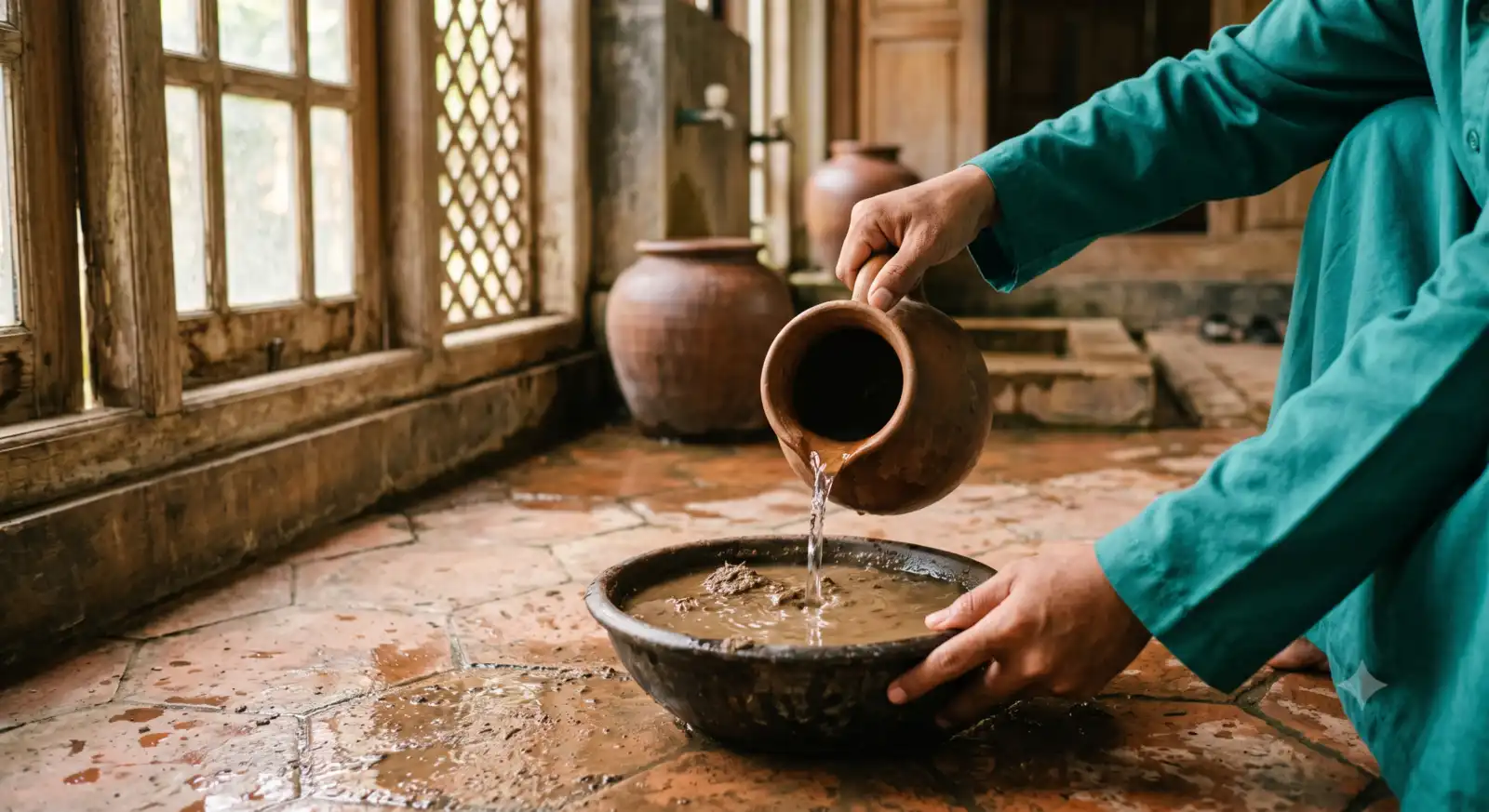
For many Muslims, the question of how to purify dog impurity comes up the moment skin or clothing comes into contact with this animal — whether by accident, or because a dog is kept for a legitimate purpose such as guarding property or hunting. Unlike ordinary impurity, which can simply be washed away with plain water, dog impurity (najis) follows a specific method laid out directly by the Prophet ﷺ. This article covers the underlying ruling, the practical step-by-step method, the valid conditions for the soil used, and the most commonly asked contemporary cases — all according to the Shafi’i school (madzhab).
Why Is Dog Impurity Different from Other Types of Impurity?
In Shafi’i fiqh, not all impurities are treated the same way. Some only need to be sprinkled with water, some only need a single rinse, and some require a specific seven-wash procedure. Dog impurity falls into this last category, which is why it deserves a dedicated discussion.
The Status of Dog Impurity as Najis Mughallazhah (Severe Impurity)
Shafi’i scholars divide impurity into three tiers: mukhaffafah (light, such as the urine of a baby boy who has not yet eaten anything besides breast milk), mutawassithah (moderate, such as feces and blood), and mughallazhah (severe). Dogs — along with pigs and anything born from either of them — fall under this mughallazhah tier, the most severe level of impurity in the Shafi’i school.
Imam Syamsuddin al-Khathib al-Syarbini states this explicitly in his book Al-Iqna’:
«القَوْل فِي النَّجَاسَة الْمُغَلَّظَة وإزالتها: وَيغسل الْإِنَاء وكل جامد… من ولوغ كل من الْكَلْب وَالْخِنْزِير»
“On severe (mughallazhah) impurity and how to remove it: the vessel and every solid object… must be washed as a result of a dog’s or pig’s licking.”[1]
This answers a question that many people often search for: can the impurity of a dog disappear on its own? The answer is no, not if it is merely left to dry, exposed to the wind, or by the passage of time. Unlike some light impurities, severe impurity (najis mughallazhah) has absolute requirements for purification.
However, it can be purified naturally (without human intent) if the object happens to undergo a process that fulfills the requirements of Islamic law—for example, falling into a flowing river containing soil or dust, and being continuously washed by the strong current equivalent to seven washings. As long as the conditions of seven flows of water and the element of soil are fulfilled by nature, it is legally deemed pure.
The book Fathul Qarib, by Ibnu Qasim al-Ghazi, likewise confirms the distinct status of dogs and pigs compared to other animals:
«وَالْحَيَوَان كُله طَاهِر إِلَّا الْكَلْب وَالْخِنْزِير وَمَا تولد مِنْهُمَا»
“Every animal is pure, except for the dog and the pig, and whatever is born from either of them.”[2]
In other words, among the many kinds of animals Allah has created, only dogs and pigs (and any crossbred offspring of the two) are ruled impure in their very essence, at the mughallazhah level. This is the basis for why the ruling on dog saliva — and every other part of its body — is treated differently from other animals, even though those other animals may also be unlawful to eat.
The Primary Evidence: The Hadith Narrated by Muslim on Wulugh (a Dog’s Licking)
The legal basis for the method of purifying dog impurity is not derived from analogy (qiyas) or independent reasoning alone, but directly from a statement of the Prophet ﷺ. Scholars refer to this as the hadith of wulugh al-kalb (a dog’s licking).
The Text of the Hadith and Its Meaning
The core hadith that forms the reference point for the entire discussion of dog impurity states:
«إِذَا وَلَغَ الْكَلْبُ فِي إِنَاءِ أَحَدِكُمْ فَاغْسِلُوهُ سَبْعَ مَرَّاتٍ أُولَاهُنَّ بِالتُّرَابِ»
“If a dog licks the vessel of any one of you, then wash it seven times, the first of which with soil.” (Narrated by Muslim)[3]
The word wulugh (وُلُوغ) linguistically means inserting the tongue into a liquid to drink — not merely touching it with another part of the body. However, Shafi’i scholars do not restrict this ruling to the act of licking alone; every wet part of a dog’s body follows the same ruling, as will be explained in the next section.
There are two crucial points in this hadith:
- The number of washes required is seven, not just one as with ordinary mutawassithah impurity.
- One of the seven washes must be mixed with soil, not plain water alone.
Variant Narrations: The Scholars’ Reconciliation on the Position of the Soil
Interestingly, there are several other narrations with different wording regarding at which wash the soil should be used. One narration by Imam Muslim himself states:
«وَعَفِّرُوهُ الثَّامِنَةَ بِالتُّرَابِ»
“And scour it with soil an eighth time.”[3]
Meanwhile, a narration by Imam Ad-Daruquthni states:
«إِحْدَاهُنَّ بِالْبَطْحَاءِ»
“One of them with the soil of a valley (bathha’).”[3]
There is also a narration authenticated by Imam At-Tirmidzi with the wording “the first or the last of them”. Given these differences among the narrations, Imam Al-Khathib Al-Syarbini explains where the scholarly reconciliation (jam’) lies:
«وَبَيْنَ رِوَايَتَيْ مُسْلِمٍ تَعَارُضٌ فِي مَحَلِّ التُّرَابِ فَيَتَسَاقَطَانِ فِي تَعْيِينِ مَحَلِّهِ وَيُكْتَفَى بِوُجُودِهِ فِي وَاحِدَةٍ مِنَ السَّبْعِ»
“Between the two narrations of Imam Muslim there is a contradiction regarding the exact position of the soil, so the two cancel each other out in determining that exact position, and it is sufficient that the soil be present in just one of the seven washes.”[3]
In other words, because the authentic narrations differ over which wash must contain the soil, the Shafi’i school takes a middle path: what is obligatory is the presence of soil in one of the seven washes, while its ideal placement is discussed in more detail in the practical method below. For a deeper look at the tiers of severe impurity, see the ruling on severe impurity (mughallazhah).
The Scope of Dog Impurity: Not Just Saliva


Many people assume dog impurity only applies to its saliva when it licks something. In reality, the scope is far broader.
Saliva, Urine, Sweat, and Every Part of a Dog’s Body
Al-Iqna’ explicitly explains that the ruling of mughallazhah impurity applies to everything that comes out of, or touches, a dog’s body — not merely its saliva:
«وَكَذَا بِمُلَاقَاةِ شَيْءٍ مِنْ أَجْزَاءِ كُلٍّ مِنْهُمَا سَوَاءٌ فِي ذَلِكَ لُعَابُهُ وَبَوْلُهُ وَسَائِرُ رُطُوبَاتِهِ وَأَجْزَائِهِ الْجَافَّةِ إِذَا لَاقَتْ رَطْبًا»
“Likewise, (mughallazhah impurity applies) through contact with any part of either of the two (dog/pig) — its saliva, its urine, all of its other bodily fluids, and even its dry parts, if they come into contact with something wet.”[1]
This point is important to understand because its meaning is broad:
- Saliva (lu’ab) — the part most commonly referenced, since it is what is directly mentioned in the hadith.
- Urine and feces — follow the same ruling as saliva.
- Sweat and other bodily fluids — everything wet from a dog’s body is covered by this ruling.
- Dry fur or skin — still causes impurity, provided it touches something wet. If both are dry, no impurity is transferred. This same status applies to old, dried traces of dog impurity: they do not disappear on their own; they simply remain “dormant” until they meet moisture again.
The same book explains why saliva is specifically mentioned in the hadith, even though its scope extends beyond that:
«وَلِأَنَّ لُعَابَهُ أَشْرَفُ فَضَلَاتِهِ وَإِذَا ثَبَتَتْ نَجَاسَتُهُ فَغَيْرُهُ مِنْ بَوْلٍ وَرَوْثٍ وَعَرَقٍ وَنَحْوِ ذَلِكَ أَوْلَى»
“Because its saliva is the ‘noblest’ of its excretions (in the sense that it most often comes into contact with something clean, such as a drinking vessel). So, if its impurity is established even in this case, the impurity of its other fluids — urine, feces, sweat, and the like — is even more certain (aula).”[3]
This principle of aulawiyah (a fortiori reasoning) provides the scholarly answer to one of the most frequently searched questions, the ruling on dog saliva: if saliva — which is logically the “cleanest” of a dog’s bodily fluids, given its location inside the mouth — is ruled as mughallazhah impurity, then other parts of the body that are generally considered less clean certainly carry the same ruling, and are even more deserving (aula) of it. For a fuller discussion of the evidence behind a dog’s licking and its legal status, see the ruling on a dog’s licking and its evidence.
The Step-by-Step Method for Purifying Dog Impurity
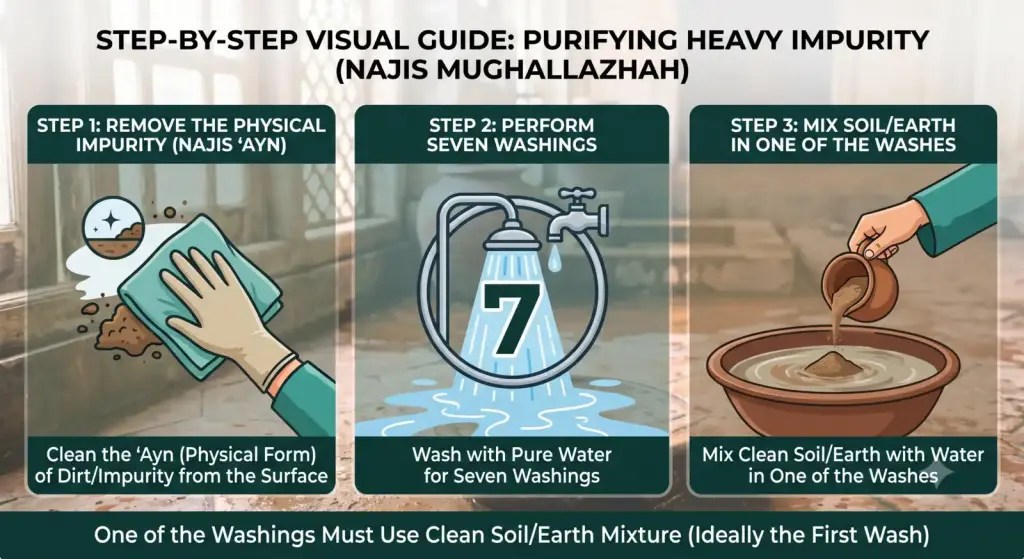
Having covered the underlying ruling, it’s time to move to the heart of this topic: how to purify dog impurity in practice. Broadly speaking, there are three main steps that must be carried out in sequence. None of them may be skipped, as each plays a distinct role in removing the status of mughallazhah impurity.
Step 1 — First, Remove the Physical Trace (‘Ain) of the Impurity
Before beginning the count of seven washes, the first required step is to remove the physical trace of the impurity — whether that’s fur stuck to the surface, thick saliva residue, or leftover feces. These initial washes only serve to remove the visible ‘ain (physical trace) of the impurity; they are not yet counted as part of the seven washes prescribed by the Shariah.
An Important Rule: Washes That Remove the Trace Count as One
There’s a rule that often causes confusion: what if the physical trace of the impurity only disappears after several washes — say, six rounds of rinsing? Are all six counted as six of the seven required washes?
The answer is no. Al-Iqna’ cites the authenticated position (tashhih) of Imam Nawawi on this matter:
«تَنْبِيهٌ: إِذَا لَمْ تَزُلْ عَيْنُ النَّجَاسَةِ إِلَّا بِسِتِّ غَسَلَاتٍ مَثَلًا حُسِبَتْ وَاحِدَةً»
“Note: if the physical trace of the impurity only disappears after, say, six washes, then all of them together count as a single wash.”[3]
So no matter how many rounds of rinsing are needed to remove the physical trace of the impurity, the entire process counts as only one wash within the required count of seven. Only once the physical trace is truly gone does the count of the remaining six plain-water washes begin.
Step 2 — Wash Seven Times with Pure, Purifying (Thahur) Water
Once the physical trace of the impurity is gone, the next step is to wash the area affected by dog impurity with thahur water (pure water that is also purifying, such as well water, rainwater, or tap water that has not changed in its properties) a total of seven times. This is the core of the seven washes for dog impurity, the distinguishing feature of mughallazhah impurity, totally unlike mutawassithah impurity, which only requires a single wash.
Every one of these water washes carries equal weight, except for the one that must be mixed with soil. The order of washing dog impurity is fixed and cannot be reduced in number, because the number seven was established directly by the hadith of the Prophet ﷺ, not derived from scholarly reasoning alone.
Step 3 — One of the Washes Must Be Mixed with Soil
Among the seven water washes, one wash must be mixed with pure soil. This is what distinguishes the method of purifying dog impurity from other impurities — the soil component is obligatory, not merely recommended.
The Recommended Position of the Soil: Not the Last Wash
Although the obligation is only satisfied by including soil in any one of the seven washes, Shafi’i scholars still offer guidance on its ideal placement. Al-Iqna’ states:
«وَيُسَنُّ جَعْلُ التُّرَابِ فِي غَيْرِ الْأَخِيرَةِ وَالْأُولَى أَوْلَى»
“It is recommended (sunnah) to place the soil anywhere other than the last wash, and the first wash is preferable.”[3]
The practical reason:
«لِعَدَمِ احْتِيَاجِهِ بَعْدَ ذَلِكَ إِلَى تَتْرِيبِ مَا يَتَرَشْرَشُ مِنْ جَمِيعِ الْغَسَلَاتِ»
— because doing so removes the need to re-apply soil to any splashes that occur during the remaining washes.[3]
The reasoning is straightforward when pictured in practice:
- If the soil is placed in the first wash, the six subsequent plain-water washes automatically “clean up” any soil-mixed splashes that may land on the surrounding area.
- If the soil is placed in the last wash, splashes from that final wash could land on other objects or areas nearby — and whatever those splashes touch would need to be treated with soil separately, since there are no further water washes left to complete the process.
The Technique for Mixing Soil with Water (Mazj)
Soil may not simply be sprinkled on without being mixed with water. Al-Iqna’ states clearly:
«وَلَا بُدَّ مِنْ مَزْجِهِ بِالْمَاءِ»
— “and mixing it (the soil) with water is essential.”[1] Dry soil merely sprinkled onto a wet surface, without the mixing (mazj) process, is not considered a valid soil-wash.
Three Valid Ways to Mix
There are three acceptable ways to mix soil and water:
- Mix them first, then pour the water-soil mixture onto the affected area.
- Place the water first, sprinkle soil on top of it, then stir the two together before rubbing it onto the affected area.
- Place the soil first, then pour water over it, then stir the two together before rubbing it onto the affected area.
All three are valid, as long as the mixing (mazj) happens before the water-soil mixture is actually used to wash or scrub the affected area — not after.
The Minimum Amount of Soil Required
How much soil needs to be mixed in? Al-Iqna’ provides a clear benchmark:
«قَدْرًا يُكَدِّرُ الْمَاءَ وَيَصِلُ بِوَاسِطَتِهِ إِلَى جَمِيعِ أَجْزَاءِ الْمَحَلِّ»
“An amount that makes the water turbid, and through which the soil, carried by the water, can reach every part of the affected area.”[1]
So there’s no fixed measurement in grams or spoonfuls. There are only two benchmarks: (1) the water must visibly become turbid from the soil, and (2) that turbidity must be sufficient to reach the entire surface affected by the impurity, not just part of it.
Practical Examples for Real-World Cases
To make this easier to apply, here is how the three steps above play out in some of the most commonly asked cases.
Purifying a Vessel or Container Licked by a Dog
This is the original case behind the hadith of wulugh al-kalb itself. The steps for washing a vessel licked by a dog:
- First discard any leftover water or food in the container, then clean off any visible saliva residue, if present.
- Wash the container with plain water six times, each time with fresh running water touching the entire inner surface of the container.
- For one of the seven washes (ideally the first), use water that has been mixed with soil until turbid, scrub it across the entire inner surface, then continue with the remaining plain-water washes until seven is reached.
How to Purify Clothes Exposed to Dog Saliva
The question of how to purify clothes exposed to dog saliva is one of the most frequently searched, and the answer follows the same general rule:
- Rub or rinse the part of the fabric touched by the saliva to remove the physical trace first (this can count as a single wash even if scrubbed repeatedly).
- Soak or wash that part with plain water, repeating the process until a total of seven washes is reached.
- Insert one soil-mixed wash among them — this can be done by soaking the affected part of the fabric in water that has been mixed with soil until turbid, then kneading it so the soil reaches every fiber affected by the impurity, before rinsing it again with plain water in the subsequent washes.
Note: the parts of the fabric not touched by the impurity do not need to be washed seven times — only the part actually touched by the saliva or other bodily fluid.
How to Remove Dog Impurity from Feet and the Body
For cases involving how to remove dog impurity from feet or other parts of the body such as hands and shins:
- Wash the affected skin with running water to remove any residual saliva, fur, or feces stuck to it.
- Continue washing the area with plain water as many times as needed until seven washes is reached, with one of them mixed with soil until turbid and rubbed evenly across the affected skin.
- Once the soil-wash step is complete, rinse again with clean water so no soil residue remains, without reducing the count of washes already completed.
The same principle applies to how to purify dog impurity on the body in general — whether it’s the sole of a foot that has stepped on it, a hand that touched it, or any other part of the body that came into direct contact with a wet part of a dog’s body.
What Soil Is Used to Clean Dog Impurity?
The question of what soil is used to clean dog impurity also comes up often — must it be a specific type of soil, or can it be replaced with something more practical, like soap?
Conditions for the Soil: It Must Be Pure and Not Previously Used
Not just any soil is automatically valid for the soil-wash. There are two main conditions that must be met.
Impure or Previously-Used Soil Is Not Valid
Al-Iqna’ states this clearly:
«وَلَا يَكْفِي تُرَابٌ نَجِسٌ وَلَا مُسْتَعْمَلٌ»
“Impure soil is not sufficient, nor is soil that has already been used (musta’mal, i.e., previously used to lift a state of minor ritual impurity via tayammum).”[3]
Two categories of soil are excluded as a valid purifying medium:
- Impure soil — for example, soil already mixed with feces or another impure substance. The logic is clear: something impure cannot possibly be used to purify something else.
- Previously-used (musta’mal) soil — that is, soil that has already been used for tayammum to lift a state of minor ritual impurity (hadats). Its status is already “spent,” so it no longer carries purifying power for another purpose.
So, soil for purifying dog impurity must be “fresh” soil — not yet impure, and not previously used for another act of purification.
Sand Dust Is Also Sufficient
The good news is that this soil requirement doesn’t necessarily mean rich, brown, loamy earth, as many people imagine.
The Ruling on Sand Dust as a Valid Option
Al-Iqna’ provides some flexibility regarding the type of soil used:
«وَيَتَعَيَّنُ التُّرَابُ وَلَوْ غُبَارُ رَمْلٍ وَإِنْ أَفْسَدَ الثَّوْبَ»
“What is required is soil, even if it is only sand dust, even if it risks staining or damaging the fabric.”[3]
This means dust for mughallazhah impurity covers a broad range — it doesn’t have to be moist, fertile clay; fine sand dust is sufficient, as long as it still meets the conditions of being pure and not previously used, as explained above.
Can Soil Be Replaced with Soap or Detergent?
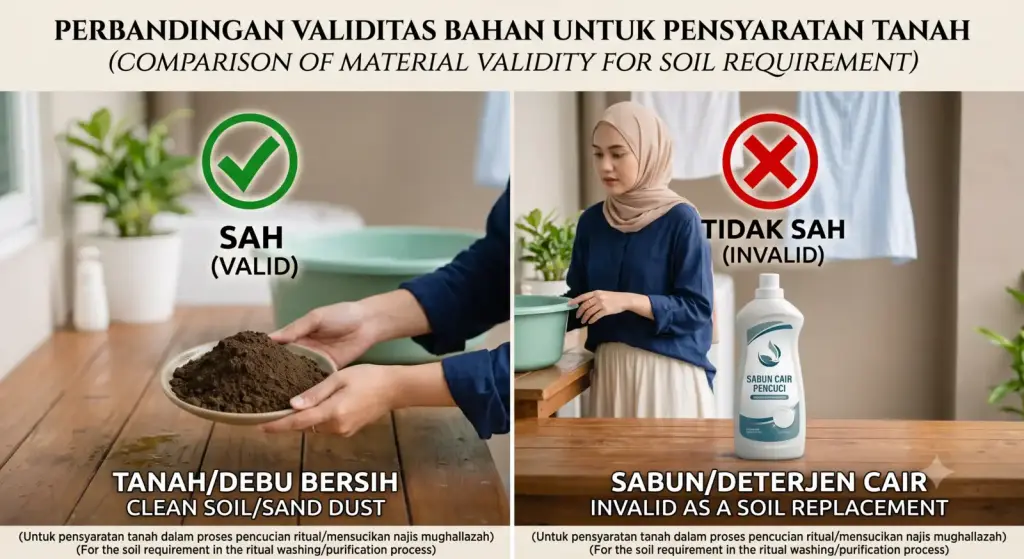
This is one of the most practical questions in modern times, given that soap and detergent are far easier to obtain and more convenient to use than soil.
The Authoritative (Mu’tamad) Shafi’i Position: Soap Does Not Replace Soil
The authoritative books give a fairly firm answer on this:
«جَمْعًا بَيْنَ نَوْعَيِ الطَّهُورِ فَلَا يَكْفِي غَيْرُهُ كَأُشْنَانٍ وَصَابُونٍ»
“Because (this soil-wash) combines two types of thahur (purifying agents — water and soil), nothing else is sufficient in its place, such as asynan (a type of cleansing plant) or soap.”[3]
The underlying reasoning (illat) here matters: the seven-wash process for dog impurity is not merely about “cleaning,” but about combining two types of thahur — water and soil — as a single purification ritual established by the text of the hadith. Soap and detergent, though chemically perhaps more effective at removing dirt or odor, are simply not soil. For that reason, they cannot take the place of soil within the count of seven washes.
This directly answers the question, can soap be used to purify dog impurity: according to the authoritative Shafi’i position, soap may certainly be used in addition to help remove the physical trace and odor of the impurity, but it cannot validly replace the soil that is obligatory in one of the seven washes. For a broader look at other purifying media besides water, see also purifying media other than water in Shafi’i fiqh.
A Special Case: Dog Impurity on Bare Soil or an Earthen Floor
What if a dog licks or relieves itself directly onto a bare soil surface — for example, an earthen floor in a yard or a kennel? Does that earthen floor need to be “treated with soil” again, the same as a container or fabric?
An Earthen Floor Does Not Need to Be “Treated with Soil” Again
Al-Iqna’ answers this case with straightforward logic:
«وَلَا يَجِبُ تَتْرِيبُ أَرْضٍ تُرَابِيَّةٍ إِذْ لَا مَعْنَى لِتَتْرِيبِ التُّرَابِ فَيَكْفِي تَسْبِيعُهَا بِمَاءٍ وَحْدَهُ»
“It is not obligatory to apply soil to an earthen floor, since there is no meaning in applying soil to soil. It is therefore sufficient to wash it seven times with water alone.”[3]
The logic is simple: the obligation to mix in soil exists because the surface affected by the impurity — a container, fabric, or skin — is not itself soil, so it must be “brought together” with the element of soil as part of the purification ritual. But if the affected surface is already soil itself, applying soil to soil is clearly meaningless. So it is sufficient to wash it seven times with plain water, with no additional soil required.
There is one additional, relevant note for this case:
«وَلَوْ أَصَابَ ثَوْبَهُ مَثَلًا مِنْهَا شَيْءٌ قَبْلَ تَمَامِ التَّسْبِيعِ لَمْ يَجِبْ تَتْرِيبُهُ قِيَاسًا عَلَى مَا أَصَابَهُ مِنْ غَيْرِ الْأَرْضِ بَعْدَ تَتْرِيبِهِ»
“And if, for example, some splash from it lands on his garment before the seven washes are complete, treating that garment with soil is not obligatory, by analogy with something that is splashed by matter other than the soil after the soil-treatment has already been done.”[3]
In other words, if a splash from the process of washing that earthen floor lands on a piece of clothing before the seven washes are finished, that clothing is considered to have already “received” the benefit of the soil-treatment — there is no need to treat it with soil separately, as long as the water-washing of the earthen floor is still in progress toward completing seven.
Is There a Special Dua or Intention for Removing Dog Impurity?
One of the most searched questions on this topic is actually not about the technical washing method at all, but about a dua for purifying dog impurity. Many people hope there is a specific formula to recite, similar to the intention (niyyah) for wudhu or the obligatory ritual bath (mandi wajib).
Setting the Record Straight: Removing Impurity Does Not Require an Intention
This point needs to be clarified from the outset, since many people conflate two types of purification (thaharah) that actually follow different rules.
The Difference Between Purification from Khabats (Impurity) and Purification from Hadats (Ritual Impurity)
In Shafi’i fiqh, thaharah is divided into two types with different rules: purification from hadats (such as wudhu and the obligatory ritual bath) and purification from khabats/najis (such as purifying clothing exposed to dog impurity). Al-Iqna’ explains the difference plainly:
«لَا يُشْتَرَطُ النِّيَّةُ فِي إِزَالَةِ النَّجَاسَةِ… بِخِلَافِ طَهَارَةِ الْحَدَثِ لِأَنَّهَا عِبَادَةٌ كَسَائِرِ الْعِبَادَاتِ، وَهَذَا مِنْ بَابِ التُّرُوكِ كَتَرْكِ الزِّنَا وَالْغَصْبِ»
“An intention is not required for removing impurity… unlike purification from hadats, because that is an act of worship like any other act of worship (requiring intention). Removing impurity, on the other hand, falls under the category of at-turuk — matters that are simply left off or removed — like abandoning zina (illicit sex) or ghashab (forcibly taking someone else’s property).”[4]
This explanation directly answers why those searching for an intention for removing dog impurity or an intention for purifying dog impurity will not find any narration of a specific formula of intention in the authoritative books. The reason is simple: removing impurity is not an act of worship requiring intention, like prayer or wudhu — it is simply the act of removing something unclean.
In other words, how dog impurity is purified is considered valid the moment the physical trace of the impurity is truly gone through the seven washes and soil mixture described above — regardless of whether any particular words were spoken during the process.
A Recommendation That Still Applies: Reciting the Basmalah
Although no specific intention or dua is prescribed for removing dog impurity, that doesn’t mean there’s no recommended etiquette at all. Reciting the basmalah before beginning the purification process is still recommended, as part of the general etiquette that applies to every act of purification in Islam. So for those searching for a recitation for purifying dog impurity, it should be understood that only the basmalah is recommended, as a matter of general etiquette — not a specific dua or recitation tied to this particular type of impurity.
Is It Possible to Remove Dog Impurity Without Soil?
The question of how to remove dog impurity without soil also comes up often, usually from people who have difficulty obtaining soil — for instance, those living in apartments or urban areas far from any source of plain soil.
A Fiqh Analysis: Soil Is a Condition in the Shafi’i School
As already discussed, in the Shafi’i school, soil is not merely recommended — it is an obligatory condition that combines two types of thahur (water and soil) at once. For that reason, strictly speaking within this school, cleaning dog impurity without soil is not considered complete; the process is only valid once one of the seven washes is indeed mixed with soil that meets the required conditions.
It’s worth understanding, however, that Islamic fiqh is not confined to the Shafi’i school alone. In brief, scholars from other schools do hold differing views on the status of dog impurity — some consider the ruling less strict than in the Shafi’i school, and some do not require mixing in soil at all. Such differences between schools are natural, since each has its own method of legal reasoning (istinbath) and its own way of understanding the relevant hadith narrations.
Readers who wish to understand the rukhshah (concession) offered by another school’s opinion should consult directly with a qualified scholar or the full reference texts of that school, to avoid mixing evidence from different schools inappropriately. This site consistently follows the Shafi’i school, so the guidance discussed here continues to uphold the obligation of soil as explained above.
Contemporary Cases
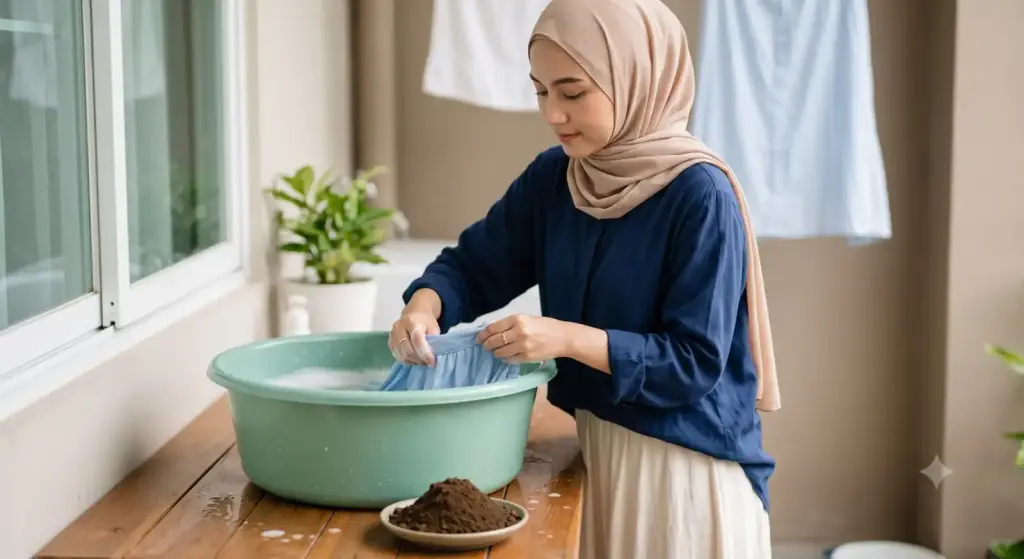
Beyond the two issues above, there are a few specific situations that come up often in daily life and deserve separate explanation.
Old, Dried Dog Impurity — Does It Still Need to Be Purified?
The question how to remove old dog impurity often comes from someone who has just noticed dried traces of dog impurity in a particular spot. As mentioned earlier, the rule is that the dried parts of a dog’s body still cause impurity “if they come into contact with something wet.”[1] The status of the impurity does not disappear simply because it has dried or time has passed; it merely remains “dormant” as long as it doesn’t encounter moisture. So if old, dried traces of dog impurity are found, they still must be purified through the seven-wash procedure with soil, as usual — regardless of how much time has passed.
A Container with a Small Amount of Water Licked by a Dog, Then Topped Up to Two Qullah
This is a rather unique case that’s often overlooked in general discussions. What if a container holding a small amount of water (less than two qullah) is licked by a dog, and then more water is added until the volume reaches two qullah or more? Al-Iqna’ cites an explanation from Imam Al-Baghawi, narrating from Ibnu Haddad, on this matter:
«وَلَوْ وَلَغَ الْكَلْبُ فِي إِنَاءٍ فِيهِ مَاءٌ قَلِيلٌ ثُمَّ كُوثِرَ حَتَّى بَلَغَ قُلَّتَيْنِ طَهُرَ الْمَاءُ دُونَ الْإِنَاءِ»
“If a dog licks a container holding a small amount of water, and the water is then increased until it reaches two qullah, the water becomes pure, but the container does not (remains impure).”[3]
This point is important to understand clearly:
- The water becomes pure, because its volume has reached the two-qullah threshold, restoring its status as water that is not easily rendered impure by ordinary contact with impurity.
- The container remains impure, because its inner surface was directly touched by the dog’s licking. The container still needs to be washed seven times, with one wash mixed with soil, in order to become pure again.
For a deeper look at this water-volume threshold, see also the two-qullah water threshold.
A Bathroom or Floor a Dog Has Previously Entered
Another case relevant to modern life: what if a bathroom or a particular area is known to have been entered by a dog years ago, but no one knows for certain which exact spot was actually touched by the impurity? Al-Iqna’ offers a highly relevant illustration through the example of a hammam (public bathhouse):
«حَمَّامٌ غُسِلَ دَاخِلَهُ كَلْبٌ وَلَمْ يُعْهَدْ تَطْهِيرُهُ… فَمَا تُيُقِّنَ إِصَابَةُ شَيْءٍ مِنْهُ مِنْ ذَلِكَ فَنَجِسٌ، وَإِلَّا فَطَاهِرٌ لِأَنَّا لَا نُنَجِّسُ بِالشَّكِّ»
“A hammam whose interior a dog once entered and bathed in, with no known history of it having been purified… whatever is certainly known to have been touched by that impurity is ruled impure. Otherwise, it is ruled pure, because we do not declare something impure based on mere doubt.”[3]
This principle — “we do not declare impurity based on mere doubt” — serves as an important guideline for similar cases today, such as a rented room, a public restroom, or an area whose history is unclear as to whether it was ever directly touched by a dog’s bodily fluids. As long as there is no certain knowledge that a particular place was indeed touched by dog impurity, the default ruling of purity remains.
Summary: A Checklist for Purifying Dog Impurity
A Quick-Reference Table of the 3 Steps
| Step | Action | Required Condition |
|---|---|---|
| 1. Remove the Physical Trace (‘Ain) | Clean off residual saliva, feces, or fur until the physical trace is completely gone | However many rinses it takes, the entire process counts as just one wash |
| 2. Wash 7 Times with Thahur Water | Wash the affected area with pure, purifying water seven times | The water must be thahur (pure and purifying), not musta’mal water or water that has changed in its properties |
| 3. Mix Soil into One of the Washes | One of the seven washes is mixed with soil, ideally the first one | The soil must be pure, not previously used, and in an amount sufficient to make the water turbid and reach the entire affected surface |
These three steps are the core of how to remove dog impurity, applicable to every case — whether a container, clothing, skin, or any other object touched by a dog’s bodily fluids.
Common Mistakes That Invalidate the Purification Process
Based on the discussion above, here are the mistakes that occur most often when cleaning dog impurity:
- Fully replacing the soil with soap or detergent — even though neither can take the place of soil within the count of seven washes.
- Sprinkling dry soil without mixing it with water (no mazj) — soil merely sprinkled onto a wet surface without the mixing process is not considered valid.
- Using impure or previously-used (musta’mal) soil — such as soil already used for tayammum, whose status no longer carries purifying power.
- Counting the washes used to remove the physical trace as part of the seven — when in fact, the initial washes to remove the ‘ain of the impurity only ever count as one.
- Re-treating an already-earthen floor with soil — when it is in fact sufficient to wash it seven times with water alone, with no additional soil needed.
FAQ on How to Purify Dog Impurity
Can dog impurity be removed with just soap, without soil?
No, that is not valid. In the Shafi’i school, soap and similar cleaning agents cannot replace soil, because this process fundamentally combines two types of thahur (water and soil) at once:
«فَلَا يَكْفِي غَيْرُهُ كَأُشْنَانٍ وَصَابُونٍ»
— “Nothing else is sufficient in its place, such as asynan or soap.”[3]
What if the physical trace of the impurity only disappears after six washes?
The entire process still counts as just one wash, not six. This follows the authenticated position of Imam Nawawi:
«إِذَا لَمْ تَزُلْ عَيْنُ النَّجَاسَةِ إِلَّا بِسِتِّ غَسَلَاتٍ مَثَلًا حُسِبَتْ وَاحِدَةً»
— “If the physical trace of the impurity only disappears after, say, six washes, then all of them together count as a single wash.”[3]
Must the water a dog has licked be discarded?
It is not obligatory, only recommended (sunnah). The stronger (ashah) opinion holds that it is recommended, not required:
«أَصَحُّهُمَا الثَّانِي، وَحَدِيثُ الْأَمْرِ بِإِرَاقَتِهِ مَحْمُولٌ عَلَى مَنْ أَرَادَ اسْتِعْمَالَ الْإِنَاءِ»
— “The more authentic view is the second one (that it is recommended to discard it), and the hadith commanding it to be discarded is understood to apply to someone who wishes to reuse the vessel.”[3]
If a dog puts its head into a container of water but its mouth comes out dry, is the water impure?
It is not ruled impure, according to the more authentic opinion. The rule falls back on the default ruling, which is purity:
«فَإِنْ خَرَجَ فَمُهُ جَافًّا لَمْ يُحْكَمْ بِنَجَاسَتِهِ»
— “If its mouth comes out dry, the water is not ruled impure.”[3]
Does an earthen floor touched by dog impurity need to be treated with soil again?
No, it does not. It is sufficient to wash it seven times with water alone:
«وَلَا يَجِبُ تَتْرِيبُ أَرْضٍ تُرَابِيَّةٍ إِذْ لَا مَعْنَى لِتَتْرِيبِ التُّرَابِ»
— “It is not obligatory to apply soil to an earthen floor, since there is no meaning in applying soil to soil.”[3]
This concludes a complete discussion of how to purify dog impurity with soil and water according to the Shafi’i school. To understand how dog impurity relates to other categories of impurity, see also the complete guide to types of impurity.
Footnotes
References
- Al-Syarbīnī, Syams al-Dīn Muḥammad bin Aḥmad. Al-Iqnāʿ fī Ḥall Alfāẓ Abī Syujaʿ. Edited by Maktab al-Buḥūts wa al-Dirāsāt, Dār al-Fikr. Beirut: Dār al-Fikr, vol. 1, pp. 92-94.
- Muḥammad ibn Qāsim al-Ghazzī, Fatḥ al-Qarīb al-Mujīb fī Sharḥ Alfāẓ al-Taqrīb = al-Qawl al-Mukhtār fī Sharḥ Ghāyat al-Ikhtiṣār, ed. Bassām ʿAbd al-Wahhāb al-Jābī, 1st ed., vol. 1 (Beirut: al-Jafān wa-al-Jābī, Dār Ibn Ḥazm, 2005), 57.


