
Human bodily fluids do not all have the same ruling in Shafi‘i fiqh. Some are najis—physical impurities that must be removed from the body, clothes, or prayer place. Others remain pure even though people may regard them as unpleasant.
Each case should be read through three questions: Is the fluid najis? Does its discharge invalidate wudu? How should it be cleansed before prayer?
Najis and Hadath Are Different
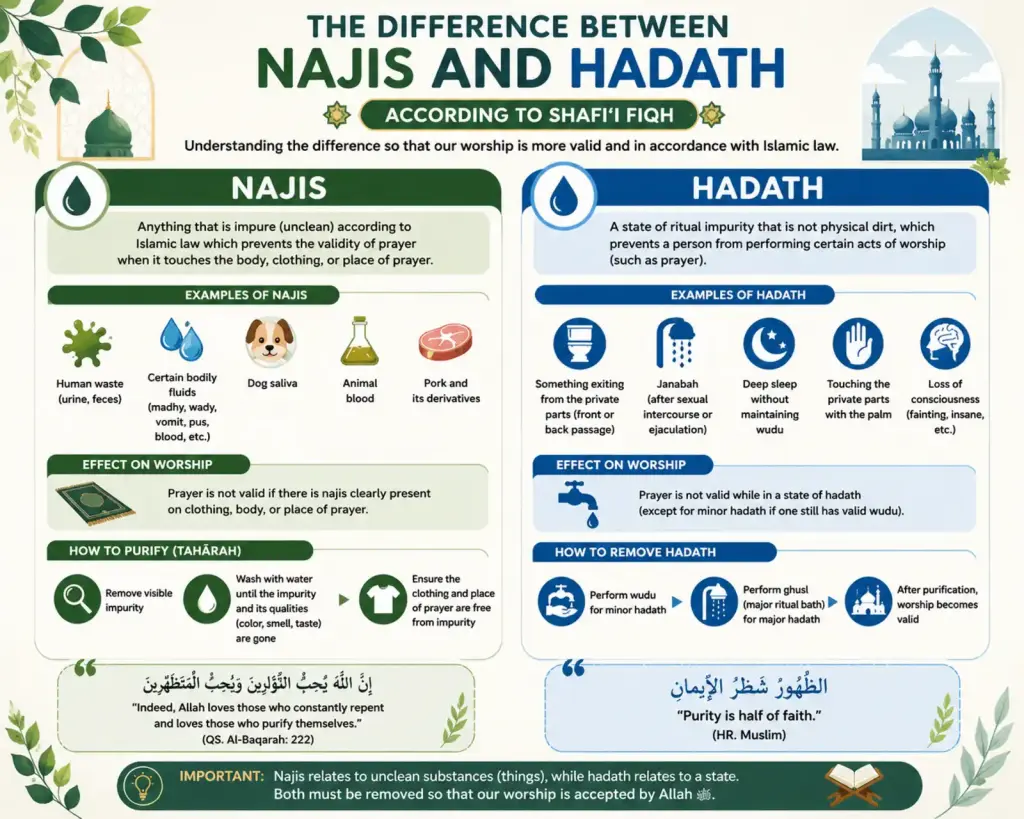
Najis is a physical substance that can affect the validity of prayer when it is on the body, clothing, or the prayer place. Hadath is a ritual state that prevents certain acts of worship until a person performs the required purification, such as wudu.
Al-Khatib al-Shirbini explains:
وَهِي لُغَة كل مَا يستقذر وَشرعا مستقذر يمْنَع من صِحَة الصَّلَاة حَيْثُ لَا مرخص
Meaning: “Linguistically, najis is whatever people find repulsive. In Sacred Law, it is something regarded as impure that prevents the validity of prayer where no concession applies.”[1]
Therefore, touching or being stained by najis does not automatically invalidate wudu. Conversely, a person may have valid wudu but still be unable to pray until visible najis is removed.
Zakariyya al-Anshari defines taharah as follows:
وشرعا رفع حدث أو إزالة نجس أو ما في معناهما
Meaning: “In Sacred Law, purification is lifting hadath, removing najis, or what takes the place of either of them.”[2]
For the broader classification, see types of najis.
The Rule for Fluids from the Private Passages
A central Shafi‘i rule concerns fluids that leave either of the two private passages. Ibn Qasim al-Ghazzi writes:
وكل مائع خرج من السبيلين نجس إلا المني
Meaning: “Every liquid that exits from the two passages is najis, except semen.”[3]
This includes ordinary discharge, such as urine and feces. It also includes unusual discharge, such as blood or pus when it leaves through the front or rear passage.
Discharge from either passage also invalidates wudu. Zakariyya al-Anshari lists the first invalidator as:
الأول الخارج من أحد السبيلين
Meaning: “The first [invalidator] is whatever exits from either of the two passages.”[4]
This distinction is essential. Blood from an external wound is najis but does not invalidate wudu. Blood that exits through the anus is najis and its exit invalidates wudu.
Hemorrhoid Bleeding: Najis, Wudu, and Prayer
The answer to “Is blood najis?” is yes in the Shafi‘i discussion used here. Zakariyya al-Anshari writes:
فرع المستحيل في الباطن نجس كدم
Meaning: “A subsidiary point: what changes within the body is najis, such as blood.”[5]
Hemorrhoid bleeding that reaches tissue, underwear, trousers, a prayer garment, or the body should be cleansed before prayer. This is a question of physical najis, not merely visible dirt.
Does hemorrhoid bleeding invalidate wudu?
When the blood exits through the anus, wudu is invalidated. The reason is not only that blood is najis, but that something has exited through one of the two private passages.[4]
When the blood comes from an external wound and does not exit through either private passage, it remains najis. However, its exit does not invalidate wudu in the Shafi‘i school.
So, “Does bleeding invalidate wudu?” cannot be answered with one rule for every type of bleeding. Blood from a cut finger is different from blood leaving through the anus.
How to cleanse hemorrhoid bleeding
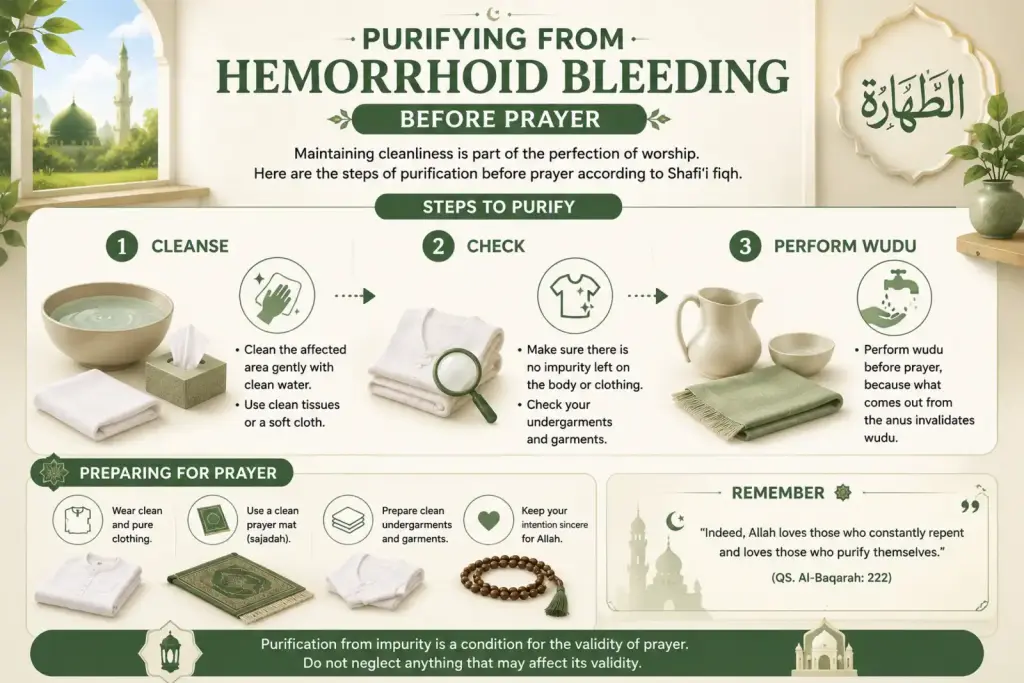
First remove the visible blood. Then wash the affected part of the body or clothing with purifying water.
For visible najis, one removes the substance itself and makes a reasonable effort to remove its properties. Ibn Qasim al-Ghazzi states:
بزوال عينها ومحاولة زوال أوصافها من طعم أو لون أو ريح
Meaning: “By removing the substance itself and attempting to remove its properties: taste, color, or smell.”[6]
When bleeding exits through the anus, clean the area and renew wudu. A clean barrier may be used when needed to prevent the blood from spreading to prayer clothes.
Madhy: Najis, Wudu, and No Ghusl
Madhy—also written madhi or madhiy—is a thin, whitish fluid that may be released when desire begins to stir. It is not semen, so it does not carry the ruling of obligatory ghusl.
Zakariyya al-Anshari explains:
ومذي بالمعجمة … وهو ماء أبيض رقيق يخرج بلا شهوة عند ثورانها
Meaning: “Madhy is a thin, white fluid that comes out without the full force of desire when desire is aroused.”[7]
The answer to “Is madhy najis?” is yes. It comes within the general rule for liquid that exits through either private passage, so it must be washed from the body or clothes.[3]
The Prophet Muhammad ﷺ said regarding madhy:
في المذي يغسل ذكره ويتوضأ
Meaning: “Regarding madhy, he washes his private part and performs wudu.”[8]
This shows two matters: the affected area is washed, and wudu is renewed before prayer. Madhy does not require ghusl.
For a fuller comparison, see differences between mani, madhy, and wady.
How to cleanse madhy



- Wash the private part or any body part touched by madhy.
- Wash the portion of clothing touched by it.
- Perform wudu before prayer.
- Do not perform ghusl merely because madhy was discharged.
Wady: A Cloudy Fluid Distinct from Madhy
Wady—also written wadi—is described as a whitish, cloudy, and thick fluid. It differs from madhy, which is generally thin.
Zakariyya al-Anshari writes:
وودي بالمهملة … وهو ماء أبيض كدر ثخين يخرج عقب البول أو عند حمل شيء ثقيل
Meaning: “Wady is a white, cloudy, thick fluid that exits after urination or when carrying something heavy.”[7]
Wady exits through a private passage. It is therefore najis, and its exit invalidates wudu.[3][4]
A question such as “Does clear discharge require ghusl?” depends on what the fluid is. If it is madhy or wady, ghusl is not required; washing the affected area and performing wudu are sufficient.
Vomit: Najis but Not an Invalidator of Wudu
The Shafi‘i position used in this article treats vomit as najis. Zakariyya al-Anshari includes it in the discussion of substances changed within the body:
وقيء وإن لم يتغير
Meaning: “And vomit, even if it has not changed.”[5]
Vomit that reaches the body, clothing, floor, or prayer mat should be cleansed before prayer. Yet vomiting does not invalidate wudu in the Shafi‘i school, because it exits through the mouth rather than either private passage.[4]
A person who vomits after making wudu cleans the vomit from the affected area. They do not repeat wudu solely because they vomited.
For the complete list, see what invalidates wudu.
Pus and Wound Discharge
The answer to “Is pus najis?” is that pus is najis when it is transformed blood. Asna al-Mathalib states:
وقيح وماء قرح تغير … لأن كلا منهما دم مستحيل
Meaning: “Pus and changed wound discharge [are najis], because each is transformed blood.”[5]
Pus on clothing or the body must therefore be cleansed before prayer. The same ruling applies to wound discharge that has changed.
However, the text gives an important qualification:
فإن لم يتغير ماء القرح فطاهر كالعرق
Meaning: “If the wound discharge has not changed, it is pure like sweat.”[5]
Thus, not every fluid from a wound is automatically najis. Unchanged wound discharge is ruled pure in this passage.
A concession for a small amount of blood and pus
Ibn Qasim al-Ghazzi writes:
ولا يعفى عن شيء من النجاسات إلا اليسير من الدم والقيح
Meaning: “Nothing of najis is excused except a small amount of blood and pus.”[9]
This concession does not turn blood or pus into pure substances. Their basic ruling remains najis, while a small amount is excused for prayer.
Mucus, Saliva, Drool, and Phlegm
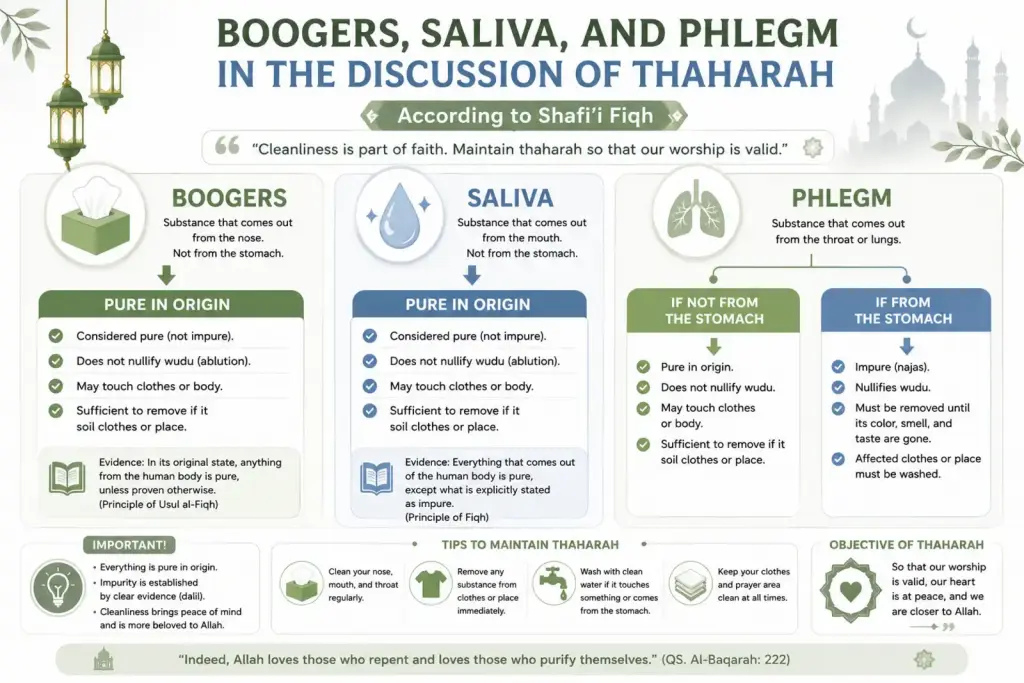
Not every bodily fluid is najis. Ordinary mucus, saliva, drool, and nasal discharge are pure.
Zakariyya al-Anshari says that bodily secretions follow the ruling of the animal from which they come, and he gives these examples:
وهو كدمع ومخاط وعرق ولعاب
Meaning: “It is like tears, mucus, sweat, and saliva.”[10]
Human beings are pure, so ordinary human mucus and saliva are pure. Clothing touched by ordinary saliva or mucus does not need to be washed for najis.
Does blowing the nose invalidate wudu?
No. Nasal mucus exits through the nose, not through either private passage. It therefore does not invalidate wudu.
Phlegm and fluid from the stomach
Phlegm should not be automatically treated like vomit. Phlegm from the throat is not automatically najis.
There is, however, a specific detail concerning fluid flowing from the mouth of a sleeping person. Zakariyya al-Anshari writes:
فإن سال من فم نائم فكان من المعدة … فنجس لا إن كان من غيرها أو شك
Meaning: “If fluid flows from the mouth of a sleeping person and comes from the stomach, it is najis. It is not so if it comes from elsewhere or if its origin is uncertain.”[11]
Therefore, “Is phlegm najis?” cannot be answered without considering its source. Fluid known to come from the stomach differs from ordinary throat phlegm.
A Brief Checklist Before Prayer
When you notice a fluid on your body or clothes, assess it calmly. Do not assume that every fluid is najis, but do not ignore najis that is clear.
- Identify the fluid where reasonably possible.
- Consider where it came from.
- Determine whether it is najis or pure.
- Determine whether its exit invalidates wudu.
- Cleanse any najis from the body, clothing, or prayer place.
- Renew wudu only where there is an actual invalidator.
For non-visible najis that is known to have affected an area, it is enough to run water over that area. Ibn Qasim al-Ghazzi says:
فيكفي جري الماء على المتنجس بها ولو مرة واحدة
Meaning: “It is enough to run water over what was affected by it, even once.”[6]
FAQ
Is hemorrhoid bleeding najis?
Yes. Hemorrhoid blood is najis. When it reaches the body or clothing, the affected part should be cleansed before prayer.
Does hemorrhoid bleeding invalidate wudu?
When blood exits through the anus, wudu is invalidated because something has exited through a private passage. When the blood comes from an external wound, it is najis but does not invalidate wudu in the Shafi‘i school.
Is madhy najis, and does it require ghusl?
Madhy is najis, and its discharge invalidates wudu. Wash the affected area and any stained clothing.
Madhy does not require ghusl. Cleanse the affected area and perform wudu.
Are vomit and pus najis?
Vomit is najis and must be cleaned when it reaches the body or clothing. Pus is also najis when it is transformed blood.
Neither vomit nor pus invalidates wudu merely because it exits through the mouth or an external wound.
Are mucus, saliva, drool, and phlegm najis?
Ordinary mucus, saliva, drool, and nasal discharge are pure. Blowing the nose does not invalidate wudu.
Phlegm from the throat is not automatically najis. Fluid known to have come from the stomach has a different ruling.
Footnotes
References
- Zakariyā al-Anṣārī, Asnā al-Maṭālib fī Sharḥ Rawḍ al-Ṭālib, with marginal notes by Aḥmad al-Ramlī, edited by Muḥammad az-Zuhrī al-Ghamrāwī (Cairo: al-Maṭbaʿah al-Maymānīyah, 1313 AH; repr. Dār al-Kitāb al-Islāmī), vol. 1, pp. 4-54.
- Al-Syarbīnī, Syams al-Dīn Muḥammad bin Aḥmad. Al-Iqnāʿ fī Ḥall Alfāẓ Abī Syujaʿ. Edited by Maktab al-Buḥūts wa al-Dirāsāt, Dār al-Fikr. Beirut: Dār al-Fikr, vol. 1, p. 88.
- Muḥammad ibn Qāsim al-Ghazzī, Fatḥ al-Qarīb al-Mujīb fī Sharḥ Alfāẓ al-Taqrīb = al-Qawl al-Mukhtār fī Sharḥ Ghāyat al-Ikhtiṣār, ed. Bassām ʿAbd al-Wahhāb al-Jābī, 1st ed., vol. 1 (Beirut: al-Jafān wa-al-Jābī, Dār Ibn Ḥazm, 2005), 56-57.


