

Queefing is the term commonly used for air leaving a woman’s private part. It may also be called vaginal air, air from the front, or simply a sound from the vagina that resembles passing gas.
So, does queefing break wudu? In the Shafi’i school, yes—when a woman is certain that air has actually exited through the qubul, meaning the front private passage. She must renew her wudu before praying.
Direct answer: Queefing that is known to be air exiting through the qubul breaks wudu in Shafi’i fiqh. It is a form of minor ritual impurity. It does not by itself require ghusl.
This article explains the textual basis, the difference between certainty and doubt, and what to do if it happens during prayer.
What Does Queefing Mean in This Discussion?
A respectful explanation of the term
“Queefing” is an English search term. In this article, it means air exiting from a woman’s private part. The clearest legal description is air exiting from the qubul.
A sound may occur, but sound is not the legal test. The issue is whether the person is certain that air has actually left through the front passage.
This matters because a search such as “does air come out but not farting break wudu?” is not simply about ordinary intestinal gas. It is about the place from which the air exits.
This is a question of hadath, not merely najasah
In fiqh, hadath and najasah are not the same. Hadath is a ritual state that prevents prayer until purification is performed. Najasah concerns an impure substance that must be removed from the body, clothes, or place of prayer.
Imam Zakariyya al-Anshari explains that hadath may refer to what obligates wudu or what obligates ghusl; when used without qualification, it commonly refers to minor hadath.[1]
For that reason, queefing is discussed under the nullifiers of wudu. It is not automatically a question of impurity on clothing.
Where a liquid, rather than air, has exited, consult the separate article on other nullifiers of wudu and vaginal discharge. The ruling must follow the actual substance involved.
Queefing among the Nullifiers of Wudu in the Shafi’i School
The four nullifiers of wudu





A common question is: how many things break wudu in the Shafi’i school? Asna al-Mathalib presents four broad nullifiers:
- Something exiting from either of the two passages: the qubul or anus.
- Loss of awareness, such as fainting, intoxication, or sleep subject to the known details.
- Skin contact between an unrelated adult man and woman, according to Shafi’i conditions.
- Touching a human private part with the inner surface of the palm.[1][2]
Queefing falls under the first category. It is not classed under skin contact or touching the private part.
For the hub article, see the four nullifiers of wudu in the Shafi’i school.
The decisive wording: “even if it is wind from the qubul”
The clearest textual basis appears in Asna al-Mathalib. Imam Zakariyya al-Anshari writes:
قوله: (نَوَاقِضُ الْوُضُوءِ) … (أَرْبَعَةٌ) … (الْأَوَّلُ الْخَارِجُ) مِنْ أَحَدِ السَّبِيلَيْنِ الْقُبُلِ وَالدُّبُرِ (وَلَوْ رِيحًا مِنْ قُبُلٍ)
“The nullifiers of wudu are four. The first is whatever exits from one of the two passages—the qubul and the anus—even if it is wind from the qubul.”[1]
The phrase ولو ريحًا من قبل expressly includes wind from the qubul. The passage does not limit the first nullifier to urine, stool, blood, or liquid.
Accordingly, when queefing is certainly air that has exited through the front private passage, it breaks wudu in Shafi’i fiqh.
Why “fart” is not precise enough
In ordinary English, “fart” usually means intestinal gas leaving through the anus. Queefing refers to air leaving through the qubul.
The direction is different. Yet both can enter the first category of nullifiers when something is certainly known to have exited from one of the two passages.
That is why a physical feeling alone should not be treated as a nullifier. The actual exit of air must be known.
Distinguishing Queefing from Liquids, Touching, and Ghusl
When air has genuinely exited
Queefing breaks wudu when the woman is certain that air has exited from the qubul. Certainty may come from an unmistakable sensation of air leaving or another clear sign.
A sound is not required. Another person does not need to hear it. What matters is her own certainty that air has exited.
By contrast, a vague feeling, pressure, or uncertain movement is not enough to say that wudu has been broken.
Queefing is different from vaginal discharge
Air and liquid are not the same subject. Fath al-Qarib states:
وَكُلُّ مَائِعٍ خَرَجَ مِنَ السَّبِيلَيْنِ نَجِسٌ إِلَّا الْمَنِيَّ
“Every liquid that exits from the two passages is impure, except semen.”[3]
The word مائع means “liquid.” The quoted passage therefore concerns liquid substances, while queefing concerns air.
If the matter involves discharge, blood, madhy, wady, or another fluid, do not apply the queefing ruling without further classification. Use the ruling for the specific fluid instead.
Queefing is different from touching the private part
Another frequent question is whether touching the private part breaks wudu. In Shafi’i fiqh, that is a separate nullifier.
Imam Zakariyya al-Anshari writes:
قوله: (الرَّابِعُ مَسُّ فَرْجِ آدَمِيٍّ) … (بِبَطْنِ كَفٍّ)
“The fourth nullifier is touching a human private part … with the inner surface of the palm.”[2]
Queefing breaks wudu because something exits from the qubul. Touching the private part is a different legal cause.
See the ruling on touching the private part after wudu for that separate discussion.
Queefing does not itself require ghusl
Queefing is not one of the causes that obligate ghusl. Asna al-Mathalib lists the causes of ghusl as death, the ending of menstruation or postnatal bleeding, childbirth, and janabah; janabah occurs through intercourse or the emission of semen.[4]
Air exiting from the qubul is not included in those causes. The required response to certain queefing is to renew wudu—not to perform ghusl.
What If You Feel Air but Are Not Certain It Came Out?

Certainty is not removed by doubt
A person who has made wudu remains in a state of purity until a nullifier is known with certainty.
While discussing doubt during prayer, Imam Zakariyya al-Anshari cites the hadith:
لَا يَنْصَرِفْ حَتَّى يَسْمَعَ صَوْتًا أَوْ يَجِدَ رِيحًا
“He should not leave [the prayer] until he hears a sound or finds a smell.”[1]
He then clarifies:
وَالْمُرَادُ الْعِلْمُ بِخُرُوجِهِ لَا سَمْعُهُ وَلَا شَمُّهُ
“What is meant is knowledge that it has exited, not hearing it or smelling it.”[1]
The point is certainty of exit, not the literal need to hear a sound or smell an odor. Therefore, an uncertain feeling does not break wudu.
A sound or movement may still be uncertain
A movement near the private part, an indistinct sound, or a feeling of pressure may have an unclear source. It should not be treated as hadath without certainty.
Do not repeat wudu merely to respond to an unproven worry. Wudu is renewed when the nullifier has actually been established.
This also explains phrases such as “a type of gas that does not break wudu.” It does not mean certain exiting air is ignored. It means doubt about whether anything exited leaves the existing wudu intact.
What to do during prayer
Use this simple order:
- You are certain that air exited from the qubul: wudu has broken. End the prayer, renew wudu, and begin the prayer again.
- You only feel doubt or an uncertain movement: continue the prayer. Your wudu is still treated as valid.
- You discover that it was a fluid rather than air: check the ruling for that fluid rather than treating it solely as queefing.
For related cases, see other nullifiers of wudu.
A note on recurring doubts
Repeated doubts can turn worship into an unnecessary burden. Do not treat every sensation as proof that wudu has broken.
Keep to one clear rule: certainty of exit breaks wudu; doubt does not. This protects worship from needless repetition.
What Should You Do After Queefing?
When you are certain it happened
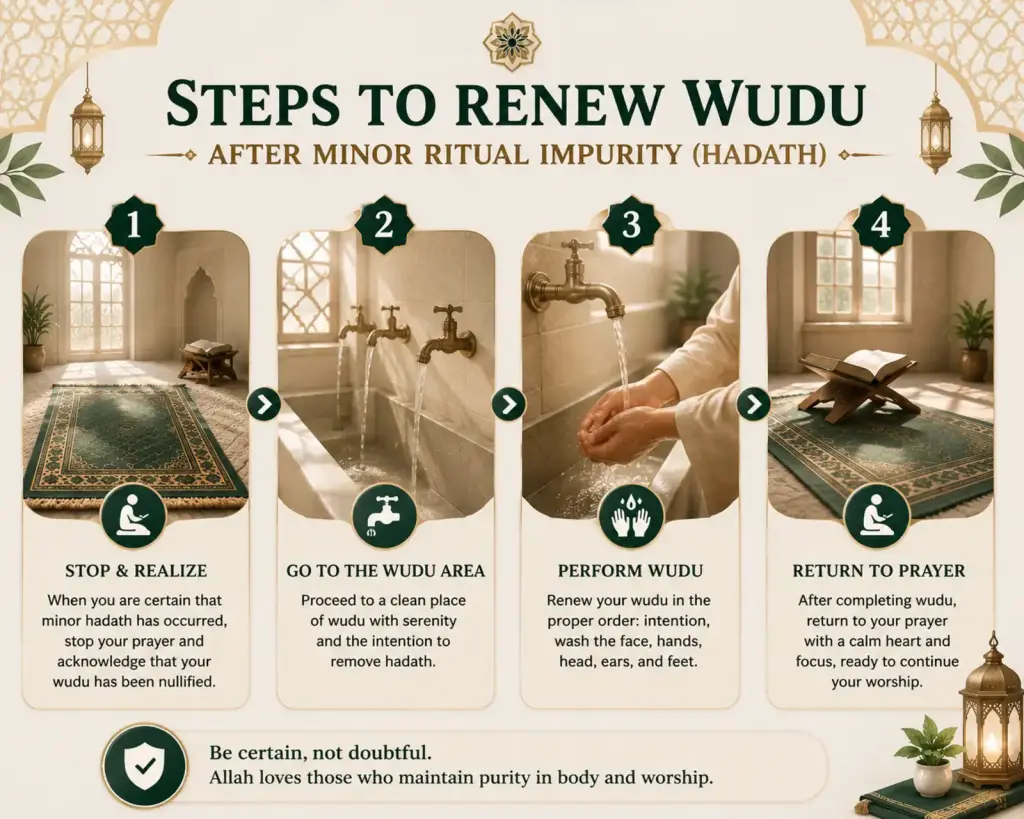
When you are certain that air exited from the qubul:
- Pause or end any act of worship that requires wudu.
- Renew your wudu.
- Resume prayer after completing wudu.
Queefing on its own does not require ghusl. This article deals with the wudu ruling for air from the qubul.
Review how to perform wudu correctly for the steps and obligatory parts of wudu.
When you are still unsure
When you are not certain that air exited, keep your existing wudu. This is the practical application of the rule that certainty is not removed by doubt.
You do not need to repeat wudu or prayer because of an unclear feeling alone.
Hadath is not the same as najasah
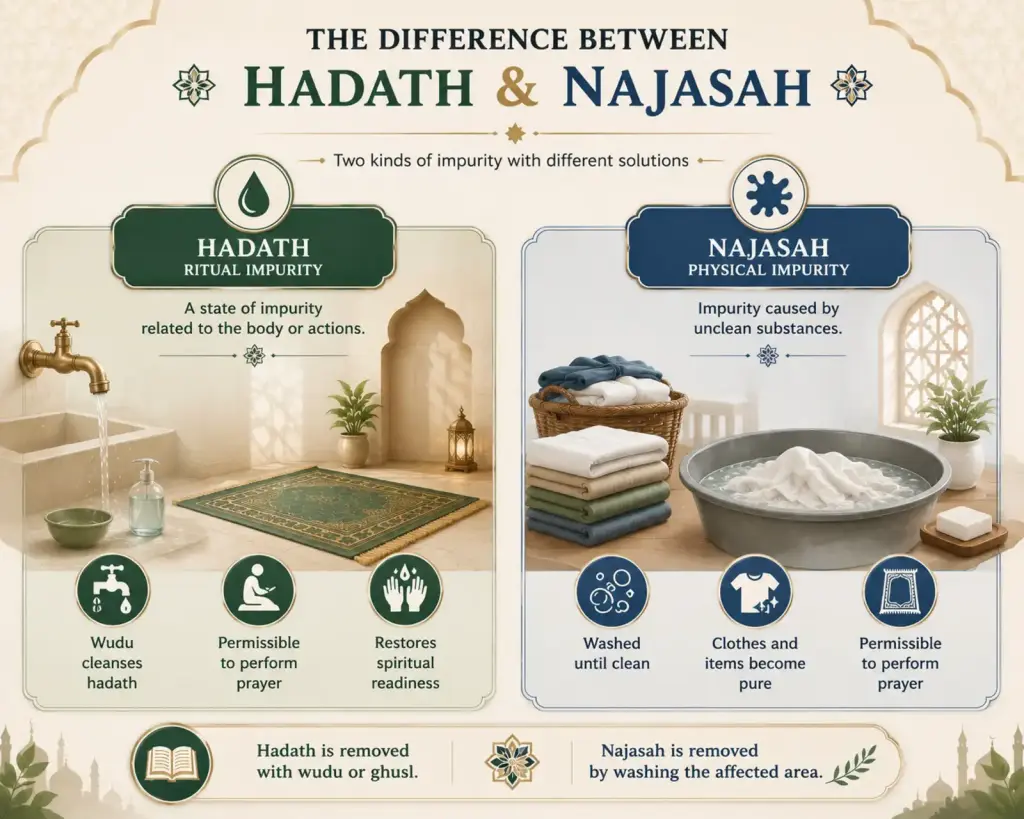
The distinction between hadath and najasah matters here. Queefing breaks wudu as a case of minor hadath under the cited Shafi’i text.
Najasah, by contrast, concerns whether an impure substance has affected the body, clothes, or place of prayer. The two questions must not be merged.
For the wider topic, see how to purify from minor hadath.
FAQ: Queefing and Wudu
Does air coming out of a woman’s private part break wudu?
Yes. In the Shafi’i school, air certainly exiting from the qubul breaks wudu. The cited text explicitly says that the first nullifier includes “wind from the qubul.”[1]
Does queefing require ghusl?
No. Queefing is not a cause of ghusl. When it is certain that only air has exited, renew wudu.[4]
Does a feeling of air from the vagina break wudu if I am not sure it came out?
No. A mere feeling or doubt does not break wudu. Wudu remains valid until the exit is known with certainty.[1]
Is queefing the same as touching the private part after wudu?
No. Queefing relates to something exiting from the qubul. Touching the private part is a separate nullifier when done with the inner surface of the palm.[2]
Must I repeat my prayer if queefing happens during it?
If you are certain that air exited, wudu breaks and the prayer must be repeated after renewing wudu. If you only doubt that anything exited, continue the prayer.[1]
Footnotes
References
- Zakariyā al-Anṣārī, Asnā al-Maṭālib fī Sharḥ Rawḍ al-Ṭālib, with marginal notes by Aḥmad al-Ramlī, edited by Muḥammad az-Zuhrī al-Ghamrāwī (Cairo: al-Maṭbaʿah al-Maymānīyah, 1313 AH; repr. Dār al-Kitāb al-Islāmī), vol. 1, pp. 54-65.
- Muḥammad ibn Qāsim al-Ghazzī, Fatḥ al-Qarīb al-Mujīb fī Sharḥ Alfāẓ al-Taqrīb = al-Qawl al-Mukhtār fī Sharḥ Ghāyat al-Ikhtiṣār, ed. Bassām ʿAbd al-Wahhāb al-Jābī, 1st ed., vol. 1 (Beirut: al-Jafān wa-al-Jābī, Dār Ibn Ḥazm, 2005), 56.


