

Direct answer: in the Shāfiʿī school, human semen is pure, not impure (najis). So the answer to “is semen impure?”, “is semen najis?”, or “is sperm impure?” is no—provided that the fluid is actually semen and has not come into contact with another impurity.
This article addresses the legal status of semen as a substance in the rules of purification (ṭahārah). That question must be kept separate from obligatory ghusl: semen may be pure, while its discharge can still place a person in major ritual impurity.
The ruling below is specifically Shāfiʿī. Readers following another school should consult the authoritative position of that school.
The Core Ruling: Semen Is Pure in the Shāfiʿī School
In Fatḥ al-Qarīb, the general rule is that fluids exiting from the two private passages are impure. The text then expressly makes an exception for semen.
وَكُلُّ مَائِعٍ خَرَجَ مِنَ السَّبِيلَيْنِ نَجِسٌ … إِلَّا الْمَنِيَّ
“Every fluid that exits from the two private passages is impure … except semen.”[1]
For that reason, the question “is semen pure or impure?” cannot be answered by treating every bodily fluid alike. Urine, madhy, and wady have their own rulings; semen is expressly excluded from the general rule.
Al-Khaṭīb al-Shirbīnī states the broader limit of the ruling:
إِلَّا الْمَنِيَّ فَطَاهِرٌ مِنْ جَمِيعِ الْحَيَوَانَاتِ إِلَّا الْكَلْبَ وَالْخِنْزِيرَ وَفَرْعَ أَحَدِهِمَا
“Except semen: it is pure from all animals, other than the dog, the pig, and the offspring of either one.”[2]
Online searches often use the word “sperm.” In fiqh, however, the legal ruling here concerns manī—semen as a fluid—not a medical assessment of sperm cells.
Something unpleasant is not automatically najis
A stain may be unpleasant or worth cleaning without being legally impure. Najāsah is a legal status that affects the purity of the body, clothing, and the place of prayer.
Semen stains may therefore be cleaned for neatness. Yet the recommendation to clean them does not change the original ruling that human semen is pure.
Purity of semen does not remove the duty of ghusl
The purity of a substance and a person’s ritual state are separate matters. Semen is pure, while its discharge can make a person junub and require ghusl before prayer.
Asnā al-Maṭālib names one cause of janābah as follows:
الثَّانِي خُرُوجُ الْمَنِيِّ
“The second cause is the discharge of semen.”[6]
Thus, “Does semen discharge require ghusl?” is a different question from “Is semen impure?” The first concerns a worship obligation; the second concerns the legal status of the fluid.
What Does Semen Mean in Fiqh?
In fiqh, semen means a fluid identified through particular signs. Those signs matter so that semen is not confused with madhy, wady, or another fluid.
Asnā al-Maṭālib states:
وَيُعْرَفُ الْمَنِيُّ بِتَدَفُّقٍ أَوْ تَلَذُّذٍ أَوْ رِيحِ طَلْعٍ أَوْ عَجِينٍ رَطْبًا وَرِيحِ بَيَاضِ بَيْضٍ يَابِسًا
“Semen is recognised by forceful discharge, pleasure at the time of discharge, or the odours described by the jurists when wet or dry.”[6]
For the signs of semen in Shāfiʿī fiqh, colour and thickness are not stand-alone tests. The same text says:
وَلَا أَثَرَ لِثَخَانَةٍ وَلَوْنٍ
“Thickness and colour do not determine the ruling.”[6]
A fluid should therefore not be ruled to be semen merely because it appears white, thick, thin, or has changed in colour. The fiqh signs and the circumstances of discharge must be considered together.
Male and female semen

In its chapter on ghusl, Asnā al-Maṭālib refers to the semen of the person concerned, whether from a man or a woman:
أَيْ مَنِيُّ الشَّخْصِ نَفْسِهِ … مِنْ رَجُلٍ أَوِ امْرَأَةٍ
“That is, the person’s own semen … from a man or a woman.”[6]
Accordingly, the answer to “is female semen impure?” is that it is pure under the rule explained here. That purity does not remove the separate discussion of ghusl when its cause is present.
This article is not a guide to fertility, health conditions, or medical diagnosis. Medical concerns should be discussed with an appropriately qualified health professional.
Evidence for Semen Being Pure
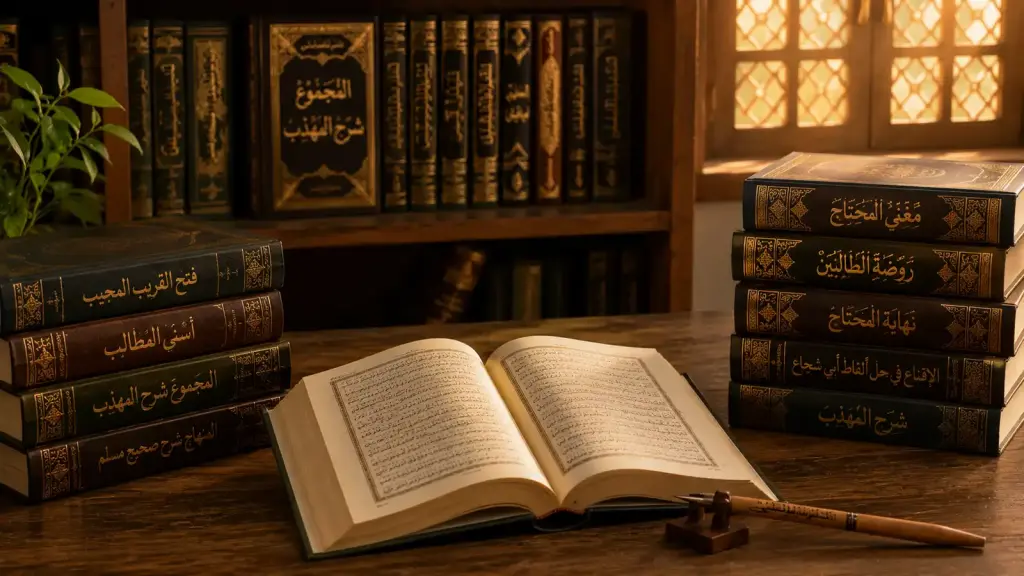
The primary proof for the purity of semen in Shāfiʿī fiqh is the report of ʿĀʾishah رضي الله عنها concerning the Prophet’s ﷺ clothing.
كَانَتْ تَحُكُّ الْمَنِيَّ مِنْ ثَوْبِ رَسُولِ اللهِ ﷺ ثُمَّ يُصَلِّي فِيهِ
“ʿĀʾishah used to scrape semen from the Messenger of Allah’s ﷺ garment, and he would then pray in it.”[2]
This report is used to show that semen is not treated as najis. Were it impure, the garment would have to be purified from najāsah before prayer; merely scraping a dry trace would not be enough.
Al-Khaṭīb al-Shirbīnī also explains the reasoning for semen from animals that are legally pure:
وَأَمَّا مَنِيُّ غَيْرِ الْآدَمِيِّ فَلِأَنَّهُ أَصْلُ حَيَوَانٍ طَاهِرٍ فَأَشْبَهَ مَنِيَّ الْآدَمِيِّ
“As for the semen of non-human animals, it is the origin of a pure animal, so it resembles human semen.”[2]
This is the basis of the Shāfiʿī ruling: human semen is pure, and semen from an animal that is legally pure is also pure. The ruling has stated exceptions.
Cleaning semen is still recommended
Shāfiʿī jurists recommend cleaning semen from clothing even though semen is not najis. Al-Khaṭīb al-Shirbīnī writes:
وَيُسْتَحَبُّ غَسْلُ الْمَنِيِّ … وَخُرُوجًا مِنَ الْخِلَافِ
“Washing semen is recommended … and is a way of leaving disagreement behind.”[2]
This is not an obligation to remove an impurity. It is a recommendation for cleanliness and caution in relation to differing scholarly views.
Is Every Kind of Semen Pure? The Limits of the Ruling
Human semen and semen from legally pure animals
Human semen is pure. Asnā al-Maṭālib also states:
قوله: (، ومني غير الكلب، والخنزير) ، وفرع أحدهما أي كل منها (طاهر)
“The semen of animals other than the dog and pig, and the offspring of either one, is pure.”[3]
For animal semen, the legal status of the animal matters. Semen from a legally pure animal follows the ruling of purity, while semen related to dogs, pigs, or their offspring falls under the exception.
Dog semen, pig semen, and their offspring
Dog semen and pig semen should not be placed under the general rule without qualification. The exception is stated plainly in Shāfiʿī texts.
It is therefore inaccurate to say, without limits, that “all semen is pure.” The accurate statement is that semen is originally pure within the categories stated above, except for dogs, pigs, and the offspring of either one.
Semen that contacts another impurity
Semen that is pure in itself may take on the ruling of impurity after contact with another najis substance. Asnā al-Maṭālib gives a specific example:
وَيَنْجُسُ مَنِيُّ مَنْ لَمْ يَسْتَنْجِ بِمَاءٍ لِاتِّصَالِهِ بِنَجَسٍ
“The semen of one who has not cleansed himself with water after relieving himself becomes impure because it has contacted an impurity.”[3]
The issue here is not semen itself. The impurity arises from the impurity attached to or mixed with it.
In practical cases, if clothing or another item has semen together with urine, madhy, wady, or another impurity, the affected impurity must be removed. For a fuller treatment of other fluids, see bodily fluids that are legally impure.
Prayer Clothes, Mattresses, Bedding, and Semen
Can clothes stained with semen be worn for prayer?
Yes. In the Shāfiʿī school, clothing stained only with human semen remains pure and may be worn for prayer.
This applies when the stain is actually semen and no other impurity is present. If the fluid is madhy, wady, or urine, the ruling changes because those fluids are impure.
Wet semen and dried semen
The legal status of semen does not change merely because it is wet or dry. Dried semen remains pure under the original ruling.
The report of ʿĀʾishah رضي الله عنها about scraping semen from the Prophet’s ﷺ garment concerns a dry trace. Scraping was not a ritual condition for the prayer to be valid; it was a way of cleaning the garment.
Mattresses, sheets, and blankets
Is semen impure if it touches a mattress? No, when the mattress has only been touched by human semen. A mattress, sheet, blanket, or pillow does not become najis merely because of semen.
Clean it when another impurity is clearly present. Where only semen is involved, washing is recommended for cleanliness, not because the bedding must be purified from najāsah.
Must semen be washed?
Semen does not have to be washed as najāsah. A person may wash the stain because the books recommend it, because it keeps clothing clean, and because it avoids scholarly disagreement.
Two mistakes should be avoided:
- Treating every semen stain as something that automatically invalidates prayer.
- Ignoring the cleanliness of clothing on the ground that semen is pure.
The Difference Between Semen, Madhy, and Wady
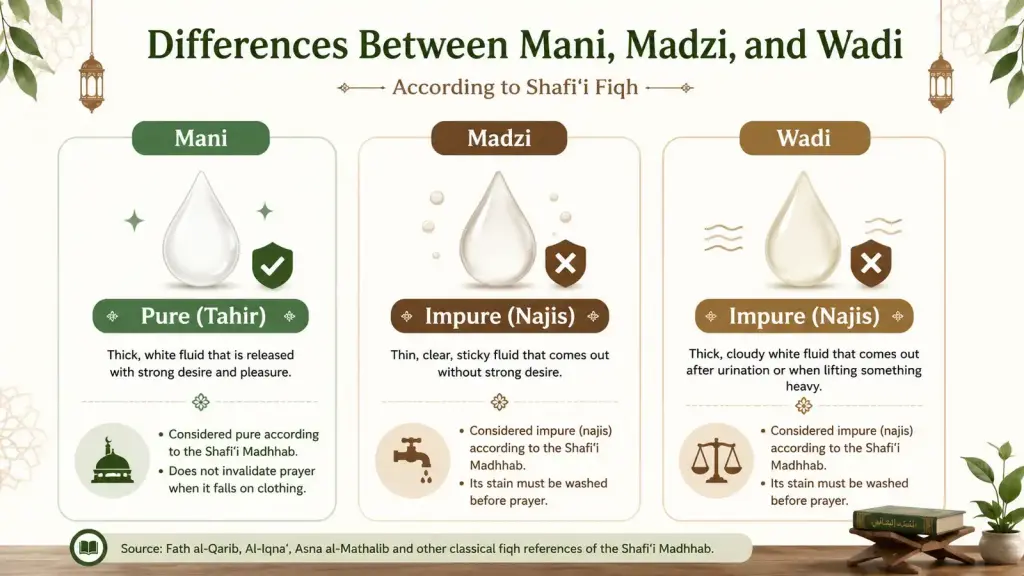
The difference between semen and madhy matters because the three fluids do not have the same rulings. This table is limited to the purification issues needed for prayer.
| Fluid | Legal status | What is required before prayer | Does it require ghusl? |
|---|---|---|---|
| Semen (manī) | Pure, subject to the limits already stated | Perform ghusl for janābah when one’s own semen has been discharged | Yes, because of its discharge[6] |
| Madhy (madzi) | Impure | Wash the affected area and perform wudu | No, not by itself |
| Wady (wadi) | Impure | Wash the affected area and perform wudu | No, not by itself |
Regarding madhy, Al-Iqnāʿ says:
وَالْمَذْيُ … مَاءٌ أَبْيَضُ رَقِيقٌ يَخْرُجُ بِلَا شَهْوَةٍ قَوِيَّةٍ عِنْدَ ثَوَرَانِهَا
“Madhy is a thin white fluid that exits without strong sexual pleasure when desire begins to stir.”[7]
In the chapter on wudu, Asnā al-Maṭālib quotes the Prophet ﷺ regarding madhy:
فِي الْمَذْيِ يَغْسِلُ ذَكَرَهُ وَيَتَوَضَّأُ
“Regarding madhy, he washes his private part and performs wudu.”[4]
Regarding wady, Al-Iqnāʿ explains:
وَالْوَدْيُ … مَاءٌ أَبْيَضُ كَدِرٌ ثَخِينٌ يَخْرُجُ عَقِبَ الْبَوْلِ أَوْ عِنْدَ حَمْلِ شَيْءٍ ثَقِيلٍ
“Wady is a thick, cloudy white fluid that exits after urination or when carrying something heavy.”[7]
Therefore, “Does madhy require ghusl?” is answered: no, not by itself. Wash the affected area and perform wudu; obligatory ghusl is tied to semen discharge or another cause of janābah.
When you are unsure whether the fluid is semen or madhy
When a person is uncertain whether the fluid is semen or madhy, it is not correct to label every fluid impure. Asnā al-Maṭālib gives a legal route:
كَمَنْ شَكَّ هَلِ الْخَارِجُ مِنْ ذَكَرِهِ مَنِيٌّ أَوْ مَذْيٌ فَإِنَّهُ يُخَيَّرُ بَيْنَهُمَا وَيَعْمَلُ بِمُقْتَضَى اخْتِيَارِهِ
“Like one who doubts whether the fluid that came out is semen or madhy: he may choose between the two and act upon the consequence of his choice.”[5]
If it is treated as semen, ghusl is performed. If it is treated as madhy, the affected area is washed and wudu is performed. For the fuller discussion, see the difference between semen, madhy, and wady.
For the causes of janābah related to semen discharge, continue with causes of obligatory ghusl after semen discharge.
FAQ: Semen in Shāfiʿī Fiqh
Is human semen impure in the Shāfiʿī school?
Is all animal semen pure?
Are clothes stained with semen impure?
Is dried semen still pure?
Yes. Both wet and dried semen remain pure under the original ruling. The report of ʿĀʾishah رضي الله عنها scraping semen from the Prophet’s ﷺ garment is the main proof discussed for a dry trace on clothing.[2]
Does semen discharge require ghusl even though semen is pure?
Yes. The purity of semen is its legal status as a substance, while ghusl is required because semen discharge is a cause of janābah.[6]
An existing wudu is not treated as a replacement for obligatory ghusl when semen has been discharged.
Does a wet dream without semen require ghusl?
No. Ghusl is not required when no semen is found. In the report cited by Asnā al-Maṭālib, the Prophet ﷺ answered the question about a woman who dreams: نَعَمْ إِذَا رَأَتِ الْمَاءَ — “Yes, if she sees the fluid.”[6]
Therefore, a wet dream without finding semen does not itself require ghusl.
Referensi
- Zakariyā al-Anṣārī, Asnā al-Maṭālib fī Sharḥ Rawḍ al-Ṭālib, with ḥāshiyah by Aḥmad al-Ramlī, edited by Muḥammad az-Zuhrī al-Ghamrāwī (Cairo: al-Maṭbaʿah al-Maymānīyah, 1313 AH; repr. Dār al-Kitāb al-Islāmī), vol. 1, pp. 13-66.
- Muḥammad ibn Qāsim al-Ghazzī, Fatḥ al-Qarīb al-Mujīb fī Sharḥ Alfāẓ al-Taqrīb = al-Qawl al-Mukhtār fī Sharḥ Ghāyat al-Ikhtiṣār, ed. Bassām ʿAbd al-Wahhāb al-Jābī, 1st ed., vol. 1 (Beirut: al-Jafān wa-al-Jābī, Dār Ibn Ḥazm, 2005), 56.
- Al-Sharbīnī, Shams al-Dīn Muḥammad bin Aḥmad. Al-Iqnāʿ fī Ḥall Alfāẓ Abī Shujāʿ. Edited by Maktab al-Buḥūth wa al-Dirāsāt, Dār al-Fikr. Beirut: Dār al-Fikr, vol. 1, pp. 88-89.


