
This article explains the Shafi’i ruling on dogs in the chapter of ritual purity. Its focus is the legal status of dogs as najis mughallazhah—major impurity—what may transfer impurity, and how an affected object is purified.
It does not attempt to cover every question about keeping dogs, hunting with dogs, or guard dogs. Those subjects have their own legal details. The discussion here is limited to impurity and purification.
The Ruling on Dogs in Shafi’i Discussions of Impurity
Scope: Physical Impurity, Not Every Ruling About Dogs
The question “are dogs impure?” needs to be placed in the correct fiqh context. This article addresses purity and impurity: whether the dog is treated as impure in itself, and what a person must do when its impurity reaches clothing, the body, a vessel, or another object.
This is not the same as hadath. Hadath is a legal state removed by ablution, ritual bathing, or dry ablution. Najāsah, by contrast, concerns an impurity on an object or body part that must be removed for prayer.
Therefore, when someone asks about the ruling on touching a dog, the first concern in this chapter is whether impurity has transferred to the hand or clothing. Merely being near a dog does not automatically require washing the whole body or every garment.
Dogs as an Exception to the Basic Purity of Animals
In Asnā al-Maṭālib, Zakariyya al-Anṣārī states that animals are basically pure, then names the dog as an exception:
«وَالْحَيَوَانُ طَاهِرٌ … لَا كَلْبٌ وَلَوْ مُعَلَّمًا»
Meaning: “An animal is pure … except for a dog, even if it is trained.”[1]
The phrase “even if it is trained” means that training for hunting or guarding does not change the dog’s impurity in this chapter of Shafi’i fiqh. The answer to “why are dogs impure?” within this school is based on textual proof and the school’s legal analysis, not on personal speculation.
Ibn Qāsim al-Ghazzī likewise writes:
«وَالْحَيَوَانُ كُلُّهُ طَاهِرٌ إِلَّا الْكَلْبَ وَالْخِنْزِيرَ وَمَا تَوَلَّدَ مِنْهُمَا أَوْ مِنْ أَحَدِهِمَا»
Meaning: “Every animal is pure except the dog, the pig, and what is born from both of them or from one of them.”[2]
Where Dogs Fall in the Categories of Impurity


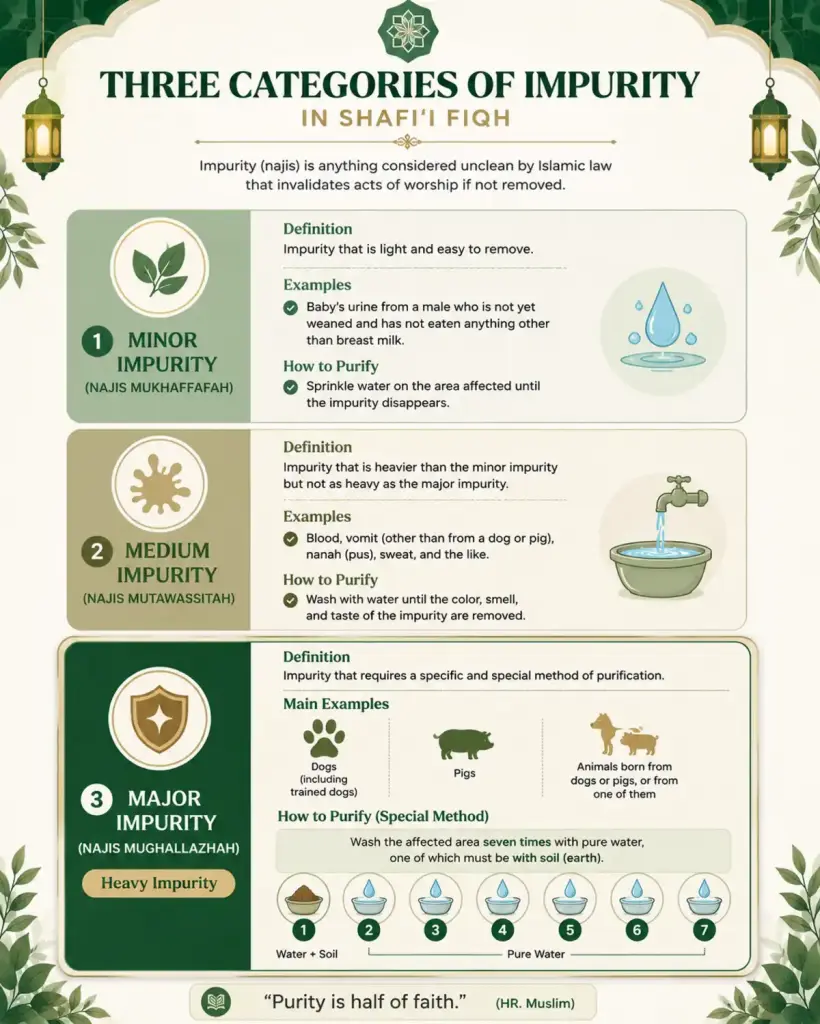
Introductory Shafi’i fiqh commonly discusses three levels of impurity:
- Najāsah mukhaffafah, an impurity with a lighter method of purification.
- Najāsah mutawassiṭah, an intermediate impurity that is generally removed with water until its substance is gone.
- Najāsah mughallazhah, a major impurity with the special requirement of seven washes, one of them with soil.
Dogs fall within the third category. An object known to be affected by dog impurity is not washed in the same manner as ordinary impurity. It requires the method set out below.
What Is Najis Mughallazhah? Definitions and Examples
The Meaning of Najis Mughallazhah in Shafi’i Fiqh
Najis mughallazhah is the term for an impurity that has a distinct method of purification. Indonesian searches may spell it mughallazhah, mughallazah, mughaladhah, or mugholadoh. The spelling differs, while the fiqh category remains the same.
The rule is stated through its purification method:
«فَصْلٌ لَا يَطْهُرُ مُتَنَجِّسٌ بِكَلْبٍ وَخِنْزِيرٍ وَفَرْعِ كُلٍّ … إِلَّا بِسَبْعٍ مِنَ الْغَسَلَاتِ بِالْمَاءِ إِحْدَاهُنَّ بِالتُّرَابِ»
Meaning: “An object affected by a dog, a pig, or the offspring of either is not purified except by seven washes with water, one of them with soil.”[3]
Thus, major impurity is not simply “very dirty” matter. It is a technical fiqh category defined here by seven washes with water and soil in one wash.
Animals Included in Major Impurity
The Shafi’i references used here name three groups:
- Dogs, including trained dogs.
- Pigs.
- The offspring of a dog or pig, whether from both or from one of them with another animal.
Al-Khaṭīb al-Shirbīnī explains:
«وَمَا تَوَلَّدَ مِنْهُمَا أَوْ مِنْ أَحَدِهِمَا … تَغْلِيبًا لِلنَّجَاسَةِ»
Meaning: “What is born from both of them or from one of them [has this ruling] by giving precedence to impurity.”[4]
This category must not be extended to every predator or animal people find unpleasant. Legal classification follows the categories named in the fiqh texts. Examples of najis mughallazhah in this discussion are therefore limited to the dog, pig, and the offspring described above.
For the related pillar article, see major impurity from dogs and pigs.
Why Is It Called Major Impurity?
The distinguishing feature is not the size or amount of the impurity. It is the special method of purification: seven washes with water, including one wash with soil.
Ordinary impurity does not have this seven-wash-and-soil requirement. That is why the method for purifying dog impurity must not be treated like the method for an ordinary stain.
Evidence and the Reason Dog Saliva Is Classified as Impure
The Hadith on a Vessel Licked by a Dog
The central evidence is the hadith concerning a vessel from which a dog licks or drinks. Prophet Muhammad ﷺ said:
«إِذَا وَلَغَ الْكَلْبُ فِي الْإِنَاءِ فَاغْسِلُوهُ سَبْعَ مَرَّاتٍ أُولَاهُنَّ بِالتُّرَابِ»
Meaning: “When a dog licks or drinks from a vessel, wash it seven times, the first of them with soil.”[3]
The Arabic word walagha refers to a dog lapping or drinking from a vessel. This hadith is treated as a legal basis for purification, not merely a general cleanliness instruction.
How the Texts Establish the Impurity of the Dog’s Mouth
Zakariyya al-Anṣārī explains the legal reasoning:
«فَتَعَيَّنَتْ طَهَارَةُ الْخَبَثِ فَثَبَتَتْ نَجَاسَةُ فَمِهِ … فَبَقِيَّتُهُ أَوْلَى»
Meaning: “It follows that the purification is purification from impurity. Thus the impurity of its mouth is established … and the rest of it is more deserving of the same ruling.”[1]
This answers the question, “is dog saliva impure?” in the Shafi’i school: dog saliva is impure according to the Shafi’i legal ruling described here. The command to purify the vessel is understood as purification from najāsah, and the dog’s mouth becomes the starting point for the wider ruling.
The Ruling Is Not Limited to Saliva
Al-Iqnāʿ says:
«وَكَذَا بِمُلَاقَاةِ شَيْءٍ مِنْ أَجْزَاءِ كُلٍّ مِنْهُمَا سَوَاءٌ فِي ذَلِكَ لُعَابُهُ وَبَوْلُهُ وَسَائِرُ رُطُوبَاتِهِ»
Meaning: “The same applies upon contact with any part of either of them, including its saliva, urine, and all its other moist substances.”[4]
For that reason, the Shafi’i answer to “why is dog saliva impure?” is not a medical theory. It is grounded in the hadith and in the legal explanation found in the school’s texts.
The ruling remains the same for a trained dog, since Asnā al-Maṭālib explicitly includes the trained dog in the exception already cited.[1]
Dog Fur, Touching a Dog, and Objects Affected by Dog Impurity
Fur, Skin, Saliva, and Other Parts of the Dog
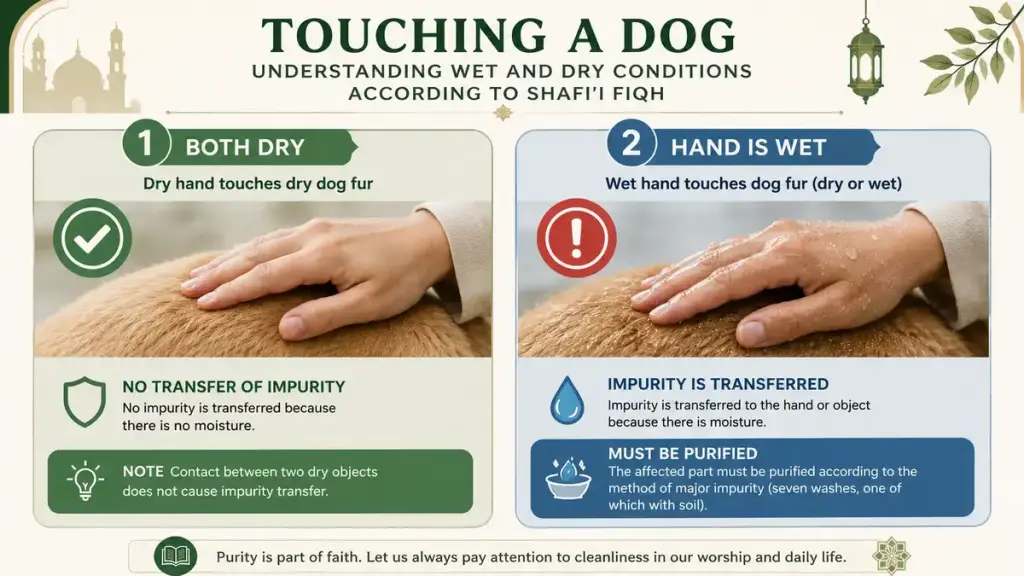
The question “is dog fur impure?” should be distinguished from the question of whether impurity transfers to another object. In the Shafi’i school, the dog’s body comes under the ruling of its impurity. Transfer to a hand, garment, or object, however, depends on moisture.
Al-Iqnāʿ states:
«وَأَجْزَائِهِ الْجَافَّةِ إِذَا لَاقَتْ رَطْبًا»
Meaning: “This includes its dry parts when they touch something moist.”[4]
Therefore, dry dog fur does not transfer impurity to another object that is also truly dry. When one side is wet or moist, the possibility of transfer must be considered.
Examples of Dry and Wet Contact
- A dry hand touches dry dog fur: impurity does not transfer.
- A wet hand touches dry dog fur: the hand is affected by major impurity.
- Wet dog fur touches clothing: the affected part of the clothing requires purification.
- Damp footwear steps on dog feces: the affected part requires the major-impurity method.
- A dog merely sniffs clothing without transferable moisture: impurity should not be presumed.
So, “is touching dog fur impure?” depends on the nature of the contact. The same applies to the search question “is touching a dog impure?”: the dog has the ruling of impurity in itself, while transfer to another object depends on wet or moist contact. A separate object is not treated as affected without transferable wetness.
The Impure Object and the Object Affected by Impurity
In this discussion, the dog is described as najis al-ʿayn: its very substance carries the ruling of impurity. Clothing, hands, vessels, and floors are pure in origin. They are only treated as affected when impurity has actually transferred to them.
This distinction prevents baseless doubt. Where there is no known wet or moist transfer, the original ruling of purity remains.
See the ruling on cat & dog fur for a focused article. For the related issue of pigs, see the impurity ruling on pigs.
How to Purify Dog Impurity with Seven Washes
The Core Requirement: Seven Water Washes and One Soil Wash
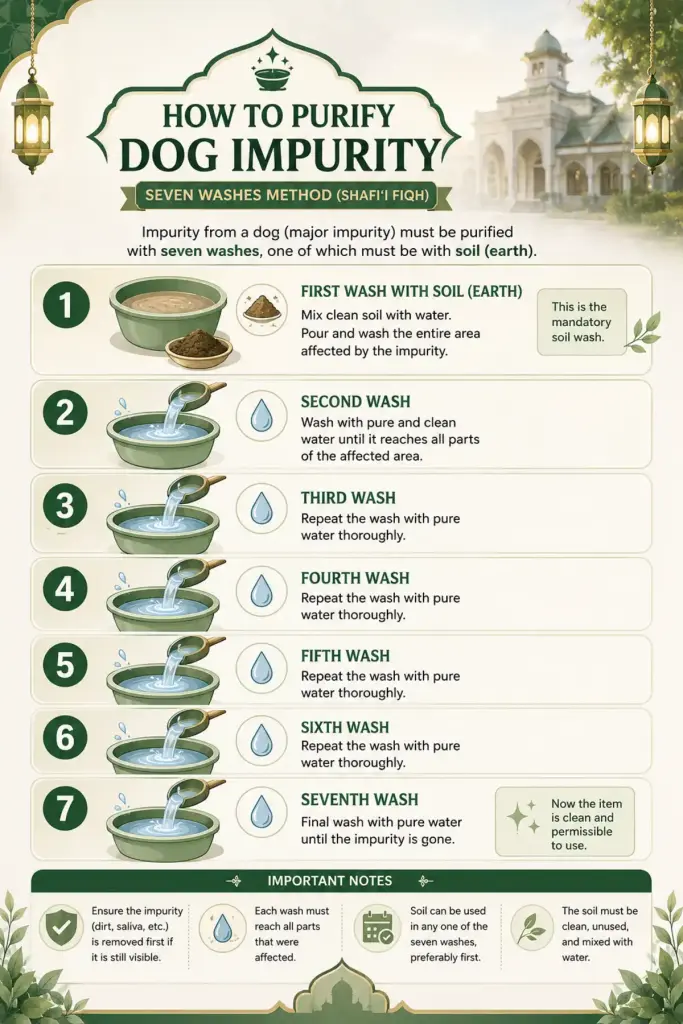
Under the Shafi’i school, cleaning dog impurity requires seven washes with pure, purifying water. One of those seven washes must include soil.
This rule applies to an object known to have been affected by a dog, a pig, or the offspring of either. The concern is the precise affected area, not automatically the whole object.
Practical Steps
The following steps to clean dog impurity explain how to clean dog impurity in this school:
- Identify the area actually affected.
Wash the place known to be affected. Do not extend the area merely because of doubt. - Remove the visible substance of impurity.
If feces, saliva, or another visible substance remains, remove it. - Perform seven washes.
Water must reach the full affected area in every wash. - Use soil in one wash.
The soil must be mixed with water and reach the entire affected area. - Complete the total of seven washes.
Ensure that the final number is seven, including the wash with soil.
This is the basic method for clothing, a body part, a vessel, or another solid object affected by dog impurity.
Which Wash Must Include Soil?
Soil is not required to be in the first wash. Al-Iqnāʿ explains that reports about its placement do not establish one obligatory position, so it is sufficient for soil to be present in one of the seven washes.[5]
The text also says:
«وَيُسَنُّ جَعْلُ التُّرَابِ فِي غَيْرِ الْأَخِيرَةِ، وَالْأُولَى أَوْلَى»
Meaning: “It is recommended that the soil be placed other than in the final wash, and the first wash is more preferable.”[3]
Soil in the first wash is preferred, but it is not a condition that the soil must always be used first.
Removing the Substance of Impurity and Counting the Washes
There is a detail that is often missed. Al-Iqnāʿ states:
«إِذَا لَمْ تَزُلْ عَيْنُ النَّجَاسَةِ إِلَّا بِسِتِّ غَسَلَاتٍ مَثَلًا حُسِبَتْ وَاحِدَةً»
Meaning: “If the substance of impurity is not removed except by six washes, for example, they are counted as one wash.”[5]
In other words, several washes that were needed before the physical substance was removed do not automatically count as several of the required seven. Those six are counted as one wash, and the washing must then be completed until seven washes are reached.
Mistakes to Avoid
- Counting washes without ensuring water reaches the affected area.
- Sprinkling dry soil without mixing it with water.
- Treating a quick rinse or wet wipe as sufficient.
- Using the ordinary-impurity method for major impurity.
- Expanding the area to be washed on the basis of unsupported doubt.
For a separate step-by-step page, see how to purify a vessel licked by a dog.
Conditions of Soil and Water for Purifying Dog Impurity
Soil Is Part of the Legal Method
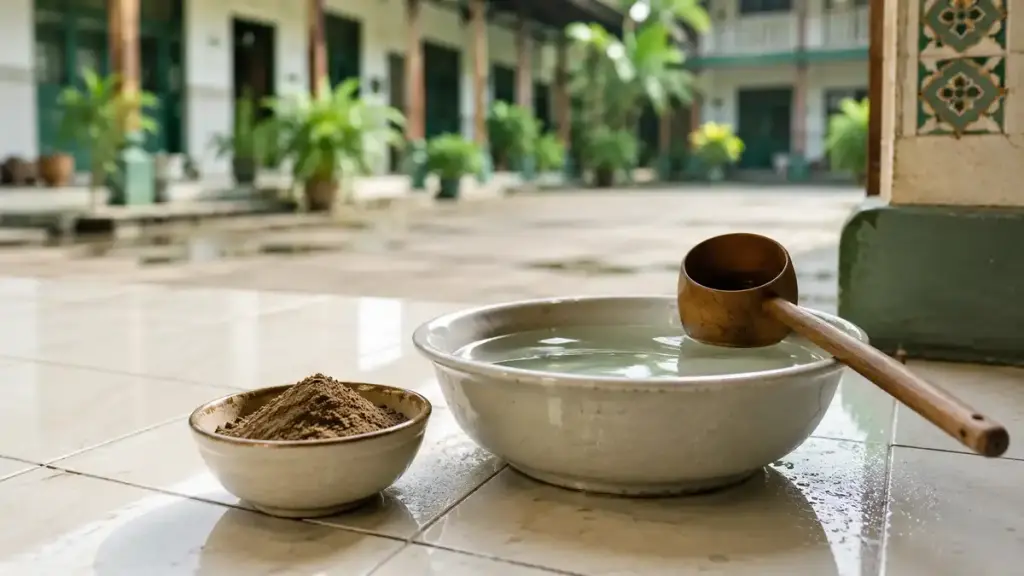
For those asking how to remove dog impurity with soil, in the Shafi’i method soil is not a substitute for water. Soil and water are used together in one of the seven washes. Water remains the main medium throughout the process.
Zakariyya al-Anṣārī writes:
«وَلْيَكُنِ التُّرَابُ الَّذِي يُغْسَلُ بِهِ ذَلِكَ طَاهِرًا غَيْرَ مُسْتَعْمَلٍ … يَعُمُّ مَحَلَّ النَّجَاسَةِ … وَلْيَكُنْ مَمْزُوجًا بِالْمَاءِ»
Meaning: “The soil used for washing should be pure and unused … it should cover the place of impurity … and it should be mixed with water.”[3]
Conditions for the Soil
The soil should be:
- Pure, not already affected by impurity.
- Unused, meaning it has not previously been used to remove hadath or impurity.
- Sufficient in amount to cloud the water and reach the whole affected area.
- Mixed with water at the time of washing.
The soil may be mixed into water before use. Soil and water may also be placed on the affected area and mixed before the wash. What is insufficient is sprinkling dry soil and then rinsing it away without mixing.
Can Soap or Detergent Replace Soil?
The answer to “how to remove dog impurity without soil” is no, according to the cited Shafi’i texts. Soap and detergent do not replace soil in the purification of major impurity.
«وَلَا يَقُومُ غَيْرُ التُّرَابِ كَأُشْنَانٍ وَصَابُونٍ مَقَامَهُ»
Meaning: “Nothing other than soil, such as cleansing agents and soap, takes its place.”[3]
Soap may still be used afterward to remove odor or ordinary residue. It does not replace the one soil wash.
The Exception for Actual Earth
If dog impurity reaches ground that is itself soil, an additional soil wash is not required. The text says:
«وَيَسْقُطُ تَتْرِيبُ أَرْضٍ تُرَابِيَّةٍ»
Meaning: “The requirement of using soil falls away for ground made of soil.”[6]
In this case, flow water over the affected area seven times. Clothing, vessels, footwear, and hands remain different cases and still require one wash with soil.
Examples: Clothing, Feet, Vessels, and Floors
Clothing or Fabric Affected by Dog Saliva
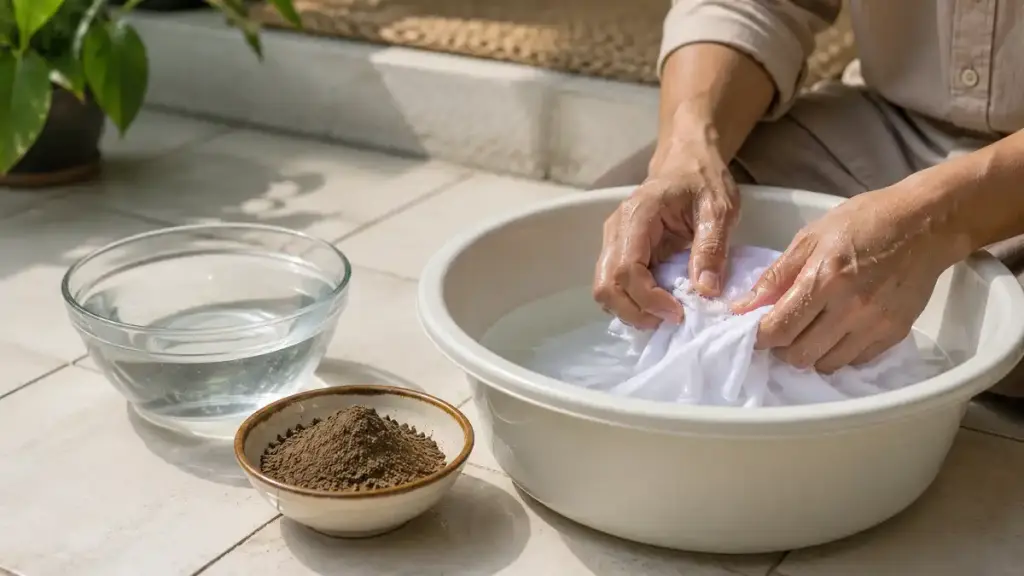
To answer how to clean dog saliva from clothing, first identify the part of the fabric actually affected. Remove any visible substance, then wash that part seven times with water. One wash must include soil mixed with water.
There is no need to wash the whole garment when the affected spot is known. Still, the soil mixture and each water wash must reach all fibers in the affected area.
Feet, Hands, and Other Body Parts
To answer how to remove dog impurity from feet, the principle is the same. Wash only the area known to be affected seven times, including one soil wash.
If only the sole of the foot was affected, there is no requirement to wash the whole leg. Fiqh does not impose washing on an area not known to be affected.
A Vessel Licked by a Dog
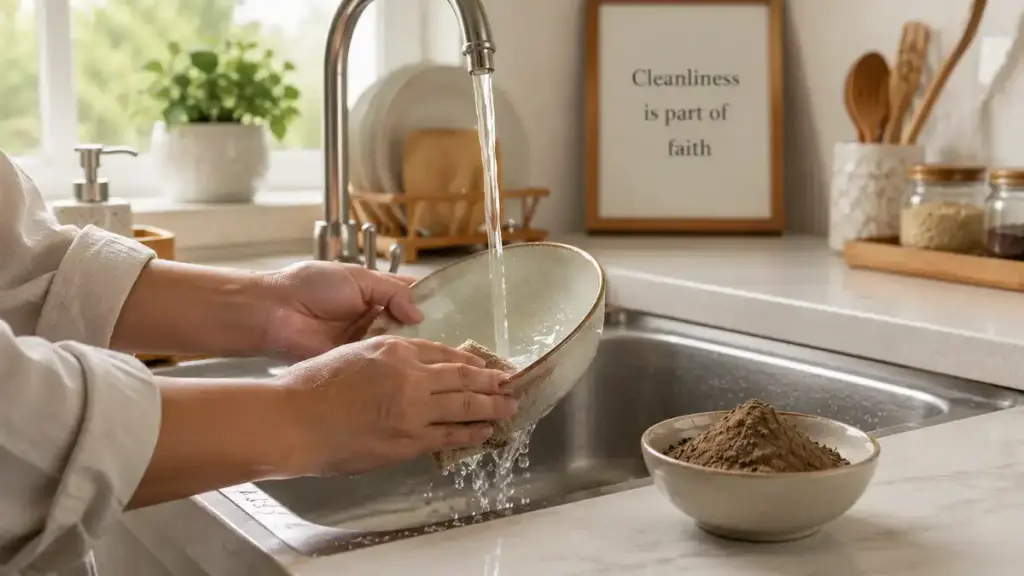
A vessel is the primary example in the hadith. When a dog licks or drinks from a bowl, cup, or food container, remove the contents if there are any, then wash the vessel seven times with one soil wash.
If the water in a vessel is a small amount and becomes affected by the dog’s lapping, it becomes impure. If more water is then added until it reaches two qullahs, the water becomes pure, but the vessel itself still needs purification.[6]
Small Water, Large Water, and Two Qullahs
Asnā al-Maṭālib states:
«وَلَا يَنْجُسُ كَثِيرُ الْمَاءِ الطَّهُورِ وَلَا إِنَاؤُهُ بِوُلُوغِهِ إِنْ لَمْ يَنْقُصْهُ عَنْ قُلَّتَيْنِ»
Meaning: “A large amount of purifying water and its vessel are not made impure by the dog’s lapping if that lapping does not reduce it below two qullahs.”[6]
This addresses water that is already abundant and does not change or fall below the two-qullah threshold. If the wet body of a dog touches a part of the vessel that the water does not reach, that contact has a separate detail because it is wet contact.
Old or Uncertain Dog Impurity
The ruling on unknown dog impurity is that impurity is not established by possibility alone. Al-Iqnāʿ says:
«فَمَا تَيَقَّنَ إِصَابَةَ شَيْءٍ مِنْهُ فَنَجِسٌ وَإِلَّا فَطَاهِرٌ لِأَنَّا لَا نُنَجِّسُ بِالشَّكِّ»
Meaning: “What is known with certainty to have been affected by it is impure; otherwise it remains pure, because we do not declare something impure through doubt.”[5]
For how to clean old dog impurity, clean it when its place is known or established. Where there is no certainty that a particular spot was affected, the original ruling is purity.
The expression “excused dog impurity” should not be used to disregard an impurity known with certainty. How to purify oneself from dog impurity follows the same rule: identify the proven affected area and apply the seven-wash method. Rather, an object merely suspected of contact is not classified as impure in the first place.
Soil, Still Water, and Flowing Water
When an affected object is immersed in a large quantity of still water, one immersion counts as one wash even if it remains in the water for a long time. Moving it seven times in that water counts as seven washes.[6]
With flowing water, seven flows of water passing over the affected area count as seven washes. This is useful for large objects or surfaces that cannot easily be moved.
FAQ: Dogs, Major Impurity, and Seven Washes
Are dogs impure according to the Shafi’i school?
Yes. In the Shafi’i school, a dog is treated as najis al-ʿayn and belongs to the category of major impurity. The same applies to a trained dog.[1]
A separate object is affected only where impurity transfers, which is relevant in wet or moist contact.
Is only dog saliva impure, or is the whole dog included?
The ruling is not limited to saliva. Al-Iqnāʿ includes saliva, urine, other moisture, and the dog’s bodily parts in the discussion of major impurity.[4]
Dry dog fur does not transfer impurity to an object that is also dry. Transfer is considered where moisture is present.
Must soil be used in the first wash?
No. Soil may be used in any one of the seven washes.[5]
Using it earlier, especially in the first wash, is recommended. It is not a validity condition that soil always be used first.
Can soap or detergent replace soil?
No. In the Shafi’i school, soap and similar cleansing materials do not replace soil in the purification of major impurity.[3]
Soap may be used for additional cleaning after the seven washes and soil requirement have been fulfilled.
Footnotes
References
- Zakariyā al-Anṣārī, Asnā al-Maṭālib fī Sharḥ Rawḍ al-Ṭālib, with ḥāshiyah by Aḥmad al-Ramlī, edited by Muḥammad az-Zuhrī al-Ghamrāwī (Cairo: al-Maṭbaʿah al-Maymānīyah, 1313 AH; repr. Dār al-Kitāb al-Islāmī), vol. 1, pp. 10-22.
- Muḥammad ibn Qāsim al-Ghazzī, Fatḥ al-Qarīb al-Mujīb fī Sharḥ Alfāẓ al-Taqrīb = al-Qawl al-Mukhtār fī Sharḥ Ghāyat al-Ikhtiṣār, ed. Bassām ʿAbd al-Wahhāb al-Jābī, 1st ed., vol. 1 (Beirut: al-Jafān wa-al-Jābī, Dār Ibn Ḥazm, 2005), 58.
- Al-Sharbīnī, Shams al-Dīn Muḥammad bin Aḥmad. Al-Iqnāʿ fī Ḥall Alfāẓ Abī Shujāʿ. Edited by Maktab al-Buḥūth wa al-Dirāsāt, Dār al-Fikr. Beirut: Dār al-Fikr, vol. 1, pp. 92-93.


