

Understanding the monthly cycle can sometimes feel like solving a puzzle, especially when bleeding appears outside the usual schedule.
This guide to women’s fiqh explains the difference between ḥayḍ (menstrual bleeding), nifās (postnatal bleeding), and istiḥāḍah (irregular non-menstrual bleeding), so that worship can be performed calmly and without unnecessary doubt.
Before going into detailed cases, it is useful to remember that these rulings belong to the wider chapter of ṭahārah, or ritual purification. They also relate closely to ḥadath, because ḥayḍ and nifās place a woman in the state of major ḥadath, while istiḥāḍah is treated as a continuous ḥadath.
For readers who want the broader legal background, this topic is also connected to the meaning and scope of fiqh.
What Is the Difference Between Ḥayḍ, Nifās, and Istiḥāḍah?
Many Muslim women are unsure when blood appears outside the usual time. Is it ḥayḍ? Is it nifās? Or is it istiḥāḍah?
This confusion is understandable, because the rulings that follow from these three types of blood are different. In Shāfiʿī women’s fiqh, the type of blood determines whether a woman must pray, may fast, must perform ghusl, or must perform wuḍūʾ for each prayer time.
The common mistake is to assume that every bleeding is ḥayḍ. In reality, blood that is less than the minimum duration of ḥayḍ, more than the maximum duration, or outside its valid time may be istiḥāḍah.
In Asnā al-Maṭālib, Shaykh Zakariyyā al-Anṣārī places the discussions of ḥayḍ, istiḥāḍah, and nifās in one connected sequence. This shows that the three are related, yet their rulings are not identical.
Why Are These Three Types of Blood Often Confusing?
The issue is not simply “blood came out” or “blood did not come out.” In the Shāfiʿī school, several points must be checked:
- whether the blood came out at a time when ḥayḍ is legally possible;
- whether the blood came out after childbirth;
- whether the blood reached the minimum and maximum limits of ḥayḍ;
- whether it follows an old habit or a changed pattern;
- whether it is major ḥadath or a continuous ḥadath.
Because of this, a safe fiqh reading begins with classification. The legal ruling depends on the type of blood.
A Brief Definition of Ḥayḍ
Shaykh Zakariyyā al-Anṣārī explains:
وهو لغة السيلان يقال حاض الوادي إذا سال وشرعا دم جبلة يخرج من أقصى رحم المرأة في أوقات مخصوصة
Meaning: linguistically, ḥayḍ means flowing. In the Sharʿī sense, ḥayḍ is natural blood that exits from the deepest part of a woman’s womb at specific times.[1]
From this definition, three points are central:
- it is natural blood, not ordinary wound blood;
- it comes from the womb;
- it occurs at a time recognized by the Sacred Law.
Therefore, not every blood that exits from a woman’s private part is automatically judged as ḥayḍ. It must meet the conditions of age, duration, and circumstance.
A Brief Definition of Nifās
Nifās is connected to childbirth. Asnā al-Maṭālib states:
وهو لغة الولادة وشرعا دم الولادة
Meaning: linguistically, nifās means childbirth. In the Sharʿī sense, it is the blood of childbirth.[12]
The beginning of nifās is also described as follows:
وأول وقته بعد خروج الولد
Meaning: the beginning of nifās is after the child has come out.[12]
Thus, blood after delivery is not read like ordinary ḥayḍ, even though many of its rulings are the same as ḥayḍ.
A Brief Definition of Istiḥāḍah
Regarding istiḥāḍah, the book explains:
كل ما لا يعد حيضا ونفاسا من الدم الخارج من الفرج فهو استحاضة
Meaning: every blood that exits from the private part and is not counted as ḥayḍ or nifās is istiḥāḍah.[4]
Istiḥāḍah is not a complete barrier to worship. A woman in istiḥāḍah, called a mustaḥāḍah, still prays and may still fast. However, she has a special purification procedure because her condition is treated like a continuous ḥadath.[4]
Quick Comparison Table
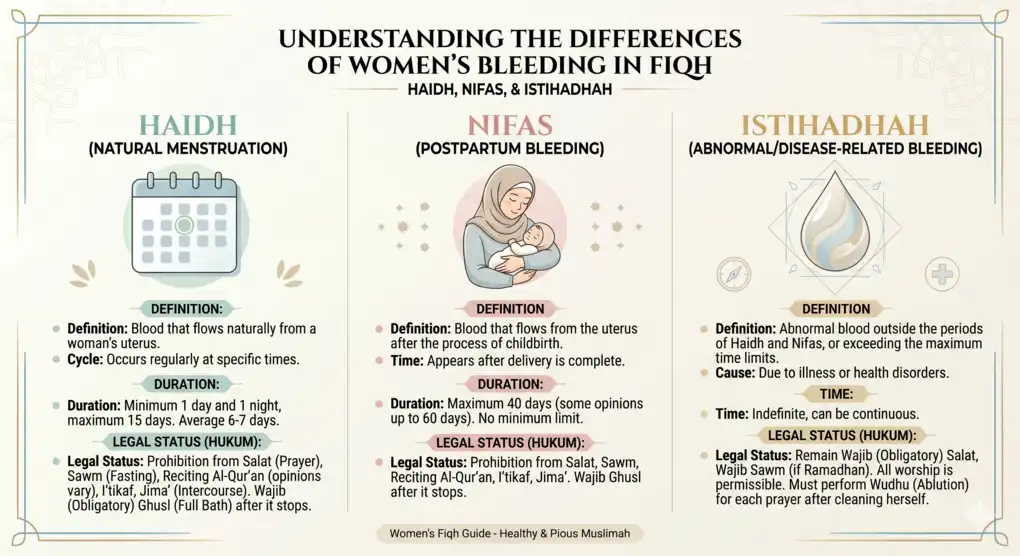
| Aspect | Ḥayḍ | Nifās | Istiḥāḍah |
|---|---|---|---|
| Cause | Natural female blood | After childbirth or delivery of a fetus | Blood outside the rulings of ḥayḍ and nifās |
| Time | At a valid age and time for ḥayḍ | After childbirth | Any time outside valid ḥayḍ/nifās |
| Minimum | 24 hours | A moment | Not measured by ḥayḍ limits |
| Maximum | 15 days and nights | 60 days | May continue |
| Prayer | She does not pray | She does not pray | She still prays |
| Fasting | She does not fast; qadāʾ is required | She does not fast; qadāʾ is required | She may fast |
| Ghusl | After purity | After purity | No ghusl merely because of istiḥāḍah |
| Daily wuḍūʾ | Normal after purity | Normal after purity | Special wuḍūʾ after the prayer time enters |
The First Key to Reading Women’s Bleeding
The safest way to read a case is not to guess. Follow this order:
- Did the blood come out after childbirth?
If yes, the starting direction is nifās. - If it is not after childbirth, does it meet the conditions of ḥayḍ?
If yes, it is ḥayḍ. - If it does not meet the conditions of ḥayḍ and is not nifās, it is istiḥāḍah.
- If the blood stops, check whether a sign of purity has appeared.
After that, the discussion moves to ghusl, prayer, and fasting.
In Asnā al-Maṭālib, yellow and murky discharge may also be judged as ḥayḍ or nifās when it occurs at a time when those rulings are possible:
والصفرة والكدرة أي كل منهما حيض ونفاس
Meaning: yellow discharge and murky discharge, each of them may be ḥayḍ and nifās.[10]
This is important for brown spotting, yellow discharge, and murky blood. Still, the ruling depends on timing, duration, and the sign of purity.
Practical Note
For women with irregular bleeding, it is very helpful to record:
- the date bleeding starts;
- the hour bleeding starts;
- the color of the blood;
- when the blood stops;
- when the sign of purity appears;
- the previous monthly habit of ḥayḍ.
This record is useful when distinguishing ḥayḍ, nifās, and istiḥāḍah.
Ḥayḍ in Shāfiʿī Fiqh: Definition, Age, and Duration
In Shāfiʿī fiqh, ḥayḍ cannot be defined simply as “monthly female bleeding.” It has an age limit, time limit, and rules for purity between two periods.
So when someone asks, “What is ḥayḍ?”, “How many days is normal menstruation?”, or “What is the ruling if bleeding goes beyond 15 days?”, the answer must return to the legal principles of the books.
The Definition of Ḥayḍ in Language and Sharʿ
The definition has already been mentioned:
وهو لغة السيلان يقال حاض الوادي إذا سال وشرعا دم جبلة يخرج من أقصى رحم المرأة في أوقات مخصوصة
Meaning: ḥayḍ linguistically means flowing. In the Sharʿī sense, it is natural blood that exits from the deepest part of a woman’s womb at specific times.[1]
The book also cites the general Qur’anic basis:
ويسألونك عن المحيض
Meaning: “They ask you about menstruation.”[1]
In the authentic ḥadīth of Sayyidah ʿĀʾishah, may Allah be pleased with her, the Prophet ﷺ said:
هذا شيء كتبه الله على بنات آدم
Meaning: “This is something Allah has decreed for the daughters of Ādam.”[1]
Thus, ḥayḍ is not a disgrace. It is a decree from Allah, and the Sacred Law gives rules so that a Muslim woman knows when to pray, when to fast, and when ghusl becomes obligatory.
The Minimum Age for Ḥayḍ
Shaykh Zakariyyā al-Anṣārī writes:
والصحيح أن أقل سنه تسع سنين قمرية
Meaning: the sound opinion is that the minimum age for ḥayḍ is nine lunar years.[1]
A lunar year means a Hijrī year. This limit follows the Islamic calendar. For background on that calendar, see the history of the Hijrī calendar.
The book also explains:
تقريبا لا تحديدا
Meaning: this limit of nine years is approximate, not a rigid exact calculation.[1]
If blood appears long before the age at which ḥayḍ is legally possible, it is not judged as ḥayḍ. In practical language, it is treated as irregular or defective blood, not menstruation.
The Minimum Duration of Ḥayḍ: 24 Hours
The book states:
وأقله أي زمنا يوم وليلة أي قدرهما وهو أربع وعشرون ساعة
Meaning: the minimum time of ḥayḍ is a day and a night, meaning a period of 24 hours.[1]
If the bleeding does not reach 24 hours, it is not legally ḥayḍ. The woman remains obligated to pray because she is not in the ruling of menstruation.
Example: blood appears for a few hours, then stops completely and does not return. If the total bleeding does not reach 24 hours, it is not ḥayḍ according to the minimum limit of the Shāfiʿī school.
The Maximum Duration of Ḥayḍ: 15 Days and Nights
Shaykh Zakariyyā al-Anṣārī continues:
وأكثره خمسة عشر يوما بلياليها
Meaning: the maximum duration of ḥayḍ is 15 days including their nights.[1]
This is the foundation for questions such as “How long can ḥayḍ last?” or “What if bleeding goes beyond 15 days?”
In the Shāfiʿī school, bleeding beyond 15 days is not all judged as ḥayḍ. After the maximum limit is crossed, the woman enters the discussion of istiḥāḍah. Then one checks whether she has a previous habit or a valid distinction between strong and weak blood.
The Usual Duration of Ḥayḍ: 6 or 7 Days
The book states:
وغالبه أي الحيض ست أو سبع وباقي الشهر غالب الطهر
Meaning: the usual duration of ḥayḍ is 6 or 7 days, and the rest of the month is usually purity.[2]
So when people ask, “How many days is normal menstruation?”, the fiqh answer is:
- minimum ḥayḍ: 24 hours;
- usual ḥayḍ: 6 or 7 days;
- maximum ḥayḍ: 15 days and nights.
Here, “normal” means the common legal measure in fiqh, not a medical diagnosis.
Purity Between Two Menstrual Periods
The book indicates that the minimum purity after ḥayḍ is 15 days:
كأقل طهر بعده حيض
Meaning: the maximum of ḥayḍ, 15 days, is also like the minimum purity before another ḥayḍ may occur.[1]
As for the maximum purity, there is no limit. The book states:
ولا حد لأكثره أي الطهر بالإجماع فقد لا تحيض المرأة في عمرها إلا مرة وقد لا تحيض أصلا
Meaning: there is no maximum limit for purity by consensus. A woman may experience ḥayḍ only once in her life, or she may never experience it at all.[2]
This answers the case of a woman who does not menstruate for a long time. In fiqh, as long as no valid menstrual blood appears, the rulings of ḥayḍ do not apply. She continues praying, fasting, and worshipping as usual.
Summary of Ḥayḍ Duration
| Issue | Shāfiʿī Ruling |
|---|---|
| Minimum age | About 9 lunar years |
| Minimum ḥayḍ | 24 hours |
| Usual ḥayḍ | 6 or 7 days |
| Maximum ḥayḍ | 15 days and nights |
| Minimum purity between two periods | 15 days |
| Maximum purity | No limit |
| Blood less than 24 hours | Not ḥayḍ |
| Blood beyond 15 days | Enters the discussion of istiḥāḍah |
Menstrual Cycle, Purity, and Reading the Habit (ʿĀdah)
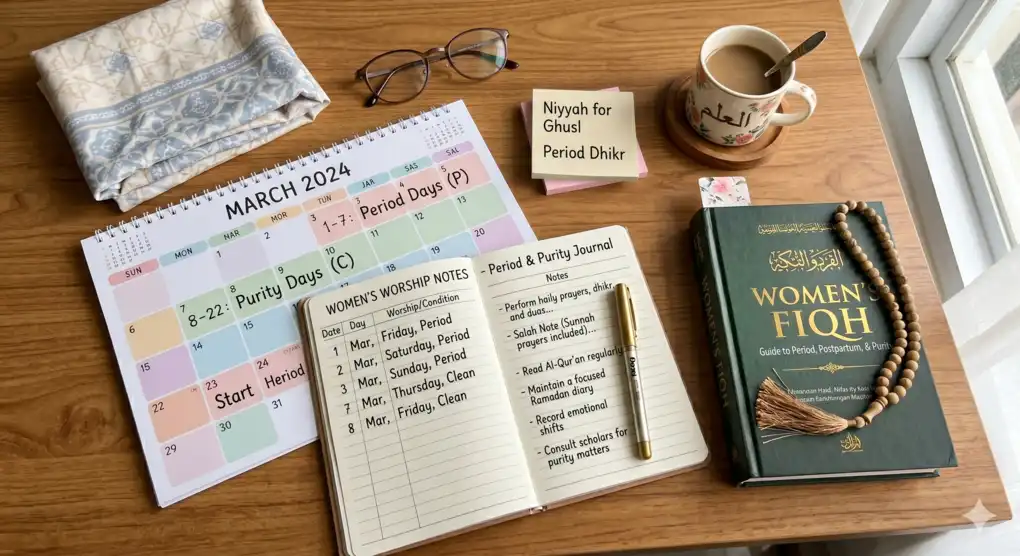
After understanding the minimum and maximum limits of ḥayḍ, the next step is to read the cycle. In fiqh, the cycle is not merely a monthly date. It is the arrangement of days of blood, days of purity, and a woman’s previous menstrual habit.
A menstrual calendar is useful as a record. However, the ruling still returns to the Shāfiʿī principles.
What Is ʿĀdah?
ʿĀdah is a woman’s menstrual habit. It may refer to the number of days, the time of arrival, or a repeating pattern.
Asnā al-Maṭālib states:
وتثبت العادة إن لم تختلف بمرة فلو حاضت في شهر خمسة ثم استحيضت ردت إليها
Meaning: if the habit does not vary, it can be established by one occurrence. If a woman menstruates for five days in one month, then experiences istiḥāḍah in the following month, she is returned to that five-day habit.[9]
This means that if a woman previously had ḥayḍ for 5 days, then the next month blood continues beyond the limit, that 5-day habit is used to separate ḥayḍ from istiḥāḍah.
Habit in Number of Days
If a woman usually menstruates for 6 days, then the following month blood continues, the number 6 becomes the first reference. The days of the habit are treated as ḥayḍ; what follows enters the discussion of istiḥāḍah if the maximum is exceeded.
The book explains:
فإن كانت تحيض في كل شهر خمسة فحاضت في شهر ستة ثم استحيضت في الشهر الثاني فحيضها الست
Meaning: if she usually menstruates five days every month, then one month she menstruates six days, and in the next month experiences istiḥāḍah, her ḥayḍ is counted as six days.[9]
The newer pattern is closer to the current condition, so in this case the 6-day habit is used as the reference.
If the Habit Varies but Is Regular
Some women do not have one fixed number, but their pattern is still regular. For example:
- first month: 3 days;
- second month: 5 days;
- third month: 7 days;
- then the pattern repeats: 3, 5, 7.
The book states:
فإن اختلفت عادتها وانتظمت بأن كانت تحيض في شهر ثلاثة مثلا وفي الثاني خمسة مثلا وفي الثالث سبعة مثلا… فهذا الدوران يثبت بمرة
Meaning: if her habit differs but is regular, such as 3 days in one month, 5 days in the next, and 7 days in the third, then that cycle is established.[9]
Not every changing cycle is legally chaotic. If the change has a pattern, that pattern can be read as ʿādah.
Intermittent Bleeding During the Menstrual Period
Sometimes blood does not flow continuously. It comes out, then stops, then comes back.
Asnā al-Maṭālib states:
فرع المبتدأة وغيرها بعد رؤية الدم قدر يوم وليلة تغتسل وجوبا لكل انقطاع وتستبيح الصلاة… فإذا انقطع الدم قبل خمسة عشر فالكل أي فكل من الدم والنقاء المحتوش حيض
Meaning: a beginner and others, after seeing blood for the measure of a day and night, must perform ghusl at every stoppage and may pray. If the blood stops before 15 days, then all of it—both the blood and the clean interval enclosed by blood—is ḥayḍ.[11]
The explanation is that if blood comes out, stops, then comes back within the maximum period of ḥayḍ, the clean interval in the middle may be treated as part of the ḥayḍ when it is enclosed by menstrual blood.
If the Bleeding Goes Beyond 15 Days
If bleeding continues beyond 15 days, a woman must not assume that all of it is ḥayḍ. The book states:
وإن جاوزها أي الخمسة عشر ورددناها إلى مرد من يوم وليلة للمبتدأة وعادة للمعتادة وتمييز للمميزة
Meaning: if it goes beyond 15 days, the woman is returned to her relevant reference: one day and night for a beginner, habit for one who has a habit, and tamyīz for one who can distinguish the blood.[11]
This is where menstrual records become very important. Without records, long or intermittent bleeding can be difficult to classify.
Common Mistakes in Calculating Ḥayḍ
Common mistakes include:
- assuming that all blood after 15 days is still ḥayḍ;
- assuming that slight spotting is definitely not ḥayḍ;
- failing to record the menstrual habit;
- recording only the date without the hour.
A good record format:
| Data to Record | Example |
|---|---|
| Blood starts | Monday, 06:00 |
| Blood stops | Saturday, 18:00 |
| Total duration | 6 days 12 hours |
| Color | red, brown, yellow |
| Clean interval | yes / no |
| Ghusl | day and hour |
| Prayer resumes | first prayer time after purity |
Color of Menstrual Blood, Brown Discharge, and Signs of Purity
Many Muslim women become unsure when the color changes: black, red, brown, yellow, murky, or just light spotting.
In Shāfiʿī fiqh, the color of ḥayḍ is discussed. But color does not stand alone. The ruling is read together with timing, minimum duration, maximum duration, and the sign of purity.
Blood Color and Tamyīz
In the discussion of istiḥāḍah, the book mentions the order of strength:
والقوة لون وثخانة ونتن وسبق كما بينها مع بيان الأقوى لونا بقوله سواد ثم حمرة ثم شقرة ثم صفرة
Meaning: strength is based on color, thickness, odor, and precedence. As for color, the stronger order is black, then red, then shaqrah, then yellow.[7]
This order is used in tamyīz, meaning distinguishing strong blood from weak blood when bleeding continues into the case of istiḥāḍah.
Black Menstrual Blood
In a ḥadīth cited by the book, the Prophet ﷺ said:
إن دم الحيض أسود يعرف فإذا كان كذلك فدعي الصلاة وإذا كان الآخر فاغتسلي وصلي
Meaning: menstrual blood is black and recognizable. If it is like that, leave prayer. If it is other than that, perform ghusl and pray.[7]
Black blood is a strong sign in the discussion of women’s bleeding. However, fiqh does not use color alone. If black blood lasts less than 24 hours, it has not met the minimum of ḥayḍ. If it continues beyond 15 days, it must be read under the rules of istiḥāḍah.
Brown Discharge and Murky Blood
Brown spotting is close to kudrah, meaning murkiness. The book states:
والصفرة والكدرة أي كل منهما حيض ونفاس
Meaning: yellow discharge and murky discharge may each be ḥayḍ and nifās.[10]
Therefore, brown spotting is not automatically outside the ruling of ḥayḍ. If it appears at a time when ḥayḍ is possible, it may be judged as ḥayḍ.
The question “Is brown discharge ḥayḍ?” cannot be answered with an absolute yes or no. It depends on when it appears.
Yellow Discharge
Yellow discharge is called shufrah. In the same text, shufrah may be judged as ḥayḍ or nifās when it occurs during a time when those rulings are possible.
Example: yellow discharge appears on the fifth day of ḥayḍ, no sign of purity has appeared, and the bleeding is still within 15 days. In this situation, the yellow discharge may still be counted as ḥayḍ.
But if yellow discharge appears after a clear sign of purity, the case needs to be reviewed again.
Signs of Purity: Qaṣṣah Bayḍāʾ and Jufūf
Sayyidah ʿĀʾishah, may Allah be pleased with her, instructed women:
لا تعجلن حتى ترين القصة البيضاء تريد بذلك الطهر من الحيضة
Meaning: do not rush until you see the white discharge. By that she meant purity from ḥayḍ.[10]
The book explains qaṣṣah:
والقصة بفتح القاف الجص شبهت الرطوبة النقية الصافية بالجص في الصفاء
Meaning: qaṣṣah, with fatḥah on the qāf, refers to gypsum or white plaster. The clear, pure moisture is likened to it because of its clarity and whiteness.[10]
If a woman does not see qaṣṣah bayḍāʾ, the other sign is jufūf, meaning complete dryness. This means that cotton or cloth used for checking comes out clean from blood, yellow discharge, or murkiness.
How to Check the Sign of Purity
The book describes the method:
وهي خرقة أو قطنة أو نحوهما تدخلها المرأة فرجها ثم تخرجها لتنظر هل بقي شيء من أثر الدم أم لا
Meaning: it is a cloth, cotton, or something similar that a woman inserts into the place of bleeding and then removes to see whether any trace of blood remains.[10]
This should be done only as needed. If the cotton comes out clean, that is a sign of purity. After that, she performs ghusl and returns to prayer.
When Does Ghusl Become Obligatory?
One of the causes of obligatory ghusl is:
وخروج حيض أو نفاس بانقطاعه
Meaning: ghusl becomes obligatory because of ḥayḍ or nifās when it has stopped.[15]
So ghusl is connected to two things: ḥayḍ or nifās has occurred, and that blood has stopped.
Rulings for Women in Ḥayḍ and Nifās: Prayer, Fasting, Muṣḥaf, Mosque, and Divorce
After knowing the limits of ḥayḍ, blood colors, and signs of purity, we now move to daily acts of worship: prayer during ḥayḍ, prayer after ḥayḍ, making up fasts, the muṣḥaf, the mosque, and divorce.
In Shāfiʿī fiqh, ḥayḍ and nifās share many rulings. Many prohibitions that apply to a menstruating woman also apply to a woman in nifās.
Acts of Worship Forbidden During Ḥayḍ and Nifās
The book states:
فصل يحرم على المرأة به أي بالحيض وبالنفاس ما يحرم بالجنابة من صلاة وغيرها مع زيادة تحريم الصوم وعدم صحته
Meaning: because of ḥayḍ and nifās, everything forbidden due to janābah is forbidden for a woman, such as prayer and other acts, with the additional prohibition and invalidity of fasting.[2]
A woman in ḥayḍ or nifās does not perform:
- prayer;
- fasting;
- ṭawāf;
- Qur’an recitation with the intention of tilāwah;
- touching and carrying the muṣḥaf;
- staying in the mosque;
- marital intimacy within the prohibited limits;
- divorce during ḥayḍ/nifās, with details in the chapter of divorce.
A Menstruating Woman Does Not Pray and Does Not Make Up Prayer
The book cites the ḥadīth:
أليس إذا حاضت المرأة لم تصل ولم تصم
Meaning: is it not the case that when a woman menstruates, she neither prays nor fasts?[2]
The prayers missed during ḥayḍ and nifās are not made up. The book states:
كنا نؤمر بقضاء الصوم ولا نؤمر بقضاء الصلاة
Meaning: we were commanded to make up fasting, and we were not commanded to make up prayer.[2]
So the answer to “Does a menstruating woman make up missed prayers?” is: no, she does not make up the prayers.
Fasting During Ḥayḍ and Nifās
Fasting is different from prayer. A woman in ḥayḍ or nifās does not fast, and if menstrual blood appears while she is fasting, that fast is invalid.
However, obligatory fasts such as Ramaḍān must be made up after purity.
| Situation | Ruling |
|---|---|
| Ḥayḍ during Ramaḍān | She does not fast |
| Nifās during Ramaḍān | She does not fast |
| Missed fasts | Qadāʾ is obligatory |
| Missed prayers | Qadāʾ is not obligatory |
Ṭawāf During Ḥayḍ and Nifās
Ṭawāf is treated like prayer in many rulings of ṭahārah. The book states:
والطواف بركعتيه كالصلاة
Meaning: ṭawāf, along with its two rakʿahs, is like prayer.[22]
Thus, a woman in ḥayḍ or nifās waits until purity and ghusl before performing ṭawāf.
Reciting the Qur’an and Touching the Muṣḥaf
In the Shāfiʿī school, women in ḥayḍ and nifās are like a person in janābah regarding the prohibition of Qur’an recitation with the intention of tilāwah:
والحائض والنفساء في تحريم القراءة كالجنب
Meaning: women in ḥayḍ and nifās, regarding the prohibition of recitation, are like the junub person.[16]
The book also mentions touching the muṣḥaf:
ومس مصحف … لقوله تعالى لا يمسه إلا المطهرون
Meaning: touching the muṣḥaf is forbidden, based on Allah’s statement: “None touch it except the purified.”[17]
Thus, women in ḥayḍ and nifās do not directly touch or carry the muṣḥaf.
Entering the Mosque During Ḥayḍ
For the mosque, distinguish between staying, moving around inside, and merely passing through. The book states:
والحائض والنفساء … كالجنب وكذا في المكث في المسجد
Meaning: women in ḥayḍ and nifās are like the junub person, and the same applies to staying in the mosque.[16]
Another passage explains:
ويكره لها عبور المسجد إن لم تخش تلويثه بالدم … فإن خشيت … تلويثه حرم عبوره
Meaning: it is disliked for her to pass through the mosque if she does not fear soiling it with blood. If she fears soiling it, passing through is forbidden.[3]
In summary:
| Situation | Ruling |
|---|---|
| Staying in the mosque | Not allowed |
| Moving around in the mosque | Not allowed |
| Passing through without fear of soiling | Disliked |
| Passing through while fearing soiling | Forbidden |
Divorce During Ḥayḍ
The book states:
ويحرم على زوجها الطلاق في ذلك … لقوله تعالى إذا طلقتم النساء فطلقوهن لعدتهن
Meaning: it is forbidden for her husband to divorce her during that time, based on Allah’s statement: “When you divorce women, divorce them for their waiting period.”[3]
The explanation is that divorce during ḥayḍ is prohibited because it lengthens the woman’s waiting period, or ʿiddah.
If Blood Stops Before Ghusl
The book states:
ويرتفع بانقطاعه تحريم الصوم والطهارة والطلاق وسقوط الصلاة
Meaning: when the blood stops, the prohibition of fasting, the prohibition of purification, the prohibition of divorce, and the dropping of prayer are lifted.[3]
However, other prohibitions, such as touching the muṣḥaf and certain marital matters, are not lifted until ghusl or valid tayammum:
لا الباقي من تمتع وغيره كمس مصحف وحمله فلا يرتفع حتى تغتسل أو تتيمم
Meaning: as for the remaining matters, such as certain forms of enjoyment, touching the muṣḥaf and carrying it, they are not lifted until she performs ghusl or tayammum.[4]
Marital Boundaries During Ḥayḍ and Nifās
Fiqh discusses marital relations during ḥayḍ to protect worship, honor, and the limits of halal and haram within marriage.
The General Principle
The book states:
وكذا يحرم وطء في فرجها ولو بحائل وما أي واستمتاع بين السرة والركبة
Meaning: intercourse in her private part is forbidden, even with a barrier, and enjoyment between the navel and the knee is also forbidden.[3]
The central prohibition is jimāʿ during ḥayḍ. In the Shāfiʿī school, intercourse remains forbidden even if the blood is slight, as long as the woman is still legally in ḥayḍ or nifās.
Qur’anic and Ḥadīth Basis
The book connects this prohibition to Allah’s statement:
فاعتزلوا النساء في المحيض
Meaning: keep away from women during menstruation.[3]
“Keeping away” does not mean abandoning one’s wife as a person. A husband may still speak to her, accompany her, serve her, and treat her kindly.
The book also mentions the ḥadīth:
أنه صلى الله عليه وسلم سئل عما يحل للرجل من امرأته وهي حائض فقال ما فوق الإزار
Meaning: the Prophet ﷺ was asked what is lawful for a man from his wife while she is menstruating. He replied: what is above the waist-wrapper.[3]
The Prohibited Area
According to the relied-upon position in the Shāfiʿī school, the following are prohibited during ḥayḍ and nifās:
- intercourse;
- direct enjoyment of the area between the navel and the knees;
- touching that enters within this prohibited boundary.
The book gives the reason:
ولأن الاستمتاع بما تحت الإزار يدعو إلى الجماع فحرم
Meaning: because enjoyment beneath the waist-wrapper may lead to intercourse, it is forbidden.[3]
What Remains Permissible
The book states:
وله الاستمتاع بباقيها أي بما عدا ما بين السرة والركبة بوطء أو غيره ولو بلا حائل وكذا بما بينهما بحائل بغير وطء في الفرج
Meaning: the husband may enjoy the rest of her body, meaning what is outside the area between the navel and knees, whether through touch or otherwise, even without a barrier. As for the area between them, it is allowed with a barrier, as long as it is not intercourse.[3]
Ḥayḍ does not mean spouses must completely distance themselves. Affection, conversation, eating together, caring for one’s wife, sharing a room, and closeness outside the prohibited boundary remain allowed.
If Someone Deliberately Violates the Ruling
The book states:
ووطؤها في الفرج عالما عامدا مختارا كبيرة
Meaning: intercourse with a menstruating woman, while knowing, deliberate, and not coerced, is a major sin.[3]
If this happens, repentance is obligatory. The book also mentions recommended charity:
ويستحب للواطئ عمدا عالما بالتحريم والحيض أو النفاس مختارا في أول الدم وقوته التصدق … بمثقال إسلامي … وفي آخره وضعفه بنصفه
Meaning: it is recommended for one who deliberately has intercourse while knowing the prohibition and knowing the state of ḥayḍ or nifās, without coercion, to give charity. At the beginning of the blood and when it is strong, he gives one Islamic mithqāl. At the end of it and when it is weak, he gives half of that.[3]
This charity is recommended, not an obligatory kaffārah. The book states:
وإنما لم يجب ذلك لأنه وطء محرم للأذى فلا تجب به كفارة
Meaning: it is not obligatory because this is intercourse forbidden due to harm, so no kaffārah becomes obligatory because of it.[3]
After the Blood Stops, Is Intimacy Immediately Allowed?
No. Marital intimacy waits for ghusl, or valid tayammum when there is a Sharʿī excuse.
The book states that some prohibitions are not lifted until ghusl or tayammum.[4] If the blood has stopped, the sign of purity is clear, and ghusl has been performed, then marital intimacy becomes lawful again.
If there is no water or she cannot perform ghusl due to a valid Sharʿī excuse, tayammum can substitute for ghusl. The book states:
أو تيممت حائض انقطع حيضها لوطء أي لحله
Meaning: a menstruating woman whose ḥayḍ has stopped may perform tayammum for marital intercourse, meaning for it to become lawful.[21]
Ghusl After Ḥayḍ and Nifās

After ḥayḍ or nifās stops, a Muslim woman must perform ghusl before returning to prayer. This is often asked with phrases such as “duʿāʾ for ghusl after ḥayḍ,” “method of ghusl after menstruation,” or “intention for ghusl after ḥayḍ.”
In Shāfiʿī fiqh, the essential requirements of ghusl are intention and making water reach the entire body. For more details, see the guide on the valid conditions of ghusl and correct intention and the complete guide to ghusl in Shāfiʿī fiqh.
When Does Ghusl Become Obligatory?
The book states:
وخروج حيض أو نفاس بانقطاعه
Meaning: among the causes of obligatory ghusl is ḥayḍ or nifās together with the stopping of the blood.[15]
The Prophet ﷺ said to Fāṭimah bint Abī Ḥubaysh:
إذا أقبلت الحيضة فدعي الصلاة، وإذا أدبرت فاغسلي عنك الدم وصلي
Meaning: when ḥayḍ comes, leave prayer. When it goes away, wash the blood from yourself and pray.[15]
The phrase “when it goes away” means that the blood stops and the sign of purity appears. After that, ghusl is performed.
The Pillars of Ghusl After Ḥayḍ and Nifās
The obligatory pillars of ghusl are two:
- intention;
- making water reach the entire body.
The book explains the intention:
ويجب قرنها أي النية بأول فرض وهو أول ما يغسل من البدن
Meaning: the intention must be joined to the first obligatory act, meaning the first part of the body that is washed.[18]
The second pillar is stated:
تعميم البدن بالماء شعرا وإن كثف وبشرا وظفرا
Meaning: making water reach the entire body, including hair even if thick, skin, and nails.[19]
Intention for Ghusl After Ḥayḍ
A common Arabic wording is:
نَوَيْتُ الْغُسْلَ لِرَفْعِ حَدَثِ الْحَيْضِ فَرْضًا لِلّٰهِ تَعَالَى
Transliteration: Nawaytu al-ghusla li-rafʿi ḥadathi al-ḥayḍi farḍan lillāhi taʿālā.
Meaning: I intend ghusl to lift the ḥadath of ḥayḍ, as an obligation for Allah Most High.
In the heart, it is enough to intend: “I intend obligatory ghusl because of ḥayḍ.”
The book states:
أو نوت الحائض الغسل منه أي من الحيض أو من حدثه أو لتوطأ صح الغسل
Meaning: if a menstruating woman intends ghusl from it, meaning from ḥayḍ, or from its ḥadath, or so that intercourse becomes lawful, the ghusl is valid.[18]
Intention for Ghusl After Nifās
A common Arabic wording is:
نَوَيْتُ الْغُسْلَ لِرَفْعِ حَدَثِ النِّفَاسِ فَرْضًا لِلّٰهِ تَعَالَى
Transliteration: Nawaytu al-ghusla li-rafʿi ḥadathi al-nifāsi farḍan lillāhi taʿālā.
Meaning: I intend ghusl to lift the ḥadath of nifās, as an obligation for Allah Most High.
Because nifās is analogized to ḥayḍ, the method of ghusl is the same. Only the cause differs.
Practical Method of Ghusl After Ḥayḍ and Nifās
A practical sequence:
- Make sure the blood has stopped.
- Remove any visible impurity.
- Make the intention when beginning to wash the body.
- Perform wuḍūʾ.
- Wet the head and hair.
- Pour water over the right side, then the left.
- Make water reach all skin.
- Pay attention to folds, between fingers and toes, under nails, the navel, and behind the ears.
- After finishing, pray if the time has entered.
The book describes the most complete ghusl:
وأكمله أي الغسل إزالة قذر ظاهر كبصاق ومني ونجس أولا … ثم بعد إزالة ذلك الوضوء كاملا
Meaning: the most complete form of ghusl is first removing visible dirt or impurity, then performing a complete wuḍūʾ.[19]
It also mentions attention to body folds:
ثم تعهد معاطفه كالأذن وغضون البطن وأصول شعر
Meaning: then one checks the folds, such as the ear, abdominal folds, and roots of the hair.[19]
Is Shampoo Obligatory?
No. What is obligatory is not shampoo, but that water reaches the hair and scalp.
If the hair is braided, the book states:
ولا يجب نقض ضفر أي شعر مضفور يصله الماء أي يصل باطنه بخلاف ما إذا لم يصله
Meaning: it is not obligatory to undo braided hair if water reaches its inside. This differs when water does not reach it.[19]
If Minor Ḥadath Occurs During Ghusl
If someone passes wind during ghusl, the ghusl is not invalidated. She completes the ghusl, then performs wuḍūʾ for prayer.
The book states:
وإن أحدث في أثنائه أي الغسل أتم وتوضأ
Meaning: if one enters minor ḥadath during ghusl, one completes it and performs wuḍūʾ.[20]
If There Is No Water or Ghusl Is Not Possible
If the blood has stopped but there is no water, or a valid Sharʿī excuse prevents ghusl, tayammum may substitute for ghusl for certain acts of worship.[21]
Nifās: Definition, Duration, and Post-Childbirth Cases
After discussing ḥayḍ and ghusl, we move to nifās. This is important because many Muslim women ask: how many days is nifās, is nifās beyond 40 days still nifās, and what is the ruling of blood after childbirth?
Definition of Nifās
The book states:
وهو لغة الولادة وشرعا دم الولادة
Meaning: nifās linguistically means childbirth. In the Sharʿī sense, it is the blood of childbirth.[12]
Its beginning is:
وأول وقته بعد خروج الولد
Meaning: its beginning is after the child exits.[12]
Therefore, blood judged as nifās is blood that exits after delivery.
Minimum, Usual, and Maximum Nifās
The book states:
وأقله لحظة وأكثره ستون يوما وغالبه أربعون
Meaning: its minimum is a moment, its maximum is 60 days, and its usual duration is 40 days.[12]
| Issue | Ruling |
|---|---|
| Minimum nifās | A moment |
| Usual nifās | 40 days |
| Maximum nifās | 60 days |
If blood stops before 40 days, the woman performs ghusl and returns to prayer. She does not wait until 40 days are complete.
If blood continues after 40 days, it is not automatically istiḥāḍah. There remains the maximum limit of nifās, which is 60 days.
If Nifās Blood Goes Beyond 60 Days
The book states:
فإن جاوز دم النفساء الستين جرت على عادتها في النفاس
Meaning: if the blood of a woman in nifās goes beyond 60 days, she follows her habit in nifās, if she has one.[12]
If she has no habit, the case enters a more detailed discussion: whether she returns to the minimum nifās, her menstrual habit, or the rules of istiḥāḍah.
Interruption During Nifās
The book explains:
ولو انقطع دمها ولم تر بعد الولادة دما ولبثت طاهرة خمسة عشر يوما فأكثر ثم رأت الدم حكمنا به حيضا ولو كان في مدة النفاس
Meaning: if her blood stops, or she sees no blood after delivery, then remains pure for 15 days or more, and then sees blood, we judge that blood as ḥayḍ, even if it occurs within the period of nifās.[13]
If the pure interval is less than 15 days:
وإن لبثت طاهرة أقل من خمسة عشر يوما ثم رأت الدم فهو نفاس
Meaning: if she remains pure for less than 15 days and then sees blood, it is nifās.[13]
If Returning Blood Is Less Than the Minimum of Ḥayḍ
The book states:
وإن نقص الدم العائد عن أقل الحيض فدم فساد لا حيض لنقصه عن أقله ولا نفاس لقطع الطهر حكمه
Meaning: if the returning blood is less than the minimum ḥayḍ, it is defective blood, not ḥayḍ because it is less than the minimum, and not nifās because the period of purity has cut off its ruling.[14]
Blood Before Delivery
The book states:
والدم الخارج مع الولد ودم الطلق ليس شيء منهما بحيض ولا نفاس
Meaning: blood that exits with the child and blood during labor contractions are neither ḥayḍ nor nifās.[12]
The reason:
لأنه من آثار الولادة ولا نفاس لتقدمه على خروج الولد بل دم فساد
Meaning: because it is from the effects of birth, and it is not nifās because it precedes the child’s exit. Rather, it is defective blood.[12]
Miscarriage and Delivery Without Blood
The book states:
وإن كان الولد علقة أو مضغة فإن الدم الخارج بعده نفاس
Meaning: even if what exits is an ʿalaqah or muḍghah, the blood that exits after it is nifās.[12]
In the chapter of ghusl, the book states:
وخروج ولد ولو علقة ومضغة وبلا بلل
Meaning: the exit of a child, even as an ʿalaqah or muḍghah, and even without wetness, is a cause of ghusl.[15]
Thus, delivery without blood still obligates ghusl because of wilādah, even if no nifās blood occurs.
Istiḥāḍah: Irregular Bleeding and How to Keep Praying
After ḥayḍ and nifās, the third discussion is istiḥāḍah. Many cases of women’s bleeding can only be understood after knowing this chapter.
Definition of Istiḥāḍah
The book states:
كل ما لا يعد حيضا ونفاسا من الدم الخارج من الفرج فهو استحاضة
Meaning: every blood that exits from the private part and is not counted as ḥayḍ or nifās is istiḥāḍah.[4]
Examples include:
- blood that lasts less than 24 hours;
- bleeding that goes beyond 15 days;
- nifās blood that exceeds the maximum limit;
- bleeding at an age when ḥayḍ is not legally possible;
- blood that does not meet the conditions of ḥayḍ or nifās.
Istiḥāḍah Is Continuous Ḥadath
The book states:
وهي حدث دائم كسلس بول ومذي
Meaning: istiḥāḍah is a continuous ḥadath, like urinary incontinence or continuous madhy.[4]
Therefore, a mustaḥāḍah does not wait for bleeding to stop completely before praying. She purifies herself according to the rule and prays even while blood continues.
The book also states:
تصلي معه المستحاضة وتصوم وتوطأ والدم يجري
Meaning: a mustaḥāḍah prays, fasts, and may have lawful marital relations while the blood continues to flow.[4]
Ḥadīth Evidence for Istiḥāḍah
The book cites the ḥadīth of Sayyidah Fāṭimah bint Abī Ḥubaysh, may Allah be pleased with her:
إني أستحاض أفأدع الصلاة فقال لا إنما ذلك عرق وليست بالحيضة فإذا أقبلت الحيضة فدعي الصلاة وإذا أدبرت فاغسلي عنك الدم وصلي
Meaning: “I experience istiḥāḍah. Should I leave prayer?” The Prophet ﷺ said: “No. It is only a vein, not menstruation. When menstruation comes, leave prayer. When it goes away, wash the blood from yourself and pray.”[7]
How to Distinguish Ḥayḍ from Istiḥāḍah
Blood is read through several paths:
- Duration: minimum ḥayḍ is 24 hours; maximum is 15 days.
- Menstrual habit: if she has an ʿādah, she returns to it.
- Tamyīz: distinguishing strong blood from weak blood.
- Beginner’s rule: when she has no habit and cannot distinguish.
The book states:
فإن انقطع لدون يوم وليلة فليس بحيض في حقهن لتبين أنه دم فساد
Meaning: if blood stops before a day and night, it is not ḥayḍ for them, because it is clearly defective blood.[8]
If it stops after a day and night or more, but before 15 days:
أو انقطع ليوم وليلة فأكثر لكن لدون أكثر من خمسة عشر يوما فالكل حيض ولو كان قويا وضعيفا
Meaning: if it stops after a day and night or more, but before exceeding 15 days, all of it is ḥayḍ, even if the blood includes strong and weak types.[8]
If it exceeds 15 days:
فإن جاوز الخمسة عشر ردت كل منهن إلى مردها
Meaning: if it exceeds 15 days, each woman is returned to her relevant reference.[8]
Four Types of Mustaḥāḍah
The book states:
المستحاضات … وهن أربع لأن التي جاوز دمها أكثر الحيض إما مبتدأة أو معتادة وكل منهما إما مميزة أو غير مميزة فهن أربع
Meaning: women in istiḥāḍah are four types, because a woman whose blood exceeds the maximum of ḥayḍ is either a beginner or one with a habit. Each of these is either able to distinguish blood or not. Thus, they are four.[7]
The four types are:
- mubtadaʾah mumayyizah;
- mubtadaʾah ghayr mumayyizah;
- muʿtādah mumayyizah;
- muʿtādah ghayr mumayyizah, including the case of the mutaḥayyirah.
Mubtadaʾah Mumayyizah
The book states:
الأولى مبتدأة مميزة وهي ذات قوي وضعيف … فالحيض في حقها القوي وغيره استحاضة
Meaning: the first type is a beginner who can distinguish, meaning one who sees strong and weak blood. For her, the strong blood is ḥayḍ, and the rest is istiḥāḍah.[7]
The conditions of tamyīz:
إن لم ينقص القوي عن أقله ولم يجاوز أكثره ولم ينقص الضعيف عن خمسة عشر ولاء
Meaning: the strong blood must not be less than the minimum ḥayḍ, must not exceed the maximum, and the weak blood must not be less than 15 consecutive days.[7]
Mubtadaʾah Ghayr Mumayyizah
The book states:
الثانية مبتدأة غير مميزة لفقد شرطه أو اتحاد صفته … فحيضها في كل شهر يوم وليلة من أوله
Meaning: the second type is a beginner who cannot distinguish, because the condition of tamyīz is missing or the blood has one uniform quality. If she knows the beginning of the bleeding, then her ḥayḍ each month is one day and one night from the start.[8]
Her purity is:
وطهرها تسعة وعشرون
Meaning: her purity is 29 days.[8]
Muʿtādah and Mutaḥayyirah
If a woman has a previous menstrual habit, that habit becomes the reference when bleeding exceeds the limit. If she can also distinguish blood, tamyīz and habit are read according to the details of the school.
The book states:
وتثبت العادة بالتمييز حال الاستحاضة
Meaning: a habit can be established through tamyīz during istiḥāḍah.[9]
If she forgets her habit, forgets its timing, or is deeply unsure and cannot determine which days are ḥayḍ and which are purity, she enters the discussion of mutaḥayyirah.
Summary Table for Istiḥāḍah
| Blood Condition | Brief Ruling |
|---|---|
| Less than 24 hours | Not ḥayḍ; defective blood/istiḥāḍah |
| 24 hours up to 15 days | Ḥayḍ, if other conditions are met |
| More than 15 days | Not all ḥayḍ; enters istiḥāḍah |
| Has a habit | Returns to ʿādah |
| Can distinguish strong and weak blood | Uses tamyīz if valid |
| No habit and no valid tamyīz | Beginner: 1 day and night from the start |
| Forgot habit and cannot determine | Enters mutaḥayyirah |
Wuḍūʾ and Prayer for a Woman in Istiḥāḍah
A woman in istiḥāḍah must still pray, even while blood continues. Because her blood keeps coming out, her purification has a special ruling.
The Principle of Purification for a Mustaḥāḍah
The book states:
وتستبيح بالوضوء فرضا واحدا ونوافل كالتيمم
Meaning: through wuḍūʾ, a mustaḥāḍah may perform one obligatory prayer and multiple voluntary prayers, like tayammum.[5]
The wuḍūʾ of a mustaḥāḍah does not fully remove ḥadath like the wuḍūʾ of an ordinary person. It permits prayer due to an excuse. For the general rules, see the complete wuḍūʾ guide.
Evidence for Wuḍūʾ for Every Prayer
The book cites the Prophet’s ﷺ instruction:
توضئي لكل صلاة
Meaning: perform wuḍūʾ for every prayer.[5]
Thus, the mustaḥāḍah performs wuḍūʾ after the prayer time enters, after cleaning the blood and taking reasonable steps to prevent its spread.
Cleaning the Blood and Using a Barrier
The book states:
إن احتاطت قبله بغسل الدم والشد والتلجم
Meaning: she may pray with that wuḍūʾ if, before it, she takes precaution by washing the blood, tying, and using a restraining cloth.[5]
The form of talajjum is explained:
بأن تشد بوسطها خرقة أو نحوها كالتكة وتتلجم بأخرى مشقوقة الطرفين تجعل أحدهما قدامها والآخر وراءها وتشدهما بتلك الخرقة
Meaning: she ties a cloth or something similar around her middle, then uses another cloth with two split ends, placing one in front and one behind, and ties them with that cloth.[5]
Today, a sanitary pad can serve that function if it prevents the blood from spreading.
If an Additional Barrier Is Needed
The book states:
فإن احتاجت في دفع الدم أو تقليله حشوه بقطن أو نحوه وهي مفطرة ولم تتأذ به وجب عليها الحشو قبل الشد والتلجم
Meaning: if she needs cotton or something similar to stop or reduce the blood, and she is not fasting and is not harmed by it, then using that barrier becomes obligatory before tying and talajjum.[5]
If she is fasting, or if the device harms her, the ruling differs according to the details of the book.
Wuḍūʾ After the Prayer Time Enters
The book states:
وتتوضأ المستحاضة بعد دخول الوقت أي وقت الصلاة ولو نافلة لا قبله كالمتيمم
Meaning: the mustaḥāḍah performs wuḍūʾ after the prayer time enters, even for a voluntary prayer, not before it, like the one performing tayammum.[6]
So wuḍūʾ before the prayer time enters is not enough for the coming obligatory prayer.
Intention for Wuḍūʾ in Istiḥāḍah
A useful Arabic wording is:
نَوَيْتُ الْوُضُوْءَ لِاسْتِبَاحَةِ فَرْضِ الصَّلَاةِ لِلّٰهِ تَعَالَى
Meaning: I intend wuḍūʾ to make the obligatory prayer permissible for Allah Most High.
The wording istibāḥah is used because this wuḍūʾ does not fully remove ḥadath like ordinary wuḍūʾ. It permits prayer because the woman has an ongoing ḥadath, similar to urinary incontinence.
Praying Immediately After Wuḍūʾ
The book states:
وتجب المبادرة بالوضوء أو بدله عقب الاحتياط المذكور
Meaning: it is obligatory to proceed immediately to wuḍūʾ, or its substitute, after the precaution mentioned.[6]
It also states:
وتبادر وجوبا بعده بالصلاة تقليلا للحدث
Meaning: she must proceed immediately to prayer after wuḍūʾ in order to reduce the time of ḥadath.[6]
Delays related to prayer are excused, such as covering the ʿawrah, waiting for congregation, or determining the qiblah. The book states:
وتمهل لأذان وستر وسائر أسباب الصلاة أي مصالحها كانتظار الجماعة والاجتهاد في القبلة
Meaning: she is allowed time for the adhān, covering, and all prayer-related needs, such as waiting for congregation and determining the qiblah.[6]
But if she delays for a non-prayer reason, the wuḍūʾ is invalidated:
فلو أخرت صلاتها عن الوضوء بلا سبب من أسباب الصلاة كأكل وغزل بطل وضوءها
Meaning: if she delays her prayer after wuḍūʾ without a prayer-related reason, such as eating or spinning thread, her wuḍūʾ is invalidated.[6]
One Wuḍūʾ for One Obligatory Prayer
With one wuḍūʾ, the mustaḥāḍah may perform one obligatory prayer and several voluntary prayers.[5]
For the next obligatory prayer, she repeats:
- cleaning the blood;
- adjusting the pad or barrier;
- performing wuḍūʾ after the time enters;
- praying immediately.
The book also states:
وتجدد وجوبا الاحتياط لكل فرض ولو لم تزل العصابة
Meaning: she must renew the precaution for each obligatory prayer, even if the bandage has not moved.[6]
If Blood Comes Out During Prayer
The book states:
وخروج الدم بلا تقصير منها لا يضر
Meaning: blood coming out without negligence from her does not harm the validity of prayer.[6]
But if the blood comes out because of negligence in applying the barrier:
فإن كان خروجه بتقصير في الشد ونحوه كالحشو بطل وضوءها وكذا صلاتها إن كانت في صلاة
Meaning: if its coming out is due to negligence in tying or similar matters, such as the barrier, her wuḍūʾ is invalidated, and so is her prayer if she is praying.[6]
When Does the Wuḍūʾ of a Mustaḥāḍah Break?
The book states:
ويبطل وضوءها أيضا بالشفاء وبانقطاع يسع الطهارة والصلاة
Meaning: her wuḍūʾ is also invalidated by recovery, and by the blood stopping for a period long enough for purification and prayer.[6]
For the general nullifiers, see the matters that invalidate wuḍūʾ.
If blood stops briefly but usually returns before there is enough time for wuḍūʾ and prayer, she remains under the ruling of a mustaḥāḍah:
فإن انقطع عنها وعادته العود قبل إمكان الوضوء والصلاة أو أخبرها بعوده كذلك ثقة صلت
Meaning: if the blood stops, but her habit is that it returns before wuḍūʾ and prayer are possible, or a trustworthy person informs her that it will return in that way, she prays.[6]
Checklist for the Prayer of a Mustaḥāḍah
- Determine the days of ḥayḍ using ʿādah or tamyīz.
- Once the istiḥāḍah period begins, do not leave prayer.
- Wait for the prayer time to enter.
- Clean the blood.
- Use a pad or barrier.
- Make the intention for wuḍūʾ of istiḥāḍah.
- Perform wuḍūʾ.
- Pray immediately.
- Do not delay without a prayer-related reason.
- Repeat for the next obligatory prayer.
Late Period, Menstrual Pain, and “Period-Inducing” Remedies: The Boundary Between Fiqh and Medicine
Late periods, menstrual pain, and products promoted as period-inducing remedies often mix fiqh and health. They should be separated.
Fiqh answers the worship status: whether ḥayḍ has begun, whether a woman is still pure, whether she must pray, whether she may fast, and whether ghusl is needed. Medical causes such as hormones, stress, pregnancy, illness, or medication should be handled by qualified health professionals.
Late Period in Fiqh
In fiqh, the ruling of ḥayḍ begins only when valid menstrual blood actually appears. If no blood has appeared, the woman remains in the ruling of purity.
Therefore, a late period does not automatically allow a woman to leave prayer or fasting. As long as no blood legally judged as ḥayḍ has appeared, she continues praying, fasting, and does not perform ghusl for ḥayḍ.
The definition of ḥayḍ in the book is tied to blood exiting the womb at specific times.[1] The ruling of ḥayḍ is therefore connected to actual bleeding, not merely the feeling that menstruation is coming, emotional changes, pain, or a calendar date.
No Menstruation for a Long Time
Purity has no maximum limit. The book states:
ولا حد لأكثره أي الطهر بالإجماع فقد لا تحيض المرأة في عمرها إلا مرة وقد لا تحيض أصلا
Meaning: there is no maximum limit for purity by consensus. A woman may menstruate only once in her life, or she may never menstruate at all.[2]
From the perspective of worship, as long as no blood appears:
- she continues praying;
- she continues fasting;
- she may recite Qur’an according to the rules of one who is pure;
- ghusl for ḥayḍ is not obligatory;
- the prohibitions of ḥayḍ do not apply.
From a health perspective, a long absence of menstruation should be checked if it seems unusual, especially with severe pain, unusual bleeding, weakness, or possible pregnancy.
Menstrual Pain Does Not Determine the Ruling
Menstrual pain may occur before blood appears. But in fiqh, pain alone does not determine the beginning of ḥayḍ.
Practical rules:
- pain without blood: not yet ḥayḍ;
- pain followed by valid menstrual blood: the ruling of ḥayḍ begins;
- pain after purity without blood: still pure;
- pain from another cause: it does not change worship rulings.
The ḥadīth states:
إذا أقبلت الحيضة فدعي الصلاة، وإذا أدبرت فاغسلي عنك الدم وصلي
Meaning: when ḥayḍ comes, leave prayer; when it goes away, wash the blood from yourself and pray.[15]
Leaving prayer is connected to the arrival of ḥayḍ, not pain alone.
Pain Medication and Period-Inducing Claims
Many people search for menstrual pain medication, period-inducing remedies, or “how to make the period come quickly.” A fiqh article should not give drug doses, herbal recipes, or product recommendations.
From the legal angle:
- if valid menstrual blood has appeared, the rulings of ḥayḍ apply;
- if no blood has appeared, she remains pure;
- if medication reduces pain, the worship ruling still follows whether blood is present;
- if medication causes blood to appear, the blood is still read through the limits of ḥayḍ, nifās, and istiḥāḍah.
If blood appears because of medicine or a medical procedure, the ruling is still checked: does it meet the conditions of ḥayḍ or not? If not, it enters the discussion of istiḥāḍah or defective blood.[4]
Late Period During Ramaḍān
If a woman’s period is late during Ramaḍān and no blood has appeared, she continues fasting.
A fast is not invalidated by the expectation of ḥayḍ. It is invalidated if menstrual blood actually appears before Maghrib.
If blood appears after Maghrib, that day’s fast remains valid. If blood appears before Maghrib, that day’s fast is invalid and must be made up.
Practical Summary: When to Pray, When to Fast, and When to Perform Ghusl
This section is a quick guide for reading cases of ḥayḍ, nifās, and istiḥāḍah. Its purpose is to help readers know when to pray, when not to pray, when fasting is valid, and when ghusl after ḥayḍ becomes obligatory.
Quick Decision Table
| Situation | Blood Status | Prayer | Fasting | Ghusl |
|---|---|---|---|---|
| Blood less than 24 hours | Not ḥayḍ | She prays | Valid | No ghusl for ḥayḍ |
| Blood 24 hours to 15 days | Ḥayḍ if conditions are met | She does not pray | She does not fast | Ghusl after purity |
| Blood beyond 15 days | Istiḥāḍah discussion | Use ʿādah/tamyīz, then pray during istiḥāḍah | Allowed during istiḥāḍah | Ghusl after the ḥayḍ portion ends |
| Blood after childbirth | Nifās | She does not pray during nifās | She does not fast during nifās | Ghusl after purity |
| Nifās blood beyond 60 days | Not all nifās | Enters istiḥāḍah details | According to the ruling after nifās | Ghusl after the nifās portion ends |
| Istiḥāḍah | Continuous ḥadath | She prays | She may fast | No ghusl merely because of istiḥāḍah |
If Blood Lasts Less Than 24 Hours
Blood less than 24 hours does not reach the minimum of ḥayḍ. The consequences:
- she continues praying;
- fasting remains valid;
- the prohibitions of ḥayḍ do not apply;
- ghusl for ḥayḍ is not required;
- the blood must still be cleaned because it exits from the private part.
If Blood Lasts 1 to 15 Days
If blood lasts at least 24 hours and no more than 15 days, it is judged as ḥayḍ if the other conditions are met.
During ḥayḍ:
- she does not pray;
- she does not fast;
- she does not touch the muṣḥaf;
- she does not perform ṭawāf;
- she does not do the acts prohibited during ḥayḍ.
If Blood Lasts More Than 15 Days
If blood exceeds 15 days, do not assume all of it is ḥayḍ. Use:
- ʿĀdah, the menstrual habit;
- Tamyīz, distinguishing strong and weak blood;
- the beginner’s rule if she has no habit;
- mutaḥayyirah details if the habit is unclear.
After the istiḥāḍah period begins, she continues praying with the procedure of a mustaḥāḍah.
If Blood Comes After Childbirth
Blood after childbirth is nifās. During nifās, the rulings resemble ḥayḍ in many prohibitions.
If nifās blood stops on day 20, ghusl is performed on that day. She does not wait for day 40.
If blood continues after 40 days, it may still be nifās as long as it has not exceeded 60 days.
If Purity Occurs Before Fajr in Ramaḍān
If ḥayḍ or nifās stops before Fajr, a woman may intend fasting, even if ghusl is performed after Fajr.
For Ṣubḥ prayer, however, she must perform ghusl first.
A Practical Five-Step Flow
- Did the blood appear after childbirth?
If yes, the first direction is nifās. - If not after childbirth, did the blood reach 24 hours?
If not, it is not ḥayḍ. - Is the blood still within 15 days?
If yes and the conditions are met, it is ḥayḍ. - If it exceeds 15 days, does she have ʿādah or tamyīz?
Use habit or blood distinction. - If it is istiḥāḍah, she still prays.
She cleans the blood, uses a pad, performs wuḍūʾ after the time enters, then prays.
Daily Record Format
| Data | Entry |
|---|---|
| Start of blood | Date and hour |
| First color | Black, red, brown, yellow |
| Blood stops | Date and hour |
| Total duration | Days and hours |
| Clean interval | Yes or no |
| Sign of purity | Qaṣṣah bayḍāʾ or dryness |
| Ghusl | Date and hour |
| Blood returns | Date and hour |
| Old habit | Usual number of days |
FAQ on Ḥayḍ, Nifās, and Istiḥāḍah
1. What are the minimum and maximum durations of ḥayḍ in the Shāfiʿī school?
The minimum of ḥayḍ is one day and one night, meaning 24 hours. The maximum is 15 days including their nights.[1]
If blood is less than 24 hours, it is not ḥayḍ. If it exceeds 15 days, not all of it is ḥayḍ; the remainder enters the discussion of istiḥāḍah according to ʿādah or tamyīz.
2. Is brown or yellow discharge considered ḥayḍ?
Yes, brown or yellow discharge can be ḥayḍ if it occurs at a time when ḥayḍ is possible and meets the duration conditions. In fiqh, yellow discharge is shufrah, and murky/brown discharge is kudrah.[10]
If it appears after a clear sign of purity, the case must be checked again: is it still part of the same ḥayḍ, a new bleeding, or istiḥāḍah?
3. Must a menstruating woman make up prayer and fasting?
A menstruating woman does not make up missed prayers, but she must make up missed Ramaḍān fasts.[2]
In summary:
- prayer during ḥayḍ: not performed and not made up;
- Ramaḍān fasting during ḥayḍ: not performed, but made up after purity.
4. What is the difference between ḥayḍ and istiḥāḍah?
Ḥayḍ is natural blood that exits from a woman’s womb at a specific time. Istiḥāḍah is blood that is not judged as ḥayḍ or nifās.[4]
| Aspect | Ḥayḍ | Istiḥāḍah |
|---|---|---|
| Blood status | Natural menstrual blood | Blood outside ḥayḍ/nifās |
| Prayer | She does not pray | She still prays |
| Fasting | She does not fast | She may fast |
| Purification | Ghusl after purity | Special wuḍūʾ after the time enters |
| Duration | Minimum 24 hours, maximum 15 days | May continue |
5. How long is nifās according to Shāfiʿī fiqh?
The minimum of nifās is a moment, the usual duration is 40 days, and the maximum is 60 days.[12]
If nifās blood stops before 40 days, the woman performs ghusl and returns to prayer. If it goes beyond 60 days, it enters the discussion of nifās habit, ḥayḍ, or istiḥāḍah.
Concise Footnotes
Reference
Zakariyyā al-Anṣārī, Asnā al-Maṭālib fī Sharḥ Rawḍ al-Ṭālib, with the marginal notes of Aḥmad al-Ramlī, edited by Muḥammad al-Zuhrī al-Ghamrāwī (Cairo: al-Maṭbaʿah al-Maymānīyah, 1313 AH; reprint: Dār al-Kitāb al-Islāmī), vol. 1, pp. 60–115.


