
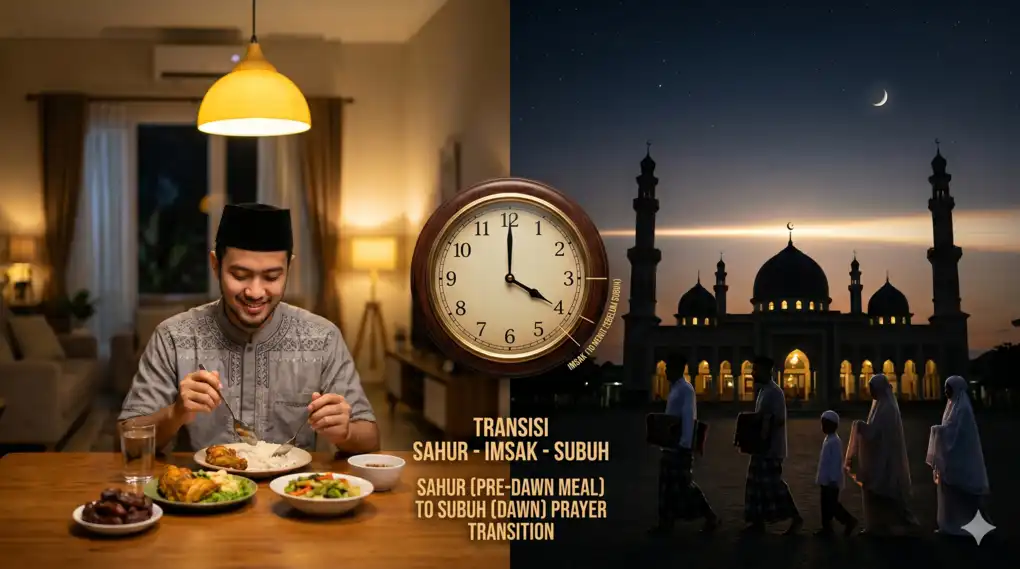
Have you ever panicked while enjoying your sahur meal when suddenly the imsak siren echoed from the mosque’s loudspeaker? Many Muslims in Indonesia reflexively stop chewing and put down their glasses, believing that the fasting limit has begun. But is this legally correct in Islamic law? Is our fast valid if we still swallow a sip of water after imsak?
This article will thoroughly examine the definition of fiqh regarding imsak, unravel its connection with the rising of dawn as the indicator of the Subuh prayer time, and correct various common misconceptions in society from the perspective of Islamic jurisprudence.
Understanding the Definition of Imsak in Fiqh Review
The Etymological Meaning of Imsak (Language)
Linguistically, imsak fundamentally means to refrain or withhold oneself from something. This definition refers to remaining silent or stopping an ongoing activity. In Arabic tradition and literature, the word imsak can be used generally when someone asks another party to stop talking, moving, or performing an action.
The Terminological Meaning of Imsak According to Sharia (Refraining from All Invalidators of Fasting)
In the review of Islamic sharia, the definition of imsak narrows down to the activity of consciously refraining from everything that corrupts the purity of fasting. This practice includes an absolute prohibition on consuming food and drink into the body’s cavities, as well as restraining physical desires from marital relations.
This ruling of imsak must be upheld without interruption from the rising of the morning horizon until the setting of the sun on the evening horizon. The starting point of this obligation to refrain coincides exactly with the second the Subuh prayer time begins for the local area.
When Exactly Does Subuh Prayer Time Begin?
Evidence of the Start of Subuh Time Based on Hadith Jibril




The determination of a valid Subuh prayer time in Islam rests firmly on the teachings of Prophet Muhammad ﷺ. The primary foundation often used by the jurists (fuqaha) is the Hadith Jibril, which directly regulates the schedule for performing obligatory prayers for the Messenger of Allah ﷺ. According to the principles taught in the obligatory prayer guide of the Shafi’i school, the changes in natural objects and atmospheric patterns are always the truest benchmark.
The following is a quote of the original text from the book Asna al-Mathalib which documents this evidence:
والفجر حين حرم الطعام والشراب على الصائم
Meaning: “And (Jibril prayed) Fajar when food and drink are forbidden for the fasting person.”[1]
This excerpt provides an indisputable foundation. The legal performance of the Subuh prayer is declared open only when Muslims are completely forbidden from reaching for sahur food.
The Appearance of Fajar Shadiq (True Dawn) as the Main Indicator
Characteristics of Fajar Shadiq (Bright Light Spreading Wide on the Eastern Horizon)
The most primary and mandatory natural sign to highlight in ensuring the beginning of Subuh time is the appearance of fajar shadiq (true dawn). The appearance of fajar shadiq is very distinctive to the eye, presenting a spread of bright light that cleaves the darkness and extends horizontally across the eastern sky.
Syaikh Zakariyya al-Anshari gives a profound visual description of it:
ثم يطلع الفجر الصادق مستطيراً بالراء أي منتشراً وسمي الأول كاذباً لأنه يضيء ثم يسود ويذهب والثاني صادقاً لأنه يصدق عن الصبح ويبينه
Meaning: “Then rises the true dawn (fajar shadiq) in a mustathir (widely spreading) manner. The first is called false (kadzib) because it brightens then turns black and disappears, while the second is called true (shadiq) because it truly informs about the morning and clarifies it brightly.”[2]
The clean white color of fajar shadiq will not shrink or fade. This light will consistently spread, moving brighter to reveal the morning dawn before the sun rises.
Its Difference from Fajar Kadzib (False Dawn: Vertical Light like a Wolf’s Tail Followed by Darkness)
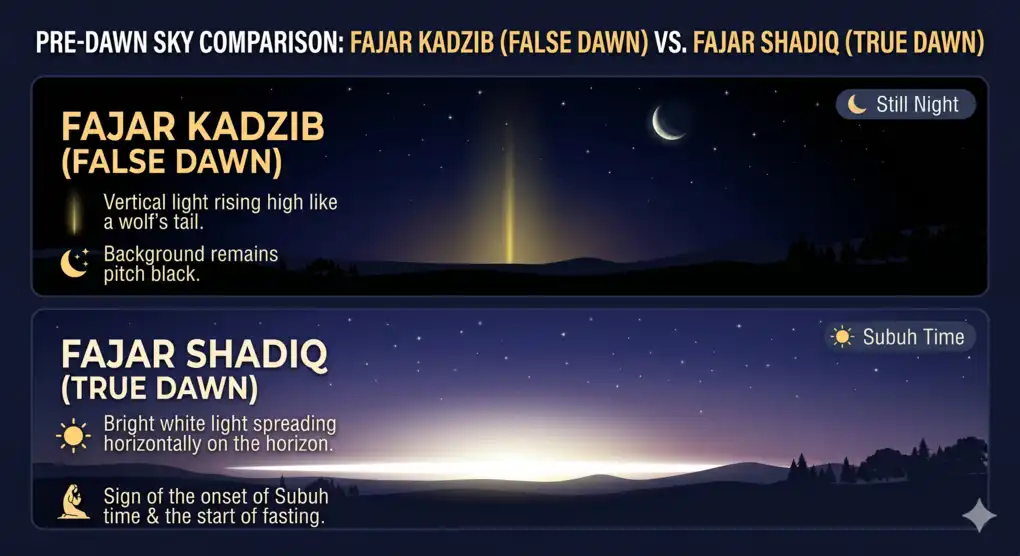
Before the true dawn appears on the horizon, the sky often displays a natural illusion called fajar kadzib (false dawn). The direction of its beam does not widen sideways, but instead points high vertically up into the sky.
In the pages of Asna al-Mathalib, the explanation of this dawn is formulated as follows:
وخرج بالصادق الكاذب وهو ما يطلع مستطيلاً بأعلاه ضوء كذنب السرحان وهو الذنب ثم يذهب وتعقبه ظلمة
Meaning: “Thus, excluded from the true dawn is the false dawn (fajar kadzib), which is the dawn that rises lengthwise upwards like a wolf’s tail, then it disappears and is followed by the darkness of the night again.”[3]
The appearance of this deceptive ray of light indicates that the Subuh prayer time limit has not yet begun. With this guidance, every Muslim is given the flexibility to finish their sahur intake naturally without needing to rush.
The Convergence Between the Obligation of Imsak and Subuh Time
The Relationship of Fajar Shadiq with the Prohibition Limit of Eating and Drinking (Sahur)
Doubt often grips ordinary people when they question what exact time imsak is truly locked. The ultimate solution rests on fajar shadiq, considering it positions itself as the boundary line closing the night that ends the fiqh rulings of sahur according to the textual rules of the Holy Quran.
Asna al-Mathalib links the morning prayer worship with the command of fasting in Surah Al-Baqarah:
وصلاة الصبح نهارية لآية {وكلوا واشربوا حتى يتبين لكم الخيط الأبيض}
Meaning: “And the Subuh prayer is a daytime (nahariyah) prayer due to the verse: ‘And eat and drink until the white thread (true dawn) becomes distinct to you…’.”[4]
This magnificent verse makes fajar shadiq a double intersection point. It becomes the sign of the start of the forbidden zone for the stomach and the obligation to perform prostration for the body. To check global timings, one can also refer to a comprehensive world prayer schedule.
Why is Imsak a Prerequisite for the Validity of Fasting Along with the Entrance of Subuh Time?
In essence, imsak occupies the position as the soul of the act of fasting. The status of the validity of a person’s fast will drop beyond rescue when they refuse to observe the true meaning of fasting at the moment the call to Subuh prayer resounds. The strictness of the sharia is designed so that a Muslim has a certain benchmark without any room for shubhat (doubt).
Considering the presence of fajar shadiq in setting the limit, the following binding legal points are born:
- Total cessation of eating and drinking activities drastically along with the appearance of dawn indications in the sky of fajar shadiq.
- The signal for the start of the fasting ritual count and the active implementation of the Subuh prayer at the same breath that synergizes together.
- The potential of falling into sin when a Muslim forces through eating sahur when the clear call of the adhan has already confirmed that the obligatory dawn has dawned.
Why is There a Time Gap Between the Imsak Schedule and the Subuh Adhan Call?
In Indonesia, we often encounter a time difference of about ten minutes between the imsak indicator and the sounding of the Subuh adhan. This gap, which routinely exists in various calendars, often makes people hesitant. Actually, what time does imsak apply with certainty in the balance of fiqh law?
Knowing the Concept of Ihtiyath (Prudence) in Shafi’i Fiqh Practice
In the tradition of the Shafi’i school, scholars highly safeguard the principle of prudence (ihtiyath) in the execution of worship. The ten-minute gap is actually intentionally designed as a time of ihtiyath so that Muslims can finish their sahur meals calmly.
This step provides a safe space for us to clean remaining food before the transitional phase of light between fajar shadiq and fajar kadzib truly appears on the eastern horizon. Mistaking the identification of this dawn light can have fatal consequences on the validity of the fast.
History and Wisdom of Establishing the Imsak Gap (About 10 Minutes Before Subuh) in Indonesia
The scholars of the Archipelago since ancient times have formulated the imsakiyah schedule very wisely. They set the gap between imsak and Subuh to be around 10 minutes as a safe transition period. This decision was taken as a form of caution regarding sahur for ordinary people who have difficulty seeing the horizon directly.
This 10-minute time was adopted from the habit of Prophet Muhammad ﷺ. He always left a short time before the adhan, the duration of which was equivalent to the time it takes to recite 50 verses of the Al-Quran.
The Ruling on Eating and Drinking When the Imsak Time Resounds

Many people suddenly stop chewing when they hear the imsak siren blaring loudly from the mosque’s loudspeaker. Then, is our fasting worship automatically void if we still drink after that warning siren echoes?
Is the Fast Still Valid if One Still Consumes Sahur After the Imsak Siren But Before the Adhan?
The answer is that your fast remains valid. The imsak time written on the calendar or broadcasted through the mosque is merely a time reminder tool. The siren is not a sign of the start of the forbidden limit to put food into the stomach. As long as fajar shadiq has not truly risen, you are still allowed to finish the remaining dishes on the table.
The book Asna al-Mathalib emphasizes the initial limit of fasting with straightforward wording:
والفجر حين حرم الطعام والشراب على الصائم
Meaning: “And (the time for the entering of) Fajar is when food and drink are forbidden for the fasting person.”[5]
The text above proves that the actual prohibition of eating only becomes purely legally active when fajar shadiq has dawned.
Tolerance Limits for Putting Food When the Sound of Subuh Adhan is Heard
Then, how should we act if food is still inside the mouth when the Subuh adhan actually resounds? Here is a practical guide that you must apply during such critical conditions:
- If the muaddhin calls the adhan on time in accordance with the rising of dawn, you must immediately spit out the remaining food or water inside your mouth.
- Swallowing food, even if only a single grain of rice, after fajar shadiq rises will instantly invalidate your fast for that very day, as it constitutes one of the explicit things that invalidate fasting.
- Immediately swallow your drink and finish chewing when the imsak warning is heard so that you can avoid this urgent condition.
Common Misconceptions in Understanding Imsak Time
Some Muslims apparently still harbor incorrect views regarding this dawn restraint schedule. This misunderstanding often gives rise to excessive panic when sahur is almost over.
Imsak Time as an Early Warning (Warning), Not an Absolute Final Limit for Sahur
The determination of this warning time functions like a yellow light in a traffic signal system. This is purely an early warning alarm for you to quickly finish eating and start brushing your teeth. This schedule is by no means a red light that forbids food. Therefore, questions regarding what time imsak is today should be interpreted as a preparation alarm, not a verdict forbidding the consumption of sahur.
Scholars’ Explanation Regarding the Rising Time of Fajar Shadiq as the True Limit of Prohibition
The true limit of the prohibition of eating sahur must always be returned to the appearance of fajar shadiq. All scholars from the four schools of thought agree that the benchmark of fasting is measured using the holy words of the Al-Quran.
Syaikh Zakariyya al-Anshari explains the legal basis of daytime in Subuh worship and fasting:
وصلاة الصبح نهارية لآية {وكلوا واشربوا حتى يتبين لكم الخيط الأبيض}
Meaning: “And the Subuh prayer is daytime-based due to the verse: ‘And eat and drink until the white thread (meaning dawn) becomes distinct to you’.”[6]
Based on the presentation of this evidence, the sharia stipulates that the absolute prohibition from all things that break the fast only falls when the white streak of dawn has been proven to rip through the remainder of the night.
Conclusion
Broadly speaking, the imsak time that we usually hear through the mosque sirens or what is printed on the calendar is not the absolute final limit for eating sahur. Imsak actually functions as a “yellow light” or an early warning designed by the scholars of the Archipelago with a duration of about 10 minutes before Subuh time.
This time gap is a form of ihtiyath (prudence) so that Muslims have space to clean the remaining food in their mouths. The true boundary of the prohibition of consuming food and drink only applies purely when fajar shadiq rises, which is the starting point of the entrance of the Subuh prayer time. By understanding the essence and differences between imsak and Subuh, we can perform the fasting worship more calmly, proportionally, and without unnecessary panic.
FAQ (Frequently Asked Questions)
Is my fast invalid if I still eat and drink after the imsak siren sounds?
No. Your fast remains valid. Imsak time (about 10 minutes before Subuh) is merely a reminder alarm, not the forbidden boundary for food. You are still allowed to finish your sahur meal until the Subuh adhan is heard, which marks the rising of fajar shadiq.
What is the main difference between Fajar Shadiq and Fajar Kadzib?
Fajar Shadiq is a bright, clean white light that spreads horizontally across the eastern horizon, serving as a certain sign for the start of Subuh time and the end of sahur. Meanwhile, Fajar Kadzib is a light illusion that appears vertically (like a wolf’s tail) before fajar shadiq, which then fades back into darkness. Fajar kadzib is not an indicator for the start of prayer or fasting.
Why does the fasting schedule in Indonesia establish an imsak gap of about 10 minutes before the Subuh adhan?
This gap is the application of the principle of ihtiyath (prudence) within the Shafi’i school tradition. Scholars established it so that ordinary people have a safe transition period to stop eating, brush their teeth, and prepare for worship without accidentally violating the fajar shadiq boundary.
What should I do if food is still in my mouth when the Subuh adhan begins?
If the muaddhin calls the adhan right at the onset of fajar shadiq, you must immediately spit out any food or drink remaining in your mouth. Swallowing it, even if it is just a single grain of rice or a drop of water, will immediately invalidate your fast for that day.
Footnotes
Reference
Zakariyā al-Anṣārī, Asnā al-Maṭālib fī Sharḥ Rawḍ al-Ṭālib, with ḥāshiyah by Aḥmad al-Ramlī, edited by Muḥammad az-Zuhrī al-Ghamrāwī (Cairo: al-Maṭbaʿah al-Maymānīyah, 1313 AH; repr. Dār al-Kitāb al-Islāmī), vol. 1, pp. 115-117.


