
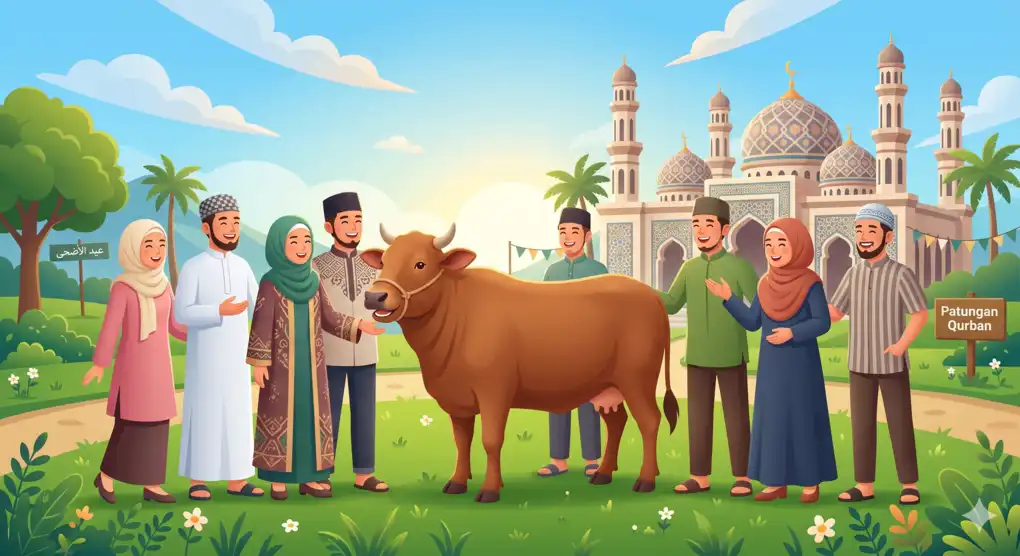
The practice of joint qurban is very common in our communities. Usually, several people collect funds to buy a single sacrificial animal. This practice is frequently seen in mosques, neighborhoods, or schools. In Islamic jurisprudence (fiqh), this joint effort falls under the chapter of syirkah or shared ownership of funds and goods.
Is Joint Qurban Allowed?
Many Muslims ask whether this joint qurban is allowed. The Shari’a essentially permits this partnership. Naturally, its permissibility depends highly on the type of animal slaughtered and the limit on the number of participants.
Knowing the ruling of joint qurban is essential so that this annual worship is valid. In various academic discussions, the primary references are the books of Shafi’i fiqh. The original ruling of the qurban itself is a confirmed sunnah. Imam Zakariyya al-Anshari explains:
قوله: (وهي) أي التضحية (سنة مؤكدة) على الكفاية
Meaning: “(And it) meaning offering qurban (is a confirmed sunnah) on a communal basis.” [1]
Conditions for Validity According to Shafi’i Fiqh
The Shafi’i school sets very clear rules regarding this partnership. Here are the details of the valid conditions for a joint qurban:
- The shared animal must be a large livestock animal, namely a cow or a camel.
- One cow or camel is limited to a maximum of seven people regarding its reward intent and ownership.
- A goat or sheep is not valid for shared ownership by more than one person.
If two people intentionally collect money to buy two goats together, their qurban becomes invalid. The original text in the book states:
ولو اشترك رجلان في شاتين للتضحية أو غيرها كالهدي لم يجز
Meaning: “If two men share in two goats for qurban or other purposes like hadyu, it is not permissible (invalid).” [2]
The defect (shortcoming) in full individual ownership makes it forbidden and fails to meet the legal conditions. You can read the complete guide to qurban in the Shafi’i school to learn more about the types of animals and their age limits.
Rules for Joint Cow and Camel Qurban
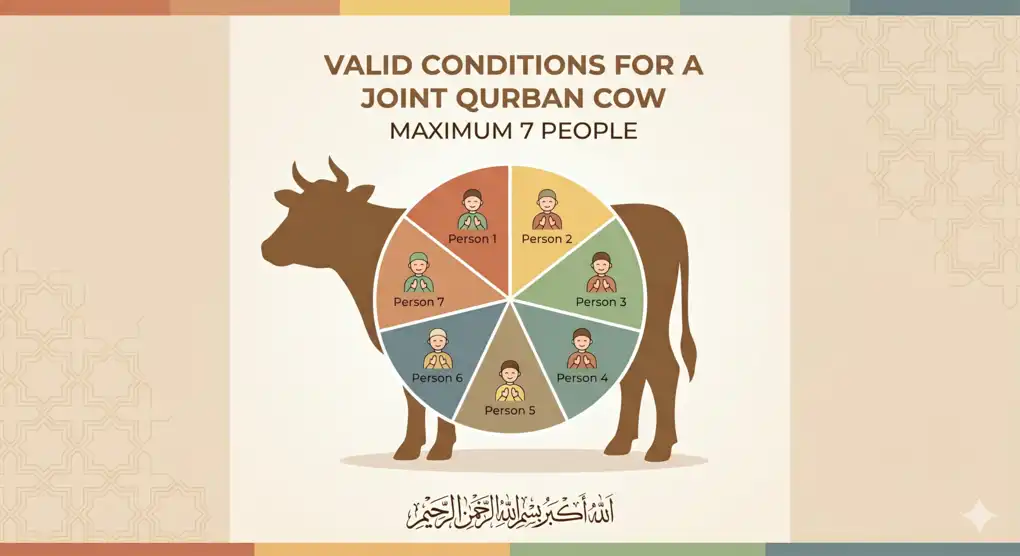
What is the Maximum Number of People for a Cow Qurban?



Questions often arise about the maximum number of people for a cow qurban to ensure the worship is valid. The Shafi’i school gives very straightforward guidance regarding the limit of participants for a large animal.
A large animal, whether a cow (baqarah) or a camel (badanah), has a maximum limit of seven people. This is clearly explained by Sheikh Zakariyya al-Anshari:
(فرع تجزئ البدنة أو البقرة عن سبعة)
Meaning: “(Branch) A badanah (camel) or a cow suffices (as a qurban) for seven people.” [3]
Evidence and Hadith for a 7-Person Joint Cow Qurban
This seven-person limit relies on strong textual evidence. The proof for joint qurban comes from the direct practice of the companions under the guidance of the Messenger of Allah ﷺ.
We can refer to the hadith narrated by Imam Muslim from the companion Jabir bin Abdullah (may Allah be pleased with him):
ولخبر مسلم عن جابر «نحرنا مع رسول الله صلى الله عليه وسلم بالحديبية البدنة عن سبعة والبقرة عن سبعة»
Meaning: “Based on the hadith of Muslim from Jabir: ‘We slaughtered with the Messenger of Allah ﷺ at Hudaibiyah a camel for seven and a cow for seven.'” [4]
This authentic narration forms a strong foundation for the permissibility of a cow qurban for 7 people. This practice remains a complete communal sunnah worship if they perform it on behalf of their respective families.
Cow Qurban for Less Than 7 People
What happens if the maximum quota of seven people is not met? For instance, there are only five participants. Many people are confused about the validity of a joint cow qurban for less than 7 people.
Legally, it remains valid, and the goodness of their intention is accepted. The remaining portion (two portions) that belongs to no one will be counted as a regular voluntary slaughter (tathawwu’). Imam Zakariyya al-Anshari details the ruling if someone slaughters a whole cow as a substitute for the obligation of one goat:
قوله: (ولو ضحى ببدنة) من بعير أو بقرة بدل شاة واجبة (فالزائد على السبع تطوع) و (يصرفه) أي الزائد (إلى أنواع) مصرف أضحية (التطوع)
Meaning: “(If one sacrifices a camel) or a cow instead of a required goat, (then the excess over one-seventh is voluntary). He may distribute that excess to the various types of voluntary qurban distributions.” [5]
Meat Distribution from a Joint Cow Qurban
A further consequence of the ruling on joint cow qurban is the distribution of meat after the slaughtering process. The seven individuals sharing the qurban have the right of distribution (qismah) over the meat according to their respective portions.
The book Asna al-Mathalib notes the rights of each sharing party:
قوله: (ولهم القسمة) أي قسمة اللحم
Meaning: “(And they have the right to division) meaning the division of the meat.” [6]
The distribution of meat to these seven people acts as an afraz (separation of rights), just like dividing partnership assets. After separation, each person has the right to manage it according to the Shari’a. For details on the portions for eating, giving charity, and gifting, please refer to the article on qurban meat distribution.
Rules for One Goat Qurban
The Basic Rule of Goat Ownership
A fundamental question often comes to mind: exactly how many people is one goat qurban for? In the scales of Shafi’i fiqh, the basic rule of ownership for a sheep (dha’n) or goat (ma’z) is very strict.
One sheep or goat, in terms of ownership status, only suffices for one person (shahibul qurban). If you ask purely from the legal perspective of physical animal ownership, the answer is absolutely one person. Sheikh Zakariyya al-Anshari affirms in the book Asna al-Mathalib:
فصل: (الشاة) تجزئ (عن واحد)
Meaning: “(Section: A goat) suffices (for one person).” [7]
It is not allowed to divide the ownership of one goat among two or more people. This differs from the rules for large animals (cows or camels), where the Shari’a provides flexibility to share among up to seven people.
One Goat for a Family (Sharing the Reward)
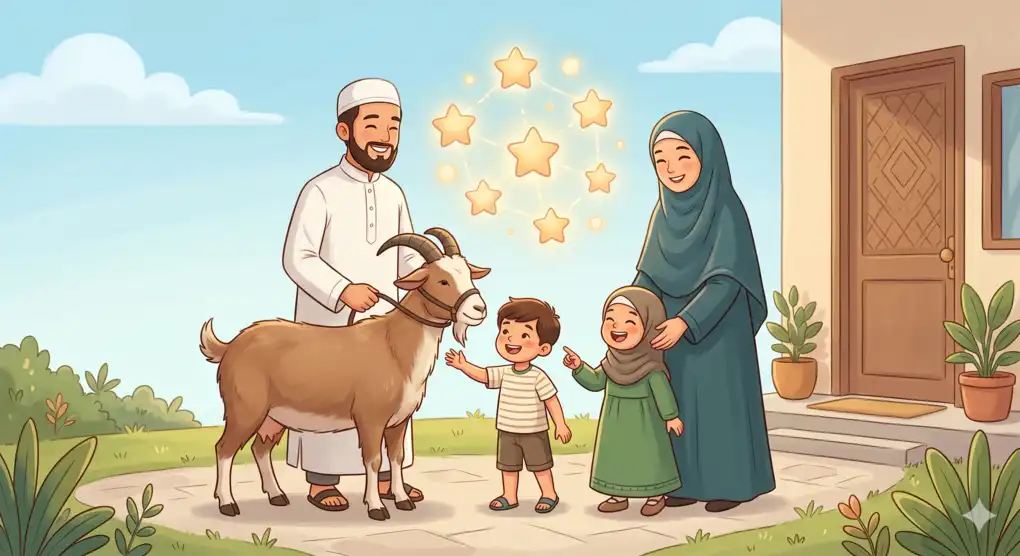
Although one goat is strictly for one person in terms of ownership, the Shari’a offers flexibility regarding the intention of the reward. A person is highly encouraged to slaughter a goat in their name and then share or include their family in the reward of that qurban.
This is the proper answer for a household wanting to use one goat for a family. The practice of offering one goat for the whole family is valid and gets its legality from the fiqh texts:
(فإن ذبحها عنه وعن أهله أو عنه وأشرك غيره في ثوابها جاز)
Meaning: “(So if he slaughters it for himself and his family, or for himself and includes others in its reward, it is permissible).” [8]
This concept of the reward of one goat for a family aligns with the rule of sunnah kifayah. If one family member (ahli bait) has offered a qurban, the demand of the sunnah for the other household members is fulfilled. The Shafi’i scholars compare it to the ruling of answering a greeting or praying for someone who sneezes.
وهي في الأولى سنة كفاية تتأدى بواحد من أهل البيت كالابتداء بالسلام وتشميت العاطس
Meaning: “And in the first case, it is a communal sunnah (sunnah kifayah) fulfilled by one person from the household, similar to initiating a greeting and praying for someone who sneezes.” [9]
The Ruling on Two People Jointly Buying Two Goats
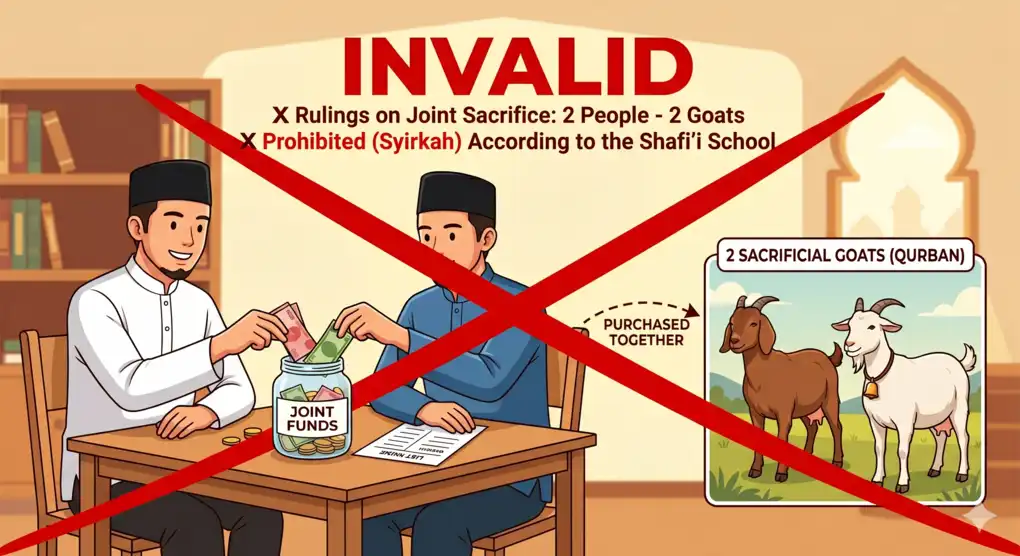
What if someone asks how many people can share a goat qurban if the number of goats matches the number of people? Suppose two people intentionally pool their money (kongsi) to buy two qurban goats.
According to the Shafi’i school, this practice of mixing ownership (syirkah) is forbidden, and their qurban becomes invalid. Sheikh Zakariyya al-Anshari explains this prohibition:
قوله: (ولو اشترك رجلان في شاتين) للتضحية أو غيرها كالهدي (لم يجز)
Meaning: “(If two men share in two goats) for qurban or other purposes like hadyu, (it is not permissible).” [10]
The reasons for its invalidity can be detailed as follows:
- The Shari’a requires one goat to be slaughtered entirely for one person.
- Mixing ownership makes the individual rights over the animal defective or incomplete.
- Each person is actually required to independently own one goat without needing to mix their funds.
Before deciding to buy a goat or other animals, it is highly important to examine the physical condition of the animal. Please study the complete details regarding the conditions and age of qurban animals so that your worship truly meets the Shari’a criteria.
Which is Better: 1 Joint Cow or 7 Individual Goats?
The Superiority of 7 Goats in Shafi’i Fiqh
Among the public, knowledge regarding joint qurban according to Islam continues to grow. Approaching Eid al-Adha, many Muslims who have extra wealth are hesitant in making a choice.
They often ask, is it better to offer a goat qurban or a joint cow if they have enough funds? In terms of fiqh, if you are faced with the choice of slaughtering one camel or cow from a seven-person joint effort, compared to slaughtering seven whole goats individually, the second option is far superior.
Even if you understand the rules of how many people for a joint cow—which is a maximum of seven people—slaughtering seven goats still holds a higher rank. Its worship value in the eyes of the Shari’a is considered greater and more virtuous (afdal).
Reasons Behind This Superiority
Then, what makes seven goats more favorable? This question about which is better, a cow or a goat, is answered very clearly by the Shafi’i scholars.
There are two rational reasons based on the main objective of the qurban worship itself. Here are the details:
- First: The quality and taste of goat meat are generally considered more delicious (athyab) for the poor and needy to enjoy.
- Second: Slaughtering seven animals means the volume of blood spilled (the amount of slaughter) is much greater. The abundance of spilled blood acts as an indicator of a greater value of drawing near (qurbah) to Allah.
Sheikh Zakariyya al-Anshari in Asna al-Mathalib records this legal ruling along with its complete reasoning:
قوله: (وسبع شياه أفضل من بدنة) بعير أو بقرة؛ لأن لحمها أطيب والدم المراق لذبحها أكثر، والقربة تزيد بحسبه
Meaning: “(And seven goats are better than a badanah) camel or cow; because its meat is tastier and the blood spilled for its slaughter is more, and the act of drawing near (qurbah) increases accordingly.” [11]
Nevertheless, whether it is a joint cow or an individual goat qurban, both remain forms of obedience that carry immense rewards when intended sincerely for Allah ﷻ.
FAQ About Joint Qurban for Cows and Goats
Is it allowed to have a joint cow qurban on behalf of a family?
The ruling is permissible, and the worship is valid. A cow (baqarah) or a camel (badanah) suffices for a maximum portion of seven people. If you are one of those seven people and intend to perform a joint qurban on behalf of your family, then the sunnah of qurban for one household is fulfilled.
This relies on the basic guideline recorded by Sheikh Zakariyya al-Anshari:
(فرع تجزئ البدنة أو البقرة عن سبعة)
meaning: “(Branch) A badanah (camel) or a cow suffices for seven people” [12].
Is it valid if 2 people jointly buy 2 qurban goats?
The answer is invalid. The Shari’a stipulates that one goat must be fully owned by one individual independently without any mixing of wealth (syirkah) in it. Mixing funds makes individual ownership rights over the animal defective. The qurban worship becomes invalid, and the slaughtered animal is only judged as regular meat.
This rule is clearly written:
قوله: (ولو اشترك رجلان في شاتين) للتضحية أو غيرها كالهدي (لم يجز)
meaning: “(If two men share in two goats) for qurban or other purposes like hadyu, (it is not permissible)” [13].
Legally regarding ownership, how many people is one goat qurban for?
From the physical ownership side of the animal, one sheep or goat is absolutely valid only for one person (shahibul qurban). However, the reward of the worship can freely be intended for all family members at home.
Sheikh Zakariyya al-Anshari explains:
فصل: (الشاة) تجزئ (عن واحد فإن ذبحها عنه وعن أهله أو عنه وأشرك غيره في ثوابها جاز)
meaning: “(Section: A goat) suffices (for one person). So if he slaughters it for himself and his family, or for himself and includes others in its reward, it is permissible” [14].
Which is better, joining a cow qurban with 7 people or offering 1 goat individually?
Both are valid acts of worship that carry rewards. However, slaughtering an entire sheep or goat independently is prioritized over merely owning one-seventh of a joint cow. If drawn on a larger scale, slaughtering seven goats individually has a much higher degree of virtue (afdal) than one cow. Goat/sheep meat is generally considered more delicious, and the volume of blood spilled from several goats is greater, meaning the value of drawing near (qurbah) to Allah ﷻ is larger.
This is affirmed in the fiqh text:
قوله: (وسبع شياه أفضل من بدنة) بعير أو بقرة؛ لأن لحمها أطيب والدم المراق لذبحها أكثر، والقربة تزيد بحسبه
meaning: “(And seven goats are better than a badanah) camel or cow; because its meat is tastier and the blood spilled for its slaughter is more, and the value of drawing near (qurbah) increases accordingly” [15].
Footnotes
Reference
Zakariyā al-Anṣārī, Asnā al-Maṭālib fī Sharḥ Rawḍ al-Ṭālib, with a marginal commentary by Aḥmad al-Ramlī, edited by Muḥammad az-Zuhrī al-Ghamrāwī (Cairo: al-Maymānīyah Press, 1313 AH; repr. Dār al-Kitāb al-Islāmī), vol. 1, pp. 534–537.


