
Approaching the sacred month of Dhu al-Hijjah, many Muslims frequently contemplate whether the ritual sacrifice is a binding obligation or a highly emphasized sunnah. Gaining a profound comprehension of the ruling of qurban in Islam is critically imperative to ensure that our worship aligns precisely with the parameters of the sacred law (sharia) and is accepted by Allah ﷻ.
As a point of reference for the Muslim community adhering strictly to the jurisprudence of the Ahlussunnah Wal Jama’ah, we are required to comprehend the execution of the sacrificial ritual with meticulous precision. This article will provide an exhaustive juristic analysis regarding the definitive requirements for sacrificial animals, focusing specifically on their mandatory age limits from the standpoint of the classical scholars of the Shafi’i school of thought. This practical framework directly references the authoritative classical jurisprudence manual, Asna al-Mathalib Sharh Rawd al-Talib authored by Syaikhul Islam Zakariyya al-Anshari.
Sacrificial Animal Requirements: The Obligation to Choose Al-An’am Species
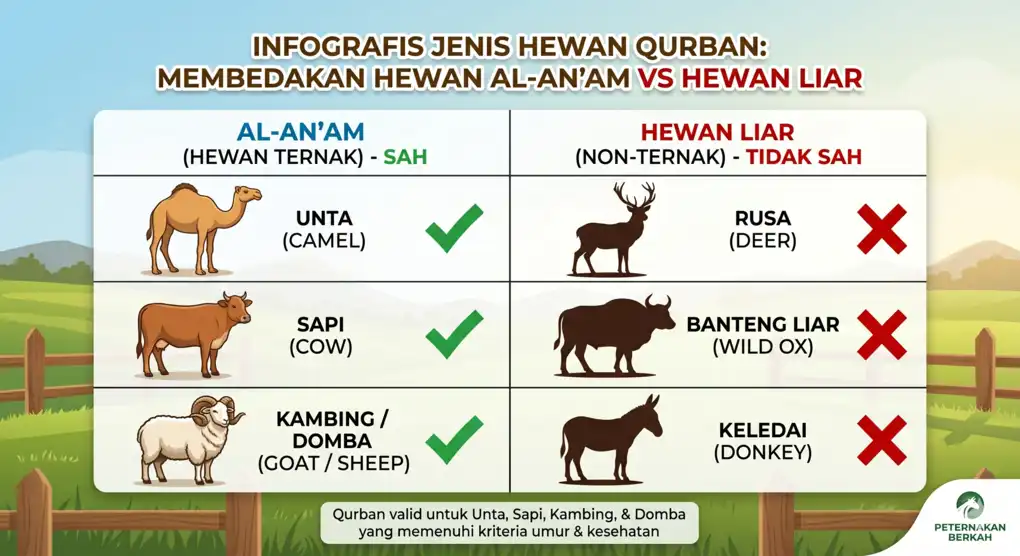
In Islamic jurisprudence, one of the most critical aspects to verify regarding the validity of a sacrificial animal (udhiyah) is its specific biological classification. Not every halal, warm-blooded, or consumable animal is permissible to be utilized for this ritual. The legal requirements for sacrificial animals under Islamic law dictate that the selection is strictly limited to domestic livestock, traditionally categorized as al-an’am.
For readers seeking a more comprehensive and holistic manual regarding this annual ritual, please consult our foundational reference text: Comprehensive Guide to Qurban According to the Shafi’i Madhhab.
Definition of Domestic Livestock (Al-An’am) in Shafi’i Fiqh
Juristic consensus (Ijma’) among Islamic scholars stipulates that the sacrificial ritual is valid exclusively when performed with camels, cattle (including water buffaloes), and small ruminants (sheep and goats), including any recognized subspecies or variants derived from them. A Muslim cannot arbitrarily choose an animal for sacrifice, as these parameters have been permanently established by scriptural texts (nash).
The definitive explanation and legal textual evidence (dalil) from Asna al-Mathalib state:
قوله: (الأول كونها من النعم) ، وهي الإبل والبقر والغنم بسائر أنواعها بالإجماع وقال تعالى {ولكل أمة جعلنا منسكا ليذكروا اسم الله على ما رزقهم من بهيمة الأنعام} [الحج: 34] ، ولم ينقل عنه صلى الله عليه وسلم ولا عن أصحابه التضحية بغيرها؛ ولأن التضحية عبادة تتعلق بالحيوان فتختص بالنعم كالزكاة
“ (The first requirement is that the animal must belong to the domestic livestock class [An’am]), which encompasses camels, cattle, and sheep/goats across all their respective subspecies, by virtue of juristic consensus (Ijma’). Allah ﷻ proclaims: {And for all religion-enacted communities We have appointed a rite [of sacrifice] that they may mention the name of Allah over what He has provided them of domestic livestock} [QS. Al-Hajj: 34]. Furthermore, it has never been transmitted from the Prophet ﷺ nor from his Companions that they performed ritual slaughter with anything other than these animals. This is because the ritual sacrifice (udhiyah) is an act of worship directly linked to the animal’s essence, meaning it is exclusively restricted to livestock, mirroring the strict criteria governing the zakat of livestock.” [1]
Ruling on Sacrificing Wild Animals
Some individuals mistakenly assume that any wild herbivorous animal that possesses delicious meat and is legally permissible to consume can serve as a valid sacrificial animal. In reality, the sacrifice of wild animals is completely invalid under Islamic law.
For instance, the specific requirements for a sacrificial cow dictate that it must be a domestic bovine (baqar), thereby excluding wild cattle, bison, or wild oxen (baqar al-wahsy). The exact same restriction applies to wild camels or undomesticated mountain goats.
Syaikhul Islam Zakariyya al-Anshari elucidates further:
فلا يجزئ غير النعم من بقر الوحش وحميره والظباء وغيرها
“Therefore, it does not suffice [is legally invalid] to use anything outside of domestic livestock, such as wild cattle [baqar al-wahsy], wild donkeys, deer/gazelles [zhiba’], and other similar undomesticated species.” [2]
This legal ruling reinforces the principle that the devotional value (taqarrub) inherent in the ritual sacrifice possesses a strict ta’abbudi dimension (an absolute ritual obedience to the texts). Muslims are not permitted to exercise creative liberties or personal preferences by replacing the species of animals beyond what has been strictly codified by the sharia.
Minimum Age Requirements for Sacrificial Animals by Species
Once a Muslim has ensured that the animal belongs strictly to the domestic livestock category (al-an’am), the next crucial pillar to examine is the physical age threshold of the animal. Islamic law explicitly forbids the ritual slaughter of animals that are too immature.
Regarding the exact age limits required for a valid sacrifice, jurists have established distinct baseline criteria depending entirely on the specific animal species. This age requirement serves as an absolute prerequisite that directly governs whether a person’s sacrifice is legally valid or void.
If you plan to perform the qurban as a group with family or relatives, it is also important to understand the procedures for a group qurban involving seven people. However, before proceeding, make sure the animal you choose meets the criteria for physical maturity.
Age Requirements for Sheep and Goats


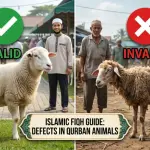
In various regions, the general public frequently treats domestic sheep (dla’n) and domestic goats (ma’iz) as interchangeable categories. However, under Shafi’i jurisprudence, these two types of small ruminants carry fundamentally different legal age standards.
While it is a common public misconception that the minimum age for any small ruminant is one year, classical fiqih dictates that this one-year threshold applies uniquely to sheep (dla’n), and does not suffice for domestic goats (ma’iz).
The legal details recorded in Asna al-Mathalib regarding sheep and goats are as follows:
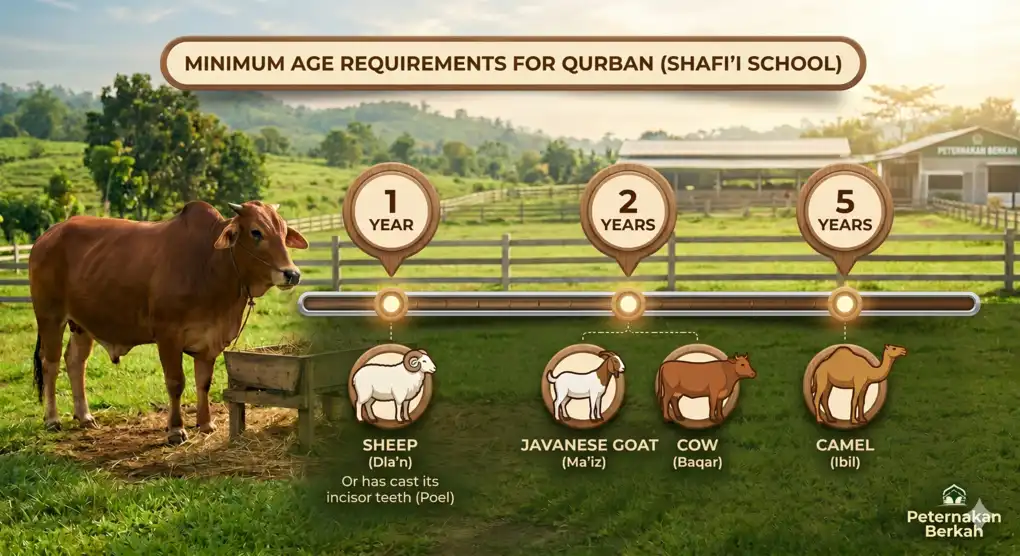
- Sheep (Dla’n): The absolute minimum age is the attainment of the Jadza’ phase, which corresponds to the completion of one full year of life.
- The Exception for Sheep (The Poel / Tooth Shedding Exception): A young sheep that has not yet completed a full year of life may still be legally valid for sacrifice provided it has naturally shed its front incisors (ajdza’a) prior to reaching the twelve-month mark.
- Goats (Ma’iz): The absolute minimum age is the attainment of the Tsaniyy phase, which means the animal must have completed two full years of life and entered its third year. Goats do not enjoy any legal leniency regarding premature tooth shedding below the age of two.
Syaikhul Islam Zakariyya al-Anshari explicitly confirms these parameters:
قوله: (ولا) يجزئ (أقل من جذع الضأن وثني المعز والإبل والبقر والجذع ذو سنة) تامة نعم إن أجذع قبلها أي أسقط سنه أجزأ كما لو تمت السنة قبل أن يجذع
“ (And it does not) suffice [it is legally invalid] to sacrifice an animal younger than the Jadza’ phase for sheep [dla’n], and younger than the Tsaniyy phase for goats [ma’iz], camels, and cattle. The Jadza’ refers to an animal that has completed one full, continuous year of life. Yes [by way of exception], if the sheep undergoes ‘ajdza’a’ [sheds its front teeth] prior to completing one full year, meaning its front incisors fall out, it is deemed legally sufficient for sacrifice, exactly as it would be if it had completed the full year before shedding its teeth.” [3]
Age Requirements for Cattle and Camels
Shifting focus to larger livestock, the legal parameters for cattle and camels necessitate a significantly longer rearing and maturation period compared to small ruminants.
For cattle, water buffaloes, and camels, the law strictly mandates that the animal must reach the physical maturity phase known as Tsaniyy. This biological milestone is structurally identified by the permanent shedding and replacement of the front incisors, occurring in tandem with reaching the age threshold mandated by sacred law.
The explicit age parameters are defined as follows:
- Cattle and Water Buffaloes (Baqar): They must fulfill the baseline Tsaniyy standard, requiring the animal to have completed two full years of life and commenced its third year.
- Camels (Ibil): They must fulfill the baseline Tsaniyy standard, requiring the camel to have completed five full years of life and commenced its sixth year.
Syaikhul Islam Zakariyya al-Anshari details these chronological boundaries precisely:
قوله: (والمعز والبقر) أي الثني منهما (ذو سنتين) تامتين (والإبل) أي الثني منها (ذو خمس سنين تامة)
“ (As for goats [ma’iz] and cattle [baqar]), meaning the Tsaniyy phase for both categories, it denotes an animal that has completed two full years of life. (And as for camels [ibil]), meaning the Tsaniyy phase for them, it denotes an animal that has completed five full years of life.” [4]
Understanding the Terms Musinnah and Mutawallid Species
When executing this noble act of devotion, every Muslim naturally aspires to ensure that their animal selection conforms strictly to the Sunnah of the Prophet Muhammad ﷺ. A core structural topic within this chapter is whether the animal must satisfy the classification of Musinnah, or if other age paradigms apply. To position this rule accurately, we must dissect how Shafi’i scholars define Musinnah alongside the legal status of crossbred livestock (Mutawallid).
What Does Musinnah Mean for Sacrificial Animals?
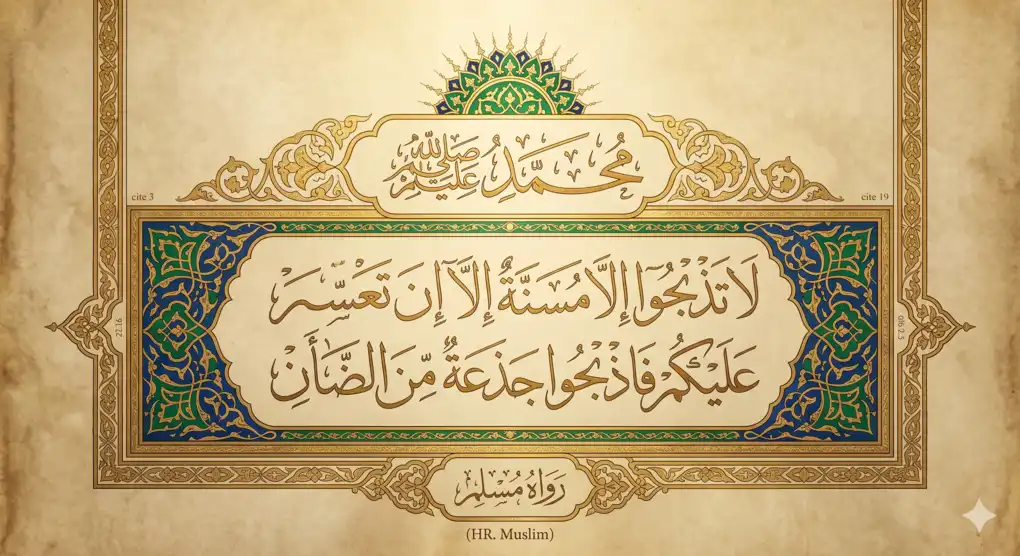
The foundational prophetic evidence motivating Muslims to prioritize mature animals is derived directly from the sound traditions of the Prophet ﷺ as compiled by Imam Muslim.
In juristic terminology, Musinnah refers to livestock that have attained the Tsaniyy stage of life. This phase is usually characterized by the shedding of the front milk teeth and their replacement with permanent incisors.
The textual authority for utilizing the Musinnah standard traces back to the statement of the Prophet ﷺ:
لخبر مسلم لا تذبحوا إلا مسنة إلا إن تعسر عليكم فاذبحوا جذعة من الضأن قال النووي في شرح مسلم قال العلماء: المسنة هي الثنية من الإبل والبقر والغنم فما فوقها
“Based on the narration recorded by Muslim: ‘Do not slaughter for sacrifice except an animal that is Musinnah [has reached the Tsaniyy phase], unless it becomes excessively difficult for you, in which case you may slaughter a Jadza’ [a sheep that has completed one year] from among the sheep.’ Imam an-Nawawi stated in Sharh Muslim: The scholars have clarified that Al-Musinnah refers precisely to the Tsaniyy level across camels, cattle, and goats/sheep, as well as anything older than that.” [5]
Does this apparent text, which restricts slaughter to Musinnah animals, invalidate the sacrifice of a one-year-old sheep (Jadza’) under normal, non-emergency circumstances? Syaikhul Islam Zakariyya al-Anshari clarifies the correct interpretation:
والجمهور على خلافه وحملوا الخبر على الاستحباب وتقديره: يستحب لكم أن لا تذبحوا إلا مسنة فإن عجزتم فجذعة ضأن.
“The vast majority of jurists [Jumhur] hold a contrary position to an absolute prohibition; they interpret the textual narrative as a recommendation [istihbab/sunnah]. The underlying implication of the text is structured as follows: ‘It is highly recommended for you not to slaughter anything except an animal that is Musinnah; however, if you are unable to do so, then slaughter a Jadza’ from among the sheep.’” [6]
Consequently, sacrificing a domestic sheep that is one year old remains entirely valid under normal conditions, even if no economic hardship or supply scarcity exists. However, prioritizing a Musinnah animal is universally deemed more meritorious (afdhal).
Regulations for Crossbred Animals (Mutawallid)
With modern advancements in animal husbandry, livestock markets frequently present new breeds resulting from the crossbreeding of two distinct domestic species (mutawallid), such as a cross between a domestic sheep and a domestic goat. What is the juristic ruling governing their eligibility?
An animal born from the crossbreeding of two distinct categories of al-an’am is legally valid to be utilized for ritual sacrifice (udhiyah), newborn celebrations (aqiqah), pilgrim offerings (hadyu), and wildlife penalties during pilgrimage. However, determining its mandatory age threshold requires the application of a specific legal maxim:
وأما المتولد بين جنسين من النعم فالظاهر أنه يجزئ هنا، وفي العقيقة والهدي وجزاء الصيد إلا أنه ينبغي اعتبار أصل أعلى الأبوين سنا في الأضحية ونحوها
“As for an animal born from crossbreeding between two distinct species of domestic livestock [An’am], the manifest, predominant legal view [dhahir] states that it suffices [is legally valid] for sacrifice, aqiqah, hadyu, and hunting compensations. However, it is necessary in the context of ritual sacrifice and its counterparts to conform strictly to the baseline criteria of whichever parental lineage demands the higher age threshold.” [7]
For example, if a sheep (minimum age requirement: 1 year) is crossed with a Javanese goat (minimum age requirement: 2 years), then the offspring must meet the higher age requirement, meaning they must be exactly 2 years old (Tsaniyy). In addition to carefully considering the age of the crossbred animal, you must also ensure that the animal is free from defects that render it invalid for sacrifice.
Wisdom Behind Age Restrictions in Qurban
The establishment of the Tsaniyy criterion (2 years for goats/cattle and 5 years for camels) is embedded with profound wisdom. Classical jurists extracted the biological and health-centric rationales (‘illah) underwriting these specific thresholds.
Imam ar-Rafi’i highlights a clear correlation between the reproductive maturity of an animal and the overall quality of its physical frame and meat yield, drawing a direct analogy to human maturity:
قال الرافعي: والمعنى في ذلك أن الثنايا تتهيأ للحمل والنزوان فانتهاؤها إلى هذا الحد كبلوغ الآدمي وحالها قبله كحال الآدمي قبل بلوغه
“Imam ar-Rafi’i observed: The underlying wisdom behind setting these specific age boundaries is that animals reaching the Tsaniyy stage have become biologically equipped for gestation and mating. Thus, the animal’s arrival at this specific threshold corresponds directly to the attainment of puberty [maturity] in humans, whereas its condition prior to reaching this stage is analogous to a human child before reaching maturity.” [8]
This juristic wisdom highlights how deeply Islamic law prioritizes quality, wholesomeness, and physical perfection when offering a sacrifice to Allah ﷻ. Only an animal that has reached complete physical maturity is deemed fit to serve as a medium of devotion during the festival of Eid al-Adha.
Furthermore, the validity of the sacrifice does not rest solely upon physical traits; it is intrinsically bound to the temporal parameters of its execution. Therefore, after confirming that the animal satisfies the maturity criteria, a Muslim must ensure that the slaughter takes place within the lawful sacrificial slaughtering timeframe mandated by the sharia.
FAQ Regarding Sacrificial Animal Requirements: Shafi’i Madhhab
Are the animal requirements for Aqiqah and Qurban identical?
Yes, the technical requirements governing the validity of animals for both aqiqah and qurban are completely identical. These strict criteria encompass the specific permissible categories of livestock, the minimum age limits, and the absolute freedom of the animal from any physical defects that could diminish the quality or quantity of its meat. The Shafi’i school clarifies that a newborn’s aqiqah occupies the exact same legal status as an udhiyah regarding its physical properties. Readers can study these parallels comprehensively via our Shafi’i Aqiqah Guide.
This reality is plainly stated in Asna al-Mathalib:
فصل: (، وهي كالأضحية في) استحبابها كما مر وفي (سائر الأحكام) من جنسها وسنها وسلامتها
“Pasal: And the aqiqah is identical to the ritual sacrifice [udhiyah] regarding its recommended nature as previously established, as well as in all other applicable legal rulings, including its genus, its age parameters, and its safety from defects.” [9]
Is it valid to sacrifice a sheep that has not yet reached one full year of age?
Sacrificing a domestic sheep that is under one year old is legally valid and permissible under one exclusive condition: the sheep must have naturally shed its front incisors (ajdza’a) prior to completing its full twelve-month cycle. This unique concession is recognized across traditional jurisprudence texts and seminary manuals.
Syaikhul Islam Zakariyya al-Anshari clarifies this mitigation:
قوله: (والجذع ذو سنة) تامة نعم إن أجذع قبلها أي أسقط سنه أجزأ كما لو تمت السنة قبل أن يجذع
“The Jadza’ refers to an animal that has completed one full year of life. Yes [by way of exception], if it undergoes ‘ajdza’a’ [sheds its teeth] prior to that mark, meaning its front incisors fall out, it is valid, exactly as it would be if it completed the full year prior to shedding its teeth.” [10]
What is the legal ruling on sacrificing wild deer or wild cattle?
Performing a ritual sacrifice with wild animals—such as wild deer, gazelles, wild oxen, or wild donkeys—is legally invalid and does not fulfill the religious obligation of udhiyah. The sharia restricts the ritual sacrifice exclusively to domestic livestock (al-an’am) that are traditionally kept and managed.
The classical text reinforces this restriction:
فلا يجزئ غير النعم من بقر الوحش وحميره والظباء وغيرها
“Therefore, it does not suffice [is legally invalid] to utilize anything outside of domestic livestock, such as wild cattle [baqar al-wahsy], wild donkeys, deer/gazelles [zhiba’], and other similar undomesticated species.” [11]
How is the valid age calculated for a crossbred animal (Mutawallid)?
For any animal born from the crossbreeding of two distinct livestock species (such as a sheep and a goat), the age requirement must strictly follow the parental lineage that carries the higher age baseline. For example, since a sheep requires 1 year while a goat requires 2 years, the crossbred offspring must complete 2 full years of life to be valid.
The legal maxim dictates:
إلا أنه ينبغي اعتبار أصل أعلى الأبوين سنا في الأضحية ونحوها
“However, it is necessary in the context of ritual sacrifice and its counterparts to conform strictly to the baseline criteria of whichever parental lineage demands the higher age threshold.” [12]
Complete Footnotes
References
Zakariyā al-Anṣārī, Asnā al-Maṭālib fī Sharḥ Rawḍ al-Ṭālib, with Ḥāsyiyah by Aḥmad al-Ramlī, edited by Muḥammad az-Zuhrī al-Ghamrāwī (Cairo: al-Maṭbaʿah al-Maymānīyah, 1313 AH; repr. Dār al-Kitāb al-Islāmī), Volume 1, pp. 535-548.


