
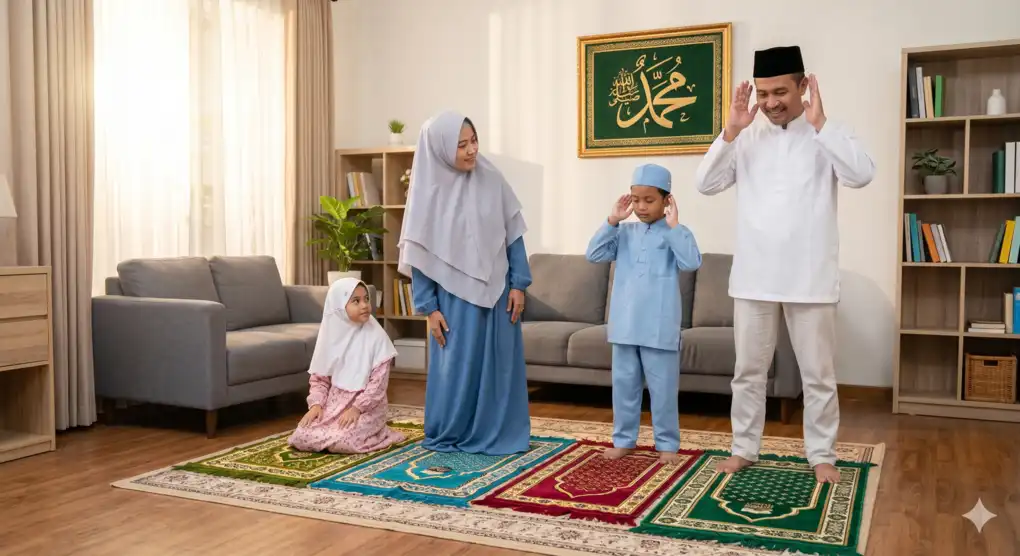
Many Muslim parents often wonder: what is the ruling on prayer for children who have not yet reached puberty? In Islamic jurisprudence (fiqh) literature, a young child fundamentally has no obligation to establish the obligatory (fardhu) prayers. This is because they have not yet entered the legal phase of taklif—the burden of sharia obligations that fully applies only to adults.
This obligation of worship is closely related to the prerequisite conditions for prayer established by the scholars. One of the main conditions is that the individual must be a Muslim who is mature (baligh), sane, and free from ritual impurity (hadas). Sheikh Zakariyya al-Anshari in his book affirms the boundaries of this ruling very clearly:
قوله: (وتجب على كل بالغ عاقل) ذكرا أو أنثى أو خنثى (طاهر) بخلاف الصبي والمجنون لعدم تكليفهما
Meaning: “(And prayer is obligatory upon every mature and sane person,) whether male, female, or khunsa, (who is in a state of purity). This is unlike the child (ash-shabi) and the insane, due to the absence of taklif (legal obligation) upon them.” [1]
Therefore, the status of a young child’s prayer is not an individual obligatory duty. The burden of sin for abandoning the prayer will not be recorded for those who biologically and legally have not reached the age of puberty. To understand when a child becomes legally responsible (mukallaf), you can read the study on the signs of a child reaching puberty.
Who Bears the Responsibility of Commanding Prayer?
Although the child does not bear the burden of obligation, the command to instruct the child to pray becomes an absolute obligation for the adults who care for them. Islamic sharia places the heavy responsibility of this worship education upon the shoulders of both parents, namely the father and the mother.
If the parents are unavailable or absent, the obligation to ensure the child is commanded to pray shifts entirely to their guardian or caretaker. This caretaker can be appointed by a religious court decree (judge) or someone who legally receives the bequest. The following is the legal determination as written in the reference text:
قوله: (ولا صلاة على صبي) لما مر (وعلى أبويه) أي كل منهما وإن علا (أو القيم) من جهة الحاكم أو الوصي (أمره بها)
Meaning: “(And there is no obligation of prayer upon a child) for the reasons previously mentioned. (And it is obligatory upon both parents), meaning each of them and their ascendants, (or a guardian) appointed by a judge or through a bequest (to command them to pray).” [2]
This sharia command must not stop as a mere recommendation; it must be accompanied by educational supervision. This is emphasized so that the child becomes accustomed to disciplining themselves in practicing the pillars of Islam from an early age before they eventually bear their own obligations.
Who Receives the Reward for the Prayer of a Pre-Pubescent Child?
The next fundamental question that often arises is: for whom is the reward of the prayer of that pre-pubescent child? In the view of Shafi’i scholars, every act of worship performed by a young child who understands worship (mumayyiz) will still be recorded by Allah ﷻ as a good deed.
The following is the breakdown of the reward distribution agreed upon by jurists:
- For the Child: They will receive the reward of a voluntary act (sunnah/nawafil) for every movement, recitation, and intention of worship they perform with valid conditions.
- For the Parents/Guardians: They receive a great reward from Allah ﷻ for their patience and effort in educating, directing, and guiding the child towards obedience.
Thus, the routine of teaching a child to pray is not a meaningless worldly activity, but an investment of perpetual charity (amal jariyah) whose rewards will continue to flow abundantly for the parents, even after they have passed away.
Age Stages for Commanding Children to Pray

According to the sunnah, the command to pray is recommended to begin verbally and gently when the child completes exactly seven years of age.
Hadith Regarding the Command of Prayer for Children
Many parents frequently ask when a child should be ordered to pray so that it aligns with the sharia taught by the Prophet Muhammad ﷺ. The determination of this age is not based on mere estimates but refers to very clear evidence from the words of the Prophet ﷺ. In jurisprudential studies, this hadith regarding children’s prayer serves as the primary foundation for parents in designing a child’s spiritual upbringing.
Sheikh Zakariyya al-Anshari in the book Asna al-Mathalib lists this evidence in detail:
لخبر أبي داود بإسناد حسن «مروا أولادكم بالصلاة وهم أبناء سبع واضربوهم عليها وهم أبناء عشر وفرقوا بينهم في المضاجع» ورواه الحاكم وصححه وكذا الترمذي
Meaning: “Based on the hadith narrated by Abu Dawud with a hasan chain: ‘Command your children to pray when they are seven years old, and discipline (hit) them for it when they are ten years old, and separate them in their beds.’ This hadith is also narrated by Al-Hakim, who graded it sahih, as did At-Tirmidzi.” [3]
This hadith, which is often equated in status as an authentic (sahih) hadith narrated by Abu Dawud and Al-Hakim, provides a gradual guideline. The first phase is the introduction and habituation phase through verbal commands starting at the age of seven.
The Condition of Seven Complete Years
In fiqh, the concept that a young child begins to be commanded to pray from the age of seven has a specific calculation. The meaning of “seven years” here is not when the child has just reached their seventh birthday, but after they have completed that age entirely.
This is explained straightforwardly in the text:
قوله: (لسبع) من السنين أي بعد تمامها
Meaning: “(At the age of seven) years, meaning after its completion.” [4]
In other words, this command becomes obligatory upon parents when the child has fully passed the age of 7 Hijri years and has stepped into their eighth year. This calculation uses the Lunar (Qamariyah/Hijri) calendar, so parents must be meticulous in noting the child’s date of birth based on the Islamic calendar. You can also study the origins of the Islamic calendar to understand its history.
The Importance of the Tamyiz Condition Before Commanding Children to Pray




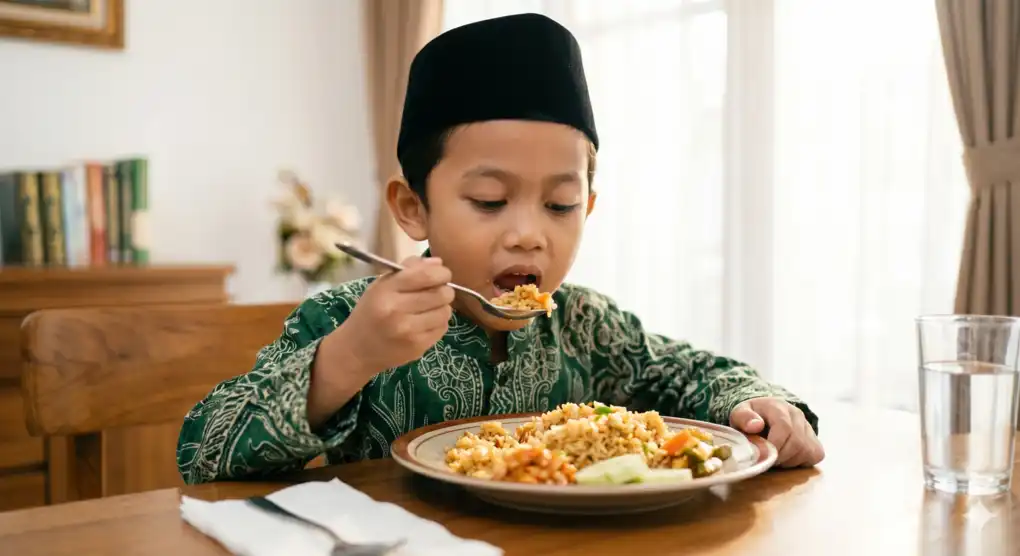
The ability to eat, drink, and clean oneself (istinja’) independently is the main indicator that a child has reached the age of mumayyiz.
However, it should be noted that the age of seven is not the sole absolute benchmark. A young child is commanded to pray only if they meet the conditions of being mumayyiz (having reached the age of discernment, or tamyiz). If at the age of seven the child is not yet mumayyiz, then parents are not yet obliged to command them to pray.
So, what are the indicators that a child is already mumayyiz? The book Asna al-Mathalib provides a very practical definition of tamyiz:
ومحل أمره به وبالصلاة (إن ميز) بأن انفرد بالأكل والشرب والاستنجاء
Meaning: “And the context of the command to him for fasting and prayer is (if he has reached tamyiz), namely by being independent in eating, drinking, and performing istinja’.” [5]
Therefore, there are three conditions of a child’s independence to be considered as having reached the tamyiz phase:
- Able to eat independently without needing to be constantly fed.
- Able to drink properly on their own.
- Able to perform istinja’ (cleaning oneself) independently and correctly after relieving themselves.
In understanding the detailed guide to prayer in the Shafi’i school, the ability to perform istinja’ is extremely crucial because it relates directly to the validity conditions of prayer, namely being pure from ritual impurity (najis). If a child cannot yet clean their own impurities, automatically they are not ready to be fully taught the prayer because they cannot adequately fulfill its pillars and validity conditions.
The Age Limit for Disciplining Children for Abandoning Prayer

At the age of 10, parents are permitted to apply educational sanctions if a child deliberately abandons the obligatory prayer.
At What Age Are Children Commanded to Pray with Firmness?
Many laypeople wonder: at what age is a young child commanded to pray with firmness in the form of physical sanctions? The Shafi’i school of fiqh stipulates that the permissible limit for hitting a child for abandoning an obligatory act of worship is when they have completely reached the age of 10.
Therefore, commanding a ten-year-old child to pray carries much firmer legal consequences than simply commanding a seven-year-old. Sheikh Zakariyya al-Anshari details the provisions very specifically:
قوله: (و) عليهم (ضربه عليهما لعشر) كذلك لخبر أبي داود بإسناد حسن «مروا أولادكم بالصلاة وهم أبناء سبع واضربوهم عليها وهم أبناء عشر وفرقوا بينهم في المضاجع»
Meaning: “(And it is obligatory) upon them (parents) to hit the child for abandoning both (prayer and fasting) at the age of ten, as based on the hadith narrated by Abu Dawud with a hasan chain: ‘Command your children to pray at the age of 7, discipline them (by hitting) at the age of 10, and separate their beds.'” [6]
Scholars within this school also explain two reasons why punishment may only be administered within this age range. First, ten years of age is the estimated period when a child approaches the threshold of puberty (ihtilam). Second, at this age, a child’s physique is considered to have the endurance and ability to tolerate the physical sanctions given.
Permissibility of Earlier Discipline (Mid-Tenth Year)
We know that the command to pray for a 7-year-old child is only in the form of verbal instruction and habituation. But what if a child is highly disobedient before they reach exactly ten years of age?
Shafi’i fiqh provides an educational concession if it is genuinely necessary to discipline the child. Light physical punishment is permitted when the child is in the middle of their tenth year, which means they have just completed nine years of age. This provision is inscribed in the text of Asna al-Mathalib:
قوله: (وكذا) يضرب (في أثناء العاشرة) ولو عقب استكمال التسع
Meaning: “(And similarly) a child may be hit (in the middle of their tenth year), even if immediately following the completion of their ninth year.” [7]
This flexibility regarding the timeframe demonstrates how comprehensive Islamic sharia is in responding to the varying psychological developments and biological readiness of different children.
Conditions and Meaning of “Hitting” in Educational Fiqh
One thing that must be understood very carefully by every educator is that this sharia permission is purely for an educational strike. The strike is by no means a legalization of venting emotions, anger, or domestic violence.
To remain within the corridors of sharia, these physical sanctions come with very strict conditions:
- The strike must not fatally hurt, injure, or leave physical marks or bruises on the child’s body.
- Parents are strictly forbidden from hitting the facial area or vital organs.
- The sanction must be directed at safe areas that are not dangerous to their bodily organs.
Furthermore, this hadith and the fiqh commentary also affirm another vital instruction: the necessity of separating the children’s beds. Separating beds aims to maintain manners (adab), preserve the boundaries of nakedness (aurah), and prevent potential indecency as they age toward puberty.
Does the Punishment Also Apply to Abandoning Missed (Qadha) Prayers?
One sub-issue that frequently arises from readers is: if a 10-year-old child deliberately abandons a prayer until its time expires, are parents obliged to order the child to perform the makeup (qadha) prayer and sanction them for it? The answer is yes, it is obligatory.
The majority of scholars affirm that parents remain obligated to command the child to make up their prayer and to discipline them if they refuse, exactly like the treatment for prayers performed on time (ada’). Sheikh Zakariyya al-Anshari presents the strongest opinion (aujah) regarding this issue:
قوله: (وهل يضرب على القضاء) ويؤمر به … (وجهان) أوجههما ما اقتضاه كلامهم أنه يضرب ويؤمر به كما في الأداء
Meaning: “(And is a child hit for abandoning a qadha prayer) and commanded to perform it? … There are two opinions. The strongest opinion based on the statements of the scholars is that they are still hit and commanded to perform it just as in the ada’ (on-time) prayer.” [8]
This obligatory status of the guardian will continuously apply until the age of puberty arrives. It is different when a child has reached adulthood, as in the case of the obligation of prayer upon reaching puberty, where the entirety of sharia obligations along with the burden of sin shifts totally to the child’s shoulders without involving any sin for their parents anymore.
The Obligation to Teach Islamic Rulings Beyond Prayer
Analogizing the Command to Fast with the Command to Pray for Children
In the Shafi’i fiqh literature, the age limits of 7 and 10 do not apply exclusively to the obligatory prayers. Sharia establishes that the command of prayer for children also serves as a standard metric for commanding the fulfillment of other pillars of Islam that rely on physical capability.
Scholars use the method of analogy (qiyas) for Ramadan fasting to apply these age stage rules to the act of fasting. Sheikh Zakariyya al-Anshari in Asna al-Mathalib explicitly explains the addition of this obligation:
قوله: (وكذا) عليهم أمره (بالصوم) … وقيس بالصلاة الصوم
Meaning: “(And similarly) it is obligatory upon them (parents/guardians) to command them (with the act of fasting) … And the act of fasting is analogized (its ruling equated) with the act of prayer.” [9]
This means that if a child has completed seven years of age and is tamyiz (capable of being independent), parents are obliged to command them to practice fasting. If they abandon fasting upon reaching 10 years of age despite being physically capable, parents are permitted to discipline them with an educational intent, exactly like the ruling for abandoning prayer.
Responsibility to Teach Sharia, Adab, and Prevent the Prohibited
Many people ask why it is recommended for children to study prayer comprehensively from an early age. The answer is that prayer is the gateway to overall obedience to the sharia. It is not enough for parents to merely ensure their children pray diligently; they are also obligated to instill an understanding of other sharia principles since the tamyiz phase.
This educational responsibility includes the obligation to teach basic fiqh such as correct ablution (wudhu), good manners (adab), and shielding them from sinful acts by preventing the prohibited (haram). This provision is clearly recorded in our primary reference text:
قوله: (وعليهم نهيه عن المحرمات وتعليمه الواجبات و) سائر (الشرائع) كالسواك وحضور الجماعات
Meaning: “(And it is obligatory upon them to prevent the child from prohibited things and to teach them the obligations and) all (sharia rulings) such as using the siwak and attending congregational prayers.” [10]
Furthermore, Sheikh Zakariyya al-Anshari notes that this education extends to the necessity of teaching the child to read the Quran and instilling noble character. This uninterrupted process becomes the primary parenting duty until the child reaches puberty with complete intellectual sanity.
Who Bears the Financial Cost of a Child’s Fiqh Education?
The process of educating a child to understand religion often requires third-party assistance, such as enrolling them in a madrasa, an Islamic boarding school (pesantren), or hiring a Quran teacher. Then, who is legally responsible according to sharia for bearing the cost of this child’s fiqh and Quranic education?
Shafi’i fiqh organizes the order of this financial responsibility very fairly and systematically:
قوله: (والأجرة) أي أجرة تعليمه الواجبات (من ماله ثم) إن لم يكن له مال فتجب (على الأب) وإن علا (ثم) على (الأم) وإن علت (و) يخرج (من ماله) أيضا (تعليم) أي أجرة تعليم (القرآن والآداب)
Meaning: “(And the wages) namely the wages for teaching them obligations (are taken from the child’s own wealth, then) if they have no wealth, it becomes obligatory (upon the father) and grandfathers ascending, (then) upon (the mother) and grandmothers ascending. (And) it is also deducted (from the child’s wealth) for education, meaning the wages for teaching (the Quran and adab).” [11]
Based on the textbook explanation above, the order of financial responsibility is as follows:
- The Child’s Wealth: If the child possesses personal wealth (for instance, from an inheritance, grant, or gift), then their educational expenses are taken from that wealth.
- The Father’s/Grandfather’s Wealth: If the child has no wealth, the absolute obligation for funding falls to their biological father, proceeding to the paternal grandfather if the father is unable.
- The Mother’s Wealth: If the father and grandfather are absent or financially incapable, then the obligation shifts to the biological mother.
This priority order of funding affirms that Islamic sharia takes the continuation of a child’s religious and worship education very seriously, preventing it from being neglected merely due to a lack of funds.
FAQs Regarding the Ruling of Prayer for Children
Are parents sinful if they let a child skip prayer before the age of 10?
Many people are still confused about whether parents bear sins if a child does not pray between the ages of 7 and just before 10. The answer is yes; parents are sinful if they do not verbally command them. Regarding the question of whether a young child is allowed to skip prayer, the sharia considers the child free of sin because they have not reached puberty, but the burden of the command (amr) falls absolutely upon their parents. Here are the ruling details from the perspective of the Shafi’iyyah scholars that must be noted:
- If a child has completed 7 years of age and meets the mumayyiz condition for prayer, the parents or guardians will bear the parents’ sin if they remain silent when the child abandons the prayer.
- However, parents are prohibited from hitting or administering physical sanctions before the child completes 10 years of age (or in the middle of their 10th year for strict education).
- The phase between the ages of 7 and 9 is purely a period of habituation and verbal education in Islamic religious training. The stipulation of this parental obligation is clearly summarized from the fiqh text:
قوله: (وأطاق) فعلهما (لسبع) من السنين أي بعد تمامها (و) عليهم (ضربه عليهما لعشر)
Meaning: “(And they are capable) of performing both (prayer and fasting) at the age of seven years, meaning after its completion. (And) it is obligatory upon them (parents) to hit them for (abandoning) both at the age of ten.” [12]
Is a 7-year-old child who cannot perform istinja’ independently obligated to be commanded to pray?
The short answer is: they are not obligated to be commanded to pray. Parents often mistakenly interpret when a child should pray based solely on physical age. Fiqh determines that a child must not only have completed seven years of age, but they must also absolutely be mumayyiz. In fiqh, a young child is considered mumayyiz if they possess the following three criteria of independence:
- Able to eat by themselves without needing to be continuously fed.
- Able to drink by themselves.
- Able to perform istinja’ (cleaning oneself) independently correctly and become pure from ritual impurities (najis).
These three absolute conditions are firmly explained by Sheikh Zakariyya al-Anshari:
ومحل أمره به وبالصلاة (إن ميز) بأن انفرد بالأكل والشرب والاستنجاء
Meaning: “And the context of the command to him for fasting and prayer is (if he has reached tamyiz), namely by being independent in eating, drinking, and performing istinja’.” [13]
Based on this evidence, if your child is not yet able to correctly clean themselves from impurities when relieving themselves, parents are not yet obliged to command them to perform prayers. This is because the pillar of purification (thaharah) cannot yet be fulfilled.
Does this obligation to educate and command prayer drop once the child reaches puberty?
Regarding the confusion about whether a young child is obligated to pray as they enter adolescence, the answer becomes an absolute obligation upon the child themselves after they reach puberty. Simultaneous with the arrival of puberty (baligh) and possessing sanity, the entire obligation of the fardhu prayer transfers entirely to their own shoulders. At this point, the obligation of the parents/guardians to command and punish in the manner of raising children is considered lifted. Sheikh Zakariyya al-Anshari provides boundaries regarding the end of this coercive educational authority:
وقضية ما ذكر انتفاء ذلك بالبلوغ وهو كذلك إذا بلغ رشيدا
Meaning: “And the consequence of what has been mentioned (regarding the command to pray and its punishment) is its removal with the (arrival of) puberty, and so it is if they reach puberty in a state of sanity/rationality.” [14]
After this period, the burden of sin for abandoning prayer is no longer delegated to the parents but is fully borne by the child who now holds the status of mukallaf (burdened by sharia). Nevertheless, parents remain obliged to offer advice within the capacity of enjoining good and forbidding evil (amar ma’ruf nahi mungkar) just as they would to fellow Muslim brothers and sisters.
Bringing Children to Pray at the Mosque: Between Recommendation and Adab
The Command to Teach Children to Attend Congregational Prayers (Hudur al-Jama’at)
Accustoming young children to pray at the mosque is a highly recommended educational step in Islamic teachings. Scholars of the Shafi’i school emphasize that parents should not solely focus on the child’s individual worship but are also obligated to teach the validity conditions of congregation and other supplementary rulings to children who have reached the age of tamyiz. This includes efforts to train them to be accustomed to attending congregational prayers (hudur al-jama’at).
Sheikh Zakariyya al-Anshari in the book Asna al-Mathalib explicitly details the scope of this educational obligation:
قوله: (وعليهم نهيه عن المحرمات وتعليمه الواجبات و) سائر (الشرائع) كالسواك وحضور الجماعات
Meaning: “(And it is obligatory upon them [parents] to prevent the child from prohibited things and to teach them the obligations and) all (sharia rulings) such as using the siwak and attending congregational prayers.” [15]
Taking children to the mosque environment also becomes a golden opportunity to instill mosque manners (adab) from an early age. Parents can directly provide an example and teach practical fiqh, such as whether it is permissible to pray upon entering the mosque (tahiyatul masjid) when arriving during specific disliked (makruh) times, thereby accustoming the child to the discipline of sharia knowledge.
Ruling on Children Praying in the Front Row
When accompanying children to the mosque, Muslims are often faced with a dilemma regarding the position of young children praying in the front row. In the hierarchy and perfection of row (shaf) arrangements in Islamic fiqh, the most ideal (afdhal) formation is placing the row of adult men at the very front, followed by the row of young boys behind them, and the women’s row at the very back. This rule is legislated to maintain the order and reverence (khusyu’) of the congregation.
However, what if a mumayyiz child (who understands worship procedures and is pure from impurities) arrives early at the mosque and has filled the first row? The majority of Shafi’iyyah scholars advise that they should not be expelled or forcibly pulled back. Forcibly driving a child away to tighten the prayer row for adults who arrive late has a high potential to psychologically hurt the child and cause trauma, making them reluctant to return to the mosque.
The wisest fiqh and educational approach is to leave the mumayyiz child in their position because they hold the right to the space they reached first. An exception applies only if the child is exactly behind the imam (the position of the imam’s substitute), where an adult may shift them slightly in a very gentle and affectionate manner.
Solutions if Children Are Noisy and Disruptive During Prayer
The most difficult challenge that frequently triggers debate in society is when young children disrupt the congregational prayer with loud noises or running around. The ruling of young children praying in the mosque is fundamentally permissible (mubah) and even holds a recommended (sunnah) value as an avenue for worship education. However, this status is bound by the absolute condition that their presence must not cause discord (fitnah) or ruin the reverence of the congregants’ prayers.
Parents must understand the different treatments based on the age of the child they bring:
- Toddlers (Non-Tamyiz Children): Babies or toddlers who are not yet tamyiz often cry uncontrollably as they cannot comprehend commands. If parents must bring them, they should position themselves at the edge of the row (near the door/wall). The goal is to easily soothe them or take them out of the main hall without splitting or disrupting the rows of other congregants.
- Children Aged 7 and Above (Already Tamyiz): A child in the age phase of being commanded to pray should be able to communicate. Parents are obligated to issue firm warnings before leaving home to ensure the child behaves properly.
If a child proves to be highly hyperactive, continuously screaming, and potentially invalidating or ruining the concentration of many people, then the sharia prioritizes the general public interest. Parents are advised to temporarily refrain from bringing that child to general congregational prayers at the mosque, while continuously educating them at home until they are ready and cooperative.
FAQs: Popular Questions About Children’s Worship
Is the Friday prayer obligatory for young children?
According to fiqh, is Friday prayer obligatory for children? The answer is it is not obligatory because one of the prerequisite conditions for obligatory prayers is to be mature (baligh) and sane. However, if the child (who is mumayyiz) participates in it and listens to the pillars of the sermon (khutbah), here is the detailed ruling:
- The Friday prayer they perform is considered valid, and they receive the reward.
- If they suddenly reach puberty during that prayer (or after it), that prayer is considered sufficient, and their obligation for the Friday or Zuhr prayer is discharged. This determination is based on the explanation of Sheikh Zakariyya al-Anshari:
قوله: (وإن صلى) صبي وظيفة الوقت (ثم بلغ) أجزأته صلاته ولو عن الجمعة
Meaning: “(And if) a young child (has performed the obligatory) prayer in its time (then they reach puberty), then their prayer is sufficient for them, even if it is the Friday prayer.” [16] This is also in line with the ijtihad regarding prayer times, including whether it is permissible to perform Friday prayer right at the zenith (istiwa) on Friday.
Can young children perform voluntary prayers such as Repentance (Taubah) or Night (Tahajjud) Prayers?
Many are curious whether young children can perform the repentance prayer or night prayers. The answer is it is highly permissible and considered valid in sharia if the child has reached the age of tamyiz. Here is the legal guideline regarding children’s voluntary prayers:
- All obligatory acts of worship (such as Zuhr, Asr, etc.) performed by a pre-pubescent child hold the status of a voluntary (nafilah/sunnah) prayer for them in the sight of Allah ﷻ.
- Because even obligatory prayers hold a sunnah status for them, performing acts of worship that are originally sunnah (such as Taubah or Dhuha prayers) is certainly highly recommended as an accustoming process.
What is the ruling if an undiscerning child suddenly crosses in front of someone praying?
Incidents often occur in the mosque where a young child crosses in front of someone praying. Islamic sharia has anticipated this by recommending the use of a prayer barrier (sutrah) when establishing worship. Sheikh Zakariyya al-Anshari emphasizes the importance of a sutrah as a condition for perfection:
والقياس اعتبار وقت الستر والتحري في القبلة لأنهما من شروط الصلاة
Meaning: “And qiyas establishes the necessity of considering the time for finding a cover (sutrah/aurah) and striving to find the Qibla, as both are among the conditions of prayer.” [17] If a toddler (not yet mumayyiz) runs across, the congregant is recommended to gently block them with their hand. This action of slowly restraining the child will not invalidate the prayer as long as it is not accompanied by major consecutive movements more than three times.
If a young child prays in a sitting position despite being physically able to stand, is it valid?
Sometimes young children feel lazy and perform the obligatory prayer while sitting, even though physically they are perfectly capable of standing upright. According to the stronger view of scholars (aujah), that child’s obligatory prayer is declared invalid. The book Asna al-Mathalib emphasizes that even though the status of the worship is voluntary for them, the pillars of prayer must still be performed correctly just like adults:
وإنها لا تصح منه قاعدا وإن كانت نفلا في حقه
Meaning: “And indeed the (obligatory) prayer is not valid from them (a young child) if performed while sitting, even if that prayer (holds the status of) a sunnah/nafilah by right.” [18] Therefore, parents remain obligated to teach them to establish the prayer perfectly while standing, and are permitted to discipline them (for educational purposes) if the child is exactly 10 years old and refuses to pray correctly.
Conclusion and Educational Media for Children’s Prayer
Demonstrating How Young Children Pray Directly
Aside from routinely issuing verbal commands when children turn seven, parental obligations also cover the practical aspect of worship. Fathers and mothers must teach the correct way for young children to pray early on so that children have both a visual and motoric understanding.
This practical education involves direct guidance on the movements of a young child’s prayer so that they comply with the pillars and valid conditions of fiqh. Parents need to supervise how children perform bowing (ruku’), prostrating (sujud), up to ensuring they understand what tuma’ninah (pausing briefly in a movement) is. Habituation to these precise movements is vital to be done long before they reach the age limit of ten, where educational sanctions begin to apply.
The Use of Learning Media and Pictures of Children Praying
In the modern era, to facilitate the child’s comprehension process, parents are highly encouraged to use various engaging educational tools. Showing illustrations of young children praying in Islamic storybooks or playing ablution (wudhu) tutorial videos is a step-by-step method proven to be effective.
However, among all these media, the most prominent and irreplaceable is providing a direct exemplary model (uswah hasanah). Children are excellent imitators; inviting them to stand together on the prayer mat or in the mosque rows every time the obligatory time arrives will leave a profound spiritual imprint on their hearts.
Do These Disciplinary Rules Apply Equally to Girls?
A question may arise in the minds of some parents: do the command to pray at 7 and the strictness of hitting at 10 apply only to boys? The Shafi’i school of fiqh asserts that this ruling is absolute for both genders without exception.
Sheikh Zakariyya al-Anshari explains the basis of this early taklif equality with a very concise sentence but holding a firm legal implication:
والصبية كالصبي فيما ذكر كما صرح به الأصل
Meaning: “And the young girl (holds the same ruling) as the young boy in the matters mentioned (regarding commands, punishments, and teaching obligations), as has been explicitly stated in its source book (Ar-Raudhah).” [19]
Therefore, there must be no discrimination or negligence of treatment between sons and daughters within the household. Both must be educated, directed, and supervised in their worship obedience equally so that later they may both become a subsequent generation steadfast in practicing the sharia.
Footnotes
Reference
Zakariyā al-Anṣārī, Asnā al-Maṭālib fī Sharḥ Rawḍ al-Ṭālib, with annotations by Aḥmad al-Ramlī, edited by Muḥammad az-Zuhrī al-Ghamrāwī (Cairo: al-Maṭbaʿah al-Maymānīyah, 1313 H; repr. Dār al-Kitāb al-Islāmī), vol. 1, pp. 121-123.


