
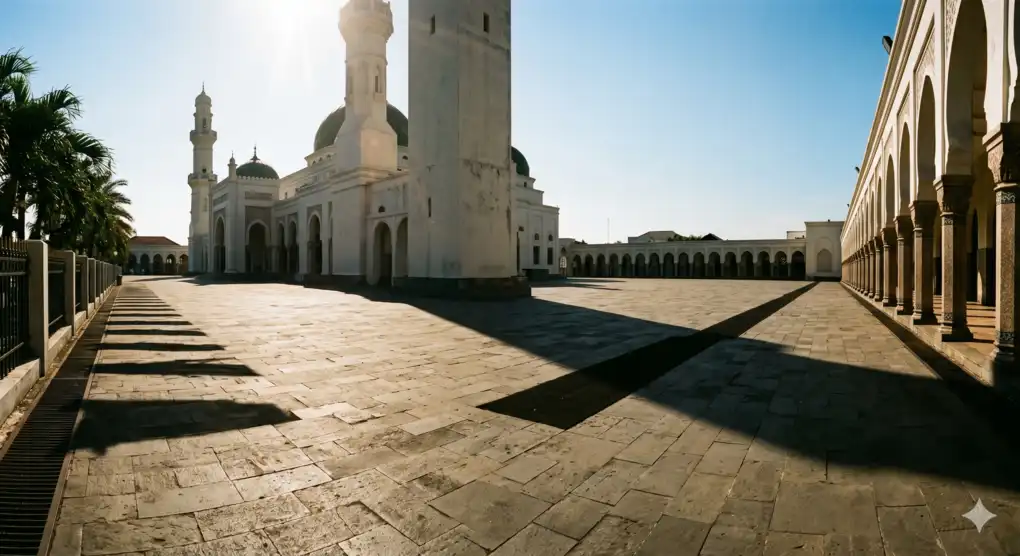
In tropical regions like Indonesia, daytime temperatures can be scorching—precisely during Dhuhr time. Walking from home to the mosque under the blazing sun can cause physical exhaustion, heavy sweating, and difficulty focusing once in the prayer row (saf).
Under these conditions, is it better to pray immediately or wait a moment for the heat to subside?
The Shafi’i school of fiqh offers a detailed answer to this question, and the answer is more nuanced than many might expect. This article explains the ruling on ibrad (إبراد)—delaying the Dhuhr prayer during extreme heat—based on the book Asna al-Mathalib by Sheikh Zakariyya al-Anshari.
Before reading further, it is highly recommended to study the complete guide to obligatory prayers.
What is Ibrad?
Linguistically, ibrad means waiting until the air cools down. In fiqh terminology, ibrad is the act of delaying the Dhuhr prayer from its initial time until the sun’s heat slightly subsides—marked by the lengthening of shadows cast by walls so that someone walking to the mosque can walk in their shade.[1]
This is an exception to the general principle that praying at the beginning of its time is the most virtuous. However, this exception is not arbitrary—it comes with very strict conditions.
Legal Basis: Hadith from the Sahihayn
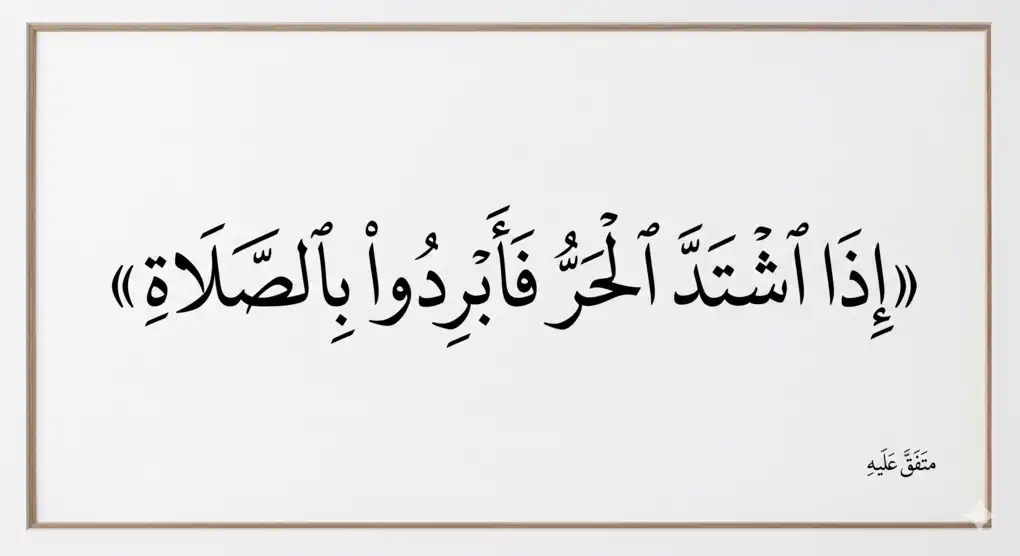
“If the heat is severe, delay the prayer” — the authentic hadith that forms the legal foundation of ibrad.
The legal basis for ibrad is a hadith documented in Asna al-Mathalib:
«إِذَا اشْتَدَّ الْحَرُّ فَأَبْرِدُوا بِالصَّلَاةِ»
“If the heat is severe, delay the prayer (until it cools).” — Narrated by the Sahihayn (Bukhari and Muslim).[2]
In another more specific narration recorded in Sahih Bukhari:
وفي رواية للبخاري: بالظهر فإن شدة الحر من فيح جهنم
“Delay the Dhuhr (prayer) (until it cools), for the severity of the heat is from the breath of Hellfire.”[3]
The Ruling on Ibrad: Sunnah, Not Just Permissible
Asna al-Mathalib asserts that ibrad under the right conditions is not merely permissible—it is recommended (sunnah):
«وَيُسْتَحَبُّ فِي شِدَّةِ حَرٍّ بِقُطْرٍ حَارٍّ إِبْرَادٌ بِظُهْرٍ»
“It is recommended to perform ibrad (delaying the Dhuhr prayer) during severe heat in a hot-climate region.”[4]
The word yustahabb (recommended/sunnah) here is crucial. This means performing ibrad under the qualifying conditions earns reward and is not merely a rukhshah (concession).
Mandatory Conditions for Ibrad

Ibrad is only valid if all four of these conditions are met—if a single condition is missing, ibrad is not recommended.
This is where Asna al-Mathalib is highly detailed. Ibrad does not apply automatically just because the weather is hot. Several conditions must be met simultaneously.
Condition 1: The Heat Must Be Truly Severe
Ibrad only applies during شِدَّة الحَرّ (syiddah al-harr)—heat that is genuinely scorching. It does not apply to merely “rather hot” weather or heat that is still tolerable.
Consequently: Ibrad is not recommended during hot but non-extreme weather—even if the region has a generally hot climate.[5]
Condition 2: Hot-Climate Regions (Not Cold or Temperate Areas)
Asna al-Mathalib affirms:
“It is not recommended to perform ibrad in regions with cold or temperate climates, even if severe heat happens to occur at the time.”[6]
This is an often-overlooked condition. Ibrad is not universally applicable—it is specific to areas that inherently have a hot climate.
Condition 3: A Congregation Walking from Afar Without Shade




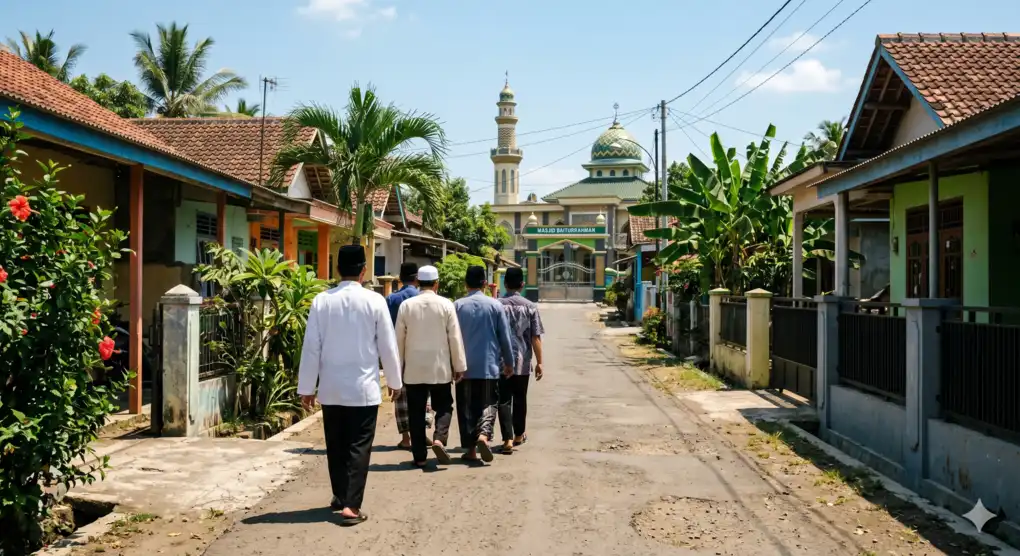
This is the most crucial condition. Asna al-Mathalib specifies ibrad for:
«لِجَمَاعَةٍ تَقْصُدُ الْمَسْجِدَ أَوْ نَحْوَهُ مِنْ بَعْدٍ فِي غَيْرِ ظِلٍّ»
“A congregation intending to go to the mosque or similar places from a distance without shade.”[7]
The measure of “distance” here is not an exact numerical value, but rather a distance that causes one’s khushu’ (concentration/reverence) or its perfection to be lost due to exhaustion and heat during the journey.[8]
Condition 4: The Final Limit of Ibrad — Shadows Lengthening
The delay cannot be arbitrary. The final limit is:
«حَتَّى يَمْتَدَّ ظِلُّ الْحِيطَانِ بِحَيْثُ يَمْشِي فِيهِ طَالِبُ الْجَمَاعَةِ»
“Until the shadows of walls lengthen to the extent that one seeking the congregation can walk within them.”[9]
This is a very practical, natural indicator: simply wait until the wall shadows along the path have lengthened enough to provide shade. Additionally, there is an extra time constraint:
“It is not permissible to delay (ibrad) beyond half the time (of Dhuhr), because that would mean the majority of the time has already passed.”[10]
Who is NOT Entitled to Ibrad?
Asna al-Mathalib explicitly outlines the parties for whom ibrad is not recommended:
ولا لمن يصلي منفردا أو جماعة ببيته أو بمحل حضره جماعة لا يأتيهم غيرهم أو يأتيهم غيرهم من قرب أو من بعد لكن يجد ظلا يمشي فيه إذ ليس في ذلك كبير مشقة وقضية كلامه أنه لا يسن الإبراد لمنفرد يريد الصلاة في المسجد وفي كلام الرافعي إشعار بسنه وهو الأوجه نبه عليه الإسنوي.
- Individuals praying alone (munfarid) — because there is no exhausting journey.
- A congregation praying in their own home — because there is no travel difficulty.
- A congregation already present at the location with no others expected from outside — because there is no hardship.
- A congregation arriving from nearby — because a short journey does not consume energy.
- A congregation arriving from afar but with shade along the way — because there is no significant masyaqqah (hardship).[11]
As for an individual praying alone but intending to pray at the mosque, there is an opinion from Imam al-Rafi’i indicating that ibrad remains recommended for them. Sheikh al-Isnawi considers this opinion more accurate (awjah).[12]
Why is Ibrad Recommended? The Principle Behind It
Asna al-Mathalib explains the fundamental reason behind the ruling of ibrad very clearly:
«أَنَّ فِي التَّعْجِيلِ فِي شِدَّةِ الْحَرِّ مَشَقَّةً تَسْلُبُ الْخُشُوعَ أَوْ كَمَالَهُ فَسُنَّ لَهُ التَّأْخِيرُ»
“Hastening the prayer during extreme heat causes hardship that strips away khushu’ or its perfection—thus, delaying it is recommended.”[13]
This is the grand principle forming the foundation of the entire discussion on ibrad: reverence (khushu’) in prayer is the primary priority. When hastening the prayer actually destroys khushu’ due to severe hardship, the Sharia provides a solution.
The book even employs a very concrete analogy:
«كَمَنْ حَضَرَهُ طَعَامٌ يَتُوقُ إِلَيْهِ أَوْ دَافَعَهُ الْخَبَثُ»
“(Like) someone who has food presented before them and desires it, or someone resisting the urge to relieve themselves.”[14]
A person attempting to pray in a state of extreme hunger or urgently needing the restroom will not be able to achieve khushu’. The same logic applies to someone who has just finished walking under a scorching sun.
One Important Exception: Ibrad Does Not Apply to Friday Prayers
Asna al-Mathalib firmly asserts:
«لَا بِالْجُمُعَةِ»
“Not (recommended to perform ibrad) for Friday prayers.”[15]
The reasons being:
- The Hadith from the Sahihayn by Salamah: “We used to perform Friday prayers with the Messenger of Allah ﷺ when the sun had passed its zenith (exactly at the beginning of its time).”
- Risk of Missing the Prayer: There is a significant risk of missing the Friday prayer if a habit of delaying leads to negligence.
- Command to Arrive Early: Worshippers are already commanded to come early (tabkir) to the mosque for Friday prayers, meaning they would not be severely impacted by midday heat.[16]
Other Conditions Where Delaying Prayer is Recommended
Beyond ibrad for Dhuhr during severe heat, Asna al-Mathalib lists other scenarios where delaying the prayer from its initial time is actually preferred:
ويستثنى من ندب التعجيل أيضا أشياء منها أنه يندب التأخير لمن يرمي الجمار ولمسافر سائر وقت الأولى وللواقف بعرفة فيؤخر المغرب وإن كان نازلا وقتها ليجمعها مع العشاء بمزدلفة ولمن تيقن وجود الماء أو السترة أو الجماعة أو القدرة على القيام آخر الوقت ولدائم الحدث إذا رجا الانقطاع آخره ولمن اشتبه عليه الوقت في يوم غيم حتى يتيقنه أو يظن فواته لو أخره
- A person throwing the jamarat during Hajj.
- A traveler on the move during the time of the first prayer (to combine it).
- A person standing (wuquf) in Arafah — delaying Maghrib to combine it with Isha in Muzdalifah.
- A person who is absolutely certain of finding water, a barrier (sutrah), a congregation, or the ability to stand at the end of the prayer time.
- A person suffering from continuous ritual impurity (hadats) who expects their condition to improve toward the end of the time.
- A person unable to ascertain the entry of prayer time on a heavily cloudy day.[17]
Summary of the Ruling on Ibrad
| Condition | Ruling on Ibrad |
| Heat is severely scorching, hot-climate region, congregation walking from afar without shade | Sunnah (Recommended) |
| Heat is not too severe | Not recommended |
| Cold or temperate climate region, even if coincidentally hot | Not recommended |
| Praying alone at home | Not recommended |
| Congregation arriving from nearby or shade is available | Not recommended |
| Friday prayers | Ibrad does not apply |
| Delaying beyond half of the Dhuhr time limit | Not permissible |
Footnotes
FAQ: Questions Regarding Ibrad and Delaying Dhuhr Prayer
1. Does ibrad apply in tropical Indonesia?
In principle, tropical regions fall under the category of hot-climate areas (quthr har). However, ibrad still requires the other conditions to be met: the heat must be truly severe (syiddah al-harr), and there must be a congregation walking from a distance without shade. If all conditions are met, ibrad is recommended.
2. Can I delay Dhuhr simply because of hot weather, even if I pray at home?
It is not recommended. Ibrad is specifically intended for a congregation walking from afar to the mosque without shade. Individuals praying at home or at a location where the congregation is already present do not face travel hardship, so the justification for ibrad is invalid.
3. Until when is it permissible to delay Dhuhr for ibrad?
The final limit of ibrad is when the shadows of walls have lengthened enough for someone walking to the mosque to walk within them. There is also an additional limit: one cannot delay it beyond half of the Dhuhr time, as that would mean the majority of the prayer time has already elapsed.
4. Does ibrad apply to Asr and other prayers?
Based on Asna al-Mathalib, ibrad is explicitly mentioned for the Dhuhr prayer (ibrad bi al-zhuhur). Friday prayers are even explicitly excluded from the ibrad ruling.
5. How does ibrad relate to the virtue of praying at the beginning of its time?
Ibrad is an exception to the general rule that the beginning of the prayer time is the most virtuous (afdhal). This exception stems from a deeper legal maxim: khushu’ (reverence/concentration) in prayer is the ultimate priority. When hastening a prayer destroys khushu’ due to severe physical hardship, the Sharia provides a solution in the form of a recommended delay.
References
Zakariyā al-Anṣārī, Asnā al-Maṭālib fī Sharḥ Rawḍ al-Ṭālib, with footnotes by Aḥmad al-Ramlī, edited by Muḥammad az-Zuhrī al-Ghamrāwī (Cairo: al-Maṭbaʿah al-Maymānīyah, 1313 AH; repr. Dār al-Kitāb al-Islāmī), vol. 1, p. 120.


