

A servant might appear steadfast in establishing prayer with lengthy recitations, generously giving large amounts of charity, and diligently attending religious gatherings every single day. However, this entire accumulation of deeds can instantly shatter and hold absolutely no weight in the sight of Allah ﷻ. This destruction occurs not because the individual violated the pillars or valid conditions of worship according to Islamic jurisprudence, but due to a spiritual disease that is extremely subtle and slips into the deepest recesses of the inner self. The disease that robs the purity of the meaning of intention is called riya.
Imam Ibn ʿAllān al-Ṣiddīqī al-Bakrī al-Shāfiʿī, in his masterpiece Dalīl al-Fāliḥīn li-Ṭuruq Riyāḍ al-Ṣāliḥīn, opens the discussion on sincerity (ikhlas) with a severe warning (takhwif) that must never be ignored by spiritual seekers:
وَفِي الآيَاتِ تَنْبِيهٌ لِلْمُوَفَّقِ عَلَى الْإِخْلَاصِ وَتَحْذِيرٌ لَهُ مِنَ الرِّيَاءِ، وَلَا يَغْتَرَّ بِخَفَائِهِ ظَاهِرًا فَإِنَّ اللهَ تَعَالَى عَالِمٌ بِخَفِيَّاتِ الْأُمُورِ، لَا تَخْفَى عَلَيْهِ وَسَاوِسُ الصُّدُورِ
“In these verses, there is a warning for the one who receives tawfiq to be sincere and a caution for him against riya. Let him not be deceived by its outward concealment, for indeed Allah Ta’ala is Knowing of the most hidden affairs, and the whispers of the chests are not hidden from Him.”1
This article will specifically dissect the essence of riya from four main perspectives: its root meaning linguistically and terminologically, the classification of its types, concrete examples of its application in various acts of worship, and its dangerous consequences for the afterlife of a believer. All foundational arguments in this article are sourced directly from classical literature, primarily the commentary of Riyadh ash-Shalihin. This study is an essential part of the knowledge pillar regarding Intention and Ikhlas in Islam: A Complete Guide from Hadith to Fiqh of Worship.
The Meaning of Riya Linguistically and Terminologically

The Linguistic Meaning of Riya
From an Arabic etymological perspective, the term riya (الرياء) is rooted in the verb raʾā — yarā — ruʾyatan wa riyāʾan (رأى — يرى — رؤية ورياء), which basically means to see or to look. The morphological pattern of the word riyāʾ itself is maṣdar mubālaghah, a noun form describing intensity or an action done deliberately and excessively. Therefore, its meaning is not merely “being seen” by chance, but rather an active effort “striving to be seen.”
This linguistic root transparently exposes the operational mechanism of this disease of the heart. Riya operates absolutely through the manipulation of the human sense of sight. The perpetrator of riya positions the eyes of the humans around them as the “audience” they seek and whose validation they crave.
This concept demands a clear distinction from merely being unable to hide a good deed. If someone worships purely lillahi ta’ala (for Allah Almighty) and coincidentally someone happens to gaze at them, this is not riya. Riya only takes authority when the urge and desire to be looked at is alive, invited, and active within the perpetrator’s inner space.
The Definition of Riya According to Ibn ʿAllān al-Ṣiddīqī
To formulate a precise operational boundary, Ibn ʿAllān provides a sharp and tactical definition of riya while dissecting a hadith regarding intention in warfare:
يُقَاتِلُ رِيَاءً أَيْ لِيُرَى النَّاسُ قِتَالَهُ
“Fighting out of riya, meaning so that people see his fighting.”2
Although this commentary is placed in the context of Abu Musa al-Ash’ari’s hadith regarding the military, the principles derived from it apply universally to all actions. Through this brief definition, there are two fundamental elements that must combine for an action to be judged as riya: first, the al-fāʿil (subject/perpetrator) executes an act of worship; second, behind the performance of that worship resides a strong qaṣd (will) for the masses to see it.
The legal parameter does not require that humans actually succeed in seeing the action at that exact moment; the primary determining factor is the presence of a cunning will in the heart.
Riya as the Perfect Opposite of Ikhlas




To recognize the darkness of riya perfectly, we must view it as the binary opposition to the light of sincerity (ikhlas). To grasp this fully, one should consult What is Ikhlas? Meaning, Levels, and How to Achieve It. Ibn ʿAllān quotes a majestic definition of ikhlas from the words of Imam Abu al-Qasim al-Qushayri:
الإخلاص إفراد الحقّ سبحانه وتعالى في الطاعات بالقصد، وهو أن يريد بطاعته التقرّب إلى الله تعالى دون شيء آخر من تصنّع لمخلوق واكتساب محمدة عند الناس أو محبة مدح من الخلق
“Ikhlas is singling out al-Haqq (Allah) in obedience with intention, which is that one intends by their obedience to draw near (taqarrub) to Allah Ta’ala without it being mixed with anything else: neither pretending before creatures, nor seeking praise in the eyes of people, nor loving flattery from fellow creations.”3
The three negative parameters listed by Imam al-Qushayri as nullifiers of ikhlas above are, in reality, the constituent elements of riya itself:
- Taṣannuʿ li-makhlūq (pretending to be devout before creatures), representing riya in the form of physical action.
- Iktisāb maḥmadah ʿinda al-nās (seeking human praise), representing riya in the form of intellectual motivation.
- Maḥabbat madḥ min al-khalq (addiction to and loving flattery), representing riya in the realm of feeling.
To affirm the differentiation between the two, observe the comparison table below:
| Dimensional Parameter | Characteristics of Ikhlas | Characteristics of Riya |
| Focus of Objective | Singular: Centered only on Allah ﷻ | Dual / Deviant: Centered on creations / non-Allah |
| Origin (Per Ibn ʿAllān) | Sourced from quwwah ʿaqliyyah (strength of a clear conscience/intellect) | Sourced from quwwah ghaḍabiyyah aw shahwāniyyah (the drive of base desires) |
| Afterlife Accountability | Deeds are judged, accepted, and multiplied in reward by Allah | Deeds are voided, rejected, and carry no weight before Allah |
| Direction of Inner Movement | Taqarrub ilallāh (Walking closer to God) | Taqarrub ila al-khalq (Seeking closeness and validation from creations) |
Qur’anic and Hadith Evidences on Riya
Imam al-Nawawi places four holy verses as the opening of the Chapter on Ikhlas in his book. These four words have different nuances of warning—from positive instructions to be sincere, reprimands over the futility of rituals devoid of a spiritual soul, to threats that Allah Ta’ala pierces all veils covering the chest.
Surah al-Bayyinah Verse 5 — The Command for Ikhlas as an Implicit Prohibition of Riya
Allah ﷻ says:
وَمَا أُمِرُوا إِلَّا لِيَعْبُدُوا اللَّهَ مُخْلِصِينَ لَهُ الدِّينَ حُنَفَاءَ
“And they were not commanded except to worship Allah, [being] sincere to Him in religion, inclining to truth.”
A rule of exegesis (tafsir) states that an absolute command to fulfill sincerity (mukhliṣīna) automatically acts as a strict prohibition against all its antonyms, which in this case is riya. Al-Hafiz Jalaluddin al-Suyuthi affirms that this holy verse serves as the primary evidence for the obligation of presenting intention lillahi ta’ala, with the rationalization that “ikhlas will never manifest without the presence of intention.”4
This means the pathology of riya is a form of treason and a direct violation of this shari’a obligation. The use of the diction ḥunafāʾ (inclining away from all deviant teachings straight towards the teaching of monotheism) further strengthens the demand for singularity: that worship is only rightful to be addressed to Allah ﷻ, and is inappropriate to be shared with the appreciative gaze of humans.
Surah al-Hajj Verse 37 — When Great Deeds Hold No Value Without Sincerity
Allah ﷻ says:
لَنْ يَنَالَ اللَّهَ لُحُومُهَا وَلَا دِمَاؤُهَا وَلَكِنْ يَنَالُهُ التَّقْوَى مِنْكُمْ
“Their meat will not reach Allah, nor will their blood, but what reaches Him is piety from you.”
There is an asbab al-nuzul (reason for the verse’s revelation) elaborated by Imam al-Qurtubi from the narration of Ibn Abbas radhiyallahu ‘anhuma, which is copied intact by Ibn ʿAllān:
كَانَ أَهْلُ الْجَاهِلِيَّةِ يَلْطَخُونَ الْبَيْتَ بِدِمَاءِ الْبُدْنِ، فَأَرَادَ الْمُسْلِمُونَ أَنْ يَفْعَلُوا ذَلِكَ فَنَزَلَتْ هَذِهِ الْآيَةُ
“The people of Jahiliyyah used to smear the walls of the Kaaba with the blood of sacrificial animals. Some Muslims intended to do the same, so this verse was revealed.”5
The practice of smearing the Kaaba with sacrificial blood is a highly demonstrative ritual, witnessed by all pilgrims, and appears grand in physical quantity—a primitive form of riya in mass sacrificial rituals. However, Islamic law rejects that procedure. What reaches His presence is only al-taqwā, namely the honesty of sincerity and silent inner submission.
The word yanāluhu (يناله) which translates to “reaches or attains” is applied metaphorically to mean the process of acceptance of deeds. The theological lesson is intensely clear: the larger, grander, and more demonstrative an outward deed is, the wider the gates open for riya to nest within it.
Surah Ali Imran Verse 29 — Even Hidden Riya is Known to Allah
Allah ﷻ says:
قُلْ إِنْ تُخْفُوا مَا فِي صُدُورِكُمْ أَوْ تُبْدُوهُ يَعْلَمْهُ اللَّهُ
“Say, ‘Whether you conceal what is in your breasts or reveal it, Allah knows it’.”
In Ibn ʿAllān’s view, this holy warning is directed specifically to harshly reprimand the group of people who feel safe because they think their foul intentions are successfully hidden. He reminds: lā yaghtarru bi-khafāʾihi ẓāhiran fa-inna Allāh ʿālim bi-khafiyyāt al-umūr (let him never be deceived by the outward concealment of riya, for Allah is Knowing of the most unseen affairs).6
The most lethal variant of riya is precisely the riya that is khafī (highly hidden). Namely, when an individual diligently worships in a quiet room without eyewitnesses, but in their inner space, they engineer hopes that one day their secret worship routine will leak, be talked about, and reap a shower of praise.
The Hadith of Abu Musa al-Ash’ari — Riya in the Greatest Deeds
The Messenger of Allah ﷺ once received a critical question regarding the differentiation of intentions:
سُئِلَ رَسُولُ اللهِ ﷺ عَنِ الرَّجُلِ يُقَاتِلُ شَجَاعَةً، وَيُقَاتِلُ حَمِيَّةً، وَيُقَاتِلُ رِيَاءً — أَيُّ ذَلِكَ فِي سَبِيلِ اللهِ؟ فَقَالَ: مَنْ قَاتَلَ لِتَكُونَ كَلِمَةُ اللهِ هِيَ الْعُلْيَا فَهُوَ فِي سَبِيلِ اللهِ
“The Messenger of Allah ﷺ was asked about a man who fights out of bravery, one who fights out of tribal fanaticism, and one who fights out of riya—which of these is in the path of Allah? He answered: ‘He who fights so that the word of Allah becomes the highest, then he is in the path of Allah’.”
Ibn ʿAllān’s commentary on this prophetic text reveals an astonishing theological veil:
حَاصِلُ الْجَوَابِ أَنَّ الْقِتَالَ فِي سَبِيلِ اللهِ قِتَالٌ مَنْشَؤُهُ الْقُوَّةُ الْعَقْلِيَّةُ لَا الْقُوَّةُ الْغَضَبِيَّةُ أَوِ الشَّهْوَانِيَّةُ
“The conclusion of the answer (of the Prophet ﷺ) is that fighting in the path of Allah is a struggle sourced from the drive of intellectual strength (spiritual conscience), not the strength of anger nor the explosion of lustful power.”7
The three intention motifs presented by the companion—shajāʿah (proving masculinity), ḥamiyyah (flesh and blood fanaticism), and riyāʾ—are all judged to not meet the qualification of fī sabīlillāh. The Messenger of Allah ﷺ did not judge them one by one, but rather directly provided one absolute line of demarcation: li-takūna kalimatu Allāh hiya al-ʿulyā (as the standard of sincere monotheism).
Ibn ʿAllān’s commentary extracts a noble psychological dimension: that riya is essentially produced by the factory of quwwah shahwāniyyah (the drive of base desires)—namely the egoistic desire to scrape for recognition, harvest praises, and secure social status in the eyes of fellow humans.
The Hadith of Abu Hurairah — Allah Judges the Heart, Not the Appearance
A fundamental rule in the consideration of afterlife law is decreed by the Prophet ﷺ:
إِنَّ اللهَ لَا يَنْظُرُ إِلَى أَجْسَامِكُمْ وَلَا إِلَى صُوَرِكُمْ، وَلَكِنْ يَنْظُرُ إِلَى قُلُوبِكُمْ
“Indeed, Allah does not look at your bodies, nor your appearances, but He looks at your hearts.”
In elaborating this saying, Ibn ʿAllān writes the formulation:
وَالْحَاصِلُ أَنَّ الْإِثَابَةَ وَالتَّقْرِيبَ لَيْسَا بِاعْتِبَارِ الْأَعْمَالِ الظَّاهِرَةِ، وَإِنَّمَا هِيَ بِاعْتِبَارِ مَا فِي الْقَلْبِ
“The final outcome: the outpouring of reward provision and the achievement of closeness (to Allah) are not measured based on the construction of outward deeds alone, but it is calculated purely based on the honesty residing in the heart.”8
He adds a highly touching description regarding the maintenance of the heart:
وَفِيهِ الِاعْتِنَاءُ بِحَالِ الْقَلْبِ وَصِفَاتِهِ بِتَحْقِيقِ عُلُومِهِ وَتَصْحِيحِ مَقَاصِدِهِ وَعَزُومِهِ، وَتَطْهِيرِهِ عَنْ كُلِّ وَصْفٍ مَذْمُومٍ، وَتَحْلِيَتِهِ بِكُلِّ نَعْتٍ مَحْمُودٍ
“This hadith contains a lesson regarding the urgency of paying attention to the condition of the heart and its attributes: actualizing its knowledge, correcting its directions and resolves, purifying it from every despicable trait (waṣf madhmūm), and adorning it with every praiseworthy attribute.”9
Through the lens of this commentary, riya is identified as a waṣf madhmūm (a despicable character disease) that is an individual obligation (fardhu ain) to operate on and clean from the chest cavity. Conversely, a heart sterile from riya is a heart that is muḥallā bi-kull naʿt maḥmūd—adorned with the crown of the attributes of sincerity.
Its practical implication is highly logical: struggling to polish the physical choreography of worship without first decontaminating the intention in the heart is a mirage that produces nothing in the court of God. This concept fully aligns with the meaning of the fundamental hadith discussed in Innamal A’malu Binniyat Meaning.
The Essence of Riya — What Truly Happens in the Heart
After grounding arguments on primary evidences, this fragment will dismantle three dimensions of the essence of riya encrypted within the commentary text—covering the psychological side, moral flaws, up to the epistemic dimension (the mystery of its concealment).
The Psychological Dimension — Riya Stems from the Wrong Power
Referring back to Ibn ʿAllān’s analysis, sincerity rises from the well of quwwah ʿaqliyyah (the strength of a sane spiritual intellect that subdues the ego), while riya spews from the pipe of quwwah ghaḍabiyyah aw shahwāniyyah (explosions of anger or lust).
This is not merely an academic lexical classification; rather, it is a sharp diagnosis answering why the disease of riya is so tough to cure. It rides the most primitive instinctual drives in the soul of the human species—namely the instinct to exist, be respected, be figured, and be cultified.
Riya is nothing else but shahwat al-qabūl (the lust pursuing public acceptance) wrapping itself in the robe of piety. This manipulative gap is what prompted classical scholars to designate riya as shirk khafī (unseen polytheism). A riya patient bows their forehead kissing the prayer mat as if worshipping Allah ﷻ, yet at the same exact second, their pulse vibrates worshipping the attention and awe of their audience.
The Moral Dimension — Riya is the Gap Between the Outward and Inward
There is a masterpiece formulation from Ibn ʿAllān when he comments on the incident of the Emigrant of Ummu Qais (a man who joined the migration wave to Madinah not for Allah, but hunting for marriage with a woman). Ibn ʿAllān writes:
لِأَنَّهُ أَظْهَرَ قَصْدَ الْهِجْرَةِ إِلَى اللهِ وَأَبْطَنَ خِلَافَهُ، وَهَذَا ذَمِيمٌ
“Because he manifested (as if) the intention of his migration was to Allah, while he hid the exact opposite in his inner self—and this is a despicable action.”10
This golden sentence represents the clearest formulation about the anatomy of riya in the text. Riya is a moral crime taking the form of identity fraud; presenting an artificial intention that contradicts one hundred percent the authentic intention. Two contradictory layers are created: the outer wrapping layer (ẓāhir) represents azhara qashda al-hijrah ilallāh (showing off the resolve of worship), while the inner core layer (bāṭin) represents abtana khilāfahu (hiding a covert agenda).
The selection of the predicate dhamīm (ذميم which means despicable or disgusting) affirms that this is not just a matter of flawed jurisprudential procedure, but a moral ugliness. It must be emphasized, the object hunted by the man (marriage) is something permissible (mubah) and halal. His action is condemned solely because he manipulated a holy worship rite as a mask to smooth out his worldly desires.
The Epistemic Dimension — The Hidden Nature of Riya (al-Khafāʾ)
Ibn ʿAllān vocally echoes this dangerous nature with the term khafāʾuhu ẓāhiran—the invisibility of this disease on the surface. This unseen characteristic makes riya possess a danger level incomparable to other conventional sins. Riya leaves no fingerprints. An individual whose chest is filled with riya can appear showing tears of devotion that are far more convincing than a sincere servant.
There are three escalations of riya’s concealment:
- Hidden from the sight of others: This is certain, because riya nests in the depths of the heart unreachable by satellites.
- Hidden from the awareness of the perpetrator themselves: A terrifying stage, where someone suffers from spiritual hallucinations, feeling they have entered the station of a sincere saint (wali), when in fact their narcissistic ego is dancing the dance of riya. To clear the mind, one must understand the essence of Tasawwuf.
- Feeling safe because of successful hiding: This is the stopping point attacked by Ibn ʿAllān’s reprimand with the phrase lā yaghtarr (do not be deceived). Given its ghost-like nature, riya demands quarantine procedures and conscience monitoring far more radical than physical sins whose foul smell is easily detected.
Types of Riya Based on the Text
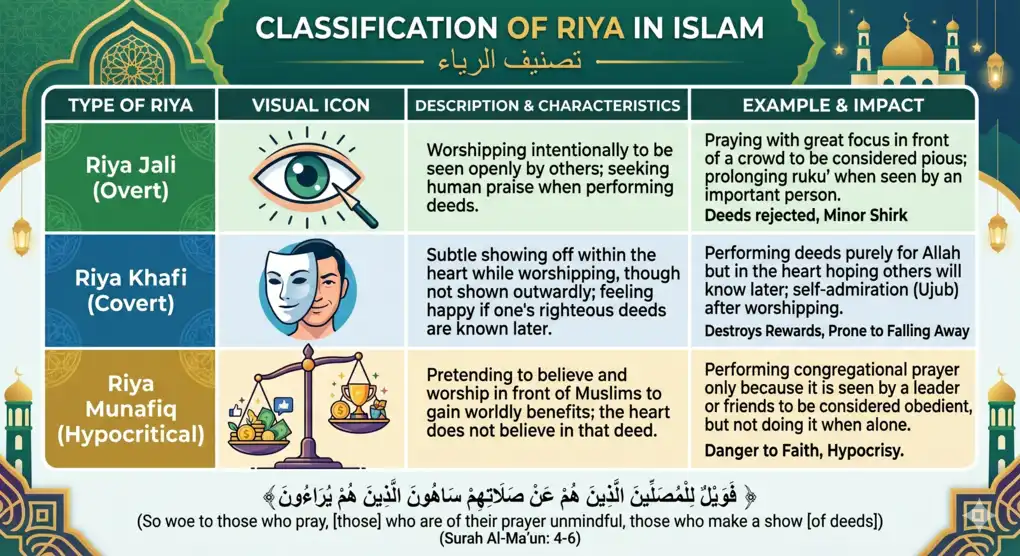
Although the manuscript of Dalīl al-Fāliḥīn does not unfold a formal sub-chapter titled “classification of riya types”, the analytical scalpel (istinbāṭ) tracing various commentary fragments within it can extract three faces of riya operating under different schemes.
The First Type — Riya Jali (Overt Riya): Acting Before People to be Directly Seen
Textual basis (pg. 74):
يُقَاتِلُ رِيَاءً أَيْ لِيَرَى النَّاسُ قِتَالَهُ
This represents riya in its most vulgar and blatant stage (jali). The execution of good deeds is deliberately arranged and held on the front lines of human gaze with the target to be watched immediately in real-time at that very second. Its main indicator is absolute dependence on the availability of an “audience” at the scene. As a figurative analogy in contemporary routines: slowing down the tempo of bowing (ruku’), suddenly perfecting the Tajweed of a Surah, or deliberately closing the eyes showing a serene effect when realizing a prospective parent-in-law or office boss is watching from the back row.
The Second Type — Riya Khafi (Hidden Riya): Displaying Worship Intentions, Hiding the True Intentions
Textual basis (pg. 55–57):
أَظْهَرَ قَصْدَ الْهِجْرَةِ إِلَى اللهِ وَأَبْطَنَ خِلَافَهُ
This variant moves on a quieter and deadlier frequency than the first type. A perpetrator might not be holding their worship attraction in an open field. However, they passively and manipulatively engineer personal branding so the wider public pins the label “expert in worship” on them, while they themselves are aware that their original motivation completely opposes that image. This type does not always beg for a live audience.
It includes verbal deception or body language, where someone blurs their true intention (e.g., donating so their company is not protested against) by declaring a holy statement, “This donation is purely lillahi ta’ala for the welfare of the ummah”. They manipulate the fate of public perception.
The Third Type — Riya Munafiq (Hypocritical Riya): Al-Tazayyun Before Two Presences
Textual basis (pg. 56–57):
نِيَّةُ أَهْلِ النِّفَاقِ التَّزَيُّنُ عِنْدَ اللهِ وَعِنْدَ النَّاسِ
“The intention of the hypocrites is to adorn themselves before Allah and before people (simultaneously).”11
This is the terminal stage of the riya cancer—the most fragile position directly intersecting with hypocrisy. The practice of al-tazayyun (adorning oneself) positions a series of obligatory and recommended worships merely as “cosmetic” devices to beautify the ego, not as a medium of submission for a lowly servant.
Their validation target is dual: they want to garner rewards from Allah, but at the same time they greedily want to collect respect from creatures. This phenomenon proves that the perpetrator refuses to place Allah ﷻ as the singular orientation, but instead associates the pleasure of God with human applause.
| Specification | Popular Name | Operational Mechanism | Requirement for Audience Presence | Textual Basis Dalīl al-Fāliḥīn |
| First | Riya Jali / Overt | Acting to be seen by people instantly | Dependent on a direct audience | Vol 1, Pg. 74 |
| Second | Riya Khafi / Hidden | Showing off worship intent, burying the original agenda | Does not need an audience during the action | Vol 1, Pg. 55–57 |
| Third | Riya Munafiq / Severe | Using worship as cosmetics in two presences | Allah and humans are made joint “audiences” | Vol 1, Pg. 56–57 |
Examples of Riya in Various Deeds
The book Dalīl al-Fāliḥīn unfolds four event backgrounds heavily laden with education regarding riya. These four cases provide a harsh slap that the pathogen of riya possesses terrifying adaptability; it can infect deeds as massive as sacrificing a life on the battlefield, down to the most trivial charity activities.
Example 1 — Riya in Jihad: Fighting to Appear Heroic
The Messenger of Allah ﷺ was once presented with a problem of intention:
سُئِلَ رَسُولُ اللهِ ﷺ عَنِ الرَّجُلِ يُقَاتِلُ شَجَاعَةً وَيُقَاتِلُ حَمِيَّةً وَيُقَاتِلُ رِيَاءً — أَيُّ ذَلِكَ فِي سَبِيلِ اللهِ؟
The shari’a of jihad occupies the highest caste in the pyramid of Islamic sacrifice—risking the loss of life, the spilling of blood, and the letting go of wealth assets. Regardless of the monumental nature of this physical sacrifice within the meaning of Islam linguistically and legally including its pillars, this hadith text unhesitatingly voids the status of fī sabīlillāh for a soldier whose sword strikes are swung fueled by riya.
The theological lesson is clear: the volume and heroism of a deed absolutely do not yield automatic immunity from riya invasion. The fact is quite the opposite; the more colossal the scale of the deed, the more delicious the temptation of riya riding it.12
Example 2 — Riya in Ritual Sacrifice: Lessons from Jahiliyyah
As the narration of the reason for revelation recorded from the era of creed transition:
كَانَ أَهْلُ الْجَاهِلِيَّةِ يَلْطَخُونَ الْبَيْتَ بِدِمَاءِ الْبُدْنِ، فَأَرَادَ الْمُسْلِمُونَ أَنْ يَفْعَلُوا ذَلِكَ فَنَزَلَتْ هَذِهِ الْآيَةُ
The culture of smearing the blood of sacrificial animals onto the holy walls of the Kaaba is a highly demonstrative theatrical deed—it leaves a provocative visual track record and is designed to be witnessed by all arriving caravans. The shari’a of monotheism declared a crushing rejection of that empty ritual proposal: “The meat and blood will never reach Allah”. This historical fragment is relevantly raised as proof that riya is not forever a solitary disease belonging to an individual. It has the contagious power to evolve into a collective cultural trend in the execution of community religious rituals.
Example 3 — Riya in Hijrah: Displaying an Intention that is Not the True Intention
As stated in the text of the hadith Innamal A’malu Binniyat:
وَمَنْ كَانَتْ هِجْرَتُهُ لِدُنْيَا يُصِيبُهَا أَوِ امْرَأَةٍ يَنْكِحُهَا فَهِجْرَتُهُ إِلَى مَا هَاجَرَ إِلَيْهِ
Ibn ʿAllān’s sharp commentary responds to the phenomenon of the Emigrant of Ummu Qais:
لِأَنَّهُ أَظْهَرَ قَصْدَ الْهِجْرَةِ إِلَى اللهِ وَأَبْطَنَ خِلَافَهُ، وَهَذَا ذَمِيمٌ
The eternal story of this emigrant demonstrates that he joined the migration group—an exodus expedition laden with military and economic risks—not to fetch the pleasure of God, but to secure a marriage ticket with the idol of his heart. The fundamental reason that made Ibn ʿAllān label this maneuver with the diction dhamīm (despicable) is not merely because his marriage intention was worldly in nature. Rather, his cunningness in engineering an outward appearance as if he were a religious mujahid fighter, while storing a civilian agenda in the pocket of his inner self. This is a form of spiritual identity fraud.13
Example 4 — The Opposite of Riya: The Three Deeds Furthest from Riya
As a comparative counterbalance, Dalīl al-Fāliḥīn highlights the miracle of the tawassul wording of three young men trapped by a giant rock in the dark hallway of a cave. Understanding the meaning of Tawassul is key here:
اللَّهُمَّ إِنْ كُنْتً فَعَلْتُ ذَلِكَ ابْتِغَاءَ وَجْهِكَ فَافْرُجْ عَنَّا مَا نَحْنُ فِيهِ
The three deeds of these unsung heroes include: extraordinary devotion to elderly parents in the silence of the late night, the strength to cut off the lust for fornication exactly when the facility for it was right in front of the eyes without CCTV, and the honesty to preserve and multiply a worker’s wages without a single sheet of written agreement notes. These three monuments of deeds are linked by an identical common thread: all were worked completely outside the reach of the human eye surveillance radar.
This great hadith does not merely present a story about a magic prayer that splits rocks. More essentially, it presents a perfect prototype of an order of deeds most sterile from the riya virus: desiring no audience, hiring no eyewitnesses, and blocking access to coverage except for Allah alone. 14
Five Dangers of Riya Mentioned in the Text

The literacy of Dalīl al-Fāliḥīn does not reduce the danger of riya merely to the cliché sentence “destroys deeds”. The analytical scalpel dissecting the pages of the commentary successfully identified five destructive consequences that afflict perpetrators of riya with different spectrums.
First Danger — Deeds are Voided: Not Included in Fi Sabilillah
Referring to the decree of the Prophet ﷺ in the commentary of Abu Musa’s hadith (pg. 74–75), the privilege of the status fī sabīlillāh is granted exclusively to servants moving with the singular vision li-takūna kalimatu Allāh hiya al-ʿulyā (exalting the word of God). Its three competitor motivations—pioneered by riya—instantly fall and are thrown out of the ranks.
This is the most instant penal sanction: the deed is annulled from being recorded as worship in the heavenly bureaucracy. The physical action indeed executes in the material realm—blood spills in war, sweat drips in prayer, bank balances shrink due to donations. However, its credit valuation on the monitor screen of the afterlife court displays a big zero.15
Second Danger — Deeds Become Despicable and Gain No Share in the Afterlife
Responding to the deviation of intention of the Emigrant of Ummu Qais (pg. 55–57), the text gives a verdict:
فَهِجْرَتُهُ إِلَى مَا هَاجَرَ إِلَيْهِ
Ibn ʿAllān’s commentary strikes without mercy:
أَيْ فَهِجْرَتُهُ قَبِيحَةٌ إِذْ لَيْسَتْ مِنَ اللهِ فِي شَيْءٍ وَذَلِكَ حَظُّهُ وَلَا نَصِيبَ لَهُ فِي الْآخِرَةِ
“That is, his flight of migration holds a despicable status (qabīḥah), because it has no correlation of connection with the pleasure of Allah in the slightest. That is his harvest portion (in the world), and he will not get a single lot of distribution on the Day of Judgment.”16
The choice of the term qabīḥah delegitimizes the deed to the lowest level of ethical badness. Followed by the verdict lā naṣīb lahu fī al-ākhirah (bankrupt without severance pay in the afterlife); he only gulps fleeting pleasures in the world—such as marrying a dream woman or scooping a number of “likes” on social media—which even then might not last long.
Third Danger — Receiving No Reward and No Closeness to Allah
Based on the commentary of Abu Hurairah’s hadith (pg. 72–73):
وَالْحَاصِلُ أَنَّ الْإِثَابَةَ وَالتَّقْرِيبَ لَيْسَا بِاعْتِبَارِ الْأَعْمَالِ الْظَّاهِرَةِ، وَإِنَّمَا هِيَ بِاعْتِبَارِ مَا فِي الْقَلْبِ
The distribution of al-ithābah (the liquid of reward) and al-taqrīb (VIP access to approach God’s Throne) is disbursed exclusively using inner access card validation, ignoring outward appearance certificates. The riya perpetrator indeed succeeds in winning the applause auction from their human colleagues, but they fail to win two crowns of eternal value: reward balances and the intimacy of taqarrub with their Creator. This is a portrait of the most tragic investment loss: selling heavenly property assets to buy a fleeting ticket of praise.17
Fourth Danger — Allah Does Not Accept What is Merely Outward
Responding to the ancient ritual traditions in QS. al-Hajj (pg. 50–51):
لَنْ يَنَالَ اللَّهَ لُحُومُهَا وَلَا دِمَاؤُهَا وَلَكِنْ يَنَالُهُ التَّقْوَى مِنْكُمْ
This verse formulates the Standard Operating Procedure for the acceptance of deeds by Allah: only al-taqwā (the vibration of monotheistic submission and inner sincerity) is permitted to cross the boundaries of the sky to reach His pleasure. Riya sabotages this driving engine, so that the riya servant’s deed rots into a pile of luhūm wa dimāʾ (carcasses of meat and pools of blood) slumped stepping on the earth without wings to fly up.18
Fifth Danger — Riya is a Despicable Trait That Must Be Cleansed From the Heart
Firmly stated on pg. 72–73:
وَتَطْهِيرِهِ عَنْ كُلِّ وَصْفٍ مَذْمُومٍ، وَتَحْلِيَتِهِ بِكُلِّ نَعْتٍ مَحْمُودٍ
Ibn ʿAllān seats riya as waṣf madhmūm (a chronic and despicable disease of inner character). This classification herds riya beyond the boundary definition of an incidental momentary sin, crowning it as a virus that freezes spiritual health. As long as this riya dirt sediment is still crusted on the inner walls, the heart is blocked from the ability of muḥallā bi-naʿt maḥmūd (receiving the nutritional intake of noble prophetic attributes). The danger of riya is not complete just by annulling the reward of one Rak’ah of prayer; it radiates a deadly radiation to the heart’s navigation function comprehensively if not quickly amputated.19
| No | Specification of Danger Threat | Key Quote from the Commentary Manuscript | Book Coordinates |
| 1 | Deed voided, struck from Fi Sabilillah | “man qātala li-takūna kalimatu Allāh…” | Vol 1, 74–75 |
| 2 | Deed labeled despicable, zero afterlife severance | “hijratuhu qabīḥah… lā naṣīb lahu fī al-ākhirah” | Vol 1, 55–57 |
| 3 | Closed access to reward and taqarrub quarantine | “al-ithābah wa al-taqrīb laysa bi-iʿtibār al-aʿmāl al-ẓāhirah” | Vol 1, 72–73 |
| 4 | Allah blocks empty physical worship packages | “lan yanāla Allāha luḥūmuhā wa lā dimāʾuhā” | Vol 1, 50–51 |
| 5 | Riya permanently pollutes the heart’s ecosystem | “taṭhīruhu ʿan kull waṣf madhmūm” | Vol 1, 72–73 |
Self-Evaluation (Muhasabah) — Three Questions to Recognize Riya Within Oneself
All the doctrinal expositions above only yield efficacy if converted into instruments of independent spiritual audit (muhasabah). The following series of introspective questions is designed based on extraction from fragments of advice in the primary reference text.
First Question — Does the Quality of My Worship Change When Someone is Looking?
Based on Ibn ʿAllān’s warning: “do not be deceived by the outward concealment of riya”, combined with the definitional postulate “acting to be seen by humans”. Evaluate brutally: If the duration of bowing (ruku’) becomes more silent, the pieces of donation money pulled from the wallet become larger denominations, or the shriek of the call to prayer (adhan) is mobilized more maximally coincident with the arrival of an important guest at the mosque—beware! At that crossroads, the seeds of riya are demanding to be watered. This does not mean that the worship rhythm of a sincere believer must be identical like a machine in all weather; what is emphasized is guarding the motivation compass so it does not shift steered by the number of attendees. [1, 2]
Second Question — Do I Let Others Think I Am Better Than My Reality?
Elaborated from the case study of Ummu Qais’s migration intention: “showing the intention of migration (worship), while hiding the opposite”. Riya does not always maneuver actively showing off medals; it is also skilled at playing passive. Letting colleagues mistakenly pin praise or the title of Ustadz on you, while you secretly enjoy the social privileges from that mistaken assumption without intending to correct it—is a toll road to the thickest hidden riya.20
Third Question — How Do I Feel When My Deeds Are Unknown to People?
Contrasted from the golden saga of the three young men behind the cave rock crevice who performed their ultimate deeds far from social life radars. Investigate your heart’s frequency: If there slips a ripple of disappointment disrupting the daily mood, grumbling dissatisfaction, or the spirit of goodness suddenly deflates when your sunnah worship project receives no attention at all from the inner circle—that is an emergency siren alarm signaling riya calling to be treated. Conversely, if performing tahajud in the dead of night or amidst the noise of a congregational qiyamullail feels equally solemn in weight, be grateful for the clarity of that heart.21
FAQ Regarding Riya
What is riya in Islamic understanding?
Riya is the manifestation of a deviation of intention by performing an action solely aiming to be witnessed by human eyes. In the commentary manuscript Dalīl al-Fāliḥīn, the great scholar Ibn ʿAllān defines it straightforwardly: “yaqātilu riyāʾan ay li-yarā al-nās qitālahu”—meaning someone acts or goes to war with a hidden agenda so the crowds of humans see the attraction of their deeds.22
Is riya classified as part of the sin of shirk?
The ranks of ushuluddin scholars label riya with the name shirk aṣghar (minor shirk). This sin positions creatures as participating allies in the intention of performing worship which is essentially the absolute prerogative right of Allah. Of course, this category has a different legal demarcation from shirk akbar (major polytheism worshiping physical idols) whose verdict executes the perpetrator out absolutely from the ranks of the Islamic religion.23
Is the ritual of prayer rendered void of obligation (invalid) due to exposure to riya?
A separation of realms is required. To properly analyze this, one must grasp the Meaning of Fiqh. From the juridical perspective of operational fiqh, the physical prayer is not automatically annulled (invalidated) as long as all pillars of movement and prerequisites for valid registration (such as fulfilling the Fardhu Wudhu) are executed flawlessly, maintaining How Many Pillars of Prayer There Are, up to the final Fiqh of Salam. However, looking from the window of the heavenly court’s reward, Ibn ʿAllān explains the definitive law: “al-ithābah wa al-taqrīb laysa bi-iʿtibār al-aʿmāl al-ẓāhirah”—the liquid of reward and the glory of closeness to Allah are not measured from the casing of outward deeds alone, but the honesty of intention in the heart.24
What is the most precise method to detect whether our inner self is infected with riya?
Ibn ʿAllān offers a sharp clinical test filter: examine carefully whether the quality and intensity of your acts of worship experience fluctuations mutating to be very prime when stepping on a stage filled with an audience. He knocks on our common sense with the message: “lā yaghtarr bi-khafāʾihi ẓāhiran”—do not be deceived into branding yourself sin-free just because the camouflage of riya is neatly hidden under the clothes of outward piety.25
If the temptation of riya whispers suddenly attacks in the middle of a worship session, does it scorch the entire deed?
The compilation of the Dalīl al-Fāliḥīn text dissected in this segment does not examine this incidental branch case in detail. This problem requires cross-sectoral study between comparative fiqh of worship and tasawwuf specialization, where the majority of scholars sort it based on how much the perpetrator responds to or repels the sudden whisper.
Does posting a worship donation on a social media page get permanently labeled as carrying the status of sum’ah or riya?
The final verdict highly depends on the load in the cockpit of the uploader’s intention. If lust presses to scoop a portion of admiration to be considered a super pious philanthropist (li-yarā al-nās), then it meets the criteria of riya absolutely. Conversely, if it is patterned purely aimed at educating the younger generation or provoking charitable competition within the framework of charity institution syiar, its ruling becomes a means of goodness. Filtering this absolutely requires the courage of honesty to interrogate one’s own heart.
Conclusion
After diving into the whirlpool of meaning from the comparison of evidences and classical commentaries above, we are guided to a conclusion that humbles the ego: the disease of riya is not merely a partial threat to one or two sheets of daily infected deeds, but rather it launches a deadly sabotage that potentially collapses the entire dimension of a servant’s vertical interaction with their Creator.
The five danger instruments successfully extracted from the commentary manuscript—starting from the annulment of noble status from deeds, annexation of a despicable label, confiscation of afterlife reward assets, blocking of physical worship, up to its mutation into a pathogen freezing the health of the heart’s ecosystem—affirm that eradicating riya is a non-negotiable price.
As a lock on reason, let us reflect again on the uncompromising echo of warning from the pool of wisdom of Ibn ʿAllān that pierces across eras:
لَا تَخْفَى عَلَيْهِ وَسَاوِسُ الصُّدُورِ
“There is absolutely no space that obscures for Him, every snort of treasonous whispers in the curves of the human chest.”26
And let us bow respectfully under the supremacy of the ultimate word that sweeps clean all masks of falsehood, Surah Ali Imran verse 29:
قُلْ إِنْ تُخْفُوا مَا فِي صُدُورِكُمْ أَوْ تُبْدُوهُ يَعْلَمْهُ اللَّهُ
Footnotes
- Ibn ʿAllān al-Ṣiddīqī al-Bakrī al-Shāfiʿī, Dalīl al-Fāliḥīn li-Ṭuruq Riyāḍ al-Ṣāliḥīn, Edited by Khalīl Maʾmūn Shīḥā, 4th Ed., Vol. 1 (Beirut: Dār al-Maʿrifah li-l-Ṭibāʿah wa-l-Nashr wa-l-Tawzīʿ, 1425 H/2004 M), 51. ↩︎
- Ibn ʿAllān, Dalīl al-Fāliḥīn, 1:74. ↩︎
- Ibn ʿAllān, Dalīl al-Fāliḥīn, 1:49. Copied by Ibn ʿAllān referring to the thoughts of Abū al-Qāsim ʿAbd al-Karīm ibn Hawāzin al-Qushayrī. ↩︎
- Ibn ʿAllān, Dalīl al-Fāliḥīn, 1:49–50. This commentary refers to the book al-Iklīl fī Istinbāṭ al-Tanzīl by Jalāl al-Dīn as-Suyūṭī. ↩︎
- Ibn ʿAllān, Dalīl al-Fāliḥīn, 1:50–51. The history of asbab al-nuzul is copied from al-Jāmiʿ li-Aḥkām al-Qurʾān by Imam al-Qurṭubī. ↩︎
- Ibn ʿAllān al-Ṣiddīqī al-Bakrī al-Shāfiʿī, Dalīl al-Fāliḥīn li-Ṭuruq Riyāḍ al-Ṣāliḥīn, Edited by Khalīl Maʾmūn Shīḥā, 4th Ed., Vol. 1 (Beirut: Dār al-Maʿrifah li-l-Ṭibāʿah wa-l-Nashr wa-l-Tawzīʿ, 1425 H/2004 M), 51. ↩︎
- Ibn ʿAllān, Dalīl al-Fāliḥīn, 1:74–75. ↩︎
- Ibn ʿAllān, Dalīl al-Fāliḥīn, 1:72–73. ↩︎
- Ibn ʿAllān, Dalīl al-Fāliḥīn, 1:72–73. ↩︎
- Ibn ʿAllān, Dalīl al-Fāliḥīn, 1:55–57. ↩︎
- Ibn ʿAllān, Dalīl al-Fāliḥīn, 1:56–57. ↩︎
- Ibn ʿAllān, Dalīl al-Fāliḥīn, 1:74–75. ↩︎
- Ibn ʿAllān, Dalīl al-Fāliḥīn, 1:55–57. ↩︎
- Ibn ʿAllān, Dalīl al-Fāliḥīn, 1:83–90. ↩︎
- Ibn ʿAllān, Dalīl al-Fāliḥīn, 1:74–75. ↩︎
- Ibn ʿAllān, Dalīl al-Fāliḥīn, 1:55–57. ↩︎
- Ibn ʿAllān, Dalīl al-Fāliḥīn, 1:72–73. ↩︎
- Ibn ʿAllān, Dalīl al-Fāliḥīn, 1:50–51. The history of asbab al-nuzul is copied from al-Jāmiʿ li-Aḥkām al-Qurʾān by Imam al-Qurṭubī. ↩︎
- Ibn ʿAllān, Dalīl al-Fāliḥīn, 1:72–73. ↩︎
- Ibn ʿAllān, Dalīl al-Fāliḥīn, 1:55–57. ↩︎
- Ibn ʿAllān, Dalīl al-Fāliḥīn, 1:83–90. ↩︎
- Ibn ʿAllān, Dalīl al-Fāliḥīn, 1:74. ↩︎
- Abū al-Faḍl ʿAbd al-Raḥīm ibn al-Ḥusayn al-ʿIrāqī, Takhrīj Aḥādīth Iḥyāʾ ʿUlūm al-Dīn, Vol. 5 (Riyadh: Dār al-ʿĀṣimah, 1408 H/1987 M), 1971. This reference documents the takhrij of hadiths categorizing acts of riya within the spectrum of shirk aṣghar authentically according to scholarly consensus. ↩︎
- Ibn ʿAllān, Dalīl al-Fāliḥīn, 1:72–73. ↩︎
- Ibn ʿAllān al-Ṣiddīqī al-Bakrī al-Shāfiʿī, Dalīl al-Fāliḥīn li-Ṭuruq Riyāḍ al-Ṣāliḥīn, Edited by Khalīl Maʾmūn Shīḥā, 4th Ed., Vol. 1 (Beirut: Dār al-Maʿrifah li-l-Ṭibāʿah wa-l-Nashr wa-l-Tawzīʿ, 1425 H/2004 M), 51. ↩︎
- Ibn ʿAllān al-Ṣiddīqī al-Bakrī al-Shāfiʿī, Dalīl al-Fāliḥīn li-Ṭuruq Riyāḍ al-Ṣāliḥīn, Edited by Khalīl Maʾmūn Shīḥā, 4th Ed., Vol. 1 (Beirut: Dār al-Maʿrifah li-l-Ṭibāʿah wa-l-Nashr wa-l-Tawzīʿ, 1425 H/2004 M), 51. ↩︎
Bibliography
- Ibn ʿAllān al-Ṣiddīqī al-Bakrī al-Shāfiʿī, Muḥammad ʿAlī ibn Muḥammad. Dalīl al-Fāliḥīn li-Ṭuruq Riyāḍ al-Ṣāliḥīn. Edited by Khalīl Maʾmūn Shīḥā. 4th Ed. 8 volumes. Beirut: Dār al-Maʿrifah li-l-Ṭibāʿah wa-l-Nashr wa-l-Tawzīʿ, 1425/2004.
- al-Qurṭubī, Abū ʿAbd Allāh Muḥammad ibn Aḥmad. al-Jāmiʿ li-Aḥkām al-Qurʾān. As referred to in Ibn ʿAllān, Dalīl al-Fāliḥīn.
- al-Qushayrī, Abū al-Qāsim ʿAbd al-Karīm ibn Hawāzin. al-Risālah al-Qushayriyyah fī ʿIlm al-Taṣawwuf. As referred to in Ibn ʿAllān, Dalīl al-Fāliḥīn.
- al-Suyūṭī, Jalāl al-Dīn ʿAbd al-Raḥmān ibn Abī Bakr. al-Iklīl fī Istinbāṭ al-Tanzīl. As referred to in Ibn ʿAllān, Dalīl al-Fāliḥīn.
- al-ʿIrāqī, Abū al-Faḍl ʿAbd al-Raḥīm ibn al-Ḥusayn. Takhrīj Aḥādīth Iḥyāʾ ʿUlūm al-Dīn. Extracted by Abū ʿAbd Allāh Maḥmūd ibn Muḥammad al-Ḥaddād. 7 volumes. Riyadh: Dār al-ʿĀṣimah, 1408/1987.


