
School-of-law note: This article presents the Shafi‘i school as explained in Asna al-Mathalib, with supporting references from Fath al-Qarib and Al-Iqna’. It does not compare rulings across the schools of law.
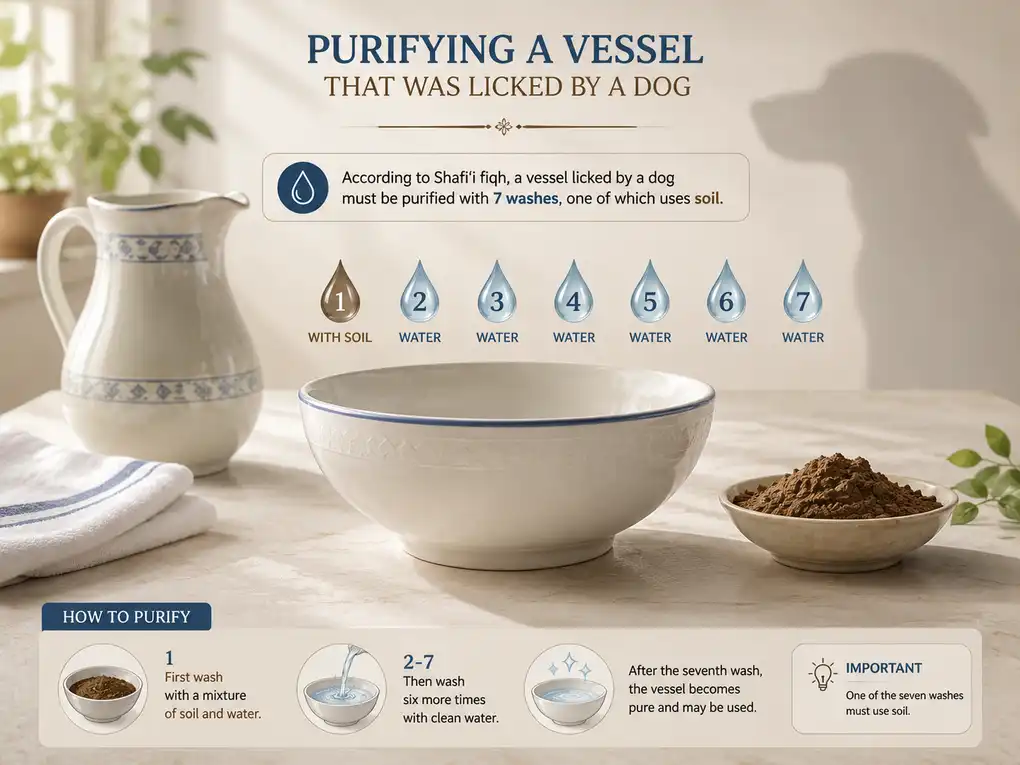
Najis mughallazhah is the Shafi‘i term for a major ritual impurity connected to dogs, pigs, and the offspring of either one. An affected object is purified through seven washes with purifying water, with soil mixed with water used in one of those washes.[1]
The term is sometimes transliterated as mugholadoh, mughallazah, or mughaladhah. This article uses the standard spelling mughallazhah. “Major” here does not simply mean something looks dirtier, smells worse, or takes more effort to clean. It means that Shafi‘i jurisprudence assigns it a distinct purification procedure.
Meaning of Najis Mughallazhah in Shafi‘i Jurisprudence

In Islamic jurisprudence, najis is not simply whatever people find unpleasant. Ibn Qasim al-Ghazzi explains that impurity has a precise legal meaning, distinct from ordinary dislike or harm.[2]
«النَّجَاسَةُ لُغَةً الشَّيْءُ الْمُسْتَقْذَرُ، وَشَرْعًا كُلُّ عَيْنٍ حَرُمَ تَنَاوُلُهَا عَلَى الْإِطْلَاقِ حَالَةَ الِاخْتِيَارِ…»
“Linguistically, impurity is something regarded as foul; legally, it is every entity whose consumption is absolutely prohibited in a state of choice ….”[2]
Shafi‘i texts commonly introduce three levels of impurity: mukhaffafah (light), mutawassitah (intermediate), and mughallazhah (major). The description “major” refers to its prescribed method of purification. It is not a label for every substance that is difficult to clean.
Legal classification follows the evidence and the juristic categories stated by the scholars. It is not decided by whether an animal is feared, wild, or disliked. For the broader framework, see a guide to impurity in Islam and the levels of impurity in Islam.
Why Does This Article Focus on Dogs and Pigs?
This article focuses on dogs, pigs, and their offspring because Shafi‘i jurists place these within the special rules of major impurity.
«وَالْحَيَوَانُ طَاهِرٌ … لَا كَلْبٌ وَلَوْ مُعَلَّمًا … وَلَا خِنْزِيرٌ … وَلَا فَرْعُ كُلٍّ مِنْهُمَا»
“Animals are pure in principle … except a dog, even if trained; a pig; and the offspring of each of the two.”[3]
This is not a discussion of every question about keeping or using dogs. The concern here is ritual impurity and the way an affected body part, garment, utensil, or surface is purified.
What Counts as Najis Mughallazhah?
Dogs, Including Trained Dogs
A dog is a primary example of najis mughallazhah. The phrase وَلَوْ مُعَلَّمًا (“even if trained”) means that training a dog for hunting, guarding, or any other use does not change this classification within the discussion of impurity.[3]
Therefore, the ruling does not depend on a dog’s breed, size, appearance, or temperament.
Pigs


Pigs are also included in this category in the Shafi‘i school. Asna al-Mathalib states:
«وَلَا خِنْزِيرٌ؛ لِأَنَّهُ أَسْوَأُ حَالًا مِنَ الْكَلْبِ»
“Nor a pig [is included among pure animals], for its condition is more severe than that of a dog.”[3]
This article distinguishes the question of impurity from the wider subject of dietary law. Here, the issue is what happens when a physical object, clothing, body part, or utensil is actually affected by the impurity of a pig.
Offspring of a Dog or Pig
The offspring of a dog or pig with another animal is also included. Zakariyya al-Anshari writes:
«وَلَا فَرْعُ كُلٍّ مِنْهُمَا مَعَ الْآخَرِ أَوْ غَيْرِهِ تَغْلِيبًا لِلنَّجَاسَةِ، وَلِتَوَلُّدِهِ مِنْهَا»
“Nor the offspring of either one, whether with the other or with another animal, because the impurity is given precedence and because it is born from it.”[3]
The juristic expression far‘ al-kalb wa al-khinzir refers to such offspring. This should not be stretched to include every predatory animal merely because it resembles a dog or has fangs.
For a focused discussion, see the ruling on pigs and dog–pig offspring.
Not Every Wild Animal Is Major Impurity
Wolves, lions, tigers, and other predatory animals are not automatically treated as najis mughallazhah. The Shafi‘i texts specifically name dogs, pigs, and the offspring of either one.[3][4]
A juristic ruling should not be based only on an animal’s appearance, predatory nature, or how people react to it.
Textual Basis for the Ruling on Dogs and Pigs
The Hadith of a Dog Licking a Utensil
The principal hadith states:
«إِذَا وَلَغَ الْكَلْبُ فِي إِنَاءِ أَحَدِكُمْ فَاغْسِلُوهُ سَبْعَ مَرَّاتٍ أُولَاهُنَّ بِالتُّرَابِ»
“When a dog laps from the vessel of one of you, wash it seven times, the first of them with soil.”[1]
Wulugh means that a dog puts its tongue into a vessel. In Shafi‘i juristic reasoning, this instruction is not treated as ordinary hygiene advice alone. It establishes a form of legal purification.
Why Is a Dog Treated as Impure?
Asna al-Mathalib gives the reasoning:
«وَجْهُ الدَّلَالَةِ أَنَّ الطَّهَارَةَ إِمَّا لِحَدَثٍ أَوْ خَبَثٍ أَوْ تَكْرِمَةٍ، وَلَا حَدَثَ عَلَى الْإِنَاءِ، وَلَا تَكْرِمَةَ، فَتَعَيَّنَتْ طَهَارَةُ الْخَبَثِ، فَثَبَتَ نَجَاسَةُ فَمِهِ»
“The manner of proof is that purification is either for ritual state, for impurity, or for honor. A vessel has no ritual state, and there is no issue of honor; therefore, this must be purification from impurity, establishing the impurity of its mouth.”[3]
This explains the Shafi‘i answer to the question, “Why is a dog considered impure?” Once the mouth is established as impure through the hadith, the text does not treat the other parts of the dog as having a lighter status.[3]
Saliva, Leftover Drink, and Other Secretions
The common case is a dog’s saliva in a food or drink vessel. Al-Khatib al-Shirbini explains that the text names saliva and that other forms of impurity from the dog are connected to it.[5]
«فَنَصَّ عَلَى اللُّعَابِ وَأُلْحِقَ بِهِ مَا سِوَاهُ … وَإِذَا ثَبَتَتْ نَجَاسَتُهُ فَغَيْرُهُ مِنْ بَوْلٍ وَرَوْثٍ وَعَرَقٍ وَنَحْوِ ذَلِكَ أَوْلَى»
“The text explicitly names saliva, and what is other than it is attached to it … once its impurity is established, then urine, droppings, sweat, and similar matters are even more so.”[5]
Thus, in the Shafi‘i school, dog saliva is impure. Yet this should not lead to obsessive doubt. Impurity is not imposed merely because someone was near a dog or saw one at a distance; there must be certainty or a sound basis that contact occurred.[6]
For a separate discussion of hair and fur, see the Shafi‘i ruling on cat fur.
Pigs and Their Offspring Follow This Procedure
When describing purification, Zakariyya al-Anshari states that an object affected by a dog, a pig, or the offspring of either one has the same requirement: seven washes with water, one of them with soil.[1] He also explains that other forms of a dog’s impurity are analogized to licking, and that the other animals named in the text are analogized to the dog.[1]
How to Purify Najis Mughallazhah
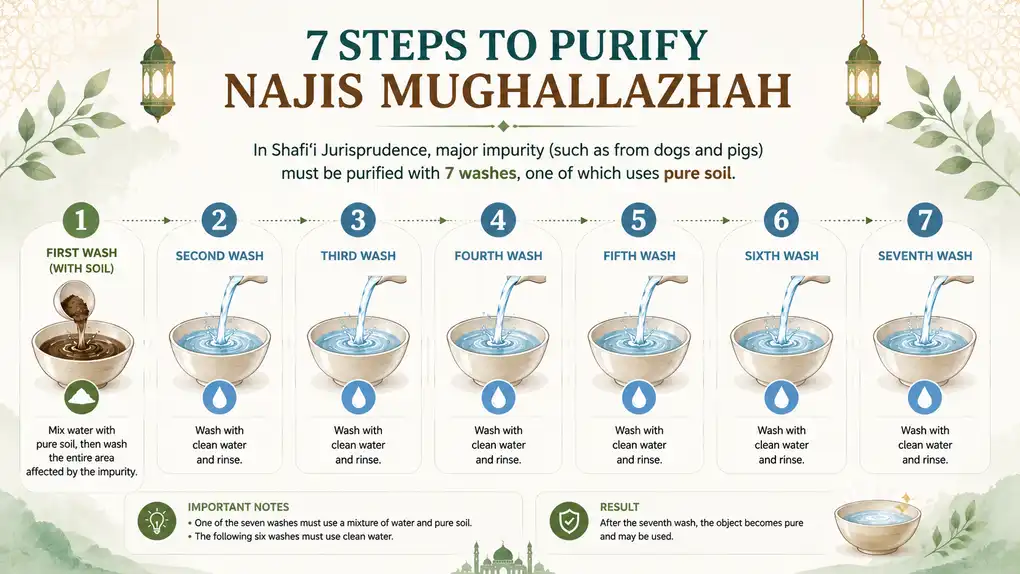
The Core Rule: Seven Washes, One with Soil
The basic procedure is:
- Remove any visible substance of impurity, if present.
- Wash the affected area seven times with purifying water.
- Use pure soil mixed with water in one of the seven washes.[1]
«لَا يَطْهُرُ مُتَنَجِّسٌ بِكَلْبٍ، وَخِنْزِيرٍ، وَفَرْعِ كُلٍّ … إِلَّا بِسَبْعٍ مِنَ الْغَسَلَاتِ بِالْمَاءِ إِحْدَاهُنَّ بِالتُّرَابِ»
“An object affected by a dog, pig, or the offspring of either one is not purified except by seven washes with water, one of them with soil.”[1]
If it takes several pours to remove a visible trace, the sequence that removes that trace is counted as one wash in the position preferred by Imam al-Nawawi and explained in Asna al-Mathalib.[7] Then complete the total to seven washes.
See how to purify dog impurity for a focused guide.
Soil Is Not Restricted to the First Wash, but the First Is Preferred
Hadith reports mention soil in different positions. Therefore, Asna al-Mathalib states that it is sufficient for soil to occur in one of the seven washes.[1]
The text also says:
«وَيُسَنُّ جَعْلُ التُّرَابِ فِي غَيْرِ الْأَخِيرَةِ، وَالْأُولَى أَوْلَى»
“It is recommended that soil be placed in a wash other than the last, and the first is more preferable.”[8]
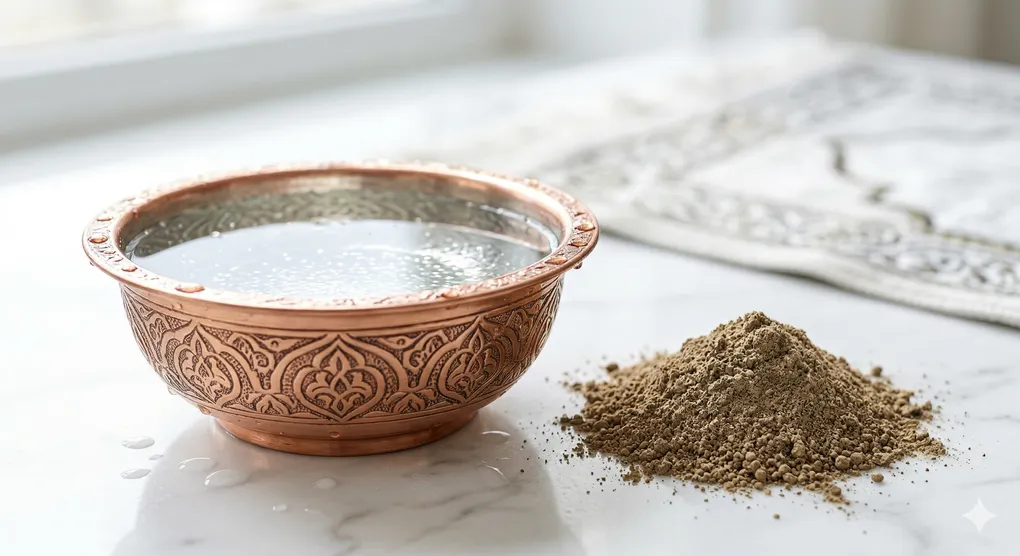
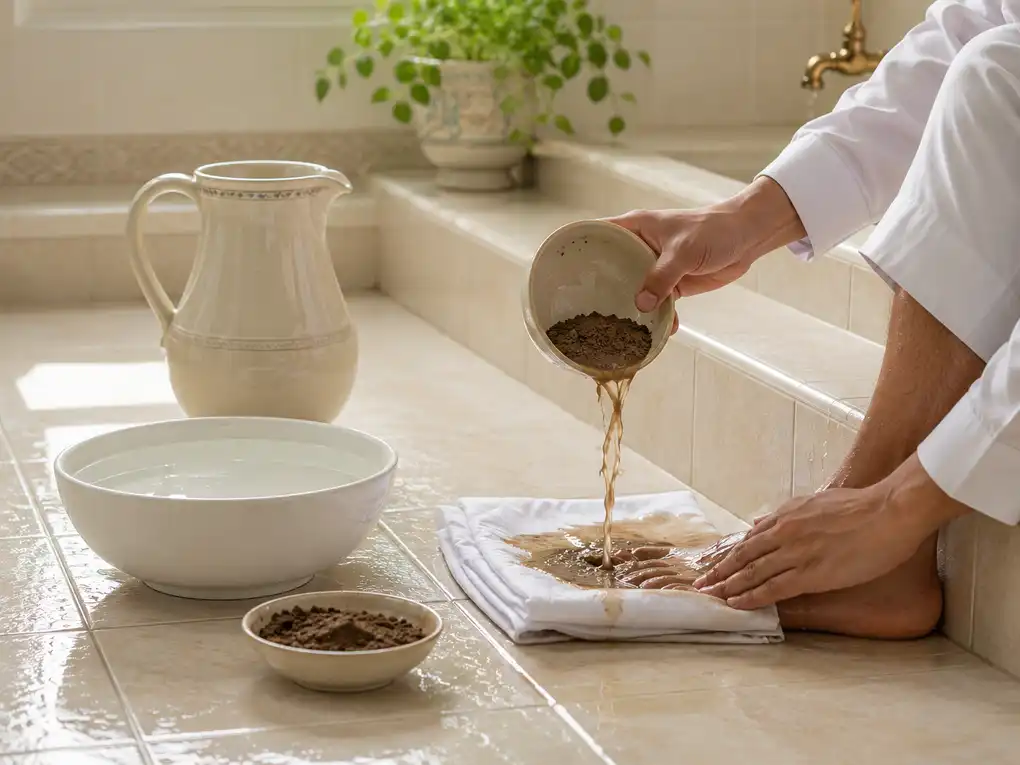
A straightforward method is to make the first wash with soil and water, followed by six washes with purifying water. Soil may be used in another wash other than the last, but the first is preferred.
Conditions for the Soil
The soil must be pure and not previously used to remove ritual state or impurity. It should be sufficient to cloud the water and reach every affected part.[8]
«وَلْيَكُنِ التُّرَابُ … طَاهِرًا غَيْرَ مُسْتَعْمَلٍ فِي حَدَثٍ أَوْ خَبَثٍ … يَعُمُّ مَحَلَّ النَّجَاسَةِ … وَلْيَكُنْ مَمْزُوجًا بِالْمَاءِ»
“The soil should be pure and not used for ritual state or impurity … it should cover the site of impurity … and it should be mixed with water.”[8]
Dry soil should not simply be sprinkled on an object, shaken off, and then followed by water. The required treatment is soil mixed with water before the washing process is complete.[8]
A practical sequence is:
- Prepare clean soil.
- Mix it with purifying water until the water becomes cloudy.
- Apply the mixture to every affected part.
- Follow with six washes of purifying water.
For the wider topic, see purification media other than water.
Soap and Detergent Do Not Replace Soil
Soap, detergent, sanitizer, and other cleaners may be used to remove stains or odor. However, under the Shafi‘i procedure for najis mughallazhah, they do not replace soil.
«وَلَا يَقُومُ غَيْرُ التُّرَابِ كَأُشْنَانٍ، وَصَابُونٍ مَقَامَهُ»
“Nothing other than soil—such as ushnan or soap—takes its place.”[1]
Physical cleanliness and legal purity are related, but they are not always identical. Soap may be an extra cleaning aid; it does not remove the requirement of one soil-and-water wash.
Is a Specific Intention or Supplication Required?
There is no obligatory formula of intention for removing impurity. Al-Iqna’ states that intention is not a condition for removing impurity, unlike purification from a ritual state.[9]
For that reason, search phrases such as “a prayer or intention for dog impurity” should not be used to invent or treat a particular formula as compulsory. What matters is that the required method of purification is completed.
Practical Cases: Clothing, Skin, Utensils, and Floors
Clothing Affected by Dog or Pig Impurity
When the affected location is known, washing that location is sufficient; it is not necessary to wash the entire garment.[10] Remove visible residue, apply one wash with soil and water, then complete six washes with water.
Make sure the mixture and later washes reach the affected fibers, seams, pockets, and folds. A layered or porous object should not be considered pure merely because its surface looks clean.
Hands, Feet, and Skin
For an affected hand, foot, or other skin area:
- Remove visible residue.
- Wash the entire affected area with soil mixed with water.
- Wash it six more times with purifying water.
- Do not miss toe gaps, finger gaps, folds of skin, or any other affected area.
Wet wipes or soap can lift visible dirt, but they do not replace the seven washes and the soil requirement in this ruling.
A Utensil Licked by a Dog
A food or drink vessel is the direct example in the hadith. First discard the affected food or drink. Then remove any visible residue, apply one wash with soil and water, and follow with six washes of water.[1]
Check the rim, lid, handle, grooves, and outer side if they were actually affected. Smooth materials such as glass, ceramic, metal, and plastic are not purified merely by wiping; they need to be washed.[7]
Soil Ground and Tiled Floors
On actual earthen ground, the additional soil requirement falls away because there is no point in applying soil to soil. Seven washes with water are still performed.[11]
«وَيَسْقُطُ تَتْرِيبُ أَرْضٍ تُرَابِيَّةٍ إِذْ لَا مَعْنَى لِتَتْرِيبِ التُّرَابِ»
“The use of soil falls away for earthen ground, because there is no meaning in applying soil to soil.”[11]
Tile, cement, marble, granite, vinyl, and comparable floors are not treated as earthen ground in this point. For them, use one soil-and-water wash and six water washes, ensuring that affected grout lines and crevices are reached.
Still Water and Running Water
Submerging an object in still water counts as one wash, even if the object remains there for a long time. Moving it through the still water seven separate times can count as seven washes.[11]
«وَالْغَمْسُ فِي مَاءٍ رَاكِدٍ يُحْسَبُ مَرَّةً وَإِنْ مَكَثَ الْمَحَلُّ فِيهِ، نَعَمْ إِنْ حَرَّكَهُ فِيهِ سَبْعَ مَرَّاتٍ حُسِبَتْ سَبْعًا»
“Submersion in still water counts as one time, even if the object remains in it; however, if it is moved in it seven times, they count as seven.”[11]
With running water, seven flows over the affected location can count as seven washes as the text explains.[11]
Common Mistakes When Purifying Major Impurity
Washing Seven Times Without Soil
Seven water washes without one soil wash do not fulfill the Shafi‘i requirement for najis mughallazhah.[1]
Using Impure or Previously Used Soil
The soil must be pure and not previously used to remove ritual state or impurity.[8] Soil left over from a previous impurity wash should not be reused.
Sprinkling Dry Soil and Rinsing It Separately
Soil must be mixed with water. Applying dry dust, shaking it off, and rinsing afterward is not the method described in the text.[8]
Replacing Soil with Soap
Soap may assist with cleaning, but it does not stand in for soil.[1]
Treating a Long Soak as Seven Washes
A long soak in still water still counts as one wash.[11] Seven washes need seven distinct movements in suitable still water or seven flows of running water.
Letting Doubt Lead to Obsession
Jurisprudence does not impose impurity merely because of doubt. Without certainty or a sound basis for contact, a person should not burden themselves with unnecessary purification.[6]
FAQ
What is najis mughallazhah?
It is the Shafi‘i category of major impurity connected to dogs, pigs, and their offspring. An affected object is purified with seven water washes, one of them using soil.[1]
Which animals count as najis mughallazhah?
Is dog saliva impure?
How many times should impurity from a dog or pig be washed?
Must soil be used in the first wash?
Can soap or detergent replace soil?
Not in the Shafi‘i procedure. Soap may be used as an extra cleaner, but it does not replace soil.[1]
Is there a required prayer or intention for purifying dog impurity?
No. A specific intention or formula is not a condition for removing impurity. The required purification procedure is what must be carried out.[9]
Footnotes
References
- Zakariyā al-Anṣārī, Asnā al-Maṭālib fī Sharḥ Rawḍ al-Ṭālib, with ḥāsyiyah (marginal gloss) by Aḥmad al-Ramlī, edited by Muḥammad az-Zuhrī al-Ghamrāwī (Cairo: al-Maṭbaʿah al-Maymānīyah, 1313 AH; repr. Dār al-Kitāb al-Islāmī), vol. 1, pp. 10-22.
- al-Shirbīnī, Shams al-Dīn Muḥammad ibn Aḥmad. Al-Iqnāʿ fī Ḥall Alfāẓ Abī Shujāʿ. Edited by Maktab al-Buḥūth wa al-Dirāsāt, Dār al-Fikr. Beirut: Dār al-Fikr, vol. 1, pp. 93-94.
- Muḥammad ibn Qāsim al-Ghazzī, Fatḥ al-Qarīb al-Mujīb fī Sharḥ Alfāẓ al-Taqrīb = al-Qawl al-Mukhtār fī Sharḥ Ghāyat al-Ikhtiṣār, ed. Bassām ʿAbd al-Wahhāb al-Jābī, 1st ed., vol. 1 (Beirut: al-Jafān wa-al-Jābī, Dār Ibn Ḥazm, 2005), p. 56.


