
Faith (Iman) constitutes the primary foundation in Islamic teachings. It firmly underlies every single aspect of a Muslim’s life, encompassing both acts of devotion (ibadah) and social transactions (mu’amalah). Orthodox Islamic theology establishes that there are six pillars of faith that an individual must correctly affirm as a strict condition for the validity of their belief. These pillars include belief in Allah, belief in His angels, belief in His books, belief in His messengers, belief in the Last Day, and belief in divine decree (Qada’ and Qadar). Among these sequential tenets, the first pillar—belief in the Almighty—stands as the absolute fundamental core and the starting point of all spiritual conviction.
The Six Pillars of Faith in Their Entirety
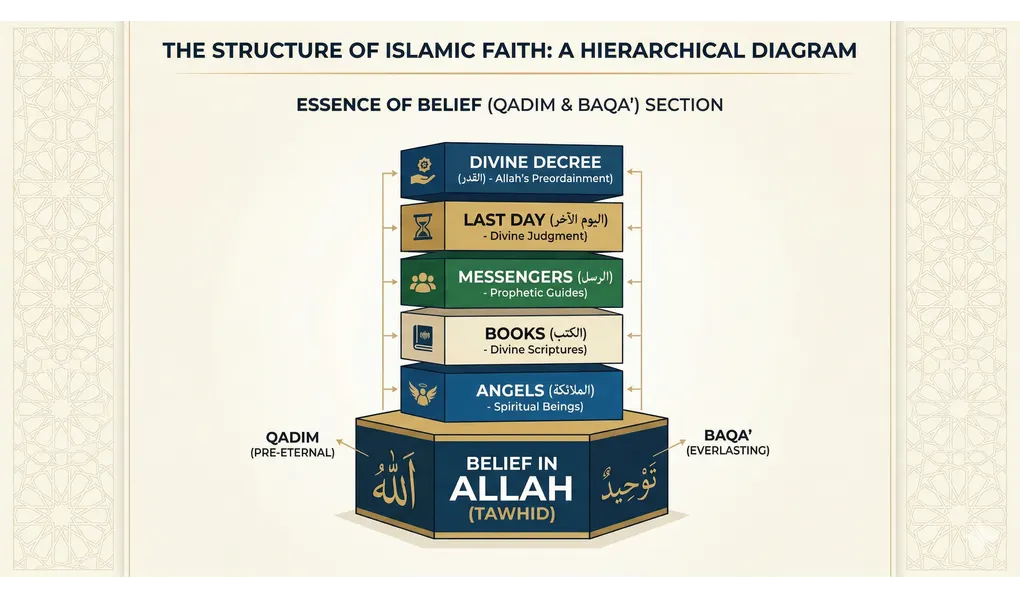
To fully grasp the number and definition of the pillars of faith, a Muslim must recognize the complete framework. The six essential pillars are:
- Belief in Allah
- Belief in the angels of Allah
- Belief in the divine books of Allah
- Belief in the messengers of Allah
- Belief in the Last Day
- Belief in divine decree (Qada’ and Qadar)
These six pillars are intrinsically interconnected and entirely inseparable. However, the first pillar functions as the supreme foundation that structurally supports the remaining five.
Belief in Allah: The Primary Foundation
Belief in Allah requires a firm, unwavering conviction in His existence, His absolute oneness (Tawhid), and His perfect, majestic attributes. According to mainstream Ahlus Sunnah wal Jama’ah (Aswaja) theology, this core conviction encompasses three main dimensions:
- Tawhid al-Rububiyyah: The affirmation that Allah alone is the Creator, Sustainer, Sovereign, and Administrator of the entire universe.
- Tawhid al-Uluhiyyah: The affirmation that Allah is the only deity inherently worthy of worship, without any partners or intermediaries.
- Tawhid al-Asma’ wa al-Sifat: The affirmation that Allah possesses unique and perfect names and attributes that do not resemble the attributes of His creation in any way, such as being All-Seeing (Al-Basir) and All-Knowing (Al-Alim).
As the first pillar, this theological premise serves as the gateway to Islamic teachings. It validates the theological acceptance of the subsequent pillars of faith, as well as the practical application of the pillars of Islam.
The Essence of Belief in Allah According to Irshad al-Ibad
To understand this concept deeply, classical Shafi’i jurisprudence offers profound insights. We refer to the esteemed text Irshad al-Ibad ila Sabil al-Rashad, authored by the prominent Shafi’i scholar, Shaykh Zainuddin bin Abdul Aziz al-Malibari.
Below is the original Arabic text outlining the orthodox Ash’ari creed regarding the Creator, followed by its translation:
واعْلَمْ أَنَّ الْإِيمَانَ بِاللَّهِ اعْتِقَادُ أَنَّهُ وَاحِدٌ لَا نَظِيرَ لَهُ فِي ذَاتِهِ وَصِفَاتِهِ وَلَا شَرِيكَ لَهُ فِي الْأُلُوهِيَّةِ وَهِيَ اسْتِحْقَاقُ الْعِبَادَةِ، وَأَنَّهُ قَدِيمٌ لَا ابْتِدَاءَ لِوُجُودِهِ، وَبَاقٍ لَا انْتِهَاءَ لِأَبَدِيَّتِهِ
Translation: “And know that indeed, belief in Allah is the firm conviction that He is One; there is nothing similar to Him in His Essence and His attributes, and He has no partner in divinity (uluhiyyah)—which is the exclusive right to be worshipped. And indeed, He is Pre-eternal (Qadim), having no beginning to His existence, and Everlasting (Baqa’), having no end to His eternity.”
Key Theological Explanations from the Text
Shaykh Zainuddin al-Malibari’s definitive statement highlights several critical theological axioms:
- The Absolute Oneness of Allah: Allah is uniquely One. He has no equal in His Essence or attributes. He is not composed of parts, nor does He bear any resemblance to created beings.
- The Exclusive Right to be Worshipped: All forms of devotion and worship must be directed solely to Allah. This is the essence of Tawhid al-Uluhiyyah.
- Pre-eternal and Everlasting Nature: Allah is Qadim (existing without a beginning) and Baqa’ (existing without an end). This establishes His absolute independence from time, emphasizing His divine eternity.
The Practical Consequences of Belief in Allah

A sound and orthodox belief in the Creator does not remain abstract; it produces tangible spiritual fruits. This deep conviction generates absolute obedience, sincere reliance (tawakkul), and an enduring awareness of divine observation (muraqabah). Furthermore, it liberates the human heart from dependency on mortal creatures, thereby elevating the overall quality and sincerity of a believer’s worship.
The Subsequent Pillars of Faith
Once the foundation is established, the believer must affirm the subsequent tenets:
- Belief in the Angels: To maintain belief in the angels means affirming them as noble creatures of Allah, created from light, who are perfectly obedient and assigned specific cosmic duties.
- Belief in the Divine Books: Affirming that Allah revealed sacred scriptures, notably concluding with the Holy Qur’an, to serve as the ultimate guidance for humanity.
- Belief in the Messengers: Affirming the chosen prophets and messengers, culminating with Prophet Muhammad (ﷺ) as the final seal of prophethood.
- Belief in the Last Day: Maintaining absolute belief in the Last Day entails acknowledging the impending resurrection, the ultimate divine judgment, and the eternal abodes of Paradise and Hellfire.
- Belief in Divine Decree: Affirming that Allah eternally knows, records, and decrees all matters (Qada’ and Qadar), while humans remain responsible for their active efforts and moral choices.
Conclusion
The six pillars of faith constitute an obligatory framework that every Muslim must study, comprehend, and internalize. Belief in Allah stands as the primary pillar and the definitive core that sustains the other five theological pillars. By deeply understanding His Oneness, His perfect attributes, and His eternal nature—as delineated by classical scholars—a Muslim cultivates a robust, authentic, and unshakable faith that guides them in this world and the hereafter.
Frequently Asked Questions (FAQ)
Why is belief in Allah considered the most important pillar of faith?
Belief in Allah is the foundational pillar because all other pillars logically and theologically depend upon it. You cannot believe in the angels, divine books, messengers, or divine decree without first affirming the existence, Oneness, and authority of the Creator who originated them.
What does it mean that Allah is “Qadim” and “Baqa'”?
In classical orthodox theology (Ash’ari and Maturidi), Qadim means Pre-eternal; Allah’s existence has no beginning. Baqa’ means Everlasting; His existence has no end. He exists independently of the created dimensions of time and space.
How does belief in Allah affect a Muslim’s daily life?
A correct belief in Allah fosters a deep sense of accountability, reliance, and peace. It encourages a Muslim to worship sincerely, act ethically in their social transactions (mu’amalah), and face life’s challenges with patience and trust in His divine wisdom.
Reference
Zainuddin bin Abdul Aziz bin Zainuddin ibn Ali bin Ahmad al-Ma’bari al-Malibari al-Hindi. Irshad al-Ibad ila Sabil al-Rashad. 1 vol. Accessed October 19, 2025. https://ketabonline.com/ar/books/19650.


