
Entering the Ḥaram (Sacred Precinct) and gazing upon the Baitullāh (House of Allah) is a transcendental moment for every believing soul. The moments when the physical eyes first behold the Kaaba are not merely a visual experience but a spiritual ascension (mi’raj) that demands profound inner etiquette. In the tradition of Islamic Jurisprudence (Fiqh), particularly as verified (taḥqīq) by Imam An-Nawawī in his monumental work Al-Majmūʿ Syarḥ Al-Muhadhdhab (Vol. 8, pp. 7-9), there are several narrated versions of the dua for seeing the Kaaba that are highly recommended (mustaḥabb).
This article presents these narrated supplications in full, accompanied by an analysis of their chains of narration (sanad) and crucial redactional corrections essential for students of knowledge.
The Etiquette of the Heart When Sighting the Kaaba
Before reciting any supplication, Al-Māwardī in Al-Ḥāwī emphasizes the importance of preparing one’s inner state (aḥwāl) when stepping into the Holy City.
“Al-Māwardī and others stated: It is Sunnah to enter Mecca with a heart full of humility (khushūʿ), limbs in a state of submission, while supplicating with earnest entreaty (taḍarruʿ).”
Complete Narrated Duas for Sighting the Kaaba
Imam An-Nawawī cites several variations of supplications sourced from the Prophets and Messengers, specifically Prophet Muhammad ﷺ, his Companions, and the Pious Predecessors (Salafus Shalih). Below are the detailed narrations:
1. The Dua of Spiritual Need and Surrender
This dua was narrated by Jaʿfar bin Muḥammad from his father, from his grandfather. It is recited upon entering Mecca or sighting the Kaaba, embodying Tawḥīd (monotheism) and total surrender.
Arabic:
اللَّهُمَّ الْبَلَدُ بَلَدُكَ، وَالْبَيْتُ بَيْتُكَ، جِئْتُ أَطْلُبُ رَحْمَتَكَ، وَأَؤُمُّ طَاعَتَكَ، مُتَّبِعًا لأَمْرِكَ، رَاضِيًا بِقَدَرِكَ، مُبَلِّغًا لأَمْرِكَ، أَسْأَلُكَ مَسْأَلَةَ الْمُضْطَرِّ إِلَيْكَ، الْمُشْفِقِ مِنْ عَذَابِكَ، أَنْ تَسْتَقْبِلَنِي، وَأَنْ تَتَجَاوَزَ عَنِّي بِرَحْمَتِكَ، وَأَنْ تُدْخِلَنِي جَنَّتَكَ
Transliteration: Allāhumma al-baladu baladuka, wa-l-baytu baytuka, jiʾtu aṭlubu raḥmataka, wa-aʾummu ṭāʿataka, muttabiʿan li-amrika, rāḍiyan bi-qadarika, muballighan li-amrika. Asʾaluka masʾalata-l-muḍṭarri ilayka, al-mushfiqi min ʿadhābika, an tastaqbilanī, wa-an tatajāwaza ʿannī bi-raḥmatika, wa-an tudkhilanī jannataka.
Translation: “O Allah, this land is Your land, and this House is Your House. I have come seeking Your mercy, intending to obey You, following Your command, pleased with Your decree. I ask You with the plea of one in desperate need of You, who fears Your punishment, that You welcome me, overlook my faults with Your mercy, and admit me into Your Paradise.”
2. The Famous Dua for Glorifying the Kaaba
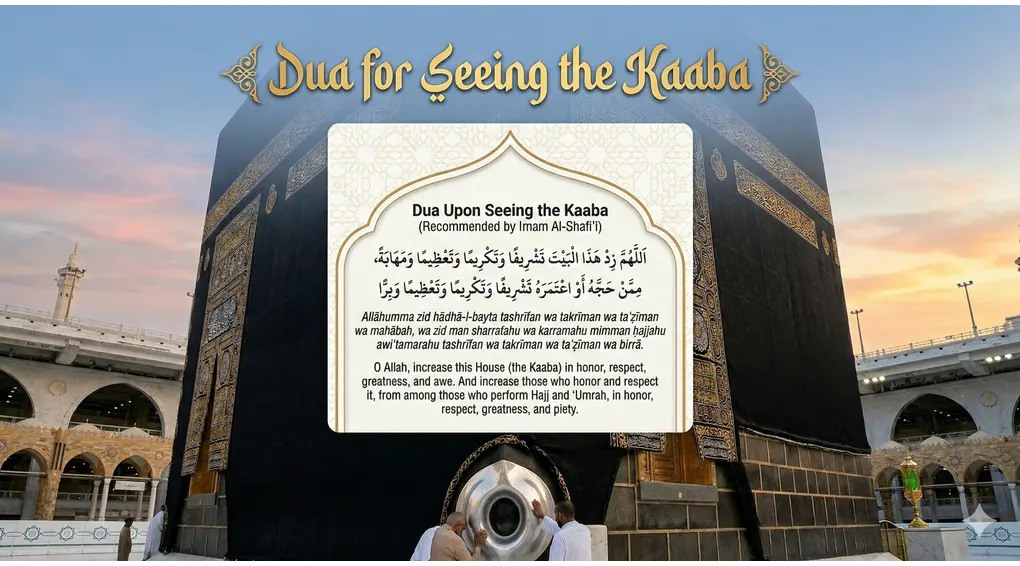
This is the most popular dua for seeing the Kaaba and is highly recommended by Imam Shāfiʿī. Narrated from Ibnu Juraij, when the Prophet ﷺ saw the Kaaba, he would raise his hands and recite:
Arabic:
اللَّهُمَّ زِدْ هَذَا الْبَيْتَ تَشْرِيفًا وَتَكْرِيمًا وَتَعْظِيمًا وَمَهَابَةً، وَزِدْ مَنْ شَرَّفَهُ وَكَرَّمَهُ مِمَّنْ حَجَّهُ أَوْ اعْتَمَرَهُ تَشْرِيفًا وَتَكْرِيمًا وَتَعْظِيمًا وَبِرًّا
Transliteration: Allāhumma zid hādhā-l-bayta tashrīfan wa-takrīman wa-taʿẓīman wa-mahabatan. Wa-zid man sharrafahu wa-karramahu mimman ḥajjahu awi-ʿtamarahu tashrīfan wa-takrīman wa-taʿẓīman wa-birran.
Translation: “O Allah, increase this House in honor, nobility, greatness, and awe. And increase those who honor and respect it—from those who perform Hajj or Umrah—in honor, nobility, greatness, and piety.”
Critical Verification (Taḥqīq)




Imam An-Nawawī provides a critical note regarding Al-Muzanī’s narration in Al-Mukhtaṣar, which erroneously added the word mahabatan (awe/majesty) to the second part of the dua concerning the pilgrims.
“Our Shāfiʿī scholars (Aṣḥāb) stated: This is an error by Al-Muzanī. The correct wording for the second part is ‘Wa Birran’ (and piety/goodness).”
The linguistic reason (balāghah) is clear: Mahabah (awe) is an attribute befitting the Baitullāh, while Birr (piety) is an attribute befitting human beings.
The Supplication for Peace (Atsar of Umar bin Khattab)
It is also recommended to add the supplication sourced from the atsar (tradition) of Umar bin Khattab (may Allah be pleased with him):
Arabic:
اللَّهُمَّ أَنْتَ السَّلَامُ وَمِنْكَ السَّلَامُ فَحَيِّنَا رَبَّنَا بِالسَّلَامِ
Transliteration: Allāhumma anta-s-salāmu wa-minka-s-salāmu fa-ḥayyinā rabbanā bi-s-salām.
Translation: “O Allah, You are As-Salām (The Source of Peace), and from You comes peace, so grant us life, O our Lord, with peace.”
Qadi Abu Ath-Thayyib explained that “As-Salām” is one of Allah’s Names, and “Wa minka as-Salām” means safety from all calamities. By asking to be lived “with peace,” we ask Allah to make our arrival at His House a sanctuary from all evil.
Legal Analysis: Raising Hands upon Sighting the Kaaba
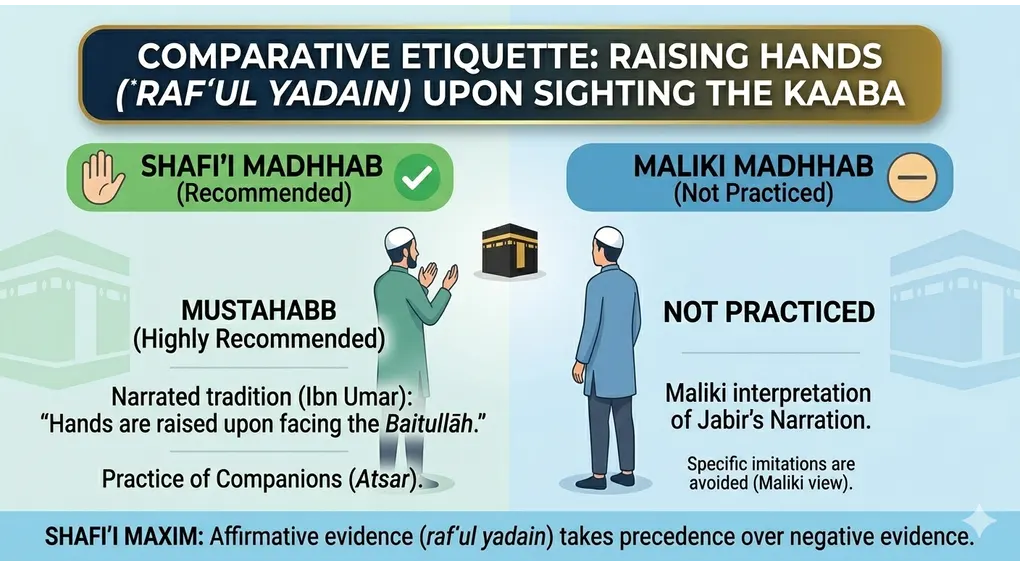
In the study of Comparative Fiqh (Fiqh Muqāran), there is a scholarly discussion regarding raising the hands (rafʿul yadain) when sighting the Kaaba:
- The Shāfiʿī View (Jumhur): Imam Shāfiʿī and the majority of scholars deem it Mustaḥabb (Recommended). The evidence is the tradition of Ibn Umar: “Hands are raised in dua upon facing the Baitullāh.”
- The Maliki View: Imam Malik argued that hands should not be raised, citing a narration from Jabir bin Abdillah.
- Scholarly Reconciliation: Shāfiʿī scholars respond by citing another narration from Jabir bin Abdillah himself (Hasan, via At-Tirmidhi) stating: “We performed the Hajj pilgrimage with the Prophet ﷺ and we did so (raised our hands).”
A Blessed Time for Answered Prayers

This moment is not merely a routine. Based on the hadith of Abu Umamah: “The gates of heaven are opened and the dua of a Muslim is answered upon seeing the Kaaba.” Therefore, Imam Shāfiʿī encourages believers to ask for anything they need regarding religious or worldly affairs, especially for forgiveness (maghfirah) and Paradise.
Legal and Supplication Summary
| Category | Primary Content / Redaction | Shāfiʿī Legal Status |
| Main Dua | Allāhumma zid hādhā-l-bayta… | Sunnah Muakkadah |
| Addition | Allāhumma anta-s-salām… | Sunnah |
| Long Dua | Allāhumma al-baladu baladuka… | Recommended |
| Movement | Raising both hands | Mustaḥabb |
| Correction | Avoid “Mahabatan” for pilgrims | Use “Birran” instead |
FAQ: Dua for Seeing the Kaaba
Which is better, the short or long version of the dua?
It is best to combine all narrated versions if possible. Begin by praising Allah (Antas-Salām), then glorifying the Kaaba (Zid hādhā-l-bayta), and conclude with total submission (Al-baladu baladuka).
Does the dua have to be in Arabic?
Reciting the original Arabic (maʾthūr) text is superior (afḍal). However, if one is unable, reciting the translation or praying in one’s own language is permissible.
Are the narrations for this dua authentic (ṣaḥīḥ)?
Imam An-Nawawī mentions that marfūʿ (from the Prophet) narrations for these specific wordings are often ḍaʿīf (weak). However, they have strong chains as athār (sayings) from Companions like Umar bin Khattab, which holds significant weight in Shafi’i Fiqh.
Conclusion
Rituals and supplications are spiritual vessels, but the core of visiting the House of Allah is the presence of the heart. By memorizing and understanding the dua for seeing the Kaaba, a pilgrim prepares themselves for a sacred encounter. May this guide benefit all future Guests of the Merciful (Dhuyūfurraḥmān).
Wallāhu aʿlam bish-shawāb.
Reference
Yaḥyā bin Sharaf an-Nawawī, al-Majmūʿ Syarḥ al-Muhadhdhab, edited by Lajnah min al-ʿUlamāʾ (Cairo: Maṭbaʿat at-Taḍāmun al-Ikhwī, 1344–1347 AH; repr. Beirut: Dār al-Fikr, n.d.), Vol. 8, pp. 7-9.


